
Why Decorative Fabrics Remain Important in Occasion Wear Design
Quick Answer
Decorative fabrics remain important in occasion wear because they help garments communicate significance. Lace, embroidery, jacquard, brocade, sequins, beads, appliqué, metallic yarns, flocking, and textured surfaces can distinguish clothing intended for weddings, ceremonies, celebrations, performances, formal receptions, and other memorable events from ordinary daily apparel.
Their value is not limited to ornament. Decorative textiles can control transparency, direct attention toward the face or waist, create dimension under changing light, strengthen a cultural or ceremonial reference, and give relatively simple silhouettes a distinctive identity. They can also support premium pricing when the material, workmanship, fit, and finishing are credible.
However, decorative fabric is not automatically luxurious. Poor motif placement, excessive embellishment, uncomfortable surfaces, weak attachment, difficult care, or uncontrolled production costs can reduce rather than increase a garment’s value.
For fashion businesses, the strategic issue is therefore not how much decoration to add. It is how to use the right decorative material in the right location, at a complexity level the brand can manufacture consistently and the customer can understand, wear, maintain, and value.
What Are Decorative Fabrics in Occasion Wear?
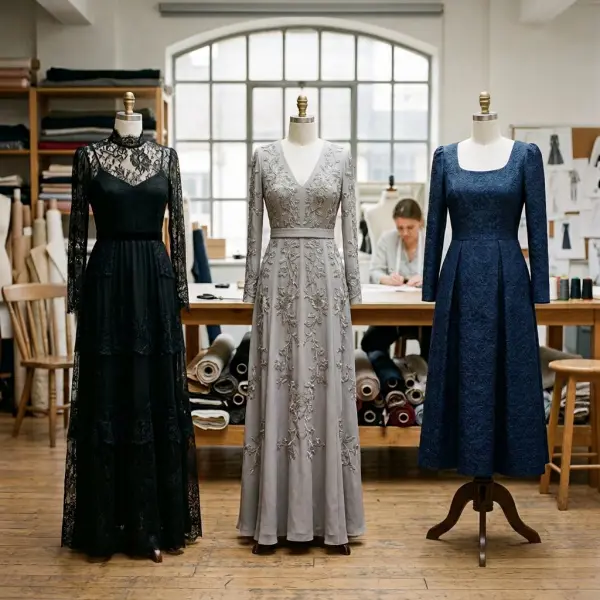
Decorative fabrics are textiles whose visual identity depends substantially on surface pattern, openwork, dimensional texture, reflectivity, applied elements, or ornamental construction. They include materials decorated during yarn production, fabric construction, dyeing, printing, finishing, embroidery, embellishment, or garment assembly.
In occasion wear, these materials are commonly used to signal that a garment belongs to a particular social, ceremonial, or expressive context. The category may include wedding gowns, evening dresses, cocktailwear, formal tailoring, festive clothing, ceremonial dress, performance costumes, prom dresses, reception outfits, religious-event garments, and culturally specific celebration wear.
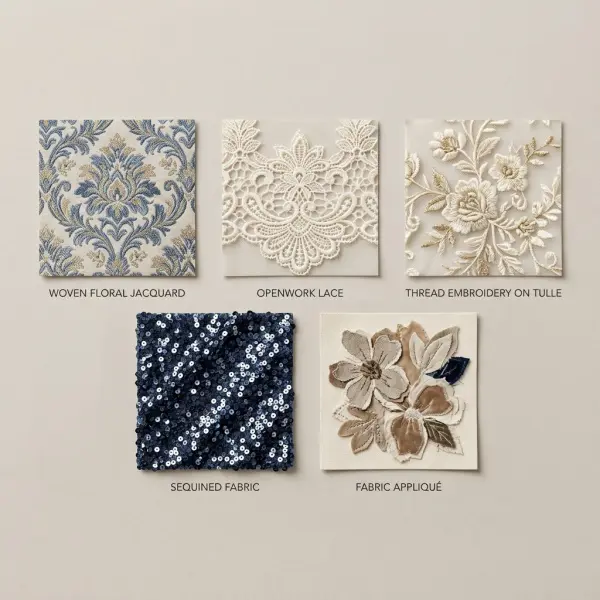
Common decorative materials and treatments include:
- Lace and openwork textiles
- Embroidered woven fabric, knit, tulle, or net
- Brocade and decorative jacquard
- Sequined or beaded fabrics
- Metallic yarns and lamé
- Appliqué and cutwork
- Flocking and devoré
- Pleating, smocking, quilting, and trapunto
- Feathers, fringe, ribbons, cords, and dimensional trims
- Printed textiles with metallic, raised, or layered effects
Not every occasion garment needs conspicuous ornament. A fabric can feel decorative through woven relief, controlled sheen, tonal pattern, architectural pleating, or a single engineered motif. The commercial strength often comes from disciplined placement rather than maximum visual density.
Why Does Occasion Wear Continue to Use Decorative Textiles?
Occasion wear serves a different purpose from most everyday clothing. It is often selected for a specific moment, audience, setting, dress code, photographic record, or emotional milestone. Decorative textiles help make that distinction visible.
Historically, dress codes separated clothing by activity, time, and formality. The Museum at the Fashion Institute of Technology notes that embellished silk dresses were strongly associated with evening use, even though distinctions between daywear and eveningwear later became less rigid. Contemporary fashion permits far more crossover, but garments for special occasions still frequently use material, surface, and silhouette to communicate formality or celebration. The Museum at FIT’s Night & Day exhibition provides historical context for this relationship.
Several practical reasons explain the category’s continuing reliance on decorative surfaces.
Decoration Creates an Immediate Visual Difference
Customers can recognize surface distinction quickly. A dress made from floral lace, embroidered tulle, metallic jacquard, or light-responsive sequins communicates differently from the same silhouette produced in plain fabric.
This is particularly relevant online, where the initial purchase decision may be based on a small set of images or a short video. Texture, contrast, motif scale, and reflected light help the garment establish a visual identity before the customer can examine its construction in person.
The effect must still translate beyond close-up photography. A delicate motif that looks beautiful in a product detail may disappear in full-length images or in a large venue. Conversely, oversized embellishment may dominate the wearer and reduce styling flexibility.
Decorative Textiles Help Mark Significance
Weddings, religious celebrations, graduations, galas, formal dinners, festivals, milestone birthdays, and performances are not interchangeable events. Clothing often helps the wearer acknowledge their importance.
Decoration can contribute to this function through:
- Greater visual complexity than daily clothing
- Materials associated with ceremony or craft
- Reflective surfaces suited to evening light
- Motifs connected to family, community, or cultural traditions
- Controlled transparency or layering
- Handwork that communicates time and attention
- Color and texture chosen for a specific social setting
This does not mean occasion wear must be expensive, heavily embellished, or culturally traditional. It means the garment usually needs a reason to feel appropriate for the moment.
Surface Design Can Carry the Garment Concept
A simple silhouette can become distinctive when the textile provides most of the visual narrative. A column dress in a strategically placed jacquard may require fewer pattern pieces than a heavily seamed garment. A restrained sheath can feel event-ready through corded lace, ombré embroidery, or a single reflective surface.
This can be commercially useful. Developing a proprietary textile, engineered border, or exclusive colorway may create stronger recognition than adding multiple construction details that are difficult to see.
The trade-off is dependency. If the fabric is delayed, discontinued, inconsistent, or difficult to reorder, the product may be impossible to reproduce without changing its identity.
Decorative Fabric Is Not the Same as Surface Embellishment
Some decorative effects are built into the fabric. Others are added after the base textile has been produced.
A brocade develops pattern during weaving. Raschel lace forms motifs through warp knitting. Embroidered tulle receives stitches after the net exists. Sequins may be incorporated by specialist embroidery equipment or attached during garment assembly. Lace motifs can be cut and appliquéd onto another surface.
This distinction affects almost every operational decision:
|
Decorative approach |
When the design is created |
Main production implication |
|
Decorative weave or jacquard |
During fabric construction |
Garment production depends on fabric repeat, usable width, and mill capacity |
|
Lace construction |
During lacemaking or warp knitting |
Openwork stability, motif placement, lining, and cutting require control |
|
Embroidered fabric |
After base fabric formation |
Stitch density, backing, puckering, and embroidery capacity matter |
|
Sequined or beaded fabric |
During specialist fabric or embroidery production |
Weight, attachment security, cutting damage, and repair become important |
|
Garment-level appliqué |
During panel or garment assembly |
Placement accuracy and additional labor affect output |
|
Hand embellishment |
Usually during or after assembly |
Skill, consistency, scheduling, and traceability constrain scale |
A deeper technical distinction between these processes appears in this comparison of embroidery, lace, and appliqué.

How Decorative Fabrics Build Perceived Value
Decorative fabric can support perceived value when customers can see or understand why the garment is different. The material may communicate complexity, rarity, precision, light response, craft, or association with a particular fashion tradition.
Museum collections provide clear historical evidence of how surface work has differentiated formal garments. A Jacques Doucet evening dress from around 1902 combined layers of silk, net, lace, ribbon, beads, sequins, and embroidery in a carefully constructed surface. The garment demonstrates that occasion wear has long used material layering and embellishment to create effects that basic fabric alone could not provide. The Metropolitan Museum of Art’s record of the Doucet evening dress documents this combination.
The business lesson is not that contemporary brands should reproduce historical levels of ornament. It is that customers often interpret value through visible material decisions.
Complexity Must Be Legible
Complexity only supports value when it can be perceived. Hundreds of additional production minutes may not strengthen a product if the surface work appears irregular, generic, or indistinguishable from a lower-cost alternative.
Legible value might come from:
- Clean motif alignment across seams
- A distinctive scalloped edge
- Fine tonal embroidery visible at conversational distance
- Controlled placement around the neckline or waist
- Subtle dimension created by cord, quilting, or layered net
- Consistent hand-applied details
- An exclusive textile developed for the collection
- Clear provenance for authentic craft work
A garment does not become premium because the bill of materials is expensive. The result must look, feel, fit, and perform as though the decisions were intentional.
Decorative Textiles Can Support Brand Recognition
Fashion brands often seek recognizable silhouettes, prints, hardware, colors, or construction details. Decorative textiles can perform a similar role.
A repeated lace family, embroidery language, geometric bead placement, woven motif, or tonal surface treatment can become part of the brand’s product vocabulary. This is more defensible when it is developed consistently rather than purchased as a generic seasonal novelty.
For a smaller label, exclusivity does not always require commissioning an entirely new fabric. The brand may create distinction through:
- A custom color on an existing base
- Exclusive motif placement
- Combining a stock lace with a proprietary lining color
- Using a decorative border in an unexpected orientation
- Cutting and repositioning motifs
- Limiting embellishment to a recognizable garment zone
- Developing a consistent thread or metallic palette
The objective is to make the textile serve the brand rather than allowing the supplier’s catalog to define the collection.
Decoration Can Support Price Architecture
Decorative surfaces can help brands establish visible differences between good, better, and premium product tiers.
A collection might use the same core silhouette across several levels:
- Plain satin for the entry version
- Lace sleeves or an embroidered panel for the middle tier
- Engineered embroidery, appliquéd motifs, or hand finishing for the premium version
This strategy can simplify fit and construction development while creating meaningful variation. It works only when each level has a clear cost structure and the higher-priced versions deliver more than superficial ornament.
Why Lace Remains Relevant in Occasion Wear
Lace offers a combination that few ordinary fabrics provide: pattern, transparency, edge detail, and textile structure in one material.
It can cover a garment fully, function as an overlay, create sheer sleeves, form necklines and hems, or provide individual motifs for placement. Different constructions can shift the mood from delicate and romantic to graphic, sculptural, restrained, or sensual.
The Metropolitan Museum of Art’s record of a Chanel evening dress from around 1930 explains how black lace and tulle added softness, pattern, and dimensionality while remaining consistent with Chanel’s comparatively linear design language. This illustrates an enduring design principle: decorative fabric can enrich a restrained silhouette without replacing its underlying identity. The Met’s Chanel evening dress record provides the full object description.
The role of lace should still be specified carefully. Chantilly-style lace, guipure, stretch lace, embroidered net, corded lace, and Leavers lace behave differently in production and wear. These distinctions are examined more fully in the guide to lace fabric types and fashion uses.
How Decorative Fabrics Affect Silhouette and Body Placement
Decoration changes how the eye reads a garment. It can emphasize, interrupt, widen, narrow, lengthen, soften, or frame an area depending on motif scale, contrast, direction, density, and placement.
This visual function is particularly important in occasion wear because customers often expect the garment to perform in photographs and in social settings where it will be seen from several distances.
Motif Direction Can Guide Attention
Vertical embroidery may reinforce length. Concentrated surface work at the shoulder can broaden the upper silhouette. A decorated waist panel can create a focal point, while a border placed at the hem can visually anchor a long skirt.
These are design tendencies, not universal optical rules. Their effect depends on the wearer, garment shape, color contrast, scale, and surrounding construction.
Product teams should examine decoration at three distances:
- Close range, where stitch quality and material detail are visible
- Conversational distance, where motif placement and proportion dominate
- Full-body or photographic distance, where the total silhouette becomes more important than fine detail
A design that succeeds only in a macro product image may disappoint in real use.
Transparency Can Be Used Selectively
Lace, tulle, net, cutwork, and open embroidery allow designers to expose or conceal different areas without changing the entire material.
Strategic transparency can create:
- Sleeves that appear lighter than the bodice
- A neckline that extends beyond the opaque foundation
- Illusion panels that support appliquéd motifs
- Layered color effects
- Visual separation between sections of a garment
- Coverage without complete visual solidity
The design must account for undergarments, seam allowances, labels, interfacing, closures, boning, cups, and skin-tone variation. “Nude” is not one universal color, and illusion materials should be developed with the intended customer range in mind.
Surface Weight Can Reshape the Garment
Heavy beadwork, dense embroidery, sequins, cords, and dimensional appliqués can pull, stiffen, or distort the base textile. Decoration may change the hang of a skirt, the support required in a bodice, or the way a sleeve moves.
The material should therefore be evaluated as part of the structural design. A heavily embellished bodice may need a stable underlayer and internal support. A beaded skirt may require reinforced waist construction. A decorative sleeve may need reduced embellishment near the underarm to preserve mobility and comfort.
The Relationship Between Light and Occasion Wear
Many occasions take place under mixed lighting: daylight, warm indoor light, stage lighting, flash photography, candles, or moving event lights. Decorative fabrics respond differently under each condition.
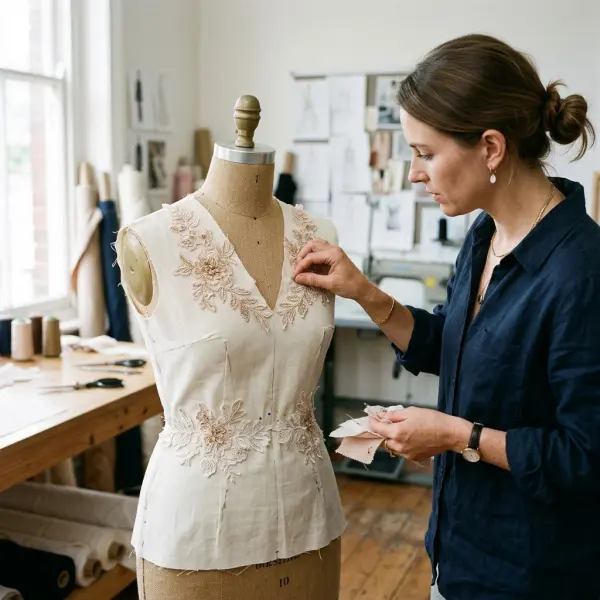
Sequins, rhinestones, metallic yarns, satin grounds, beads, and iridescent films can reflect or scatter light. Matte embroidery and guipure may create depth through shadow instead. Tulle and lace can reveal layered color as the wearer moves.
A 2025 Museum at FIT exhibition examined glittering fashion through production, social value, conservation, and environmental concerns. It emphasized that shine can be created by many materials and that glittering surfaces carry meanings that may range from elegance and financial value to cultural expression and artifice. All That Glitters at the Museum at FIT offers useful context for understanding why reflective surfaces remain visually powerful but also materially complex.
Brands should test reflective fabrics under the conditions in which the garment is likely to be seen. A subtle metallic effect in a studio may become intense under flash. Transparent sequins that appear refined on a hanger may reveal distracting reflections during movement.
Photographic testing is especially useful for occasion wear sold online.
Cultural and Ceremonial Meaning Requires Care
Decorative textiles often carry cultural significance. Embroidery patterns, lace traditions, woven motifs, beadwork, metallic decoration, and color combinations may be connected to particular communities, regions, ceremonies, social roles, or histories.
Using these references responsibly requires more than describing them as “ethnic,” “tribal,” “exotic,” or “inspired.” Such language can erase the actual source and reduce living textile traditions to visual inventory.
Fashion businesses should ask:
- What is the documented origin of the motif or technique?
- Is the design sacred, ceremonial, occupational, regional, or restricted in meaning?
- Is the source community involved in production or commercial benefit?
- Are artisan names and locations traceable?
- Has the motif been materially changed, and how should that be described?
- Does marketing distinguish genuine collaboration from aesthetic influence?
- Are claims of authenticity supported?
Not every geometric flower, bead arrangement, or embroidery technique belongs exclusively to one culture. At the same time, visual similarity does not justify making an unsupported cultural claim.
Precise attribution is stronger than vague storytelling.
Decorative Fabrics Create Operational Complexity
The same qualities that make decorative fabrics distinctive can make them difficult to manufacture. Motif repeats reduce marker efficiency. Beads damage cutting equipment. Sequins may need removal from seam allowances. Embroidery can pucker. Lace edges may distort. Metallic yarns may abrade or react poorly to pressing.
For this reason, decorative materials should enter product development before the garment is fully engineered.
Material Consumption Is Not Based on Width Alone
A fabric may have a nominal width of 140 centimetres but a smaller usable area because of scallops, borders, damaged selvedges, unembroidered margins, or motif direction.
Large repeats and engineered placements can increase consumption. Symmetrical garments may require mirrored motifs. One-way sequins or directional flowers may prevent pattern pieces from being turned.
Costing should use an actual or simulated marker based on:
- Usable width
- Motif repeat
- Direction
- Edge utilization
- Required matching
- Defect allowance
- Garment size range
- Placement requirements
The purchase price per metre is only one part of the material cost.
Cutting May Damage the Decoration
Beads, sequins, cords, embroidery threads, and dense motifs can interfere with blades, drills, notches, or automated cutters. Some components must be removed from seam allowances before sewing.
Where decoration is concentrated, factories may need:
- Reduced ply height
- Single-ply cutting
- Protective cutting layers
- Manual motif cutting
- Special blade management
- Separate cutting for embellished and plain areas
- Clear instructions for securing cut thread ends
- Segregation of damaged components
A supplier’s assurance that the fabric is “ready to cut” should be validated in the intended factory.
Sewing Through Decoration Can Create Weak or Bulky Seams
A seam that crosses beads, sequins, dense embroidery, corded motifs, or heavy appliqué may be uncomfortable, unstable, or difficult to press.
Possible solutions include removing decorative components from the seam allowance, repositioning motifs, using lapped construction, applying decoration after seaming, or changing the panel line.
Each solution affects labor. Removing sequins may appear minor on one sample but become significant across a large order.
Finishing and Pressing Need Material-Specific Controls
Synthetic lace, metallic yarns, adhesives, sequins, flocked surfaces, and dimensional embroidery can react badly to heat, steam, pressure, solvents, or direct iron contact.
Pressing trials should establish:
- Temperature
- Steam level
- Pressure
- Contact time
- Protective covering
- Direction of pressing
- Whether the surface should be pressed from the reverse
- Recovery time before packing
The goal is not only to prevent visible damage. Heat may weaken adhesives or elastic components even when the surface initially appears unchanged.
Repair Capacity Matters
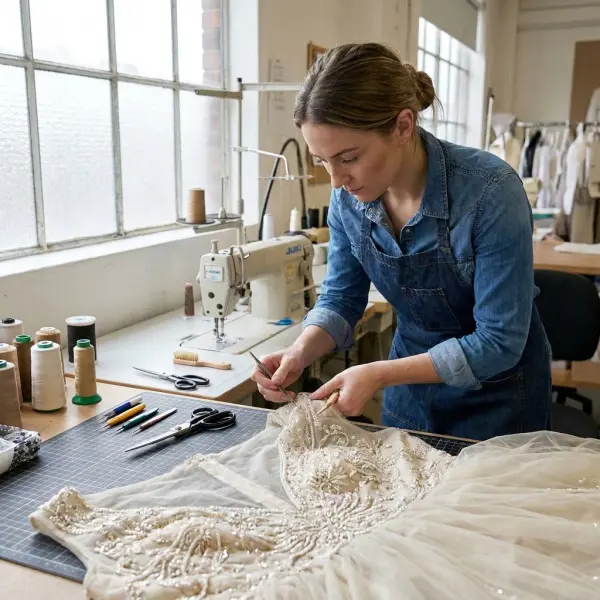
Decorative fabrics have defect types that ordinary sewing lines may not be equipped to repair. Broken beads, loose sequins, interrupted embroidery, damaged lace bridges, missing appliqué corners, and metallic-thread pulls require suitable materials and trained operators.
Factories should receive spare components, matching threads, beads, sequins, motifs, and clear repair standards. Without these, minor defects may become full-garment rejects.
How Decoration Affects Comfort and Wearability
Occasion wear is sometimes tolerated as less comfortable than everyday clothing, but discomfort still has commercial consequences. Customers may return the garment, alter it incorrectly, avoid wearing it again, or associate the brand with poor fit.
Decorative elements can cause:
- Abrasion against skin
- Excessive weight
- Restricted movement
- Heat retention
- Snagging on jewelry or furniture
- Noise during movement
- Pressure at seams
- Sharp thread ends
- Irritation from backing or trims
- Imbalanced garments that rotate or pull
A garment can look delicate and still feel rough. Fine-looking metallic yarns or cut sequins may be abrasive. Heavy embroidery may be comfortable on a stable bodice but unsuitable across a flexible underarm area.
Wear trials should include sitting, walking, raising the arms, dancing where relevant, entering a vehicle, using the restroom, and carrying accessories. Occasion garments are worn in real situations, not only photographed while standing.
Durability Expectations Are Different, but Not Absent
Occasion wear may be worn less frequently than everyday clothing, yet customers can expect it to survive transport, fitting, a long event, photography, cleaning, storage, and possible reuse.
Decorative garments face particular risks:
- Crushing during packaging
- Snagging during handling
- Embellishment loss
- Adhesive failure
- Tarnishing
- Color transfer
- Yellowing of pale materials
- Oxidation of metallic components
- Stretching during hanging
- Distortion after cleaning
- Damage from incorrect storage
Low frequency of use should not be used to excuse poor workmanship. A garment worn once may still be expected to remain intact throughout an emotionally important event.
Brands should establish realistic care information and avoid promising washability or dry-cleaning compatibility without testing the completed garment.
Sustainability Claims Need More Precision
Decorative textiles can be material- and labor-intensive. They may combine several fiber types, coatings, adhesives, plastics, metals, and trims in one surface, making recycling or material separation difficult.
However, a simple fabric is not automatically more responsible, and a decorated garment is not automatically wasteful. The outcome depends on material choices, production waste, durability, use frequency, resale, alteration, emotional retention, care, and end-of-life options.
Businesses should avoid broad claims such as:
- Eco-friendly sequins
- Sustainable embellishment
- Biodegradable dress
- Zero-waste embroidery
- Ethical handwork
- Recyclable occasion wear
These descriptions require specific evidence and clearly defined boundaries.
A more credible approach is to communicate verifiable attributes, such as:
- Documented recycled content in a particular component
- Reduced embellishment coverage compared with a previous design
- Reusable or detachable decorative pieces
- Offcut motifs used in accessories
- Repair services
- Made-to-order production
- Traceable artisan partnerships
- Mono-material design where technically feasible
- Eliminating a particular coating or adhesive
Even these attributes should not be presented as proof that the entire garment has a low environmental impact.
Can Decorative Fabrics Work at Different Price Points?
Yes. Decorative fabric is not limited to couture or luxury fashion. The level of complexity can be adjusted through material choice, placement, construction, and production method.
Accessible Occasion Wear
At an accessible price point, brands may use commercially available Raschel lace, machine embroidery, printed jacquard effects, localized sequins, narrow trims, or a decorative panel rather than covering the whole garment.
The priority is repeatability. A simple but well-controlled border often performs better than dense embellishment with inconsistent attachment.
Contemporary Premium Products
Premium ready-to-wear may use higher-quality lace, custom colors, exclusive motifs, engineered embroidery, refined linings, cleaner placement, and selective hand finishing.
The value should be visible in the garment’s reverse, seams, motif alignment, closures, and comfort—not only in its face fabric.
Luxury and Couture-Level Work
Luxury and couture products may justify custom textile development, multiple decorative techniques, intensive hand placement, complex internal structures, and significant finishing time.
The distinction is not simply more decoration. Higher-level work often involves more precise integration between textile, silhouette, and construction.
A heavily decorated garment with generic materials and inconsistent finishing does not become luxury through labor hours alone.
How Fashion Businesses Can Apply Decorative Fabrics Strategically
Define the Occasion and Customer First
A wedding reception dress, religious ceremony outfit, stage costume, prom dress, gala gown, and formal corporate-event dress do not have identical requirements.
Product teams should define:
- Expected dress code
- Climate and venue
- Length of wear
- Required mobility
- Customer age and styling expectations
- Likely undergarments
- Photography conditions
- Care and storage behavior
- Acceptable price
- Possibility of repeat wear
This information should guide the material rather than being added after fabric selection.
Give Each Decorative Element a Job
Decoration may provide focal placement, transparency, structure, color, movement, cultural reference, or brand identity. It should have a clear purpose.
When several techniques perform the same function, the garment can become visually crowded and commercially inefficient. Lace, beads, feathers, sequins, embroidery, pleating, and metallic fabric do not need to appear together simply because the product is occasion wear.
Editing is part of design.
Start With a Decoration Map
A decoration map shows where the surface treatment begins, ends, changes density, crosses seams, or interacts with fit points.
It should identify:
- Front and back placement
- Motif direction
- Symmetry requirements
- Areas requiring grading
- Seam and dart intersections
- Closure zones
- High-friction areas
- Skin-contact areas
- Areas excluded from embellishment
- Placement tolerances
This document helps align design, pattern, sourcing, sampling, costing, and quality control.
Develop the Material and Silhouette Together
A rigid guipure may support a clean A-line form but resist soft gathering. Dense beadwork may stabilize a bodice but overload a fluid bias-cut skirt. A stretch lace can follow the body but may not provide enough support on its own.
The pattern should respond to the textile. Forcing a decorative material into a silhouette designed for a different fabric often creates avoidable fit and production problems.
Prototype at Full Scale
Small swatches do not show how a repeat behaves over the body or how weight accumulates across a full garment.
A proper development sample should test:
- Full motif scale
- Actual backing or lining
- Complete decoration density
- Real seam construction
- Closures and internal support
- Garment balance
- Movement
- Lighting response
- Care
- Packaging
This may appear expensive during sampling, but it is less expensive than discovering structural problems after bulk material has been ordered.
Align Complexity With Production Capacity
A supplier that can sew occasion garments may not have the expertise to cut beaded fabric, repair lace, digitize embroidery, manage hand embellishment, or control appliqué placement.
Capacity assessment should include equipment, operator skills, production rate, defect standards, repair capability, subcontracting, and backup planning.
The question is not whether a factory can make the sample. It is whether it can reproduce the approved standard across the order and size range.
Explain the Value Clearly
Customers may not recognize the difference between woven pattern, embroidery, lace, print, and appliqué without context.
Product descriptions can explain relevant facts such as:
- The material construction
- Whether motifs are engineered or randomly placed
- Which areas are hand-finished
- Why a lining was selected
- How the garment should be stored
- Which details require careful handling
- Whether natural variation is expected
This information should be accurate and proportionate. It should not turn routine machine work into an exaggerated craft narrative.
Common Mistakes in Decorative Occasion Wear
Adding Decoration After the Silhouette Is Finalized
This often creates motifs crossing darts, beads inside seam allowances, excessive weight, or decoration that does not grade properly.
Decoration should be developed alongside the pattern, not placed on top of it at the end.
Assuming More Detail Creates More Value
Excess decoration can obscure shape, increase weight, create discomfort, and make the product appear less refined.
Value comes from material suitability, execution, placement, and coherence—not decorative quantity.
Costing Only the Fabric
The true cost may include cutting loss, lining, motif matching, bead removal, hand placement, slower sewing, repair, inspection, pressing controls, and protective packaging.
Garment-level costing is essential.
Designing Only for Product Photography
A surface that performs under studio lighting may appear flat in normal light or overly reflective under flash. It may also snag, feel rough, or restrict movement.
The garment must succeed when worn, not only when enlarged on a screen.
Treating Handmade as a Complete Quality Standard
Handmade work can be skilled, meaningful, and commercially valuable. It can also be inconsistent or poorly managed.
Brands should define tolerances, workmanship, compensation, traceability, and production capacity rather than relying on the word “handmade.”
Ignoring the Garment Reverse
Backings, loose threads, rough seams, exposed appliqué edges, adhesive residue, and poorly secured embellishment can undermine comfort and perceived quality.
Occasion wear should be inspected from the inside as carefully as from the outside.
Making Unverified Cultural Claims
A commercially sourced motif should not be assigned a cultural origin because it looks similar to a traditional design.
Document the source or use neutral, accurate language.
Failing to Plan for Repairs
Small embellishment failures can turn finished garments into rejects when matching replacement materials are unavailable.
Production orders should include repair components and approved repair methods.
What Brands Should Verify Before Committing to Production
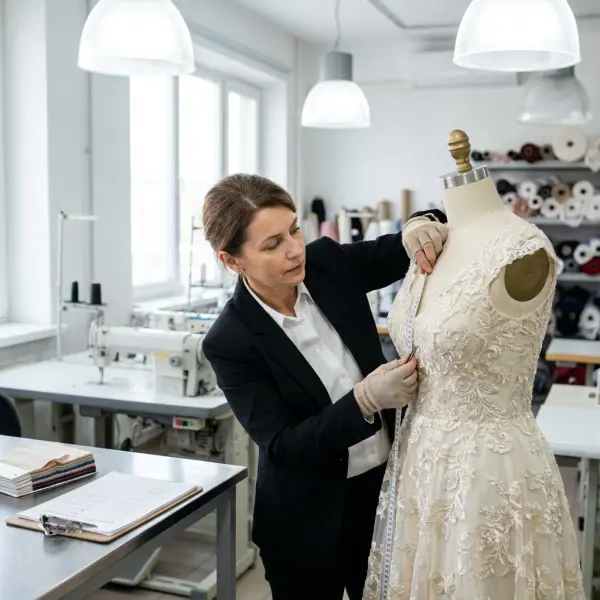
Before approving a decorative fabric or garment, verify the following:
- Exact textile construction
- Fiber composition of every significant component
- Decorative technique and production sequence
- Nominal and usable width
- Motif repeat and direction
- Placement requirements by size
- Weight and balance
- Stretch and recovery
- Skin-contact comfort
- Seam compatibility
- Embellishment attachment strength
- Pressing and heat response
- Care performance
- Colorfastness and color transfer
- Tarnishing or discoloration risk
- Bulk repeatability
- Repair method
- Protective packaging
- Supplier lead time and capacity
- Accuracy of cultural, craft, and sustainability claims
The approved garment should become the production standard. Photographs and technical sheets are important, but they do not fully capture handfeel, weight, reflectivity, and dimensional surface quality.
Frequently Asked Questions
What makes a fabric suitable for occasion wear?
A fabric is suitable for occasion wear when its appearance, drape, comfort, structure, durability, and care requirements support the intended event and garment design.
Decorative characteristics such as lace, embroidery, sheen, texture, or embellishment can help communicate formality, but they are not mandatory. A plain silk-like fabric, fine wool, crepe, or well-engineered knit can also work for an occasion garment.
Suitability depends on the customer, climate, venue, dress code, silhouette, construction, price, and expected use.
Why are lace and embroidery common in formal clothing?
Lace and embroidery can create pattern, texture, transparency, and focal placement without relying only on print or complex seams.
They are also historically associated with dressmaking, ceremony, craft, and formal apparel in many markets, although their meanings vary by period and culture.
Their continued use is practical as well as aesthetic. Modern machinery allows these effects to be developed at several price points. The final quality still depends on construction, fiber, motif placement, finishing, and garment integration.





Comments 0
Leave a CommentSend Comment
Anda harus Login terlebih dahulu untuk dapat memberikan komentar.