

Fashion Sourcing Strategy Explained for Growing Apparel Brands
Quick Answer
A fashion sourcing strategy is a structured plan for deciding what materials, components, manufacturing services, and finished products an apparel business will obtain, from which suppliers, under what commercial terms, and with what controls for cost, quality, delivery, compliance, and scalability.
For a growing apparel brand, good sourcing is not simply about finding the lowest factory quotation. The real objective is to build a supply network that can repeatedly deliver the right product specification, in the required quantity, at a commercially viable total cost and within the selling calendar.
That means evaluating more than unit price. Brands need to consider minimum order quantities, material availability, sample development, production capacity, quality systems, freight, duties, payment terms, supplier communication, subcontracting, traceability, and the cost of delays or defects.
A strong sourcing strategy also reflects the product mix. Reliable replenishment may matter most for permanent basics, while flexible minimums and fast development may be more valuable for seasonal collections. Technical garments may require specialist materials, testing, and production capabilities.
The best sourcing model is therefore not universally local, overseas, single-source, or multi-source. It is the model that fits the product, market, operating scale, risk tolerance, and commercial priorities of the business.

What Is a Fashion Sourcing Strategy?
Fashion sourcing strategy is the business framework used to select, organize, manage, and develop the external resources needed to turn a product concept into a commercially deliverable garment or accessory.
Those resources may include:
- Fibers, yarns, fabrics, linings, and interlinings
- Buttons, zippers, labels, thread, elastic, and other trims
- Pattern making, grading, sampling, cutting, sewing, and finishing
- Printing, embroidery, washing, dyeing, coating, or specialist treatments
- Packaging, inspection, testing, warehousing, and transportation
- Full-package manufacturing or finished private-label products
Sourcing is sometimes treated as another term for purchasing, but the two are not identical. Purchasing or procurement generally covers the transactional process of placing orders, confirming prices, and arranging payment. Sourcing begins earlier and has a broader strategic role. It determines which supply markets, production models, and supplier relationships the business should build before individual purchase orders are issued.
A sourcing strategy should answer five fundamental questions:
- What does the business need to source?
- Which supplier capabilities are required?
- Where should those capabilities be located?
- What cost, quality, lead-time, and risk conditions are acceptable?
- How will performance be verified and improved?
For a small label, these questions may initially be handled informally by the founder. That can work while the assortment is narrow and order quantities remain manageable. Once the brand adds more styles, sales channels, product categories, or delivery markets, informal sourcing becomes fragile. Decisions held in personal messages and memory are difficult to repeat, audit, or delegate.
A documented sourcing strategy turns those decisions into an operating system.
Why Sourcing Becomes More Difficult as an Apparel Brand Grows
Growth adds more than production volume. It increases the number of decisions that must remain coordinated.
A young brand may begin with one supplier, four styles, a small range of fabrics, and one annual production cycle. A growing brand may carry permanent basics, seasonal products, promotional capsules, multiple colorways, extended sizes, wholesale commitments, and direct-to-consumer inventory at the same time.
Each additional style can create new combinations of:
- Fabric and trim requirements
- Minimum order quantities
- Sample approvals
- Size specifications
- Packaging formats
- Production schedules
- Quality checkpoints
- Shipping destinations
- Labeling and regulatory requirements
The challenge is not simply ordering more units. It is managing more interdependencies without losing control of margin or delivery.
Suppose a brand orders the same shirt in eight colors from a single factory. The sewing operation may be straightforward, but each color could require a separate fabric dye lot. A fabric mill’s minimum order may exceed the quantity required for one color, while the garment factory’s minimum may be acceptable. The apparent garment-level sourcing solution therefore fails at the material level.
This is why sourcing teams need visibility beyond the final assembly supplier. A garment manufacturer may be capable of sewing the order but still depend on mills, laundries, printers, packaging vendors, or subcontractors whose capacity and timelines affect the finished product.
A scalable strategy accounts for these dependencies before confirming a launch date.
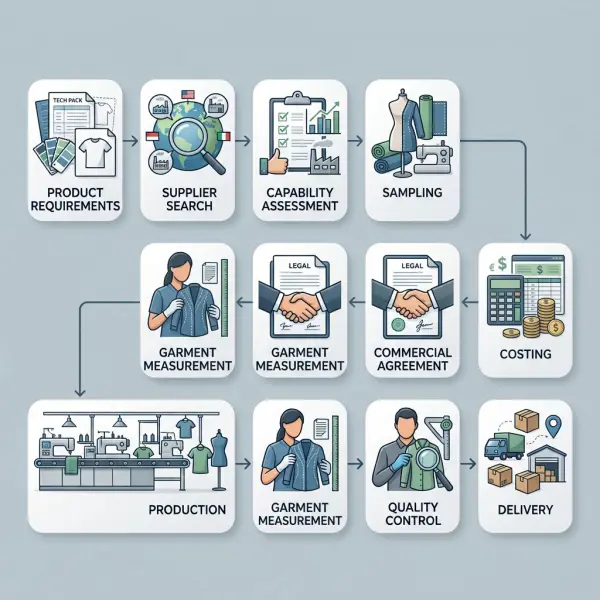
The Core Decisions Behind an Effective Sourcing Strategy
What Should the Brand Source Externally?
The first decision is not which factory to contact. It is which activities the business should perform internally and which should be sourced from external partners.
A brand with strong pattern-making expertise may retain technical development internally while outsourcing sewing. Another may work with a full-package manufacturer that sources materials, develops samples, produces garments, and arranges packaging. Neither model is automatically superior.
The appropriate division depends on:
- Internal technical capability
- Available working capital
- Product complexity
- Required development speed
- Desired control over materials
- Production volume
- Intellectual property sensitivity
- Supplier management capacity
Full-package manufacturing can reduce coordination work, but it may also reduce visibility into upstream material costs or suppliers. Cut-make-trim production gives the buyer more material control, although the buyer must coordinate fabric, trims, transportation, and production timing more closely.
For a growing business, the more useful question is: Which model gives us sufficient control without creating operational work that our team cannot manage reliably?

Where Should Production and Materials Be Sourced?
Location affects cost, transportation time, communication, minimum quantities, material access, production expertise, trade rules, and the brand’s ability to visit or monitor suppliers.
Geographic proximity can simplify communication and replenishment, but a local supplier may depend on imported fabric or trims. An overseas manufacturing quotation may appear lower, yet freight, duties, inspection, financing, and longer inventory exposure can change the final economics.
The decision should therefore be based on supply-chain configuration rather than country labels alone. A detailed discussion belongs in the comparison between local and overseas sourcing, where the trade-offs can be evaluated without reducing the decision to price or distance.
Many brands ultimately use a mixed model. Core volume may be placed with a larger offshore supplier, while limited collections, samples, urgent replenishment, or highly customized products are produced closer to the primary market.
Which Supplier Capabilities Are Actually Required?
A supplier that performs well for cotton T-shirts may not be suitable for tailored jackets, seamless activewear, waterproof outerwear, lingerie, or heavily embellished occasionwear.
Supplier selection should begin with the technical and commercial requirements of the product. Relevant capabilities may include:
- Experience with the required fabric construction
- Appropriate machinery and attachments
- Pattern and sample development capability
- Size grading and fit control
- Printing, embroidery, washing, or bonding expertise
- Testing and inspection procedures
- Production planning systems
- Material sourcing access
- Export documentation capability
- Capacity at the required order scale
The factory’s customer profile also matters. A facility designed for very large standardized orders may struggle to support a growing brand that needs frequent development, moderate quantities, and late assortment decisions. Conversely, a flexible workshop may produce excellent samples but lack the line organization, purchasing power, or quality systems required for larger repeat orders.
Supplier fit is contextual. A respected factory can still be the wrong factory for a particular brand.
Under What Commercial Terms Will the Relationship Operate?
A sourcing decision is incomplete until responsibilities, costs, and risks are clearly allocated.
Commercial negotiations commonly cover:
- Unit price and price-validity period
- Minimum order quantity
- Minimum quantity per color or material
- Sample and development charges
- Tooling, molds, screens, or pattern ownership
- Payment schedule and deposit requirements
- Currency and exchange-rate treatment
- Packaging responsibilities
- Inspection and testing costs
- Delivery term and shipping point
- Treatment of defects, rework, shortages, and delays
- Confidentiality and intellectual property
- Cancellation and change-order conditions
For cross-border transactions, Incoterms® rules can help define certain delivery responsibilities, costs, and points of risk transfer between the buyer and seller. They do not replace a complete sales contract, product specification, payment agreement, or quality standard. The International Chamber of Commerce explains that the rules clarify tasks, costs, and risks related to delivery rather than resolving every contractual issue. ICC guidance on Incoterms® 2020
Terms such as EXW, FOB, FCA, CIF, or DAP should not be used as price labels without understanding the associated delivery point and obligations. A lower FOB quotation, for example, cannot be compared directly with a delivered quotation until freight, insurance, import costs, and handling responsibilities are aligned.
How Much Visibility and Control Does the Brand Need?
Some brands know their sewing factory but not the origin of their fabric. Others know the fabric mill but have limited visibility into yarn, fiber, chemical processing, or subcontracted operations.
The required depth of visibility depends on the product, market, regulatory exposure, and claims the brand intends to make. However, every growing apparel business should at least know:
- The legal identity of its direct supplier
- The physical site where production occurs
- Whether work may be subcontracted
- The principal material and component suppliers
- Who controls quality at each critical stage
- Which records can support origin, composition, or compliance claims
Visibility is not the same as total control. A smaller buyer may not be able to dictate every upstream practice, but it can still request disclosure, document risk, prioritize higher-risk materials, and avoid making claims it cannot substantiate.
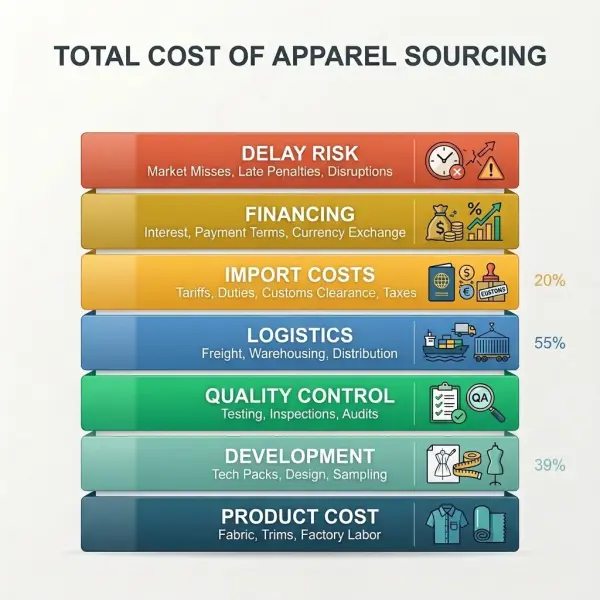
Price Is Only One Part of Sourcing Cost
The quoted unit price is only the visible portion of sourcing cost. The commercially meaningful figure is the cost of making the product available for sale in the required market, at the required time, and at an acceptable quality level.
A useful internal calculation is:
Effective sourced cost = quoted product cost + development, quality, logistics, compliance, and financing costs + expected cost of sourcing risk
The cost stack may include:
|
Cost component |
What it may contain |
Why it matters |
|
Product cost |
Fabric, trims, labor, finishing, packaging, supplier margin |
Forms the initial supplier quotation |
|
Development cost |
Patterns, samples, fit rounds, screens, molds, lab dips |
Can be substantial for small runs or complex products |
|
Quality cost |
Testing, inspections, rework, rejected units |
Often omitted from early comparisons |
|
Logistics cost |
Inland transport, freight, insurance, handling, warehousing |
Changes according to route, volume, and delivery terms |
|
Import cost |
Duties, taxes, brokerage, documentation |
Depends on product classification and destination |
|
Financing cost |
Deposits, long cash cycles, currency exposure |
Affects working capital and margin |
|
Delay cost |
Missed selling window, cancellations, markdowns, expedited freight |
Can exceed a small difference in factory price |
|
Failure cost |
Returns, repairs, replacements, reputation damage |
Appears after the goods have entered the market |
Not every cost can be predicted precisely. The purpose is not to create a fictional level of accuracy. It is to prevent sourcing teams from comparing quotations that include different responsibilities and risk exposures.
A supplier charging slightly more may produce the lower effective cost when it offers consistent quality, shorter sample cycles, dependable delivery, and fewer corrective shipments. A cheaper supplier may still be appropriate, but only when the business has accounted for the extra coordination and risk.
How Should a Brand Evaluate Supplier Fit?
Supplier evaluation should combine evidence, direct observation where possible, product testing, and performance over time. A polished presentation or recognizable customer list is not sufficient.
A practical supplier assessment usually covers six dimensions.
|
Evaluation area |
Questions to investigate |
Useful evidence |
|
Technical capability |
Can the supplier consistently make this product? |
Machinery list, sample quality, similar production examples |
|
Capacity |
Can it support the quantity and delivery window? |
Line plan, production calendar, monthly capacity, current workload |
|
Quality management |
How are specifications and defects controlled? |
Inspection procedures, quality records, corrective-action process |
|
Commercial fit |
Do minimums, payment terms, and pricing fit the business model? |
Formal quotation, cost breakdown, written terms |
|
Communication |
Are issues reported clearly and early? |
Sample feedback, response quality, escalation process |
|
Responsible business conduct |
Are labor, safety, environmental, and integrity risks managed? |
Policies, assessments, records, worker mechanisms, corrective actions |
Quality-system certification can provide useful information, but it should be interpreted correctly. ISO 9001 defines requirements for a quality management system and includes areas such as supplier approval, performance evaluation, and continual improvement. Certification does not prove that a particular garment shipment will meet the buyer’s specification. ISO explanation of quality management systems
For new suppliers, the most informative test is often a controlled development and pilot process:
- Issue a complete product brief.
- Review the supplier’s questions and proposed construction.
- Evaluate sample accuracy and communication.
- Confirm material sources and lead times.
- Place a limited production order.
- Inspect performance during and after production.
- Review quality, timing, documentation, and problem resolution.
A supplier should not receive strategically important volume simply because one pre-production sample looks good. Sample-room performance and production-line consistency are different capabilities.
Build the Sourcing Model Around the Product Portfolio
A single sourcing model rarely suits every item in a growing brand’s assortment. Product segmentation helps the business apply different priorities without creating arbitrary supplier decisions.
Core and Replenishment Products
Permanent basics usually benefit from suppliers that can deliver stable materials, repeatable color, consistent measurements, predictable capacity, and reliable replenishment.
For these products, the sourcing priority is often continuity rather than novelty. Frequent supplier changes may create shade variation, handfeel differences, fit drift, or packaging inconsistency that customers notice across repeat purchases.
A core-product strategy may justify:
- Reserved material or production capacity
- Longer-term price discussions
- Approved substitute materials
- Secondary-source qualification
- Formal replenishment forecasts
- Tighter performance monitoring
Seasonal and Fashion-Led Products
Seasonal items carry higher demand uncertainty and shorter selling windows. Flexible minimums, rapid sample development, material availability, and reliable calendar management may be more valuable than the lowest possible unit cost.
A factory with a slightly higher price but a strong sample room and flexible production slots can be commercially appropriate for limited capsules. The brand avoids committing large quantities before demand is visible.
This does not mean seasonal sourcing should be improvised. Development deadlines, material booking, final approval dates, and cancellation points need to be particularly clear because lost time cannot always be recovered through faster sewing.
Technical and Performance Products
Products such as waterproof outerwear, compression garments, protective clothing, bonded activewear, or highly structured lingerie may require specialized machinery, seam construction, material compatibility, or performance testing.
The supplier must understand both the visual design and the functional requirement. A fabric described as water-resistant does not automatically create a water-resistant garment if seams, closures, pattern design, and finishing are not engineered accordingly.
Technical sourcing should therefore involve product-specific validation rather than relying solely on general factory credentials.
Craft-Based and Small-Batch Products
Artisanal textiles, hand embroidery, hand dyeing, and small-workshop production introduce a different form of value and risk. Natural variation may be part of the product identity, but acceptable variation still needs to be defined.
Brands working with craft-based suppliers should align on:
- Realistic production capacity
- Acceptable visual variation
- Documentation of techniques and materials
- Payment schedules that support production
- Quality checks that do not erase handmade character
- Contingency planning for weather, seasonality, or artisan availability
Trying to manage artisanal output with the same expectations as highly standardized factory production can damage both the supplier relationship and the product proposition.
Lead Time Must Be Managed as a System
A supplier’s quoted production lead time is not the same as the brand’s total sourcing lead time.
Total lead time may include:
- Product briefing and quotation
- Pattern and sample development
- Fit approval
- Material sourcing or production
- Color and print approval
- Purchase-order confirmation
- Pre-production preparation
- Cutting, sewing, and finishing
- Inspection and corrective work
- Freight and customs clearance
- Distribution-center receiving
Many delays occur before bulk sewing starts. A late fabric approval may push production into another booking window. A zipper that arrives one week late can prevent completion of an otherwise finished garment. Repeated design changes may require updated patterns, consumption calculations, trims, or labeling.
For this reason, the sourcing calendar should identify dependencies rather than showing one generic production period.
Buyer behavior also affects supplier performance. Research from the International Labour Organization has examined how purchasing practices—including price pressure, order changes, and lead-time decisions—can influence suppliers’ ability to manage wages and working conditions. ILO research on purchasing practices in garment supply chains
An unrealistic delivery date does not become realistic because it appears on a purchase order. When buyers approve late, change quantities, or request compressed timelines, suppliers may respond with overtime, subcontracting, rushed inspection, or expensive expedited transport.
Good sourcing therefore depends on good internal planning. The relationship between sourcing and apparel production planning is direct: buying decisions, material availability, capacity, and delivery dates must operate from the same calendar.
Quality Control Starts Before Production
Final inspection cannot correct a poorly defined product.
Quality begins with clear specifications, appropriate materials, validated construction, and mutually understood acceptance criteria. A strong sourcing process establishes these conditions before bulk production.
The basic control package may include:
- Technical pack with construction details
- Bill of materials
- Measurement specification and tolerances
- Approved fit or pre-production sample
- Approved fabric, color, print, and trims
- Labeling and packaging requirements
- Required testing methods
- Defect classification and inspection plan
- Procedure for changes and approvals
Quality controls should match the product risk. A simple jersey top, a children’s garment, a flame-resistant workwear item, and a waterproof jacket do not require the same tests or documentation.
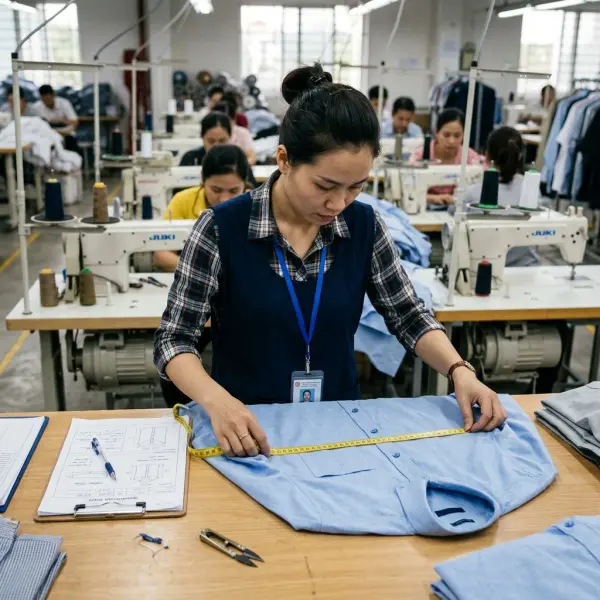
Inspection may occur at several stages. Material inspection can identify shade, width, weight, or surface problems before cutting. Inline inspection can reveal recurring sewing defects while correction is still practical. Final inspection evaluates finished goods against the agreed standard.
Statistical sampling plans may be useful, but a passing sample does not prove that every unit is defect-free. Sampling reduces inspection effort by estimating lot quality under defined conditions. It should not be treated as a substitute for process control.
Responsible Sourcing Is an Operating Discipline
Responsible sourcing is not achieved through a supplier code of conduct or a single audit. It requires an ongoing process for identifying, preventing, mitigating, tracking, and communicating supply-chain risks.
The OECD Due Diligence Guidance for Responsible Supply Chains in the Garment and Footwear Sector describes due diligence as an ongoing, proactive, and reactive process rather than a checklist exercise. It applies across areas such as labor rights, occupational health and safety, environmental impacts, and integrity risks. OECD garment and footwear due diligence guidance
For growing brands, a proportionate system can begin with:
- Mapping direct suppliers and production sites
- Identifying high-risk materials, processes, and locations
- Prohibiting unauthorized subcontracting
- Requesting evidence relevant to the identified risks
- Establishing escalation and corrective-action procedures
- Tracking whether corrective actions are completed
- Reviewing the brand’s own purchasing behavior
Audits can provide useful observations, but they have limitations. Conditions may change after the visit, records may be incomplete, and some issues require worker engagement or deeper investigation. Multiple audit reports also do not compensate for unrealistic prices or production schedules imposed by the buyer.
Market access can create additional obligations. For example, U.S. Customs and Border Protection advises importers addressing forced-labor risk to trace inputs, evaluate risk, communicate with suppliers, and maintain supply-chain documentation. The exact legal exposure depends on the goods, sourcing route, and destination market. CBP forced-labor compliance resources
Product-data expectations are also developing. Textile and apparel products are a priority group under the European Union’s Ecodesign for Sustainable Products Regulation working plan, but textile-specific Digital Product Passport requirements still depend on future delegated rules. Brands should therefore improve data readiness without claiming that every apparel product already has a fixed DPP obligation or implementation date. European Commission information on textile Digital Product Passports
The practical lesson is straightforward: sourcing records are becoming business infrastructure. Supplier identity, production site, materials, approvals, testing, and transaction documentation should not remain scattered across personal inboxes.
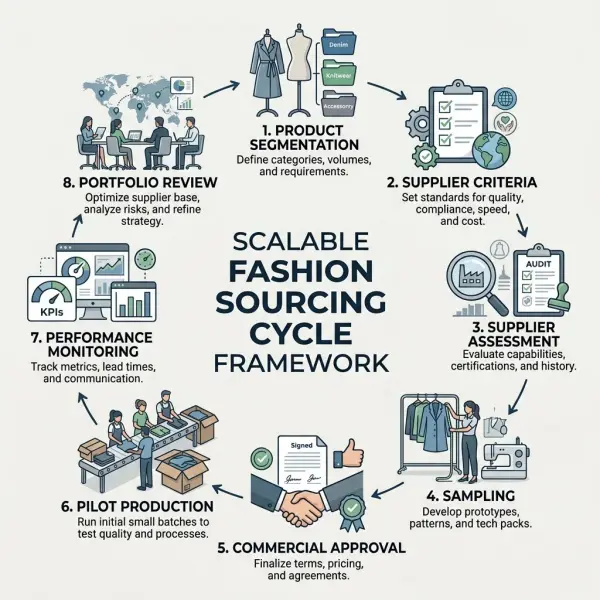
What Does a Scalable Sourcing Operating Model Look Like?
A scalable sourcing model converts strategy into repeatable stages, decision rights, and records.
|
Stage |
Main activity |
Required output |
|
Product segmentation |
Classify products by volume, complexity, margin, and demand risk |
Sourcing priority by product group |
|
Source brief |
Translate product and business needs into supplier criteria |
Capability, cost, quantity, quality, and timing requirements |
|
Supplier discovery |
Identify potential factories, mills, agents, or full-package vendors |
Qualified longlist |
|
Verification |
Review legal identity, facilities, capability, capacity, and risk |
Supplier assessment |
|
Development |
Produce samples, confirm materials, and validate construction |
Approved product specification |
|
Commercial approval |
Align price, minimums, terms, ownership, and delivery responsibilities |
Signed agreement or purchase order |
|
Pilot production |
Test real production performance at controlled scale |
Production and quality evidence |
|
Performance management |
Track delivery, quality, communication, and corrective action |
Supplier scorecard |
|
Portfolio review |
Reallocate volume and develop alternatives |
Updated sourcing plan |
Not every small brand needs specialized sourcing software. The immediate priority is reliable product data and decision discipline.
A well-maintained spreadsheet can outperform an expensive platform when it contains accurate supplier records, item-level costs, approved specifications, order status, and performance history. As the operation expands, product lifecycle management or enterprise systems may become useful, particularly when multiple teams need synchronized data. The strategic role of these systems is discussed further in fashion product lifecycle management.
How Can Growing Apparel Brands Apply This Strategically?
The most effective implementation is usually incremental. A growing brand does not need to map every upstream entity before improving its most urgent sourcing weaknesses.
Step 1: Segment the Product Range
Separate products according to business and sourcing characteristics:
- Core versus seasonal
- High-volume versus experimental
- Standard versus technically complex
- Stable demand versus uncertain demand
- High-margin versus cost-sensitive
- Easy to substitute versus difficult to replace
This prevents the business from applying one supplier policy to every product.
Step 2: Create a Sourcing Brief Before Requesting Quotations
A supplier cannot provide a dependable quotation from an incomplete product concept.
The sourcing brief should define:
- Product type and construction
- Target material and performance
- Expected quantity and size range
- Target delivery window
- Required development support
- Packaging and labeling
- Intended sales market
- Target cost or retail architecture
- Required compliance documentation
The brief can evolve during development, but material changes should be documented because they may affect consumption, price, minimum quantities, and timing.
Step 3: Compare Suppliers on a Common Basis
Request quotations against the same specification and delivery assumptions. Confirm what each price includes.
A useful comparison separates:
- Product price
- Sample charges
- Material minimums
- Packaging
- Testing
- Inspection
- Delivery term
- Payment terms
- Lead time
- Quotation validity
- Currency
- Exclusions
Without this normalization, the lowest number may simply be the least complete quotation.
Step 4: Qualify Before Scaling
Start with samples and a controlled production order. Evaluate the supplier’s ability to handle changes, document approvals, report problems, and meet the required date.
A pilot should test the working relationship, not only the garment. Technical performance matters, but so do communication, transparency, and corrective action.
Step 5: Track a Small Set of Performance Indicators
Growing brands can begin with a concise supplier scorecard:
- On-time sample delivery
- On-time bulk delivery
- First-pass sample approval
- Defect or rejection rate
- Quantity accuracy
- Responsiveness
- Corrective-action closure
- Documentation completeness
Metrics must be interpreted in context. If a buyer repeatedly changes the specification after approval, the resulting delay should not be attributed entirely to the supplier.
Step 6: Build Contingency Without Creating Unnecessary Duplication
Not every product requires two active suppliers. Maintaining duplicate development and minimum orders can be expensive.
Alternative sourcing is most valuable for:
- High-revenue core products
- Long-lead-time materials
- Single-source specialist components
- Suppliers with capacity or financial risk
- Products tied to firm wholesale dates
- Materials exposed to regulatory or origin concerns
The backup may be a fully approved second source, a tested substitute material, reserved capacity, or a documented emergency production option.

Common Sourcing Mistakes That Weaken Growth
The detailed operational consequences of these failures are covered in common fashion sourcing mistakes affecting cost, quality, and delivery. Four problems are especially important at the strategy level.
Selecting Suppliers Primarily by Unit Price
This happens because quotations are easy to compare while reliability, communication, and failure risk are harder to quantify.
The result may be repeated sampling, quality corrections, late delivery, or unexpected logistics costs. A better approach compares effective sourced cost and supplier fit using consistent criteria.
Scaling Volume Before Production Capability Is Proven
A good sample can create false confidence. Samples may be produced by senior technicians under controlled conditions, while bulk orders run through different workers, lines, or subcontractors.
The better approach is to validate materials, production processes, inspection, documentation, and communication through a controlled pilot before assigning critical volume.
Treating Supplier Problems as Separate from Buyer Decisions
Late approvals, inaccurate forecasts, last-minute quantity changes, and incomplete specifications can destabilize production.
Brands should record which party caused a change and revise their internal process where necessary. Supplier accountability is essential, but sourcing performance is co-produced by buyer and supplier.
Keeping Critical Information in Informal Communication
When specifications, prices, and approvals remain inside messaging applications, teams may work from different versions.
The solution is not necessarily sophisticated software. It is one controlled source for approved specifications, quotations, decisions, and production status.
What Should Brands Verify Before Acting?
Before approving a significant supplier or sourcing route, the business should be able to verify the following:
Supplier identity and production location
Confirm the legal entity, business address, ownership where relevant, physical production site, and whether another company will invoice or export the goods.
Product capability
Review similar products, machinery, development skills, material access, testing capability, quality procedures, and sample accuracy.
Capacity and subcontracting
Ask how much capacity is actually available during the required period and which operations may be subcontracted. Written restrictions are useful only when monitoring and disclosure procedures exist.
Commercial responsibilities
Clarify price inclusions, payment timing, delivery terms, packaging, inspection, intellectual property, delays, shortages, defects, and cancellation.
Material and product documentation
Confirm fiber composition, supplier declarations, test reports, origin records, care labeling, and any market-specific documentation rele





Comments 0
Leave a CommentSend Comment
Anda harus Login terlebih dahulu untuk dapat memberikan komentar.