

Fashion Product Launch Planning Explained for Growing Brands
Quick Answer
Fashion product launch planning is the coordinated process of preparing a new apparel product or collection for commercial release. It connects product readiness, customer positioning, pricing, inventory, sales channels, marketing, fulfilment, compliance, and performance measurement around one launch objective.
For a growing fashion brand, a launch plan does more than schedule promotional content. It helps the team decide which products deserve inventory depth, when production must be completed, how each item will be presented, what claims can be supported, which channels will carry the range, and how performance will be evaluated after release.
A strong plan cannot guarantee that a collection will sell. Demand may still be affected by product relevance, price, fit, weather, competition, economic conditions, and customer trust. What planning can do is reduce avoidable failures: launching with incomplete product information, promoting items that are not ready to ship, ordering the wrong size mix, or spending heavily before the brand has validated demand.
For smaller brands, clarity is usually more valuable than complexity. A focused assortment, realistic inventory position, documented launch calendar, and clearly assigned decisions often provide a better foundation than an elaborate campaign with weak operational support.
What Is Fashion Product Launch Planning?
Fashion product launch planning is a cross-functional business process that prepares an apparel product or collection for market in order to generate demand, fulfil customer orders reliably, and learn whether the commercial proposition is working.
The process begins before the product becomes available for purchase. It draws together decisions made across design, merchandising, sourcing, production, e-commerce, wholesale, marketing, customer service, and finance. The exact structure varies by business model, but the underlying purpose is consistent: the brand must make sure that the product, promise, stock, channel, and customer experience are aligned.
This matters because a fashion launch is not a single event. The public release date may be visible to customers, but it is supported by months of less visible work: sample approval, costing, purchase orders, size allocation, photography, product data, packaging, warehouse preparation, campaign production, and channel setup.
A launch can therefore fail even when the marketing looks polished. If the fit information is confusing, inventory arrives late, product pages omit important details, or customer service has not been briefed, promotional attention may expose those weaknesses rather than overcome them.

A product launch plan is broader than a marketing campaign
Product launch planning and launch marketing overlap, but they are not the same activity.
Launch marketing determines how the brand will create awareness, communicate product value, and encourage purchase. Product launch planning covers that work while also addressing whether the product can be sold and delivered as promised.
|
Area |
Product launch planning |
Launch marketing |
|
Primary purpose |
Prepare the complete commercial release |
Generate attention and demand |
|
Typical decisions |
Assortment, price, inventory, timing, channels, fulfilment, compliance, measurement |
Creative concept, content, media, influencers, email, public relations |
|
Main owners |
Product, merchandising, operations, marketing, sales, finance |
Marketing, creative, communications, performance media |
|
Main risk |
The business cannot support the customer promise |
The campaign does not reach or persuade the intended audience |
|
Success evidence |
Product availability, conversion, sell-through, margin, fulfilment, returns, customer feedback |
Reach, engagement, qualified traffic, subscriber response, campaign-attributed sales |
Marketing may bring customers to the product, but it cannot repair a weak size range, an uncompetitive price, or a missed production date. Conversely, a commercially sound product may remain invisible if the brand has no credible way to introduce it to the market.
Why Does Launch Planning Matter More as a Fashion Brand Grows?
Growth increases the number of dependencies attached to every launch. A founder-led label may initially coordinate product approval, photography, website updates, and customer messages informally. That approach becomes fragile once the brand adds employees, suppliers, wholesale accounts, marketplaces, multiple warehouses, or international customers.
The cost of misalignment also rises. A late delivery no longer affects only a few direct orders; it may disrupt retailer commitments, paid advertising, influencer agreements, cash-flow forecasts, and future production bookings.
Launch planning gives growing brands a shared operating picture. It establishes what is being launched, who the product is for, which assumptions are being made, what must be ready, who owns each decision, and what evidence will be used to judge the result.
It connects creative ambition with commercial constraints
Fashion teams naturally focus on the product and its story. Those elements matter, but a launch also has to work within less glamorous constraints: minimum order quantities, production capacity, lead times, packaging availability, warehouse space, media budgets, and the cash tied up in stock.
A visually strong collection containing too many new silhouettes may require more samples, photography, product data, and size-level inventory than a growing brand can manage well. In that situation, reducing assortment breadth can create more room to support the strongest products properly.
Planning forces these trade-offs to surface before the launch date.
It protects scarce inventory and marketing capital
Inventory and customer acquisition spending are two substantial launch commitments. Both rely on assumptions.
The inventory plan assumes that the selected colors, sizes, and styles will sell in a particular pattern. The marketing plan assumes that certain messages, audiences, channels, and creative assets will produce valuable demand. Neither assumption should be treated as fact.
A launch plan makes those assumptions visible and establishes limits. A brand might reserve part of its advertising budget until early conversion evidence is available, for example, or place deeper inventory only behind products that have relevant historical demand signals.
The objective is not to eliminate risk. Fashion is commercially uncertain by nature. The objective is to make the amount and location of risk deliberate.

The Core Components of a Fashion Product Launch Plan
A useful launch plan should answer six connected questions:
- What exactly is being launched?
- Who is expected to buy it, and why?
- Is the product commercially and operationally ready?
- How will customers discover and evaluate it?
- Can the business fulfil the expected demand?
- How will the team know what worked?
These questions can be organized into a practical launch architecture.
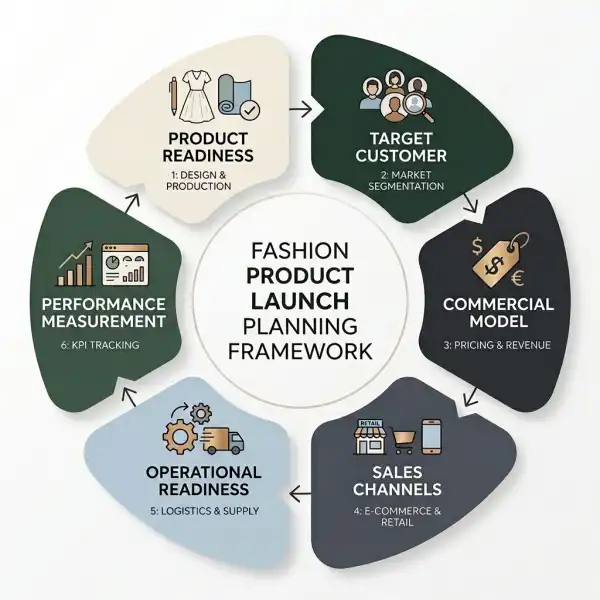
1. Product and assortment definition
The team needs one agreed version of what will be released. This includes more than style names. It should identify every sellable stock keeping unit, including its color and size variants, along with launch quantities, cost status, sample approval, imagery requirements, and expected availability.
The assortment should also have a clear internal hierarchy. One practical model is to distinguish between:
- Hero products that carry the central launch story
- Supporting products that complete outfits or increase basket value
- Commercial products expected to provide accessible volume
- Experimental products intended to test a silhouette, material, or price point
- Continuity products that connect the launch with proven existing demand
This classification helps prevent a common mismatch in which every item receives equal promotional treatment even though inventory, visual strength, and commercial importance differ considerably.
The hierarchy should not become a rigid formula. A limited-edition designer label, a uniform supplier, and a direct-to-consumer basics brand will require different assortment logic.
2. Target customer and demand hypothesis
A target customer description becomes operationally useful only when it influences the product and launch decisions.
“Women aged 25–40” says little about why someone would choose a garment. A stronger demand hypothesis might describe a customer looking for polished workwear that feels less restrictive during commuting and long office days, at a price below premium designer labels.
That hypothesis gives the team something to test. It affects silhouette, fabric explanation, styling, price architecture, photography, channel selection, and the objections addressed on the product page.
The launch brief should distinguish evidence from assumption. Previous sales, search behavior, waiting-list activity, fit feedback, wholesale inquiries, and customer-service conversations may provide evidence. A team’s belief that a color will be popular remains an assumption until supported by relevant demand.
3. Commercial model and unit economics
A fashion product may attract sales without producing a healthy commercial result. Launch planning therefore needs to consider the economics at product and channel level.
Relevant inputs can include:
- Landed product cost
- Packaging and inbound handling
- Payment processing and marketplace fees
- Pick-and-pack and outbound fulfilment costs
- Expected discounts or promotional allowances
- Return processing and potential loss of value
- Wholesale margin where applicable
- Customer acquisition spending
- Duties and taxes for relevant markets
Gross margin alone may not reveal the full picture. A product with a healthy gross margin can still generate weak contribution after fulfilment, returns, discounts, and paid acquisition are considered.
This does not mean every launch needs a sophisticated financial model. A growing brand should at least know the selling price, landed cost, expected channel deductions, and the conditions under which additional marketing spend remains commercially sensible.
4. Channel and customer journey readiness
The launch channel determines what information, assets, inventory access, and operational coordination are required.
A direct-to-consumer website gives the brand considerable control over product presentation and customer data. A marketplace may impose product-identifier, image, taxonomy, fulfilment, and listing requirements. Wholesale introduces line sheets, buyer deadlines, order terms, delivery windows, and retailer-specific assets.
Product discovery and purchase should be reviewed as one journey. A customer may first see the product in a creator video, visit a mobile product page, consult a size guide, leave, receive an email, and later complete the purchase on a desktop computer. Contradictory prices, different product names, or inconsistent availability across those touchpoints create unnecessary friction.
Where products require retail identifiers, a Global Trade Item Number can uniquely identify a trade item within supply-chain and retail systems, according to GS1’s official GTIN standard. Identifier assignment should be resolved before listings, packaging, and retailer data are finalized.
5. Operational readiness
Operational readiness asks whether the business can deliver the offer customers are about to see.
The answer depends on the launch model. For an in-stock collection, inventory must be received, checked, recorded, and available to the correct channel. For pre-orders, the customer-facing production window and delay policy need to be realistic. For wholesale, confirmed quantities, packing requirements, and delivery appointments may matter more than the direct-to-consumer website date.
Operational readiness typically covers:
- Final quality approval and measurement checks
- Inventory received by style, color, and size
- Channel allocation and stock synchronization
- Packaging and labelling
- Warehouse picking and dispatch procedures
- Delivery promises
- Return and exchange handling
- Customer-service briefing
- Escalation procedures for delays or quality issues
A launch should not be declared ready merely because finished goods have left the factory. Stock still has to pass through receiving, quality control, system entry, storage, and channel allocation before customers can reliably buy it.
6. Measurement and learning
The final component is a predefined measurement system. Without it, teams often interpret a launch according to whichever metric looks most favorable.
High traffic may conceal weak conversion. A strong first-day revenue figure may be concentrated in one heavily stocked hero product. Rapid sell-out may indicate genuine demand, but it may also reflect an intentionally small quantity. Strong gross sales can be offset by returns, discounts, or expensive acquisition.
Launch measurement should connect customer behavior with product and operational performance. Useful indicators may include:
- Qualified traffic and product-page engagement
- Email or waiting-list response
- Conversion rate
- Average order value
- Units per transaction
- Sell-through by product, color, and size
- Stockout timing
- Full-price versus discounted sales
- Return rate and return reasons
- Fulfilment speed and customer-service contacts
- Contribution after variable launch costs
Sell-through is commonly calculated as units sold divided by units available for sale over a defined period. The period, inventory basis, cancellations, and returns should be kept consistent when products are compared.

How Should Growing Brands Build a Launch Plan?
The most effective plan is not necessarily the longest. It is the one the team can use to make and record decisions.
For many growing brands, the process begins with a one-page launch brief. The brief establishes the commercial logic before individual departments build their detailed work.
Start with a clear launch objective
A launch cannot optimize for everything at once. The team should identify its primary objective and supporting constraints.
Possible objectives include:
- Generating profitable sales from a proven product category
- Entering a new category or price tier
- Acquiring customers from a new audience
- Testing demand before a larger production commitment
- Supporting a wholesale selling season
- Increasing repeat purchase among existing customers
- Building attention around a distinctive hero product
The objective changes the plan. A demand-testing launch may deliberately restrict inventory and prioritize learning. A revenue-focused seasonal release may require deeper stock, broader channel coordination, and stricter delivery timing.
The objective should also include a time horizon. “Successful launch” is too vague. The team needs to know whether it is evaluating the opening weekend, the first 30 days, the full selling season, or a replenishment cycle.
Build the launch around decision gates
A deadline tells the team when something is due. A decision gate determines whether the launch is ready to move forward.
Useful gates might include:
- Commercial approval: price, cost, margin, quantity, and channel plan are accepted.
- Product approval: fit, construction, color, material, and quality standards are signed off.
- Production confidence: delivery timing and quantity risks are understood.
- Content readiness: imagery, copy, size information, and claims have been approved.
- Channel readiness: product data, inventory, payment, shipping, and tracking have been tested.
- Release approval: unresolved risks have named owners and an explicit decision.
A gate does not have to mean stopping the entire launch whenever one issue appears. It creates a moment when the team decides whether to proceed, reduce scope, delay specific products, change the promise, or accept a documented risk.
Work backward from genuine availability
The public date should be based on operational reality, not only campaign preference.
Working backward reveals dependencies. Product photography requires approved samples. Product-page copy requires confirmed composition and care information. Warehouse setup requires final variants and barcodes. Seeding products to creators requires stock, shipping time, briefing, and disclosure expectations.
A calendar should therefore distinguish between:
- Internal target date
- Supplier-confirmed date
- Warehouse receipt date
- Quality-release date
- Channel-ready date
- Customer-facing launch date
Treating these dates as interchangeable creates false confidence. The detailed allocation of pre-launch, launch, and post-launch activities deserves a separate operational workflow because the appropriate timing depends on the channel and production model.
Use one source of truth
Launch information often becomes fragmented across messaging threads, spreadsheets, supplier documents, e-commerce systems, and creative folders. The result is not simply inconvenience. Different teams may act on different prices, product names, dates, or material descriptions.
A central launch record should contain or link to the approved version of:
- Product and variant data
- Costs and prices
- Inventory position
- Approved claims and product copy
- Asset status
- Channel status
- Calendar and owners
- Known risks
- Performance definitions
The tool can be simple. Discipline matters more than software sophistication. Someone must own version control and define which fields require formal approval before they change.
Product, Inventory, and Content Must Tell the Same Story
Fashion launches often separate merchandising from communication too early. The product team finalizes the range while marketing later constructs a story around it. Better planning allows each side to inform the other without confusing their responsibilities.
If the launch story emphasizes lightweight travel dressing, the assortment, photography, garment details, and fulfilment timing should support that promise. A heavy fabric, limited styling versatility, or delivery date after the relevant travel season would weaken the proposition.
Inventory depth should follow product role and uncertainty
Inventory allocation is not simply a forecast of which item will be popular. It is a risk decision made under incomplete information.
Historical sales may help when the new product resembles an existing style. Yet demand can change with fabric, color, price, season, fit, channel, and marketing exposure. A previous bestseller is evidence, not a guarantee.
Growing brands can reduce exposure by combining several approaches:
- Use historical size and color demand where the comparison is relevant.
- Separate proven silhouettes from genuinely new product experiments.
- Obtain supplier lead-time and replenishment constraints before setting quantities.
- Identify the inventory required for content, press, creators, wholesale, and exchanges.
- Protect against overselling when multiple channels draw from the same stock.
- Define what will happen if a hero product sells faster or slower than expected.
The deeper discipline of fashion sourcing strategy matters here. A low unit cost is less useful when the supplier’s minimum order, lead time, quality variability, or replenishment limits create excess commercial risk.

Product information is part of launch readiness
Product data is frequently treated as administrative work completed after creative production. In e-commerce, it is part of the sales experience.
Customers may need to understand garment dimensions, model measurements, fit description, material composition, lining, stretch, opacity, care, closure, pockets, and color variation. The relevant details depend on the product, but uncertainty should not be replaced by vague language.
Accurate garment measurements and product specifications also support internal consistency. The measurement data approved during development should not conflict with the size guide or product-page copy.
For products sold in the United States, most covered textile products must identify fiber content, country of origin, and the manufacturer or another responsible business; clothing is also subject to care-labelling requirements. Brands should review the applicable category and exemptions in the U.S. Federal Trade Commission’s textile and wool labelling guidance.

How Do Launch Requirements Change by Fashion Business Model?
The basic planning questions remain the same, but their priority changes according to how the brand sells and produces.
|
Business model |
Primary launch concern |
Operational implication |
|
Direct-to-consumer, in stock |
Product-page conversion and fulfilment readiness |
Inventory, site, payment, warehouse, email, and media must be synchronized |
|
Pre-order |
Credible delivery promise and customer trust |
Production assumptions, cut-off dates, updates, cancellations, and delay handling need clear policies |
|
Made-to-order |
Capacity and lead-time control |
Order intake must remain aligned with material and production capacity |
|
Wholesale |
Buyer commitments and delivery windows |
Line sheets, samples, minimums, terms, allocation, and retailer assets become central |
|
Marketplace |
Listing compliance and stock accuracy |
Product identifiers, taxonomy, images, fees, fulfilment rules, and inventory feeds require validation |
|
Limited drop |
Fair access and demand concentration |
Traffic capacity, purchase limits, fraud controls, and overselling prevention may be important |
|
Omnichannel retail |
Consistent availability across locations |
Allocation, store briefing, stock visibility, pricing, and returns must work across channels |
A pre-order model can reduce the amount of finished inventory committed before demand is known, but it does not remove risk. The brand still commits to materials, production capacity, customer communication, and a delivery promise. If the launch produces more demand than the supplier can handle, the apparent commercial success can turn into delayed orders and lost trust.
Who Should Own a Fashion Product Launch?
A launch needs one accountable leader, even though many teams contribute. Without a clear owner, meetings may generate updates without resolving conflicts.
The launch owner does not personally complete every task. The role is to maintain the integrated plan, surface dependencies, coordinate decisions, and escalate risks. Depending on company structure, this person may work in product, merchandising, operations, brand, or general management.
Functional ownership can then be divided clearly:
- Product or design owns the approved product intent and sample decisions.
- Merchandising owns assortment logic, pricing architecture, and inventory recommendations.
- Sourcing and production own supplier status, manufacturing risks, and delivery confidence.
- E-commerce or sales owns channel setup and product availability.
- Marketing owns the audience plan, campaign assets, and demand-generation activity.
- Operations owns receiving, fulfilment, packaging, and returns readiness.
- Customer service owns customer-facing guidance and issue escalation.
- Finance validates budgets, margin assumptions, and commercial reporting.
Smaller companies may have one person covering several roles. The important point is not the number of people; it is whether each decision has one accountable owner.

What Should a Growing Brand Measure After Launch?
Measurement should reflect the launch objective and commercial model. No single metric explains the complete result.
A brand testing a new category might prioritize qualified demand, fit feedback, return reasons, and full-price conversion. A seasonal revenue launch may focus more heavily on sell-through, contribution, inventory cover, and replenishment potential. A wholesale launch may be judged through account conversion, order quality, and delivery execution.
Metrics should be read together:
- Traffic without conversion may indicate weak targeting, product presentation, price resistance, or technical friction.
- Conversion without healthy contribution may reflect excessive discounts or acquisition costs.
- Fast sell-through with frequent stockouts may reveal demand, but it may also indicate that initial quantities were too conservative.
- Strong unit sales with concentrated returns may signal a fit, quality, or expectation problem.
- High engagement without product-page visits may mean the creative is interesting but the commercial proposition is unclear.
The most useful review moves below collection-level revenue. Teams should examine style, color, size, channel, customer segment, discount status, and return reason where the data volume permits. That is where actionable product and inventory lessons usually appear.
Common Launch Planning Mistakes to Recognize Early
Several planning mistakes appear repeatedly because they make the launch feel simpler in the short term.
Choosing the public date before confirming the critical path
A date selected for a seasonal moment or marketing opportunity may be commercially attractive. It becomes dangerous when the production, customs, photography, warehouse, or channel dependencies have not been tested.
The better response is not necessarily to abandon the date. The brand may reduce the assortment, separate later products, change an in-stock launch to a carefully managed pre-order, or adjust the campaign promise.
Treating every product as a hero
When every product receives equal attention, the central proposition becomes difficult to understand. Content production is spread thinly, customers face too many choices, and inventory decisions may lose focus.
A clearer hierarchy allows the brand to lead with a small number of distinctive products while using supporting items to provide choice and complete the commercial offer.
Scaling promotion before validating readiness
Increasing media spend can amplify demand, but it also amplifies operational weaknesses. Before scaling, teams should confirm that the product page, checkout, inventory feed, fulfilment capacity, customer support, and measurement are functioning.
Changing facts late without controlling versions
Last-minute changes to price, composition, delivery timing, or product naming can spread inconsistently across packaging, advertising, line sheets, marketplace listings, and customer-service scripts.
A controlled approval process is less exciting than campaign development, but it protects the accuracy of the public offer.
These are only the high-level warning signs. The operational consequences and corrective approaches are explored more deeply in common fashion product launch mistakes that reduce sales momentum.
What Should Brands Verify Before Acting?
Launch readiness should include a market-specific compliance review. Requirements can depend on product category, customer age, material, country of sale, sales channel, advertising claim, and the role the business performs in the supply chain.
Important areas to verify include:
- Textile composition, care, country-of-origin, and responsible-business labelling
- Product safety and traceability
- Children’s product requirements where relevant
- Pricing, promotions, and scarcity claims
- Environmental and performance claims
- Influencer or endorsement disclosures
- Customer rights, returns, warranties, and delivery information
- Privacy and marketing consent
- Import, tax, and customs obligations
- Marketplace-specific listing policies
For products offered to consumers in the European Union, the General Product Safety Regulation has applied since 13 December 2024 and includes requirements affecting distance sales and the information presented with online product offers. Brands selling into the EU should assess their exact obligations using the current text of Regulation (EU) 2023/988 and appropriate legal or compliance advice.
Environmental language also needs evidence before it enters campaign copy, product names, filters, packaging, or creator briefs. The UK Competition and Markets Authority states that businesses across the supply chain should ensure that environmental claims are accurate and not misleading, including when information originates with another party. Its 2026 guidance on environmental claims across the supply chain advises businesses to use robust, credible, relevant, and current evidence.
This is one reason compliance should not be left until the campaign is finished. If a central claim cannot be supported, the team may need to revise the product story, creative assets, product page, and channel materials.
A Practical Launch Planning Framework for Small and Growing Teams
A growing brand can begin with a compact framework rather than a large corporate process.
The one-page launch brief
The brief should contain:
- Launch name and customer-facing date
- Primary objective and evaluation period
- Target customer and purchase occasion
- Customer problem or demand hypothesis
- Hero products and supporting assortment
- Price range and commercial guardrails
- Inventory or production model
- Priority channels
- Core customer promise
- Evidence required for product claims
- Primary risks and decision owners
- Success metrics
This document establishes alignment. It does not replace production trackers, content calendars, product data sheets, or channel checklists.
The readiness review
Hold a structured review far enough before release that the team can still change the scope. Each function should report evidence, not only a subjective percentage of completion.
“Photography is 90% complete” is less useful than “all product images are approved except the blue jacket, which will be delivered on Thursday and blocks its product page.” The second statement exposes the dependency and allows a decision.
The launch control window
During the public release, the team needs a short list of signals and escalation owners. It should know who can correct pricing, pause advertising, change a delivery message, investigate payment failure, reconcile inventory, or respond to a quality complaint.
This does not require a permanent command center. It requires enough coordination to prevent an issue from moving between teams without ownership.
The evidence-based review
After sufficient data has accumulated, compare the results with the original assumptions. The aim is not to defend the launch plan. It is to improve the next product, order, size curve, channel choice, creative approach, and operational process.
Separate three questions:
- Did customers respond to the product proposition?
- Did the business execute the launch reliably?
- Did the resulting sales create acceptable commercial value?
A weak result may have different causes. A good product can suffer from poor execution; a well-executed campaign can expose weak product-market fit. Those situations should not lead to the same decision.
Frequently Asked Questions
How far in advance should a fashion brand plan a product launch?
Planning should begin early enough to accommodate the longest critical dependency, which may be material sourcing, production, compliance testing, wholesale selling, photography, or importation. There is no universally correct number of weeks.
A locally produced small batch may require a shorter schedule than an imported seasonal collection with custom fabric and retailer commitments. The team should map dependencies backward from operational availability and add contingency based on supplier reliability and product complexity. The public launch date should come after realistic warehouse, quality, data, and channel-readiness dates—not directly after the factory’s estimated completion date.
What is the most important part of a fashion launch plan?
The most important element is alignment between the product promise and the brand’s ability to deliver it. That requires accurate product information, credible availability, appropriate pricing, sufficient operational readiness, and a clear target customer.
Marketing reach matters, but generating attention before these elements are aligned can make problems more visible. For a growing brand, the first priority should usually be a commercially coherent product supported by reliable execution. Campaign scale can then increase according to readiness and early evidence rather than ambition alone.
How many products should a growing brand include in one launch?
There is no ideal assortment size that applies to every fashion brand. The appropriate number depends on production resources, inventory capital, product complexity, channel needs, customer expectations, and the team’s ability to present each item clearly.
A focused range may be more manageable when the brand is testing a new customer, category, or supplier. A broader assortment may make sense when established demand patterns and operational capacity support it. Each additional style, color, and size creates more stock-keeping units, data, images, quality checks, and allocation decisions. Assortment breadth should therefore be treated as an operational commitment, not only a creative choice.
Can a fashion brand launch before all inventory has arrived?
It can, but the customer promise must match the actual availability model. A brand might release an in-stock portion separately, operate a clearly communicated pre-order, or postpone products whose delivery remains uncertain.
Presenting unreceived stock as immediately available creates fulfilment and trust risks. Supplier completion, transit, customs clearance, warehouse receipt, and quality approval are different milestones. Before selling, the team should know which inventory is physically and systemically available, what happens if delivery is delayed, and how customers will be informed.
Is pre-ordering safer than holding inventory?
Pre-ordering can reduce finished-goods inventory exposure and provide demand evidence before full production, but it transfers risk into capacity, timing, communication, and customer trust.
A pre-order launch still requires material access, supplier commitment, realistic production capacity, quality control, payment and cancellation policies, and a plan for delays. It works best when the brand can explain the timeline clearly and deliver within the promised window. It is not a substitute for production planning, and it may be unsuitable when customers expect immediate seasonal availability.
Which metrics should be reviewed first after launch?
Begin with metrics connected to the launch objective, then review product, commercial, and operational signals together. Typical early indicators include qualified traffic, product-page behavior, conversion, units sold, stock position, channel performance, and customer-service issues.
As more data becomes available, examine full-price sell-through, contribution, size-level demand, return rate, and return reasons. Avoid judging the launch from revenue alone. Strong sales may be unprofitable after discounts, returns, fulfilment, or acquisition costs, while a smaller test launch may be successful if it produces reliable evidence for a larger decision.
Does a small fashion brand need launch-planning software?
Not necessarily. A structured spreadsheet, shared calendar, approved product-data file, and clear document ownership may be sufficient for a small team.
Software becomes more valuable when the brand manages many products, contributors, channels, markets, or dependencies. Even then, a platform will not resolve unclear accountability or inconsistent product data on its own. The brand should first define its workflow, decision gates, owners, and approved source of truth. Technology should support that system rather than conceal the absence of one.
Conclusion
Fashion product launch planning turns a collection release into a coordinated commercial decision. It connects what the brand has designed with what it can produce, explain, sell, deliver, and learn from.
For growing brands, the discipline is particularly valuable because each launch places more capital, people, channels, and customer trust at risk. The answer is not to create an unnecessarily complicated process. It is to make the critical assumptions visible, assign decisions clearly, work backward from real availability, and measure the result beyond headline sales.
A launch plan will not remove uncertainty from fashion. It should make that uncertainty manageable.





Comments 0
Leave a CommentSend Comment
Anda harus Login terlebih dahulu untuk dapat memberikan komentar.