

Fashion Cash Flow Management Explained for Small Brands
Fashion cash flow management is the process of planning, monitoring, and controlling when money enters and leaves a fashion business so the brand can meet supplier, production, payroll, marketing, tax, and other obligations when they fall due.
For small fashion brands, cash management can be particularly demanding because money often leaves the business well before finished products generate customer receipts. Fabric deposits, sampling, trims, manufacturing, freight, photography, campaign spending, and inventory may all require funding before a collection produces meaningful cash inflow.
That makes cash flow different from sales and different from accounting profit. A brand can record healthy revenue or a profitable collection while still facing a temporary cash shortage if too much money is tied up in inventory, receivables, production commitments, or upcoming expenses.
Good cash flow management therefore connects financial forecasting with merchandising, inventory purchasing, production planning, payment terms, and sales timing. The objective is not simply to hold as much cash as possible. It is to ensure that the business has enough liquidity at the right points in its operating cycle without unnecessarily restricting growth.

What Is Fashion Cash Flow Management?
Fashion cash flow management is financial management focused on the timing, amount, and reliability of cash receipts and payments across the apparel business cycle.
The distinction around timing matters. Revenue may be recorded when a sale occurs, but the cash associated with that sale may reach the company later. Likewise, a production cost may affect profitability over one accounting period while the actual supplier payment has to be made much earlier.
Under IAS 7 Statement of Cash Flows, cash flows are broadly classified into operating, investing, and financing activities. For a small fashion brand, most routine product-related movements—customer receipts, supplier payments, wages, fulfilment costs, and similar expenses—sit within the operating side of the business.
Small brands do not need to turn every merchandising decision into an accounting exercise. They do, however, need to understand where cash is committed before it becomes visible again in the bank account.
Consider a simple collection. A brand may need to pay for:
- design and sampling;
- fabric or finished-goods deposits;
- labels, trims, packaging, and testing;
- manufacturing balances;
- freight and import-related charges;
- photography and campaign production;
- paid media;
- warehousing and fulfilment.
Several of those payments can occur before a single unit is sold.
That is why cash management in fashion is inseparable from product planning.
Why Cash Flow Is Especially Important in Fashion
A service company can sometimes invoice shortly after completing work without carrying much physical inventory. A fashion business usually has a more capital-intensive path between deciding what to sell and receiving the money from selling it.
The problem becomes clearer when the lifecycle of a garment is viewed financially rather than creatively.
A small brand may approve a collection in January, pay an initial factory deposit in February, settle material costs in March, pay the production balance before shipment in April, receive stock in May, and then sell that inventory gradually over several months.
From a merchandising perspective, the product is progressing normally.
From a cash perspective, money may be leaving the company for months before the full investment is recovered.
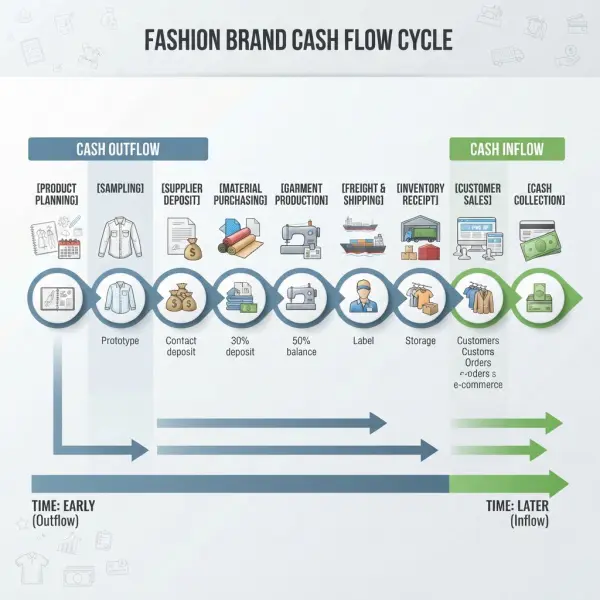
This timing gap is one reason working capital matters so much in product businesses. ACCA describes the cash operating cycle as the time between paying suppliers and receiving cash from sales, with inventory, receivables, and supplier payment terms influencing the length of that cycle. In manufacturing, inventory can include raw materials, work in progress, and finished goods.
For fashion businesses, that framework is useful because one product commitment can exist in several cash-consuming forms before it reaches the customer: fabric that has been ordered, garments being sewn, completed units in transit, finished stock in a warehouse, or wholesale invoices waiting to be paid.
The deeper mechanics of how inventory, production timing, and pre-orders change this cycle deserve separate treatment. See how pre-orders, inventory, and production cycles affect cash flow.
Cash Flow Is Not the Same as Revenue or Profit
This is one of the most important distinctions for a growing fashion business.
Revenue tells you what the business has sold. Profit measures revenue against recognized costs and expenses. Cash flow tells you when actual money enters or leaves the business.
Those figures interact, but they are not interchangeable.
Suppose a small wholesale-focused brand delivers $40,000 of merchandise to retailers and records the related sales. If buyers are allowed 30 or 60 days to pay, the revenue may already appear in the accounts while much of the cash has not yet reached the bank.
Meanwhile, the factory that produced the merchandise may already have been paid.
The opposite situation can also occur. A direct-to-consumer brand receiving customer payments immediately may have strong short-term cash inflow during a launch, even though future fulfilment costs, taxes, returns, supplier bills, and replenishment commitments still have to be funded.
This is why a large bank balance after a successful drop should not automatically be interpreted as free money available for expansion.
The accounting relationship between profit and cash can become considerably more detailed. The related article why profitable fashion brands can still run out of cash examines that distinction more closely.
The Main Cash Inflows and Outflows in a Small Fashion Brand
Understanding cash flow becomes easier when the business stops treating the bank account as one undifferentiated pool of money.
Cash movements can instead be mapped to their operational causes.
|
Cash-flow area |
Typical fashion example |
Management question |
|
Customer receipts |
DTC orders, marketplace payouts, wholesale invoice collections |
When will the money actually reach the bank? |
|
Product development |
Samples, patterns, prototypes, fit sessions |
How much cash is being committed before production approval? |
|
Inventory purchasing |
Finished goods or materials |
How long might this cash remain tied up? |
|
Manufacturing |
Factory deposits and balance payments |
Which payments occur before stock is sellable? |
|
Freight and logistics |
International freight, customs handling, fulfilment |
Are these costs included in the launch cash plan? |
|
Marketing |
Photography, creators, media buying, launch events |
Is marketing spend due before the expected sales period? |
|
Operating overhead |
Payroll, rent, software, insurance |
Which costs continue regardless of sales volume? |
|
Financing |
Owner funding, loans, investor capital |
What obligations or dilution accompany the funding? |
|
Taxes |
Sales-related or corporate tax obligations depending on jurisdiction |
Has cash been reserved rather than treated as available spending money? |
The exact categories vary by business model. A made-to-order atelier, wholesale label, marketplace seller, vertically integrated manufacturer, and digitally native direct-to-consumer brand will not share the same cash cycle.
What matters is visibility.
If management can see when each major cash commitment occurs, it can decide whether planned purchasing, hiring, marketing, or production is financially supportable before the payment is due.

Inventory Is Both an Asset and a Cash Commitment
Inventory creates a particularly important tension in fashion.
Accountingly, inventory is an asset rather than simply money that has disappeared. IAS 2 specifies principles for measuring inventory and generally requires inventories within its scope to be measured at the lower of cost and net realisable value. The cost can include purchase costs and, where applicable, conversion and other costs necessary to bring inventory to its present location and condition.
For cash management, however, the operational reality is more immediate: money invested in inventory cannot simultaneously be used to pay another obligation.
A warehouse containing $80,000 of stock is not equivalent to having $80,000 in the bank.
The stock must still be sold, and its recoverable value may be influenced by demand, seasonality, markdowns, returns, damage, sizing imbalance, and selling costs.
This is where cash management and merchandising should meet.
A merchandising team may want deeper stock coverage to protect availability. Finance may want lower inventory exposure. Marketing may want enough inventory to support an aggressive campaign. Production may prefer larger runs because factory economics improve at higher quantities.
None of those perspectives is automatically wrong.
The commercial task is to find a stock position that protects sales without absorbing more cash than the business can safely support.

Working Capital Connects Daily Operations to Cash
Working capital is commonly understood as current assets minus current liabilities. The U.S. Small Business Administration similarly describes working capital as the amount of current assets remaining after current debts are accounted for.
For a fashion operator, the more useful question is not simply whether working capital is positive.
It is where the working capital is sitting.
A brand might have substantial current assets, but much of them could consist of slow-moving garments rather than immediately available cash. Another business might have strong wholesale receivables but still need enough liquid cash to fund its next production deposit before retailers pay their invoices.
Three operational variables deserve particular attention:
- Inventory days: how long inventory remains in the business before being sold.
- Receivable days: how long customers, particularly wholesale accounts, take to pay.
- Payable days: how long the business has before suppliers must be paid.
ACCA summarizes the cash operating cycle as inventory days plus receivable days minus payable days. A longer cycle generally means more resources remain tied up in working capital.
These metrics should not be optimized mechanically. Extending supplier payments may temporarily improve cash, for example, but repeatedly paying factories late can damage a commercially important relationship. Similarly, drastically reducing stock may improve cash while creating stockouts that undermine sales.
Cash efficiency still has to support the operating model.
How Should a Small Fashion Brand Forecast Cash Flow?
A cash flow forecast estimates when cash is expected to enter and leave the business, allowing management to see potential surpluses or shortages before they happen.
UK government business guidance, for example, recommends considering a 12-month forecast and emphasizes that forecasts should reflect when money is actually received or paid rather than simply when invoices are issued.
For a small fashion brand, a useful system can have two horizons:
A short-term operational view can track upcoming weeks in greater detail, especially when major production, freight, payroll, or tax payments are approaching.
A rolling medium-term view can cover several months or approximately a year, allowing the team to see collection launches, production seasons, stock buys, wholesale collections, and overhead requirements in context.
The system does not have to begin with sophisticated software. ICAEW notes that the usefulness of cash forecasting depends heavily on the information placed into the forecast, and even a spreadsheet can be valuable if maintained properly.
The model should become more sophisticated as the business requires it—not before.
Start with the opening cash position
The first number is the cash the business can actually use.
That may sound obvious, but founders sometimes mentally combine bank cash with expected payments, unsold inventory, available credit, or hoped-for future sales.
Keep them separate.
Expected customer receipts belong in the forecast on the dates they are reasonably expected to arrive.
Inventory belongs in inventory reporting.
Unused financing capacity belongs in financing planning.
Opening cash should represent actual available liquidity.
Map cash inflows by expected receipt date
For a small apparel business, inflows might include:
- website and store receipts;
- marketplace settlements;
- wholesale invoice payments;
- pre-order receipts;
- licensing income;
- financing;
- owner or investor capital.
Forecasting should reflect payment behavior rather than only sales forecasts.
If a retailer places a $25,000 wholesale order but pays 60 days after delivery, the brand cannot safely treat the $25,000 as cash available on shipping day.
Map cash outflows by payment date
Fashion founders often forecast sales with enthusiasm but estimate expenditure more loosely.
That creates false confidence.
A production order should be broken into its actual payment milestones. For example:
fabric payment → factory deposit → production balance → freight → duty → warehouse receiving.
Marketing can be scheduled in the same way.
Campaign photography paid six weeks before launch has a different cash effect from performance advertising charged after the collection is already selling.
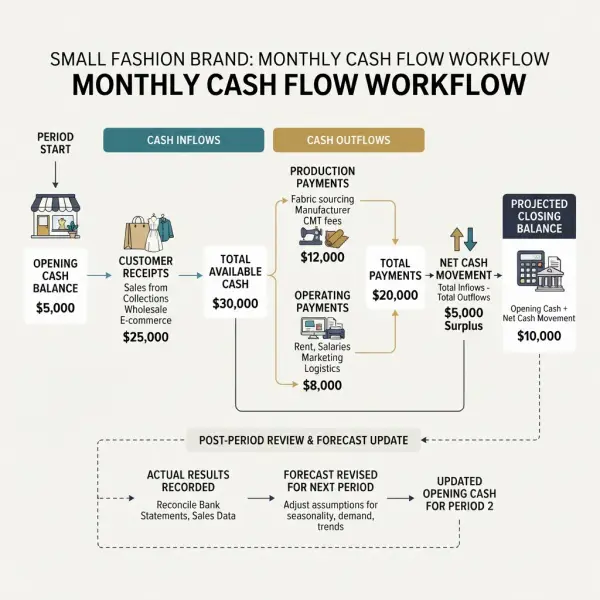
Calculate the projected closing cash balance
A simple structure is:
Opening cash + cash received − cash paid = closing cash
The closing balance then becomes the next period's opening balance.
What matters most is not whether the spreadsheet is complicated. It is whether management can identify the point at which available cash becomes uncomfortably low.
Build the Forecast Around Fashion Milestones, Not Just Calendar Months
A generic monthly finance spreadsheet is useful, but fashion operators should also connect it to the commercial calendar.
Cash pressure often clusters around events.
A spring collection, for example, may require multiple cash commitments before launch. A wholesale trade show can generate promising orders yet also trigger sampling, travel, booth, and follow-up production costs. Holiday inventory may require funding well before holiday customer receipts arrive.
Useful cash milestones can include:
- collection development approval;
- sample payment;
- purchase-order confirmation;
- material deposit;
- factory deposit;
- manufacturing completion;
- production balance;
- freight departure;
- stock arrival;
- campaign launch;
- wholesale delivery;
- expected retailer settlement;
- major tax or payroll dates.
Once those dates are visible together, commercial decisions become easier to challenge.
A founder may discover that the real problem is not annual profitability. It is that two collections, a trade event, and an annual insurance payment all create demands on cash during the same six-week period.
This is exactly the kind of problem that cash forecasting is supposed to reveal before it becomes urgent.
A Practical Example: When a Collection Creates a Cash Squeeze
Imagine a small direct-to-consumer womenswear brand with $70,000 in available cash.
Management approves a new collection expected to generate $120,000 in sales.
On paper, it looks comfortable.
But consider the sequence:
|
Period |
Cash event |
Cash effect |
|
Week 1 |
Sampling and development |
-$4,000 |
|
Week 2 |
Factory deposit |
-$18,000 |
|
Week 4 |
Fabrics and trims |
-$14,000 |
|
Week 6 |
Photography and campaign |
-$7,000 |
|
Week 8 |
Production balance |
-$20,000 |
|
Week 9 |
Freight and fulfilment setup |
-$5,000 |
|
Week 10 |
Collection launches |
Sales begin |
|
Weeks 10–18 |
Customer receipts |
Cash gradually returns |
Before meaningful launch receipts arrive, this simplified example has committed $68,000.
The expected $120,000 of sales does not solve the Week 8 cash problem if the money has not arrived yet.
Nor does projected profit.
Management might respond by changing order quantities, negotiating legitimate supplier milestones, staggering the launch, arranging financing ahead of time, reducing discretionary spending, using a controlled pre-order model, or maintaining a larger cash reserve.
Which solution is appropriate depends on margins, demand confidence, supplier relationships, borrowing costs, fulfilment capacity, and brand strategy.
The purpose of cash management is to make that decision while options still exist.
Which Cash-Flow Metrics Matter Most?
Small brands do not need dozens of financial ratios.
A compact operating dashboard can often be more useful if each metric is tied to a management decision.
Available cash
How much unrestricted cash can the company actually deploy?
This is the starting point, not the whole picture.
Projected minimum cash balance
Instead of looking only at month-end cash, identify the lowest expected balance during the forecast.
A brand expecting to finish December with $60,000 may still have a serious problem if cash falls below required payroll in mid-November.
Inventory value and inventory days
Inventory metrics reveal how much capital is committed and how quickly stock moves.
They should ideally be reviewed by product category, season, collection, or SKU rather than only as one company-wide number. Fast-selling permanent basics and experimental seasonal pieces do not have the same risk profile.
Receivables and expected collection dates
This becomes especially important in wholesale.
A sale is not available cash until payment is received.
The team should know which invoices are due, which are overdue, and whether customer payment behavior differs from contracted terms.
Supplier obligations
Purchase orders can create future cash commitments before the money leaves the bank.
A cash dashboard should therefore look beyond current accounts payable and include confirmed upcoming production commitments.
Fixed operating cash requirement
Payroll, rent, software, insurance, professional services, and other recurring expenses create a baseline that continues even during a weak sales period.
Knowing that baseline helps management estimate how much liquidity is needed before approving optional inventory, marketing, or capital spending.
Cash Buffers Should Reflect the Business Model
There is no universally correct cash reserve for every fashion brand.
A company with short domestic production lead times, flexible reorder quantities, immediate DTC settlement, and low fixed costs may tolerate a different liquidity position from a wholesale-heavy business placing large overseas orders six months in advance.
Instead of choosing an arbitrary reserve percentage, management can model the cash required to survive plausible disruptions such as:
- a major wholesale customer paying later than expected;
- a collection selling more slowly than planned;
- a freight bill being higher than budgeted;
- a factory requiring payment before shipment;
- customer returns temporarily increasing;
- a launch moving several weeks later;
- replenishment becoming necessary earlier than expected.
The question is not simply, “How many months of cash should we hold?”
A better question is, “Which obligations must this business be able to fund if expected receipts are delayed?”
That produces a reserve policy grounded in the operating model rather than a generic benchmark.
Cash Flow Decisions Should Be Shared Across the Fashion Team
Cash flow is sometimes treated as the accountant's responsibility.
That is too narrow.
Finance may maintain the forecast, but many of the decisions that change cash are made elsewhere.
Merchandising determines assortment breadth and buying depth.
Design can increase development expenditure through additional styles, fabrics, or sample rounds.
Production determines order timing and supplier commitments.
Marketing determines campaign expenditure.
Wholesale teams negotiate customer payment terms.
Operations influence freight, warehousing, and fulfilment costs.
Founders decide when to hire, invest, or launch another collection.
A useful cash management process therefore connects those functions before commitments become irreversible.

One practical rule helps: every major commercial decision should be translated into a cash date and cash amount.
“Order 2,000 units” is not yet a cash plan.
“Pay a 30% deposit on March 15, the remaining production balance before shipment on May 20, and freight in early June” is much closer to one.
How Small Fashion Brands Can Improve Cash Flow Management
Improving cash flow does not necessarily mean cutting every expense or delaying every payment.
The aim is to make commitments more deliberate.
Connect buying decisions to cash capacity
A promising style is not automatically a financially sensible order.
Before committing to production, test what the order does to the lowest projected cash balance.
If the purchase leaves too little headroom for payroll, taxes, existing supplier commitments, or fulfilment, the brand may need to reduce the order, phase it differently, or find suitable financing.
Separate committed cash from discretionary cash
Some future payments are effectively unavoidable once a production order has been placed.
Others remain optional.
Management should distinguish between:
Committed: confirmed purchase orders, contracted payroll, tax obligations, rent, approved freight.
Planned but adjustable: campaign expansion, secondary shoots, discretionary software, optional travel, speculative additional inventory.
When conditions change, this distinction shows where action is still possible.
Negotiate payment structures before cash becomes tight
Supplier negotiations are usually more constructive when conducted during purchasing rather than after a payment problem appears.
Depending on supplier capability and the commercial relationship, brands may be able to negotiate deposits, production milestones, payment terms, or split deliveries.
Terms should still be commercially fair. Stretching suppliers simply because the brand has mismanaged liquidity transfers financial pressure rather than solving the underlying problem.
Review forecast versus actual results
A forecast that is never compared with reality quickly becomes decorative.
Each review should ask why receipts or payments differed from expectations.
Was the sales assumption wrong?
Did the factory invoice arrive earlier?
Did shipping cost more?
Did wholesale customers pay later?
Did return rates reduce net cash receipts?
Repeated differences reveal where future assumptions need improvement.
ICAEW recommends using relevant indicators such as cash in hand, debtor days, inventory days, supplier days, and sales when monitoring financial performance and cash forecasting.
Common Cash Flow Mistakes in Small Fashion Brands
Mistake 1: Treating sales forecasts as cash forecasts
A sales plan answers what the business expects to sell.
A cash forecast answers when the money will actually arrive.
The difference is particularly important when the brand has wholesale credit terms, marketplace settlement delays, pre-orders, refunds, or payment processor timing.
A better approach is to start with expected sales but translate them into realistic receipt dates.
Mistake 2: Spending launch cash before all launch costs are settled
A successful product launch can create a large inflow in a short period.
That bank balance can be misleading if production balances, advertising charges, returns, tax obligations, or fulfilment expenses remain outstanding.
Before reinvesting launch proceeds, reconcile which liabilities are still attached to the sales already generated.
Mistake 3: Buying inventory because the unit cost looks attractive
Factories often have minimum quantities, and larger production runs can reduce cost per unit under certain arrangements.
But cheaper units do not automatically mean better cash economics.
Saving $2 per garment is not necessarily beneficial if obtaining the lower price requires the brand to spend another $30,000 on inventory that takes a year to sell.
Cash exposure, demand risk, storage, markdowns, and opportunity cost belong in the same decision.
Mistake 4: Forecasting only one scenario
A forecast built entirely around target sales describes what management hopes will happen.
Cash planning should also test what happens if important assumptions fail.
For instance:
- sales arrive four weeks later;
- only 70% of the expected launch volume sells initially;
- a wholesale customer pays 30 days late;
- production costs rise;
- freight becomes more expensive.
The purpose is not pessimism. It is identifying which assumptions could create a liquidity problem.
Mistake 5: Using supplier payments as the default source of financing
Extending agreed terms through negotiation can be legitimate.
Habitually paying factories late without agreement is different.
A small fashion brand often depends heavily on a limited supplier network. Damaging those relationships can eventually affect production priority, trust, flexibility, or willingness to accept future orders.
Mistake 6: Managing cash only when the balance looks low
By the time the bank account signals a problem, many decisions may already have been locked in.
Fabric may be ordered. Production may be running. Marketing contracts may be signed.
Forecasting moves the intervention point earlier, when management still has choices.
What Brands Should Verify Before Making Cash Decisions
Cash flow planning involves estimates. Estimates should not be treated as certainty.
Before approving a major purchase or production commitment, verify the assumptions that materially affect liquidity.
Check:
- confirmed supplier payment dates rather than assumed dates;
- whether quoted manufacturing prices include all relevant costs;
- realistic freight and import costs;
- actual marketplace or payment-provider settlement timing;
- wholesale contractual payment terms;
- overdue customer balances;
- likely return and refund timing;
- tax obligations applicable in the relevant jurisdiction;
- existing purchase orders not yet invoiced;
- planned payroll and recurring overhead;
- available financing terms and repayment obligations.
Accounting and tax treatment also varies by jurisdiction and entity structure. IFRS principles cited in this article provide useful financial context, but they should not be interpreted as a substitute for local accounting, tax, or legal advice, and not every small fashion business is required to report under IFRS.
A Simple Cash Management Rhythm for a Growing Brand
Cash flow management works better as a recurring operating process than as an emergency finance exercise.
For a small brand, a workable rhythm might look like this:
Weekly: review available cash, customer receipts, upcoming supplier payments, payroll, major purchase commitments, and short-term forecast changes.
Monthly: reconcile forecast versus actual results, update future sales and production assumptions, review inventory exposure, and extend the rolling forecast.
Before every major production order: test the order against the projected minimum cash balance.
Before major expansion decisions: model the combined effect of new inventory, hiring, marketing, systems, retail space, or wholesale growth rather than evaluating each expense separately.
The point is not the exact frequency.
The point is that cash becomes part of normal merchandise and operational planning.
As a brand grows, finance software, inventory systems, enterprise resource planning tools, or dedicated financial staff may make this process more sophisticated. But better technology cannot compensate for weak assumptions.
A simple forecast updated consistently is more useful than an elaborate model based on unrealistic sales timing.
Cash Flow Management Is Ultimately About Decision Timing
Small fashion brands rarely fail because managers are unaware that cash matters.
The harder problem is translating that awareness into day-to-day commercial decisions.
Should another colorway be added?
Can production be increased?
Is the brand ready to hire?
Can a wholesale order be accepted if the retailer pays in 60 days?
Should additional marketing spend be approved?
Is enough cash available to reorder the bestseller without putting the next payroll cycle under pressure?
Cash flow management gives those questions a common financial language.
It does not tell management what strategy to choose. It shows which strategies the business can currently finance, where additional capital may be required, and which assumptions carry the greatest liquidity risk.
That is a much more useful role than simply watching the bank account.
Frequently Asked Questions
How is cash flow management different from bookkeeping?
Bookkeeping records financial transactions, while cash flow management uses financial information to plan and control liquidity. A bookkeeper may accurately record a factory invoice, customer payment, or marketing expense after it occurs. Cash management asks whether the company will have enough available money when upcoming invoices, payroll, production deposits, and other obligations become due. Small fashion brands need both. Accurate records improve the quality of forecasting, while forecasting helps management act before a shortage appears.
How often should a fashion brand update its cash flow forecast?
The appropriate frequency depends on the brand's risk and operating cycle. A stable business with predictable receipts may not need the same level of short-term monitoring as a young label financing several production runs. Many small brands benefit from detailed weekly visibility for near-term payments combined with a rolling monthly view covering the broader commercial calendar. Forecasts should also be updated whenever a material assumption changes, such as a delayed shipment, major wholesale order, unexpected inventory purchase, or changed sales outlook.
Does holding more inventory always make cash flow worse?
Not necessarily. Inventory uses cash, but sufficient inventory is also necessary to fulfil demand. The objective is not to minimize inventory regardless of commercial consequences. A brand that cuts stock too aggressively may lose revenue through stockouts, delay deliveries, or become unable to respond to successful marketing. The better question is whether the expected sales contribution, margin, replenishment time, and risk of holding each inventory position justify the amount of cash committed.
Can pre-orders solve a small fashion brand's cash flow problems?
Pre-orders can change the timing of customer receipts and may reduce some inventory risk, but they are not a universal cash-flow solution. The brand still needs enough operating capacity to produce and fulfil the orders, manage cancellations or refunds, communicate realistic delivery dates, and comply with relevant consumer rules. Pre-orders are most useful when the operating model, supplier arrangements, customer expectations, and fulfilment process are designed around them rather than when they are introduced only because the business has run short of cash.
Should a fashion brand delay supplier payments to improve cash flow?
Only within legitimately agreed commercial terms. Negotiating suitable payment schedules can improve working-capital efficiency, particularly when cash receipts occur after production payments. Simply paying suppliers late without agreement creates a different problem. Small brands often rely on long-term factory and material relationships, and persistent late payment can undermine trust and future flexibility. Better cash management focuses first on forecasting obligations, negotiating terms in advance, controlling inventory commitments, and arranging suitable financing where necessary.
What is the most important cash flow number for a small fashion brand?
There is no single metric that is sufficient on its own. Current bank cash is important, but management should also understand the projected minimum cash balance after known commitments. Inventory value, upcoming purchase orders, receivables, supplier obligations, and fixed operating costs provide essential context. A brand with $100,000 in the bank may still have limited financial flexibility if $90,000 of committed production and operating payments are due within the next month.
When should a fashion brand consider outside financing?
Financing may be appropriate when a commercially sound opportunity creates a timing gap that existing cash cannot comfortably support—for example, funding confirmed wholesale orders or seasonal production. It should not automatically be used to conceal persistent losses, uncontrolled inventory, or inaccurate forecasting. Before borrowing or raising





Comments 0
Leave a CommentSend Comment
Anda harus Login terlebih dahulu untuk dapat memberikan komentar.