

Common Fashion Product Launch Mistakes That Reduce Sales Momentum
Quick Answer
Fashion product launches often lose sales momentum because the brand creates demand before the product, inventory, customer journey, and operating teams are fully ready.
The most common mistakes include:
- Selecting a public launch date before validating the critical path
- Launching too many products without a clear hierarchy
- Misjudging demand by style, color, or size
- Treating factory completion as sellable inventory
- Using incomplete or inconsistent product information
- Depending on discounts or artificial urgency
- Activating every marketing channel simultaneously
- Scaling promotion before checkout and fulfilment are stable
- Reacting too quickly to early performance data
- Evaluating the launch from revenue alone
- Failing to document customer feedback and operational lessons
These problems do not always produce an immediate collapse in sales. Some launches begin strongly and then slow because the hero product sells out, customers cannot choose the right size, fulfilment falls behind, advertising reaches unsuitable audiences, or the commercial offer becomes dependent on discounting.
The appropriate response depends on the cause. Teams should separate product demand, launch execution, and commercial performance before changing the product, price, campaign, or inventory plan.
What Does Losing Sales Momentum Mean in a Fashion Launch?
Sales momentum describes the brand’s ability to convert sustained customer interest into completed, fulfilable, and commercially valuable orders throughout the intended launch period.
It does not simply mean that sales increase every day.
A limited collection may generate most of its demand during the first 48 hours. A premium product may have a slower consideration cycle. A pre-order launch may build gradually as customers receive more fit, styling, and production information.
A launch is more likely to be losing momentum when qualified demand weakens or fails to convert for reasons the business could have prevented.
Possible signals include:
- Product-page traffic rises, but add-to-cart activity remains weak.
- Customers add products to their carts but abandon checkout.
- The hero product sells out while supporting inventory remains untouched.
- Advertising spend increases without corresponding valuable orders.
- Customer-service questions reveal confusion about fit, delivery, or product details.
- Orders grow, but fulfilment delays and cancellations also increase.
- Strong opening sales are followed by rapid discounting.
- Revenue appears healthy while returns, acquisition costs, or operational expenses reduce contribution.
The purpose of diagnosing lost momentum is not to preserve sales growth at any cost. It is to identify whether the constraint comes from the product proposition, inventory, customer journey, marketing, operations, or commercial model.
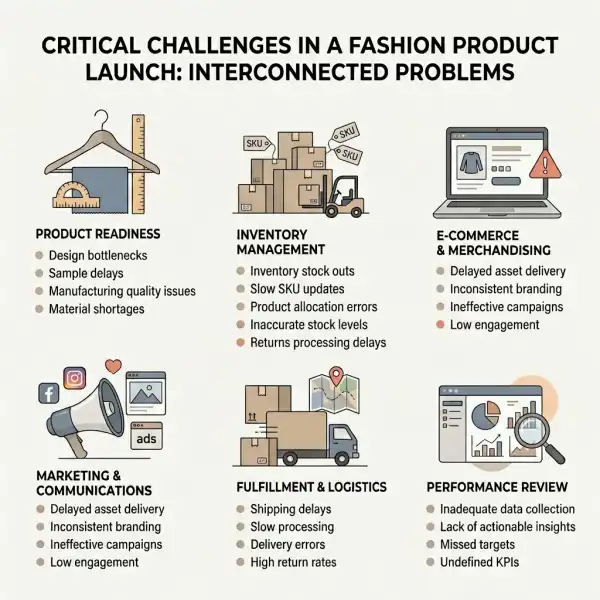
Why Do Fashion Launch Problems Compound So Quickly?
Fashion launches connect many dependent decisions within a short period.
A late production change can make photography inaccurate. Inaccurate photography can create customer expectation problems. Expectation problems can produce questions, weak conversion, or returns. Returns then affect inventory availability, fulfilment workload, and contribution.
This compounding effect means a small unresolved issue can spread across several functions.
|
Initial problem |
Immediate effect |
Wider commercial consequence |
|
Hero product arrives late |
Campaign cannot sell the featured item |
Attention is generated for unavailable inventory |
|
Size data is incomplete |
Customers hesitate or choose incorrectly |
Lower conversion, more exchanges, or higher returns |
|
Stock feed updates slowly |
Unavailable products remain promoted |
Wasted media spend and customer frustration |
|
Promotion rules are unclear |
Checkout price differs from expectation |
Abandonment, complaints, and manual corrections |
|
Demand exceeds fulfilment capacity |
Orders wait longer to dispatch |
Support contacts, cancellations, and damaged trust |
|
Campaign targets a broad audience |
Traffic increases without qualified intent |
Acquisition costs rise without sustainable sales |
A strong launch process therefore manages dependencies before it increases exposure. The complete sequence should already be mapped through the brand’s pre-launch, launch, and post-launch activities.
Mistake 1: Choosing the Public Date Before Validating the Critical Path
A commercially attractive date may correspond with a season, holiday, fashion event, creator collaboration, or retailer deadline. The mistake is not choosing an ambitious date. It is publicly committing to that date before confirming the dependencies that make the launch possible.
The critical path may include:
- Final product and fit approval
- Material or trim availability
- Production capacity
- Quality inspection
- Import and customs processes
- Warehouse receiving
- Product photography
- Product-data approval
- E-commerce configuration
- Marketplace review
- Creator sample delivery
- Fulfilment preparation
When the date leads the plan, teams may compress quality checks, photograph unfinished samples, publish uncertain delivery promises, or accept incomplete product information.

Warning signs
- The campaign calendar is final while production timing remains provisional.
- The launch date follows the factory completion estimate without allowing for transport, receiving, or quality control.
- Marketing assets depend on samples that have not been approved.
- Several critical tasks are scheduled for the final days before release.
- No decision has been defined for late products.
Corrective action
Work backward from the date when inventory can genuinely be sold and fulfilled. Separate internal milestones from the public date and define a final decision gate.
If one product threatens the full schedule, the brand may:
- Remove it from the initial release
- Launch it separately
- Reduce its campaign prominence
- Open a clearly managed pre-order
- Replace it with an available supporting product
- Move the entire launch when the central proposition cannot be delivered
The best decision depends on how important the delayed product is to the customer promise. A supporting accessory can often be separated. A missing hero product may require a broader change.
Mistake 2: Launching Too Many Products Without a Clear Hierarchy
A broad assortment can create variety, outfit-building opportunities, and higher basket potential. It also multiplies stock-keeping units, product data, images, quality checks, allocations, and campaign decisions.
The problem becomes more serious when every product receives equal importance.
Without a hierarchy, customers may struggle to understand what is distinctive about the collection. Marketing resources become fragmented, and the team may produce insufficient content for the products most likely to generate demand.
Warning signs
- Campaign content gives every item similar prominence.
- The team cannot identify the main customer-entry product.
- Photography and copy are incomplete across many products.
- Inventory is spread thinly across a large number of variants.
- Supporting products consume resources needed by the hero range.
- Customers engage with the campaign but do not move to a specific product page.
Corrective action
Classify the assortment before allocating inventory and content:
|
Product role |
Commercial purpose |
Typical launch support |
|
Hero product |
Communicate the central launch proposition |
Strongest imagery, video, paid media, fit guidance, and storytelling |
|
Volume product |
Generate meaningful unit demand |
Clear product page, reliable stock, conversion-focused content |
|
Basket builder |
Complement the primary purchase |
Outfit placement, recommendations, bundles, or styling content |
|
Image product |
Strengthen brand identity |
Selective editorial exposure and controlled inventory |
|
Test product |
Validate demand or category potential |
Limited stock, focused audience, and defined learning objective |
Hierarchy does not mean ignoring supporting products. It ensures that the brand knows which products must attract attention, convert demand, improve basket value, or produce market evidence.
Mistake 3: Planning Inventory Only at Collection Level
A collection can have enough total units and still be poorly stocked.
Fashion demand occurs at variant level. Customers purchase a particular style, color, and size—not an abstract collection total. If demand concentrates in unavailable variants, the launch can lose momentum while substantial inventory remains.
For example, a brand may sell out of medium and large sizes in the featured color while holding excess units in less popular colors or peripheral sizes. Collection-level sell-through may initially look acceptable, but customers arriving through the campaign can no longer purchase the item they were shown.
Warning signs
- Inventory planning uses total units without a size-and-color demand assumption.
- Every color receives the same size curve despite different customer or channel expectations.
- Marketing does not know which variants have limited stock.
- Samples, creator gifting, replacements, and quality losses are not deducted from sellable inventory.
- The same inventory is promised to multiple channels.
- Stockouts occur in core variants while campaign spend continues unchanged.
Corrective action
Review inventory by style, color, size, channel, and status. Teams should distinguish:
- Ordered units
- Produced units
- Received units
- Quality-approved units
- Reserved units
- Allocated units
- Sellable units
- Units already committed to customers
Marketing exposure should reflect actual sellable depth. If the hero variant has limited inventory, the team may introduce alternative colors earlier, direct customers to coordinated products, activate a waitlist, or adjust paid promotion.
Inventory discipline should not aim to keep stock as low as possible. It should balance availability, cash exposure, lead time, minimum order quantities, and the cost of missed demand. The broader principles are discussed in fashion inventory management for retail businesses.

Mistake 4: Treating Factory Completion as Sellable Availability
Production completion is only one milestone.
Inventory may still require supplier dispatch, transportation, customs clearance, warehouse receiving, quantity reconciliation, quality inspection, system entry, channel allocation, and physical storage before it can support customer orders.
Brands create risk when they use the supplier’s estimated completion date as the basis for public availability.
Warning signs
- Products are marked in stock before warehouse receipt.
- Campaign timing assumes no transportation or customs delay.
- The team has not established how quickly received inventory can be inspected and entered into the system.
- Pre-launch stock quantities come from supplier reports rather than accepted units.
- Products with unresolved quality issues remain included in available inventory.
- The brand has no policy for partially received production.
Corrective action
Use milestone-specific language internally:
- Production completed
- Dispatched by supplier
- In transit
- Received by warehouse
- Quantity reconciled
- Quality approved
- Entered into inventory system
- Allocated to channel
- Available for sale
For an in-stock launch, the safest commercial quantity is the inventory that has passed the required controls and is available both physically and systemically.
A pre-order can allow selling before finished inventory arrives, but it requires a different customer promise. Material availability, production capacity, order limits, delivery windows, cancellation conditions, and delay communication must be managed explicitly.
Mistake 5: Using Unapproved Samples or Inconsistent Product Information
Customers evaluate clothing through images, measurements, descriptions, fit information, video, reviews, and other indirect evidence. If those sources describe different versions of the product, the launch creates uncertainty.
Common inconsistencies include:
- Photographed sample differs from final production.
- Product-page measurements come from an earlier pattern.
- Material composition differs between the label and online listing.
- Fit language is copied across products with different silhouettes.
- Price or availability differs across the website, feed, advertisement, and marketplace.
- Customer service receives information that has not been updated after a product change.
These problems can reduce conversion before purchase and increase returns afterward.
Warning signs
- Several spreadsheets contain different product facts.
- Copywriters use sample notes rather than approved specifications.
- Product changes are communicated through informal messages.
- Model sizing information is missing or inconsistent.
- Product feeds are updated later than the website.
- Customers repeatedly ask questions already expected to be answered on the product page.
Google Merchant Center requires availability in submitted product data to match the landing page and checkout experience. Google also identifies delayed updates and differences between feeds, landing pages, and structured data as causes of availability or price mismatches. Brands using the channel should review the official guidance on mismatched product availability.
Corrective action
Establish one approved source of product truth. Each item should have a controlled record covering:
- Product name and identifier
- Final style, color, and size variants
- Approved price
- Garment measurements
- Fit description
- Material composition
- Construction features
- Care instructions
- Country-of-origin information where required
- Approved imagery
- Availability status
- Delivery model
- Returns information
- Evidence for customer-facing claims
Changes should have an owner, approval date, and distribution process. The product page, feed, marketplace listing, campaign copy, packaging, and customer-service guidance should be updated from the same approved decision.
Reliable garment measurements and size specifications are especially important because vague fit language cannot replace accurate product-level information.
Mistake 6: Using Discounting or Artificial Urgency as the Main Launch Proposition
Discounting can support acquisition, reward existing customers, clear a defined stock position, or create a time-bound commercial incentive. It becomes a launch weakness when customers have little reason to buy without it.
A promotion-led launch may generate an opening spike while making it difficult to determine whether customers wanted the product, responded only to the lower price, or delayed purchases because they expect further reductions.
Artificial urgency creates additional risk. Countdown timers, “ending soon” messages, popularity claims, and scarcity statements should reflect real conditions.
The UK Competition and Markets Authority advises online businesses to be transparent when using urgency and price-reduction claims and identifies misleading countdown, scarcity, and comparison-price practices as potential concerns. Brands selling to UK customers should review the CMA guidance on urgency and price-reduction claims.
For price reductions offered to EU consumers, Article 6a of the Price Indication Directive generally defines the prior price as the lowest price applied by the trader during a period of at least 30 days before the reduction. Exact application and permitted exceptions should be assessed for the relevant market using the current EU price-indication rules and appropriate professional advice.
Warning signs
- The campaign message focuses almost entirely on the discount.
- The reference price has little genuine selling history.
- A countdown restarts after reaching zero.
- Scarcity messages do not reflect available or incoming stock.
- Customers are trained to wait for a larger promotion.
- Full-price conversion is not included in the evaluation.
- Margin assumptions ignore discount interaction with returns, fulfilment, or acquisition costs.
Corrective action
Build the launch proposition around customer value:
- Product usefulness or problem solved
- Fit or comfort advantage
- Design distinction
- Material and construction
- Styling versatility
- Limited production that is genuinely limited
- Seasonal relevance
- Compatibility with products customers already own
- Credible availability or delivery promise
If a promotion is used, define its purpose, eligible products, audience, period, commercial floor, technical implementation, and measurement method before launch.
Mistake 7: Activating Every Marketing Channel at the Same Time
Simultaneous activation can create impact, but it removes the opportunity to identify and correct early problems before exposure increases.
If email, creators, organic social media, paid advertising, affiliates, marketplaces, and retail activity all begin together, a pricing error or checkout problem can affect a much larger audience.
The brand may also lose the ability to distinguish how different customers respond.
Warning signs
- No early-access or controlled-release group is used.
- Paid media begins at full budget immediately.
- Campaign links have not been tested before publication.
- Customer-service and fulfilment teams receive no gradual increase in volume.
- All creators are scheduled for the same hour regardless of stock depth.
- The launch plan has no pause or redirection criteria.
Corrective action
Sequence channels according to launch risk and customer strategy. A possible sequence is:
- Internal transaction and operational verification
- Controlled early access
- Existing customer or waiting-list release
- Owned-channel announcement
- Creator and partner content
- Paid-media expansion
- Follow-up product education and styling content
A phased sequence is not always necessary. A limited drop may depend on one coordinated release. Even then, the team should test the live environment and prepare clear controls before generating peak traffic.
Mistake 8: Scaling Promotion Before the Customer Journey and Operations Are Stable
Marketing can amplify a functioning launch, but it can also amplify technical and operational weaknesses.
Increasing traffic does not resolve unclear product information, incorrect shipping charges, payment failure, inventory mismatch, or warehouse backlog. It exposes those problems to more customers.

Warning signs
- Traffic increases while payment completion falls unexpectedly.
- Customer-service contacts rise faster than orders.
- Warehouse backlog continues to grow.
- Inventory availability differs between channels.
- Campaigns still promote products that cannot be fulfilled reliably.
- The team increases budget to compensate for weak conversion without diagnosing the funnel.
Corrective action
Define readiness conditions for scaling. They may include:
- Product pages and campaign links verified
- Price, discount, and shipping logic functioning
- Inventory synchronized at an acceptable frequency
- Payment completion operating normally
- Purchase tracking validated
- Fulfilment backlog within capacity
- Customer-service issues understood
- Core products sufficiently available
- Early orders producing acceptable commercial value
If operations become constrained, protect existing customer commitments. The team may pause specific advertising, redirect traffic to available products, update delivery messaging, limit pre-orders, or temporarily reduce promotional intensity.
A short-term reduction in acquisition can preserve longer-term momentum when the alternative is cancellations, unresolved orders, and loss of customer trust.
Mistake 9: Leaving Launch Decisions Without a Clear Owner
Cross-functional collaboration becomes slow when several people contribute but no one has decision authority.
During a live launch, an issue may move between marketing, e-commerce, merchandising, operations, finance, and customer service while customers continue to experience it.
Warning signs
- Teams maintain separate status reports.
- Nobody can approve a price, inventory, or campaign change quickly.
- Different functions give customers conflicting information.
- Important issues remain in messaging threads without a recorded resolution.
- Team members assume another department is monitoring the problem.
- Senior approval is required for routine operational corrections.
Corrective action
Assign one launch coordinator and functional decision owners.
|
Decision area |
Example authority |
|
Product |
Approve, correct, or remove a product |
|
Inventory |
Reallocate, reserve, or close availability |
|
Pricing |
Correct price or promotional rules |
|
Marketing |
Pause, redirect, or scale activity |
|
E-commerce |
Change product visibility or customer messaging |
|
Operations |
Adjust fulfilment priority or capacity |
|
Customer service |
Approve recovery communication |
|
Finance |
Confirm commercial guardrails and exceptions |
The launch coordinator does not make every specialist decision. The role maintains the shared operating picture and ensures each issue reaches the appropriate owner.
Mistake 10: Reacting to Early Data Without Enough Context
Launch-day data is valuable for identifying technical failure, immediate customer response, and stock pressure. It may be unreliable for larger product or commercial conclusions.
Early customers may be unusually loyal. Creator activity may create short traffic spikes. Paid campaigns may still be stabilizing. Small order volumes can make conversion or return patterns appear more meaningful than they are.
Warning signs
- The team changes several campaign variables after a few hours.
- A product is labelled unsuccessful before it receives qualified traffic.
- Strong engagement is treated as proof of purchase demand.
- A rapid sell-out is interpreted as evidence for a large reorder.
- Early conversion is compared with unrelated products or periods.
- No record is kept of campaign, price, stock, or content changes.
Corrective action
Use different review windows for different decisions:
|
Decision |
Minimum evidence to consider |
|
Fix technical failure |
Immediate verified evidence |
|
Correct inaccurate product information |
Immediate verified evidence |
|
Adjust stock exposure |
Current orders and available inventory |
|
Pause clearly inefficient traffic |
Sufficient channel and conversion evidence |
|
Change the campaign proposition |
Repeated behavior across relevant audiences |
|
Replenish inventory |
Demand, stockout timing, lead time, margin, and seasonality |
|
Change product fit or construction |
Returns, feedback, inspection, and measurement evidence |
|
Discontinue the product |
Full commercial and product context |
When a change is necessary, record what changed and when. Otherwise, the post-launch team may attribute later performance to the wrong cause.
Mistake 11: Judging Launch Success From Revenue Alone
Revenue is important, but it does not explain whether the launch created sustainable value.
Two launches with the same revenue can produce very different outcomes when one requires deep discounts, expensive acquisition, high return rates, manual fulfilment, or customer recovery.
A useful review separates:
- Product response: Did customers want the product?
- Execution quality: Did the business deliver the launch reliably?
- Commercial value: Did the resulting orders create acceptable contribution?
Relevant measures may include:
- Qualified product-page traffic
- Conversion
- Units sold
- Full-price sell-through
- Average order value
- Discount rate
- Acquisition cost
- Payment and platform fees
- Fulfilment cost
- Return and cancellation rate
- Contribution by product or channel
- Remaining inventory
- Customer-service workload
- Delivery performance
- Repeat or replenishment potential
Corrective action
Define success before launch. Metrics should follow the objective.
A test launch may succeed by producing reliable category, price, fit, or size-curve evidence even when revenue is modest. A revenue-focused seasonal launch may fail commercially despite strong unit sales if contribution is weak and inventory remains concentrated in difficult variants.
Evaluation should therefore compare results with the original decision the launch was designed to support.
Mistake 12: Failing to Capture Returns, Questions, and Operational Lessons
A launch is incomplete when the team reports sales but does not convert customer and operational evidence into future decisions.
Important information often remains fragmented across:
- Customer-service conversations
- Product reviews
- Return-reason codes
- Warehouse inspection notes
- Marketplace feedback
- Creator comments
- Social-media questions
- Campaign reports
- Merchandising spreadsheets
- Supplier quality records
Without consolidation, the next launch may repeat the same measurement, photography, fit, allocation, or fulfilment problem.
Warning signs
- Return reasons are reviewed only as percentages.
- Customer questions are answered individually but not categorized.
- The team holds a retrospective without assigning actions.
- Supplier or technical teams do not receive customer evidence.
- Campaign reporting is separated from product and operational review.
- Lessons are not incorporated into templates or approval procedures.
Corrective action
Create one evidence-based retrospective covering:
- Original objective and assumptions
- Product and variant demand
- Inventory availability
- Customer-journey performance
- Channel quality
- Full-price and discounted sales
- Contribution
- Fulfilment performance
- Returns and recurring questions
- Quality or expectation gaps
- Decisions changed during launch
- Actions for the next product or release
Each lesson should identify an owner and a process that needs to change.
For example:
|
Evidence |
Possible cause |
Follow-up action |
|
Customers repeatedly ask whether fabric stretches |
Product information is incomplete |
Add standardized stretch information to product templates |
|
One size has concentrated returns |
Measurement, grading, expectation, or production issue |
Compare specifications, finished garments, and return feedback |
|
Paid traffic converts poorly on mobile |
Audience quality or customer-journey friction |
Review mobile product page, checkout, speed, and campaign targeting |
|
Hero color sells out immediately |
Demand or allocation assumption was too conservative |
Review color depth, launch exposure, and replenishment feasibility |
|
Orders arrive late despite on-time picking |
Carrier or delivery promise mismatch |
Adjust carrier process or customer-facing estimates |

How Can Teams Identify the Real Cause of Weak Launch Performance?
Weak sales do not automatically mean the product is unwanted.
The team should move through the problem in a logical order.
Step 1: Confirm measurement accuracy
Verify that traffic, product views, cart activity, purchases, revenue, discounts, and refunds are being recorded correctly.
Step 2: Confirm availability
Check whether the promoted products and important variants were genuinely sellable during the evaluation period.
Step 3: Examine traffic quality
Determine whether visitors matched the intended customer, market, and purchase occasion.
Step 4: Review the product proposition
Assess whether customers could understand the product’s relevance, distinction, fit, price, and expected use.
Step 5: Inspect the customer journey
Review product-page clarity, mobile usability, variant selection, checkout, payment, shipping cost, and delivery information.
Step 6: Examine execution
Check whether stock synchronization, fulfilment, customer service, and campaign sequencing operated as intended.
Step 7: Evaluate commercial value
Calculate whether completed orders produced acceptable value after discounts, variable costs, returns, and acquisition expenses.
This sequence prevents the brand from changing the design or reducing the price when the actual problem is unsuitable traffic, inaccurate availability, or checkout failure.





Comments 0
Leave a CommentSend Comment
Anda harus Login terlebih dahulu untuk dapat memberikan komentar.