
Fashion Licensing Explained for Brand Expansion
Quick Answer
Fashion licensing is a commercial arrangement in which a brand owner—the licensor—authorizes another business—the licensee—to use specified intellectual property under agreed conditions. In fashion, the licensed rights may include trademarks, logos, copyrighted artwork, product designs, brand characters, or distinctive visual assets.
Licensing can help a fashion brand enter new product categories or geographic markets without building every manufacturing, distribution, and retail capability internally. A clothing brand, for example, might license its name to an experienced eyewear or fragrance company while retaining ownership of the brand.
The model is not simply permission to print a logo on a product. A workable licensing program defines the products, territories, sales channels, approval process, quality standards, financial terms, reporting requirements, and exit conditions. The licensee normally takes responsibility for development and commercialization, while the licensor protects brand consistency through structured oversight.
Licensing works best when the brand has recognizable intellectual property, the licensee contributes capabilities the brand lacks, and both parties can support an approval and reporting system. Without those foundations, rapid category expansion can create inconsistent products, channel conflict, or brand dilution.

What Is Fashion Licensing?
Fashion licensing is a contractual business model that permits a licensee to use defined intellectual property in order to develop, manufacture, market, or sell approved products, while ownership of that intellectual property generally remains with the licensor.
This distinction matters. Licensing is not the same as selling a brand. The UK Intellectual Property Office describes an intellectual property licence as an agreement that permits another party to do something that would otherwise infringe the owner’s rights, as explained in its official guidance on intellectual property licensing.
A straightforward fashion example would be an apparel brand granting a specialist manufacturer the right to produce watches under its trademark in selected countries for five years. The watch company gains access to an established brand identity. The apparel brand gains category reach and royalty income without developing watchmaking capabilities from scratch.
The permission is limited by the contract. It may apply only to certain products, countries, retailers, price positions, or marketing uses. Anything outside that scope remains unauthorized unless the agreement is amended.
Who Are the Licensor and Licensee?
The licensor owns or controls the intellectual property being licensed. This may be a fashion house, designer, celebrity-owned brand, retailer, entertainment company, sports organization, artist, estate, or other rights holder.
The licensee is the business receiving permission to commercialize those rights. In fashion, a licensee is often selected because it already possesses category-specific capabilities such as footwear engineering, fragrance development, accessory manufacturing, regulatory compliance, wholesale relationships, or regional distribution.
The relationship is therefore an exchange of assets rather than a simple supplier appointment:
- The licensor contributes brand recognition, intellectual property, creative direction, and market meaning.
- The licensee contributes product expertise, operating infrastructure, capital, production capacity, and routes to market.
- Both parties contribute governance, information, and staff time.
A licensee is not automatically a contract manufacturer. A factory that merely produces garments according to a brand’s instructions may not have independent rights to market products under that brand. A true licensee normally receives a defined commercialization right and bears a meaningful share of the commercial responsibility.
What Can Be Licensed in Fashion?
Fashion licensing commonly centers on trademarks, but a program may involve several types of intellectual property. The relevant rights depend on what appears on the product and what the licensee is allowed to reproduce.
Potential licensed assets include:
- Brand names, logos, monograms, and other trademarks
- Copyrighted illustrations, prints, photographs, or characters
- Registered or unregistered design rights, where recognized
- Packaging artwork and visual identity elements
- Product design specifications or proprietary know-how
- Campaign assets and approved brand content
- A designer’s name, signature, or other protected identity rights, subject to applicable law
The World Intellectual Property Organization (WIPO) describes merchandising as a specialized form of IP licensing in which a trademark, design, or copyrighted work is applied to consumer goods to increase their appeal. Its overview of IP assignment, licensing, and merchandising also distinguishes licensing from transferring ownership.
A logo licence does not automatically include every print, archive design, photograph, or person’s likeness associated with the brand. The ownership and authorization chain for each asset must be verified.
Why Do Fashion Brands Use Licensing for Expansion?
Fashion brands use licensing primarily to access capabilities, categories, or markets that would be slow, expensive, or operationally difficult to build internally. Revenue matters, but capability access is often the stronger strategic reason.
Consider a ready-to-wear brand exploring fragrance. Fragrance requires formulation expertise, packaging engineering, safety assessment, regulatory knowledge, specialist supply chains, and different retail relationships. An experienced beauty licensee may already possess all of them. The fashion brand can provide the positioning and creative codes while the partner manages category execution.
Licensing may support several expansion objectives:
- Entering an adjacent product category
- Reaching a new region through an established local operator
- Monetizing artwork, characters, archives, or other IP
- Extending a lifestyle proposition beyond the core collection
- Increasing visibility at price points or channels the core business does not serve
- Generating royalties without owning the licensee’s full operating infrastructure
Government export guidance similarly identifies licensing as a route through which a rights holder can permit another business to make and sell its product or IP in a particular market in return for payment. The practical benefits and limitations are summarized in official guidance on licensing as an export route.
Licensing is sometimes described as asset-light expansion. That description is only partly accurate. The licensor may avoid owning factories or holding all inventory, but still needs legal, creative, merchandising, approval, finance, and compliance resources. A poorly staffed licensing program can become an approval bottleneck or allow weak products into the market.
How Is Licensing Different From Collaboration, Distribution, and Franchising?
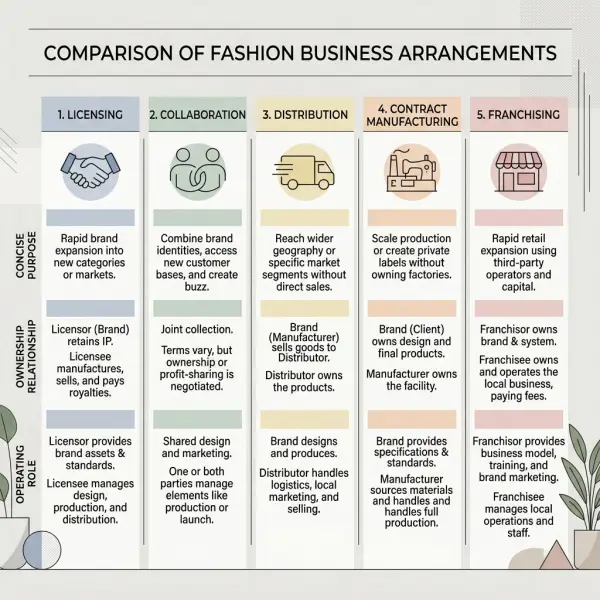
A fashion licence grants defined rights to use intellectual property. A collaboration is a broader creative or commercial partnership, while distribution focuses on getting products into a market. Franchising usually involves the operation of a business under a controlled system, not merely the development of a licensed product.
|
Arrangement |
Primary purpose |
Who usually develops the product? |
How the brand is used |
Typical commercial structure |
|
Licensing |
Commercialize specified IP in a category or territory |
Usually the licensee, subject to approval |
Used within a defined contractual scope |
Royalty, advance, minimum guarantee, or combined structure |
|
Brand collaboration |
Create shared attention, design value, or audience access |
One or both partners |
Often co-branded and campaign-specific |
Revenue share, wholesale arrangement, fixed fee, shared cost, or mixed model |
|
Distribution |
Sell an existing product range in a market |
Usually the brand or its manufacturer |
Distributor markets authorized products |
Wholesale margin, commission, or distribution discount |
|
Contract manufacturing |
Produce goods for the commissioning brand |
Brand leads design; factory executes production |
Manufacturer normally gains no independent commercialization right |
Manufacturing price |
|
Franchising |
Replicate a branded operating format |
Depends on the business model |
Brand identifies a controlled business system |
Initial fees, ongoing royalties, and other payments |
The boundaries are not always determined by the agreement’s title. A contract labelled “licence” may contain features that create other regulatory obligations. In the United States, for example, the Federal Trade Commission’s franchise framework considers the use or association with a trademark, significant control or assistance, and required payment when assessing whether an arrangement falls within its Franchise Rule. Classification must therefore be checked in each relevant jurisdiction.
Limited-edition fashion collaborations can also rely on underlying trademark and copyright licences. Their strategic purpose, however, is usually different. A collaboration often seeks a temporary creative or audience effect, while licensing frequently creates an ongoing category business. The strategic conditions behind that distinction are examined more deeply in when fashion collaborations build brand value.
The Main Fashion Licensing Models
Not every licensing program follows the same structure. The model should match the expansion problem the brand is trying to solve.
Product Category Licensing
Category licensing authorizes a specialist to develop products outside or alongside the brand’s core competence. Common applications may include eyewear, watches, fragrance, footwear, luggage, hosiery, home textiles, or children’s products.
This works best when the category has a credible relationship with the brand. A category can be commercially attractive yet still confuse customers if it has little connection to the brand’s design language, price position, or lifestyle territory.
Geographic or Market Licensing
A territorial licensee receives rights for one or more specified markets. The licensee may adapt product development, sourcing, merchandising, and distribution to local conditions while remaining within the brand’s standards.
Local expertise can accelerate entry, but territorial arrangements require careful channel definitions. Online retail, cross-border marketplaces, travel retail, and social commerce can cause products to appear outside the intended market. A contract that defines countries without addressing digital sales leaves a significant operational gap.
Character, Artwork, and Archive Licensing
A fashion company may license imagery or cultural content owned by an entertainment company, artist, museum, photographer, or archive. Alternatively, a fashion brand may license its own visual assets for use by another product company.
The agreement needs to identify the exact work being used. Permission to use a character on T-shirts, for instance, does not necessarily authorize modification of the artwork, use in paid advertising, animation, or application to unrelated categories.
Exclusive, Sole, and Non-Exclusive Licensing
Exclusivity determines who else may exploit the licensed rights within the agreed scope.
- An exclusive licence generally reserves the covered rights for the licensee, potentially excluding even the licensor from using them within that scope.
- A sole licence generally permits one licensee while allowing the licensor to continue using the IP.
- A non-exclusive licence allows the licensor to retain use and grant additional licences.
These concepts are outlined in government guidance on exclusive, sole, and non-exclusive licences. Their precise legal effect can depend on the governing law and contract language.
Exclusivity should never be evaluated as a single yes-or-no term. A licence may be exclusive for handbags in Japan, non-exclusive for small leather goods, and exclude airport retail or global e-commerce. Product, territory, channel, customer type, price tier, and term all affect the actual value of the grant.
How Does a Fashion Licensing Agreement Work in Practice?
A licensing program converts brand permission into an operating system. The contract establishes the boundaries, but teams must translate those boundaries into product calendars, approval gates, data flows, and commercial decisions.
A typical structure follows six connected stages.
1. The Brand Defines the Expansion Thesis
The first question is not “Who will pay for our logo?” It is “Why should this category or market exist under our brand?”
The brand should define the intended customer, price position, category role, distribution logic, design connection, and expected contribution. Without that thesis, partner selection tends to be driven by short-term revenue or unsolicited proposals.
2. Both Parties Conduct Due Diligence
The licensee needs evidence that the licensor owns or controls the proposed rights. The licensor needs evidence that the licensee can finance, develop, produce, distribute, and report on the business.
Commercial due diligence may cover:
- Intellectual property ownership and registrations
- Existing licences, restrictions, or disputes
- Product development and sourcing competence
- Financial capacity and working capital
- Factory and supplier controls
- Product safety and regulatory experience
- Sales channels and geographic coverage
- Reporting systems and audit readiness
- Reputation, litigation, and compliance history
A famous name does not compensate for unclear rights. Likewise, valid IP does not compensate for a partner that cannot deliver products on time.
3. The Licensed Scope Is Defined
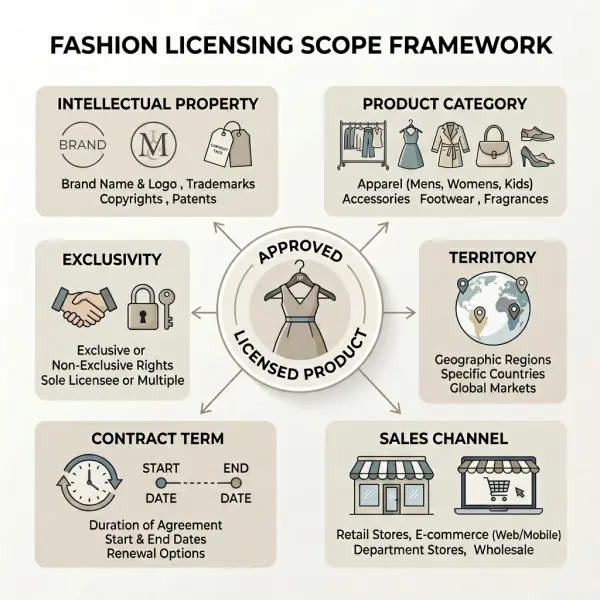
The rights grant should identify what the licensee may use and where it may use it. The scope commonly includes the IP assets, products, territory, channels, customer groups, term, exclusivity, sublicensing rights, and permitted marketing activities.
This creates a practical licensing matrix:
|
Scope question |
Example of a defined answer |
|
Which rights? |
Specified word mark, logo, and approved seasonal artwork |
|
Which products? |
Sunglasses and optical frames, excluding sports goggles |
|
Which territory? |
Indonesia, Singapore, and Malaysia |
|
Which channels? |
Approved optical retailers, department stores, and localized e-commerce |
|
For how long? |
Three-year term plus an agreed sell-off period |
|
How exclusive? |
Exclusive only for the defined category and territory |
|
Who may manufacture? |
Approved factories disclosed to the licensor |
|
What requires approval? |
Designs, samples, packaging, claims, campaigns, and major retailers |
The tighter the scope, the easier it is to assign responsibility and detect unauthorized expansion.
4. Commercial Terms Allocate Value and Risk
Fashion licensing income can include an upfront fee, royalty, advance, minimum guarantee, marketing contribution, or a combination of these. None has a universally appropriate rate.
A royalty is commonly calculated as:
Royalty payable = agreed royalty rate × contractually defined sales base
The words “defined sales base” carry much of the commercial significance. Royalties may be based on invoiced wholesale sales or another definition of net sales rather than the final consumer price. The contract must address permitted deductions such as returns, discounts, taxes, freight, marketplace fees, and bad debt.
Suppose a licensed item retails for $100, but the licensee records $45 in qualifying net wholesale sales. If the contract uses a hypothetical 10% royalty on that defined base, the earned royalty would be $4.50—not $10. This example illustrates the calculation only; it does not represent a recommended or standard fashion royalty rate.
Other common mechanisms include:
- Advance: An upfront payment that may be recoupable against future earned royalties if the agreement says so.
- Minimum guarantee: A minimum amount payable over an agreed period, whether or not earned royalties reach that amount.
- Marketing commitment: A defined expenditure, contribution, or percentage intended to support the licensed business.
- Performance threshold: Sales, distribution, or launch targets linked to continued exclusivity or renewal.
- Audit right: Permission for the licensor to verify sales records and royalty calculations.
Minimum guarantees can signal commitment, but an unrealistic guarantee may encourage excessive production or discounting as the licensee tries to recover its investment. Financial ambition must remain compatible with demand and brand positioning.
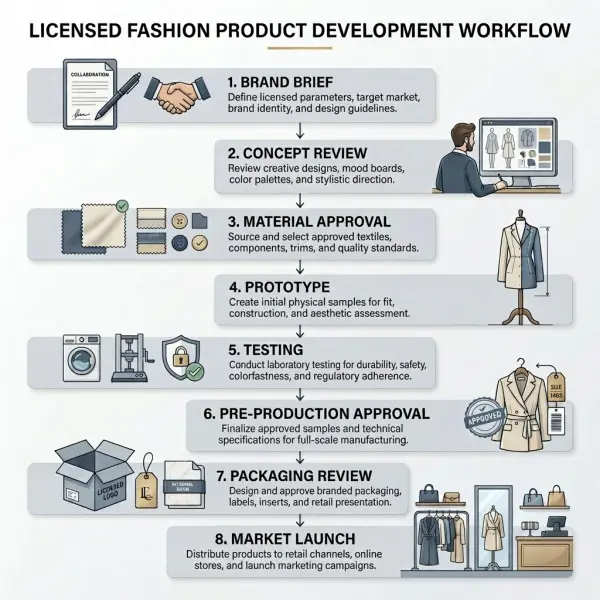
5. Products Pass Through Approval Gates
Quality control should be a working process rather than a clause that sits unused in the agreement. The licensor normally establishes brand standards and approval rights; the licensee integrates those requirements into its development calendar.
Depending on the category, approvals may cover:
- Initial concept and assortment architecture
- Design sketches and colorways
- Materials, trims, components, and workmanship
- Prototypes, samples, and pre-production units
- Fit, performance, safety, and regulatory testing
- Labels, packaging, care information, and product claims
- Campaign concepts, photography, and product descriptions
- Retailers, marketplaces, promotions, and markdown strategy
Not every decision should require executive approval. A sensible system assigns decision rights, response deadlines, escalation paths, and approved reference standards. Otherwise, products miss production windows while both teams wait for feedback.
6. Sales, Royalties, and Brand Performance Are Monitored
After launch, the relationship moves from product approval to portfolio management. Teams need consistent reporting definitions and review periods.
A useful review looks beyond royalty income to examine:
- Sales by product, channel, retailer, and territory
- Returns, cancellations, and markdowns
- Distribution quality rather than store count alone
- On-time development and approval performance
- Product defects, complaints, and recalls
- Marketing execution and brand presentation
- Unauthorized sellers or territorial leakage
- Forecast accuracy and inventory exposure
- Royalty reporting accuracy
- Renewal, correction, or exit decisions
A licensing program that produces revenue while weakening price integrity or customer trust is not performing well in strategic terms.
What Does Each Party Actually Control?
The licensor should control the use of its brand and approve decisions that could materially affect brand meaning. The licensee should retain enough operating authority to use its category expertise efficiently.
|
Area |
Licensor’s primary role |
Licensee’s primary role |
|
Brand identity |
Define brand codes and permitted uses |
Apply approved identity correctly |
|
Product strategy |
Approve category fit and positioning |
Build commercially viable assortment |
|
Design |
Set direction and approve outputs |
Develop concepts and technical solutions |
|
Sourcing |
Set required standards and oversight rights |
Select and manage approved supply base |
|
Compliance |
Specify brand requirements and review exposure |
Meet applicable product and market obligations |
|
Production |
Monitor agreed quality controls |
Plan, fund, and manage manufacturing |
|
Distribution |
Approve channel framework |
Sell through authorized accounts |
|
Marketing |
Protect tone, imagery, and claims |
Develop and execute approved campaigns |
|
Finance |
Validate reports and collect payments |
Maintain records and submit accurate reports |
|
Inventory |
Monitor brand exposure |
Forecast, purchase, and manage stock |
The exact allocation varies. A highly controlled luxury licence may involve intensive creative approval, while a regional licence for a commercially established product system may give the licensee more localized autonomy.
What matters is alignment between authority and responsibility. Holding the licensee accountable for launch dates while allowing no predictable approval timeline is structurally unfair. Giving broad independence without usable standards is equally risky.
When Is a Fashion Brand Ready to License?
A brand is ready to license when it has protectable assets, a credible expansion opportunity, transferable brand codes, and enough internal capacity to govern an external operator. Popularity alone is not sufficient.
The following readiness signals deserve particular attention.
The Brand Has a Clear Identity Beyond Its Logo
A licensee needs to understand what makes a product recognizably part of the brand. That may include silhouette, proportion, color logic, materials, motifs, styling, tone of voice, price architecture, and customer context.
If all decisions still depend on the founder’s intuition, the brand may struggle to transfer its identity without either slowing the partner down or accepting inconsistent work.
The Intellectual Property Position Has Been Checked
Trademark protection is territorial and linked to specified goods or services. A registration in the brand’s home market does not automatically establish usable rights in every expansion country or category.
The WIPO Madrid System simplifies applications and management across participating territories, but it does not create an automatically enforceable “worldwide trademark.” Protection in designated markets remains subject to the applicable national or regional process. WIPO explains this structure in its Madrid System guidance for international trademark protection.
The brand should therefore check ownership, registration status, territorial coverage, product classifications, conflicting rights, and any restrictions created by previous agreements.
There Is Evidence of Category or Market Fit
Customer awareness of the core brand does not automatically create demand for every extension. Readiness evidence might include customer research, search behavior, adjacent-category purchases, retailer feedback, prior collaborations, or small product tests.
The purpose is not to produce artificial certainty. It is to distinguish a credible extension from a category chosen mainly because a licensee offered attractive financial terms.
Governance Resources Are Available
Even a narrow licence generates briefs, sample reviews, legal questions, marketing approvals, performance reports, and escalations. Before signing, the licensor should identify who owns each decision and how much workload the team can realistically absorb.
A small brand may be better served by one tightly scoped licence than several simultaneous category deals.
How Fashion Businesses Can Build a Licensing Program
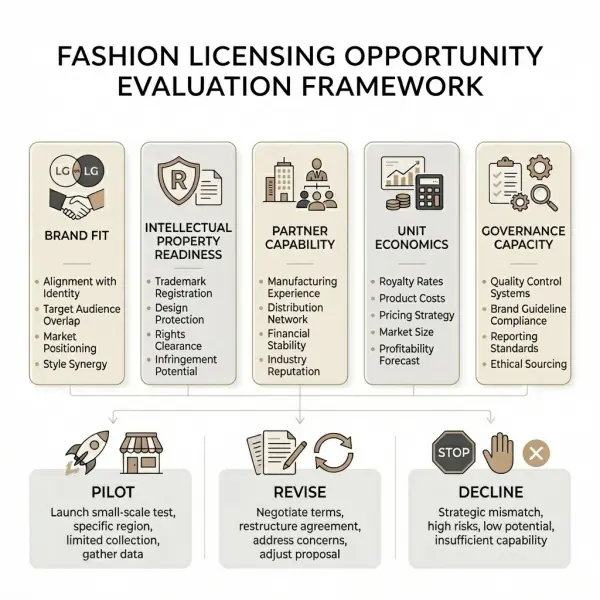
The safest starting point is a bounded commercial pilot with clear learning objectives. It creates evidence before either party commits to a wide territory, long term, or broad exclusivity.
Step 1: Audit the Brand Assets
List the trademarks, designs, artworks, content, know-how, and visual materials the business owns or is authorized to use. Record ownership, registration, territory, category, expiry, and third-party restrictions.
This exercise often reveals that some campaign photographs, fonts, freelance illustrations, or archive materials cannot be reused as broadly as the commercial team assumed.
Step 2: Choose the Expansion Gap
Identify the capability or market access the brand lacks. The gap might be technical product knowledge, manufacturing infrastructure, regulatory competence, working capital, or regional distribution.
Licensing should solve a defined gap. If the brand already has the capability and capital to operate the category effectively, direct development may deserve comparison.
Step 3: Build a Partner Scorecard
Evaluate prospective licensees against the requirements of the specific category rather than general company size.
A practical scorecard can consider:
- Product and technical competence
- Design compatibility
- Relevant retailer and channel relationships
- Financial resilience
- Responsible sourcing and compliance controls
- Reporting and forecasting capability
- Speed and discipline in approvals
- Existing brand portfolio and potential conflicts
- Reputation among retailers, suppliers, and other licensors
Site visits, references, product inspection, financial review, and supply-chain checks are more informative than a polished pitch deck alone.
Step 4: Model the Unit Economics
Both sides should test conservative, expected, and stronger-demand scenarios. Include development costs, samples, testing, minimum guarantees, royalties, marketing, logistics, retailer margins, returns, markdowns, inventory financing, and currency exposure where relevant.
The licensee needs a viable product business after royalty costs. The licensor needs enough return to justify governance workload and brand exposure. A deal that works only under an optimistic sales forecast is fragile from the beginning.
Step 5: Design the Approval System Before the Contract Starts
Create submission templates, calendars, responsible decision-makers, response times, and escalation routes. Connect approvals to production lead times.
The licensed launch should also follow a disciplined fashion product launch planning process. Licensing adds another organization to the workflow, making dependencies and deadlines even more important.
Step 6: Start With a Controlled Scope
A sensible pilot may limit:
- Product types
- Number of stock-keeping units
- Territory
- Retail accounts
- Initial production volume
- Contract term
- Exclusivity
- Marketing claims
A controlled scope does not mean a weak launch. It means the first phase is designed to produce usable evidence without exposing the entire brand architecture.
Step 7: Establish a Shared Performance Review
Agree which measures will determine continuation, expansion, correction, or termination. Review meetings should cover brand health, operations, and economics—not sales alone.

Common Mistakes That Weaken a Licensing Strategy
Treating Every Category as a Revenue Opportunity
A brand may receive offers for categories that have little relationship to its identity. Accepting them can generate fees while making the brand harder to understand.
The better approach is to define category territories before proposals arrive. A brand built around technical outdoor performance, for example, should ask whether a proposed lifestyle product strengthens that promise, broadens it credibly, or merely uses the logo.
Granting Broad Exclusivity Too Early
Licensees may request exclusivity because they will invest in development and distribution. The concern is legitimate, but unrestricted exclusivity can prevent the brand from using its rights even when the partner underperforms.
Exclusivity should be connected to a precise category, territory, channel, term, and measurable performance obligation. Rights can expand after evidence is produced.
Negotiating the Royalty Rate Without Defining the Base
A headline royalty rate has little meaning until the sales base, deductions, currency treatment, timing, returns, related-party sales, and audit process are defined.
Finance and commercial teams should model the contract using realistic transactions. This exposes ambiguity before reporting begins.
Underestimating Approval Work
Some licensors promise close control without staffing it. Concepts then wait for decisions, samples expire, factories lose production slots, and launches move into the wrong season.
Approval control must be matched by service levels. The brand should decide which matters require full review and which can be governed through pre-approved standards.
Ignoring the End of the Relationship
Licences end because of expiry, underperformance, breach, strategic change, or mutual agreement. Yet brands frequently focus on launch and give insufficient attention to exit operations.
The agreement and operating plan should address outstanding orders, raw materials, finished inventory, sell-off periods, destruction or de-branding, digital listings, marketing removal, customer service, and final royalty reporting.
Assuming a Strong Contract Can Repair a Weak Partner Fit
Contracts allocate rights and remedies; they do not create product expertise, trust, cash flow, or compatible working styles. If a prospective licensee lacks the capability to execute the category, more approval clauses may only document the failure more precisely.
Important Legal and Commercial Caveats
Fashion licensing laws and contract requirements vary by country. Brands should obtain advice from qualified professionals in the jurisdictions connected to the rights, manufacturing, sales, and parties.
Several issues should be verified close to the start of the project:
- Whether the licensor owns or controls every proposed asset
- Whether relevant trademarks and designs are protected in the required categories and territories
- Whether local law requires or benefits from recording the licence with an IP office
- Whether the arrangement could fall under franchise, agency, competition, tax, or foreign-exchange rules
- Which party is responsible for product safety, labeling, testing, claims, recalls, and consumer remedies
- Whether suppliers and subcontractors may access confidential designs or brand assets
- Whether sublicensing is permitted
- How infringement by third parties will be detected and managed
- Whether sustainability, origin, performance, or certification claims can be substantiated
- What happens after termination or expiry
These are not minor contract details. They shape whether products can legally enter a market, who carries financial exposure, and how effectively the brand can respond when something goes wrong. A fuller examination belongs in common legal and commercial risks in fashion brand partnerships.
Frequently Asked Questions
Can a small fashion brand use licensing?
Yes, but a small brand should usually begin with a narrow scope. The brand needs identifiable intellectual property, evidence that the proposed category or market is commercially relevant, and enough internal capacity to review products and monitor performance.
A specialist licensee may help a smaller company enter a technically difficult category. However, the brand should not assume the partner will define its identity for it. Brand standards, ownership records, decision rights, and financial expectations need to be organized before negotiations become advanced.
Does a trademark have to be registered before it can be licensed?
Not in every jurisdiction or situation, but registration can materially improve certainty about ownership, scope, and enforceability. Unregistered rights may exist under some legal systems, yet their recognition and strength differ.
Before licensing, the parties should check the mark’s owner, status, product or service coverage, territory, conflicting rights, and pending challenges. A licensee investing in development and inventory will generally want reliable evidence that the licensor can grant the promised rights.
How are fashion licensing royalties calculated?
Royalties are calculated using the rate and sales base defined in the agreement. The base may be net wholesale sales, invoiced sales, or another contractually specified measure. Permitted deductions can materially change the result.
There is no single appropriate rate for all fashion licences. Brand strength, category economics, territory, exclusivity, expected volume, marketing obligations, minimum guarantees, and the licensee’s investment all affect the negotiation. Parties should model actual product margins rather than copy a rate from an unrelated deal.
Is an exclusive fashion licence better than a non-exclusive licence?
Neither structure is universally better. Exclusivity may justify greater investment from the licensee because competitors cannot receive the same rights within the agreed scope. It can also restrict the licensor if performance is weak.
Non-exclusive licensing preserves flexibility but may reduce a partner’s willingness to invest or create channel conflicts among multiple licensees. The decision should be made at the level of category, territory, channel, term, and performance—not as a broad brand-wide promise.
How much control should a fashion licensor retain?
The licensor should retain enough control to protect brand identity, product quality, authorized use, and market positioning. The licensee still needs operational authority to apply its category expertise and meet production timelines.
A practical division gives the brand approval over material decisions while providing clear standards for routine execution. Excessive micro-approval can delay products; weak oversight can allow inconsistent quality or messaging. Decision rights and response times should be documented before development begins.
Can licensing help a fashion brand expand internationally?
Yes. A regional licensee can contribute local product knowledge, regulatory experience, retailers, logistics, and market relationships. Licensing can therefore reduce some barriers to international expansion.
It does not eliminate territorial IP checks, local compliance, tax considerations, cross-border e-commerce issues, or the need to monitor brand presentation. International expansion should be based on the partner’s actual market capability rather than the simple availability of a licensing offer.
How should a brand measure whether a licensing deal is successful?
A brand should measure financial performance together with brand, operational, and channel outcomes. Royalty income alone can conceal high markdowns, unsuitable distribution, quality complaints, or weak customer response.
Useful measures include net sales, earned royalties, minimum-guarantee coverage, full-price sell-through, returns, defects, approval speed, retailer quality, unauthorized distribution, inventory exposure, and customer feedback. The most relevant metrics should be agreed before launch so renewal decisions are based on evidence.





Comments 0
Leave a CommentSend Comment
Anda harus Login terlebih dahulu untuk dapat memberikan komentar.