

Pre-Launch, Launch, and Post-Launch Activities Fashion Teams Should Prepare
Quick Answer
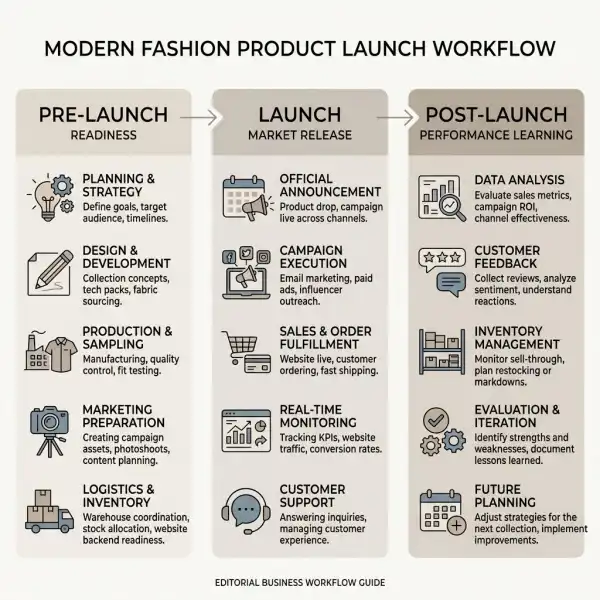
Fashion launch activities should be organized into three connected phases:
- Pre-launch: Confirm that the product, inventory, content, sales channels, fulfilment process, and measurement systems are ready.
- Launch: Release the product, verify the customer journey, monitor demand and stock, coordinate fulfilment, and resolve issues quickly.
- Post-launch: Complete outstanding orders, analyze commercial and product performance, review customer feedback, and turn the findings into decisions for the next production or launch cycle.
The phases should not operate as separate marketing campaigns. Information produced before launch—such as approved pricing, product specifications, inventory quantities, and success metrics—must remain consistent during and after release.
For growing fashion brands, a practical launch workflow is usually more valuable than an oversized checklist. Every critical activity should have an owner, deadline, readiness requirement, and escalation path.
How Do the Three Fashion Launch Phases Work Together?
Pre-launch, launch, and post-launch activities form one continuous commercial process.
Pre-launch prepares the customer promise. The launch phase tests that promise in the market. Post-launch determines whether the promise produced sustainable commercial value and what the brand should do next.
|
Phase |
Primary purpose |
Central question |
Typical output |
|
Pre-launch |
Prepare the product and business for release |
Are we ready to sell and deliver what we are promoting? |
Approved assortment, launch calendar, product assets, inventory position, tested channels |
|
Launch |
Release and control the commercial offer |
Is the customer journey working, and can operations support demand? |
Live products, monitored sales, issue log, updated stock and fulfilment status |
|
Post-launch |
Stabilize, evaluate, and learn |
What happened, why did it happen, and what should we change? |
Performance review, replenishment decisions, return analysis, documented lessons |
These phases may overlap. A brand can still be producing supporting content after the product becomes available, while early orders may provide useful information before the formal post-launch review.
However, overlapping work should not be confused with launching unfinished products. Critical facts such as price, availability, sizing, product composition, fulfilment expectations, and return terms should be resolved before customers are asked to buy.
Pre-Launch Activities Fashion Teams Should Prepare
The pre-launch phase creates the operating foundation for the release. Its purpose is not simply to generate anticipation. It should confirm that the product being promoted is approved, commercially viable, available through the intended channels, and supported by accurate information.
Pre-launch timing depends on the business model, supply chain, product complexity, and market. Instead of applying one universal schedule, the team should work backward from the date when the product can genuinely be purchased and fulfilled.
Confirm the launch scope and objective
The launch brief should identify exactly what the business intends to release.
At a minimum, it should include:
- Launch name and customer-facing date
- Primary commercial objective
- Target customer and purchase occasion
- Hero and supporting products
- Final styles, colors, and sizes
- Price range
- Inventory or production model
- Priority sales channels
- Geographic market
- Campaign proposition
- Evaluation period
- Core success metrics
The objective needs to be specific enough to guide decisions. A launch designed to validate a new category should not be managed in the same way as a seasonal collection expected to produce immediate revenue.
For example, a demand-validation launch may use limited inventory or pre-orders, restricted advertising expenditure, and a stronger emphasis on customer feedback. A revenue-focused launch may require deeper stock, greater fulfilment capacity, and more coordinated activity across paid, owned, wholesale, and retail channels.
The broader principles behind these choices should already be documented in the brand’s fashion product launch plan. The phase-based workflow then translates that plan into scheduled activities.
Build a critical-path calendar
A launch calendar should show dependencies, not only deadlines.
Product photography cannot be completed without approved samples. Product-page copy depends on confirmed composition, measurements, care instructions, and fit. Warehouse preparation depends on final stock-keeping units and identifiers. Creator seeding requires available samples, delivery time, and an approved brief.
A useful calendar distinguishes between:
- Product approval date
- Production completion estimate
- Supplier-confirmed dispatch date
- Warehouse receipt date
- Quality-release date
- Content completion date
- Product-data approval date
- Channel-testing date
- Campaign activation date
- Customer-facing launch date
These dates should not be treated as interchangeable.
A factory completion date does not mean inventory is ready for sale. Goods may still require transport, customs clearance, receiving, quality inspection, system entry, storage, and channel allocation.
The calendar should also identify the activities that would directly delay or reduce the launch if they are not completed. These form the critical path and should receive more attention than non-essential campaign additions.

Assign owners and decision rights
Every critical deliverable needs one accountable owner.
Several people may contribute to product photography, for example, but one person should have authority to confirm whether the final images are approved. The same principle applies to prices, inventory quantities, product copy, campaign creative, channel readiness, and fulfilment.
A compact ownership model may look like this:
|
Activity |
Accountable function |
Supporting functions |
|
Product approval |
Product or design |
Technical, sourcing, production |
|
Assortment and pricing |
Merchandising |
Finance, sales, product |
|
Production and delivery |
Sourcing or production |
Suppliers, quality, operations |
|
Product data and e-commerce |
E-commerce |
Product, merchandising, compliance |
|
Campaign and content |
Marketing |
Creative, merchandising, sales |
|
Inventory and fulfilment |
Operations |
Warehouse, e-commerce, customer service |
|
Performance tracking |
Analytics or e-commerce |
Finance, marketing, merchandising |
In smaller brands, one person may hold several roles. Clear accountability still matters because it prevents an unresolved decision from moving between team members without an owner.
Complete product and quality approval
The team should confirm that the item presented in campaign and product-page content represents the product customers will receive.
Depending on the product, approval may cover:
- Fabric, color, and trims
- Construction and finishing
- Fit and garment measurements
- Size grading
- Wash or care performance
- Label and packaging accuracy
- Product safety requirements
- Final sample consistency
- Quality tolerances
- Approved changes from earlier samples
If the final production differs visibly from the photographed sample, the team must decide whether the content needs to be updated.
Small differences can affect customer expectations. A change in garment length, fabric texture, pocket construction, lining, closure, or color may influence purchasing decisions even when the product remains technically acceptable.
Product approval should therefore be connected to customer-facing accuracy, not only manufacturing acceptance.
Confirm inventory and channel allocation
Inventory readiness should be reviewed at variant level, not only as a collection total.
A launch can appear adequately stocked while having serious gaps in commercially important sizes or colors. The team should know:
- Units received by style, color, and size
- Units that passed quality inspection
- Units reserved for photography, creators, press, or exchanges
- Sellable stock available to each channel
- Inventory still in transit
- Damaged or quarantined units
- Replenishment availability and lead time
- Overselling controls
- Safety-stock policy, if used
Where multiple channels share inventory, the brand must decide whether stock will be pooled or allocated separately. Wholesale commitments, physical stores, marketplaces, and the direct website may compete for the same units.
This decision should be made before the launch becomes public. Reallocating stock after customers or retail partners have placed orders can create cancellations and damage trust.
Prepare accurate product information
Product information is part of launch conversion and customer expectation management.
The appropriate fields vary by product, but fashion product pages may need:
- Product name
- Price and promotional conditions
- Available colors and sizes
- Fit description
- Garment measurements
- Model measurements and worn size
- Material composition
- Lining and transparency information
- Stretch or structure
- Closures, pockets, and adjustable features
- Care instructions
- Country of origin where applicable
- Delivery availability
- Return or exchange information
The e-commerce team should compare product-page information with approved technical data rather than relying only on marketing copy.
Accurate garment measurements and size specifications are especially important when customers cannot try the product before purchase. Terms such as “relaxed,” “oversized,” or “true to size” should be supported by useful measurements and fit context whenever possible.
Produce launch content around product priorities
Not every product requires the same volume of content.
Hero products may need campaign photography, short-form video, styling demonstrations, creator content, editorial copy, email features, and paid advertising variations. Supporting products may be sufficiently presented through strong product photography, outfit combinations, and collection-level content.
Before producing assets, the team should define:
- Core launch message
- Product hierarchy
- Customer questions or objections
- Required formats for each channel
- Asset dimensions and technical specifications
- Copy and visual approval process
- Usage rights and expiration dates
- Localization requirements
- Backup content for delays or stock changes
Content should reflect actual availability. A campaign should not depend entirely on a hero product whose production or quality status remains uncertain.

Configure and test every sales channel
Products should be reviewed in the environment customers will actually use.
Testing may include:
- Product visibility and collection placement
- Mobile and desktop layouts
- Variant selection
- Size-guide access
- Price and discount logic
- Inventory status
- Add-to-cart behavior
- Checkout and payment
- Shipping rates and delivery estimates
- Tax calculation
- Confirmation emails
- Tracking information
- Return instructions
- Marketplace listings
- Product feeds and advertisements
If the brand uses Google Merchant Center, its product data should keep price and availability consistent with the landing page. Google’s official specification includes supported availability values such as in stock, out of stock, preorder, and backorder. The current requirements can be checked through the Google Merchant Center product data specification.
Testing should use real launch products and realistic transactions where possible. A generic test product may not reveal problems involving variant inventory, discounts, shipping restrictions, or product-specific data.
Verify analytics before release
Measurement cannot be repaired completely after customer activity has already occurred.
Before launch, the team should verify that it can identify important interactions such as:
- Product views
- Product-list clicks
- Add-to-cart activity
- Checkout initiation
- Completed purchases
- Order value
- Products and quantities purchased
- Discounts
- Refunds
- Campaign source or channel
Google Analytics 4, for example, supports recommended e-commerce events including view_item, add_to_cart, begin_checkout, and purchase. The implementation requirements are described in Google’s official e-commerce events documentation.
The team should confirm that purchase events fire once, values are recorded correctly, internal testing is excluded where appropriate, and channel links use consistent campaign parameters.
Brief customer service and fulfilment teams
Customer-facing and operational teams should understand the launch before the first order arrives.
The briefing should cover:
- Product features and fit
- Expected customer questions
- Size guidance
- Delivery promises
- Pre-order conditions
- Return and exchange process
- Known limitations
- Promotion terms
- Stockout responses
- Escalation owners
- Approved wording for delays or defects
Customer service should not have to infer answers from campaign content after customers begin asking questions.
The warehouse or fulfilment partner should also know whether the launch introduces new packaging, bundles, gifts, insert cards, shipping priorities, or unusually high order concentration.
Prepare contingency decisions
A contingency plan should define actions for credible scenarios, not attempt to predict every possible problem.
Relevant scenarios may include:
- Hero product arrives late
- Important size is unavailable
- Website traffic exceeds normal capacity
- Checkout or payment fails
- Promotional code applies incorrectly
- Product feed shows the wrong price
- Creator content is delayed
- Quality issue appears in early orders
- Fulfilment capacity is exceeded
- Customer demand is much weaker or stronger than expected
For each scenario, the team should know who can decide whether to delay a product, adjust campaign content, pause media, change availability messaging, contact affected customers, or release reserved inventory.
The Final Pre-Launch Readiness Review
A formal review should take place while there is still time to reduce scope or correct critical issues.
|
Readiness area |
Evidence to review |
Possible decision |
|
Product |
Approved sample, measurements, quality status |
Approve, correct, or remove product |
|
Inventory |
Sellable units by variant and channel |
Launch, reduce exposure, or change availability model |
|
Content |
Approved imagery, copy, size and care information |
Publish, revise, or delay affected asset |
|
Commerce |
Tested product page, checkout, payment, shipping |
Approve or block channel release |
|
Operations |
Receiving, picking, packaging, fulfilment capacity |
Proceed, limit demand, or add support |
|
Marketing |
Approved campaign, audience, budget, disclosures |
Activate, revise, or hold |
|
Measurement |
Tested events, dashboard, reporting definitions |
Proceed or correct tracking |
|
Customer service |
Product briefing and escalation process |
Approve or complete training |
The review should record unresolved risks and accepted trade-offs. A launch does not need to be completely free of risk, but the team should know what remains uncertain and who owns the response.
Launch-Phase Activities Fashion Teams Should Prepare
The launch phase begins when the product becomes publicly available or when the brand starts accepting orders.
Its purpose is to confirm that the planned release is functioning in real customer conditions. The team should monitor the customer journey, inventory, marketing, fulfilment, and customer response without reacting impulsively to every short-term fluctuation.
Publish and verify the live customer journey
Immediately after release, the team should check the live experience rather than assuming scheduled changes were executed correctly.
Verification should include:
- Correct products are visible
- Prices and promotions are accurate
- Images and product details load properly
- Variants show the correct availability
- Mobile purchase flow works
- Payment options function
- Delivery information is accurate
- Confirmation messages are sent
- Campaign links reach the intended pages
- Analytics events are recorded
Checks should cover important customer locations and devices where practical. A product may appear available to the internal team while being restricted, cached incorrectly, or misconfigured for another market.
Activate communication in the planned sequence
Launch communication should follow the customer and inventory strategy.
A typical sequence may include:
- Early access for waiting-list members or loyal customers
- Launch email or app notification
- Website and social media release
- Creator or partner content
- Paid campaign activation
- Follow-up content focused on fit, styling, or product details
- Stock or deadline communication where necessary
Not every brand needs all these activities. The sequence should reflect where the target audience already interacts with the brand.
If creators receive payment, free products, discounts, or another material benefit, applicable endorsement-disclosure requirements should be reviewed. For campaigns that may affect United States consumers, the FTC’s guidance for endorsements and influencers explains the importance of clearly disclosing material connections. Other markets may apply different requirements.
Monitor a focused launch dashboard
The launch team needs a small set of signals that supports decisions.
|
Signal |
What it may reveal |
|
Product-page sessions |
Whether campaign activity is reaching the commercial offer |
|
Add-to-cart activity |
Initial purchase interest and possible product-page friction |
|
Checkout and payment completion |
Technical or commercial barriers |
|
Sales by product and variant |
Where demand is concentrated |
|
Inventory by size and color |
Stockout or allocation risk |
|
Average order value |
Basket composition and cross-selling |
|
Fulfilment backlog |
Operational capacity pressure |
|
Customer-service contacts |
Confusion, defects, or expectation gaps |
|
Campaign spend and conversion |
Whether paid activity is producing valuable demand |
These signals should be interpreted together. A decline between add-to-cart and purchase could reflect payment failure, shipping cost, delivery time, price hesitation, or normal customer comparison behavior. The metric alone does not establish the cause.
Control inventory and fulfilment
During the launch, stock data should be reconciled frequently enough for the sales volume and number of channels involved.
The team should watch for:
- Overselling
- Duplicate or failed orders
- Unexpected size concentration
- Stock held in abandoned or unpaid orders
- Marketplace synchronization delays
- Warehouse backlog
- Incorrect bundles
- Damaged units
- Address or delivery problems
- Pre-order capacity limits
If demand exceeds capacity, the response should protect existing orders before creating more demand. This may require slowing paid promotion, changing delivery estimates, closing a pre-order window, or marking specific products unavailable.
Maintain one issue log
A launch issue log prevents important incidents from disappearing in messaging threads.
Each entry should contain:
- Time detected
- Product or channel affected
- Customer impact
- Current status
- Temporary response
- Responsible owner
- Final resolution
- Follow-up action
The team should distinguish critical incidents from minor imperfections. Incorrect pricing, payment failure, overselling, serious product defects, and misleading availability require rapid escalation. Minor content refinements may be scheduled without interrupting the full launch.
Avoid changing too many variables at once
Early launch data can be noisy. Small order volumes, loyal-customer behavior, media timing, and stock limitations may distort the first results.
Unless a clear customer or operational problem exists, the team should avoid changing the price, creative, audience, product hierarchy, and promotion simultaneously. If everything changes at once, it becomes difficult to understand what affected performance.
Documenting changes also matters. The post-launch review needs to know when budgets, messages, prices, stock availability, or delivery promises were adjusted.

Post-Launch Activities Fashion Teams Should Prepare
Post-launch work begins before all products have finished selling. Its first responsibility is to stabilize customer and operational outcomes. Deeper evaluation follows after sufficient data has accumulated.
Complete fulfilment and customer recovery
Revenue should not be treated as complete launch success while orders remain delayed, cancelled, or unresolved.
The team should review:
- Orders awaiting fulfilment
- Dispatch and delivery performance
- Customer contacts
- Exchanges and cancellations
- Payment or refund issues
- Reported defects
- Incorrect items or quantities
- Pre-order progress
- Customers affected by delays
- Marketplace or wholesale exceptions
When a problem affects several customers, a coordinated response is usually more effective than allowing each case to be handled independently.
Evaluate results across several time horizons
Different questions require different evaluation windows.
|
Review window |
Main purpose |
|
Launch day |
Confirm technical stability and immediate demand |
|
First 2–3 days |
Identify stock pressure, fulfilment issues, and campaign response |
|
First 1–2 weeks |
Evaluate conversion, product preferences, and early customer feedback |
|
First 30 days |
Review sell-through, contribution, returns, and channel performance |
|
Full selling period |
Assess total commercial outcome and remaining inventory |
The correct window depends on product type, order volume, channel, season, delivery model, and return period. A slow-consideration product should not be judged by the same opening-day expectations as a limited drop promoted to an established community.
Separate product, execution, and commercial performance
A useful post-launch review examines three layers:
- Product response: Did customers want the product, and which variants did they prefer?
- Execution quality: Did the website, marketing, inventory, fulfilment, and service operate reliably?
- Commercial value: Did the launch produce acceptable contribution after variable costs?
This distinction prevents the team from reaching the wrong conclusion.
A strong product may underperform because it received weak traffic or launched with incomplete sizing information. A polished campaign may generate substantial sales for a product that later produces high returns. These outcomes require different actions.
Analyze performance below collection level
Collection-level revenue can hide important differences.
Where data volume allows, examine:
- Product
- Color
- Size
- Channel
- Customer type
- Traffic source
- Full-price versus discounted orders
- New versus returning customers
- Geographic market
- Return reason
- Fulfilment status
A style may look successful overall while one color holds excess stock. A product may convert well but produce poor contribution through paid media. Another item may have modest unit sales but increase basket value when purchased with the hero product.
Review returns and customer feedback
Return information should be treated as product and communication evidence, not only an operational cost.
Relevant patterns may include:
- Item too small or too large
- Garment proportions did not suit the customer
- Fabric differed from expectations
- Color appeared different online
- Product felt uncomfortable
- Quality or construction concern
- Styling was difficult
- Product arrived too late
- Customer ordered several sizes intentionally
- Product description was incomplete or unclear
Return reasons are not always reliable when customers select from a short predefined list. Customer-service conversations, written comments, product reviews, and physical inspection of returned garments may provide more context.
The team should compare feedback with technical specifications, photography, fit language, size guidance, and production quality before deciding whether the problem is the product, presentation, or both.
Make replenishment, continuation, or exit decisions
Post-launch evidence may lead to several different actions:
- Reorder the same product
- Replenish selected sizes or colors
- Continue the product with minor changes
- Correct fit or construction before reordering
- Adjust product information
- Test a different price or channel
- Reduce future quantity
- Mark down remaining stock
- Transfer inventory between channels
- Discontinue the product
A fast sell-out does not automatically justify a large reorder. The team should consider whether demand was driven by limited quantity, launch urgency, seasonality, creator exposure, discounting, or repeatable customer need.
Replenishment also depends on supplier minimums, material availability, production capacity, lead time, cash flow, and whether the product will remain relevant when new stock arrives.
Hold an evidence-based retrospective
The retrospective should compare the original launch assumptions with actual results.
Useful questions include:
- Which customer responded most strongly?
- Which products and variants created demand?
- Where did the customer journey lose potential buyers?
- Were the price and promotion commercially sustainable?
- Did inventory match the size and color demand?
- Which content answered customer questions?
- Which channels produced valuable orders?
- Did fulfilment meet the customer promise?
- What caused returns or service contacts?
- Which decisions should be repeated?
- What must change before the next launch?
The meeting should end with named actions, not only observations. Lessons may need to update product briefs, size specifications, supplier requirements, photography guidelines, e-commerce templates, campaign planning, or reporting definitions.
Detailed failure patterns should be documented separately so this workflow does not become an oversized risk catalogue. They can be explored in common product launch mistakes that reduce sales momentum.






Comments 0
Leave a CommentSend Comment
Anda harus Login terlebih dahulu untuk dapat memberikan komentar.