
Collaborations in Fashion: When They Build Brand Value and When They Do Not
Quick Answer
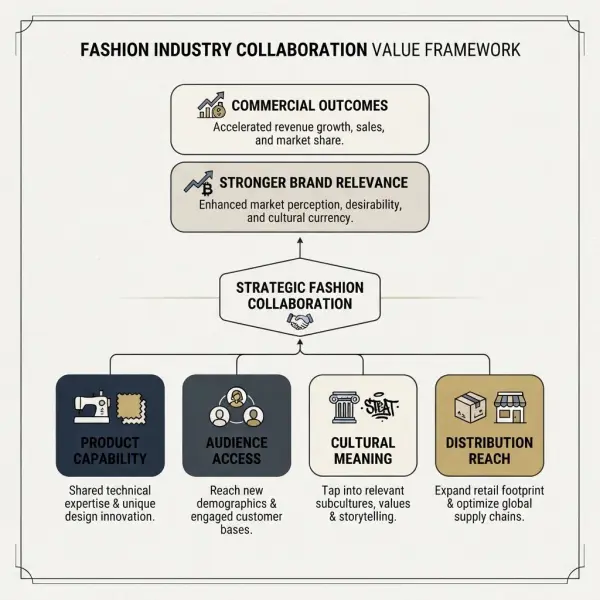
Fashion collaborations build brand value when the partners create something that neither could deliver as convincingly alone. The strongest collaborations combine complementary assets—such as design authority, cultural relevance, technical expertise, audience access, or distribution—and express that combination through a product customers genuinely want.
Partner fit does not require the brands to look identical. A degree of contrast can make a collaboration interesting, but customers still need to understand why the partners belong together. The product, story, price, quality, and retail experience must support that logic.
Collaborations tend to underperform strategically when they rely on logo placement, borrowed attention, artificial scarcity, or follower counts without a credible product proposition. They may generate impressions or sell out briefly without improving how customers perceive either brand.
Fashion businesses should therefore measure more than launch-day sales. Brand association, new-customer quality, full-price demand, product satisfaction, audience retention, channel development, and post-collaboration behavior provide a better view of lasting value. A collaboration is successful when it leaves the brand more relevant, more distinctive, or more capable after the campaign has ended.

What Is a Fashion Collaboration?
A fashion collaboration is a defined commercial or creative partnership in which two or more independent parties combine selected assets to develop, present, or distribute a shared product, collection, experience, or campaign.
Those assets may include brand identity, design expertise, intellectual property, technical knowledge, manufacturing capability, retail access, cultural influence, or an established audience. The partners remain separate entities, even though their names or creative contributions appear together for the collaboration.
A sportswear company working with a fashion designer may combine technical materials with a distinctive design language. A retailer and an established label may create an exclusive capsule that gives the retailer traffic and gives the label access to a wider customer group. An artist may contribute original artwork to products developed and distributed by a fashion brand.
Not every partnership is co-branding. A co-branded product normally presents two recognizable brand identities to customers. Some collaborations give one partner less public prominence, such as when a material technology company contributes performance capability without appearing equally on the product.
The arrangement may also contain trademark, copyright, design, name-and-likeness, or other permissions. When one party receives ongoing rights to commercialize another party’s intellectual property, the underlying model may overlap with fashion licensing for brand expansion. The strategic purpose of a collaboration, however, is commonly more concentrated around a particular product story, audience exchange, creative contribution, or launch moment.
Why Do Fashion Brands Collaborate?
Fashion brands collaborate because a well-selected partner can contribute credibility or capability that would be difficult to develop quickly from inside the business.
A collaboration can provide access to:
- A new or adjacent customer group
- Specialist product knowledge
- A different cultural or creative perspective
- Stronger distribution in a particular channel
- A recognizable artwork, character, or archive
- Technical materials or manufacturing competence
- Editorial attention and social conversation
- A new price tier or product category
- Credibility in a community where the brand is not yet established
The value does not come from association alone. It comes from what the association enables the partners to make, communicate, or reach.
A heritage label may bring archive depth while a younger partner contributes a contemporary silhouette and digital community. A footwear manufacturer may provide technical construction that allows a designer’s ideas to become a functional product. A museum or artist may contribute cultural material, while the fashion company contributes garment development, retail operations, and market presentation.
The strategic test is simple: if either partner could produce essentially the same result alone, the collaboration may be adding publicity rather than substantive value.
How Can a Collaboration Create Brand Value?
A collaboration builds brand value when positive customer responses extend beyond the individual product and influence how people understand, remember, or choose the participating brands.
This effect is sometimes described as brand spillover. Research into brand alliances has found that attitudes toward an alliance can affect subsequent impressions of the individual partner brands, although the effect is not necessarily equal for both parties. The findings and their limitations are explained in research on spillover effects in brand alliances.
For fashion businesses, potential value may appear in several forms:
|
Value created |
What it means in practice |
|
Stronger differentiation |
Customers associate the brand with a more distinctive design, capability, or point of view |
|
New audience access |
The brand earns attention and purchases from relevant customers outside its existing base |
|
Category credibility |
A specialist partner makes entry into a new product category more believable |
|
Cultural relevance |
The collaboration connects the brand with a meaningful creative field or community |
|
Distribution development |
Products reach suitable retailers, platforms, or geographic markets |
|
Product innovation |
The partners create a construction, material, function, or aesthetic neither offered previously |
|
Customer reappraisal |
Existing assumptions about a brand are updated or broadened |
|
Organizational learning |
Teams gain knowledge, relationships, or processes that remain useful after the project |
Not every collaboration needs to generate all eight forms of value. Problems arise when the business has not decided which one matters. A project intended to build category credibility requires different partners and success measures from one intended to acquire new customers.

When Fashion Collaborations Build Brand Value
The Collaboration Has a Clear Strategic Job
The strongest starting point is a specific brand or business problem. “We want attention” is too vague to guide partner selection, product development, or measurement.
A collaboration may be designed to:
- Introduce the brand to a younger but relevant customer group
- Add technical credibility to a fashion-led product
- Reinterpret archive assets without abandoning brand heritage
- Test demand in an adjacent category
- Enter a retailer or market that is otherwise difficult to reach
- Strengthen the brand’s association with art, sport, music, craft, or another cultural field
- Create a product that demonstrates a new design direction
The strategic job determines what the partner must contribute. If the objective is technical credibility, a large social following is not an adequate substitute for product expertise. If the goal is international distribution, creative compatibility alone will not solve the route-to-market problem.
The Partners Are Compatible but Not Redundant
Useful partner fit is not the same as visual similarity. Two nearly identical brands may produce a coherent collaboration, but customers may struggle to see what is new. At the other extreme, a surprising pairing may attract attention while appearing commercially arbitrary.
The productive middle ground combines understandable relevance with a meaningful difference. Customers should be able to answer two questions:
- Why do these partners belong together?
- What can they produce together that feels new?
Classic research into composite branding found that two brands with complementary attributes could create a more favorable product profile than a combination of two highly regarded but non-complementary brands. This does not provide a universal formula for fashion, but it supports the practical importance of complementarity, as discussed in research on composite brand alliances.
A technically respected outdoor brand and a concept-driven designer might create productive tension: one contributes performance, the other reframes how the product looks and is styled. Two brands bringing the same logo-driven streetwear proposition may have less to add to each other.
Each Partner Contributes Something Customers Can Recognize
The respective contributions do not need to be equal in size, but they should be substantive and understandable.
Recognizable contributions may include:
- A signature silhouette or construction method
- Proprietary material technology
- Archive prints or culturally significant artwork
- A distinctive color or graphic system
- Craft knowledge
- Category-specific fit and performance expertise
- Retail access or localized market knowledge
- A credible community or cultural relationship
Logo placement is not a substitute for contribution. If customers cannot identify what changed beyond the labeling, the product may feel like standard merchandise priced for association.
The Product Is Strong Enough Without the Announcement
The collaboration product has to perform as a product. Fit, comfort, material quality, functionality, durability, finish, packaging, and price still shape customer judgment after the initial excitement fades.
This is where collaborations often reveal an internal imbalance. Marketing teams may receive more time than product teams because the announcement date appears to be the main deadline. The product is then built around a campaign rather than a customer need.
A more rigorous product brief asks:
- Who is expected to use or wear the product?
- What improves because of the partnership?
- Which design elements belong to each partner?
- Is the price justified by the product and experience?
- Can the construction be manufactured consistently?
- Does the product meet the standards associated with both names?
- Would customers still find it desirable after the launch conversation subsides?
A collaboration can sell quickly because availability is restricted. That does not necessarily mean customers are satisfied after purchase.
The Story Is Credible and Specific
Customers need a clear explanation of why the partners came together. The story should arise from the product, relationship, or shared subject—not be added after development to make the pairing appear meaningful.
Credible narratives may come from a shared place, craft, functional problem, archive reference, creative influence, community, or design question. The more specific the connection, the less the campaign needs inflated language.
A credible story also recognizes differences between the partners. It should not pretend that two businesses have identical histories, values, or audiences when they do not.
Scarcity Supports the Concept Instead of Replacing It
Limited availability can focus attention and reduce inventory exposure. In experimental research on retailer-brand collaborations, limited-duration offers and higher perceived partner fit were associated with greater urgency to buy in the studied scenarios. The results are described in research on retailer-brand collaboration duration and fit.
That does not mean every collaboration should manufacture extreme scarcity. Small quantities may reflect genuine production limits, experimental demand, expensive craft, or a deliberate collectible format. Scarcity becomes less useful when its only function is to provoke fear of missing out.
Artificially restricted supply can also push customers toward resellers, bots, inflated secondary-market prices, or frustration. In that situation, attention may rise while the intended audience never experiences the product.
Distribution Reinforces the Positioning
Where a collaboration is sold affects what it communicates. A carefully designed product can lose credibility when it appears through unsuitable retailers, uncontrolled marketplaces, constant discounting, or stores that cannot explain it.
The distribution plan should consider:
- The overlap and differences between both customer bases
- Retailer suitability
- Geographic availability
- E-commerce allocation
- Launch timing across channels
- Purchase limits and bot management where relevant
- Returns and customer service
- Markdown authority
- How unsold inventory will be handled
A collaboration between a premium designer and a mass retailer may intentionally use wider distribution. That can be strategically coherent if accessibility is part of the concept. The issue is not whether the channel is prestigious; it is whether the channel supports the intended meaning.

Both Brands Can Absorb the Result
A successful collaboration should connect back to each partner’s broader brand system. Otherwise, customers may remember the product but not revise their understanding of either brand.
Absorption can happen through follow-up merchandising, content, community engagement, new product capability, retailer relationships, or a refined design direction. The objective is not necessarily to continue the collaboration. It is to retain the useful value it created.
For example, if a partner helps a brand demonstrate credible performance apparel, the brand should decide whether that association supports future products. If there is no connection to subsequent activity, the collaboration may remain an isolated event.
When Fashion Collaborations Do Not Build Lasting Value
The Partnership Is Chosen for Reach Alone
A large audience can create exposure, but audience size says little about relevance, trust, buying behavior, geography, or price compatibility.
A creator with millions of followers may contribute fewer suitable customers than a smaller designer, athlete, artist, or specialist whose community closely overlaps with the product’s intended user. The correct comparison is not follower count versus follower count. It is the quality of the audience and the role that audience plays in the collaboration.
The Product Is Merely a Logo Combination
Placing two marks on an existing product may be commercially sufficient for merchandise, but it rarely demonstrates meaningful creative collaboration.
The weakness becomes more visible when the price increases substantially without a change in design, material, function, construction, or experience. Customers may initially purchase for collectibility, yet repeated logo-led releases can make collaborations feel interchangeable.
The Partner Difference Creates Confusion Rather Than Productive Tension
An unexpected pairing can be effective when the product explains the connection. It fails when surprise is the entire concept.
If customers need a long campaign manifesto to understand why the partners belong together, the strategic link may be weak. The problem is not difference itself. It is the absence of a believable bridge between the brands.
One Partner Gains While the Other Becomes Less Distinctive
Brand spillover is not necessarily balanced. A smaller partner may gain legitimacy from a recognized name, while the larger partner receives limited new value. Conversely, an established label may use an emerging creative partner’s cultural credibility without giving that partner meaningful visibility or economic benefit.
Asymmetry is not automatically unfair. Partners can have different objectives and contributions. It becomes a problem when the value exchange was never made explicit or when one party absorbs most of the reputational and operational risk.
Launch-Day Activity Is Mistaken for Brand Growth
Views, mentions, queues, and rapid sell-outs describe activity. They do not independently show that the collaboration improved brand perception or created valuable customers.
Launch attention can be distorted by:
- Extremely limited inventory
- Paid media
- Influencer seeding
- Contests or giveaways
- Resale demand
- Existing fans purchasing collectibles
- Automated buying
- Controversy or negative conversation
The business needs a baseline and an evaluation window extending beyond the launch. Otherwise, it cannot distinguish temporary attention from durable change.
Operational Failure Overwhelms the Creative Idea
Delayed deliveries, poor fit, faulty components, confusing sizing, overselling, order cancellations, and weak customer service become part of the collaboration story.
Customers do not separate the partners neatly. A failure caused by one company can affect perceptions of both. That is why operational readiness should be evaluated before the campaign date is announced.
Repetition Removes the Sense of Meaning
Frequent collaborations can keep a brand visible, but they may also suggest that the company lacks an independent creative direction. Customers become less attentive when every month brings another partner, logo combination, or limited drop.
Collaboration frequency should match the brand’s ability to develop distinctive products and explain why each partnership exists. More activity is not necessarily more relevance.
A Practical Framework for Evaluating a Fashion Collaboration
1. Define the Value Objective
Choose one primary objective and a limited number of supporting objectives.
|
Primary objective |
What the collaboration must contribute |
|
Reach a new audience |
Relevant customers, not merely a larger following |
|
Enter a category |
Technical competence and category credibility |
|
Refresh brand perception |
A believable new association or design perspective |
|
Build cultural relevance |
Authentic participation in a community or creative field |
|
Access distribution |
Suitable retailers, platforms, or geographic coverage |
|
Create innovation |
A measurable improvement in product, material, or experience |
|
Generate short-term revenue |
Viable demand, margin, inventory, and fulfillment |
Trying to optimize every objective usually produces a vague partnership. Strategic clarity also makes it easier to decline partners who are visible but unsuitable.
2. Evaluate Partner Fit Across Several Dimensions
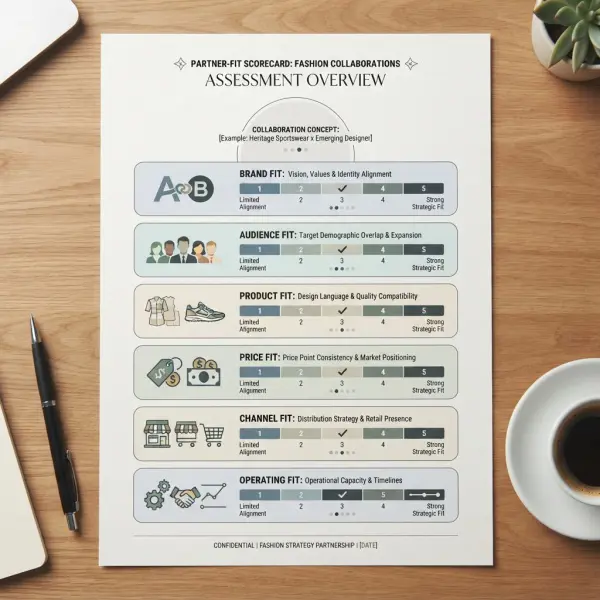
Partner fit should be examined as a set of questions rather than a single intuition.
A useful evaluation covers:
- Brand fit: Can customers understand the relationship?
- Customer fit: Are the audiences relevant to each other?
- Product fit: Can the partners produce a credible shared offering?
- Price fit: Can the price architecture be explained?
- Channel fit: Are the retail environments compatible with the concept?
- Values fit: Are public commitments and business conduct sufficiently aligned?
- Operating fit: Can the teams make decisions at compatible speeds?
- Risk fit: Can each party tolerate the inventory, financial, and reputational exposure?
A partner can score strongly in one area and poorly in another. An exciting creative match may still be commercially unworkable if production calendars, approval structures, or price expectations are incompatible.
3. Map the Value Exchange
Each party should document what it contributes, what it receives, what it funds, and what risk it carries.
The discussion should include:
- Intellectual property and creative assets
- Product development work
- Manufacturing and inventory funding
- Marketing budget and content production
- Retail and distribution access
- Customer data and permitted use
- Public visibility and brand prominence
- Revenue, fees, royalties, or profit allocation
- Returns, defects, cancellations, and markdown exposure
- Knowledge or capability retained after completion
This prevents the negotiation from becoming narrowly focused on logo size and revenue split while ignoring the resources required to make the project work.
4. Build the Product Proposition Before the Campaign Concept
The partners should first define the customer, product role, design contribution, price, quality level, and reason to buy. The campaign should then express those choices.
This sequence is easy to reverse because announcing a famous partner feels urgent. Yet a strong campaign cannot compensate indefinitely for a product that lacks fit, function, quality, or distinctiveness.
5. Establish Governance and Approval Rules
A collaboration usually crosses two sets of creative, commercial, legal, and executive stakeholders. Unclear decision authority causes revisions and delays.
Teams should establish:
- Named decision-makers
- Approval stages and response times
- Which brand leads each workstream
- How disagreements are escalated
- Which changes require both parties’ consent
- Rules for marketing claims and public statements
- Product testing and quality responsibilities
- Confidentiality and pre-launch security
- A process for delays, defects, or reputational incidents
Questions involving ownership, liability, termination, exclusivity, or unauthorized use should be addressed through appropriate agreements. They are explored further in legal and commercial risks in fashion brand partnerships.
6. Plan Demand, Inventory, and Customer Access
The demand plan should distinguish the intended customer from speculative or resale demand. Production volume must reflect lead times, minimum order quantities, margins, working capital, returns, and the strategic purpose of the release.
If a collaboration is positioned as accessible, producing quantities that make access nearly impossible contradicts the proposition. If it is intended as an artisanal edition, low volume may be an honest result of process and capacity.
The collaboration also needs the same operational discipline as any fashion product launch plan, with the added complexity of shared approvals and coordinated communications.
7. Decide How Success Will Be Measured
Metrics should match the collaboration’s strategic job.
|
Objective |
Useful indicators |
Warning indicators |
|
Audience acquisition |
New qualified customers, repeat purchase, retained subscribers |
Giveaway-led followers, immediate unsubscribes |
|
Brand perception |
Changes in relevant associations, consideration, sentiment |
Confusion about the brand or partner role |
|
Product innovation |
Product satisfaction, technical performance, learning transferred |
High defects, novelty without customer value |
|
Distribution |
Quality of new accounts, continuing retailer relationships |
Uncontrolled channels or heavy markdowns |
|
Commercial return |
Contribution margin, full-price sell-through, returns |
Revenue growth with weak margin or excess stock |
|
Cultural relevance |
Credible community response, earned editorial interest |
Attention driven mainly by controversy |
|
Long-term capability |
New process, supplier, knowledge, or category competence |
All capability remains with the partner |
A sell-out is useful information only when quantity, timing, cancellations, returns, and resale activity are understood.
[gambar]
FILE: fashion-collaboration-performance-meeting.jpg
ALT: Fashion business teams evaluating collaboration sales, customer response, and product quality
TYPE: photo
PROMPT: Ultra realistic editorial photography showing two fashion business teams conducting a post-launch collaboration review with garment samples, anonymized sales summaries, customer feedback notes, and a simple retail map on the table, realistic professional meeting room, soft natural light, calm analytical mood, clean composition, no readable private information, no text overlay, no futuristic dashboard, no clutter
[/gambar]
Common Collaboration Mistakes
Beginning With a Famous Name Instead of a Business Problem
A partner may be highly visible but unable to contribute the attribute the brand actually needs. The collaboration then becomes an expensive media event without a durable strategic role.
Begin by identifying the desired audience, capability, perception, or channel. Partner search should follow that definition.
Assuming Creative Fit Means Operational Fit
Two designers may share a compelling vision while their organizations have incompatible calendars, approval processes, budgets, or quality standards.
Operational due diligence should examine staffing, production capacity, reporting, decision speed, customer service, and financial responsibility—not only creative chemistry.
Making Scarcity the Main Customer Benefit
Scarcity can create urgency, but it does not explain why the product deserves to exist. If the only persuasive message is “buy before it disappears,” the collaboration may attract speculation more effectively than loyalty.
The better approach is to establish product value first and use limited availability only where it supports production reality or the concept.
Measuring Both Partners as if They Have the Same Objective
One partner may seek reach while the other seeks category credibility. Their contribution and success measures will therefore differ.
The project needs a shared outcome, but it can also contain distinct partner-level objectives. These should be agreed openly so that one party’s success is not misread as the other’s failure.
Neglecting the Post-Launch Phase
Fashion collaborations often receive extensive pre-launch planning and minimal post-launch evaluation. Customer feedback, returns, product performance, media response, new-customer retention, and operational learning are left fragmented across departments.
A formal review should take place after enough time has passed to observe product use and customer behavior—not only first-week sales.
What Brands Should Verify Before Announcing a Collaboration
Before making the partnership public, both parties should confirm that the commercial, intellectual property, product, and communication foundations are ready.
Critical checks include:
- Authority to use every name, mark, image, artwork, archive item, and likeness
- Ownership of jointly created designs, campaign assets, and product content
- Rights to reuse collaboration materials after the project ends
- Product safety, testing, labeling, and regulatory responsibility
- Approved sustainability, origin, performance, and material claims
- Production capacity and delivery feasibility
- Confidentiality and leak-response procedures
- Revenue allocation, costs, returns, markdowns, and unsold inventory
- Retailer, territory, marketplace, and e-commerce boundaries
- Public-response protocols if either partner faces controversy
- Cancellation, postponement, termination, and sell-off arrangements
When creators, celebrities, or influencers promote a collaboration, material relationships may require disclosure under applicable advertising rules. In the United States, the Federal Trade Commission advises that relevant financial, employment, personal, family, or other value-based relationships should be disclosed clearly when they are not otherwise apparent. The FTC provides details in its official endorsement and influencer guidance.
Disclosure and intellectual property requirements vary between jurisdictions. These checks should be conducted with qualified advisers for the markets in which the collaboration will be promoted or sold.
Frequently Asked Questions
What makes two fashion brands suitable collaboration partners?
Suitable partners have a credible connection and complementary contributions. Their customers should be able to understand why they are working together and what the partnership enables them to create.
Compatibility should be evaluated across brand identity, audience, product, price, distribution, values, operations, and risk. The brands do not need to look identical. A productive contrast can make the collaboration distinctive, provided the product creates a believable bridge between them.
Does a fashion collaboration need to be a limited edition?
No. Limited duration can create focus, support experimentation, and reduce initial inventory exposure, but it is not essential to every collaboration.
An ongoing partnership may be more appropriate when the partners are building a repeatable product system, technology platform, or long-term category. The duration should reflect the strategic purpose and operating model. Scarcity should not be used to conceal weak product value or create customer frustration without a clear reason.
Can a collaboration succeed if the brands have very different audiences?
Yes, if the audience difference is relevant to the objective and the product gives both groups a reason to engage. One brand may intentionally seek access to an audience already understood by the other.
The teams should examine customer geography, age, price expectations, interests, channel behavior, and actual purchase patterns rather than relying on broad demographic labels. If there is no meaningful bridge, audience difference may generate attention without conversion or lasting brand value.
Is selling out proof that a fashion collaboration was successful?
No. A sell-out shows that available supply was purchased, but it does not independently reveal the strength or quality of demand.
A very small release may sell out while reaching few target customers. Orders may also be influenced by resale speculation, automated purchasing, giveaways, or extreme scarcity. Brands should review full-price sales, cancellations, returns, customer satisfaction, new-customer retention, resale patterns, margin, and changes in brand perception.
Should both brands have equal visibility?
Not necessarily. Visibility should reflect the agreed roles, contributions, customer proposition, and strategic objectives. An established brand and an emerging designer may choose different levels of prominence without making the arrangement ineffective.
Problems arise when the public presentation obscures a partner’s substantive contribution or contradicts what was negotiated. Product labeling, campaign credits, retail presentation, media communication, and social content should be agreed before launch.
How long should a brand wait before evaluating collaboration results?
Initial sales and media performance can be reviewed immediately, but lasting brand effects require a longer observation period. The appropriate window depends on the product lifecycle, purchase frequency, delivery timing, and objective.
Brands should conduct several reviews: an operational review after launch, a product review after customers have used the items, and a later brand or retention review. This separates campaign performance from product satisfaction and longer-term customer behavior.
Can an unsuccessful collaboration damage both brands?
Yes. Poor product quality, unsuitable partner behavior, misleading claims, or operational failures may affect customer perceptions of both participants. Research on brand alliances indicates that spillover effects can occur, although they may not affect each partner equally.
The practical response is not to avoid all collaborations. It is to conduct partner due diligence, define standards, assign responsibilities, monitor emerging issues, and prepare a response process before the partnership becomes public.
Conclusion
Fashion collaborations create lasting value when they combine compatible meaning with complementary capability. The partnership should make the product more credible, distinctive, useful, or culturally relevant than either name could make it alone.
Attention can support that outcome, but it is not the outcome itself. Logo visibility, limited supply, launch queues, and social conversation may produce a successful moment without strengthening the underlying brands.
The more useful question is what remains after the moment passes. A strong collaboration can leave behind new customers, deeper brand associations, better products, stronger distribution, or valuable organizational knowledge. A weak one leaves only content, clearance inventory, or a temporary spike in mentions.
Brands should therefore choose collaborators with the same discipline used for product categories, suppliers, and markets. The creative surprise matters. So do product integrity, value exchange, operational compatibility, and what the partnership teaches the business.





Comments 0
Leave a CommentSend Comment
Anda harus Login terlebih dahulu untuk dapat memberikan komentar.