
How Brands Prepare Line Sheets, Samples, and Buyer Meetings
Quick Answer
Fashion brands preparing for wholesale trade shows need three things to work together: a buyer-ready line sheet, a commercially representative sample collection, and a structured plan for buyer meetings.
The line sheet should make ordering straightforward by showing essential information such as style identification, product imagery, available variants, wholesale pricing, suggested retail pricing where relevant, order requirements, and delivery information. Wholesale marketplace Faire, for example, requires brands to provide product names, variations, wholesale and retail prices, descriptions, order information, and lead-time data as part of its wholesale product setup.
Samples perform a different job. They allow buyers to evaluate fabric, construction, color, proportion, fit, and overall product quality.
The meeting then connects those materials to a commercial decision. Instead of presenting every style equally, the brand should understand the retailer, edit the collection around likely relevance, explain pricing and delivery clearly, record buyer feedback, and define the next step.
The objective is not simply to impress a buyer. It is to make the assortment easy to understand, evaluate, and potentially order.

Why Trade Show Preparation Is Really Wholesale Sales Preparation
A trade show booth may be temporary, but the commercial decisions behind it are not.
Before a buyer ever handles a garment, a brand has already made decisions about assortment, pricing, production capacity, delivery timing, minimum orders, sizing, color availability, and which products deserve emphasis. The line sheet and sample rack merely make those decisions visible.
That is why preparing for a fashion trade show should not be treated mainly as event preparation. It is wholesale sales preparation compressed into a physical market environment.
As discussed in fashion trade shows for growing apparel brands, trade shows connect brands with buyers but do not create wholesale readiness on their own. A buyer meeting exposes whatever commercial structure already exists behind the collection.
A polished presentation can generate interest. It cannot answer an unresolved production question.
If a buyer asks whether 60 units of a particular dress can arrive for a planned retail floor set and the brand does not know whether the fabric is available, whether the factory has capacity, or what delivery date is realistic, the limitation is not presentation skill. It is an operational gap.
For growing brands, this distinction matters because trade show preparation often becomes visually dominated: garment racks, graphics, booth furniture, lookbooks, lighting.
Those elements have value. But the buyer ultimately needs enough information to decide whether the collection belongs in a retail assortment.
What Is a Fashion Line Sheet?
A fashion line sheet is a wholesale sales document that organizes products and essential commercial information so that buyers can review an assortment and make purchasing decisions efficiently.
It is not the same thing as a lookbook.
A lookbook primarily communicates visual identity, styling, collection mood, and brand direction. A line sheet is more transactional. It helps answer questions such as:
- What is the style?
- Which colors and sizes are available?
- What does it cost wholesale?
- What is the intended retail price?
- When can it ship?
- What are the order requirements?
- How does the buyer identify the item when placing an order?
Faire describes the line sheet as a tool that consolidates product information, imagery, wholesale pricing, and ordering terms so that retailer interest can progress toward an order. Its platform requirements also illustrate the level of product data commonly needed in wholesale commerce, including variations, wholesale and retail pricing, descriptions, minimums, and lead times.
For fashion brands, the exact fields vary according to category and business model. Footwear may require different size information from dresses. Accessories may have fewer fit variables. A made-to-order luxury brand may structure delivery differently from a stocked contemporary label.
The principle remains the same: the buyer should not have to reconstruct the commercial offer from scattered documents and conversation.
What Should a Fashion Line Sheet Include?
A useful line sheet balances completeness with speed.
Buyers may review many brands during market week. A document overloaded with brand philosophy or decorative editorial imagery can make straightforward purchasing information harder to find.
For apparel, the core information usually includes the following.
|
Line sheet element |
What the buyer needs to understand |
|
Style name or number |
How the product can be identified |
|
Product image |
What the style looks like |
|
Color options |
Which colorways can be ordered |
|
Size range |
Which sizes are commercially available |
|
Wholesale price |
What the retailer pays |
|
Suggested retail price |
Intended consumer price where applicable |
|
Delivery window |
When merchandise is expected |
|
Order minimum |
Required opening or style-level commitment where applicable |
|
Fabric or material |
Relevant product construction information |
|
Product description |
Concise information needed to understand the style |
|
Collection or season |
Where the product sits within the assortment |
|
Brand/contact details |
Who handles the account and order |
Not every field belongs on every individual product tile. Terms such as payment conditions, cancellation policy, shipping responsibility, or opening-order minimum may be clearer in a dedicated order-information section.
What matters is consistency.
If Style 101 uses one naming convention, Style 102 another, and the order form uses a third, buyers and sales staff are more likely to create avoidable errors.
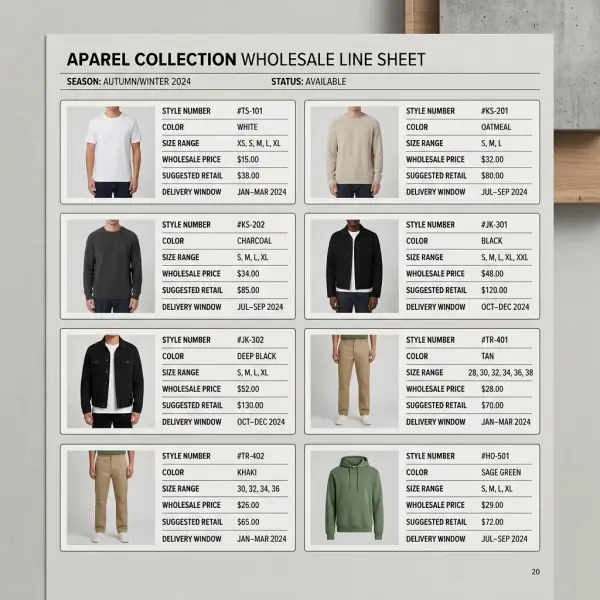
Style identification needs to be operational, not decorative
Style codes look unimportant until orders, production documents, invoices, packing lists, and buyer emails begin referring to the same garment.
A style identifier should therefore be stable and unambiguous.
Suppose a brand calls a garment the "Mira Dress" in a lookbook, "Dress 04" internally, and "MD-SS27" on an order form. The buyer may still understand the presentation, but the business has introduced unnecessary translation into the order workflow.
A clean style-number system helps connect sales information to inventory, purchase orders, production, warehouse activity, and future reorders.
Wholesale prices should already be commercially approved
A trade show is a poor place to discover that pricing has not been finalized.
The wholesale price needs to reflect the brand's actual economics, not simply a number chosen because it looks attractive next to the retail price.
Brands need to understand product cost, packaging, freight or logistics assumptions where relevant, sales commissions, discounts, payment terms, and other costs that affect wholesale contribution.
Retailers also need room for their own economics. Faire notes that retailers evaluate wholesale prices in relation to the margin they can generate when selling the product.
There is no universal retailer margin that applies to every apparel category or market. Price architecture varies by product, retailer, region, brand power, distribution model, markdown exposure, taxes, and commercial agreement.
The useful question is therefore not simply, "Is our wholesale price low enough?"
It is:
Can both the brand and the retailer make the economics work at this price?
Delivery information needs to reflect production reality
An attractive delivery date printed on a line sheet becomes a commitment risk if the supply chain cannot support it.
Before publishing delivery windows, a brand should reconcile:
- material availability;
- sample approval status;
- supplier lead times;
- manufacturing capacity;
- finishing and quality-control requirements;
- transport assumptions;
- order cut-off dates; and
- realistic buffers for known operational uncertainty.
Faire explicitly asks wholesale brands to provide realistic shipping lead times because retailers rely on those timelines when buying.
For seasonal apparel, timing is especially important. Merchandise arriving after the retailer's relevant selling window may lose substantial commercial value even if the garment itself is correct.
Line Sheet vs Lookbook: What Is the Difference?
A line sheet and a lookbook can describe the same collection, but they are built for different jobs.
|
|
Line sheet |
Lookbook |
|
Primary purpose |
Support wholesale evaluation and ordering |
Communicate collection image and styling |
|
Main audience |
Buyers, sales reps, distributors |
Buyers, media, stylists, customers, partners |
|
Product presentation |
Structured and repeatable |
Editorial and expressive |
|
Pricing |
Usually included for wholesale use |
Often omitted |
|
Style numbers |
Important |
Optional |
|
Color/size data |
Important |
Usually secondary |
|
Ordering terms |
Often included or attached |
Normally not central |
|
Photography |
Clear product representation |
Lifestyle/editorial imagery |
|
Best use |
Commercial decision |
Brand and collection storytelling |
A brand does not necessarily need to choose one over the other.
A short lookbook can establish the collection's point of view. The line sheet can then translate that visual proposition into products a retailer can actually evaluate.
Digital wholesale platforms increasingly combine these functions. JOOR, for example, supports digital line sheets containing imagery and product information alongside virtual showroom tools, reflecting the movement toward combined visual and transactional wholesale presentation.
Still, clarity matters more than format.
A beautiful digital presentation with incomplete prices and delivery data remains incomplete.
How Should Brands Prepare Samples for a Trade Show?
Trade show samples are not simply garments placed on a rack. They are sales tools representing what the buyer may eventually receive.
That does not mean every market sample must be identical to final bulk production in every circumstance. Product development timelines sometimes require brands to sell from samples before production is complete.
But any meaningful difference should be understood internally and communicated when it materially affects the buying decision.
A buyer evaluating a sample may be judging:
- handfeel;
- fabrication;
- weight;
- color;
- trim quality;
- stitch execution;
- finishing;
- fit;
- garment proportion;
- construction;
- perceived value; and
- how the product might sit alongside the retailer's existing assortment.
JOOR's guidance for wholesale fashion pitches specifically emphasizes swatches and physical samples because buyers benefit from being able to experience product quality and material characteristics directly.
That makes sample selection a merchandising decision as much as a production decision.

Do brands need to bring every SKU?
Not necessarily.
The correct assortment depends on the brand, event, booth size, sales strategy, and how buyers place orders.
A complete sample set gives buyers maximum visibility, but bringing every variation can create a dense rack where the commercial story becomes harder to understand.
Growing brands can instead think in layers.
The physical assortment might prioritize:
- key silhouettes;
- hero styles;
- products expected to drive volume;
- important new developments;
- strategically relevant price points;
- representative colorways; and
- products that require physical handling to appreciate.
Additional colors or variants can then be shown digitally or through swatches where appropriate.
The objective is not to make the rack look full. It is to allow the buyer to understand the assortment efficiently.
Sample condition changes how the collection is perceived
A sample with a missing button, damaged hem, visible pinning, broken zipper, incorrect label, or excessive wear can distort the buyer's assessment.
Some development-stage imperfections are unavoidable. What matters is whether the sales team knows about them and whether they change what is being represented.
If a sample uses a substitute fabric but the production order will use something meaningfully different, a buyer should not leave believing the sample accurately represents bulk production.
The same principle applies to color.
A digital image, lab dip, sample fabric, and bulk dye lot may not look identical. Brands should avoid promising exact visual results based on material that is not yet production-confirmed.
Sample tracking matters once the collection becomes larger
At a small show, sample control may be as simple as a numbered garment rack.
As a brand grows, samples may move among trade shows, sales representatives, photographers, showrooms, buyers, fit teams, and press contacts. Without a tracking system, missing samples can become surprisingly expensive and disruptive.
A simple sample record can identify:
style → color → sample size → current location → condition → responsible person → expected return
The system does not need to be technologically sophisticated. It needs to be reliable.
Should Brands Use Physical Samples or Digital Catalogs?
For apparel wholesale, this is usually not an either-or decision.
Physical samples provide information that photographs struggle to communicate fully: texture, weight, construction, drape, finishing, and three-dimensional proportion.
Digital tools provide breadth.
A tablet can show additional colors, styles, videos, product attributes, inventory information, or combinations that would be impractical to carry physically. JOOR's current wholesale tools, for example, are designed to combine digital catalogs with in-person market appointments and order capture.
A practical hybrid setup might therefore use:
physical sample → buyer inspection → digital variants → line sheet → order discussion
That model is particularly useful when one style has many colors or when the full collection exceeds available booth space.
The risk is relying on digital tools without operational backup.
Trade show Wi-Fi can be unreliable, batteries can fail, accounts can log out, and screens can become difficult to share during busy conversations. If critical information exists only in one online system, a technical problem can interrupt the appointment.
Digital efficiency works best when the team knows how to continue selling without it.
What Should Brands Know Before Scheduling Buyer Meetings?
A buyer appointment is more useful when the brand knows whom it is meeting.
This sounds obvious, but the quality of preparation can vary dramatically.
Before a scheduled conversation, the sales team should understand the retailer's:
- location and market;
- customer profile;
- price architecture;
- brand assortment;
- relevant product categories;
- store or channel format;
- likely competitive set; and
- previous relationship with the brand, if any.
This does not require an extensive research dossier for every visitor.
A concise account note can be enough to prevent generic pitching.
JOOR recommends tailoring wholesale pitches to the retailer rather than using the same presentation indiscriminately for every buyer.
Major trade shows also increasingly facilitate structured matchmaking rather than relying entirely on accidental booth traffic. COTERIE's current programs, for example, include curated one-to-one networking and personalized appointment scheduling for selected brands and buyers.
The implication for brands is important: buyer meetings should be treated as finite sales opportunities, not casual introductions.
How Should a Fashion Buyer Meeting Be Structured?
There is no universal script, and rigid scripts can make a meeting feel detached from what the buyer actually wants.
Still, a useful appointment usually moves through several commercial stages.
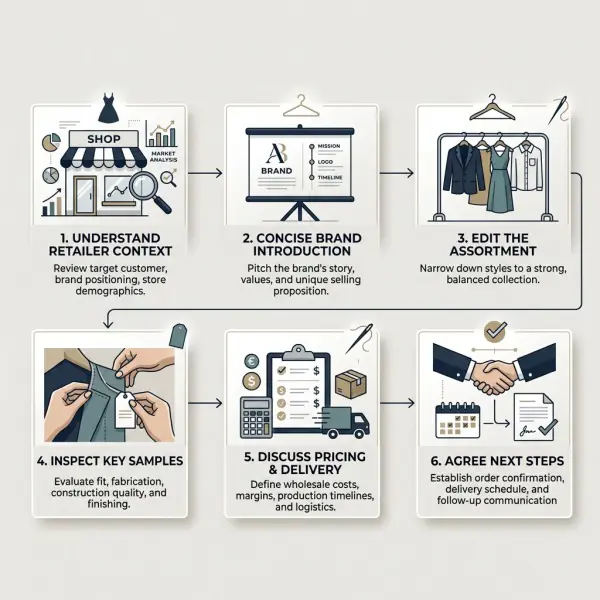
1. Establish the buyer's context
A good opening is less about immediately describing the brand and more about establishing what the buyer is looking for.
A buyer responsible for contemporary dresses may not need a ten-minute explanation of the brand's accessories.
Useful context can emerge from simple questions about category needs, current assortment, price range, delivery period, or what brought the buyer to the booth.
This gives the sales representative a basis for editing the presentation.
2. Explain the brand briefly
A wholesale buyer generally needs enough brand context to understand where the collection belongs in the market.
Useful information may include:
- target customer;
- primary category;
- price positioning;
- distribution profile;
- distinctive product proposition;
- relevant sales evidence; and
- the idea behind the current collection.
The challenge is proportion.
A buyer meeting is not a founder biography. Brand storytelling should support the commercial argument rather than delay the product review.
3. Edit the collection around relevance
Showing every garment in rack order may be easy for the salesperson but inefficient for the buyer.
If research and early conversation suggest that the retailer is primarily interested in casual dresses between particular price points, lead with those products.
This does not mean hiding the wider assortment. It means sequencing it intelligently.
A strong salesperson can move from:
buyer need → relevant style → adjacent product → broader collection
rather than:
first hanger → second hanger → third hanger → fourth hanger
The difference is subtle operationally but significant commercially.
4. Let the product carry part of the conversation
Fashion samples are persuasive when the product genuinely has something worth examining.
Instead of describing a jacket as "premium," the representative can show the buyer the fabric, lining, construction, fit detail, or finishing that supports the positioning.
Concrete product information is more useful than adjectives.
If a material or construction feature materially affects care, durability, price, or customer expectations, explain it accurately rather than turning it into an exaggerated sales claim.
5. Discuss commercial terms clearly
Once interest becomes serious, the conversation needs to move beyond aesthetics.
Relevant questions may involve:
- wholesale price;
- retail positioning;
- minimum order;
- size range;
- color availability;
- delivery;
- payment terms;
- territory;
- exclusivity;
- reorder availability;
- shipping;
- cancellation terms; or
- expected sales support.
Not every meeting requires detailed negotiation on every point.
But sales staff should know which terms are fixed, which can be discussed, and who has authority to approve exceptions.
6. End with a defined next step
"Great meeting you" is not a sales process.
The next step may be:
- preparing an order;
- sending the line sheet;
- sending additional product information;
- confirming inventory;
- arranging a showroom appointment;
- supplying samples;
- checking territory availability;
- discussing terms with a senior buyer; or
- following up for a later season.
The sales team should record that action while the conversation is still fresh.
How Long Should a Buyer Meeting Take?
There is no universal ideal duration.
The appropriate length depends on collection size, buyer interest, appointment format, relationship history, category complexity, and trade show traffic.
A first introduction at a busy booth might be brief. A pre-arranged market appointment with an existing account could take significantly longer because the buyer is building an assortment.
The more useful principle is meeting efficiency rather than meeting length.
A buyer should be able to understand quickly:
- who the brand is;
- why the assortment could matter to the retailer;
- which products deserve attention;
- how those products are priced;
- when they can be delivered; and
- what happens next.
An appointment that reaches those answers in 15 focused minutes may be stronger than a 40-minute presentation that never establishes commercial fit.
How Should Brands Prepare Their Sales Team?
A well-prepared founder cannot personally handle every conversation once booth traffic increases.
Anyone representing the collection should therefore share the same basic commercial information.
Before the show, sales staff should be aligned on:
- collection story;
- hero products;
- product construction;
- wholesale prices;
- recommended retail prices where used;
- available sizes and colors;
- delivery windows;
- minimum orders;
- payment terms;
- production limitations;
- existing distribution restrictions; and
- escalation procedures for requests they cannot approve.
This is less about memorizing a script than eliminating contradictory answers.
Imagine one representative tells a retailer that a style can ship in four weeks while another says eight. The issue is not merely awkward communication. The buyer may now question whether the brand understands its own supply chain.
A short internal sales briefing, product walkthrough, and mock buyer conversation can identify these inconsistencies before the first appointment.
Buyer Notes Are Part of the Sales Asset
One of the least visually impressive parts of trade show preparation may be among the most commercially useful: the method for recording conversations.
After several hours of meetings, "the buyer who liked the green dress" is not a reliable customer relationship system.
At minimum, the brand should capture:
|
Buyer information |
Why it matters |
|
Buyer and retailer name |
Account identification |
|
Contact information |
Follow-up |
|
Categories discussed |
Future relevance |
|
Styles of interest |
Assortment opportunity |
|
Pricing concerns |
Commercial feedback |
|
Delivery needs |
Order feasibility |
|
Agreed action |
Follow-up discipline |
|
Sales representative |
Account ownership |
|
Follow-up deadline |
Pipeline management |
The exact system could be a customer relationship management platform, wholesale platform, spreadsheet, tablet form, or structured paper notes transferred later.
The technology is secondary.
The important point is that useful context survives beyond the conversation.
From Buyer Interest to Wholesale Order
A trade show meeting can feel successful long before a commercial commitment exists.
A buyer may compliment the collection, request a line sheet, photograph products, ask detailed questions, or say they will discuss the range with colleagues.
Those are different degrees of interest—not confirmed revenue.
The sales team should therefore classify opportunities realistically.
A simple pipeline might use:
new contact → qualified account → product interest → follow-up required → order discussion → order confirmed
More sophisticated brands may use additional stages, but the principle is useful even at small scale.
It prevents enthusiastic conversations from being treated as forecast orders and helps management prioritize follow-up.
Where digital wholesale systems are used, part of this workflow can happen directly during appointments. JOOR, for example, supports order creation and editing from the trade show floor, including offline capture followed by later synchronization.
That can shorten the administrative path, but software does not replace commercial judgment. A poorly structured order captured digitally is still a poorly structured order.
Practical Pre-Show Preparation Framework
For growing apparel brands, preparation becomes more manageable when divided into four workstreams.
Commercial readiness
Confirm pricing, terms, delivery periods, minimums, territories, and approval authority.
Product readiness
Confirm which samples will be shown, their condition, production status, color information, size information, and any known deviations from final production.
Sales readiness
Build line sheets, account notes, product talking points, meeting schedules, lead-capture processes, and follow-up responsibilities.
Operational readiness
Confirm freight, sample arrival, booth setup, technology, backups, staffing schedules, garment care equipment, chargers, packaging, and return logistics.
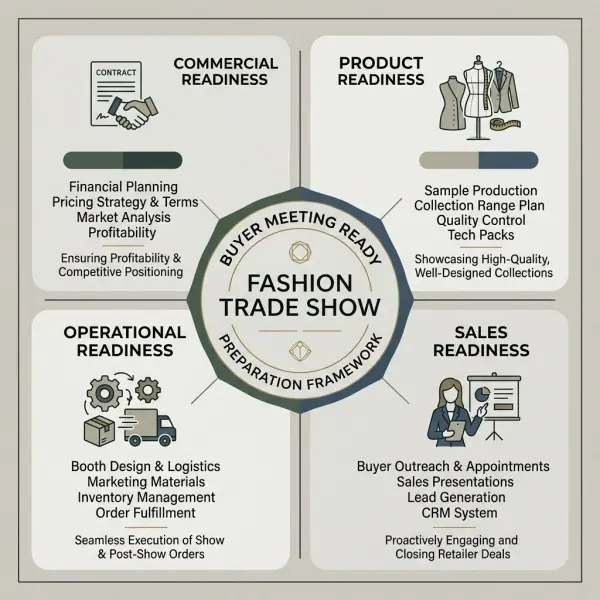
The framework is intentionally broader than "pack the samples and print the line sheets." Good buyer meetings depend on all four areas connecting.
Preparation Gaps to Catch Before the Show
Several problems are worth identifying during preparation because they become much harder to resolve in front of a buyer.
A line sheet may contain prices that no longer match the company's approved wholesale matrix. A new sample color may be shown even though material availability has not been confirmed. Sales representatives may use an old delivery calendar. The founder may promise a territory arrangement without checking existing accounts.
The better approach is to run a pre-show commercial audit.
Ask the team to simulate a buyer asking:
- Can I order this color?
- What sizes are available?
- What is the wholesale price?
- When can it ship?
- What is your opening minimum?
- Can I reorder it?
- Is the style already sold to another retailer in my market?
- Is this the final production fabric?
- Who confirms my order?
- What happens next?
Any answer that remains uncertain deserves attention before the event.
The next cluster article, common trade show mistakes that limit wholesale opportunities, examines these execution failures more deeply, including the business consequences when preparation, buyer targeting, booth behavior, and follow-up break down.
What Brands Should Verify Before Finalizing Their Trade Show Materials
Line sheets and samples sit close to the buyer's purchasing decision, so errors can propagate quickly.
Before final approval, brands should verify several categories of information.
Product accuracy
Confirm that style names, codes, colors, sizes, materials, and product images correspond to what is actually being sold.
Commercial accuracy
Confirm wholesale prices, suggested retail prices where supplied, order minimums, payment terms, and any relevant regional pricing.
Production accuracy
Confirm which products are actually orderable and whether stated delivery windows remain achievable.
Sample accuracy
Document meaningful differences between display samples and planned production.
Contact accuracy
Make sure buyers know who owns the account and where orders or questions should go.
Version control
If printed and digital line sheets coexist, both should reflect the same commercial information.
This final point becomes increasingly important as collections change.
A price adjustment made in a spreadsheet but not in a PDF can create multiple versions of the truth. Simple version numbers or dates on commercial documents can help the team identify which file is current.
Frequently Asked Questions
What is the most important information on a fashion line sheet?
The most important information is whatever allows the buyer to identify, evaluate, and order the product without unnecessary ambiguity.
For apparel, that usually means a clear product image, style identifier, available color and size information, wholesale price, relevant retail price, delivery information, and ordering requirements. Material or concise construction information may also be useful.
The exact design is secondary to information hierarchy. A visually sophisticated line sheet that makes style numbers or prices difficult to find performs poorly as a wholesale sales tool.
Does a line sheet need professional photography?
It needs product imagery that represents the garment accurately and clearly, but that does not necessarily require an elaborate editorial campaign.
Clean e-commerce or product photography often works well because the buyer needs to distinguish individual styles. JOOR's digital wholesale tools similarly emphasize high-resolution product imagery and structured product information in line sheets and catalogs.
Editorial images can complement the line sheet through a lookbook, but they should not make product identification more difficult.
Can a fashion brand use a digital line sheet instead of printing one?
Yes. Digital line sheets are widely used in modern wholesale selling and can make updating data, showing additional products, and taking orders more efficient. Platforms such as JOOR combine digital line sheets with virtual showrooms and in-person wholesale appointment tools.
However, brands should consider practical trade show conditions. Devices can lose power, networks can fail, and some buyers may prefer documents they can review later.
A digital-first system with an accessible backup is often more resilient than depending entirely on either paper or technology.
Do all trade show samples need to be production-ready?
Ideally, samples shown to buyers should represent production as accurately as possible, but development and selling calendars do not always allow every detail to be completely finalized.
If a sample differs materially from planned production—such as fabric, color, trim, fit, or construction—the sales team should understand the difference and avoid representing the sample as final.
The more important issue is not whether a sample carries the label "prototype." It is whether the buyer receives an accurate understanding of what will eventually be delivered.
Should brands give buyers samples at trade shows?
Not automatically.
Full garment samples can be expensive, limited in number, and needed for other appointments, photography, showroom selling, or production reference.
Whether samples are gifted, loaned, or retained depends on the product category, buyer importance, sales strategy, and availability.
If samples leave the booth, brands should record who received them, which styles were involved, whether return is expected, and any follow-up responsibility.




Comments 0
Leave a CommentSend Comment
Anda harus Login terlebih dahulu untuk dapat memberikan komentar.