

Automated Fabric Inspection Explained for Textile and Apparel Production
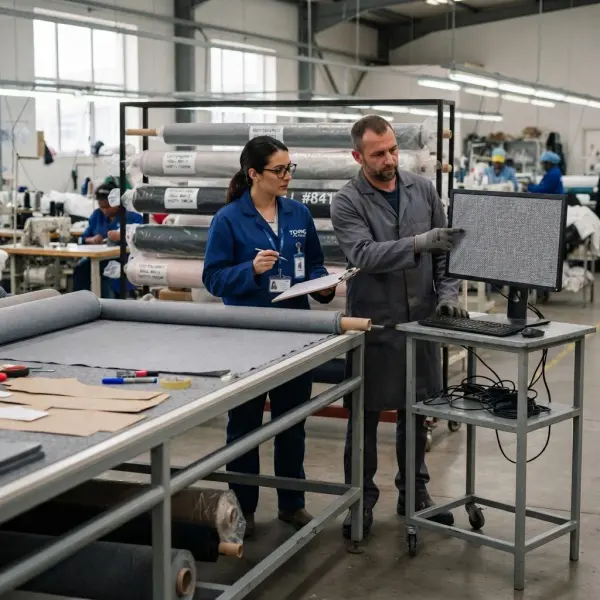
Automated fabric inspection brings cameras, controlled lighting, image-processing software, and quality data into a task traditionally performed by an operator watching fabric move across an inspection frame. Beyond “seeing” defects, it can record their positions, connect roll quality with cutting decisions, and help trace recurring problems back to production.
The technology still needs careful interpretation. A system may identify a hole, stain, missing yarn, crease, or local pattern irregularity, but the commercial meaning of that finding depends on the fabric, end product, buyer specification, defect position, and agreed grading method. Automated inspection therefore works best as a controlled quality system—not as an isolated camera purchased to replace human judgment.
Quick Answer
Automated fabric inspection is a machine-based quality-control process that scans fabric with cameras or optical sensors under controlled lighting, analyzes the captured images for surface irregularities, and records suspected defects by type, size, severity, and location. It can operate on a production line or as an offline roll-inspection station.
For textile mills, the system can reveal recurring weaving, knitting, dyeing, or finishing problems while creating more consistent roll-quality data. For apparel manufacturers, the defect map can help incoming quality teams and cutting rooms avoid placing visible or performance-reducing faults in garment panels. Some systems can also exchange data with enterprise resource planning, roll mapping, spreading, or cut-optimization tools.
Automation does not guarantee that every defect will be found. Detection performance depends on fabric structure, color, pattern, surface texture, line speed, camera resolution, illumination, fabric tension, model training, and the definition of an acceptable defect. Human verification and agreed grading rules remain important, particularly for unfamiliar fabrics, subtle shade variation, subjective appearance issues, and high-risk orders.
What Is Automated Fabric Inspection?
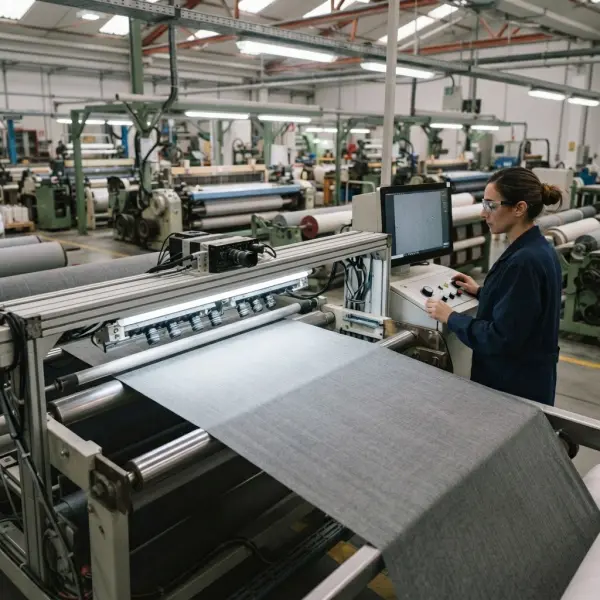
Automated fabric inspection is an optical quality-control system that examines moving fabric in order to detect, locate, classify, and document visible irregularities before the material proceeds to later production or customer delivery. Depending on the installation, it may inspect woven, knitted, nonwoven, coated, printed, dyed, or technical fabrics, but the hardware and detection configuration must suit the material.
That last condition matters. Smooth, solid-color shirting presents a different visual task from lace, brushed fleece, mélange jersey, jacquard, reflective material, or a high-contrast print. The system compares observed surface information with rules, reference images, learned patterns, or a combination of these—not one universal definition of “bad fabric.”
The term also covers more than defect-detection software. A workable installation usually combines fabric transport, tension control, illumination, cameras or other optical sensors, a processing unit, an operator interface, defect-marking or position-tracking functions, and reporting software. Where the workflow is integrated, the inspection result can become a digital roll map used by downstream teams.
This scope is broader than machine vision for detecting fabric defects. Machine vision is the sensing and analysis layer. Automated fabric inspection is the full operational system around it, including fabric presentation, quality rules, data handling, review, grading, and action.
A fabric defect is not defined only by appearance
In quality control, a defect is generally an unintended fault that can reduce expected fabric performance or make the material visibly unacceptable in its intended use. The ISO 8499:2003 vocabulary for knitted-fabric defects reflects this link between a fault, expected performance, and possible rejection when the fault appears prominently in a finished product.
This means a detected irregularity is not automatically a rejected roll. A small mark close to a selvedge may be irrelevant to one cutting plan but serious for another. A slight bar may be acceptable in a hidden lining yet commercially unacceptable in a plain premium dress. Inspection technology supplies evidence; specifications determine what the evidence means.
Where Inspection Sits in Textile and Apparel Production
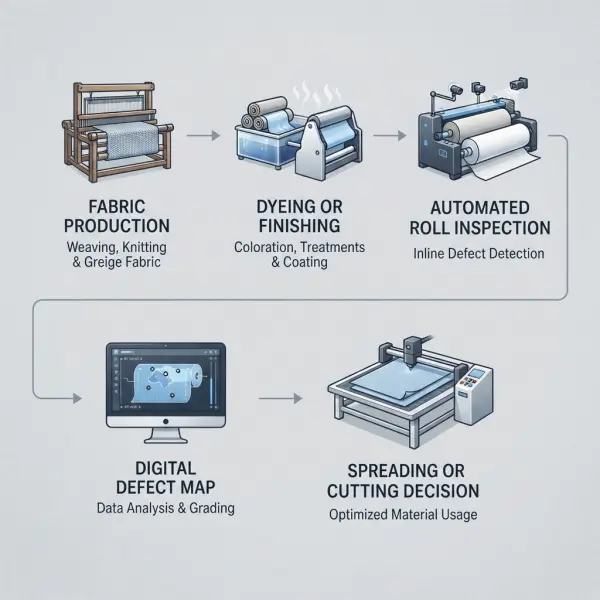
Inspection can take place at several points, and the best location depends on who owns the process and what action can still be taken. A weaving or knitting mill may install an in-line system to identify recurring faults as fabric is produced. A dyeing or finishing operation may inspect after a critical process to find stains, creases, coating gaps, print problems, or local appearance variation. A fabric supplier may use final roll inspection before grading and shipment. An apparel factory may inspect incoming rolls before relaxation, spreading, and cutting.
The earlier a finding reaches someone who can act, the more valuable it becomes. A defect discovered during weaving may prompt a loom check. Found only after dyeing, it has already absorbed more processing time and capacity. At the garment factory, pre-cutting detection may protect marker yield, but the opportunity to correct the original textile process has passed.
The practical sequence often looks like this:
|
Production point |
Primary inspection purpose |
Typical action from the data |
|
Weaving or knitting |
Detect structural or recurring machine-related faults |
Check yarn feed, needles, loom settings, contamination, or machine condition |
|
Dyeing, printing, coating, or finishing |
Find process-induced surface and appearance irregularities |
Hold, reprocess where feasible, segregate, or investigate the process |
|
Final textile inspection |
Grade rolls and prepare quality documentation |
Accept, downgrade, mend, cut out, allocate, or reject according to specification |
|
Incoming inspection at an apparel factory |
Verify received material before production |
Approve, quarantine, claim, shade-sort, or allocate rolls to suitable styles |
|
Spreading and cutting preparation |
Use defect positions in material planning |
Place markers, splice, avoid affected areas, or reserve panels for review |
This is why inspection should not be treated as an end-of-line ritual. It is a feedback point within fabric cutting and garment production planning, and its usefulness depends on how quickly the information changes a decision.
How Does an Automated Fabric Inspection System Work?
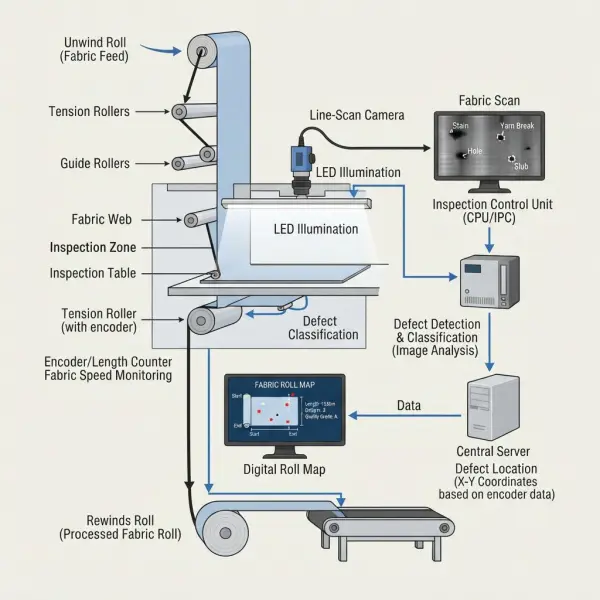
The system first has to present the fabric in a stable and observable condition. It then captures images, separates ordinary fabric variation from possible faults, records the position of each event, and delivers information that operators or connected systems can use. Each stage affects the reliability of the result.
1. Fabric handling creates the inspection condition
Fabric is unwound or passed through the inspection zone at a controlled speed and tension. Excessive vibration, wrinkles, unstable tracking, dust, and changing tension can create false indications or hide genuine faults. Depending on the material, inspection may require transmitted light from behind the fabric, reflected light from above, illumination at an angle, or multiple arrangements.
These are not minor installation details. In its implementation guidance, Uster states that its optical inspection requires smooth, tension-controlled fabric flow, stable lighting, a crease-free presentation, and freedom from dust or lint in the inspection area. The same automated inspection setup guidance describes both in-line and offline configurations.
2. Cameras and illumination reveal surface information
Industrial cameras capture a continuous sequence of the moving fabric. Line-scan cameras are common in continuous web inspection because they build an image one narrow line at a time as the material moves. Camera coverage, spatial resolution, exposure, lens selection, and light geometry determine the size and type of feature that can be observed.
Lighting is often as decisive as the camera. Backlighting can make holes, missing yarns, or density differences more visible, while front or angled lighting may better reveal stains, protruding fibers, creases, texture disturbances, or coating irregularities. Dark, glossy, sheer, pile, highly textured, or reflective fabrics can require different optical arrangements.
3. Software identifies deviations
The captured image is processed to distinguish the expected fabric structure from irregular regions. Systems may use conventional image-processing rules, statistical texture analysis, machine learning, deep-learning models, or hybrid approaches. The software can flag a location, draw a boundary around it, estimate size, and assign a defect category or confidence score.
The distinction between detection and classification is useful. Detection asks whether a suspicious region exists and where it is. Classification asks what kind of problem it resembles. Segmentation may go further by outlining the affected pixels. A production system can perform one or more of these tasks, and its actual output should be confirmed rather than inferred from an “AI-powered” label.
4. Position data becomes a roll map
When the system synchronizes image findings with fabric movement, it can record the longitudinal and cross-width position of each suspected defect. The resulting roll map may include defect type, dimensions, image evidence, location, severity, roll identity, machine or batch reference, and inspection time.
That record turns a fleeting observation into operational data. Quality managers can compare machines or batches, cutting teams can locate an affected area, and suppliers and buyers can discuss the same documented position.
What Types of Fabric Defects Can the Technology Detect?
Automated systems can be configured to detect many visible surface and structural irregularities, but no single list applies equally to every fabric. Detection depends on whether a defect creates enough measurable contrast in color, brightness, texture, geometry, or light transmission under the chosen inspection condition.
Common target groups include:
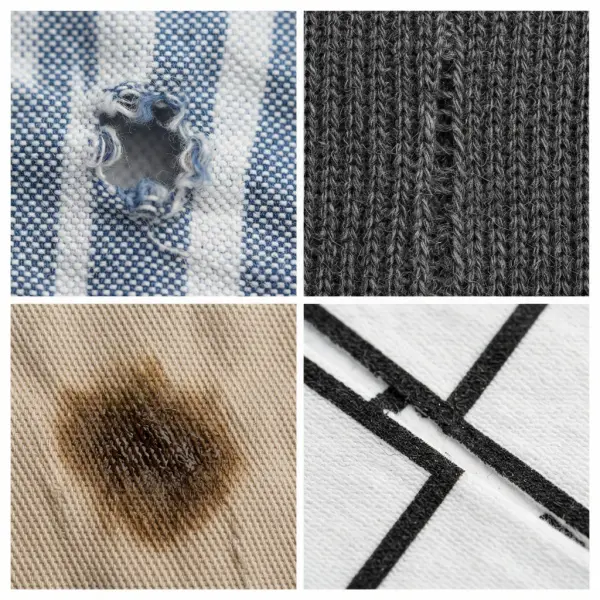
- Yarn and construction faults, such as missing or broken yarns, thick or thin places, dropped stitches, needle lines, floats, slubs outside specification, reed marks, and localized density variation.
- Surface contamination and damage, including holes, stains, oil marks, foreign fibers, dirt, tears, abrasions, and some crease marks.
- Dyeing, printing, and finishing irregularities, such as local color patches, print misregistration, coating gaps, streaks, or uneven surface treatment when they produce a detectable visual difference.
- Fabric geometry problems, including some cases of bow, skew, edge distortion, or width variation, provided the system has the required measurement and reference functions.
- Pattern or repeat deviations, when the system is designed and trained to compare the expected repeat with the observed fabric.
The word can is essential. A visible stain on plain white fabric is not equivalent to a tonal disturbance in mélange knit. A hole may be easy to reveal with transmitted light, while subtle side-to-side shade variation may require color-calibrated measurement rather than ordinary defect imaging. Some systems combine surface inspection with separate shade-monitoring equipment; buyers should not assume one camera setup measures every quality attribute.
Research results also need context. One 2025 experimental system, for example, was developed specifically for holes, color bleeding, and crease defects on plain, patternless cotton and linen materials. That defined research scope illustrates why a strong result on selected materials and defect classes should not be treated as universal performance across prints, pile fabrics, lace, technical textiles, or defects absent from the training data.
Automated Inspection Versus Manual Visual Inspection
Automated and manual inspection are not mutually exclusive. Automation is strongest at continuous, repeatable scanning and precise data capture. Experienced inspectors remain valuable when a decision depends on tactile qualities, aesthetic judgment, unusual fabric behavior, buyer-specific nuance, or review of uncertain findings.
|
Consideration |
Automated inspection |
Manual visual inspection |
|
Observation pattern |
Continuously scans using a configured optical setup |
Depends on operator attention, viewing conditions, speed, and work method |
|
Repeatability |
Can apply the same configured detection logic across rolls |
May vary among inspectors and across shifts |
|
Data capture |
Can save images, positions, counts, and roll-level records automatically |
Often relies on manual marking and reporting unless digitally assisted |
|
Adaptation to unfamiliar issues |
May miss or misclassify features outside its configuration or training |
An experienced inspector may recognize unexpected visual or contextual problems |
|
Subjective appearance |
Requires translated rules and representative reference data |
Human judgment can interpret appearance, placement, and end-use context |
|
Scalability |
Suitable for continuous inspection once validated for the material |
Additional volume generally requires more inspector time or staffing |
|
Quality decision |
Supports grading and disposition but does not define the commercial rule by itself |
Can apply buyer rules, though decisions may be inconsistent without clear standards |
The most credible model is often “machine first, human where needed.” The system scans the roll; an inspector reviews uncertain events, validates serious defects, audits performance, and handles characteristics the optics do not measure well.
From Defect Detection to Fabric Grading
Finding a defect and grading a roll are different activities. Detection records an event. Grading translates defects into an agreed quality result, often considering defect length or size, severity, frequency, usable width, roll length, location, and end-use requirements.
ASTM D5430-26 describes procedures for visually examining and grading fabrics and allows its use for roll or shipment acceptance when purchaser and seller agree. Crucially, the standard notes that penalty results may vary considerably when different point-assignment options are used. The current ASTM D5430-26 scope and significance statement therefore reinforces an operational rule: supplier, buyer, factory, and system integrator need the same grading logic before comparing results.
An automated system may support a four-point method or another agreed system, but the technology should not silently create the commercial standard. Teams must define which defect categories receive which penalty, whether continuous defects are treated separately, how roll width and inspected length enter the calculation, and what threshold triggers acceptance, downgrade, repair, or rejection.
A single total score can hide many isolated faults, one continuous line, concentrated defects, or problems near the edges. Good configuration preserves this event data because similar aggregate scores can require different cutting decisions.
Why Does Automated Inspection Matter to Fashion Businesses?
Fabric quality becomes financially visible when it disrupts production or reaches the customer. A defect can reduce marker utilization, stop spreading, trigger recutting, delay a line, increase claims, or appear on a finished garment. Inspection matters when it changes an outcome early enough to act.
More consistent evidence across rolls and shifts
A configured system can examine material with repeatable imaging conditions and save comparable records. This does not eliminate all variability, but it reduces reliance on memory and handwritten descriptions. For multi-site sourcing teams, standardized defect images and roll maps can make supplier discussions more specific.
Better use of fabric before cutting
When defect positions are available in a usable format, the cutting room can plan splices, avoid affected zones, allocate cleaner rolls to visually sensitive styles, or separate material for review. Some commercial systems connect inspection data with cut planning: Uster, for example, documents the use of defect maps and quality rules in optimized cut-control workflows. The achievable yield effect will depend on fabric quality, order mix, marker constraints, data integration, and the factory’s ability to act on the recommendations.
Stronger process feedback
Repeated defects at similar positions or intervals may help textile engineers investigate a machine, yarn feed, needle, printing unit, or finishing condition. The data is more valuable when connected with roll, batch, machine, shift, and process information. Without that traceability, the system may produce a large defect archive without helping anyone prevent recurrence.
Clearer supplier and buyer communication
Photographic evidence and standardized location data can support claims, incoming-material decisions, and supplier development. They do not settle every disagreement: parties may still differ on severity, acceptability, or cause. Clear specifications and agreed sampling or inspection procedures remain necessary.
How Can Textile and Apparel Businesses Apply the Technology?
The first practical task is not selecting a camera brand. It is defining the decision the inspection result must improve. A textile mill may prioritize real-time process feedback and roll grading. An apparel factory may care more about incoming fabric verification and passing a defect map to spreading and cutting. A sourcing office may need comparable supplier quality data rather than its own inspection machine.
A disciplined application usually covers five areas:
- Define the material families and critical defects. Group fabrics by construction, surface, color, pattern, width, and end use. Identify which faults cause actual cutting losses, claims, or customer rejection.
- Translate quality specifications into operating rules. Agree on defect vocabulary, size or severity bands, grading method, roll-acceptance limits, and escalation rules with relevant suppliers and buyers.
- Validate the optical condition. Test representative good fabric, known defects, borderline appearance issues, different shades, and real production speeds. Include fabrics likely to be difficult, not only the easiest sample.
- Design the response workflow. Decide who reviews alerts, stops or continues a line, quarantines a roll, approves a downgrade, investigates recurrence, and communicates with the cutting room.
- Connect the data to action. Ensure roll identity and defect position remain traceable through warehousing, relaxation, spreading, and cutting. Measure whether the data changes yield, rework, claims, or process correction.
For smaller apparel businesses, purchasing a full system may not be the first step. They can ask fabric suppliers or inspection partners for digital roll reports, establish a stronger incoming inspection process, and record defect-related cutting losses. That evidence will clarify whether automation addresses a costly recurring problem or merely adds equipment to an inconsistent workflow. The deeper investment questions belong in the decision guide to adopting inspection technology.
Common Mistakes That Reduce the Value of Inspection Automation
Treating the system as a universal defect detector
This happens when a business evaluates a demonstration on one plain fabric and assumes the same configuration will perform equally on every knit, print, pile, coating, and color. The result can be missed defects, excessive false alerts, or repeated manual overrides. The better approach is to establish validated operating envelopes for material groups and a review process for new fabrics.
Automating an undefined quality standard
If inspectors, suppliers, merchandisers, and buyers use different defect names or acceptance thresholds, automation makes the disagreement faster rather than resolving it. Detection classes, severity rules, grading options, and commercial tolerances should be documented before the output is used for acceptance decisions.
Measuring detection but not downstream impact
A dashboard may show thousands of identified events without revealing whether marker loss, recutting, claims, or second-quality output improved. Teams should connect technical indicators—such as missed defects, false alarms, review time, and system availability—with business indicators such as usable fabric yield, defect-related downtime, and claim value.
Ignoring material presentation and maintenance
Dirty optics, changing light, dust, vibration, creases, poor tracking, or unstable fabric tension can degrade performance. Calibration, cleaning, reference checks, maintenance ownership, and change-control procedures are part of quality assurance, not optional technical housekeeping.
Removing human oversight too early
Even a validated system can encounter a new pattern, finish, contamination type, or process condition. Eliminating review before the organization understands false-negative and false-positive behavior can create hidden quality risk. Human audit samples and clear escalation thresholds should remain in place, especially during commissioning and material changeovers.
Important Technical Caveats
Automated visual inspection assesses what its sensors can observe under configured conditions. It does not replace laboratory testing for properties such as tensile or bursting strength, dimensional stability, colorfastness, abrasion resistance, pilling propensity, chemical compliance, or fiber composition. A fabric can appear visually clean and still fail a physical or chemical requirement.
Several limitations should remain close to any performance claim:
- Reported accuracy depends on the dataset, defect definition, class balance, image resolution, validation method, and decision threshold.
- A high average score can conceal weak performance on rare but commercially serious defects.
- False negatives allow faults to pass; false positives consume review time and may reduce usable yield if operators overreact.
- Patterned, textured, reflective, sheer, hairy, or highly variable fabrics can require different models, lighting, or additional sensors.
- Detection at production speed may differ from a controlled laboratory test.
- Shade consistency, fabric hand, odor, stretch behavior, and internal performance are not necessarily covered by surface-defect imaging.
- Software performance can drift when materials, lighting, cameras, processes, or defect definitions change.
This does not make the technology unreliable. It means performance is conditional and must be managed. The right question is not “What is the accuracy of automated inspection?” but “How reliably does this configured system find our critical defects on our representative fabrics at our operating speed, and what happens when it is uncertain?”
Frequently Asked Questions
Can automated fabric inspection replace human inspectors completely?
Not in every operation. Automation can perform continuous surface scanning, record defect positions, and apply configured rules more consistently than unaided visual observation. Human inspectors are still useful for validating uncertain detections, judging subjective appearance, assessing unfamiliar materials, interpreting buyer-specific tolerances, and auditing missed defects. A mature workflow often shifts people from watching every metre of fabric toward reviewing exceptions and analyzing quality patterns. The appropriate level of human involvement depends on material complexity, system validation, order risk, defect severity, and whether the inspection result controls an irreversible decision such as cutting or shipment acceptance.
Is automated fabric inspection the same as the four-point system?
No. Automated inspection is the method used to observe and document suspected faults; a four-point system is one possible method for assigning penalty points and grading fabric. A machine can supply defect dimensions, types, and positions, then apply a configured point rule. The buyer and seller must still agree on the grading method, thresholds, treatment of continuous defects, inspected width and length, and acceptance criteria. Different point-assignment options can produce different roll results, so the system configuration should be visible and controlled rather than treated as an unchangeable default.
Can the same system inspect woven and knitted fabrics?
Potentially, but not necessarily with the same optical setup or detection model. Woven and knitted fabrics have different structures and characteristic faults; surface texture, elasticity, width stability, yarn appearance, color, and pattern add further variation. A supplier should demonstrate performance on representative materials from the intended production range. Validation should include normal variation, known critical defects, edge conditions, multiple colors, real line speeds, and material changeovers. A broad compatibility statement is less useful than documented results for each fabric family and a defined process for introducing new constructions.
Does automated inspection reduce fabric waste?
It can reduce avoidable loss when earlier detection leads to process correction or when accurate defect positions improve roll allocation, splicing, marker planning, and panel placement. The effect is not automatic. If defect data is not connected to production decisions, the system may document waste without preventing it. Businesses should separate several outcomes: less defective fabric produced, more usable area recovered from imperfect rolls, fewer defective garment panels, and fewer finished products rejected. Each outcome has a different cause and should be measured against a baseline before attributing improvement to inspection technology.
What information should a digital fabric inspection report contain?
A useful report should identify the roll and relevant batch, supplier or machine reference; record inspected length and width; show each defect’s location, category, dimensions or severity, and image where available; state the grading rule and acceptance result; and preserve inspection time, configuration, and reviewer actions. For downstream cutting, position accuracy and roll identity are particularly important. For process improvement, the report should also be linkable to machine, shift, style, finish, or lot data. A polished summary without traceable event-level information may be inadequate for root-cause analysis or cut planning.
What should a fashion brand ask its fabric supplier about automated inspection?
Ask which materials and defect classes the system is validated for, where inspection occurs, whether every roll or only a sample is scanned, how defects are graded, and whether reports include images and position maps. Confirm how the supplier handles false alarms, manual review, new fabric constructions, calibration, and system downtime. The brand should also align acceptance tolerances with the garment’s end use: a small fault may carry different risk in printed casualwear, plain formalwear, lingerie, performance apparel, or safety-critical technical products. Inspection evidence is most useful when both parties agree beforehand how it affects approval, replacement, claims, and cutting decisions.
Conclusion
Automated fabric inspection is best understood as quality infrastructure. Cameras and algorithms are important, but the commercial result comes from the surrounding system: stable fabric presentation, relevant defect definitions, agreed grading rules, traceable roll data, trained reviewers, and a clear response when a problem is found.
For textile producers, that infrastructure can shorten the distance between a recurring fault and corrective action. For apparel manufacturers, it can make incoming quality more visible and help protect cutting decisions. For sourcing teams and brands, it can create a more precise basis for supplier dialogue. None of those benefits is guaranteed by installing equipment alone.
The sensible starting point is a representative fabric-and-defect study tied to real production losses. Once a business knows which defects matter, where they should be detected, and who will act on the data, inspection technology can support a more consistent and accountable quality process—without pretending that optical automation can measure every aspect of fabric quality.





Comments 0
Leave a CommentSend Comment
Anda harus Login terlebih dahulu untuk dapat memberikan komentar.