
Common Legal and Commercial Risks in Fashion Brand Partnerships
Quick Answer
Fashion brand partnerships create legal and commercial risk when the parties do not clearly define what each partner owns, contributes, controls, pays for, approves, and may continue using after the relationship ends.
The most common problem areas include intellectual property ownership, licensing scope, exclusivity, product quality, regulatory compliance, supplier responsibility, revenue calculations, marketing claims, customer data, confidentiality, reputational incidents, and unsold inventory.
A signed agreement is necessary, but it is not enough. The partners also need operational processes that match the contract: named approvers, product standards, testing records, reporting calendars, authorized factories, claim substantiation, incident escalation, and termination procedures.
Risk cannot always be transferred simply by adding an indemnity clause. Consumer protection authorities, product safety regulators, customers, and retailers may still hold one or both brands responsible depending on their roles and the applicable law.
Before committing to a collaboration, licence, capsule collection, retail partnership, or co-branded product, each business should conduct legal and commercial due diligence in every relevant territory. The resulting agreement should reflect how the partnership will actually operate, not an idealized version of the project.

Why Are Fashion Brand Partnerships Legally Complex?
Fashion partnerships are complex because a single product can combine intellectual property, creative work, manufacturing, marketing, distribution, customer data, and regulatory responsibilities from several organizations.
A collaborative jacket, for example, may involve trademarks owned by two brands, artwork created by a freelance designer, fabric purchased from a nominated supplier, production managed by one partner, campaign photography commissioned by the other, and sales through multiple retailers. If the agreement addresses only revenue sharing and logo placement, much of the real business remains undefined.
The term “fashion partnership” may describe several different arrangements:
- A co-branded capsule collection
- A trademark or character licence
- A designer or artist collaboration
- A retailer-exclusive range
- A celebrity or influencer product line
- A technology or material partnership
- A manufacturing and distribution licence
- A joint venture or jointly owned brand
- A promotional partnership without a shared product
Each structure creates a different allocation of ownership, operational control, investment, and liability. A short campaign collaboration should not automatically use the same agreement as a multiyear licensing relationship.
The underlying commercial model should therefore be identified before drafting begins. Brands that need a clearer foundation can first review how fashion licensing works for brand expansion and when fashion collaborations create lasting brand value.
A Practical Risk Map for Fashion Partnerships
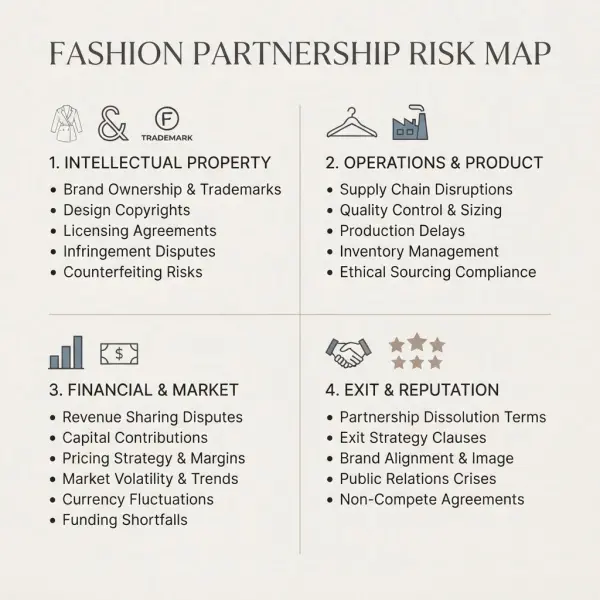
The principal risks can be organized around four business questions: what is being contributed, how the project will operate, how value and exposure will be shared, and what happens when the relationship changes.
|
Risk area |
Core question |
Typical consequence if unclear |
|
Authority and ownership |
Does each party control what it promises to contribute? |
Infringement claims, delayed launch, unusable products |
|
Licensed scope |
Where, how, and for how long may IP be used? |
Unauthorized products, territorial leakage, channel conflict |
|
New creative work |
Who owns designs and content created together? |
Disputes over reuse, registration, enforcement, and future collections |
|
Exclusivity |
What opportunities are restricted? |
Blocked growth or insufficient partner commitment |
|
Product development |
Who decides and who approves? |
Delays, inconsistent quality, missed production windows |
|
Manufacturing |
Who appoints and monitors suppliers? |
Defects, late delivery, labor or sourcing exposure |
|
Product compliance |
Who handles testing, labels, traceability, and recalls? |
Regulatory action, withdrawal, customer harm |
|
Financial structure |
How are sales, costs, deductions, and payments calculated? |
Underpayment, margin disputes, audit findings |
|
Marketing |
Who can make which claims? |
Misleading advertising, reputational harm |
|
Data and confidentiality |
What information may be shared and used? |
Data protection breaches or loss of trade secrets |
|
Reputation |
What happens after misconduct or controversy? |
Public conflict, suspension, retailer withdrawal |
|
Exit |
What survives termination? |
Unauthorized sell-off, lingering listings, disputed inventory |
This map should be adapted to the product, market, partner roles, and duration. A collaboration involving children’s sleepwear, for example, requires a different safety analysis from a campaign-only partnership involving no physical product.
Risk 1: A Partner Does Not Own All the Rights It Promises
The first legal question is whether each party has authority to contribute the proposed brand name, logo, artwork, design, photograph, archive item, character, music, or personal likeness.
Possession is not the same as ownership. A brand may have used an illustration for years while holding only a limited campaign licence from the illustrator. A retailer may own photographs of a previous collection but lack permission to modify or sublicense them. A celebrity’s management company may have commercial authority in some areas but not every category or territory.
Fashion products can involve several forms of intellectual property. WIPO identifies trademarks, copyright, and industrial designs among the rights relevant to fashion creation and commercialization in its official overview of intellectual property in fashion.
Before signing, the parties should verify:
- The legal owner or authorized controller of each asset
- Trademark registrations and applicable goods or services
- Territorial coverage and pending applications
- Existing licences, exclusivity, security interests, or restrictions
- Creator, employee, agency, photographer, and model agreements
- Rights to modify, reproduce, manufacture, distribute, advertise, and sublicense
- Whether third-party material appears within the proposed asset
- Whether registrations or permissions need renewal during the term
Warranties in the contract create remedies if information proves inaccurate, but they do not prevent a launch from being delayed or challenged. Rights clearance should happen before substantial product and campaign expenditure is committed.

Risk 2: The Licensed Scope Is Too Broad or Too Vague
A fashion partnership should define precisely what each party is permitted to do. Broad wording such as “worldwide use of the brand for fashion products” may cover far more than the commercial team intended.
The rights grant should normally address:
- Specific trademarks, designs, artwork, and other assets
- Product categories and explicit exclusions
- Countries or regions
- Wholesale, retail, marketplace, social commerce, and other channels
- Business-to-business and direct-to-consumer sales
- Contract term and renewal
- Exclusivity or non-exclusivity
- Manufacturing and sourcing use
- Advertising, public relations, packaging, and digital content
- Sublicensing and use by factories, agencies, retailers, and affiliates
- Samples, gifts, influencer seeding, and promotional merchandise
- Sell-off rights after expiry or termination
Online sales make territorial drafting particularly important. A country-specific licence needs rules for localized websites, international shipping, global marketplace listings, paid media targeting, and passive orders from outside the territory.
The licence should also distinguish permission to manufacture from permission to sell. A factory may require controlled access to logos and technical files without receiving any right to commercialize products independently.
Risk 3: Exclusivity Blocks Opportunities the Partner Cannot Deliver
Exclusivity can encourage investment because the protected partner does not face direct competition within the agreed scope. It can also prevent a brand from pursuing other opportunities when the exclusive partner underperforms.
The commercial effect depends on how exclusivity is defined. A restriction could apply to:
- A precise product type
- An entire product category
- A territory
- A retailer or retail format
- A price tier
- A customer segment
- A distribution channel
- A celebrity, artist, or character category
- A particular launch period
Broad exclusivity should normally be connected to measurable obligations such as launch deadlines, distribution, minimum purchases, sales performance, marketing expenditure, or product development milestones. The agreement can provide for exclusivity to narrow or become non-exclusive if those conditions are not met.
Exclusivity and distribution restrictions may also raise competition-law questions. In the European Union, vertical agreements are assessed under rules that distinguish potentially permissible restrictions from serious restrictions that can remove the benefit of a block exemption. The framework, including treatment of certain territory, customer, resale, and online restrictions, is summarized in official EU guidance on vertical agreements.
Competition rules vary by jurisdiction. Provisions affecting resale prices, passive sales, online channels, customer allocation, or competitors should be reviewed by qualified competition counsel rather than copied from another agreement.
Risk 4: Ownership of New Designs and Content Is Never Decided
Fashion collaborations generate new intellectual property even when the partners begin with existing brands.
New outputs may include:
- Garment and accessory designs
- Surface prints and graphics
- Patterns, specifications, and technical drawings
- Color systems and packaging
- Product names
- Photographs and videos
- Campaign concepts and copy
- Digital assets
- Product-development knowledge
- Customer insights and launch data
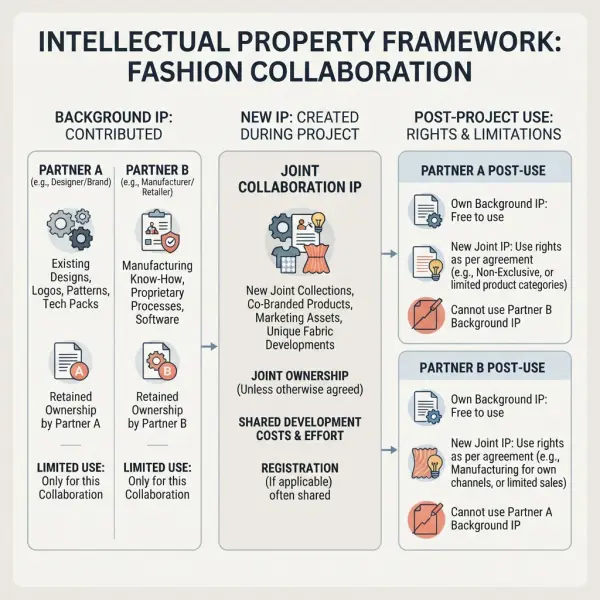
The agreement should distinguish background IP from project IP or foreground IP. Background IP existed before the partnership or was developed independently. Project IP is created through the collaboration.
Ownership should be decided before the work is generated. Leaving everything “jointly owned” may sound balanced, but joint ownership rules differ across rights and countries. Depending on applicable law, one owner may or may not be able to exploit, license, assign, register, or enforce jointly owned IP without the other’s consent.
Government model-agreement guidance similarly emphasizes that collaboration agreements should determine who owns and may exploit results produced through a joint project. This principle is explained in official guidance on ownership in collaborative projects.
A practical ownership provision should answer:
- Who owns each type of project output?
- Does the other party receive a licence?
- Is the licence limited to the collaboration or usable elsewhere?
- Who may register the rights?
- Who pays registration and enforcement costs?
- Who decides whether to act against infringement?
- Can either party modify or create derivative works?
- May archive assets be used after the partnership ends?
- What credit must be given to creators and partners?
- What happens if a freelancer or agency contributed to the work?
Risk 5: Approval Rights Do Not Match the Product Calendar
Fashion agreements often say that products and marketing require approval but fail to define how approval works. The result is a legal right without a usable process.
A practical approval system should identify:
- Which materials require approval
- Submission format and required information
- Named approvers and substitutes
- Review and response deadlines
- Whether silence means rejection, approval, or no decision
- Number of permitted revision rounds
- Objective standards and reference samples
- Escalation procedures
- Treatment of urgent manufacturing changes
- Final approval before bulk production
- Approval of retailer, campaign, discount, and marketplace use
The licensor or brand owner needs enough oversight to protect its identity and product expectations. WIPO notes that trademark licensing is connected to perceptions of source, quality, and reputation, and that the trademark owner is well advised—and may be required under some trademark laws—to retain a degree of quality control. This is discussed in its official guidance on IP assignment and licensing.
Approval should not be confused with operational responsibility. A brand that approves a sample may not automatically assume every manufacturing obligation, but approval also may not protect it from customer or regulatory exposure. Roles must be assessed under the applicable law and actual conduct.
Risk 6: Product Quality Is Defined Subjectively
Terms such as “premium quality,” “industry standard,” or “satisfactory to the brand” may not provide enough information for production teams or dispute resolution.
Fashion quality should be translated into measurable requirements appropriate to the product. These may cover:
- Approved materials and component suppliers
- Fabric weight, construction, color, and finish
- Measurement tolerances and grading
- Seam, stitch, and attachment requirements
- Shrinkage, colorfastness, pilling, abrasion, or other performance tests
- Hardware and trim performance
- Chemical restrictions
- Packaging protection
- Defect classifications and inspection levels
- Pre-production and production reference samples
- Corrective action and rejection procedures
The agreement should also address whether a partner can replace a material or supplier after approval. A substitution made to preserve margin or delivery timing can alter performance, appearance, regulatory compliance, and sustainability claims.
A clear quality system connects the contract to specifications, test methods, inspection records, and approval samples. Without those documents, disputes tend to become arguments about expectation rather than evidence.
Risk 7: Manufacturing Responsibility Is Split Without Supply-Chain Visibility
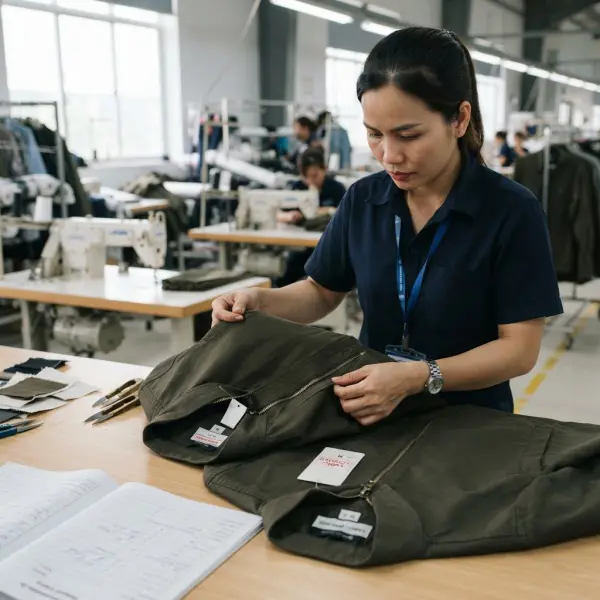
One partner may own the brand while the other selects factories, sources materials, and places production orders. This separation can make responsibilities appear clear on paper while leaving the brand with limited visibility into the supply chain.
The agreement and operating process should address:
- Who appoints factories and material suppliers
- Whether written approval is required
- Whether subcontracting is permitted
- Supplier codes and purchasing standards
- Audit, inspection, and information rights
- Traceability expectations
- Labor, human rights, environmental, and safety due diligence
- Corrective action
- Unauthorized production and excess units
- Disposal or de-branding of rejected products
- Factory access to trademarks, artwork, patterns, and confidential files
- Insurance and incident reporting
A certification, social audit, or supplier warranty may contribute evidence, but none should automatically be treated as complete due diligence. Risk assessment should consider the product, sourcing location, production process, purchasing practices, and available evidence.
The OECD Due Diligence Guidance for Responsible Garment and Footwear Supply Chains provides a risk-based framework for identifying, preventing, mitigating, and accounting for adverse impacts across operations, supply chains, and business relationships.
Risk 8: Product Compliance Is Treated as a Factory Problem
Factories can conduct tests and prepare documents, but the businesses placing, importing, distributing, or selling products may retain statutory obligations depending on the market.
Compliance can involve:
- General product safety
- Textile fiber composition
- Country-of-origin marking
- Care and warning labels
- Chemical restrictions
- Flammability
- Children’s product requirements
- Drawstrings, small parts, and attachment hazards
- Personal protective equipment rules
- Packaging and waste requirements
- Traceability
- Technical documentation
- Recall reporting and customer remedies
Requirements change by product and country. An adult cotton shirt, children’s sleepwear, safety footwear, sunglasses, cosmetics, and smart wearable are not governed by the same compliance framework.
For example, the EU General Product Safety Regulation applies a general safety framework to consumer products within its scope and includes responsibilities concerning risk assessment, documentation, traceability, corrective action, recalls, and responsible economic operators. The European Commission summarizes these obligations in its official guidance on the General Product Safety Regulation.
For textile products marketed in the EU, applicable products must also follow fiber-composition labeling requirements. The current basic requirements are explained in EU guidance on textile labels.
The parties should identify the manufacturer, importer, authorized representative, distributor, retailer, and other relevant economic operators for each market. Contractual indemnities may allocate financial exposure between partners, but they do not necessarily remove regulatory duties imposed by law.
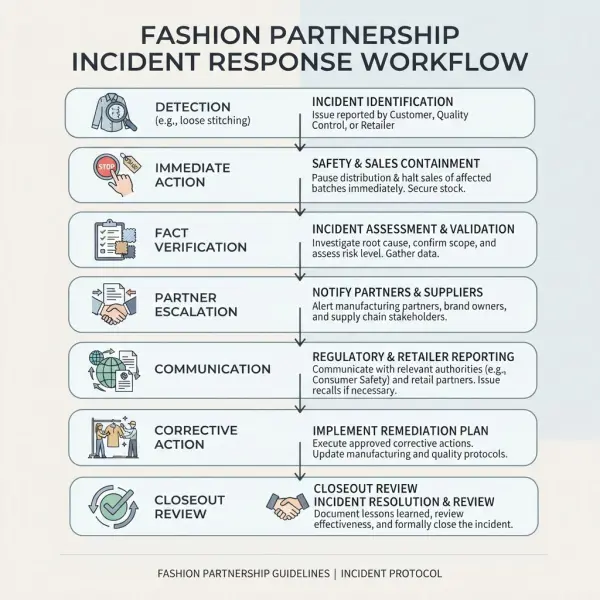
Recall Responsibility Must Be Decided Before a Recall
A recall clause should establish:
- Who receives and investigates complaints
- What triggers escalation
- Who conducts risk assessment
- Who contacts regulators and retailers
- Who can stop sales
- Who controls public communication
- How customers receive notice and remedies
- How affected units are traced
- Who funds retrieval, refunds, replacement, testing, and disposal
- How responsibility is allocated when the cause is uncertain
Waiting for an incident to decide these questions can increase customer harm and produce conflicting public statements.
Risk 9: Revenue and Royalties Are Calculated From Different Definitions
Commercial disputes frequently arise because the agreement states a percentage but does not define the calculation with enough precision.
The parties should specify:
- Whether payment is based on gross sales, invoiced sales, net sales, receipts, profit, or another measure
- Treatment of discounts, returns, cancellations, taxes, freight, duties, commissions, and marketplace fees
- Related-party and affiliate transactions
- Bundled products and promotional units
- Samples, gifts, seconds, and damaged goods
- Currency conversion source and date
- Withholding taxes
- Payment schedule and reporting format
- Minimum guarantees and recoupable advances
- Marketing contributions
- Audit rights, record retention, and underpayment remedies
“Profit share” is particularly vulnerable to disagreement if allowable costs are not defined. Product development, internal staff, marketing, warehousing, financing, returns, and overhead can substantially change the reported profit.
The parties should test the formula using realistic transactions before signing. A sample royalty statement or profit calculation attached to the agreement can expose ambiguity early.
Minimum Guarantees Can Distort Operating Decisions
A minimum guarantee may demonstrate commitment and protect the rights holder’s expected return. If the guarantee is based on an unrealistic forecast, however, the operating partner may overproduce, push products into unsuitable channels, or discount aggressively to recover its investment.
Performance commitments should be evaluated alongside market demand, lead times, margin, inventory capacity, and brand positioning.
Risk 10: Inventory Exposure Is Not Allocated Clearly
Fashion partnerships can finish with unsold fabric, components, packaging, finished stock, retailer returns, samples, and work in progress. The agreement needs to determine who owns and funds these items.
Inventory provisions should cover:
- Forecast approval and production authorization
- Minimum order quantities
- Ownership while goods are in production or transit
- Cancellation after materials have been ordered
- Excess and defective units
- Retail returns and chargebacks
- End-of-season markdowns
- Outlet, off-price, donation, recycling, destruction, or de-branding
- Sell-off after expiry or termination
- Ongoing quality and reporting obligations during sell-off
A partner should not assume it can continue selling branded goods until inventory is exhausted. Unlimited sell-off can function like an uncontrolled extension of the partnership.
Risk 11: Marketing Claims Are Approved Without Evidence
Both names on a product can be affected by unsupported claims, even if one partner wrote the copy.
Marketing-risk review should cover:
- Material and fiber claims
- Country-of-origin statements
- Performance and durability claims
- Comparative claims
- Environmental and circularity claims
- Certification references
- Charitable contributions
- Limited-edition or exclusivity statements
- Influencer endorsements
- Customer reviews and testimonials
- Price comparisons and discount claims
Environmental language deserves particular care. In the United States, the Federal Trade Commission’s current Green Guides are administrative guidance rather than standalone regulations, but they explain how the FTC applies truth-in-advertising principles to environmental marketing. The agency advises marketers to avoid broad, unqualified claims such as “green” or “eco-friendly” and to state substantiated benefits specifically, as explained in its summary of environmental marketing guidance.
If creators or influencers receive payment, free products, revenue participation, employment, or another material benefit, disclosure obligations may apply. FTC guidance states that material relationships should be made apparent when they are not otherwise clear and warns that advertisers may face exposure for endorsements they create or disseminate. Its current position is described in official endorsement and influencer guidance.
Other jurisdictions have their own consumer protection and advertising requirements. A campaign approved for one country may require different wording, qualifications, or disclosures elsewhere.
Risk 12: Customer Data Is Treated as a Shared Partnership Asset
A collaboration may generate customer records, email sign-ups, competition entries, event attendance, browsing behavior, and sales analytics. Commercial interest in the data does not automatically create permission for both partners to use it.
Before collecting information, the parties should decide:
- Which entity collects the data
- The purpose and legal basis for processing
- What customers are told
- Whether data is shared
- Whether the parties act as independent controllers, joint controllers, or processors
- Who handles access, correction, deletion, and objection requests
- Data retention periods
- Security responsibilities
- Cross-border transfers
- Use for future marketing after the collaboration
- Breach notification and incident response
The General Data Protection Regulation (GDPR), where applicable, requires principles including purpose limitation, data minimization, storage limitation, security, and accountability. The European Commission summarizes these requirements in its official explanation of GDPR data-processing principles.
Putting both logos on a sign-up page does not itself establish a valid basis for both companies to add every participant to independent marketing databases.
Risk 13: Confidential Information Leaks Through the Collaboration
Partners may exchange launch calendars, pricing, customer insights, prototypes, supplier details, technical files, manufacturing methods, and unreleased campaign material.
A non-disclosure agreement signed during early discussions is useful, but it may not cover the full operating relationship. The final agreement should define confidential information, permitted recipients, security measures, approved purposes, disclosure exceptions, duration, return or destruction, and breach response.
WIPO explains that trade secret protection generally depends on information being commercially valuable because it is secret, known to a limited group, and subject to reasonable protective steps. Its collaboration guidance also distinguishes pre-existing information from trade secrets or know-how developed through the project. These principles are outlined in the WIPO guide to trade secrets in collaborative innovation.
Operational controls may include restricted file access, watermarked samples, secure portals, supplier confidentiality terms, access logs, pre-launch embargoes, and prompt removal of access when team members leave.
Risk 14: Reputational Clauses Are Either Too Weak or Too Subjective
A partner’s misconduct, public controversy, misleading claims, supply-chain incident, or executive behavior can affect the other brand. Yet a clause allowing immediate termination whenever one party believes the other caused “embarrassment” may be difficult to apply fairly.
A reputational-risk process can distinguish:
- Allegations from verified events
- Private conduct from conduct materially connected to the partnership
- Minor criticism from serious legal or ethical exposure
- Temporary suspension from permanent termination
- Conduct by the company from conduct by employees, owners, endorsers, or subcontractors
The agreement should establish notification, investigation, consultation, interim suspension, public communication, and termination rights. It should also consider symmetry: both partners can create reputational exposure.
Commercial preparation matters as much as wording. Teams should know who can pause a campaign, remove content, contact retailers, hold shipments, and issue a public statement.
Risk 15: Termination Is Drafted as a Legal Event, Not an Operating Process
Ending the agreement does not automatically remove products, files, listings, advertisements, samples, and customer communications from the market.
Termination provisions should address:
- Expiry, breach, insolvency, non-performance, and reputational triggers
- Notice and cure periods
- Immediate suspension rights
- Outstanding development and production orders
- Payment of accrued royalties, fees, and expenses
- Finished inventory and work in progress
- Sell-off duration, channels, pricing, and reporting
- Removal of logos, product pages, advertisements, and social content
- Return or destruction of brand assets and confidential material
- Customer service, returns, warranties, and recalls
- Data retention or deletion
- Continuing confidentiality and IP restrictions
- Final audit
- Public communication about the separation
Sell-off rights should be treated as a controlled phase of the relationship. Product quality, reporting, approved channels, and brand presentation may still require oversight.
How Should Fashion Partners Allocate Risk?
Risk should normally be allocated to the party best positioned to prevent, control, insure, or respond to it. That principle is more useful than assigning every possible liability to the party with less negotiating power.
|
Risk |
Party commonly closest to control |
Necessary shared mechanism |
|
Trademark and archive ownership |
Party contributing the asset |
Rights documentation and warranties |
|
Product design accuracy |
Design lead |
Joint approval record |
|
Manufacturing defects |
Party managing production |
Specifications, inspection, and incident notification |
|
Regulatory compliance |
Relevant manufacturer, importer, or market operator |
Market compliance matrix and document access |
|
Marketing claims |
Party creating and publishing the claim |
Evidence file and approval workflow |
|
Royalty reporting |
Party making sales |
Standard report, records, and audit rights |
|
Customer data |
Party collecting or controlling the data |
Privacy notices and data agreement |
|
Recall |
Parties performing regulated and customer-facing roles |
Coordinated recall plan |
|
Reputational incident |
Party connected to the conduct |
Mutual notification and response procedure |
|
Unsold inventory |
Party authorizing or funding production |
Forecast and exit rules |
Contractual allocation should be supported by insurance, records, training, approval systems, and realistic financial capacity. An indemnity from an undercapitalized company may have limited practical value.
A Pre-Signature Due Diligence Checklist
Before final approval, fashion businesses should run a cross-functional review rather than leaving the entire assessment to legal teams.
The review should involve commercial, finance, product, sourcing, quality, compliance, marketing, e-commerce, data, and customer-service stakeholders where relevant.
Key checks include:
- Confirm the legal entities and signing authority.
- Verify ownership and permitted use of all intellectual property.
- Map products, territories, channels, term, and exclusivity.
- Review conflicts with existing partnerships and licences.
- Assess partner finances, operating capacity, and insurance.
- Inspect product-development and supplier capabilities.
- Identify applicable product, labeling, and safety requirements.
- Model realistic sales, margin, royalty, and inventory scenarios.
- Define approval stages and response times.
- Test reporting and audit requirements.
- Review advertising, endorsement, and environmental claims.
- Determine customer-data roles and permissions.
- Prepare incident, recall, and reputational-response procedures.
- Model expiry, early termination, and sell-off.
- Confirm governing law and dispute resolution.
The checklist is not a substitute for jurisdiction-specific advice. Its purpose is to expose assumptions early enough for the parties to clarify, price, control, or decline the risk.
Common Partnership Mistakes
Using a Generic Collaboration Template
A template can provide a starting structure, but a retailer capsule, artist project, territorial licence, and technology partnership require different provisions.
The agreement should follow the actual flow of IP, money, products, approvals, data, and liability.
Signing Before Commercial Details Are Stable
Teams sometimes sign a short memorandum and begin development while major questions remain open. Once samples, launch dates, and public expectations exist, negotiating leverage changes.
A phased agreement can permit limited preliminary work while clearly restricting manufacturing, public announcement, and commercial use until final terms are approved.
Allowing the Contract and Workflow to Contradict Each Other
The contract may require written approval while teams routinely approve through informal messages. It may prohibit subcontracting while the operating partner uses multiple undeclared factories.
Repeated departure from the agreed process weakens governance and complicates evidence when a dispute occurs. The process should either be corrected or the agreement formally updated.
Assuming Indemnity Eliminates Brand Exposure
An indemnity may support recovery between partners after a loss. It does not necessarily stop regulators, retailers, customers, or the media from approaching the visible brand.
Prevention, oversight, insurance, response planning, and partner financial capacity remain necessary.
Reviewing Revenue but Not Brand and Inventory Risk
A partnership can meet its sales target while generating excessive returns, markdowns, poor reviews, unsuitable distribution, or surplus stock.
Commercial reviews should cover margin, quality, customer response, channel integrity, inventory, claims, compliance, and reputational effects—not only invoiced sales.




Comments 0
Leave a CommentSend Comment
Anda harus Login terlebih dahulu untuk dapat memberikan komentar.