

Practical Limits of 3D Scanning in Fashion Retail and Production
Quick Answer
3D body scanning can improve apparel measurement, sizing analysis, digital fit workflows, and made-to-measure processes, but it does not remove the fundamental difficulties of fitting diverse human bodies. Its practical limits come from several sources: measurement accuracy varies by scanner and body dimension; posture, clothing, hair, lighting, and occlusion can affect capture; mobile systems depend heavily on customer compliance; scan measurements still have to be translated into garment patterns and fit rules; and implementation may introduce cost, integration, privacy, and operational complexity.
The technology is therefore most valuable when a brand has a clearly defined problem that better body data can solve. A retailer trying to reduce uncertainty in remote sizing may benefit from consumer body measurement. A uniform supplier may gain efficiency when fitting thousands of wearers. A made-to-measure business may use scans to accelerate measurement capture.
By contrast, a brand with inconsistent garment specifications, weak grading, or unreliable product-level fit data may gain little from collecting increasingly sophisticated body scans. The practical question is not whether 3D scanning is advanced technology. It is whether the resulting data improves a specific apparel decision enough to justify the workflow required to obtain and use it.
Why 3D Body Scanning Is Not an Automatic Fit Solution
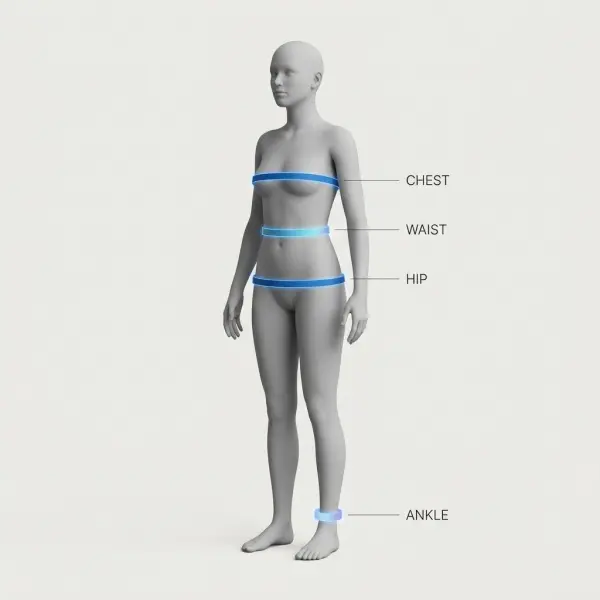
3D body scanning solves a measurement problem. Apparel fit is a larger system. A scanner can capture or estimate body geometry. It may extract chest, waist, hip, inseam, shoulder, torso, limb, and other dimensions. Some systems also produce a detailed three-dimensional mesh or statistical body model. None of those outputs independently determines whether a jacket, trouser, dress, uniform, or sports garment will fit correctly.
Garment fit still depends on:
- pattern geometry,
- garment measurements,
- wearing ease,
- fabric stretch and recovery,
- construction,
- grading,
- manufacturing tolerances,
- intended silhouette,
- posture and movement,
- customer fit preference.
That distinction is easy to lose when body scanning is presented as part of a digital fitting experience. A technically accurate customer waist measurement does not compensate for trousers whose garment specifications vary between production batches. A precise digital avatar does not fix an inappropriate base pattern. And a sophisticated size recommendation engine cannot reliably compensate for inconsistent product data indefinitely. For that reason, body scanning should usually be considered one component of a fit system rather than the fit system itself. Readers who need the technical foundation can first review how 3D body scanning works for apparel fit and sizing.
Limit 1: Measurement Accuracy Is Not Uniform
The first limitation is straightforward: “3D scanning” does not represent one standardized level of accuracy. Different systems use different sensors, camera configurations, algorithms, statistical models, landmarking methods, and measurement extraction procedures.
ISO 20685-1 exists specifically to establish evaluation protocols for dimensions extracted from 3D body scans. The standard covers the use of 3D surface-scanning systems for acquiring human body shape data and anthropometric measurements and was reviewed and confirmed in 2024. ISO 20685-1 evaluation protocol for 3D body scan measurements
That standard is important because measurement validity cannot be inferred from the visual quality of an avatar. A body model may look extremely convincing while one or more derived measurements remain less accurate than others. One apparel-focused study involving 194 men and 181 women reported mean absolute errors ranging from approximately 2.5 mm to 16 mm depending on the anthropometric measurement. Neck circumference performed considerably better than ankle circumference in the study, and missing point-cloud information contributed to some larger errors. These results apply to that scanner and processing pipeline rather than to every 3D scanning system. research on anthropometric clothing measurements from 3D body scans
The practical implication is significant. A retailer should not ask: “How accurate is your scanner?” It should ask: “How accurate and repeatable are the specific measurements we will use for this application?”
Limit 2: Scan Protocol Can Change the Result
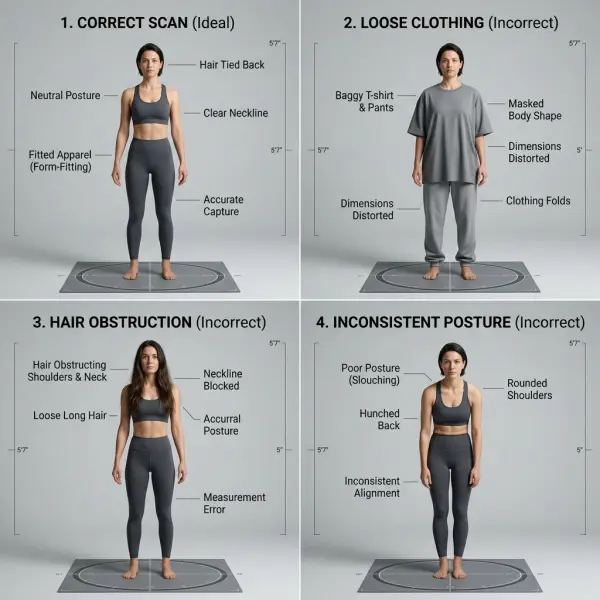
Human bodies are not rigid manufactured components. Small changes in posture can change body geometry. A person who raises the shoulders slightly, shifts weight toward one leg, changes abdominal tension, turns the feet, bends the knee, or changes arm position is presenting a different surface to the scanner.
This is why research-grade scanning protocols usually control subject position carefully. A repeatability study using an NX-16 3D body scanner, for example, required subjects to wear minimal form-fitting clothing, stand in a standardized position, remain still, and follow controlled positioning instructions. The researchers also highlighted calibration, lighting, clothing, and posture as potential sources of variability. research on test-retest repeatability in 3D body scanning
For a controlled apparel laboratory, these requirements may be manageable. For home scanning, they become much harder to guarantee.
The customer may:
- stand too close to the camera,
- rotate slightly,
- wear loose clothing,
- hold the phone at the wrong angle,
- scan in poor lighting,
- allow hair to cover the shoulder or neck,
- or misunderstand the required pose.
Each small deviation can introduce uncertainty into the measurement pipeline. This creates an important distinction between technological capability and field reliability. A system can perform very well under validated laboratory conditions while producing more variable outcomes when thousands of customers use it independently.
Limit 3: Clothing and Hair Can Distort the Captured Surface
Optical scanners generally observe surfaces. If a person wears loose clothing, the scanner captures the outside of the clothing rather than the exact underlying body contour. That is why many body-scanning studies use underwear, close-fitting garments, scan suits, or other standardized clothing. Research on optical scanning has repeatedly identified clothing as a practical variable. One recent model-based study specifically notes that conventional whole-body scanning commonly requires tight-fitting clothing and that this requirement can add time, cost, and privacy concerns to the process.
Hair can create a similar problem around the neck, shoulders, and head. For some fashion applications, small deviations may not be commercially important. For others, they can matter. A made-to-measure bodice, tailored jacket, bra, compression product, or close-fitting uniform may require more precise surface information than an oversized T-shirt. Therefore, the required accuracy should be determined by the garment application rather than by a generic technology benchmark.

Limit 4: Some Body Regions Are Difficult to Capture
Optical body scanners need visibility. Areas where body surfaces meet or where one body part blocks another can therefore be technically difficult.
Examples may include:
- the crotch,
- armpits,
- areas between the arms and torso,
- surfaces between the legs,
- feet,
- areas hidden by hair,
- highly concave body regions.
The exact problem depends on scanner architecture and pose. In the apparel measurement study discussed earlier, missing point-cloud information around certain body regions contributed to registration failures and measurement errors. This is one reason common scanning poses separate the arms from the torso and the legs from one another.
It is also why an incomplete scan should not automatically be interpreted as a complete measurement of the physical person. Software may interpolate missing geometry, fit a statistical body model, or infer dimensions using a trained algorithm. That can be extremely useful. But inferred geometry and directly observed geometry are not technically identical.
Brands evaluating a system should understand where measurement comes from: Was it directly captured, geometrically reconstructed, statistically estimated, or predicted from other variables? The distinction becomes more important as scanning moves from dedicated hardware toward image-based mobile solutions.
Limit 5: Mobile Body Scanning Trades Control for Convenience
Smartphone-based scanning removes one of the largest barriers to dedicated body scanners: location. Customers no longer need to enter a specialist booth or visit a physical measurement site. That can dramatically improve accessibility. But the trade-off is reduced environmental control.
A review of 18 mobile 3D body-scanning applications found considerable variation in capture procedures. Some required front and side photographs, others additional views, and some required a 360-degree capture. The apps also differed in how much effort customers had to make during the process. review of mobile 3D body scanning applications for apparel The same review notes that form-fitting clothing and defined poses were commonly required for the applications examined.
From a technology perspective, the process may be fast. From a retail perspective, every additional customer action creates friction. A shopper who only wants to buy a $35 T-shirt may not want to:
- download an app,
- create an account,
- change into fitted clothing,
- position a phone,
- stand several metres away,
- take multiple images,
- wait for processing,
- and authorize storage of body information.
The technology may technically function while the customer journey still fails commercially. That is why adoption should be tested within the context of the actual product category. The acceptable amount of friction for a bespoke suit is very different from the acceptable friction for an impulse-fashion purchase.
Limit 6: Customers Must See Enough Value to Complete the Scan
This is an underestimated retail constraint. Fashion technologies are often evaluated according to what they can do after the customer completes the process. Retailers also need to examine whether customers are willing to complete the process at all.
The 2023 mobile scanning review noted that fixed body-scanning systems had not achieved the broad consumer adoption once anticipated, while mobile scanning was being explored partly because it reduces access barriers.
For a consumer-facing implementation, the brand should therefore measure the entire funnel:
customer sees scanning option
→ begins the process
→ completes capture
→ receives recommendation
→ trusts recommendation
→ purchases product
→ keeps or returns product.
A highly accurate system with a low completion rate may create less business value than a slightly simpler system customers actually use. Retail operators should therefore monitor metrics such as:
- scan initiation rate,
- scan completion rate,
- failed scans,
- repeated scans,
- recommendation acceptance,
- conversion,
- return rate,
- exchanges,
- customer support contacts,
- opt-out or deletion requests.
The technology has to survive contact with real customers, not only technical validation.
Limit 7: A Body Scan Does Not Automatically Map to a Garment Size
A scanner can generate body measurements. A retailer still needs to answer: What do those measurements mean for this specific product? That requires garment data.
Suppose a scanner measures a customer's hip circumference accurately. To recommend trousers, the system may also need to know:
- the product's actual garment dimensions,
- intended ease,
- rise,
- waist-to-hip relationship,
- fabric stretch,
- cut,
- grading,
- and possibly the customer's preferred fit.
A size label alone is not enough. “Size 12” is a classification. It is not a complete geometric description of a garment. This is why body scanning cannot compensate for poor product data indefinitely.
A retailer may invest in excellent customer measurement technology only to discover that its own clothing specifications are inconsistent across suppliers, categories, seasons, or production batches. In that scenario, the limiting factor is no longer customer measurement. It is product-data quality. For the population-analysis side of this problem, see how body scan data helps brands understand real customer measurements.
Limit 8: Digital Fit Still Requires Reliable Garment Inputs
A related problem appears in virtual garment simulation. A body scan or digital avatar represents only one half of the interaction. The garment also needs to be digitized appropriately. Depending on the workflow, meaningful simulation may require:
- accurate pattern geometry,
- seam construction,
- garment dimensions,
- material parameters,
- fabric weight,
- stretch characteristics,
- bending behavior,
- pressure or collision assumptions,
- appropriate simulation settings.
A beautiful visualization is therefore not necessarily a validated fit prediction. The problem is especially relevant when virtual try-on, body scanning, and digital garment simulation are marketed together. They may be connected technologies, but their outputs should not be treated as equivalent.
A visual try-on image may answer: “What might this look like on me?” A sizing system attempts to answer: “Which commercial size should I select?”
A technical garment simulation may attempt to answer: “How might this pattern interact with this body and material under specified conditions?” Those are different questions.
Limit 9: Integration Can Be Harder Than Scanning
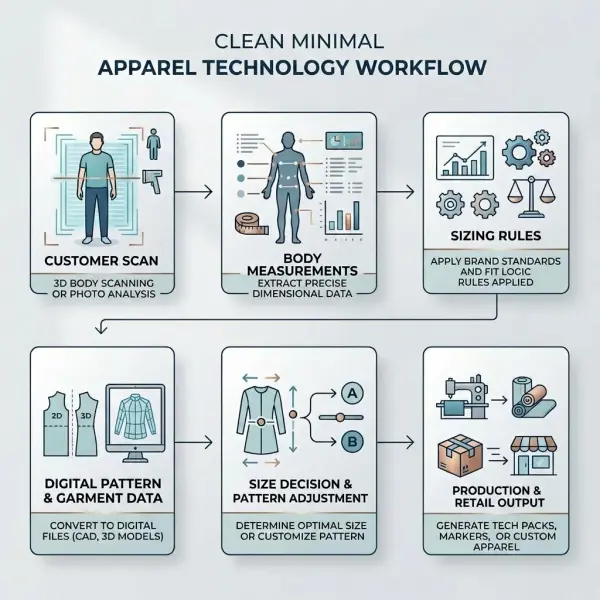
Capturing a body can take seconds. Integrating the result into apparel operations can take considerably more work. A production workflow may involve:
body scanner
→ measurement database
→ customer profile
→ size recommendation engine
→ CAD pattern system
→ product lifecycle management system
→ ERP
→ e-commerce platform
→ manufacturing instructions.
Each connection creates questions about:
- data structure,
- measurement naming,
- units,
- API access,
- file formats,
- customer identity,
- version control,
- data ownership,
- and system responsibility.
Consider a made-to-measure business. If a scan generates 150 body variables but the pattern-adjustment system uses only 20 manual measurements with different landmark definitions, the company does not yet have an automated workflow. It has two incompatible measurement systems. Data mapping has to happen before automation.
This is where implementation projects can become misleading. The scanning demonstration looks finished because a customer avatar appears immediately on a screen. Operational integration may only be beginning.
Limit 10: Scanner Data May Not Be Interchangeable
Two systems may both output a measurement called “waist circumference.” That does not necessarily prove that the measurements were obtained from precisely the same anatomical position or calculated using the same geometry. This matters particularly when:
- a company changes scanner vendors,
- combines historical manual data with new scan data,
- merges datasets from several research projects,
- or compares its data with a national anthropometric survey.
A 2026 systematic review of markerless 3D and 4D body measurement research examined 33 qualifying studies and found substantial heterogeneity in devices, software, methodologies, and statistical approaches. The authors noted that the lack of consistent procedures makes cross-study comparison difficult. 2026 systematic review of markerless 3D anthropometry
That does not mean scan datasets cannot be combined. It means compatibility should be demonstrated rather than assumed. For apparel companies building long-term body databases, measurement definitions and metadata may be almost as important as the measurements themselves.
Limit 11: Implementation Cost Extends Beyond the Scanner
The purchase price or software subscription is only one part of implementation cost. Depending on the operating model, costs can include:
- hardware,
- software licensing,
- integration,
- calibration,
- dedicated space,
- technical support,
- staff training,
- customer assistance,
- cloud processing,
- data storage,
- security,
- workflow development,
- pattern-system integration,
- and ongoing validation.
Dedicated scanning booths can impose significant physical and operational requirements. Mobile scanning can remove much of that infrastructure but transfers more of the capture process to customers and may introduce support and failed-scan costs.
For manufacturing applications, the economics become different again. If body data feeds mass customization, the factory may need:
- automated pattern adjustment,
- order-specific marker planning,
- individual cutting instructions,
- garment identification,
- unit-level production tracking,
- and a way to prevent customized orders from becoming mixed during manufacturing.
The scanning step can therefore be the cheapest part of personalized production.
Limit 12: More Accurate Fit Can Increase Production Complexity
Personalization sounds attractive because it moves clothing closer to individual bodies. Manufacturing usually benefits from the opposite principle: standardization. Ready-to-wear production achieves efficiency by grouping people into a limited number of sizes and producing repeated units. Body scanning exposes how much variation those sizes compress.
A company can respond by introducing:
- more sizes,
- additional lengths,
- alternative body-shape fits,
- made-to-measure adjustment,
- or fully individualized patterns.
Each option may improve fit for some customers. Each also adds operational complexity. Additional variations can increase:
- SKU count,
- pattern count,
- sampling,
- inventory fragmentation,
- forecasting difficulty,
- minimum-order challenges,
- warehouse complexity,
- and customer choice.
The goal should therefore not be to convert every body variation detected by a scanner into a new product. The more useful question is: Which variation is commercially important enough to justify a different garment solution? This is where anthropometric insight has to meet merchandising and operations.
Limit 13: Production Tolerance Does Not Disappear
A customer can be measured to high precision while the manufactured garment still varies. Fabric relaxation, cutting, sewing, pressing, washing, finishing, operator technique, and allowable tolerances can all affect finished dimensions. Consider a trouser whose production specification permits dimensional variation. If the sizing algorithm makes distinctions smaller than the real variation occurring in manufactured garments, the apparent precision of the recommendation can exceed the precision of the product. That is false precision.
Before investing in extremely granular body measurement, brands should ask whether their manufacturing processes can consistently produce garments at a comparable level of dimensional control. For some product categories, improving quality control may yield more immediate fit benefits than increasing customer measurement precision.
Limit 14: Static Scans Do Not Fully Represent Bodies in Motion
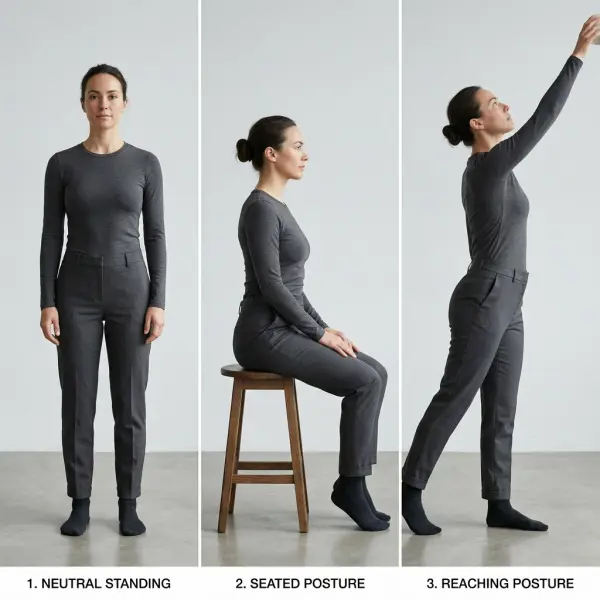
Most conventional 3D body scans capture a standardized static pose. People do not wear clothing statically. They sit, bend, reach, walk, breathe, rotate, squat, and raise their arms. Body dimensions and surface relationships can change with posture.
Research comparing standing and sitting scanned body models has shown measurable changes in several circumferences when posture changes. The exact differences depend on the body and measurement method, but the broader implication is clear: static geometry is not the whole fit problem.
This matters especially for:
- workwear,
- sportswear,
- protective clothing,
- uniforms,
- compression apparel,
- adaptive clothing,
- and close-fitting products.
A static scan may still be extremely valuable. It should simply not be interpreted as a complete simulation of movement. Physical wear testing and functional fit assessment remain relevant.
Limit 15: Body Data Creates Privacy and Governance Responsibilities
A detailed body scan is not ordinary product data. It describes a person's physical characteristics. The legal classification and required safeguards depend on jurisdiction, processing purpose, identifiability, and what information is retained. Under the European Union's General Data Protection Regulation (GDPR), information relating to an identified or identifiable living person is personal data. The European Commission also notes that pseudonymized data remains personal data when re-identification is possible. European Commission guidance on personal data under the GDPR
An important nuance concerns biometric data. Under the GDPR, biometric data is defined as personal data resulting from specific technical processing of physical, physiological, or behavioral characteristics that allows or confirms unique identification. Biometric data processed for uniquely identifying a person receives special protection. A body measurement dataset is therefore not automatically equivalent to regulated biometric identification data simply because it describes the body; the processing purpose and technical use matter. This distinction is important because privacy claims around body scanning are sometimes oversimplified in both directions. Brands should obtain jurisdiction-specific legal guidance rather than assuming every scan has the same legal classification everywhere.
Operationally, companies should still ask:
- What information do we genuinely need?
- Do we need the raw photographs?
- Do we need the full 3D mesh?
- Would derived measurements be sufficient?
- How long should those records be retained?
- Can data be deleted independently of the customer account?
- Who can access it?
- Does the scanning provider retain a copy?
- Can it be used to train other models?
- Where is it processed and stored?
If a brand cannot answer those questions, the implementation is not complete.
Limit 16: Consumer Trust Matters as Much as Legal Compliance
Legal permission does not automatically create customer comfort. Body scanning can require customers to photograph themselves in close-fitting clothing or create a detailed digital representation of their shape. Some customers will consider that convenient. Others may find it intrusive. A retailer therefore needs to communicate clearly:
- what is being captured,
- why it is required,
- what outputs are generated,
- how long data is retained,
- whether images or scans are stored,
- and how customers can manage their information.
The experience should also avoid implying that customers need to change their bodies to fit the brand's system. The purpose of body measurement in apparel is to help products interact with people—not to turn the human body into a pass/fail sizing standard. This is partly an ethical issue, but it is also commercial design. A customer who does not trust the scanning experience will not provide high-quality data because they will simply avoid the process.
When Does 3D Body Scanning Make Strong Commercial Sense?
The technology tends to become more compelling when measurement has high value, repeated manual measurement is expensive, or incorrect fit has meaningful consequences. Potentially strong applications include:
- Made-to-measure apparel.
Individual measurements directly influence the product being manufactured. - Uniform programs.
Organizations may need to size large workforces consistently across multiple locations. - Protective and performance clothing.
Body dimensions and functional fit may have greater operational importance than in loosely fitted fashion products. - Anthropometric sizing research.
Large collections of scan data can support size-chart and population analysis. - Specialized fit segments.
Brands serving populations poorly represented by conventional sizing may gain useful evidence from detailed body data. - High-value e-commerce categories.
When returns are expensive and fit strongly affects purchase decisions, measurement assistance may justify additional customer friction.
The technology case is weaker when the underlying product is forgiving, low-value, inconsistently manufactured, or poorly documented.
When Might 3D Body Scanning Be Overkill?
A basic oversized T-shirt provides a useful example. Suppose a brand sells an intentionally loose silhouette made from forgiving knit fabric. Customers already understand the sizing, return rates are low, and garment dimensions are consistent. A detailed body scan may generate technically interesting data without materially improving the purchase decision.
The same investment could potentially create more value if spent on:
- clear garment measurements,
- better size charts,
- model measurements,
- fit notes,
- consistent product photography,
- better quality control,
- or clearer comparisons with previous products.
Technology should therefore be proportional to the uncertainty it is meant to remove. 3D scanning is not inherently superior to simpler tools when those simpler tools already solve the problem.
A Practical Decision Framework for Fashion Businesses
Before adopting body scanning, a retailer or apparel manufacturer can evaluate the project through five questions.
|
Decision Question |
What to Examine |
|
What problem are we solving? |
Returns, custom fitting, size-chart design, uniform allocation, research, or another specific problem |
|
Is body measurement actually the limiting factor? |
Check pattern, grading, garment data, manufacturing consistency, and customer communication first |
|
How accurate must the data be? |
Determine tolerance according to garment category and application |
|
Can the data change an operational decision? |
Scan output must connect to sizing, pattern, manufacturing, or retail logic |
|
Is the value greater than the added complexity? |
Consider technology, integration, support, privacy, inventory, and customer friction |
A useful rule follows from this framework: Do not scan customers simply because scanning is possible. Scan when the resulting information changes a decision that matters.
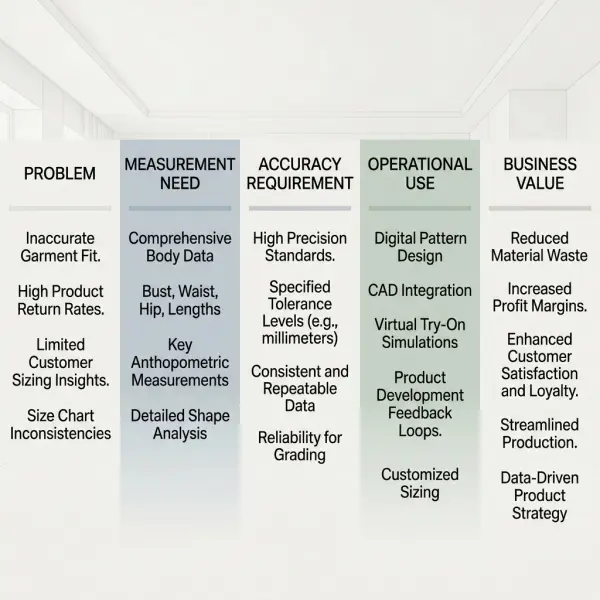
A Better Implementation Strategy: Start Narrow
Brands do not need to connect body scanning to the entire organization on day one. A controlled pilot is usually more informative. For example, an online trouser retailer could test the system on one stable product family. The pilot might compare:
- existing size recommendation,
- scan-based recommendation,
- customer-selected size,
- purchase conversion,
- exchanges,
- returns,
- return reasons,
- scan completion,
- and customer feedback.
The technical team should separately verify measurement repeatability and product-data accuracy. If the pilot demonstrates meaningful improvement, the system can expand. If it does not, the company has learned where the real limitation sits.
Perhaps measurement accuracy is inadequate. Perhaps customers abandon the scan. Perhaps recommendations are accurate but garments vary too much. Perhaps the existing size chart is the problem. Perhaps customers simply prefer a different fit.
A narrow implementation makes these failures diagnosable. A company-wide rollout can hide them.
Common Strategic Mistakes
Buying the Scanner Before Defining the Problem
A technology demonstration can create enthusiasm before anyone identifies which business metric is supposed to improve. The result is often a data-collection project rather than a fit-improvement project. Start with the decision. Then select the measurement method.
Trusting Vendor Accuracy Claims Without Independent Validation
A single headline accuracy figure is rarely sufficient. Brands should ask which measurements were evaluated, against what reference, on what population, under which capture protocol, and with what error distribution. ISO 20685-1 provides a useful framework for thinking about validation rather than relying only on marketing specifications.
Assuming More Measurements Must Produce Better Recommendations
Hundreds of variables do not automatically produce a better model. Only measurements that relate meaningfully to the fit decision add value. Complex models can also become harder to validate and maintain.
Ignoring the Garment Side of the Equation
Body data without reliable product measurements creates only half a sizing system. The retailer should audit product specifications before expecting scanning to solve customer fit.
Treating Consumer Scanning Like Laboratory Scanning
A method validated under controlled lighting, clothing, posture, and operator supervision may behave differently when customers scan themselves at home. Retail validation should reproduce actual use conditions.
Collecting More Personal Data Than Necessary
If a recommendation requires only derived measurements, retaining raw photographs and full meshes indefinitely may create unnecessary governance exposure. Data minimization should be part of system architecture rather than an afterthought.
Measuring Success Only Through Returns
Returns are useful but noisy. Customers return clothing for many reasons unrelated to fit. A stronger evaluation considers scan completion, conversion, exchange behavior, size-related return reasons, recommendation acceptance, customer satisfaction, and garment-level fit performance together.
What Brands Should Verify Before Implementation
A serious evaluation should cover four areas.
- Measurement validation Determine which dimensions matter and whether they are sufficiently accurate and repeatable under realistic conditions.
- Product-data readiness Confirm that size charts, garment specifications, patterns, and fit rules are reliable enough to use the customer measurements.
- Operational integration Map exactly where scan data enters the workflow and which system turns it into an action.
- Commercial and customer viability Test whether customers complete the process and whether the improvement justifies the added cost and complexity.
The strongest body-scanning implementation is therefore not necessarily the one with the most advanced scanner. It is the one where measurement, product, operations, and customer experience all connect.
FAQ: Practical Limits of 3D Body Scanning
Are 3D body scanners accurate enough for apparel?
Some are, for specific measurements and applications, but accuracy should be validated measurement by measurement. Research has shown that 3D systems can achieve strong agreement with reference measurements, while also showing that error can differ substantially between body dimensions and scanning methods. For apparel businesses, the relevant threshold depends on the product. A loose sweatshirt and a made-to-measure tailored garment do not require the same precision. Brands should therefore avoid asking whether a scanner is simply “accurate” and instead verify whether its performance is sufficient for the measurements and tolerances used in their specific fit workflow.
Can customers scan themselves accurately at home?
They can with some systems, but home capture introduces more uncontrolled variables than a supervised scanning environment. Phone position, clothing, lighting, pose, distance, hair, available space, and customer compliance can affect the process. Mobile scanning applications also use different capture mechanisms, ranging from a few photographs to more extensive capture sequences. A retailer should therefore validate performance with ordinary customers using their own devices and homes rather than relying exclusively on laboratory tests. The relevant metric is not just measurement accuracy among successful scans, but also how frequently customers can produce a usable scan without assistance.
Will body scanning automatically reduce fashion returns?
Not necessarily. Fit-related returns can potentially be addressed when better body information improves the size decision, but returns also occur because of style preference, color, fabric feel, quality, delivery, inaccurate photography, buyer behavior, and many other factors. Even a fit-related return may originate from inaccurate garment data rather than customer measurement. Brands should therefore test the effect on clearly identified size- or fit-related return reasons rather than assuming that total returns will fall automatically. A controlled pilot comparing products and customer cohorts is more credible than attributing every return change to scanning technology.
Is smartphone body scanning less accurate than a dedicated scanner?
Not universally. The systems operate differently, and performance depends on hardware, algorithms, measurement definitions, capture conditions, and the specific dimension being estimated. Dedicated scanners generally provide more control over lighting, sensors, pose, and environment, while smartphone systems provide far greater accessibility. Mobile systems may also use statistical estimation in addition to directly captured geometry. For commercial selection, the useful comparison is not “phone versus booth” in the abstract. Brands should compare validated performance, customer friction, required measurements, integration capability, and cost for their intended use case.
Can 3D scanning replace physical fit testing?
Usually not completely. Scanning is highly useful for describing body geometry and testing digital assumptions, but garments also have to work during movement and real wear. Fabric response, pressure, balance, comfort, restriction, dressing ease, construction, and subjective fit preference are not fully represented by a static body scan. Digital workflows can reduce the number of unnecessary physical iterations and allow teams to explore more bodies, but physical fit evaluation remains important for many categories—especially performance apparel, workwear, structured garments, and products where movement is central to function.
What is the biggest operational barrier to 3D body scanning?
For many fashion businesses, the hardest problem is not capturing the scan but connecting it to usable garment decisions. Body measurements must align with size tables, product measurements, fit rules, digital patterns, and manufacturing systems. If those data are inconsistent, a technically excellent scan can still produce weak recommendations. Retailers should therefore evaluate product-data maturity before treating body measurement as the main problem. In many implementations, the scanner is one relatively contained component inside a much larger data and apparel-engineering workflow.
Is storing a customer's 3D body scan legally the same as storing biometric identification data?
Not automatically. Legal classification depends on jurisdiction and purpose. Under the GDPR, information relating to an identifiable person is personal data. Biometric data has a more specific definition involving technical processing of physical, physiological, or behavioral characteristics that enables or confirms unique identification, and biometric data used for uniquely identifying a person receives special protection. A fashion company should therefore not casually label every measurement as biometric identification data—or assume that body scans have no special privacy implications. Jurisdiction-specific legal review and a clearly defined data-governance policy are appropriate before deployment.
Should a small fashion brand invest in 3D scanning?
Only when it solves a clearly valuable problem that simpler methods cannot solve adequately. A small brand struggling with inconsistent factory measurements, incomplete size charts, or weak grading may get greater value from fixing those fundamentals first. Scanning becomes more compelling when customer body data directly supports a high-value use case such as custom clothing, specialized fit, anthropometric research, or a validated e-commerce sizing workflow. The decision should be based on expected operational value, not on technological sophistication.
Conclusion
3D body scanning can make human body data more detailed, scalable, and useful for apparel businesses. Its limitation is not that the technology fails to work. The limitation is that apparel fit involves much more than body measurement. A scan can be influenced by posture, clothing, occlusion, environment, software, landmark definitions, and measurement algorithms. Consumer-facing systems add another layer of uncertainty because customers must perform the scan correctly and see enough value to complete the process.
After capture, an equally difficult problem begins. The data must connect to accurate garment specifications, pattern systems, sizing rules, production workflows, customer preferences, and privacy controls. That makes 3D scanning most valuable when it is applied selectively. A strong implementation begins with a clearly defined fit or measurement problem, identifies the minimum data needed to solve it, validates the technology under realistic conditions, connects the result to an operational action, and measures whether that action improves the business outcome.
For fashion companies, the mature question is therefore no longer: “Can we scan the customer?” It is: “What decision becomes meaningfully better because we scanned the customer?” That distinction separates useful apparel technology from technology that merely produces impressive data.





Comments 0
Leave a CommentSend Comment
Anda harus Login terlebih dahulu untuk dapat memberikan komentar.