

Elastic vs Fixed Waistbands: Function, Comfort, and Fit
Choosing between an elastic waistband and a fixed waistband is not simply a question of whether a garment should feel casual or tailored. The decision changes how the garment accommodates body variation, how precisely it must be fitted, how it behaves during movement, how the waistline looks, and how the product is manufactured.
A fixed waistband generally maintains a relatively controlled circumference and relies on accurate pattern shaping plus a closure such as a zipper, button, hook, or snap. An elastic waistband deliberately stretches beyond its relaxed dimension, allowing the garment to expand during dressing, movement, or changes in posture before recovering toward its original size.
Neither system is inherently more comfortable or better made. A carefully engineered fixed waistband can feel extremely comfortable, while an elastic waistband that applies excessive tension can feel restrictive despite its stretch. The appropriate choice depends on garment category, intended silhouette, fabric, fit strategy, target customer, manufacturing method, and how much size accommodation the product is expected to provide.
Quick Answer: What Is the Difference Between Elastic and Fixed Waistbands?
An elastic waistband uses elastic material to provide extensibility and recovery around the waist, allowing the garment circumference to expand and contract. A fixed waistband relies primarily on non-elastic or stabilized construction to maintain a defined circumference and usually requires an opening or closure so the garment can pass over the hips.
Elastic waistbands generally offer greater fit tolerance, easier dressing, and more accommodation during movement. Fixed waistbands provide more controlled shaping, cleaner tailoring, and a more stable relationship between the garment waist, rise, closure, pockets, and belt loops.
The choice should not be reduced to comfort versus appearance. Elastic can be visible, concealed, partially integrated, or combined with structured sections, while fixed waistbands can be designed with stretch fabrics or shaped patterns that improve comfort substantially. For fashion businesses, the better question is: how much flexibility, visual structure, size precision, and manufacturing complexity does this product actually need?
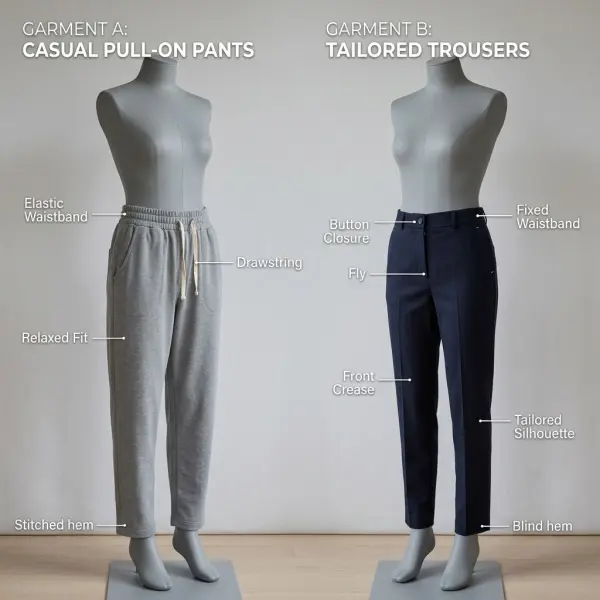
What Is an Elastic Waistband?
An elastic waistband is a waist-finishing system that uses elastic material to create controlled stretch around the body. The elastic can sit inside a casing, be stitched directly to the garment, form the visible waistband itself, or be incorporated only into selected areas such as the back or side waist.
The basic mechanical idea is simple: the waistband is smaller in its relaxed state than the circumference it can reach when stretched. This allows the garment to expand sufficiently for dressing, sitting, bending, or body movement and then contract again when the load is released.
The elastic itself is therefore not merely a trim. Its width, construction, extension, recovery, tension, softness, and durability all influence the finished product. Different elastic types are designed for different uses. Sewing & Craft Alliance guidance, for example, distinguishes lightweight braided elastic commonly used inside casings from firmer no-roll elastic intended to resist twisting at waistlines, as well as softer elastic developed for lightweight garments. waistband elastic types and characteristics
For product developers, this means that specifying only “elastic waistband” is rarely sufficient. The garment may behave very differently depending on whether the elastic is narrow or wide, soft or firm, enclosed or exposed, free-moving or stitched through several times.
What Is a Fixed Waistband?
A fixed waistband is designed to maintain a substantially defined circumference rather than providing major expansion through elastic. It is typically shaped through the pattern and may be stabilized with interfacing or other structural materials.
Because a fixed waistband usually cannot stretch enough to pass over the hips, the garment commonly requires a zipper, button opening, hook-and-bar closure, placket, or another opening system. The waistband may be straight, contoured, faced, extended from the garment body, or assembled as a separate component.
Its primary advantage is control. The designer can establish a precise waistline, maintain a crisp silhouette, position belt loops and closures accurately, and coordinate the waistband with the rise and upper garment structure.
That precision also reduces tolerance for incorrect fit. If the waistband circumference, contour, rise, or closure position is wrong, the wearer has less flexibility available to compensate than with a highly elasticized system.
Readers who need the construction fundamentals behind these components can refer to Waistband Construction Explained for Pants, Skirts, and Shorts.
Elastic vs Fixed Waistbands at a Glance
The most useful distinction is not simply whether elastic exists, but where the garment obtains its stability and where it obtains its flexibility.
|
Factor |
Elastic Waistband |
Fixed Waistband |
|
Waist expansion |
Designed to stretch substantially |
Usually limited |
|
Fit tolerance |
Generally broader |
Generally more precise |
|
Dressing |
Often pull-on |
Usually requires closure |
|
Waist definition |
Can be soft or gathered |
Usually more controlled |
|
Movement accommodation |
Often high |
Depends heavily on fit and fabric |
|
Closure requirement |
Often unnecessary |
Commonly required |
|
Size sensitivity |
More forgiving within design limits |
More dependent on accurate sizing |
|
Visual character |
Casual to technical, although not exclusively |
Tailored to structured, although not exclusively |
|
Belt-loop integration |
Possible but less typical on very soft systems |
Common and structurally straightforward |
|
Pattern precision |
Still important, but elasticity adds accommodation |
Particularly important |
|
Production complexity |
Can be relatively simple, but not always |
Often involves more components and operations |
|
Alteration behavior |
Elastic may sometimes be replaceable or adjustable |
Usually requires pattern/seam alteration |
These are tendencies rather than universal rules. A concealed-elastic tailored trouser can appear almost identical to a fixed-waist trouser, while a decorative exposed elastic can become a deliberate fashion feature rather than simply a casual construction shortcut.

How Elastic Waistbands Create Comfort
Elastic waistbands often feel comfortable because they can accommodate changes in circumference during normal movement. When a wearer sits, bends, eats, breathes deeply, or changes posture, abdominal and waist dimensions do not remain perfectly constant.
Elastic can absorb some of those changes without requiring the entire garment to shift position. This is particularly useful in loungewear, pajamas, casual pants, children's clothing, some uniforms, maternity-adjacent designs, adaptive apparel, and many sports or movement-oriented products.
However, stretch alone does not guarantee comfort.
Elastic creates tension as it stretches. If the elastic is cut too short, has excessive modulus for the application, is too narrow for the required load, or concentrates pressure over a small area, the waistband can dig into the body. Sewing guidance therefore recommends selecting elastic with appropriate recovery and ensuring it is snug enough to hold the garment without becoming uncomfortable. guidance for choosing and sewing garment elastic
A wider waistband can sometimes distribute pressure over a larger surface area, but width alone does not solve poor tension. Comfort comes from the interaction between elastic force, waistband width, garment weight, body shape, fabric behavior, and the amount of stretch required during wear.
Why Fixed Waistbands Can Also Be Comfortable
Fixed waistbands are sometimes described as less comfortable because they lack elastic expansion, but that comparison is too simplistic.
A well-drafted fixed waistband follows the intended body position rather than relying on compression to hold the garment in place. When waist circumference, contour, rise, hip shaping, and closure placement are correct, the wearer may experience little noticeable pressure.
This is particularly important in tailored trousers and skirts. Instead of stretching significantly as the wearer moves, the garment distributes fit through pattern geometry: darts, side seams, center-back shaping, curved waistband sections, rise length, seat shaping, and sometimes controlled ease.
Fabric can also contribute limited flexibility. A fixed waistband constructed from a stretch woven shell may accommodate movement differently from one made from rigid denim or tightly woven suiting, although stabilization may intentionally limit some of that stretch.
The trade-off is precision. A fixed waistband cannot compensate as easily for differences between the intended body dimensions and the actual wearer. Fit problems elsewhere in the garment can also be transferred toward the waist, making the waistband feel tighter even when its flat circumference appears technically correct.
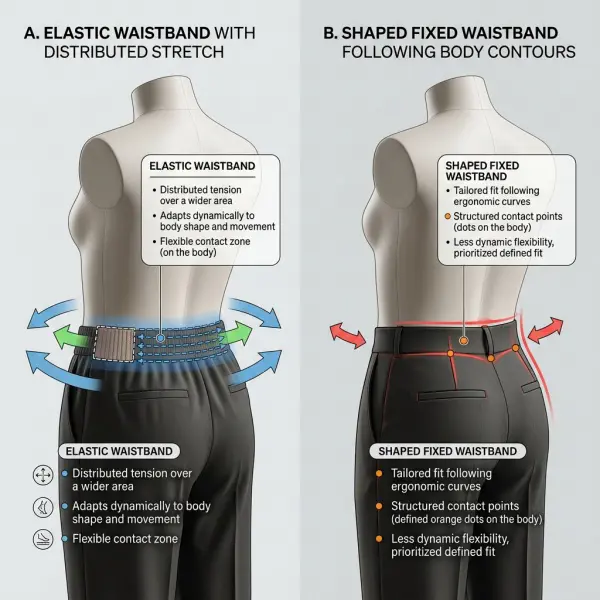
Fit Tolerance: Where Elastic Has a Clear Functional Advantage
One of the most commercially useful properties of elastic is fit tolerance. A garment can accommodate a range of waist circumferences because the waistband is not restricted to a single fixed dimension.
That tolerance can be valuable for fashion businesses dealing with relaxed-fit products, simplified size ranges, children's growth, uniforms, rental garments, or products where customers expect easy pull-on dressing. It can also reduce the precision required at the waist relative to a closely fitted fixed-band garment.
But fit tolerance has limits.
An elastic waistband may accommodate variation at the waist while the hip, rise, thigh, or seat remain incorrectly sized. A customer who can technically pull on a pair of pants may still experience poor crotch fit, pocket distortion, excessive gathering, or insufficient hip room.
Elastic therefore broadens some dimensions of fit; it does not make conventional pattern grading unnecessary.
The design team still needs to determine how much fabric is being gathered into the elastic waist. Excessive difference between garment waist circumference and relaxed elastic circumference can create bulky gathers, especially in thick fabrics. Too little difference may reduce the pull-on opening or fail to create enough tension to keep the garment secure.
Fixed Waistbands Provide More Silhouette Control
Where elastic provides accommodation, fixed construction provides control.
A structured waistband can hold a relatively stable upper edge, support a front closure, create a defined waistline, and provide a consistent platform for belt loops, pockets, pleats, and tailoring details.
This is especially useful when the silhouette depends on precision. Tailored trousers, fitted pencil skirts, formal shorts, uniform pants, and many denim styles rely on a consistent relationship between the waistband and the garment below it.
Fixed waistbands can also maintain a cleaner surface because they do not inherently need to gather the shell fabric around the waist. That matters when the design calls for uninterrupted vertical lines, sharp pleats, pressed creases, or fitted upper-hip shaping.
There is still room for variation. A contoured waistband can follow body curvature, a stretch woven can introduce limited give, and the waistband can be engineered with hidden flexible sections without changing the visible silhouette substantially.
This is one reason the market increasingly contains hybrid solutions rather than a strict binary between elastic and fixed construction.
The Rise of Hybrid Waistband Systems
A hybrid waistband combines structured and elasticized zones to balance appearance with fit accommodation.
One common configuration uses a fixed front waistband and elasticized back. From the front, the garment maintains a relatively clean tailored appearance, while the back section expands to accommodate movement and waist variation.
Other possibilities include:
- concealed elastic inside side sections;
- adjustable elastic inside children's waistbands;
- elastic inserts positioned behind belt-loop areas;
- stretch panels incorporated into workwear waistbands;
- internal elastic stabilizers inside otherwise structured garments;
- drawstring-and-elastic combinations in casual or active products.
Hybrid systems are useful because waistband requirements are often contradictory. A customer may want trousers that look structured but feel forgiving after several hours of wear. A uniform buyer may want a professional appearance while also needing one product to accommodate a wider range of body shapes.
The compromise is additional engineering. Transitions between fixed and stretch sections must remain smooth, elastic extension needs to be controlled, and grading must account for how much each section contributes to the total waist circumference.
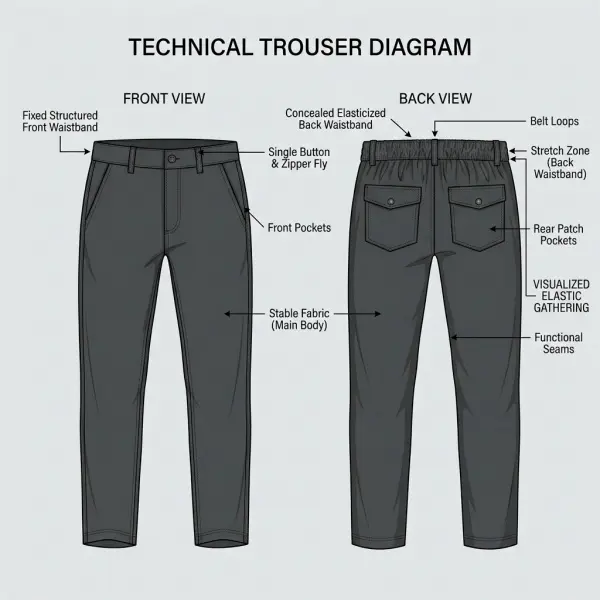
How Casing Construction Changes Elastic Performance
Elastic waistbands are often built using a casing: a fabric tunnel through which the elastic passes. The casing may be created by folding the garment edge inward or by attaching a separate strip of fabric.
Sewing & Craft Alliance guidance defines a casing as a tunnel used for elastic or drawstrings and identifies pull-on pants, skirts, pajamas, and exercise shorts as common waistband applications. It also notes that sufficient clearance is needed for the elastic to move through the casing without encouraging unnecessary twisting. waistband casing construction guidance
The relationship between elastic and casing affects the final garment considerably. A casing that is too tight may restrict elastic movement or create friction. One that is disproportionately loose may allow the elastic to fold or twist.
Material bulk matters as well. Folding medium- or heavyweight shell fabric into an elastic casing can create several layers around the waist. A separately applied casing made from lighter fabric is one way to reduce that buildup in suitable designs. Sewing & Craft Alliance specifically describes lightweight applied casings as an option for reducing bulk in heavier fabrics.
Not All Elastic Behaves the Same Way
Product developers should avoid treating elastic as a commodity component with interchangeable performance.
Elastic products vary in width, thickness, construction, extension, recovery, softness, and resistance to rolling. Some are designed primarily for casings, while others are suitable for direct attachment to fabric.
For example, braided elastic can become narrower when stretched and is generally suited to enclosed casing applications, whereas knitted and woven elastics may be used in a broader range of constructions depending on the product specification.
At development stage, teams should assess at least:
- Extension: how far the elastic needs to stretch during dressing and movement.
- Recovery: how effectively it returns toward its original dimension after extension.
- Tension: how much force the wearer experiences at the intended circumference.
- Width: whether pressure is distributed appropriately and whether the width suits the visual design.
- Thickness: whether it creates undesirable bulk.
- Rolling or twisting behavior: particularly in wide waistbands or loose casings.
- Care compatibility: whether laundering, heat, or other expected care conditions affect performance.
- Attachment method: whether the elastic is free inside a casing or stitched directly to the garment.
A waistband sample should therefore be tested as a complete assembly rather than evaluating the elastic only in its unused state.
Elastic Recovery Matters More Than Stretch Alone
Stretch describes how far an elastic can extend, but recovery describes what happens afterward. For a waistband, both matter.
A highly extensible elastic that does not recover adequately can allow the garment to become loose after repeated use. Conversely, an elastic with strong recovery but excessive tension may hold its dimension while producing an uncomfortable waistband.
Recovery is particularly relevant because waistbands experience repeated cycles of loading. Pull-on garments stretch every time they pass over the hips, and elastic continues to extend and contract as the wearer moves.
This is why sampling should include repeated use rather than a single fitting session. Teams should observe whether the waistband returns close to its intended relaxed circumference, whether the fabric gathers redistribute evenly, and whether stitching limits the elastic in unintended ways.
Care testing also matters. The garment's real performance is determined after sewing, finishing, laundering, and wear—not simply by the technical characteristics of unused elastic.
How Garment Weight Influences the Choice
A waistband does not only fit the body; it also carries part of the garment's weight.
Light pajama shorts place relatively little load on the waist, while heavy denim, cargo trousers, or garments with multiple loaded pockets can demand considerably more support. An elastic that feels comfortable in a lightweight garment may not provide enough holding power for a heavier product.
Increasing elastic tension can improve security, but that can shift the problem toward pressure and discomfort. Designers may instead use wider elastic, structural reinforcement, a drawstring, a fixed waistband, belt loops, or a hybrid solution.
This is an important commercial consideration for products with large pockets. The garment may fit properly when empty but sag once the wearer loads a phone, wallet, tools, or other items into the pockets.
Waistband design should therefore be considered alongside pocket construction and functional details, particularly for workwear, cargo products, travel garments, and utility-oriented apparel.
Elastic vs Fixed Waistbands by Garment Category
Tailored Trousers
Fixed or predominantly structured waistbands remain a logical choice when the garment depends on precise shaping, fly construction, crease lines, belt loops, and a clean tailored waist.
Elastic can still appear in concealed back or side sections where greater accommodation is desirable. The challenge is maintaining the intended silhouette when those areas extend.
Casual Pull-On Pants
Elastic construction is often well suited to relaxed trousers where dressing convenience and everyday comfort are major priorities.
Fabric selection remains important. Soft lightweight fabrics can gather smoothly into elastic, whereas heavy or stiff fabrics may create excessive bulk around the waist unless the pattern or casing is adapted.
Skirts
Both systems can work effectively. A fitted pencil skirt may benefit from a structured waistband or faced waist, while gathered, casual, or pull-on skirts often pair naturally with elastic.
The amount of fabric controlled at the waist deserves attention. Large skirt circumference compressed into a relatively small elastic waist creates more gathering than a lightly flared pattern.
Shorts
Shorts cover an unusually broad range of waistband systems because the category includes tailored shorts, denim shorts, uniforms, lounge shorts, swim-adjacent products, and sportswear.
The waistband therefore needs to follow intended use rather than the garment label. A tailored Bermuda short and running short solve completely different fit and movement problems.
Workwear and Uniforms
Hybrid systems can be especially useful where professional appearance, repeated movement, long wearing periods, and body-size variability occur together.
Durability becomes critical. Elastic performance, closure reinforcement, pocket loading, laundering frequency, and ease of replacement may matter more than they would in occasional fashion wear.
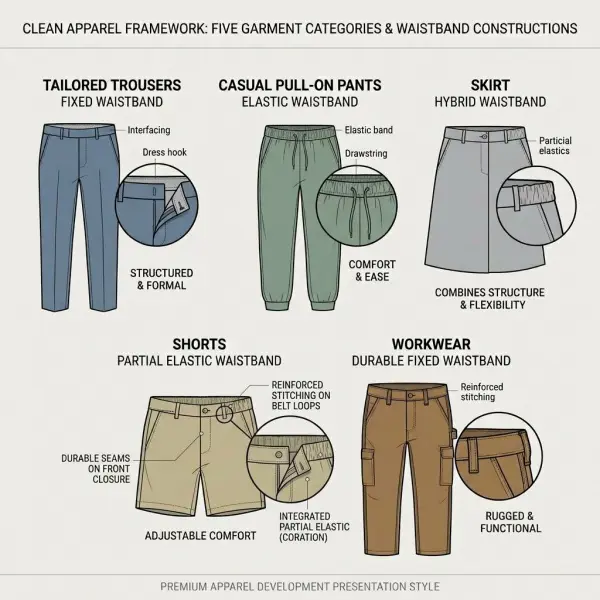
Sizing Implications for Fashion Brands
Elastic waistbands can make sizing more forgiving, but brands should resist the temptation to use stretch as a substitute for thoughtful grading.
A pull-on pant may cover a broader waist range within one size, yet the customer still needs sufficient hip room to put the garment on and enough rise and thigh room for comfortable movement. The fit experience is therefore constrained by whichever dimension has the least accommodation.
This becomes particularly important for one-size or very broad dual-size products. A waistband may stretch across the advertised range while the shell fabric does not provide corresponding accommodation elsewhere.
Fixed waistbands typically require tighter dimensional control because the finished waist circumference is less flexible. That can make sizing clearer for fitted garments but also increases sensitivity to variation in body shape.
For both systems, brands should fit-test across the intended size range rather than approving only the base size. Elastic tension, gather distribution, waistband depth, rise proportion, and visual appearance can change as patterns are graded.
Manufacturing and Cost Trade-Offs
Elastic waistbands are often assumed to be cheaper because a basic casing can eliminate zipper installation, buttonholes, waistband interfacing, and some precise closure operations. For straightforward pull-on products, that can indeed simplify assembly.
But elastic construction is not automatically the lowest-cost option.
Wide exposed elastic, specialized branded elastic, multi-row topstitching, drawcord systems, adjustable mechanisms, or complex hybrid waistbands can add material and sewing operations. Operators must also control gathering consistently, and incorrect elastic tension can create measurable quality variation.
Fixed waistbands often involve more pattern pieces and operations: interfacing, facing, pressing, closure assembly, end finishing, topstitching, and sometimes belt loops. Those steps can increase labor and require more precise sewing.
The commercial comparison should therefore be based on the actual bill of materials and standard minute value of the selected construction rather than a general assumption that elastic equals inexpensive and fixed equals premium.
How Waistbands Affect Product Positioning
Waistband construction can contribute to how customers interpret a garment, although it should not be treated as a rigid style code.
A fully gathered elastic waist often communicates ease, informality, adjustability, or movement. A clean fixed waistband may support a sharper tailored impression. Exposed branded elastic can create a sporty or underwear-influenced visual language, while concealed elastic can deliver flexibility without noticeably changing the exterior.
This creates useful opportunities for product teams. Instead of treating elastic as something that must be hidden, a brand can decide whether it should be invisible engineering or an intentional visual feature.
The decision needs to remain consistent with the rest of the garment. A highly structured wool trouser with a visibly gathered elastic waistband sends a different message from one with discreet side elastic. Neither is automatically wrong, but each establishes different expectations regarding fit, formality, and styling.
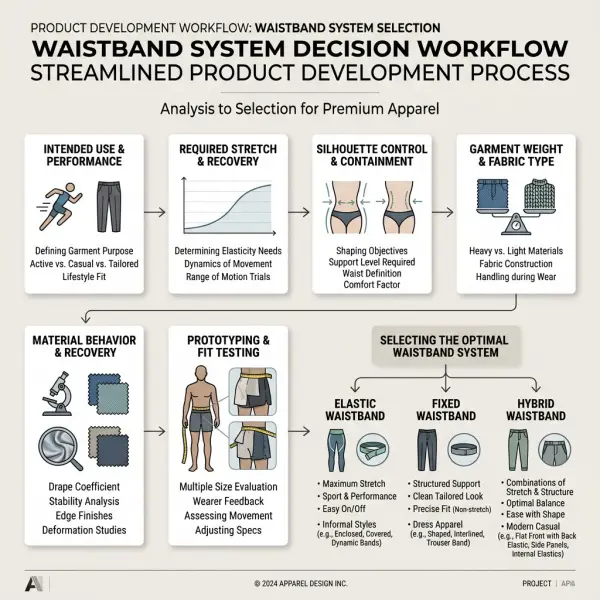
How to Choose Between Elastic and Fixed Waistbands
A useful selection process starts with intended use rather than construction preference.
Ask first how the garment should behave on the body. If users need easy pull-on dressing, significant movement accommodation, or a broad waist tolerance, elastic becomes attractive. If the silhouette depends on precise waist positioning, strong tailoring, belt use, or an integrated fly system, fixed construction may be more suitable.
Then consider the material. Lightweight fabric may gather cleanly around elastic; thick fabric may create excessive bulk. Stretch woven fabric can make a fixed waistband more forgiving, while slippery lightweight fabric may require additional control even in an elasticized construction.
Product teams can evaluate five questions:
- How much must the waist expand during dressing and movement?
- How precisely should the garment sit at a defined waist position?
- How much gathering or surface fullness is visually acceptable?
- How heavy is the garment and what must the waistband support?
- Does the desired appearance require visible structure, flexibility, or both?
The answer may also point toward a hybrid rather than either extreme.
Practical Application for Fashion Businesses
For brands and manufacturers, waistband selection should be validated during product development rather than decided from a sketch alone.
Begin with the intended wearing position and fit profile. Establish whether the garment should sit securely at the natural waist, float around the upper hip, compress lightly, or accommodate substantial movement.
Next, prototype the waistband using production-intent materials. Elastic should be tested at the intended length and attachment method, while fixed waistbands should be evaluated with the intended shell fabric, interfacing, facing, and closure.
Fit testing should include dressing, walking, sitting, bending, and repeated wear. For elastic systems, observe tension and recovery. For fixed systems, look for pressure, gaping, shifting, or distortion around the rise and upper hip.
Finally, document measurable standards. An approved waistband should not exist only as a visual sample; technical documentation should define relevant dimensions, materials, elastic specification, attachment method, stretch expectations where applicable, closure placement, and quality criteria.
Common Strategic Mistakes When Choosing a Waistband
Assuming Elastic Automatically Means Better Comfort
Elastic can accommodate movement, but excessive tension can create persistent pressure around the waist. Comfort should be evaluated through actual wear testing rather than inferred from stretch alone. The correct elastic construction must hold the garment securely without requiring unnecessary compression.
Using Elastic to Compensate for Weak Pattern Grading
Elastic can broaden waist accommodation but cannot solve insufficient hip, rise, seat, or thigh dimensions. When a product fits a wide waist range only because the elastic stretches while the rest of the pattern remains restrictive, customers may experience inconsistent fit despite technically fitting within the size chart.
Selecting Elastic Only by Width
Two elastics of similar width may have very different stretch, recovery, firmness, thickness, and intended use. Width is only one specification. Sampling should evaluate the actual material under expected garment loads and care conditions.
Assuming Fixed Waistbands Must Feel Restrictive
Restriction usually comes from the interaction of waistband dimensions, body shape, rise, fabric, stabilization, and pattern design rather than from the absence of elastic alone. A carefully shaped fixed waistband can provide secure fit without excessive pressure.
Treating a Hybrid Waistband as a Simple Compromise
Adding elastic to the back of a trouser does not automatically produce the best of both systems. The elasticized and fixed sections need coordinated pattern dimensions, extension limits, seam transitions, and grading. Poor integration can make the front appear structured while the back collapses or gathers excessively.
What Brands Should Verify Before Production
Elastic and fixed waistbands should be evaluated against different risks.
For elastic products, verify recovery, tension, extension required for dressing, casing compatibility, gather distribution, rolling behavior, attachment security, and performance after care testing.
For fixed products, verify waist circumference, waistband contour, closure alignment, interfacing compatibility, seam bulk, upper-hip relationship, and comfort during movement.
Hybrid constructions require both sets of checks.
The most important principle is to test the waistband within the finished garment. Elastic tested on a worktable does not experience the same loads as elastic supporting trousers, and a fixed waistband measured flat does not reveal how the rise and body curvature affect comfort.
Detailed defect diagnosis—including rolling, gaping, twisting, stretching, puckering, and closure distortion—belongs to the next article in this cluster, Common Waistband Problems and How to Prevent Them.
Frequently Asked Questions About Elastic and Fixed Waistbands
Are elastic waistbands always more comfortable than fixed waistbands?
No. Elastic waistbands can improve accommodation during movement, but comfort depends on elastic tension, width, recovery, fabric bulk, garment weight, and body shape. An overly tight elastic waistband can create more pressure than a properly fitted fixed waistband. Fixed waistbands rely more heavily on accurate pattern shaping, but when the waist, rise, and upper hip are correctly balanced, they can feel secure without significant compression. Wear testing is therefore more useful than judging comfort from construction type alone.
Which waistband is better for fluctuating waist measurements?
Elastic or hybrid waistbands generally provide more accommodation when waist circumference changes within the garment's intended stretch range. They may therefore suit products where flexibility is a priority. That does not mean one size can accommodate unlimited variation. Hip circumference, rise, seat, and thigh dimensions still influence overall fit, and excessive elastic extension can increase pressure or alter the garment silhouette.
Can tailored trousers use elastic waistbands?
Yes. Elastic does not have to create a visibly gathered casual waistband. Tailored trousers can use concealed elastic at the back or sides, internal stretch mechanisms, or hybrid waist constructions while preserving a structured front appearance. The challenge is controlling the transition between fixed and stretch sections so the garment retains the intended silhouette. Material choice, grading, and elastic extension need to be engineered deliberately rather than added after the pattern has already been finalized.
Why does some waistband elastic twist inside the casing?
Twisting can occur when the relationship between the casing and elastic allows excessive movement, when the elastic is relatively narrow or soft for the casing, or when the waistband is repeatedly folded during wear and laundering. Some products use firmer or no-roll elastic, multiple stitching rows, or strategically secured elastic to control rotation. The appropriate solution depends on the desired appearance and whether the design requires the elastic to move freely inside the casing.
Does a fixed waistband require interfacing?
Not universally, but many structured fixed waistbands use interfacing or another stabilization method to help maintain shape, support closures, and control distortion. The amount of stabilization should match the fabric and intended silhouette. Heavy interfacing can make a lightweight or stretch garment unnecessarily rigid, while insufficient stabilization can allow a tailored waistband to lose definition. Testing the complete shell-and-interfacing combination is more reliable than applying a universal rule.
Can elastic waistbands reduce the number of garment sizes a brand needs?
They may allow a broader waist range within individual sizes, but size consolidation should be approached carefully. The waistband is only one part of fit. Hip, rise, seat, thigh, and garment length still need to work across the intended customer range. Aggressive size consolidation can create garments that technically stretch around the waist but fit inconsistently elsewhere. Fit testing across the proposed combined-size range is therefore essential.
When is a hybrid waistband more useful than choosing elastic or fixed construction alone?
A hybrid system is useful when the product requires both visual structure and meaningful fit accommodation. Examples include work trousers, uniforms, travel pants, or tailored casual garments that need to maintain a clean front while allowing greater movement at the back or sides. The system is most effective when the stretch zones are planned from the pattern stage. Adding elastic late in development can alter balance, gathering, and fit in ways the original pattern did not anticipate.
Conclusion
Elastic and fixed waistbands solve different garment engineering problems. Elastic provides extensibility, recovery, and greater waist accommodation. Fixed construction provides dimensional control, structural definition, and a stable platform for tailoring details, closures, belt loops, and precise silhouette development.
The practical distinction is less binary than it first appears. Elastic systems can be highly engineered and visually refined, while fixed waistbands can incorporate stretch fabrics, contouring, or concealed flexible zones. Hybrid construction makes the boundary even less rigid.
For fashion businesses, the strongest decision comes from matching the waistband to the product's actual use. Garment weight, movement, dressing method, fabric behavior, sizing strategy, silhouette, manufacturing operations, and customer expectations all need to be considered together.
Comfort should not be assumed simply because a waistband stretches, and structure should not be confused with restriction. A good waistband is one whose degree of flexibility and stability matches what the garment is intended to do.




Comments 0
Leave a CommentSend Comment
Anda harus Login terlebih dahulu untuk dapat memberikan komentar.