
Why Twill Fabrics Are Common in Workwear, Pants, and Jackets
Twill appears repeatedly in jeans, chinos, utility trousers, uniforms, overshirts, work jackets, and structured outerwear for a practical reason: its weave architecture can be engineered to combine useful body, surface coverage, flexibility, and mechanical performance in fabrics substantial enough for garments that experience regular wear.
That does not mean twill is automatically durable, heavy, or suitable for workwear.
The weave is only one part of the textile system. Fiber type, yarn strength, yarn count, fabric density, weight, finishing, stretch components, garment construction, and expected use can change performance considerably. A lightweight fashion twill and a dense workwear drill may share the same basic weave family while behaving very differently.
What twill does offer is a versatile structural starting point.
In particular, longer-float constructions such as 3/1 twill have fewer interlacing points than basic plain weave and can provide useful tear-strength characteristics. CottonWorks notes that 3/1 twill is commonly used for heavier bottom-weight fabrics such as denim, chino, and gabardine. CottonWorks guide to basic woven fabric structures
That combination helps explain why twill became so closely associated with garments designed for the lower body, structured layering, and everyday utility.
Quick Answer: Why Is Twill Used So Often for Pants, Jackets, and Workwear?
Twill fabrics are common in pants, jackets, and many forms of workwear because their staggered weave structure can support dense, substantial fabrics while retaining more yarn mobility than a basic 1/1 plain weave. Depending on the construction, this can provide a useful combination of drape, body, surface coverage, and tear resistance.
A 3/1 twill, for example, lets each warp yarn float over three weft yarns before passing under one. CottonWorks states that the longer floats create fewer interlacing points and that this construction is used for heavier bottom-weight materials including denim, chino, and gabardine.
Those characteristics align well with garments that need to maintain shape while allowing movement and tolerating repeated use.
However, twill should not be treated as a durability guarantee or a safety certification. A garment's actual performance depends on its fibers, yarns, density, weight, finish, seams, reinforcements, laundering conditions, and intended use. Specialized protective workwear may also need to meet hazard-specific performance standards beyond ordinary apparel construction.
The Connection Starts With Bottom-Weight Fabric Construction
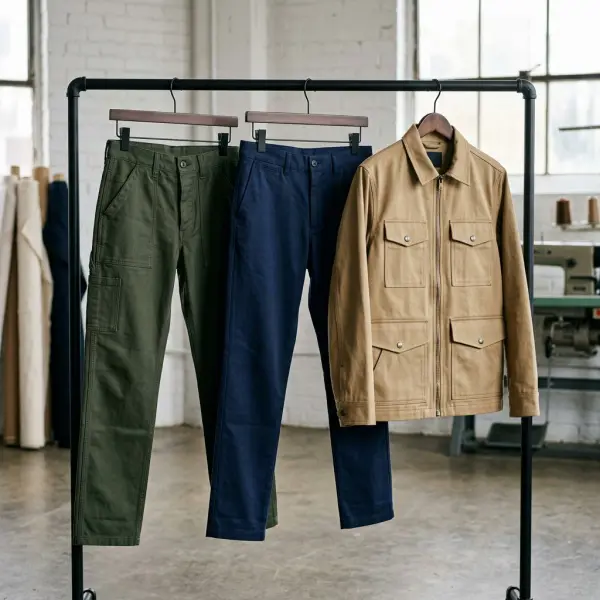
In textile sourcing, bottom-weight generally refers to fabrics substantial enough for garments worn on the lower body, such as trousers, jeans, shorts, and skirts. These fabrics usually need more body and resistance to everyday mechanical stress than typical lightweight shirting materials.
Twill is well suited to this design space because its interlacement can be engineered into relatively substantial constructions without requiring every warp yarn to interlace with every successive weft yarn.
A 3/1 twill is a good example.
In this structure, each warp yarn passes over three filling yarns before going beneath the next one. CottonWorks identifies 3/1 as a commonly used twill for bottom-weight fabrics and specifically associates it with denim, chino, and gabardine.
That does not make 3/1 the only useful construction.
Depending on the desired fabric, mills can use 2/1, 2/2, broken twills, herringbone derivatives, and other structures. Denim alone demonstrates this variety: CottonWorks documents 3/1, 2/1, 2/2, and broken twill constructions within the category. CottonWorks denim construction overview
The important point is that twill gives textile developers a broad construction toolkit rather than one fixed performance profile.
Why Twill Works Well for Pants
Trousers create a demanding textile environment.
A fabric must move repeatedly at the hips, knees, and seat while still supporting the intended silhouette. Pocket openings, belt loops, fly construction, waistband seams, and seat seams add localized mechanical stress. The garment also encounters friction from sitting, walking, bags, furniture, and repeated laundering.
Fashion trousers add another requirement: appearance.
The fabric needs to work mechanically without losing the surface, drape, or visual quality expected at its retail position.
Twill can provide a useful middle ground.
It can combine body with movement
A trouser fabric often needs enough body to avoid collapsing around every seam while remaining flexible enough for natural walking and sitting.
Longer floats and fewer interlacing points can give twill yarns greater freedom to move than highly interlaced basic plain structures, although the final result still depends heavily on yarn, density, weight, and finishing.
This can produce fabrics that feel substantial without necessarily feeling board-like.
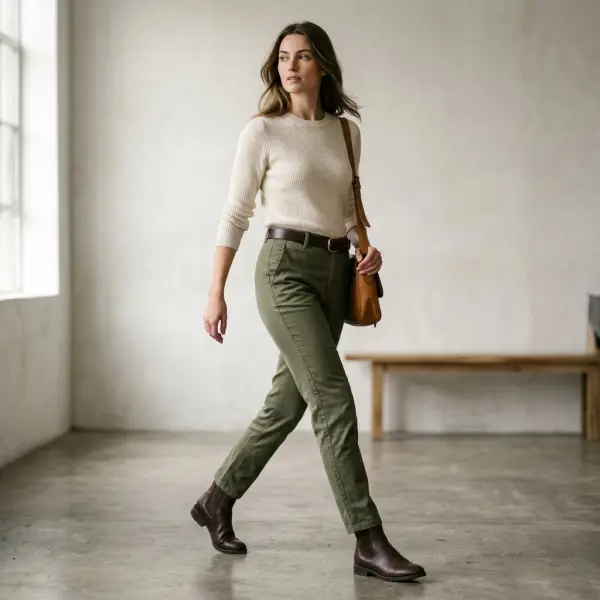
For classic straight-leg chinos, for example, moderate fabric body helps maintain a clean leg line. A softer washed twill can serve relaxed trousers where movement and casual drape matter more. Stretch twills can be engineered for slimmer silhouettes where mobility becomes critical.
The same weave family can therefore support very different fit strategies.
Twill can create strong surface coverage
Many trouser fabrics benefit from a visually compact surface.
In warp-faced twills, longer warp floats dominate the technical face, creating a relatively continuous surface appearance. Depending on yarn size and density, this can help produce the clean, substantial look expected in chinos, denim, work trousers, and tailored casual pants.
That visual coverage is one reason twill often feels appropriate for products positioned between lightweight shirting and heavy outerwear.
But surface coverage should not be confused with opacity alone. Fiber, yarn density, color, fabric weight, and finishing also matter.
The diagonal adds subtle visual depth
Twill lines give trousers texture without necessarily requiring prints, dobby patterns, or highly decorative yarns.
A fine gabardine may show only a controlled diagonal ridge. A casual cotton twill may make the weave more visible. Denim can emphasize it strongly through contrasting warp and filling yarns.
This gives designers another aesthetic variable while keeping the material commercially familiar.
For consumers, the effect may register simply as “structured,” “rugged,” “tailored,” or “premium casual,” even when they do not identify the weave technically.
Why Denim Is Such a Strong Example of Twill in Practice
Few fabrics illustrate the commercial potential of twill better than denim.
Traditional denim commonly uses colored warp yarns and lighter filling yarns in a 2/1 or 3/1 twill. CottonWorks' textile encyclopedia describes denim as normally using these constructions, while its denim education materials document additional twill variations used by the industry.
The weave supports several characteristics that have become central to denim products.
The warp-dominant surface allows the colored warp yarns to visually control the face while lighter filling yarns remain more visible on the reverse. The diagonal structure gives denim its familiar texture. Fabric weight, yarn count, density, indigo dyeing, finishing, washing, and garment construction then determine whether the final material feels rigid, soft, lightweight, stretchy, vintage, polished, or heavily worn.
CottonWorks lists finished denim weights across a broad range and notes that lighter versions may be used for tops and shirts, while heavier constructions are commonly used for jeans, trousers, and jackets.
This is an important reminder for fashion teams.
The weave provides the architecture; the commercial fabric emerges from everything built around it.
Why Twill Is Common in Jackets
Jackets ask something different from fabric than trousers.
A jacket usually needs enough structure to support collars, fronts, pockets, sleeves, facings, closures, and sometimes lining or interfacing. At the same time, the material must bend repeatedly at the shoulder and elbow and remain comfortable enough for layering.
Twill can accommodate that tension effectively.
It can provide useful body without requiring extreme stiffness
A utility jacket should generally hold its shape when open, support patch pockets, and maintain a recognizable silhouette. A fabric that is too fluid may collapse visually. One that is excessively rigid can restrict movement.
Medium- and heavyweight twills can occupy the useful space between those extremes.
The garment pattern still matters enormously. Seam construction, yokes, sleeve shape, lining, interfacing, garment wash, and finishing can all make the same base fabric behave differently.
For this reason, product teams should evaluate twill jackets as complete prototypes rather than judging fabric only while it lies flat on a sourcing table.
Twill works with visible topstitching and utility details
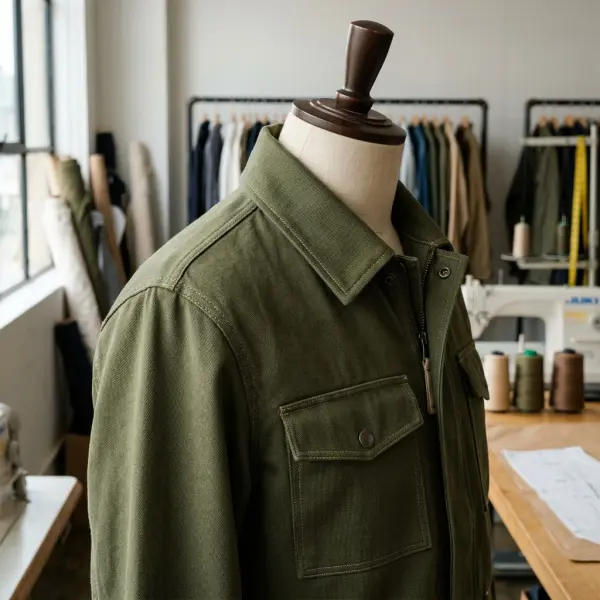
Many twill-based jackets use construction details as part of the design language: patch pockets, flap pockets, reinforced seams, topstitching, metal hardware, bartacks, and structured collars.
A sufficiently substantial twill can provide a stable visual base for those features.
Denim jackets demonstrate this particularly clearly. The fabric itself is strong enough visually to support prominent seam lines and hardware without those details appearing out of proportion.
Yet this is not exclusive to denim.
Cotton drill, gabardine, brushed twills, stretch twills, and blended constructions can all support jacket development depending on the intended silhouette and market position.
Finishing can radically change the jacket's personality
A raw or minimally finished twill may look crisp and utilitarian.
Garment washing can soften it. Brushing can make the surface warmer and less formal. Enzyme processes, sanding, pigment dyeing, coatings, or other treatments can create different tactile and visual effects depending on material compatibility and process control.
This gives product developers considerable latitude.
The same structural family can move from uniform-inspired outerwear to washed fashion jackets without requiring an entirely different weaving principle.
Why Twill Became Closely Associated With Workwear
Workwear is not one single textile category.
It can mean ordinary garments designed for physical work, uniforms used for brand or role identification, rugged utility clothing, trade-specific garments, or certified protective clothing designed for particular hazards.
Twill is particularly common in the first several categories because it can be engineered into substantial, serviceable fabrics suitable for repeated movement and regular laundering.
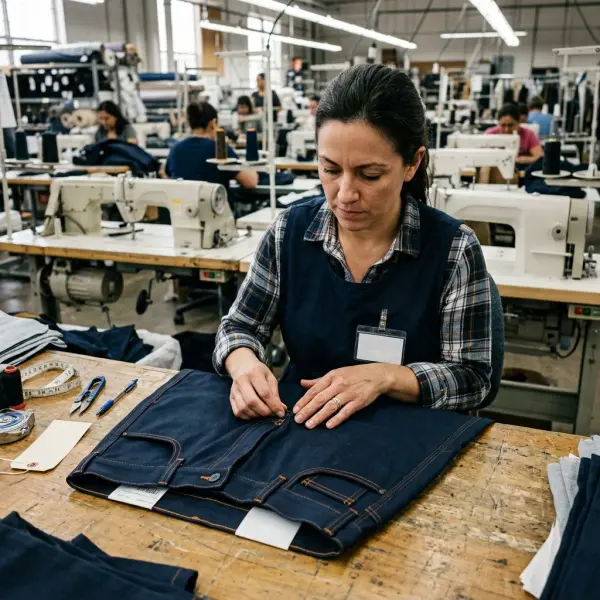
Work trousers, coveralls, chore jackets, shop coats, utility uniforms, and similar garments frequently need a combination of body, mobility, pocket support, and tolerance for repeated physical use.
Dense cotton or cotton-blend twills can address those needs effectively when properly specified.
But the relationship between twill and workwear should not be romanticized.
A fabric is not appropriate for demanding occupational use simply because it looks rugged.
Tear behavior can matter in utility garments
Work garments may encounter localized stress from kneeling, climbing, tools, equipment, or contact with surfaces.
CottonWorks states that 3/1 twill's longer floats and reduced number of interlacements can produce higher tear strength and identifies the construction with heavier bottom-weight fabrics.
That can be commercially useful.
However, tear strength is only one form of performance. Tensile strength, abrasion resistance, seam strength, dimensional stability, colorfastness, pilling, snagging, and stretch recovery may also matter depending on the job.
A textile buyer should therefore avoid replacing a testing specification with the sentence “use heavy twill.”
Weight and density can support repeated use
Workwear fabrics are often specified at weights and densities that provide meaningful body and surface coverage.
Twill works effectively across this space.
But heavier does not automatically mean better. Excess fabric weight can reduce thermal comfort, increase garment mass, restrict movement, increase drying time, and change sewing requirements.
A warehouse uniform used in a hot climate has different needs from an outdoor winter work jacket.
Product developers should therefore design around actual working conditions rather than reproducing traditional workwear specifications by habit.
Utility design benefits from a stable-looking base
Work garments often carry more functional components than ordinary fashion basics.
Cargo pockets, tool loops, reinforced knees, gussets, pocket bags, bartacks, knee-panel seams, reflective trim, or heavy closures can create concentrated loads.
A properly engineered twill provides a visually and structurally appropriate base for many such constructions.
The weave alone, however, does not ensure that these details will survive use. Seam type, stitch density, thread choice, reinforcement method, pocket architecture, and stress-point engineering remain critical.
Twill Does Not Automatically Mean Abrasion-Proof
Because denim and workwear frequently use twill, abrasion resistance is often attributed to the weave itself.
That is too simplistic.
Abrasion occurs at the fabric surface, where yarns and fibers experience repeated rubbing. The outcome depends on fiber strength, yarn structure, twist, density, fabric thickness, finishing, surface treatment, and the type and direction of abrasion.
A heavy cotton twill engineered for work trousers can perform very differently from a lightweight fashion twill even if both share a diagonal weave.
Finishing can also modify abrasion performance.
Cotton Incorporated, for example, publishes abrasion data for its proprietary TOUGH COTTON™ treatment showing improvements relative to untreated cotton under specified test methods. The useful lesson is not that every treated fabric will achieve the same result, but that finishing technology can materially change performance even when the underlying fabric remains a twill. CottonWorks information on abrasion performance and cotton finishing
For a fashion business, the practical implication is straightforward: test the finished fabric you intend to buy.
Do not infer abrasion performance solely from the weave name.
Twill Can Also Support Stretch Pants and Mobility-Focused Workwear
Modern trousers rarely need to behave exactly like their historical counterparts.
Consumers may expect closer fits, greater freedom of movement, softer handfeel, and easier care. Workwear users may need to crouch, climb, drive, lift, or move repeatedly through constrained spaces.
Textile developers can respond by combining twill construction with stretch fibers or mechanical stretch engineering.
CottonWorks' material collections include 3/1 right-hand twills containing cotton and elastane, illustrating how traditional twill architecture can be paired with stretch components.
This creates new trade-offs.
Adding stretch can improve comfort and fit recovery when engineered correctly, but it can also affect heat response, laundering, dimensional behavior, fabric growth, sewing conditions, and recyclability considerations depending on the fiber system.
More stretch is not automatically better.
For trousers, the relevant questions are how much extension is needed, in which direction, under what load, and how well the fabric recovers after repeated use.
A fabric that stretches easily but does not recover may develop bagging at knees or seat areas.
That is a product-performance problem, not merely a fabric-marketing issue.
How Twill Weight Changes the Garment Application
The word twill does not specify fabric weight.
This matters because weight often determines how the weave is experienced in a garment.
A relatively light twill can work for shirts, dresses, overshirts, or warm-weather trousers. Medium-weight versions are common in chinos, skirts, casual pants, uniforms, and lighter jackets. Heavier constructions can support jeans, chore coats, work trousers, and structured outerwear.
Denim provides a documented illustration. CottonWorks describes finished denim from approximately 3.5 to 16.5 ounces per square yard, with lighter ranges used for tops and shirts and heavier ranges commonly used for trousers, jeans, and jackets.
The exact thresholds should not be generalized to every twill family.
A wool twill, cotton drill, polyester uniform twill, and denim may feel quite different at equivalent area weights because fiber density, yarn size, thickness, finish, and structure vary.
For sourcing teams, GSM or ounces per square yard should therefore be treated as one specification—not a complete description of body or performance.
Common Twill Fabrics Used for Pants and Jackets
Several familiar commercial fabrics help illustrate how broadly twill can be engineered.
|
Fabric family |
Typical fashion applications |
What the twill structure contributes |
|
Denim |
Jeans, jackets, skirts, overshirts |
Strong visual diagonal, warp-dominant face, broad range of substantial constructions |
|
Chino cloth |
Casual trousers, shorts, uniforms |
Clean compact surface and useful bottom-weight body |
|
Drill |
Work trousers, utility garments, uniforms, jackets |
Substantial construction suitable for rugged-looking apparel |
|
Gabardine |
Tailored trousers, uniforms, coats, jackets |
Fine pronounced twill with a comparatively refined surface |
|
Stretch twill |
Slim pants, casual trousers, uniforms |
Twill structure combined with engineered extension and recovery |
|
Brushed twill |
Casual shirts, overshirts, jackets |
Twill base with mechanically altered softer surface |
These names are useful starting points, not guaranteed specifications.
A fabric sold as “drill” by one supplier may differ considerably in composition, weight, thread density, finish, shrinkage, and physical performance from another mill's version.
Physical swatches and technical data remain essential.
Twill vs Plain Weave for Utility Garments
Plain weave and twill can both be used in substantial apparel.
Canvas proves that plain weave can be extremely rugged. Twill therefore does not dominate pants and jackets because plain weave is inherently weak.
The difference lies more in structural trade-offs.
Basic plain weave has very frequent yarn intersections, producing high structural stability. Twill reduces some of those intersections and creates longer floats, which changes yarn mobility, surface character, and some aspects of mechanical behavior.
For a detailed construction-level comparison, see Twill vs Plain Weave: How Fabric Construction Changes Performance.
The product decision should still be made garment by garment.
A rigid canvas chore jacket might benefit from a stable plain structure. A trouser requiring controlled drape and a dense diagonal surface may be better served by twill. Neither answer is universally superior.
What Twill Means for Fashion Product Development
For brand owners and sourcing teams, knowing that twill is “good for pants” is not specific enough to place an order.
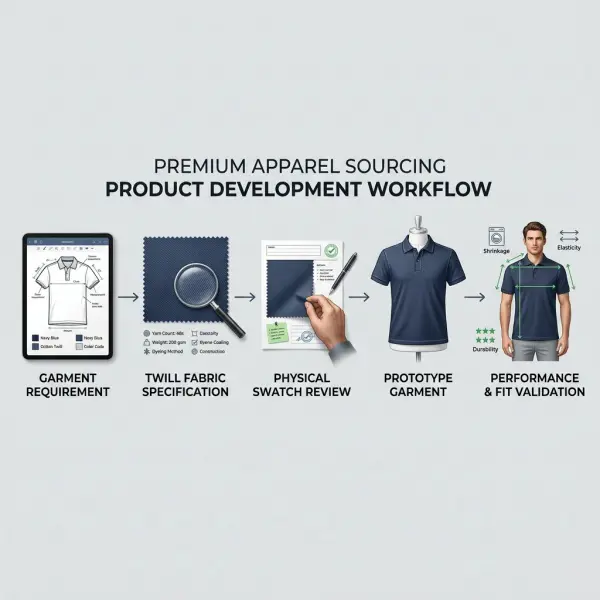
A commercially useful development process starts with the garment's functional brief.
Consider a brand developing a five-pocket casual trouser.
The design team may want a dry cotton hand, moderate structure, slight comfort stretch, clean recovery, good color retention, and enough resistance to daily wear for repeated use. The factory needs a material that cuts cleanly, tolerates topstitching, supports pocket construction, and remains stable after washing.
“Twill” addresses only one part of that brief.
A proper fabric specification would also address composition, weight, width, construction, stretch, recovery, shrinkage, colorfastness, surface finish, tolerances, and appropriate physical performance tests.
The same principle applies to jackets and workwear.
For product development
Evaluate the textile in the actual silhouette.
A fabric may look ideal on the roll yet prove too stiff once a jacket receives facings and multiple pocket layers. Conversely, a soft twill that drapes beautifully may not support the sharp utility silhouette shown in the design sketch.
Make representative samples before locking bulk production.
For sourcing
Do not substitute based only on composition and GSM.
Two 100% cotton twills at the same nominal weight can have different yarn sizes, thread densities, weave repeats, finishes, dimensional behavior, and handfeel.
A substitution should be assessed against the properties that made the original fabric work.
For manufacturing
Consider fabric direction, visible twill lines, shrinkage, pressing, needle choice, seam construction, topstitching, and bulk at multi-layer points.
A dense workwear trouser waistband may contain several fabric layers. A jacket pocket corner can concentrate significant thickness. Those production realities need to be addressed during sampling rather than after bulk cutting.
For merchandising
Translate fabric technology into customer-relevant information carefully.
“Cotton twill” is accurate if the fabric is cotton and uses twill weave.
“Built for extreme durability” is a performance claim and should have evidence appropriate to the intended use.
Product communication becomes more credible when it distinguishes material description from tested performance.
Workwear Twill Is Not Automatically Protective Clothing
This distinction is especially important for brands entering uniforms, industrial apparel, or business-to-business garment supply.
A pair of heavy cotton twill trousers may be excellent everyday work clothing.
That does not automatically make it personal protective equipment.
Protective apparel intended for hazards such as flame, heat, chemicals, particles, electrical exposure, or other workplace risks may need to meet specific standards and test requirements for the relevant hazard and market.
ISO 13688 provides general requirements for protective clothing covering areas such as ergonomics, innocuousness, sizing, ageing, compatibility, marking, and manufacturer information. Importantly, ISO states that the standard is intended to be used together with other standards defining specific protective performance rather than by itself. ISO 13688 protective clothing requirements
That distinction protects both wearer and brand.
Ordinary workwear can be designed around comfort, durability, professional appearance, and routine utility. Certified protective clothing must be developed around documented hazards and applicable technical requirements.
A twill weave alone proves none of those protective properties.
Common Mistakes When Specifying Twill for Pants, Jackets, or Workwear
Mistake 1: Asking for “heavy-duty twill” without measurable requirements
Suppliers can interpret this phrase very differently.
One mill may prioritize weight. Another may provide a dense fabric with high tensile performance. Another may simply supply a coarse-looking utility textile.
Replace subjective language with measurable specifications wherever possible.
Keep “heavy-duty” as a design intention if useful, but define what performance actually matters.
Mistake 2: Assuming more GSM automatically means more durability
Increasing fabric weight may add body and material mass, but durability involves multiple failure mechanisms.
A heavier textile can still suffer poor seam performance, color loss, excessive shrinkage, weak abrasion behavior, or premature tearing if other parts of the construction are inadequate.
Extra weight can also reduce comfort.
Specify the performance requirement rather than simply maximizing mass.
Mistake 3: Ignoring garment construction
Strong fabric does not guarantee a strong garment.
If pocket corners are poorly reinforced, seams use inappropriate thread, stitch density is wrong, or stress points are badly engineered, the garment may fail before the base textile does.
Fabric development and garment engineering must be evaluated together.
Mistake 4: Treating stretch percentage as a complete comfort metric
A supplier may quote extension, but product teams also need to understand recovery.
Excessive growth after sitting or bending can leave knees and seat areas visibly bagged.
For fitted pants, extension and recovery should be assessed together under conditions relevant to the garment.
Mistake 5: Assuming all workwear must be extremely stiff
Traditional workwear aesthetics can encourage unnecessarily rigid specifications.
But users who spend long periods driving, crouching, lifting, or moving may benefit from carefully engineered flexibility.
The correct balance depends on work conditions, climate, fit, safety requirements, laundering, and product positioning.
Mistake 6: Confusing ordinary workwear with PPE
A rugged twill jacket is not automatically flame-resistant, chemical-protective, antistatic, high-visibility, or otherwise protective.
If the garment is sold for hazard protection, the applicable standards, testing, certification requirements, labeling, and regional regulations must be verified separately.
What Brands Should Verify Before Ordering Twill
A useful sourcing decision separates the weave from the rest of the specification.
|
Verification point |
Why it matters for pants, jackets, and workwear |
|
Fiber composition |
Influences comfort, strength, moisture response, care and price |
|
Twill construction |
Determines the basic interlacement and surface structure |
|
Weight |
Helps establish garment body and seasonal suitability |
|
Yarn count and density |
Affect compactness, texture and physical behavior |
|
Finished width |
Influences marker efficiency and material consumption |
|
Shrinkage |
Critical for garment measurement control |
|
Stretch and recovery |
Important for fitted or mobility-focused pants |
|
Tear strength |
Relevant where fabrics may encounter localized tearing forces |
|
Tensile performance |
Addresses another form of mechanical loading |
|
Abrasion resistance |
Important for repeated surface friction |
|
Colorfastness |
Relevant to laundering, rubbing, perspiration and product combinations |
|
Pilling or surface wear |
Affects long-term appearance |
|
Seam performance |
Shows whether garment construction works with the fabric |
|
Finish durability |
Determines whether functional or aesthetic treatments survive use |
|
Bulk consistency |
Ensures production fabric remains close to the approved standard |
Testing priorities should match actual product risk.
A fashion chino sold for casual city use does not need the same validation program as trousers marketed for industrial protective applications.
That proportionality keeps testing commercially sensible without replacing evidence with assumptions.
FAQ About Twill for Workwear, Pants, and Jackets
Why is twill commonly used for work pants?
Twill can be engineered into dense, substantial fabrics that combine body with useful yarn mobility. Longer-float constructions such as 3/1 twill can also provide favorable tear-strength characteristics, which helps explain their use in bottom-weight fabrics. However, work-pant performance depends on much more than weave. Abrasion resistance, seams, reinforcement, fiber composition, fabric weight, shrinkage, and laundering conditions should all be considered.
Is cotton twill good for jackets?
Cotton twill can work very well for casual jackets, chore coats, utility jackets, overshirts, and similar garments when its weight, density, finish, and hand match the design. A firmer twill can support patch pockets and structured silhouettes, while washed or lighter constructions can create softer jackets. Climate and layering requirements also matter. “Cotton twill” alone is therefore not enough information to determine suitability.
Why is twill used in jeans?
Conventional denim commonly uses twill construction, often 2/1 or 3/1, with colored warp yarns and lighter filling yarns. The structure lets warp yarns dominate the face and creates denim's characteristic diagonal appearance. Weight, indigo dyeing, yarn construction, density, washing, finishing, and stretch components then determine the specific look and performance of the jeans.
Is twill more durable than canvas?
Not necessarily. Canvas is typically associated with strong plain-weave constructions and can be exceptionally rugged. Twill and canvas distribute yarn intersections differently, but actual durability depends on fiber, yarn, density, fabric weight, finishing, and the type of stress involved. If the product requires abrasion, tear, tensile, or seam performance, compare tested fabrics rather than assuming one weave family will always outperform the other.
What GSM twill is best for pants?
There is no universal best GSM. Lightweight fashion trousers, summer chinos, classic casual pants, denim jeans, and industrial work trousers require different levels of body and performance. GSM should be selected together with fiber, thickness, density, weave, finish, fit, climate, and target use. Product teams should compare physical swatches and garment prototypes rather than selecting fabric weight from a number alone.
Does stretch twill make better work pants?
Stretch twill can improve mobility in garments designed for bending, kneeling, climbing, driving, or fitted silhouettes, but the benefit depends on both extension and recovery. Too little recovery can cause bagging, while excessive stretch may change fit, durability, sewing, or care behavior. For demanding workwear, mobility requirements should be balanced against fabric stability and the conditions in which the garment will be used.
Is ordinary cotton twill workwear considered PPE?
No, not simply because it is made from heavy twill. Protective clothing must address the specific workplace hazard and may need to meet applicable technical standards and regulatory requirements. ISO 13688 itself is a general protective-clothing standard designed to be used with hazard-specific standards rather than as a standalone performance claim. Brands should verify requirements for the intended market and hazard before marketing a garment as protective equipment.
Conclusion
Twill became common in pants, jackets, and workwear because its structure gives textile developers useful room to balance body, yarn mobility, surface coverage, texture, and mechanical performance.
A 3/1 twill can produce substantial bottom-weight fabrics with longer floats and fewer interlacements, which helps explain its long-standing use in denim, chino, and gabardine. Other twill constructions expand the possibilities further, from soft casual pants to structured utility jackets.
But the weave name is only the beginning.
A successful pair of work trousers depends on more than its diagonal line. So does a denim jacket, a chino, or a uniform. Fiber, yarn, density, weight, finishing, fit, stretch, reinforcement, sewing, laundering, and appropriate performance testing ultimately determine whether the product succeeds.
For fashion businesses, the best use of twill is therefore not to treat it as shorthand for “durable.”
Use it as a structural tool.
Define the garment's real demands first, then engineer the twill specification around them.
For the underlying weave mechanics, see Twill Fabric Explained: Weave Structure, Texture, and Uses. For a direct construction comparison, see Twill vs Plain Weave: How Fabric Construction Changes Performance.




Comments 0
Leave a CommentSend Comment
Anda harus Login terlebih dahulu untuk dapat memberikan komentar.