

Pocket Construction Explained for Apparel Design
Quick Answer
Pocket construction is the way a garment pocket is designed, patterned, reinforced, assembled, and integrated into the garment so that it performs its intended function without undermining fit, comfort, durability, or appearance.
A successful pocket is more than an opening and a fabric bag. Designers and product developers must consider where the pocket sits on the body, what the wearer is expected to carry, how the opening is accessed, how weight transfers into the garment, whether reinforcement is needed, and how the pocket affects production cost and sewing complexity.
Patch pockets, welt pockets, side-seam pockets, slash pockets, cargo pockets, and other variations solve these requirements differently. Their detailed construction differences deserve separate comparison; this article focuses on the underlying engineering decisions that make any pocket work.
For apparel businesses, these decisions matter because apparently minor pocket details can influence sampling revisions, sewing time, fabric consumption, garment balance, quality failures, and customer satisfaction. A visually attractive pocket that is too shallow, poorly placed, difficult to access, or inadequately supported is still a weak product decision.
What Is Pocket Construction in Apparel Design?
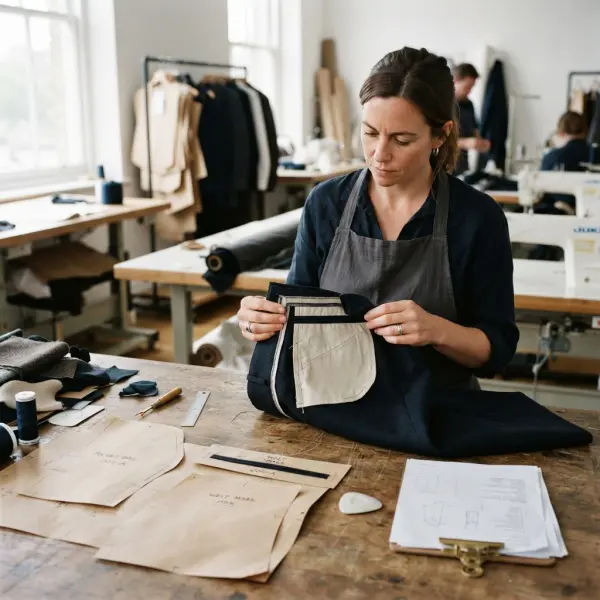
Pocket construction is the combination of pattern engineering, fabric selection, sewing methods, reinforcement, placement, and finishing used to create a functional or decorative pocket within a garment. The visible shape is only one part of the construction. A pocket may also contain hidden components such as pocket bags, facings, stay tape, interfacing, lining pieces, zipper tapes, flaps, seam allowances, or reinforcement stitching. This is why two pockets that look similar from the outside may behave very differently when worn. One may remain flat against the garment when empty and support a phone without significant distortion. Another may gape, sag, twist the side seam, or pull the garment downward because the internal structure was not designed for the intended load.
For apparel designers, therefore, pocket development sits at the intersection of aesthetics and garment engineering. A pocket has to look right. It also has to work.
Why Pocket Construction Matters More Than It Appears
Pockets are small components relative to an entire garment, but they interact directly with the wearer. People repeatedly insert hands and objects into them, pull on their openings, sit with objects inside them, and sometimes expect them to carry surprisingly heavy items. That creates concentrated mechanical stress. The highest loads often occur around the opening rather than in the middle of the pocket bag. If the opening stretches, stitching breaks, fabric yarns shift, or the pocket bag detaches, the garment can fail even when the surrounding fabric remains in good condition.
Pocket design can also affect the silhouette. A heavy object placed in a poorly supported pocket may pull a lightweight dress sideways. An oversized pocket bag may show through slim trousers. A thick pocket assembly can create visible ridges under a close-fitting garment.
The practical question is therefore not simply: “Does this garment have pockets?” It is: “Are these pockets appropriate for how the garment will actually be worn?”
The Main Components of a Functional Pocket
Most pocket constructions can be understood by separating them into a few functional components. These elements do not appear in every pocket, but thinking in terms of functions rather than names makes pocket development much easier. A designer can then ask whether each function has been resolved instead of assuming that choosing “welt pocket” or “patch pocket” automatically determines everything else.
|
Component |
What It Does |
What Designers Need to Consider |
|
Pocket opening |
Provides access |
Width, angle, hand access, stretching, reinforcement |
|
Pocket bag or pocket body |
Holds objects |
Depth, width, material, capacity, bulk |
|
Facing or visible edge |
Finishes the opening |
Appearance, wear resistance, fabric compatibility |
|
Attachment area |
Connects pocket to garment |
Load distribution and seam strength |
|
Reinforcement |
Supports stress points |
Fabric strength, expected load, appearance |
|
Closure |
Helps retain contents |
Zip, button, snap, flap, hook-and-loop or none |
|
Supporting anchor points |
Stabilize the pocket |
Waist seam, side seam, yoke, waistband or panel seam |
Pocket Placement Is an Ergonomic Decision
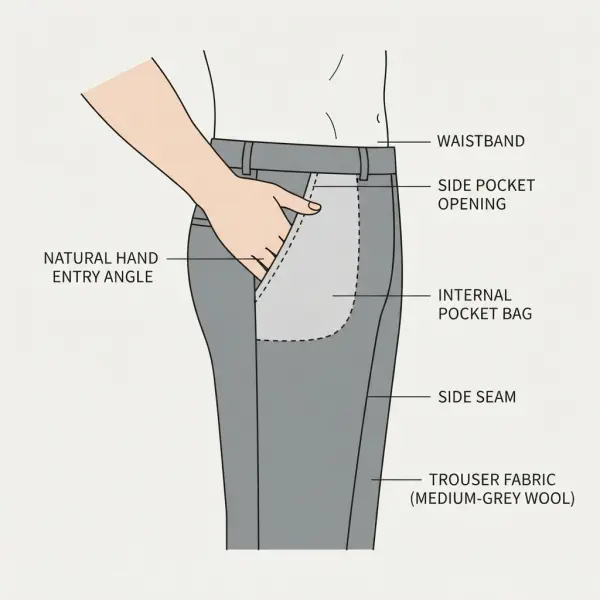
Pocket placement should begin with the human body, not only the fashion sketch. The wearer must be able to reach the opening comfortably while standing, walking, or performing the activities associated with the garment. A technically well-made pocket can still feel unsuccessful when positioned too high, too far toward the back, or at an awkward angle. This becomes particularly obvious with trousers. Moving a front pocket opening only slightly can affect how naturally the hand enters it. Similarly, the position of a coat pocket can influence whether the wearer can comfortably use it while wearing several layers underneath.
Placement also interacts with garment size. A pocket position that works on a base size should be evaluated across the graded size range rather than assumed to remain ergonomically correct automatically. Pocket width, hand access, and visual proportion can behave differently as the garment becomes substantially smaller or larger.

Pocket Depth and Capacity Need an Intended Use
One of the most common pocket design problems is specifying dimensions without defining what the pocket should carry. A decorative shirt pocket and a workwear cargo pocket should not be developed around the same performance assumptions. For everyday trousers, the design team might consider whether the pocket is expected to accommodate a hand, keys, a wallet, or a smartphone. A running garment may instead require compact storage that prevents contents from bouncing excessively. An outerwear pocket may need enough volume to remain usable while the wearer is wearing gloves.
Making the pocket larger is not automatically better. Greater depth increases fabric consumption and may create additional bulk. Large pocket bags can fold underneath the garment, become caught in seams, show through lightweight fabrics, or interfere with movement. Pocket capacity should therefore be treated as a product requirement rather than an arbitrary pattern dimension.
Pocket Bag Shape Matters Too
The internal pocket bag does not always need to follow a simple rectangle. Its shape can be adjusted according to:
- the opening position;
- the garment silhouette;
- expected contents;
- available internal space;
- nearby seams and construction details;
- whether the pocket needs to be anchored elsewhere in the garment.
A curved lower edge, for example, can eliminate sharp internal corners where small objects collect, although the most suitable shape depends on the garment and production method. The pocket bag should also remain safely within the garment rather than extending into areas where it may become visible or uncomfortable during wear.
Fabric Choice Changes How a Pocket Behaves
Pocket construction cannot be separated from textile properties. A stable medium-weight woven fabric generally behaves differently from fluid viscose, stretch jersey, loosely woven tweed, lightweight silk, or heavy denim. The same pocket pattern should therefore not be copied mechanically across fabrics.
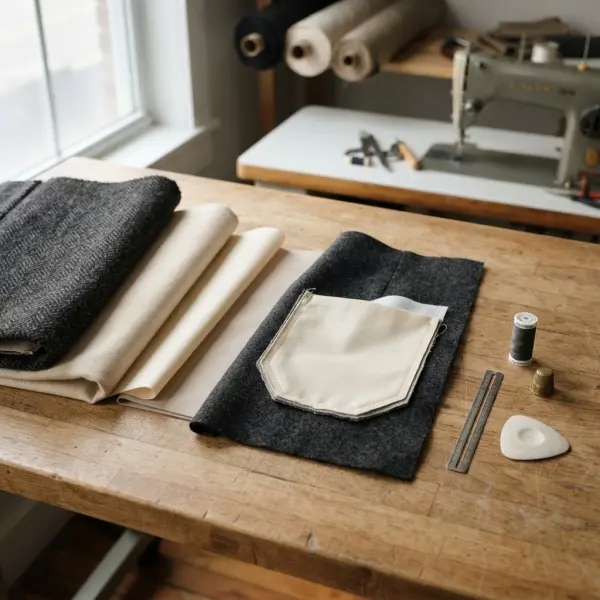
A lightweight shell fabric may require a lighter pocketing material to control bulk. A loosely structured fabric may need additional support around a slashed opening. Stretch materials can require careful stabilization because repeated hand entry may distort the opening. Heavy fabrics create the opposite problem: too many folded layers may become difficult to sew cleanly.
Designers should evaluate several characteristics together:
- Fabric weight and thickness. Multiple folded layers can quickly become bulky.
- Dimensional stability. Fabrics that stretch or distort easily may require additional support.
- Surface structure. Raised textures, coatings, pile, or loose constructions may affect marking, pressing, and stitching.
- Transparency. Pocket bags and seam allowances may be visible through light-colored or sheer garments.
- Drape. A stiff pocket component attached to a fluid garment can change how the garment hangs.
- Abrasion behavior. Pocket openings receive frequent contact from hands and objects.
Why Pocket Openings Are Critical Stress Areas
The pocket opening is often where repeated use concentrates force. Every time a wearer places a hand into a pocket, the opening can be pulled outward or downward. Objects inside the pocket add further load. For that reason, reinforcement often focuses on the ends of the opening. Possible approaches include backtacking, bartacking, triangular reinforcement stitching, additional seam construction, tape, interfacing, or anchoring the pocket assembly into another structural seam.
None of these is universally correct. A dense bartack that performs well on denim may be visually inappropriate or potentially damaging on a fine lightweight fabric. Reinforcement should strengthen the assembly without creating a new hard point where the surrounding fabric becomes more likely to tear. This is an important distinction. More stitches do not necessarily equal better construction.
Reinforcement Should Follow the Load Path
Good pocket engineering asks where the force goes after an object is placed inside. Consider a trouser pocket carrying a phone. The load is not held only by the bottom of the pocket bag. It travels through the bag, attachment seams, opening area, and potentially the waistband or side seam.
Anchoring a pocket bag into a stable garment structure can sometimes distribute this load more effectively than leaving the bag supported only around the opening. This principle becomes increasingly important as pocket size and intended carrying capacity increase.
Pocket Construction Begins at Pattern Development
Many pocket problems that appear in the sewing room actually originate earlier. The pattern defines:
- opening length and position;
- pocket depth;
- pocket bag volume;
- seam allowances;
- notches and alignment points;
- facings;
- extension pieces;
- reinforcement locations;
- relationships with nearby garment seams.
Even a small alignment error can become visible on a symmetrical garment. Two chest pockets placed slightly differently can make a shirt look unbalanced. Welt openings positioned inconsistently can make tailored garments appear poorly manufactured even when the stitching itself is clean. Accurate pattern marking therefore matters. Pocket placement should be tied to stable pattern reference points rather than estimated visually during sewing.
The Sewing Sequence Can Determine Pocket Quality
Pocket construction also has to be considered within the garment's overall operation sequence. Some pockets are easiest to construct while panels are still flat. Others need to interact with waistbands, side seams, linings, facings, or zippers later in assembly. Changing the sequence can affect both efficiency and quality. For example, operations that require precise positioning are generally easier before the garment becomes three-dimensional and difficult to handle. At the same time, a pocket component must not be installed so early that later operations damage, trap, or distort it.
This is where design decisions begin to influence manufacturing economics. A pocket that requires several separate positioning, pressing, turning, topstitching, reinforcement, and inspection operations increases standard minute requirements compared with a simpler construction. The detailed differences between patch, welt, and side-seam pocket construction are covered separately, but the principle is consistent: added construction complexity usually introduces additional operations and additional opportunities for variation.
What Does Good Pocket Construction Look Like?
Good pocket construction is not defined by one stitch type or one visual standard. It means that the pocket performs consistently with the garment's intended use. When reviewing a sample, product teams should examine the pocket both empty and loaded. A practical evaluation includes several questions:
- Does the opening lie correctly when empty?
- Can the wearer insert a hand comfortably?
- Does the pocket bag remain inside the garment?
- Does the pocket pull nearby seams when holding a realistic object?
- Are both sides positioned symmetrically where symmetry is intended?
- Does reinforcement look appropriate for the garment?
- Are corners clean?
- Are topstitching and welts even where visible?
- Does the construction create unnecessary bulk?
- Does the garment still hang correctly after the pocket is used?
These checks reveal problems that a flat measurement sheet alone may miss.
Pocket Construction and Seam Strength Are Related—but Not Identical
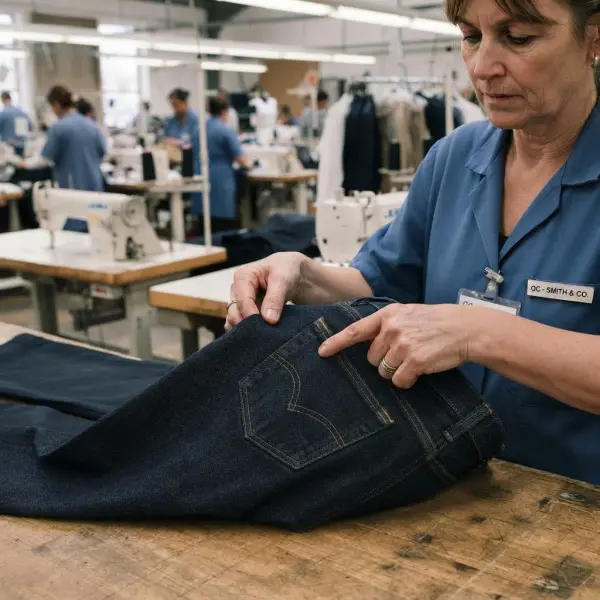
Pocket durability depends partly on seam performance, but laboratory seam strength does not describe every condition a pocket experiences in real use. For example, ISO 13935-2:2026 specifies a grab-method procedure for determining maximum force to rupture of certain sewn seams under controlled conditions. Its scope concerns seam testing rather than complete prediction of pocket performance, and the method applies to straight seams under specified conditions. Readers working with formal product testing can review the ISO 13935-2:2026 seam tensile properties overview for the stated test scope.
A pocket experiences more complicated stresses: repeated insertion, local pulling, object movement, abrasion, changing load directions, laundering, and interaction with the wearer's body. This is why physical wear trials and garment-level evaluation remain valuable even when component tests are available.
Pocket Construction Affects Garment Appearance
Functional details can quietly reshape the visual language of clothing. A patch pocket places construction on the surface and may therefore become a strong design element. A concealed pocket can preserve a cleaner silhouette. Welted openings can create a tailored visual line. Large utility pockets immediately suggest a different product character from discreet pockets hidden in seams.
The effect also depends on proportion. Pocket width, height, flap size, opening angle, stitch width, and spacing from nearby seams all contribute to how the garment is read visually. These choices should support the rest of the design rather than appear to have been added after the silhouette was completed. The wider relationship between utility and visual identity is explored further in how functional details affect garment usefulness and style.
Functional Pockets Can Influence Fit and Drape
A pocket may look flat on a hanger but behave differently when the garment is worn. Pocket bags occupy physical space between the body and outer fabric. This matters most in slim silhouettes, lightweight materials, and areas where the garment sits close to the body.
A large pocket bag in narrow trousers can create visible outlines. A pocket placed directly over a high-tension fit area can gape. A heavy object in a loose side-seam pocket can distort the side of a dress or skirt. For this reason, fit sessions should include pocket use rather than treating pockets only as visual details.
- Ask the fit model to place a hand into the pocket.
- Test a realistic object.
- Sit down.
- Walk.
- Observe the garment from the front, side, and back.
That simple procedure often exposes problems that static fitting misses.
Pocket Construction Has a Real Production Cost
A pocket can increase cost through more than material consumption. Additional costs may come from:
- extra pattern pieces;
- pocketing fabric;
- interfacing or tape;
- zippers, snaps, buttons, or other closures;
- cutting complexity;
- additional sewing operations;
- pressing;
- specialist machinery or folders;
- quality inspection;
- higher rejection or repair risk when tolerances are difficult.
A visually minimal welt pocket, for example, can require greater sewing precision than its simple appearance suggests. This is one reason fashion startups should resolve pocket construction during development rather than treating it as a styling detail that can be finalized immediately before production. Late changes can affect patterns, markers, bills of materials, samples, sewing sequences, and costing simultaneously.
How Fashion Businesses Should Specify Pockets in a Tech Pack
“Add side pockets” is not an adequate production instruction. A useful pocket specification should communicate enough information for the pattern maker and factory to reproduce the approved sample without making important assumptions. Depending on the design, the tech pack may need to show:
- Construction type. Identify the intended pocket structure.
- Finished opening dimensions. Specify measurable length or width.
- Placement measurements. Reference stable garment points.
- Pocket bag dimensions or pattern reference. Do not leave internal capacity undefined.
- Materials. Identify shell, pocketing, lining, interfacing, or reinforcement components.
- Stitching details. Include visible topstitching requirements where relevant.
- Reinforcement. Specify the approved method and placement instead of writing only “reinforce.”
- Closures. Include zipper length, button, snap, or other component specifications.
- Artwork or pattern alignment. Relevant for stripes, checks, prints, or directional fabrics.
- Tolerance. Define appropriate placement and dimensional tolerances according to the product and quality standard.
A good technical package removes avoidable interpretation while still allowing the manufacturer to apply appropriate production engineering.
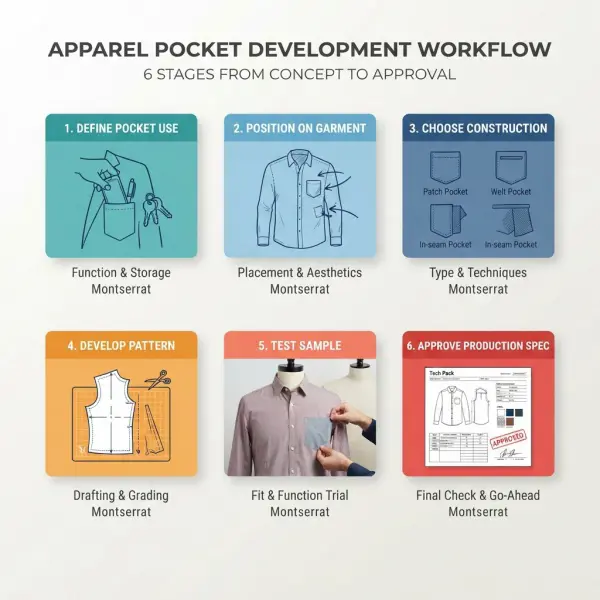
Practical Pocket Development Workflow for Fashion Teams
A reliable process begins with use rather than construction terminology.
1. Define What the Pocket Is For
Decide whether the pocket is primarily decorative, intended for hands, designed for everyday personal items, or expected to carry equipment. This determines almost every subsequent decision.
2. Establish Placement on the Body
Evaluate accessibility and visual proportion on a real garment or toile. Avoid approving placement from a flat sketch alone.
3. Select the Construction
Choose a structure that fits the garment aesthetic, material, price point, manufacturing capability, and expected use.
4. Engineer the Pocket Bag and Support
Define depth, shape, pocketing material, attachment points, and reinforcement.
5. Build and Use the Sample
Do not merely inspect the pocket. Put objects inside it. Repeatedly insert a hand. Sit and move while using it.
6. Review Manufacturing Feasibility
Ask whether the construction creates excessive operations, difficult tolerances, unnecessary bulk, or avoidable handling.
7. Lock the Specification
Update patterns, bill of materials, construction diagrams, measurements, and approved sample references before bulk production.
Common Pocket Construction Mistakes
Designing the Pocket From Appearance Alone
Fashion sketches communicate visual intent well but rarely resolve internal engineering. When the pocket bag, reinforcement, or attachment method is left undefined, factories may interpret the design differently. The better approach is to develop the visible and hidden components together.
Making the Pocket Too Small to Be Useful
This frequently happens when visual proportion is prioritized over hand access or object size. A pocket may technically exist while providing little practical value. Prototype testing should therefore include realistic use rather than simply confirming the finished measurement.
Using the Same Construction Across Different Fabrics
A pocket that works in rigid cotton twill may not behave similarly in lightweight rayon, loosely woven material, stretch fabric, or thick coating. Fabric substitution should trigger a construction review when the change materially affects thickness, stability, stretch, or drape.
Reinforcing Without Considering the Fabric
Heavy bartacking is sometimes treated as the universal solution to pocket-opening failure. It is not. Reinforcement must be compatible with the textile. Concentrating dense stitching in a weak or delicate fabric can simply transfer stress to the area beside the stitching.
Ignoring the Pocket During Fit Sessions
Fit models are sometimes asked to stand while pockets remain untouched. That misses valuable information. Hand entry, object storage, sitting, and movement may reveal gaping or distortion that does not appear during static fitting.
Allowing the Factory to Guess Critical Details
Experienced manufacturers can propose good solutions, but unspecified design decisions still create inconsistency. The factory should help engineer production—not be forced to invent the product specification.
Important Technical Caveats
Pocket construction does not have a universal formula. Recommendations must be adjusted according to garment type, fabric structure, intended load, wash treatment, price point, production machinery, sizing, and quality requirements. Several cautions are particularly important.
First, seam strength and fabric strength are not interchangeable. A strong sewing thread cannot compensate indefinitely for a fabric that tears or slips around the stitch line. Second, laboratory seam tests should not automatically be interpreted as complete wear predictions. ASTM D1683, for example, specifically notes that its sewn-seam test does not predict actual seam wear performance.
Third, reinforcement should not be added automatically everywhere. It can increase bulk, stiffness, cost, and visual prominence. Finally, construction must be validated on the actual material combination. Replacing shell fabric, pocketing, interfacing, thread, finishing process, or garment wash may alter performance enough to justify new sampling.
What Should Brands Verify Before Approving a Pocket?
Before approving production, product teams should be able to answer four practical questions.
- Can the wearer use it comfortably? Accessibility should be tested on the body, not inferred from the flat pattern alone.
- Can the garment support what the pocket is expected to carry? The answer depends on the complete assembly rather than pocket depth alone.
- Does it remain visually acceptable during use? Observe gaping, sagging, seam distortion, bulk, and pocket-bag visibility.
- Can the factory reproduce it consistently? Beautiful sample-room construction may not be commercially sensible if the required tolerance is unnecessarily difficult at production scale.
A pocket is ready for production when utility, appearance, manufacturing feasibility, and product positioning reach an acceptable balance.
FAQ
What is the simplest definition of pocket construction?
Pocket construction is the method used to build and attach a pocket to a garment. It includes the opening, pocket bag or external pocket body, stitching, facings, reinforcement, closures, and attachment points. The construction method determines not only how the pocket looks but also how it behaves when used. Designers therefore need to consider pocket construction during pattern and product development rather than treating pockets as decorative additions at the end of the design process.
What are the main types of pockets used in apparel?
Common pocket families include externally applied pockets such as patch pockets, pockets positioned within seams, and set-in or slash-opening constructions such as welted pockets. Numerous variations exist, including cargo pockets, flap pockets, zipped pockets, curved trouser pockets, kangaroo pockets, and utility pockets. The names describe different combinations of placement, opening, structure, or styling. For a focused construction comparison, see the differences between patch, welt, and side-seam pockets.
Why do pocket openings often need reinforcement?
Pocket openings receive repeated pulling when hands or objects enter and leave the pocket. The ends of the opening can therefore become concentrated stress areas. Reinforcement may reduce distortion or stitching failure, but the method should match the fabric and expected use. Bartacks are appropriate for some products, while interfacing, tape, backtacking, alternative stitch configurations, or structural anchoring may be more suitable elsewhere. Excessive reinforcement can create stiffness or concentrate stress in delicate fabrics.
Should pocket bags use the same fabric as the garment?
Not necessarily. Using shell fabric can provide visual consistency and may be appropriate for some constructions, but it can add unnecessary thickness in heavier garments. Lighter pocketing or lining materials are often used to reduce bulk, provided they have sufficient strength and are suitable for the garment's care requirements. Visibility also matters. In light-colored or partially transparent garments, pocketing material should be evaluated for show-through as well as physical performance.
How can a fashion brand test whether a pocket is functional?
Start with realistic wear testing. The wearer should insert a hand repeatedly, carry the type of objects anticipated for the garment, walk, sit, and observe whether the opening gapes or surrounding fabric distorts. Teams should also inspect stitching, reinforcement, pocket-bag position, and attachment after testing. Higher-risk or performance-oriented products may require additional laboratory evaluation according to relevant material and seam standards. Prototype use testing and laboratory testing answer different questions and can complement each other.
Can pockets change garment fit?
Yes. Pocket bags, facings, reinforcements, and objects stored inside them add volume and load to the garment. The effect is particularly noticeable in fitted trousers, lightweight skirts, dresses, or soft materials. A poorly positioned or oversized pocket can create visible outlines, pulling, gaping, or asymmetrical drape. Because of this, pockets should be evaluated during fit sessions while being used rather than only while the garment is hanging empty.
Why can pockets increase manufacturing costs significantly?
Pocket cost comes from both materials and operations. A pocket may require additional pattern pieces, pocketing fabric, interfacing, closures, pressing, positioning, topstitching, reinforcement, and inspection. More technically demanding pockets may also require slower sewing or tighter workmanship tolerances. For a brand developing a price-sensitive style, simplifying an unnecessarily complex pocket can sometimes reduce manufacturing effort without materially reducing customer utility—but that decision should be made during product development rather than after bulk production has been planned.
Conclusion
Pocket construction is one of the clearest examples of how apparel design moves beyond surface styling. What appears to be a small detail requires decisions about ergonomics, pattern engineering, materials, load distribution, sewing sequence, fit, quality control, and cost.
The most reliable starting point is not asking which pocket looks fashionable. It is identifying what the wearer needs the pocket to do. From there, construction can be engineered around the garment's material, silhouette, manufacturing method, and price point. That approach also prevents a common product-development mistake: adding visible functionality without delivering usable functionality.
For fashion brands and manufacturers, well-designed pockets should feel almost uneventful to the customer. They open naturally, carry what they are supposed to carry, remain stable, and support the garment's visual identity without creating new problems. Achieving that simplicity takes more engineering than the finished pocket usually reveals.





Comments 0
Leave a CommentSend Comment
Anda harus Login terlebih dahulu untuk dapat memberikan komentar.