

Waistband Construction Explained for Pants, Skirts, and Shorts
A waistband may look like a narrow strip of fabric at the top of a garment, but its construction affects far more than appearance. It helps establish the waistline, supports the garment on the body, manages the transition between the torso and lower garment, and often carries closures, belt loops, topstitching, elastic, or other functional components.
In pants and shorts, the waistband also interacts with the rise, fly, pockets, and seat fit. In skirts, it may control how smoothly the garment sits at the natural waist or lower hip. Even small construction decisions—such as whether the waistband is straight or contoured, stabilized or flexible, faced or folded—can change how the finished garment feels and behaves.
Quick Answer: What Is Waistband Construction?
Waistband construction is the method used to design, stabilize, assemble, attach, and finish the upper edge of pants, skirts, shorts, and similar garments so that the garment fits securely around the body. Depending on the design, a waistband may be a separate fabric component, a shaped extension of the garment, a faced waist finish, an elastic casing, or a combination of these systems.
A well-constructed waistband balances several requirements at once. It must match the garment waist seam accurately, accommodate the intended closure or stretch, control unwanted distortion, remain comfortable during movement, and produce a clean internal and external finish.
There is no single correct waistband construction for every garment. Structured trousers, denim jeans, tailored skirts, athletic shorts, and lightweight pull-on pants require different levels of stability, shaping, bulk control, and stretch. The appropriate construction therefore depends on the pattern, fabric characteristics, intended fit, manufacturing method, and product positioning.
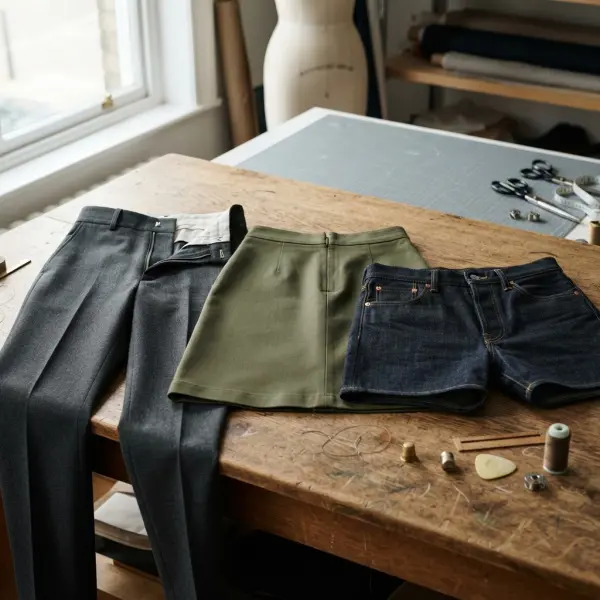
What Is a Waistband in Garment Construction?
A waistband is the finished structure at the upper edge of a lower-body garment that helps define and support the garment around the waist or upper hip. Depending on the design, it may function as a visibly separate band, a shaped continuation of the garment, or an internal structure that is barely noticeable from the outside.
This distinction matters because “waistband” does not describe only one sewing technique. A classic trouser waistband, for example, may consist of an outer waistband, inner facing, interfacing, closure extension, belt loops, and topstitching. A lightweight skirt may use a simpler faced waist. Pull-on shorts may rely primarily on a folded casing containing elastic.
In production terms, the waistband is therefore better understood as a waist-finishing system rather than simply a strip of fabric. Its construction needs to work with the pattern, material, closure, garment silhouette, and expected wearing conditions.
Interfacing is frequently used when additional stability is required. The Sewing & Craft Alliance defines interfacing as a structural material placed between fabric layers where extra body, stability, or support is needed. The appropriate type and weight still need to be matched to the fashion fabric and intended result. Sewing & Craft Alliance guide to interfacing
Why Does Waistband Construction Matter So Much?
The waistband sits at one of the garment's most mechanically demanding areas. The wearer bends, sits, walks, reaches, and changes posture while expecting the waist to remain secure without excessive pressure, gaping, twisting, or collapse.
This makes waistband construction closely connected to fit. A beautifully sewn band will not correct a poorly drafted waist or an incorrect relationship between waist circumference, hip circumference, rise, darts, and side seams. Conversely, a well-drafted garment can still feel uncomfortable or look unfinished if the waistband stretches, rolls, becomes bulky, or does not align correctly with the closure.
For fashion businesses, the consequences extend beyond sewing quality. Waistband decisions influence pattern development, material consumption, interfacing selection, operator steps, pressing requirements, closure installation, inspection criteria, and alterations. The waistband may represent only a small percentage of the garment's visible area, yet mistakes there can make the entire product feel poorly fitted.
This is especially relevant when a design contains other construction features around the same area. Front pockets, side-seam pockets, belt loops, fly extensions, pleats, darts, and lining can all add layers close to the waist. Coordinating these elements with pocket construction and functional details is important for controlling unnecessary thickness.
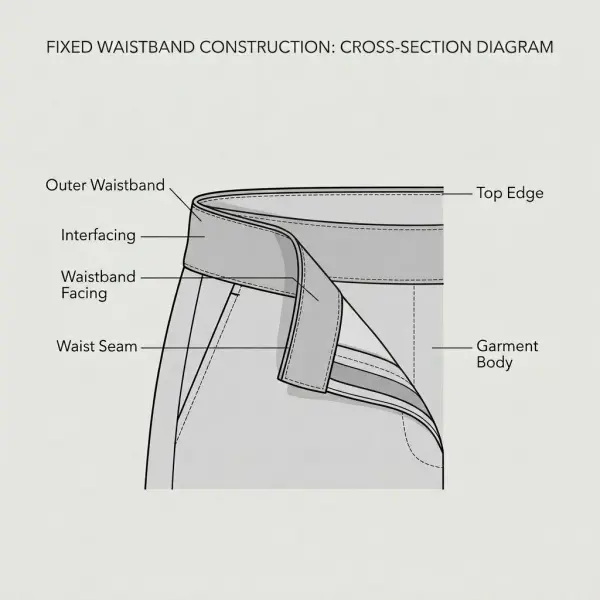
The Main Components of a Conventional Waistband
Although construction varies substantially, a conventional fixed waistband frequently contains several functional layers or components.
Outer Waistband
The outer waistband is the visible layer on the exterior of the garment. It may be cut from the main fabric and can be straight, slightly shaped, or strongly contoured depending on the garment pattern.
Its dimensions cannot be considered independently from the garment waist seam. Notches, side seams, center-back positions, closure extensions, and shaping points need to correspond accurately with the garment body so that the waistband can be attached without unwanted stretching or easing.
Waistband Facing or Inner Waistband
The inner waistband finishes the inside of the garment and encloses seam allowances or structural elements. Depending on the product, this layer may be cut from the same shell fabric, a lighter-weight fabric, lining material, or another suitable construction fabric.
Using a lighter inner layer can sometimes help control bulk in thick materials. That choice, however, must also account for durability, laundering, shrinkage compatibility, colorfastness, and the visual standard expected inside the garment.
Interfacing and Other Stabilization
Interfacing can help a waistband retain its shape, support closures, reduce unwanted stretching, and create the degree of firmness required by the design. It should not automatically be interpreted as “the stiffer, the better.”
A heavy interfacing paired with a light shell fabric may create an unnaturally rigid edge or visible bubbling. Too little stabilization, meanwhile, can allow a tailored waistband to collapse or distort. Selection should therefore consider fabric weight, stretch, drape, fusion conditions, garment care, waistband width, and the desired handfeel.
For readers who need a deeper view of structural support materials, interlining and fusible materials provides the broader material context.

Waist Seam and Inner Finish
The waistband must eventually be joined to the upper edge of the garment. The resulting seam allowance is usually pressed, graded, trimmed, or enclosed according to the construction method.
The inner waistband may then be secured through methods such as stitching in the ditch, edge stitching, topstitching, hand finishing in higher-touch production, or another specified method. These choices affect appearance, labor time, repairability, bulk, and the degree to which internal stitching is visible.
Closure Extension and Reinforcement
Many fixed waistbands extend beyond the center front or another opening to accommodate a button, hook-and-bar closure, snap, or similar fastening.
These areas often require additional reinforcement because repeated opening and closing places localized stress on the fabric. In practical trouser construction, reinforcement may be concentrated around the buttonhole or hook area rather than making the entire waistband excessively rigid. Detailed trouser waistband methods commonly combine an interfaced outer waistband with a facing and local reinforcement around the closure.
The Main Waistband Construction Systems
There are many design variations, but most waist treatments used in pants, skirts, and shorts can be understood through a few basic construction families.
Separate Set-On Waistband
A set-on waistband is cut separately from the main garment and stitched to the upper edge. This is common in trousers, jeans, chinos, skirts, uniforms, and many structured shorts.
Because it is a separate pattern component, designers can control its width, shape, internal structure, closure extension, and material independently from the garment body. It also creates a visible seam around the waist, which becomes part of the product's design language.
This system works particularly well when the garment requires a clearly defined waist, belt loops, structured closure, or a noticeable waistband treatment. Production teams must nevertheless control alignment carefully, because discrepancies between the waistband length and garment waist seam can lead to puckering, stretching, or mismatched closure edges.
Contoured Waistband
A contoured waistband is shaped to follow the changing circumference and curvature between the waist and upper hip rather than relying on a simple straight strip.
Its pattern may contain curved upper and lower edges or multiple sections. This can help the band sit more naturally on garments positioned below the narrowest part of the waist or on designs where body curvature needs more accommodation.
The trade-off is additional pattern and sewing complexity. A curved waistband must be handled accurately so that its shape is preserved during cutting, interfacing, stitching, and pressing. Stretching a curved edge unintentionally can undermine the fit that the pattern was designed to provide.
Grown-On or Extended Waist
In a grown-on construction, the upper garment itself extends upward to form some or all of the waist finish instead of receiving a fully separate waistband.
The inside may be completed with a facing, lining, or another finishing method. This can create a cleaner exterior because there is no obvious horizontal waistband seam, which is useful for some tailored skirts, minimalist trousers, and formal silhouettes.
The absence of a separate waistband does not eliminate the need for stabilization or accurate fit. The upper edge must still resist distortion, and a facing must usually be controlled so that it remains inside rather than rolling toward the exterior.
Elasticized Waist and Casing
Elastic waist systems allow the garment to accommodate a range of body positions and, depending on the design, body measurements. Elastic may run through a fabric casing, be stitched directly to the garment, or be integrated into only part of the waist.
A casing is essentially a fabric tunnel through which elastic or a drawstring passes. Guidance from the Sewing & Craft Alliance notes that casings are commonly used for pull-on pants, skirts, pajamas, and exercise pants or shorts. Sewing & Craft Alliance guide to waistband casings
Elastic construction introduces a different set of considerations from a rigid tailored waistband, including elastic recovery, casing dimensions, distribution of gathers, twist control, stretch requirements, and long-term comfort. These differences are explored in more detail in Elastic vs Fixed Waistbands: Function, Comfort, and Fit.
Hybrid Waistbands
Many commercial garments sit between the previous categories. A trouser may look tailored from the front but contain concealed elastic at the sides or back. Children's pants may use an internal adjustable elastic system. Workwear can combine rigid front structure with stretch panels intended to accommodate movement.
Hybrid solutions can broaden fit tolerance without completely changing the visual language of the product. They also require more careful engineering because sections with different stretch behavior must transition cleanly into one another.
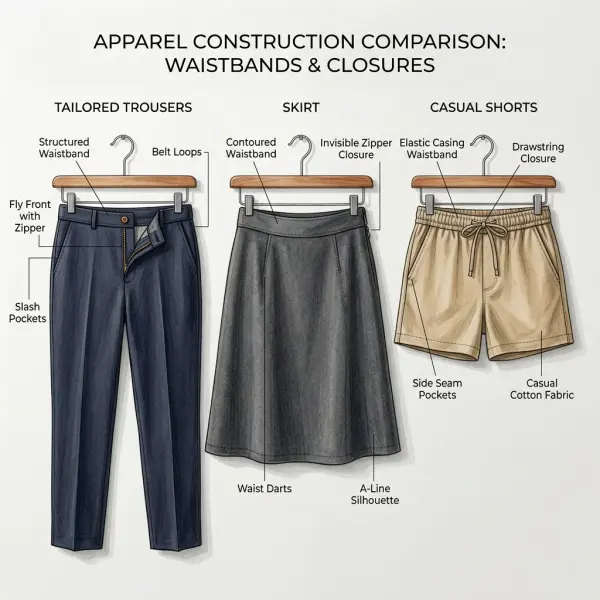
How Waistband Construction Changes Across Pants, Skirts, and Shorts
The basic purpose remains similar, but the surrounding garment architecture changes what the waistband must accomplish.
|
Garment |
Typical Construction Priorities |
Important Interactions |
|
Pants |
Waist security, rise balance, closure alignment, sitting comfort |
Fly, front and back rise, pockets, belt loops, seat fit |
|
Skirts |
Waist shaping, smooth upper silhouette, closure integration |
Darts, lining, zipper, pleats, gathers, skirt volume |
|
Shorts |
Comfort, mobility, bulk control, intended casual or structured appearance |
Rise, pockets, hem proportion, elastic or drawstring systems |
For pants, the waistband forms part of a larger three-dimensional fit system. Waist circumference cannot be assessed without looking at the rise, hip, crotch curve, seat, and position of the trouser on the body. A waistband that seems correct when measured flat may still feel restrictive if the rise or upper hip shaping is wrong.
Skirt waistbands face a somewhat different challenge. Because there is no crotch structure stabilizing the garment vertically, darts, side seams, pleats, gathers, or panel shaping often determine how the skirt transitions from the waist into the hip area. The waistband needs to preserve that relationship without forcing the garment into an unintended shape.
Shorts can use either trouser-like structure or much simpler pull-on construction. A tailored walking short may have nearly the same waistband engineering as trousers, while lightweight lounge or athletic shorts may rely almost entirely on elastic. Product category matters more than garment length alone.
How Is a Separate Waistband Constructed?
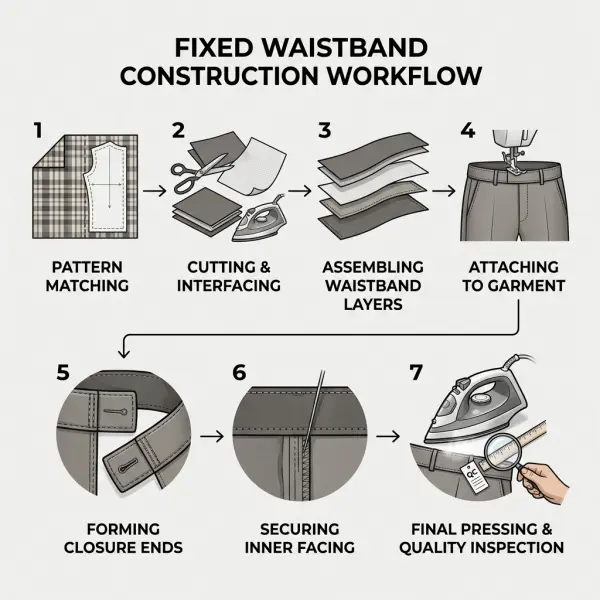
The exact operation sequence differs by factory, pattern, and garment, but a conventional fixed waistband generally moves through several recognizable stages.
1. Pattern Development and Waist Matching
The process begins before sewing. The waistband pattern must correspond to the finished waist seam of the garment while accounting for closure extensions, seam allowances, shaping, and any intentional ease or stretch behavior.
Pattern teams also need to consider how darts, pleats, and seams affect the waist measurement. Simply using a nominal waist measurement is not enough; what matters during assembly is whether the actual seam lines are designed to match correctly.
2. Cutting and Stabilization
The outer waistband and inner components are cut according to grain direction and pattern specifications. Interfacing, when required, is cut and applied to the designated piece or sections.
Fusion conditions deserve attention in production. Adhesive interfacing depends on appropriate temperature, pressure, and dwell time, while compatibility with the shell fabric must be confirmed through testing. Poor fusing can create delamination, bubbling, distortion, or unwanted changes in handfeel.
3. Assembling the Outer and Inner Waistband
The outer waistband and facing may be joined at the top edge before the waistband is attached to the garment, although alternative sequences exist. The seam is then pressed and may be graded to reduce bulk.
Understitching can be used on certain constructions to encourage the facing to remain toward the inside. On thick fabrics, grading different seam allowance layers can prevent a prominent ridge from forming along the waistband edge.
4. Attaching the Waistband to the Garment
The outer waistband is aligned with the garment waist using notches, seam intersections, center points, and closure positions as references. Accuracy at this stage is critical because the waistband should not be forced onto an incompatible garment waist.
Belt loops may also be caught into the waistband seam depending on the construction sequence. On trousers, the waistband ends need to remain aligned with the fly or front closure so the finished edges meet properly when the garment is closed.
5. Forming the Ends and Closure Extension
Waistband ends are sewn, trimmed, turned, and pressed to create a clean finished shape. Corners often contain several layers, so excessive seam allowance can produce bulky or rounded edges.
Closure reinforcement and buttonholes, hooks, bars, snaps, or buttons are then positioned according to the specification. Their placement should be evaluated on the finished garment rather than treated only as isolated trim placement.
6. Securing the Inner Waistband
The facing or inner waistband is folded over the waist seam and secured. Depending on the product specification, it can be stitched in the ditch, topstitched, edge stitched, or finished through another suitable method.
The objective is not merely to hide raw edges. The inner finish should lie flat, avoid catching the wearer uncomfortably, and remain stable through repeated wearing and laundering.
7. Final Pressing and Inspection
Pressing shapes the waistband and helps establish a clean edge, but excessive heat or pressure can damage sensitive fabrics or create unwanted shine.
Inspection should then confirm circumference, symmetry, closure alignment, waistband height, top edge appearance, internal finishing, belt-loop placement, and seam quality. Fit evaluation on a body or approved form remains valuable because flat measurements cannot reveal every three-dimensional issue.
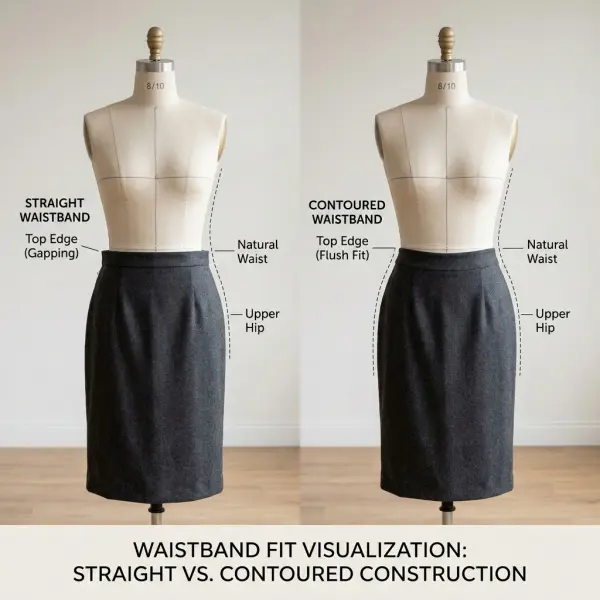
Straight vs Contoured Waistbands: Why Shape Matters
A straight waistband is essentially drafted as a relatively straight strip and works most naturally where the garment sits close to a body circumference that does not require strong shaping across the band's height. A contoured waistband incorporates curvature so its upper and lower edges can correspond more closely to different body circumferences.
This becomes important because the human torso is not cylindrical. On many bodies, the circumference at the upper edge of a waistband differs from the circumference at its lower edge, especially when the garment sits below the natural waist. Pattern geometry must account for that difference somehow—through the waistband itself, darts, seams, stretch, or a combination.
Neither method is automatically superior. A straight waistband may be efficient and appropriate for many classic garments, while a contoured waistband may improve conformity in certain silhouettes. The correct choice depends on waistband position, width, fabric behavior, garment category, target fit, and size range.
Brands should therefore avoid evaluating waistband shape in isolation. A contoured waistband cannot compensate for an incorrect trouser rise, while a perfectly drafted straight band can still perform poorly if a stretch fabric is not stabilized appropriately.
How Fabric Changes the Construction Decision
Fabric behavior can substantially change how the same waistband pattern performs.
A stable woven wool trouser fabric, rigid denim, lightweight linen, stretch twill, soft rayon blend, and knitted fabric do not resist deformation in the same way. Their thickness, extensibility, recovery, drape, surface texture, shrinkage, and response to pressing also differ.
This affects several decisions simultaneously:
- Interfacing weight: enough support may be needed to stabilize the waist, but excessive stiffness can overpower the shell fabric.
- Seam bulk: thick denim or coating-like materials may need aggressive grading or a lighter inner waistband.
- Stretch management: fabrics containing elastane may require stabilization strategically rather than eliminating all stretch indiscriminately.
- Pressing: temperature and pressure must suit both shell fabric and interfacing.
- Edge appearance: lightweight fabrics can reveal seam allowance ridges or adhesive irregularities more easily.
- Care compatibility: shell, interfacing, lining, and trims need to remain compatible through expected laundering or cleaning.
The useful question is therefore not “Does this waistband need interfacing?” but “What degree and type of stabilization will produce the intended fit and appearance with this specific material system?”
How Waistband Construction Influences Fit
Waistband fit depends on more than its circumference. Width, shape, position, material stretch, closure construction, and the geometry of the garment beneath it all change how pressure is distributed around the body.
A narrow waistband may conform differently from a deep waistband. As waistband depth increases, the difference between the circumference at its upper and lower edges can become more significant, which may require contouring or another form of shaping.
The position of the waistband is equally important. A high-rise trouser waistband sits on a different body region from a low-rise skirt or shorts waistband. Using the same assumptions about body shape across those positions can create gaping, pressure points, or instability.
Movement adds another layer. Sitting increases flexion around the hip and abdomen, while walking and bending alter tension across the front and back rise. This is why trouser waistband evaluation should include movement rather than relying exclusively on a static standing fit.
Elasticity can increase accommodation, but greater stretch does not automatically equal better fit. The balance between extension and recovery determines whether the waistband can expand when necessary and return toward its intended dimension afterward. The design implications of this trade-off belong primarily in the cluster's detailed comparison of elastic and fixed waistbands.
What Fashion Businesses Should Specify Before Production
For brands, a vague instruction such as “standard waistband” leaves too much room for interpretation. A technical package should communicate enough information for the pattern, sample, sourcing, sewing, and quality teams to reproduce the intended result consistently.
Useful specifications may include:
- finished waistband height;
- waistband pattern type and component references;
- shell, facing, and interfacing materials;
- interfacing placement;
- seam and topstitch requirements;
- closure type and positioning;
- extension dimensions;
- belt-loop quantity and placement;
- edge-finishing method;
- key finished measurements and tolerances;
- pressing requirements where material sensitivity matters.
The appropriate level of documentation depends on the production relationship. A long-standing factory with a validated construction standard may not require every familiar operation to be redrawn, while a new supplier, unusual construction, or premium finish generally benefits from more explicit documentation.
Most importantly, sample approval should establish the construction standard before bulk production. Written specifications and physical reference samples solve different problems: documentation communicates measurable requirements, while an approved sample captures nuances of shape, handfeel, pressing, and finish that can be difficult to describe numerically.
Quality Control Checkpoints for Waistbands
Waistband quality should be evaluated as both a measurement issue and a construction issue. Checking only the finished waist circumference can miss asymmetry, twisting, poor closure alignment, or internal finishing problems.
A useful inspection can cover several points:
- waistband circumference and height against approved specification;
- left-right symmetry where applicable;
- alignment of side seams and center-back positions;
- clean connection with fly or zipper opening;
- smooth top edge without unwanted stretching or rippling;
- secure and correctly positioned closures;
- appropriate waistband stiffness and flexibility;
- flat, secure inner facing or casing;
- consistent topstitching where specified;
- correct belt-loop placement and reinforcement;
- absence of excessive seam bulk at intersections;
- fit and comfort during standing, sitting, and basic movement when a fit check is part of the QC process.
These checks should be adapted to the product. A soft elastic lounge short should not be judged by the same rigidity standards as tailored trousers, just as a premium skirt with a concealed internal finish may have different visual expectations from five-pocket denim.
Common Construction Mistakes to Watch For
This article does not attempt to cover every waistband defect—that is addressed separately in Common Waistband Problems and How to Prevent Them—but several construction errors are worth recognizing because they originate early in development.
Treating the Waistband as an Independent Measurement
A waistband may be manufactured to the correct nominal length yet still fit poorly if the garment waist seam, darts, rise, or closure geometry is incorrect. The better approach is to verify the waistband and garment waist as one connected system during pattern checking and sample fitting.
Choosing Interfacing by Weight Alone
A heavier interfacing does not automatically create a higher-quality waistband. It may introduce excessive stiffness, visible ridges, or incompatibility with stretch and drape. Testing the complete shell-and-interfacing combination is more useful than selecting support material from weight categories alone.
Ignoring Bulk at Seam Intersections
Belt loops, pocket facings, side seams, fly components, waistband layers, and seam allowances can converge within a very small area. If layer buildup is not considered during pattern and construction planning, the finished waistband can become thick, difficult to press, or uncomfortable.
Correcting Fit Through Sewing Manipulation
Stretching the waistband or garment edge during assembly to make mismatched pieces meet can hide a pattern problem temporarily. It can also introduce rippling, twisting, or dimensional instability. Unless easing is intentionally engineered into the construction, persistent mismatch should be investigated at the pattern or cutting stage.
Assessing the Waist Only While Standing
A waistband that looks acceptable on a static fit model can still pinch, gape, roll, or shift during movement. Pants and shorts in particular should be assessed while sitting and bending because posture changes the relationship between the abdomen, hip, rise, and waistband.
Important Technical Caveats
Waistband construction terminology is not completely standardized across every factory, pattern company, country, and product category. Terms such as inner waistband, facing, waistband lining, self waistband, casing, shaped waistband, and contoured waistband may be used somewhat differently depending on the construction system.
Seam allowances and operation sequences also vary. A sewing tutorial may specify a particular seam width or order of operations because it was developed for one pattern; that does not automatically make the same dimensions appropriate for industrial production or another design. For example, one documented trouser method uses an interfaced outer waistband, separate facing, seam grading, understitching, and stitch-in-the-ditch finishing, but those are construction choices rather than universal requirements.
Fabric testing remains essential whenever fusible interfacing, stretch fabrics, unusual coatings, heavy materials, or washable garments are involved. Pattern, material, and process must be validated together.
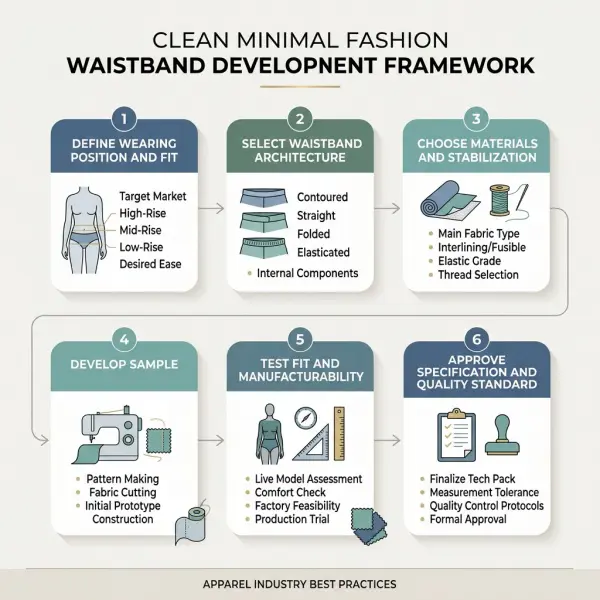
A Practical Waistband Development Workflow
For a fashion brand developing a new pant, skirt, or short, waistband decisions are best made progressively rather than left until the final sample.
Start by defining where the garment is intended to sit on the body and how fitted or flexible that position should feel. From there, establish the waist architecture: separate straight band, contoured band, faced waist, elastic system, or hybrid construction.
Next, test the material combination. The shell fabric, facing, interfacing, elastic, closure, thread, and nearby pocket components should be considered as one system. A waistband that works well in a medium-weight cotton twill may need redesign when translated into stretch denim or lightweight viscose.
Sampling should then verify three things at the same time: fit, construction, and manufacturability. A waistband that fits beautifully but requires difficult manual manipulation may create production inconsistency. A method optimized exclusively for sewing speed may save minutes while weakening the appearance or comfort that defines the product.
Once approved, record the construction clearly in the technical package, preserve the approved sample, and establish measurable QC checkpoints. This creates a repeatable standard rather than forcing production teams to reinterpret the design in every manufacturing run.
Frequently Asked Questions About Waistband Construction
What is the difference between a waistband and a waist facing?
A waistband is usually a defined structural or visible section forming the top of a garment, while a waist facing generally finishes the upper edge from inside without creating the same obvious external band. A faced waist can therefore produce a cleaner uninterrupted exterior line, especially on skirts and minimalist trousers. The distinction is not purely cosmetic: waistband and facing constructions differ in pattern pieces, stabilization, seam placement, pressing, and how the garment distributes support around the body. Terminology can vary between manufacturers, so technical drawings and construction details are more reliable than relying on the component name alone.
Does every waistband need interfacing?
No. Interfacing is used when the waistband requires additional stability, body, shape retention, or local reinforcement, but the appropriate level depends on the fabric and intended design. Some structured woven trousers benefit from substantial stabilization, while certain stretch-denim, knit, elasticized, or intentionally soft waistbands may use lighter support or only local reinforcement. Eliminating interfacing and applying heavy interfacing can both create problems when the decision is made without testing. Brands should evaluate the complete material combination after sewing, pressing, wearing, and—where relevant—laundering.
Why are some waistbands curved instead of straight?
A curved or contoured waistband is designed to accommodate the difference in body circumference across the height of the band. This can be useful when a garment sits below the natural waist or when a deeper waistband needs to follow the upper hip more closely. A straight waistband can still work very well for many garments, depending on its position, width, fabric, and underlying pattern shaping. Curvature should therefore be treated as a pattern-engineering choice rather than an automatic indicator of better fit.
Can the waistband fix a garment that gaps at the back?
Sometimes waistband shaping contributes to back gaping, but it is not the only possible cause. The problem may also involve waist-to-hip proportions, back-rise length, dart shaping, yoke construction, seat shape, waistband stretch, or the position where the garment sits on the body. Reducing only the waistband can distort the rest of the garment if the underlying pattern is incorrect. Fit diagnosis should therefore examine the trousers or skirt as a complete three-dimensional system before deciding which pattern component needs adjustment.
Why do tailored waistbands usually feel firmer than casual waistbands?
Tailored garments often use more stabilization because the waistband is expected to maintain a defined edge, support closures and belt loops, and preserve a controlled silhouette. Casual or performance garments may prioritize flexibility and movement instead. Firmness is not automatically a quality indicator, however. The correct handfeel depends on design intent, fabric, garment category, consumer expectation, and wearing conditions. Excessive rigidity can be just as undesirable as inadequate support.
Should the inside waistband use the same fabric as the outside?
Not necessarily. Some garments use self fabric for both layers, while others use lighter fabric, lining, or specialized waistband materials internally to control bulk, comfort, cost, or appearance. Any substitute needs to remain compatible with the outer fabric in terms of dimensional stability, care method, strength, color behavior, and overall construction. Thick denim, for example, may benefit from an inner treatment that reduces layer buildup, while premium tailored products may deliberately use a distinctive internal waistband finish.
What should brands inspect first when a waistband feels uncomfortable?
Start by identifying whether the issue is circumference, shape, position, rigidity, or interaction with the rest of the garment. Measure the finished garment against the approved specification, then evaluate the rise, hip fit, closure, seam bulk, and waistband behavior while the wearer sits and moves. Simply increasing waist circumference may solve pressure in one case but create gaping in another. Accurate diagnosis should precede pattern modification because several different construction or fit problems can produce a similar sensation for the wearer.
Conclusion
Waistband construction is a compact example of how apparel design, pattern engineering, material selection, manufacturing, and fit converge in one part of a garment. A waistband must do more than finish a raw edge: it helps determine where the garment sits, how securely it stays there, how the upper silhouette is shaped, and how comfortably the wearer can move.
The most appropriate solution depends on the garment rather than on a universal construction hierarchy. Structured trousers may require controlled shaping and stabilization; skirts may rely on a contoured band or clean faced waist; casual shorts may perform better with an elasticized system. Even within those categories, fabric behavior and target fit can substantially change the answer.
For fashion businesses, the practical priority is to treat the waistband as part of the total garment architecture. Pattern measurements, material behavior, interfacing, closure design, pockets, belt loops, seam bulk, pressing, and movement should be validated together. Once the right construction is established, clear technical specifications and consistent quality control turn that design decision into a repeatable production standard.




Comments 0
Leave a CommentSend Comment
Anda harus Login terlebih dahulu untuk dapat memberikan komentar.