

Crepe Fabric Explained: Texture, Drape, and Fashion Uses
Quick Answer
Crepe fabric is a broad family of textiles recognized by a subtly crinkled, grainy, or pebbled surface rather than by one specific fiber. The crepe effect may be created through highly twisted yarns, particular weave structures, chemical or mechanical finishing, or combinations of these methods. Crepe can therefore be made from silk, rayon or viscose, cotton, wool, polyester, and other fibers; the fiber content and construction determine how a particular crepe actually feels, drapes, stretches, wears, and should be cared for. The Museum of Fine Arts Boston's CAMEO materials database similarly describes crepe as a finely crinkled fabric that can be produced from several natural and manufactured fibers. CAMEO definition of crepe
For fashion businesses, this distinction matters. Ordering "crepe" alone does not define a usable material specification. A fluid viscose crepe intended for a blouse can behave very differently from a structured polyester crepe used for a tailored dress or a lightweight silk crepe de Chine. Sourcing decisions should therefore consider fiber composition, weight, opacity, stretch, surface texture, drape, recovery, finishing, care requirements, and intended garment construction—not simply the fabric name.
What Is Crepe Fabric?
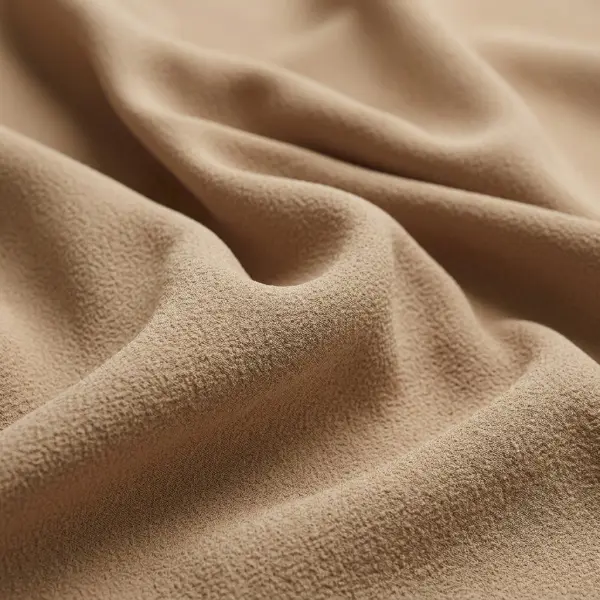
Crepe is best understood as a textile family defined by surface character and construction rather than a single fiber composition. Its identifying feature is an intentionally irregular surface that may appear finely grainy, pebbled, crinkled, or slightly puckered. Depending on the construction, that texture can be barely visible until the fabric moves under light, or pronounced enough to become part of the garment's visual identity.
This is why statements such as "crepe is a silk fabric" are incomplete. Traditional silk crepes are important members of the category, but contemporary crepes may contain rayon or viscose, polyester, wool, cotton, blends, or other fibers. CAMEO lists silk, rayon, cotton, wool, and synthetic fibers among the materials used for crepe, while historical fashion collections also document multiple forms of silk crepe such as crepe de Chine.
That distinction has practical consequences. Crepe describes an effect; fiber content helps determine performance. A polyester crepe may offer easier care and dimensional stability than some delicate silk constructions, while a viscose crepe may provide soft movement but require more attention to shrinkage, distortion, and handling. Those are tendencies rather than universal rules because yarn size, fabric weight, weave, finishing, and garment construction can change the result significantly.
For buyers and product developers, the useful question is therefore not simply, "Is this crepe?" It is, "What kind of crepe is this, how was the effect created, and does its actual performance suit the product?"
How Does Crepe Get Its Distinctive Texture?
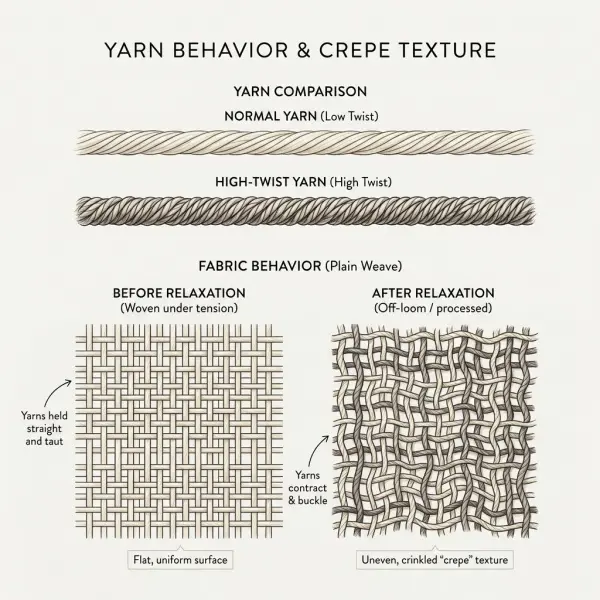
The characteristic crepe surface can be produced in several ways. One of the classic approaches uses yarn with unusually high twist. When these energetic yarns are incorporated into fabric and subsequently relaxed or wet-finished, their tendency to contract and torque can disturb an otherwise flat surface, creating the irregular texture associated with crepe.
Research published through the Textile Society of America demonstrates this principle particularly clearly: variations in the amount and direction of yarn twist can generate crepe effects even in a simple plain-weave construction. Textile Society of America paper on crepe and yarn twist
The important point is that not every crepe gets its texture in exactly the same way. Textile references identify several routes, including twisted filling yarns, crepe weave structures, and certain finishing treatments.
In practice, the main routes can be summarized as follows:
- High-twist yarn effects: yarn torque and relaxation create small-scale surface irregularity.
- Alternating twist directions: S- and Z-twisted yarns may be arranged strategically to balance torque while maintaining a creped surface.
- Crepe weave structures: irregular interlacing can break up the visual regularity of the fabric face.
- Finishing processes: mechanical or chemical treatments may reinforce or generate a crinkled effect.
- Combined construction and finishing: some commercial fabrics use more than one mechanism to achieve the required hand and surface.
These mechanisms matter because two fabrics can look similar on an online swatch while behaving very differently during spreading, cutting, sewing, pressing, washing, or wear.
Why yarn twist matters
Twist changes the geometry and internal energy of yarn. In highly twisted crepe yarns, the yarn is less relaxed than a softly twisted yarn. Once woven and subjected to appropriate finishing conditions, the stored tendency to untwist or contract can produce localized distortion in the cloth.
A historical Smithsonian description of silk georgette provides a useful real-world example. The museum identifies right- and left-twist filling yarns as responsible for the fabric's characteristic "crepy" effect. Smithsonian silk georgette textile record
The effect is not simply decorative. Surface structure influences how light reflects from the material, how the cloth feels against the hand, and how the fabric visually reacts when draped over a three-dimensional body.
Crepe is not the same as crepe weave
The terminology can become confusing because crepe fabric and crepe weave are related but not interchangeable concepts. A crepe-like surface may be achieved through yarn properties even when the underlying weave is relatively simple. Conversely, weave design can be manipulated to create irregular surface effects without depending entirely on extremely high-twist yarn.
For sourcing teams, this is more than a technical distinction. Knowing how the effect is achieved can help explain differences in shrinkage, stability, appearance after laundering, sewing behavior, and price.
What Does Crepe Fabric Feel Like?
There is no single crepe handfeel, but most crepes share some degree of surface irregularity rather than the completely flat face associated with many smooth woven fabrics. The texture may feel dry and grainy, softly crinkled, slightly sandy, or barely pebbled depending on yarn, fiber, weave, and finishing.
This surface character frequently produces a visually subdued appearance. Many crepes scatter light across their irregular surface rather than reflecting it as uniformly as a smooth satin face. That does not mean every crepe is matte: crepe-backed satin, for example, deliberately combines a lustrous satin face with a crepe-textured reverse. The fabric name must therefore be interpreted together with its construction.
Texture also affects perceived quality. A tightly controlled fine crepe may appear refined and understated, while a stronger crinkle can create a more casual or tactile aesthetic. Neither is inherently superior. The appropriate choice depends on the garment design and the intended market.

How Does Crepe Drape?
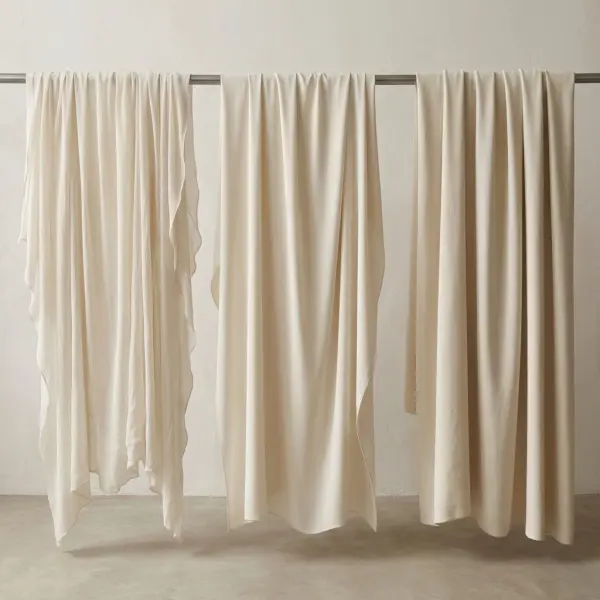
Crepe is often associated with attractive drape, but crepe does not automatically mean fluid. Drape depends on several variables, including fabric weight, thickness, fiber stiffness, yarn construction, weave density, finishing, and any stretch component.
A lightweight silk crepe de Chine can move softly around the body. A medium-weight viscose crepe may produce deeper folds suitable for dresses and relaxed trousers. A heavier polyester crepe may retain a cleaner silhouette and provide enough body for structured dresses, jackets, or uniforms. Some wool crepes have considerably more body again.
This distinction is particularly important during digital sourcing. A supplier photograph may show a dramatic cascade of fabric, yet photography alone cannot tell a buyer how the material will behave in a sleeve head, bias panel, gathered waist, placket, collar, or full-length skirt.
A better assessment combines physical and specification-based checks:
- Hang a sufficiently large swatch vertically rather than judging only a small flat cutting.
- Observe whether folds are narrow and fluid or broad and structured.
- Test movement in both warp and weft directions.
- Check whether the fabric rebounds after being compressed or folded.
- Evaluate opacity while the material is hanging, not only when it lies flat.
- Compare drape after any intended wash or finishing treatment.
Drape should therefore be treated as a measurable product-development characteristic, even when the final assessment includes subjective visual judgment.
Crepe Is a Fabric Family, Not a Fiber
One of the most useful sourcing principles is to separate fiber identity from fabric identity. A product marketed as "viscose crepe" tells the buyer both its primary fiber category and its crepe construction or surface character. "Polyester crepe," "silk crepe," and "wool crepe" work similarly, although each label still leaves many specifications unresolved.
The fiber strongly affects the way the fabric performs. Viscose-based fabrics can offer attractive drape, but their dimensional behavior and wet handling depend on the specific material and finish. Polyester crepes can be engineered across a large range of weights, stretch characteristics, and textures. Silk crepes can combine low weight with sophisticated movement. Wool crepes may deliver a drier hand and greater tailoring potential.
Fiber names should therefore never be used as shorthand for guaranteed performance.
For sustainability claims, the same principle applies. Crepe itself is not an inherently sustainable or unsustainable material category. Environmental impacts depend on the fiber source, manufacturing route, dyeing and finishing, energy and chemical use, product longevity, care, and end-of-life context. Textile Exchange similarly treats raw-material sourcing and verified material claims as issues that require material-specific information rather than generic textile labels. Textile Exchange materials and standards resources
Common Types of Crepe Used in Fashion
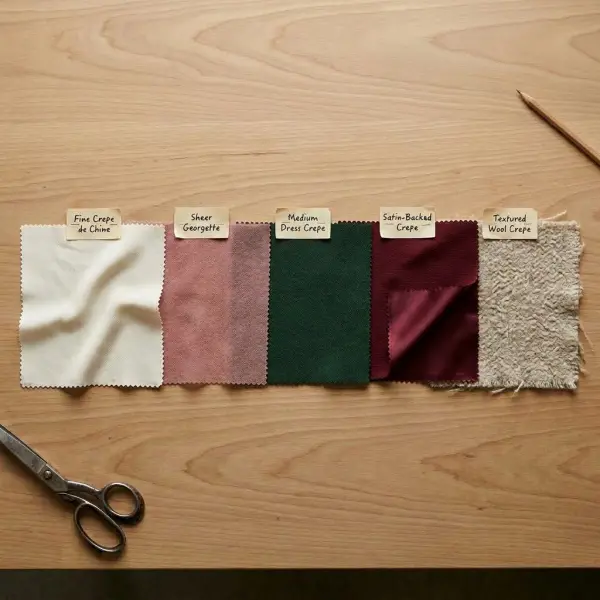
The word "crepe" covers numerous commercial constructions. Naming conventions also vary among mills and markets, so these labels are useful starting points rather than complete specifications.
|
Crepe type |
Typical character |
Common fashion use |
What buyers should verify |
|
Crepe de Chine |
Lightweight, fine crepe surface, generally fluid |
Blouses, dresses, linings, luxury apparel |
Fiber, weight, opacity, snag sensitivity, care |
|
Georgette |
Lightweight to sheer, dry creped surface |
Dresses, blouses, overlays, scarves |
Transparency, lining needs, seam behavior |
|
Crepe-back satin |
Smooth lustrous face with crepe reverse |
Eveningwear, occasion dresses, premium separates |
Which face is intended, weight, shine, pressing behavior |
|
Medium-weight dress crepe |
Moderate texture with more body |
Dresses, trousers, skirts, uniforms |
Stretch, recovery, opacity, crease response |
|
Wool crepe |
Dry textured surface with tailoring potential |
Dresses, skirts, jackets, tailored pieces |
Wool content, weight, pressing and care |
|
Stretch crepe |
Crepe surface combined with mechanical or elastane-assisted stretch |
Fitted dresses, trousers, contemporary tailoring |
Stretch %, recovery, growth, heat sensitivity |
|
Knit crepe |
Knitted rather than conventionally woven, with crepe-like surface |
Dresses, tops, flexible garments |
Knit structure, stretch direction, recovery, seam stabilization |
The Museum of Fine Arts Boston identifies georgette as a sheer fabric with a non-shiny crepe surface made using alternating S- and Z-twisted yarns and records its use in blouses, dresses, and gowns. This illustrates why a specific crepe name can communicate useful construction information—but still does not replace a technical specification.
Crepe de Chine
Crepe de Chine is historically associated with lightweight silk crepe and has long been used in fashion garments. Museum collections include dresses, scarves, skirts, and undergarment pieces made from crepe de Chine, demonstrating its established place in apparel rather than its being a recent commercial label. Paris Musées Collections
Modern sourcing requires more precision because a supplier may use "crepe de Chine" for silk, synthetic, or blended interpretations. Buyers should verify composition rather than assuming the name guarantees silk.
Georgette
Georgette sits within the wider crepe ecosystem but is usually lighter and more transparent than many general dress crepes. Its finely twisted yarns contribute to a dry, slightly granular surface, while low fabric mass allows considerable movement.
Because georgette is often sheer, garment application frequently involves layering, lining, gathering, or controlled volume. That makes it especially relevant to dresses, blouses, overlays, and scarves. A full technical comparison between lightweight crepe constructions and chiffon belongs in Crepe vs Chiffon: What Makes These Dress Fabrics Different?.
Crepe-back satin
Crepe-back satin shows why "crepe" cannot be interpreted simply as a matte fabric. One side presents the smoother, more reflective appearance associated with satin, while the reverse has a crepe character. Designers can exploit either side or occasionally use both within one garment.
This construction is useful when a collection requires visual richness without introducing a completely unrelated material family. However, sewing and pressing trials remain important because the two surfaces can respond differently to handling, marking, seam impressions, and light.
Why Is Crepe Used for Dresses, Blouses, and Other Fashion Products?
Crepe works particularly well when a garment needs surface interest without a printed pattern and movement without looking excessively shiny. Its irregular texture can make a solid-color garment visually richer, while many lightweight and medium-weight crepes provide enough drape for soft silhouettes.
This helps explain the material's broad use in dresses and blouses, but application is much wider. Depending on weight and construction, crepe may appear in skirts, trousers, jumpsuits, scarves, occasionwear, tailored pieces, linings, and layered garments. CAMEO's textile records document historical use in dresses, blouses, undergarments, kimonos, and related apparel categories.
Crepe also suits design languages that favor long uninterrupted areas of fabric. A fine surface texture can keep a monochromatic garment from appearing visually flat, while fluid versions can accommodate gathering, draping, pleats, flounces, and softer sleeve shapes.
Its relevance to contemporary blouse, dress, and modest-fashion categories deserves deeper treatment on its own; that discussion continues inWhy Crepe Remains Popular in Blouses, Dresses, and Modest Wear.
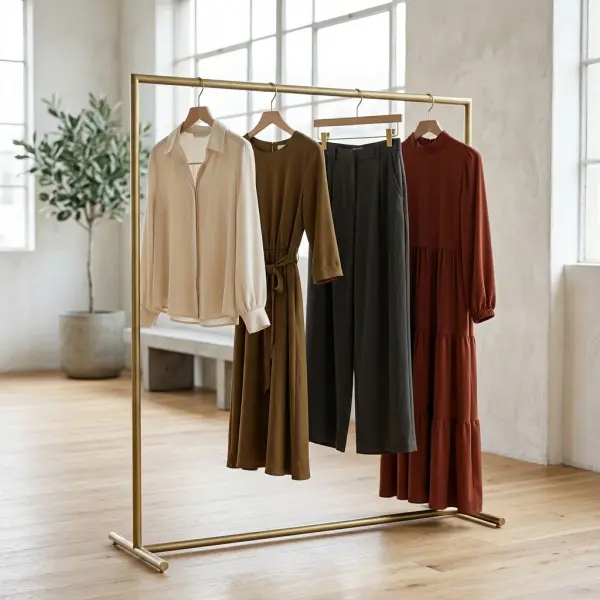
What Crepe Means for Garment Construction
A beautiful drape does not automatically translate into easy production. Lightweight crepes can shift during spreading and cutting, while certain textured surfaces make grain alignment less visually obvious. Fine fabrics may also react poorly to oversized needles, excessive tension, rough feed mechanisms, or repeated unpicking.
Heavier crepes present different challenges. Bulk can accumulate at enclosed seams, waistbands, facings, pockets, or multilayer junctions. Stretch crepes add another variable: if recovery is insufficient, fitted garments may grow at the seat, knees, elbows, neckline, or waist during wear.
Sampling should therefore reproduce the actual production method rather than relying on a small hand-sewn swatch. Useful tests include seam appearance, stitch balance, puckering, pressing response, edge fraying, needle marking, dimensional change, and the way the garment hangs after being left on a hanger.
Pattern engineering also matters. A soft crepe may work beautifully in a bias-cut or draped silhouette but provide too little support for a sharply sculpted collar. Conversely, a firmer dress crepe may produce cleaner tailored lines yet feel too rigid for the soft movement envisioned by the designer.
What Should Fashion Businesses Specify When Sourcing Crepe?
"Black crepe fabric" is not a production-ready specification. At minimum, the sourcing team should know enough about the material to reproduce the approved garment consistently across sampling, bulk production, replenishment, and potentially different mills.
A practical crepe specification may include:
- Fiber composition and percentage.
- Woven or knitted construction.
- Fabric weight, normally expressed in grams per square meter where appropriate.
- Usable width.
- Stretch direction and percentage, when applicable.
- Recovery expectations for stretch products.
- Surface character and approved reference swatch.
- Color standard and acceptable shade variation.
- Opacity or lining requirement.
- Dimensional-change requirements after the intended care process.
- Pilling, snagging, abrasion, or seam-performance requirements where relevant to the garment.
- Finishing treatment.
- Care method and labeling requirements.
- Approved bulk standard or sealed sample.
The appropriate test plan depends on the product. An evening blouse does not face the same stresses as work trousers, and a decorative outer layer should not automatically be subjected to the same performance expectations as a uniform fabric.
A strong buying team therefore starts with the end use, then defines which properties are commercially important. Specification is not about collecting the largest possible number of test results; it is about identifying the characteristics that could cause fit problems, returns, production disruption, customer dissatisfaction, or inconsistent repeat orders.
Evaluating Crepe During Sampling and Quality Control
Crepe deserves both technical testing and visual inspection because its appeal depends heavily on texture and drape. A laboratory may confirm composition and dimensional performance while still missing a noticeable change in surface character between production lots.
For incoming or pre-production assessment, teams should compare bulk fabric against the approved standard under consistent lighting. Particular attention should be paid to texture uniformity, width, shade, skew or bow where relevant, defects, handfeel, stretch behavior, and any difference in drape.
The garment itself should then be assessed after sewing and pressing. Some problems emerge only after construction: seam puckering that was invisible on the roll, shine created by excessive pressing, distorted hems, stretched necklines, or panels that no longer hang evenly.
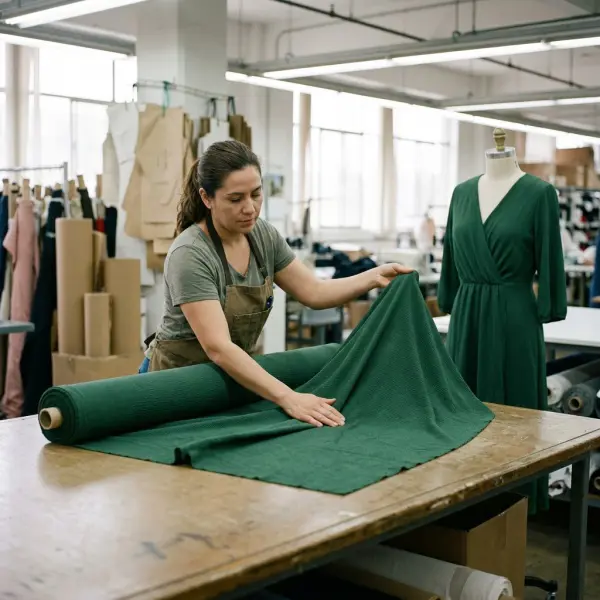
Crepe vs Smooth Fabrics: What Changes in the Finished Garment?
The practical difference is often visible before it is measurable. A smooth fabric tends to produce a cleaner uninterrupted surface, while crepe introduces small irregularities that break up reflected light and add tactile interest. The same garment silhouette can therefore communicate a different visual mood when made from crepe instead of satin, poplin, or another comparatively smooth cloth.
Crepe should not be assumed to be softer, heavier, more breathable, or more durable simply because it is crepe. Those characteristics belong to the total material system rather than the surface label. A lightweight polyester crepe and a wool crepe may share an irregular face while differing dramatically in thermal behavior, weight, resilience, care, and intended end use.
This is similar to the broader principle discussed in Twill Fabric Explained: Weave Structure, Texture, and Uses: textile names become useful only when the construction and material behind the name are understood.
How Fashion Brands Can Use Crepe Strategically
Choosing crepe strategically starts with silhouette rather than trend. If the garment needs soft movement, a subtle matte texture, layered volume, or an elegant solid-color surface, an appropriate crepe may be a strong candidate. The next step is narrowing the enormous category to the weight, fiber, construction, and performance level that can actually deliver that silhouette.
For product development teams, physical swatches should be evaluated on forms or garments, not just sample cards. A fabric that feels attractive in the hand may hang differently over a full skirt or become unexpectedly heavy once several meters are used.
Sourcing teams should also avoid approving a fabric solely through supplier nomenclature. Instead of asking another mill for "the same crepe," provide the approved construction and performance information together with a physical standard whenever possible.
At retail level, customer communication should remain concrete. Saying "textured crepe with a fluid drape" tells the customer more than simply using "premium crepe." If the fabric is polyester, viscose, silk, or a blend, the composition should be communicated accurately rather than allowing "crepe" to imply a fiber that is not present.
For businesses selling across several seasons, consistency can become a commercial advantage. Establishing a small library of approved crepe bases—for example, one fluid blouse quality, one opaque dress quality, and one stretch trouser quality—can reduce repeated sourcing work while allowing color, print, silhouette, and styling to change around familiar materials.
Common Mistakes When Working With Crepe
Treating "crepe" as a complete specification
This is the most fundamental mistake. A supplier can legitimately offer multiple fabrics under the crepe label that differ in composition, weight, opacity, stretch, weave, finish, and drape. Buying by name alone increases the risk that the bulk fabric will not reproduce the approved garment. A better approach is to combine the commercial fabric name with measurable specifications and an approved physical standard.
Assuming all crepes have the same drape
Crepe is often described as drapey, but the category includes materials ranging from delicate and fluid to comparatively firm and structured. Designing a pattern around an imagined "crepe drape" before approving the actual fabric can create fit and silhouette problems. Pattern development should use the intended production quality or a substitute with genuinely comparable weight and behavior.
Selecting fabric from a small swatch only
A small swatch communicates color, touch, and surface reasonably well, but it does not show how several meters of cloth will behave under gravity. This matters particularly for full skirts, long dresses, wide-leg trousers, kaftans, and layered garments. Hanging a larger cutting or making an early toile in a comparable fabric gives the design team more useful information.
Ignoring opacity until late in development
Some lightweight crepes look sufficiently opaque when doubled on a swatch card but become translucent once suspended or stretched over the body. Discovering that a dress requires lining after costing is complete can change material consumption, labor, garment weight, delivery timing, and retail price. Opacity should therefore be reviewed under realistic lighting during initial material selection.
Assuming texture hides every wrinkle or sewing defect
The irregular surface of crepe may visually soften minor creasing in some constructions, but it does not eliminate poor sewing. Seam puckering, uneven hems, feed distortion, shine from pressing, or stretched edges can remain highly visible. Production settings should be validated on the real fabric rather than relying on the texture to disguise workmanship problems.
Making sustainability claims from the word "crepe"
Crepe describes a textile effect, not an environmental credential. A sustainability claim needs evidence relating to the actual fiber, sourcing, manufacturing, chemistry, durability, traceability, or certification involved. Brands should avoid language such as "eco-friendly crepe" unless the underlying claim is specific, substantiated, and appropriately qualified.
Important Technical Caveats
Several commonly repeated descriptions of crepe become misleading when stripped of context.
First, not every crepe is produced with high-twist yarn. High twist is an important traditional route, but textile references also recognize crepe weaves and finishing processes as ways of producing the effect.
Second, crepe does not identify fiber content. A garment labeled as crepe may be silk, rayon or viscose, polyester, wool, cotton, a blend, or another composition depending on the product.
Third, crepe does not guarantee a particular level of breathability, wrinkle resistance, opacity, durability, or stretch. These properties depend on the complete fabric construction.
Finally, commercial textile terminology is not perfectly standardized across every supplier and market. When fabric performance matters, a physical approved standard plus technical specifications is more reliable than a name alone.
FAQ: Crepe Fabric
Is crepe a natural or synthetic fabric?
Crepe can be either. The term describes a textured textile category rather than one specific fiber. Crepe has historically been produced from silk and wool, while modern versions may use viscose or rayon, polyester, cotton, blends, and other materials. That means a shopper or sourcing team cannot determine fiber content from the word "crepe" alone. Check the composition label or technical data sheet, especially when fiber choice affects price, care, sourcing requirements, or product positioning.
Is crepe fabric always lightweight?
No. Lightweight silk crepes and georgettes are well known, but crepe fabrics also exist in medium and heavier weights suitable for trousers, structured dresses, skirts, jackets, or tailoring. Even fabrics with similar surface textures can have very different body and drape. For product development, fabric weight should therefore be specified separately rather than inferred from the crepe name.
Does crepe wrinkle easily?
There is no universal answer because wrinkle behavior depends on the fiber, yarn construction, weight, finishing, and garment use. Some crepe fabrics may visually disguise minor creasing because their surface is already textured, but that is different from being inherently wrinkle-resistant. A polyester crepe, viscose crepe, silk crepe, and wool crepe should not be expected to respond identically. When wrinkle performance is commercially important, brands should evaluate the actual fabric rather than relying on category assumptions.
What is the difference between crepe and chiffon?
Crepe is a broad family of textured fabrics, while chiffon is usually a lightweight, sheer, plain-weave fabric made from finely twisted yarns. CAMEO describes chiffon specifically as sheer and diaphanous, whereas its crepe definition covers a much wider range of fibers and constructions. CAMEO chiffon textile definition Because some crepes—especially georgette-like constructions—can also be lightweight and sheer, the categories may look similar in garments. Their construction, handfeel, transparency, and end use should be compared directly rather than treating the names as interchangeable.
Is crepe fabric good for hot weather?
Some lightweight crepes can work well in warm-weather clothing, but the crepe label alone does not establish thermal comfort. Fiber composition, fabric mass, weave density, air permeability, garment looseness, lining, color, and climate all affect how comfortable a garment feels. A loose, lightweight crepe blouse and a dense lined polyester crepe dress may provide very different experiences despite sharing the same broad textile name. Buyers should evaluate the actual construction and garment system rather than assuming all crepe is cool.
Does crepe need lining?
Not necessarily. Medium-weight or densely constructed crepes may provide sufficient opacity on their own, while lightweight crepe de Chine, georgette, pale-colored crepes, or loosely structured fabrics may require lining depending on the garment. Lining can also be introduced for comfort, shape, seam coverage, or improved hang even when opacity is acceptable. Because lining adds cost, weight, labor, and material consumption, the decision is best made during sampling rather than after the garment has been costed.
Is crepe difficult to sew?
Some crepes are easy to handle, while lightweight, slippery, stretchy, or highly fluid constructions can require more control during spreading, cutting, stitching, and pressing. The production team may need to optimize needle size, stitch parameters, feed, seam construction, stabilization, and pressing temperature for the particular fabric. A supplier's "crepe" classification therefore says little about sewing difficulty by itself. Production trials on the bulk-intent fabric remain the safer approach.
What should a fashion brand check before buying crepe in bulk?
Start with the properties that affect the actual garment: fiber composition, weight, width, construction, stretch and recovery where relevant, opacity, surface appearance, drape, dimensional stability, shade consistency, care, and required performance tests. Then compare bulk fabric against an approved physical standard rather than relying only on a product code or fabric name. This reduces the risk of a fabric technically being "crepe" while behaving differently from the material used for the approved sample.
Conclusion
Crepe is useful precisely because it is not one narrowly defined fabric. The category can range from delicate silk crepe de Chine and sheer georgette to opaque dress crepes, stretch constructions, wool crepes, and modern synthetic versions. Across those variations, the recurring idea is an intentionally irregular surface created through yarn, weave, finishing, or a combination of them.
For designers, that texture can add depth to a solid-colored garment and support anything from soft draping to more controlled tailoring. For sourcing and production teams, however, the breadth of the category makes precision essential. "Crepe" should begin the material conversation, not end it.
The strongest product decisions come from matching fiber + construction + weight + texture + drape + performance to a specific garment. When those variables are understood and tested together, crepe becomes much easier to source consistently and use deliberately rather than simply selecting it because its commercial name sounds appropriate.






Comments 0
Leave a CommentSend Comment
Anda harus Login terlebih dahulu untuk dapat memberikan komentar.