
Why Functionality and Style Should Work Together in Adaptive Fashion
Quick Answer: Why Do Functionality and Style Matter Equally in Adaptive Fashion?
Functionality and style should work together in adaptive fashion because clothing needs to support practical dressing requirements while allowing people to express their identity, preferences, and personal sense of style. A garment that is easy to wear but aesthetically unappealing may not meet the expectations of its intended customer. Equally, fashionable clothing that remains difficult to put on, uncomfortable, or incompatible with mobility requirements may offer limited practical value.
Adaptive fashion brings these considerations into the same product development process. Functional details such as accessible fastenings, adjustable openings, and seated-fit construction should be developed alongside silhouette, fabric, color, proportion, and overall garment appearance.
For fashion brands, this means treating accessibility as a design requirement rather than an additional feature applied after the collection has been styled.
Research on adaptive apparel increasingly recognizes that clothing needs extend beyond physical function. Consumers also consider how garments communicate personal identity and fit different social situations.
The strongest adaptive fashion concepts therefore begin with a clear understanding of both clothing usability and consumer preference. Their success depends on delivering a practical garment that customers genuinely want to wear, rather than expecting them to compromise one requirement to satisfy another.
Adaptive Fashion Is Both a Practical and Personal Clothing Experience
Adaptive fashion is commonly associated with clothing features designed to accommodate specific dressing or mobility requirements. Alternative closures, modified garment openings, adjustable construction, and seated-fit patterns are familiar examples. These details can address practical barriers that conventional clothing may overlook.
However, clothing is not simply a functional covering for the body.
People use clothing to communicate personality, participate in social settings, meet professional expectations, and make choices about how they present themselves. These motivations do not disappear because someone has a disability or requires a different method of dressing.
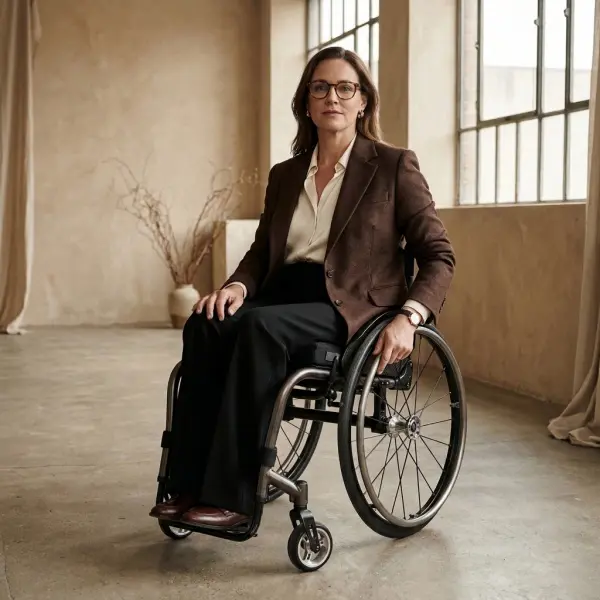
A customer shopping for an adaptive blazer may be looking for appropriate seated proportions and an accessible closure. That same customer may also want contemporary tailoring, a flattering color, and a silhouette suited to their professional wardrobe.
The requirements are connected. If the garment provides excellent fastening access but looks unlike the clothing the customer prefers, the design may still fall short of its intended purpose.
A 2024 systematic literature review published in the International Journal of Consumer Studies examined 51 articles on adaptive apparel and identified both functional and aesthetic clothing attributes as important research areas. It also highlighted the need for greater attention to consumers' expressive and aesthetic requirements.
The systematic review of adaptive apparel research provides academic context for understanding adaptive clothing as a consumer product category rather than solely a technical response to disability.
For fashion businesses, this distinction changes the design brief. The question is no longer only how to make a garment easier to wear. It is also how to ensure that the improved garment remains desirable within the customer's preferred wardrobe.
What Happens When Clothing Prioritizes Function but Ignores Style?
Function-first clothing may solve a practical dressing problem while offering limited variety in appearance, silhouette, color, or suitability for different occasions.
This does not mean that simple or utilitarian clothing is inherently undesirable. Some customers actively prefer understated garments, relaxed silhouettes, or products developed primarily around convenience. The problem emerges when practical clothing becomes the only realistic option available, regardless of the consumer's personal preferences.
Consider a customer who needs trousers with an accessible waistband and a fit appropriate for extended sitting. If the only suitable options are basic casual trousers, the customer may struggle to find clothing for a formal event, a professional meeting, or a preferred personal style.
The accessibility requirement has been addressed, but the broader clothing need remains only partially fulfilled.
A 2024 article in Neuromuscular Disorders examined shopping experiences and clothing-related difficulties among people with limited mobility. The research discussed the challenge of finding clothing that is both practical and stylish, along with barriers encountered during shopping.
The study on practical and stylish clothing for people with limited mobility reinforces a commercially relevant point: product choice and the ability to find suitable clothing matter alongside physical garment functionality.
The Limitations of a Purely Utilitarian Approach
A design process focused exclusively on ease of dressing may overlook the conventions that customers expect from specific fashion categories.
Formalwear, for example, needs to communicate an appropriate level of formality through fabric, proportion, construction, and finishing. A garment designed around practical access alone may not satisfy these expectations.
Workwear creates similar challenges. A customer may need adaptive construction while still wanting clothing that fits professional dress codes and their preferred image.
When a company ignores these contexts, it risks developing garments that perform adequately during dressing tests but remain poorly matched to the situations in which customers intend to wear them.
Style Restrictions Can Reduce Meaningful Choice
A narrow adaptive assortment can limit customer choice even when individual products are technically functional.
If accessible garments are available only in a small selection of colors, silhouettes, or categories, consumers may need to choose between wearing clothing they prefer and wearing clothing they can manage comfortably.
This tension is not unique to adaptive fashion, but the consequences can be more significant when suitable alternatives are limited.
The appropriate response is not to assume that every adaptive product needs more decoration or trend-driven styling. It is to recognize that customers should have access to a reasonable range of design choices, including minimal, classic, contemporary, and expressive styles.
Why Style Matters to Clothing Identity and Consumer Preference
Style is not merely an optional decorative layer added to an otherwise functional garment. It influences whether clothing feels appropriate for a person's identity, lifestyle, and social environment.
For one customer, style may mean understated tailoring and neutral colors. For another, it may involve expressive prints, contemporary streetwear, or clothing that aligns with a particular cultural or professional setting.
Adaptive clothing should not presume that a functional requirement determines these preferences.
A 2026 study published in Clothing and Textiles Research Journal examined symbolic and functional clothing values among male wheelchair users. Based on interviews with seven participants and analysis of 14 adaptive apparel brands, the researchers identified a gap between functional product offerings and consumers' expectations regarding style, identity, and social acceptance.
The 2026 study of functional and symbolic values in adaptive apparel provides evidence that clothing preferences cannot be understood through technical performance alone. Its qualitative findings are valuable for identifying design concerns, although the small interview sample should not be generalized to all wheelchair users or adaptive fashion consumers.
Clothing as a Form of Self-Expression
A garment communicates through its color, cut, texture, detailing, and relationship to the rest of a wardrobe. These elements help people construct a visual identity that reflects their preferences.
Adaptive design can preserve this possibility by integrating practical features without unnecessarily restricting aesthetic decisions.
For example, a contemporary overshirt could incorporate an easier fastening system while retaining familiar pocket placement, fabric texture, and proportions. The product's functionality may differ from a conventional overshirt, but the customer's styling options need not be fundamentally altered.
This does not mean accessible features must always be hidden. Some consumers may prefer visible or distinctive design elements. The relevant principle is that the wearer, rather than the designer's assumptions about disability, should influence what the garment looks like.
Dressing for Different Social Situations
Fashion collections are commonly developed around occasions and lifestyle activities. Casual clothing, professional attire, occasion wear, and outerwear serve different practical and social purposes.
Adaptive fashion needs to account for these distinctions as well.
An accessible shirt suitable for everyday wear may not fulfill the requirements of a formal dress shirt. Similarly, comfortable adaptive trousers for casual activities may not substitute for appropriate professional tailoring.
A more complete wardrobe requires choices across clothing categories. Fashion businesses can use this perspective to identify assortment gaps rather than treating adaptive apparel as a single product type.
Understanding Functional, Expressive, and Aesthetic Clothing Needs
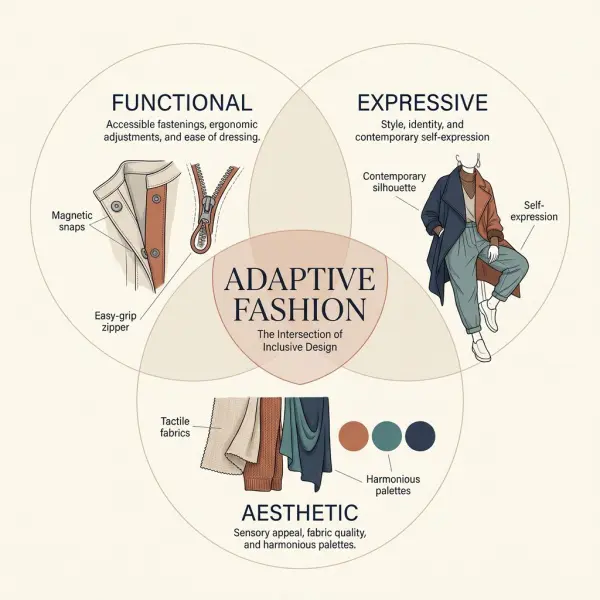
One useful framework for evaluating adaptive fashion is the Functional, Expressive, and Aesthetic (FEA) consumer needs model.
The model considers clothing through three related dimensions: how a garment performs, what it communicates about the wearer, and how its visual qualities satisfy the user's preferences.
These dimensions are particularly relevant when developing clothing for consumers whose practical requirements have historically been separated from mainstream fashion considerations.
Research published in the International Journal of Consumer Studies in 2023 used functional, expressive, and aesthetic concepts to analyze adaptive clothing customer reviews. The study found that clothing function was the most frequently discussed theme in its analyzed reviews, followed by customer service and clothing aesthetics.
The research on adaptive clothing customer reviews suggests that functionality is a major concern for the consumers represented in the study, but it does not make aesthetic preferences irrelevant.
Three Dimensions of Adaptive Clothing Value
|
Dimension |
What It Addresses |
Example in Adaptive Fashion |
Business Implication |
|
Functional |
Physical usability, fit, comfort, and clothing performance |
A blazer with accessible fastenings and seated-fit proportions |
Product specifications and testing need to address real user requirements |
|
Expressive |
Personal identity, social presentation, and desired image |
Professional clothing that reflects the wearer's preferred style |
Assortment development should consider lifestyle and social context |
|
Aesthetic |
Silhouette, color, texture, proportion, and visual appeal |
Contemporary tailored trousers offered in several finishes |
Design and merchandising should provide meaningful style choices |
The three dimensions can reinforce one another, but they may also introduce design trade-offs.
A highly structured jacket may satisfy a customer's visual preference while requiring construction adjustments to improve dressing access. A soft, flexible fabric may support movement but provide less of the crisp appearance expected from formal tailoring.
Good product development recognizes these interactions early.
Rather than treating function, expression, and aesthetics as competing departments, brands can use them as complementary criteria throughout garment design.
How Can Functionality Be Integrated Without Compromising Garment Design?
Integrating accessibility into fashion requires designers to consider practical performance and visual design from the beginning of product development.
Adding functional modifications after a garment is already finalized can create awkward construction, visible inconsistencies, or changes to fabric behavior. In some cases, the modifications may also fail to address the complete dressing process.
A more effective approach develops garment construction and aesthetic decisions together.
This does not mean every functional detail must be invisible. It means the placement, appearance, and operation of adaptive features should be intentional.
Design Fastenings as Part of the Garment Architecture
Alternative closures can influence the appearance of a garment front, placket, cuff, or waistband. Their selection therefore affects both usability and design.
A shirt with magnetic closures may be styled to retain the appearance of a conventional button-front shirt. In another design, larger visible fastenings might become part of the garment's visual identity.
Both approaches can be appropriate when they reflect intended user preferences and are technically validated.
Closure selection also involves practical considerations, including operating force, durability, wash performance, and compatibility with relevant safety requirements.
For designers, the central question is whether the closure supports the garment's intended use while remaining consistent with its visual character.
Use Patternmaking to Improve Fit and Silhouette Together
Pattern construction determines how fabric is distributed around the body. It influences both physical comfort and the finished silhouette.
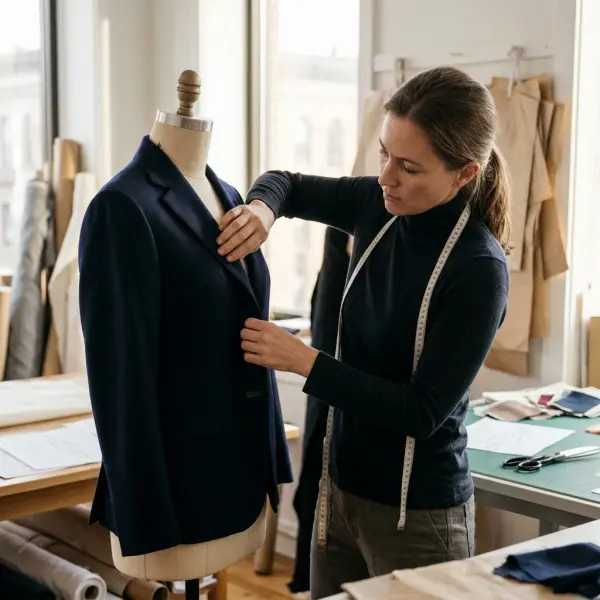
A seated-fit jacket, for example, may require altered body length or proportions to avoid excessive fabric accumulation. When carefully developed, these changes can support a more balanced appearance in the intended wearing position.
Similarly, a pair of trousers can incorporate modifications to its rise or waistband while retaining a contemporary tailored style.
The objective is not necessarily to imitate standing-fit proportions. It is to create a visually balanced garment for the wearer's actual body position and preferences.
More detailed technical considerations are covered in inclusive clothing design for different mobility and dressing needs.
Make Material Selection a Shared Functional and Creative Decision
Fabric selection affects garment movement, handfeel, shape retention, drape, and overall appearance.
A flowing fabric may work well for an occasion dress requiring generous openings and soft movement. A structured woven fabric may support formal tailoring but need additional engineering around access points.
Neither material type is inherently more accessible.
Product teams should evaluate textile characteristics against both the intended wearing experience and the desired aesthetic result.
For instance, a soft stretch lining may improve comfort in some tailored garments, but the complete fabric combination still needs to be assessed for fit, stability, laundering, and durability.
Why Co-Design Matters When Balancing Style and Accessibility
A designer may understand garment construction without fully understanding how a particular customer experiences dressing. Equally, consumers may be able to describe a clothing difficulty without knowing which technical modification would address it most effectively.
Co-design connects these forms of knowledge.
In adaptive fashion, co-design involves people with relevant lived experience participating meaningfully in design decisions. Their contribution can influence the initial concept, functional specifications, appearance, fitting, and product evaluation.
This is different from presenting a finished garment to a small group and asking whether they like it.
A genuinely collaborative process creates opportunities to change the product before major technical and commercial decisions are locked in.
What Users Can Reveal That Conventional Design Briefs May Miss
Consider a brand developing an adaptive formal dress.
The design team may initially focus on creating an accessible side opening. During user research, however, participants might explain that discreet access is less important to them than being able to put on the garment without assistance, having a secure fit while seated, or choosing from several contemporary silhouettes.
These findings can change the direction of product development.
They may also reveal trade-offs that cannot be resolved through a single standard garment. A closure preferred by one user may be unsuitable for another, while different customers may have contrasting preferences about garment shape or visible detailing.
For fashion businesses, the value of co-design lies in identifying these differences before committing to production.
Open Style Lab and Collaborative Design Practice
Open Style Lab is a nonprofit organization that brings together designers, engineers, occupational therapists, and people with disabilities to develop accessible wearable solutions.
Its work emphasizes that clothing should address practical needs without disregarding style and self-expression.
This interdisciplinary approach offers an important lesson for apparel companies. Accessibility and aesthetics benefit from being considered within the same development conversation rather than assigned to separate stages.
A fashion designer can contribute knowledge of silhouette, construction, and visual identity. A technical specialist may help evaluate material or fastening performance. The intended wearer provides essential insight into real use, preferences, and whether the proposed solution is meaningful.
No single perspective should replace the others.
Real Industry Examples of Function and Style Working Together
The relationship between adaptive functionality and contemporary style is increasingly visible in actual fashion development projects.
These examples are valuable because they illustrate different commercial approaches. Some brands integrate adaptive features into familiar wardrobe categories, while others develop specialized tailoring, occasion wear, or co-designed fashion concepts.
However, product launches and marketing materials should not be treated as independent proof that garments meet every consumer requirement. Each collection still needs to be assessed according to its intended audience and documented performance.
ASOS Adaptive: Bringing Accessibility Into Contemporary Fashion Categories
On September 24, 2026, ASOS launched its first adaptive collection, developed with accessibility consultancy Tilting the Lens and co-created with people with disabilities.
According to the official ASOS Adaptive launch announcement, the collection included 51 options spanning womenswear, menswear, and curve categories.
The range incorporated contemporary tailoring, occasion wear, dresses, everyday garments, and adaptive features such as alternative fastenings, concealed openings, stretch construction, and modified proportions for seated wearers.
ASOS and Tilting the Lens also reported that 86% of participants in their research identified comfort and fit as leading purchase motivators. This is a finding from research reported by the companies, not a representative statistic for the entire global adaptive fashion market.
The significant product-development lesson is the relationship between category and functionality.
Rather than presenting adaptive clothing only as basic practical apparel, the collection applied accessibility considerations to recognizable fashion categories, including occasion dresses and tailored clothing.
For apparel businesses, this demonstrates one possible assortment strategy: develop products around both the situations in which customers want to wear clothing and the physical requirements those garments must accommodate.
The CFDA/Vogue Fashion Fund Adaptive Design Challenge
In 2025, the CFDA/Vogue Fashion Fund incorporated an adaptive fashion design challenge that paired participating designers with people from the disability community.
The initiative, discussed in Vogue's coverage of the adaptive fashion challenge, encouraged designers to interpret accessibility through their existing creative approaches while collaborating with intended wearers.
This illustrates another method of bringing adaptive design into mainstream fashion development.
A designer does not necessarily need to abandon an established visual identity to incorporate accessibility. Instead, functional requirements can become part of the creative brief, influencing proportion, construction, and how garments are intended to be worn.
The challenge also highlights the importance of collaboration, although a design showcase alone does not establish commercial scalability or long-term garment performance.
How Fashion Brands Can Balance Design, Accessibility, and Commercial Viability
Balancing functionality and style introduces business considerations beyond garment appearance.
A company needs to understand whether the intended product addresses a specific consumer need, fits the brand's positioning, and can be manufactured at an acceptable cost.
A technically sophisticated garment may be difficult to commercialize if its required components are expensive or unavailable at scale. An attractive collection may also struggle if customers cannot identify whether the products suit their practical needs.
The challenge is to connect design decisions with realistic product development and retail operations.
Define the Customer Through Needs and Style Preferences
Demographic or diagnostic categories alone rarely provide enough information to develop a desirable adaptive fashion assortment.
Product teams should consider how customers dress, which clothing categories they prefer, and the specific practical barriers they experience.
A useful consumer profile might describe someone seeking contemporary professional clothing with seated-fit proportions and manageable closures. Another may focus on occasion wear requiring accessible openings without compromising a preferred silhouette.
These profiles combine functional and fashion-related requirements, giving designers a clearer product direction.
They should be validated through research rather than constructed entirely from assumptions.
Decide Which Features Should Be Standard and Which Should Be Specialized
Some adaptive features may be appropriate across multiple products, while others are closely associated with particular user requirements.
For instance, an easier-to-grip zipper pull may be relevant to a comparatively broad group of customers. A garment opening designed around specific equipment access may serve a narrower group.
A company should not assume that integrating every possible feature into one garment will make it more inclusive.
Additional components can increase weight, cost, complexity, or visual clutter. They can also create conflicting functional requirements.
A more effective assortment architecture may include accessible features within mainstream products alongside specialized styles intended for clearly defined needs.
Evaluate Production Costs Without Sacrificing Essential Function
Alternative trims, modified pattern blocks, smaller production runs, and additional fitting requirements may increase development or unit costs.
However, the impact depends on product complexity, supplier capability, materials, order quantities, and whether components can be shared across multiple styles.
Brands should identify which accessibility details are essential to garment performance and which aesthetic choices offer flexibility.
If a customer requires a particular opening configuration, replacing it with a cheaper but inaccessible alternative would undermine the product's purpose. Conversely, changing a decorative detail may be acceptable when it does not compromise the functional requirement or intended style.
This distinction helps sourcing and manufacturing teams make commercially responsible decisions.
Evaluate the Entire Product Experience
Commercial success is influenced by more than the garment itself.
Customers may need clear product descriptions, accessible ecommerce navigation, detailed fit guidance, and demonstrations of how functional features operate.
A sophisticated adaptive blazer can be difficult to purchase confidently if the product page provides no information about closure operation or seated-fit measurements.
Retail teams therefore need to communicate both the aesthetic qualities and the practical construction of the garment.
A Product Development Framework That Brings Function and Style Together
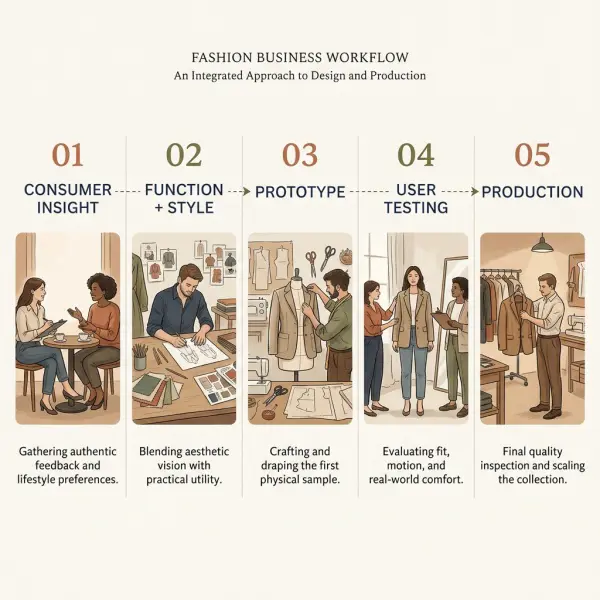
Fashion businesses can integrate accessibility into their normal development workflow without establishing a completely separate creative process.
The key is to evaluate practical and aesthetic requirements together at each major decision point.
The following framework provides a starting structure.
|
Development Stage |
Functional Question |
Style Question |
Recommended Output |
|
Consumer research |
What dressing or wearing problem needs to be addressed? |
What clothing styles and occasions matter to the customer? |
Combined functional and aesthetic design brief |
|
Concept development |
Which construction changes may improve usability? |
Which silhouettes, colors, and design details are appropriate? |
Preliminary design concepts with accessibility requirements |
|
Material and trim selection |
Will fabrics and components perform as intended? |
Do they support the desired appearance and handfeel? |
Approved material and trim options |
|
Sampling and fitting |
Can intended users dress and wear the garment comfortably? |
Does the garment meet their visual preferences? |
Revised prototype with recorded user feedback |
|
Production planning |
Can critical functional details be reproduced consistently? |
Can the intended quality and finishing be maintained? |
Technical package and quality control criteria |
|
Retail preparation |
Can customers understand and evaluate accessibility features? |
Is the garment presented as a desirable fashion product? |
Accurate product information and inclusive merchandising |
This framework is not a guarantee of commercial success. It is a way to prevent important questions from being addressed too late in development.
For smaller apparel brands, the process can begin with one well-defined garment rather than an entire adaptive collection. A focused pilot can generate useful learning about consumer preferences, construction feasibility, and the relationship between functionality and aesthetic appeal.
Why Retail Presentation Should Not Separate Adaptive Fashion From Style
Even a well-designed adaptive garment can be presented poorly at retail.
If a retailer communicates only medical or functional attributes, customers may struggle to understand how the product fits their personal style. If the retailer emphasizes appearance without explaining accessible construction, shoppers may lack the information needed to assess suitability.
Good merchandising combines both.
A product page for an adaptive dress, for example, can feature editorial styling photography alongside practical explanations of garment openings, fastenings, fabric properties, and intended fit.
The customer should be able to appreciate the garment as fashion while understanding the features relevant to their dressing requirements.
Show Clothing in Realistic Wearing Contexts
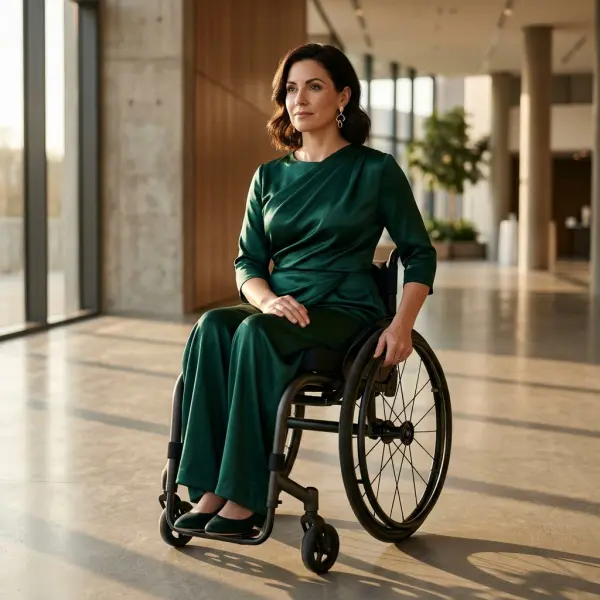
Adaptive fashion imagery benefits from showing garments on intended users in appropriate settings.
A tailored jacket can be photographed in a contemporary professional environment. An occasion dress may be presented through refined editorial photography. Everyday casualwear can be shown in familiar lifestyle situations.
The purpose is to communicate authentic product use rather than reducing the wearer to a demonstration of disability.
Where specific functional details are important, separate close-up photography or explanatory videos can provide clarity.
Brands should also avoid assuming that one type of representation reflects the entire adaptive clothing audience.
Describe Features Without Making Universal Claims
Descriptions such as "comfortable for everyone" or "perfect for all disabilities" are difficult to substantiate and may mislead shoppers.
More useful product copy explains the actual design.
For example, a retailer may describe a jacket as incorporating an alternative front fastening, a modified body length, or a lining selected for a particular construction purpose.
Such descriptions can be paired with relevant measurements and information about how the garment was designed to be worn.
This helps customers evaluate both the practical features and the appearance of a product without relying on exaggerated accessibility claims.
Common Mistakes When Balancing Functionality and Style
Treating Fashionability as an Optional Final Detail
One common mistake is completing the functional construction before considering whether the resulting garment fits the intended customer's aesthetic preferences. At that stage, changing silhouette or material may require substantial redevelopment. The result can be a technically functional product with limited commercial relevance. A better process identifies visual expectations during initial research and develops them alongside practical requirements.
Assuming All Adaptive Consumers Prefer Discreet Design
Some consumers prefer adaptive features that blend into conventional garments, while others value visible functionality or distinctive design details. Treating discreetness as a universal requirement can restrict creativity and ignore individual preferences. Designers should test different aesthetic directions where appropriate and allow user feedback to determine whether a feature should be concealed, integrated, or intentionally visible.
Following Fashion Trends Without Validating Accessibility
Trend-driven silhouettes can introduce construction challenges when they involve restrictive fits, complicated closures, or difficult garment entry. A fashion brand may successfully reproduce a popular visual style while failing to deliver the intended adaptive performance. Product teams should evaluate which trend elements can be retained and which require modification. The goal is not to eliminate contemporary styling, but to ensure that accessibility remains effective after aesthetic decisions are made.
Designing Only for Basic Everyday Clothing
Focusing exclusively on casual apparel may overlook demand for professional clothing, occasion wear, outerwear, and other wardrobe categories. This can leave customers with practical garments but limited options for particular activities and social settings. Brands should examine unmet needs by clothing occasion rather than assuming that one basic assortment can satisfy an entire consumer segment. Expansion should still be based on validated demand and production feasibility.
Using Inclusive Marketing Without Inclusive Product Development
A campaign may feature diverse models and compelling accessibility language while providing little evidence that the garments were developed for relevant user requirements. This creates a gap between brand communication and product performance. Inclusive representation has value, but it does not substitute for user research, garment testing, accurate specifications, and clear product information. The most credible approach connects marketing claims with documented product development decisions.
What Brands Should Verify Before Expanding Adaptive Fashion Collections
The relationship between functionality and style is clear at a conceptual level, but its commercial execution requires careful validation.
A fashion brand should verify that the intended product offers a meaningful functional improvement, meets relevant aesthetic expectations, and can be delivered consistently through its supply chain.
Several limitations deserve attention.
Consumer preferences are not uniform. Research findings from one disability group, country, garment category, or age segment should not automatically be applied to other consumers. A 2026 study in Fashion and Textiles evaluated 30 adaptive lower-garment attributes using survey responses from 214 participants and found overall priorities around physiological comfort and accessible dressing mechanics, alongside exploratory differences between demographic subgroups. These findings support differentiated product development rather than a universal design formula.
The 2026 research on adaptive lower-garment requirements provides useful evidence, but its scope should not be extended indiscriminately to all adaptive apparel categories.
Aesthetic appeal does not establish accessibility. A garment can look contemporary while remaining difficult for its intended wearer to operate. Functional claims require appropriate testing.
Accessibility does not guarantee commercial demand. A product may address a valid clothing need without achieving sufficient sales at a particular price point. Brands need to assess customer preferences, competing options, affordability, and distribution.
Additional design features can introduce technical risks. Alternative fasteners, specialized openings, and modified construction details must be evaluated for durability, safety, maintenance, and manufacturing consistency. Magnetic components, for example, require appropriate safety assessment where relevant to implanted medical devices.
Inclusive design is not equivalent to universal suitability. A product developed for a particular group should not be marketed as appropriate for everyone unless evidence genuinely supports that claim.
These considerations provide a practical boundary for responsible product development. They help distinguish meaningful accessibility improvements from attractive concepts that have not yet been validated.
Frequently Asked Questions About Functionality and Style in Adaptive Fashion
Why Is Style Important in Adaptive Clothing?
Style matters because adaptive clothing is part of a person's wardrobe, not merely a functional product. Consumers may want garments that reflect their personality, cultural preferences, professional environment, or preferred fashion aesthetic.
A product can address a dressing difficulty while still failing to meet those expectations. Research on adaptive apparel has identified expressive and aesthetic needs alongside functional requirements, although preferences vary between individuals. For fashion brands, this means style decisions should be informed by consumer research rather than treated as optional decoration. A well-developed adaptive garment should provide practical value while giving customers meaningful choices about appearance and self-presentation.
Can Adaptive Clothing Be Both Fashionable and Functional?
Yes. Adaptive clothing can incorporate accessible fastenings, modified garment proportions, alternative openings, and other functional details within contemporary silhouettes. The combination is technically possible, but it requires deliberate design and validation.
For example, adaptive tailored trousers may incorporate seated-fit pattern modifications while retaining a professional appearance. An occasion dress can include functional access points while using the fabric, drape, and silhouette associated with contemporary formalwear. The final result depends on material behavior, construction quality, and the intended user's needs. Brands should test accessibility and aesthetic acceptability together rather than assuming that a fashionable appearance establishes functional suitability.
Does Adaptive Fashion Have to Look Different From Regular Clothing?
No. Adaptive garments can resemble conventional clothing while incorporating different construction details. Some features, such as alternative fastenings or modified pattern proportions, may be visually subtle when the garment is worn.
However, adaptive fashion does not need to imitate conventional clothing in every situation. Some users prefer distinctive details, visible functional elements, or specialized silhouettes. The appropriate appearance depends on personal preferences and the product's practical purpose. Brands should avoid treating concealed features as inherently superior. The goal is to provide clothing that works for the intended wearer and reflects their desired style, whether the adaptive construction is visible or not.
How Can Fashion Designers Balance Comfort and Appearance?
Designers can balance comfort and appearance by evaluating fabric, pattern construction, fit, fastenings, and silhouette as connected decisions. A material that looks attractive may behave differently during movement or extended wear, while a functional construction change can influence garment proportions.
The process begins with understanding intended users and the situations in which they will wear the clothing. Designers can then compare prototypes, assess appearance in relevant body positions, and collect feedback on usability and personal preference. Comfort should not be inferred only from softness or stretch. The final design needs to perform under realistic wearing conditions while meeting the customer's aesthetic expectations.
Are Fashion Trends Relevant to Adaptive Clothing Design?
Yes. Fashion trends can influence the styles, colors, materials, and silhouettes consumers want to wear, including customers who purchase adaptive clothing. Contemporary styling can therefore be relevant to assortment planning and product differentiation.
However, trend adoption should not override essential accessibility requirements. Certain silhouettes or construction details may need adaptation to remain usable for the intended wearer. Brands should identify which design elements reflect genuine customer preferences and which modifications are necessary for comfort and dressing access. Trend relevance also varies by market, age group, lifestyle, and personal style. Adaptive consumers should not be treated as a group with uniform fashion tastes.
Can Small Fashion Brands Develop Stylish Adaptive Clothing?
Yes. Smaller fashion brands can investigate adaptive clothing through focused product development rather than launching a large specialized collection. A practical approach is to identify one garment category where the business already has design and manufacturing expertise, then research a specific accessibility need.
For example, a small tailoring brand could explore a seated-fit blazer or trousers with modified construction. The project would still require appropriate user participation, prototype testing, cost evaluation, and supplier coordination. Specialized trims or small production volumes may affect unit economics. Success depends less on the number of adaptive styles launched than on whether the product provides a meaningful and desirable solution for its intended customers.




Comments 0
Leave a CommentSend Comment
Anda harus Login terlebih dahulu untuk dapat memberikan komentar.