

Pleats, Tucks, and Gathers Explained in Garment Construction
Pleats, tucks, and gathers are three fundamental fabric manipulation techniques used to control fullness, shape garments, and introduce visual texture. Although they all involve managing excess fabric, their construction methods create noticeably different results. Pleats organize fabric into deliberate folds, tucks secure folded sections with stitching, and gathers draw fabric together to produce softer, more distributed fullness.
A skirt with sharply pressed pleats behaves differently from a gathered skirt, even when both use a similar amount of fabric. A blouse with narrow pintucks may have a refined, almost architectural surface, while a gathered neckline introduces softness and movement. These differences influence not only the appearance of a garment but also fabric consumption, sewing operations, fit, pressing requirements, and production consistency.
For fashion designers, apparel manufacturers, and sourcing teams, understanding these techniques makes garment development more predictable. A construction detail that looks simple on a fashion illustration may require precise pattern adjustments, additional machinery operations, or careful handling during mass production.
This guide explains how pleats, tucks, and gathers work, where they are commonly applied, how fabrics affect their performance, and what fashion businesses should consider before including them in a collection.
Quick Answer: What Is the Difference Between Pleats, Tucks, and Gathers?
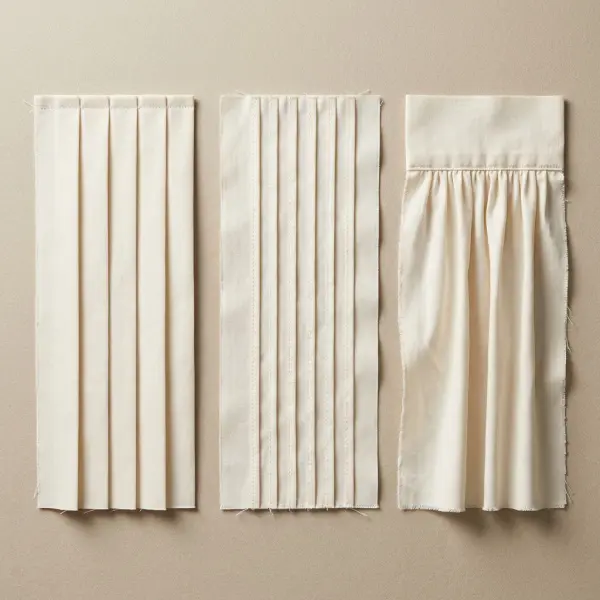
Pleats, tucks, and gathers are garment construction techniques that manipulate fabric fullness, but they differ in how the fabric is folded, secured, and distributed. Pleats create intentional folds with defined placement and direction. Tucks fold fabric and typically secure it with stitching along a specified length. Gathers use stitching or another gathering mechanism to draw a longer fabric section into a shorter area, producing many small folds.
The main distinction is the degree of structural control. Pleats usually create a more organized appearance, especially when pressed sharply. Tucks produce controlled shaping or decorative texture, often remaining relatively flat. Gathers create softer, less geometrically defined fullness, although their volume depends heavily on the gathering ratio and material.
These techniques are not interchangeable in every design. Replacing a pleated skirt with a gathered construction changes the visual silhouette, while replacing pintucks with pleats may alter the placement and release of fullness.
For fashion businesses, choosing the right technique requires evaluating the intended silhouette, fabric behavior, construction complexity, and consistency across production batches.
Understanding Fullness in Garment Construction
Fullness refers to additional fabric incorporated into a garment beyond the dimensions required to cover or closely follow the body. Designers introduce fullness to create movement, provide ease, shape a silhouette, or achieve a particular decorative effect.
A fitted waistband, for instance, may connect to a significantly wider skirt panel. That excess width must be managed where the two pieces join. Pleating creates measured folds, gathering distributes many small folds, and certain tuck constructions reduce or control fabric width within a panel.
Fullness can be concentrated around a waist, shoulder, sleeve cap, neckline, cuff, or yoke. It can also be introduced across an entire garment section, changing how the fabric falls and responds to movement.
Three factors determine the result: the amount of extra fabric, how it is controlled, and where the fullness is released. Two garments may contain identical fabric yardage yet appear very different because one uses crisp, pressed folds and the other distributes the fabric into soft gathers.
This distinction becomes particularly relevant during pattern development. A designer cannot assume that changing the construction technique will preserve the garment's original proportions or fit.
What Are Pleats in Garment Construction?
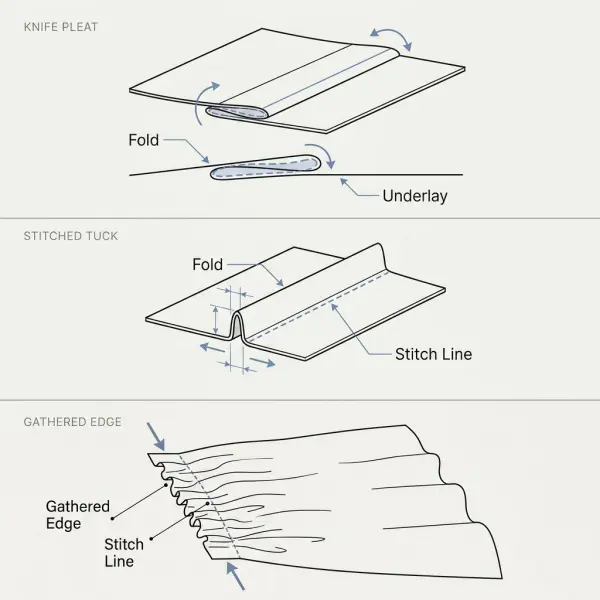
Pleats are deliberate folds formed in fabric to control fullness, create shape, or introduce decorative structure. They are commonly marked, folded, and secured at specific locations, allowing the remaining fabric to fall in a controlled direction or open as the garment moves.
A pleat generally involves an outer fold, underlying fabric, and a placement relationship determined by the sewing pattern. Its depth and spacing influence how much fabric is concealed within the construction. In a pressed pleat, the crease also contributes to the final visual effect.
Pleats are widely associated with tailored skirts, trousers, dresses, uniforms, and certain types of outerwear. However, their function extends beyond appearance. A well-positioned pleat can introduce additional movement through the hip or back without making the garment look continuously loose.
Common Types of Pleats
Several pleat structures are used in apparel design. Their main differences concern fold direction, arrangement, and how the fabric is secured.
Knife pleats feature repeated folds facing the same direction. They create an orderly rhythm and are commonly used in pleated skirts and uniform-inspired designs.
Box pleats contain two opposing folds that face outward from a central point on the garment's right side, forming a symmetrical raised arrangement. They can create localized fullness while maintaining an organized appearance.
Inverted box pleats reverse that arrangement, with the visible folds meeting toward the center. They are commonly used when designers want additional fullness concealed beneath a relatively clean exterior.
Accordion pleats consist of narrow, regularly repeated folds that create an alternating folded structure. Depending on the fabric and finishing method, they may require specialist pleating processes to maintain consistent dimensions and crease retention.
Other variations include sunray or radiating pleats, which change direction or width across a panel.
A detailed comparison of knife pleats and box pleats in garment design explores the specific pattern calculations, construction methods, and design trade-offs between these two widely used structures.
How Pleats Are Constructed
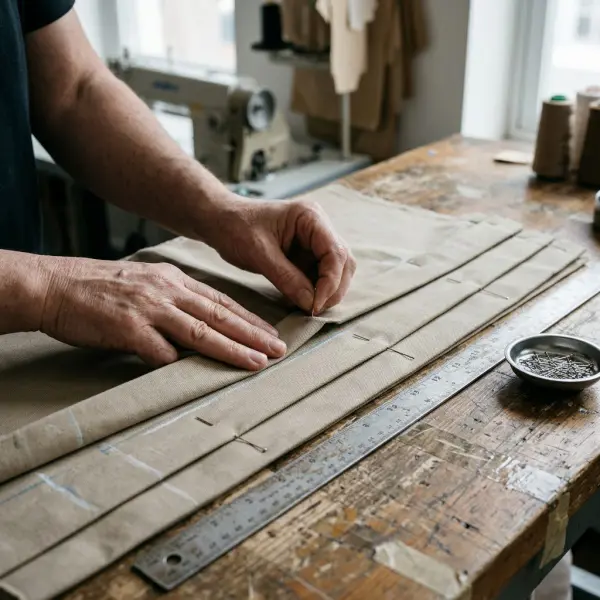
The basic construction process begins with the pattern. Foldlines and placement lines indicate where the fabric must be brought together. These markings determine both the finished dimensions and the direction of the folds.
During preparation, the operator transfers the markings onto the fabric, folds the panel according to the specification, and temporarily secures the arrangement. Depending on the garment, the pleats may be basted, stitched across a seam allowance, topstitched for part of their length, or held primarily through pressing and their attachment to another garment component.
Pressing is particularly important when the design requires crisp creases. However, not every pleat should be pressed sharply throughout its length. Soft pleats and certain draped constructions intentionally allow the material to fall without a rigid crease.
The manufacturer must also consider whether the pleat is intended to remain closed or open with movement. A fully stitched section behaves differently from a fold secured only at the waistband.
How Pleats Affect Garment Fit and Movement
The functional value of a pleat depends on where the additional fabric is released. In trousers, a front pleat can provide room through the upper hip and thigh when the wearer sits or moves. In a skirt, pleats may allow the garment to expand outward during walking while maintaining a relatively controlled waistline.
Pleats can also influence the visual proportions of a garment. Repeated vertical folds emphasize a directional pattern, while a single deep pleat may concentrate volume at one point. These effects depend on the fabric's drape, the position of the folds, and whether the pleats are pressed or stitched down.
More fabric does not automatically mean better comfort. A pleat positioned incorrectly may create unwanted bulk or pull awkwardly across the body. The pattern must accommodate body measurements, fabric thickness, and the intended release of the fold.

What Are Tucks in Sewing and Garment Design?
Tucks are folded sections of fabric that are usually secured with stitching to create controlled shaping, surface texture, or decorative detail. Unlike many pleats, which can open beyond their attachment points, conventional stitched tucks keep the folded fabric captured along the stitched portion.
A tuck is formed by folding the fabric and sewing at a measured distance from the fold. The stitching creates a narrow or wide raised section, depending on the chosen width and fabric properties.
Tucks are frequently used on blouse fronts, dress bodices, yokes, sleeves, children's clothing, and decorative panels. Their visual character can range from extremely subtle to distinctly architectural.
The terminology is not completely rigid. Some decorative folds are described as either tucks or stitched pleats, depending on the garment-making tradition and construction details. For production purposes, the important distinction is not the label alone but the location, length, and function of the stitching.
Pintucks: Small Folds With a Refined Finish
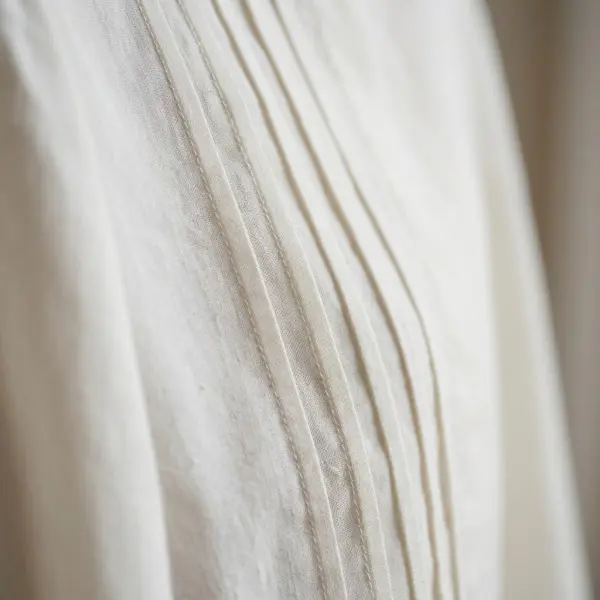
Pintucks are narrow tucks sewn very close to the folded edge. They create fine, repeated lines that add texture without necessarily introducing substantial released volume.
A blouse with several evenly spaced pintucks down the front may have a tailored decorative finish while retaining a soft silhouette. On lightweight cotton lawn or fine shirting, these narrow stitched folds can produce delicate texture without the heavy appearance of larger folds.
Pintucks require accurate marking and consistent stitching. Small differences in seam distance can become visually obvious because the folds are typically repeated close together.
For manufacturers, this creates a quality-control requirement. The width, spacing, alignment, and stitch consistency should be evaluated on a sample before production starts.
Standard Tucks and Decorative Variations
Wider tucks can be used to reduce the width of a garment panel, organize surface texture, or create repeated dimensional details. Depending on the design, the folds may run vertically, horizontally, diagonally, or across a localized section of fabric.
Some garments incorporate released tucks, where the stitched section ends and the remaining fabric opens into fullness. This introduces an important distinction between the portion that is controlled and the portion that contributes to the silhouette.
Decorative tucks may also be arranged in groups or intersecting patterns. Such applications usually require careful construction planning because repeated folds change the dimensions of the original fabric panel.
When developing a garment with multiple tucks, a manufacturer should confirm whether the pattern dimensions represent the fabric before or after the tucks are sewn. Misinterpreting this information can result in a finished panel that is too narrow.
What Are Gathers in Garment Construction?
Gathers are small fabric folds created by drawing a longer section of fabric into a shorter finished length. They produce distributed fullness around a seam or garment area, commonly creating softer volume than evenly measured pleats.
Gathering is frequently used in dresses, skirts, blouses, puff sleeves, ruffles, and tiered garments. It is particularly useful when a designer wants fabric to fall with fluidity rather than follow a visible series of geometric folds.
For example, a gathered sleeve may have additional fabric concentrated near the shoulder or cuff. The gathered area creates volume, while the adjoining seam or band controls the finished circumference.
The appearance of gathers depends on fabric weight, density, softness, and the proportion between the original fabric length and the final gathered length. Lightweight fabrics often accommodate closely distributed gathers more easily than heavy, bulky materials, although the result must be evaluated with the actual fabric.
How Gathering Works
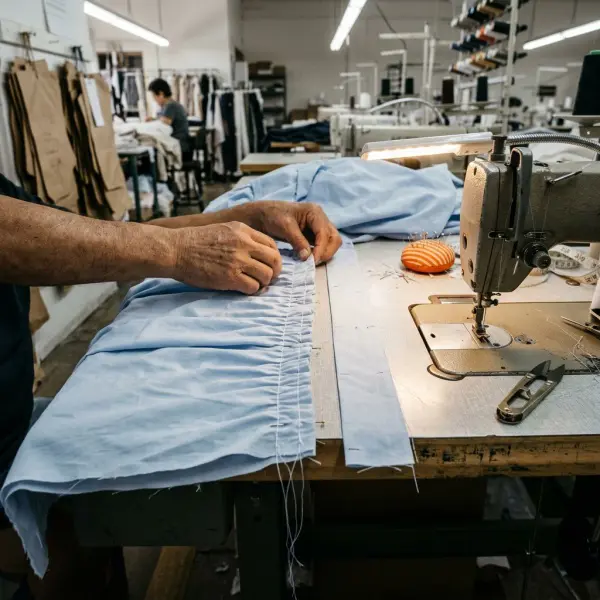
A conventional machine-gathering method uses two or more parallel rows of temporary stitching. The operator leaves thread tails, draws up the fabric along the stitches, and distributes the fullness until the gathered edge matches the required seam length.
The gathered panel is then attached to its adjoining component with permanent stitching. Temporary gathering threads may be removed when they would otherwise remain visible or interfere with the finish.
Some production methods use a gathering foot, ruffler attachment, specialized feeding system, or elastic-based construction. These approaches are not identical, and the appropriate method depends on the fabric, product design, desired appearance, and available machinery.
The goal is not simply to make the fabric shorter. It is to distribute the extra length in a controlled way without creating unintended flat sections, bulky clusters, or distorted seams.
Understanding the Gathering Ratio
The gathering ratio describes the relationship between the original fabric length and the finished length after gathering.
For example, if a 120 cm fabric edge is gathered to fit a 60 cm waistband, the ratio is 2:1. The original fabric edge contains twice the length of the finished gathered section.
A higher ratio generally provides more fabric to distribute into the finished length, but it does not guarantee a softer or more attractive result. A densely woven heavyweight cotton may become bulky at a ratio that works comfortably in lightweight voile.
Ratio selection should therefore be based on the actual material and desired silhouette. It should also account for whether the gathered section joins a rigid waistband, a soft yoke, or an elastic component.
Why Even Distribution Matters
Uneven gathers can make a garment appear poorly balanced. A skirt with excessive fullness concentrated near one side seam may hang asymmetrically, even when the pattern dimensions are technically correct.
Manufacturers often divide the gathered edge and its adjoining piece into matching sections. These reference points help operators distribute fullness consistently before stitching the final seam.
The fabric must also be managed carefully during sewing. If gathered folds shift beneath the presser foot, the finished seam may develop irregular spacing or accidental tucks.
A consistent gathering method is particularly important when producing multiple units of the same design. The objective is not microscopic uniformity, but a repeatable appearance that matches the approved sample.
Pleats vs Tucks vs Gathers: Key Construction Differences
Although all three methods manipulate fabric, they do not provide the same combination of shape, texture, and structural control. The most appropriate technique depends on the design objective and the way the material should behave after construction.
|
Construction factor |
Pleats |
Tucks |
Gathers |
|
Basic method |
Fabric is folded in defined arrangements |
Folded fabric is usually stitched along a specified length |
Fabric is drawn into a shorter length |
|
Visual appearance |
Organized folds, sharp or soft |
Controlled raised lines or stitched folds |
Small, distributed folds and soft volume |
|
Fullness control |
Determined by fold depth and placement |
Determined by tuck width, length, and release |
Determined by gathering ratio and distribution |
|
Main stitching role |
Secures selected parts of the folds |
Holds folded fabric along the tuck |
Holds distributed fullness at a seam or selected area |
|
Common applications |
Skirts, trousers, dresses, uniforms |
Blouses, yokes, bodices, decorative panels |
Sleeves, skirts, ruffles, tiered dresses |
|
Main production concern |
Marking accuracy and fold consistency |
Uniform stitching and finished dimensions |
Even distribution and seam control |
|
Typical design effect |
Directional structure |
Surface texture or controlled shaping |
Fluid, distributed fullness |
A pleated skirt may use substantial additional fabric without appearing heavily gathered at the waist. Much of the material is concealed in organized underfolds. A gathered skirt makes that same type of fullness more visible through the distribution of small folds.
Tucks occupy a slightly different position. They can reduce the finished dimensions of a panel, create texture, or release fullness beyond the stitched section. However, decorative pintucks do not necessarily produce the substantial lower-body volume associated with pleated or gathered skirts.
The three methods can also appear in the same garment. A dress might use pintucks on its bodice, pleats at the waist, and gathers around the sleeve head. Their construction choices serve different design purposes rather than competing for a single function.
How Fabric Selection Changes the Final Result
Fabric selection strongly influences how pleats, tucks, and gathers perform. Weight, thickness, drape, weave or knit structure, surface texture, finishing, and response to heat all contribute to the outcome.
A technique that looks precise on a cotton poplin sample may become bulky when reproduced in a thick denim. Conversely, an intentionally crisp pleat may appear softer and less defined in a fluid rayon fabric.
The fabric's behavior should therefore be evaluated before finalizing both the design and production specification.
Lightweight and Fluid Fabrics
Lightweight woven materials such as chiffon, voile, and certain rayon fabrics can produce soft gathers and delicate draping effects. Their relatively low bulk allows multiple small folds to be concentrated near a seam, although slippery or unstable materials may require additional handling.
Fine pintucks can also work well on lightweight fabrics, provided the material has enough stability to support accurate stitching. Extremely sheer materials may reveal seam allowances or underlying layers, making construction decisions more visible.
Pleats in fluid fabrics can appear elegant, but maintaining sharply defined creases may require appropriate finishing or specialist pleating services. Fabric softness alone does not establish how well a crease will survive wear and laundering.
Medium-Weight Woven Fabrics
Cotton poplin, lightweight twill, certain linen fabrics, and suitable wool weaves often provide useful options for structured folds. They can offer enough body to display pleat geometry while remaining manageable during sewing.
Their behavior still varies considerably. A crisp cotton poplin may emphasize fold edges, while a softer washed linen can create a more relaxed appearance.
For a brand producing pleated trousers or uniform-inspired skirts, fabric testing should include crease definition, bulk at the waistband, and the garment's behavior after washing or professional cleaning.
Heavyweight and Thick Fabrics
Heavier fabrics can support pronounced structural shapes, but their thickness increases the risk of bulk where multiple layers overlap.
Deep pleats in heavyweight twill, for example, may create excessive thickness around a waistband or seam intersection. Dense gathers can be even more challenging because many small fabric folds accumulate within a limited length.
Designers may need to reduce the gathering ratio, alter pleat depth, reposition seam intersections, or use a lighter fabric. These decisions should be made through sampling rather than relying solely on the fashion illustration.
Knitted and Stretch Fabrics
Pleats, tucks, and gathers can be applied to knitted fabrics, but stretch and recovery change how the details behave.
A pleat formed in a stretch jersey may not retain a sharp pressed edge in the same way as a suitable woven fabric. Tucks can pull or distort when stitching tension is inappropriate, while gathered seams may need construction methods that preserve the intended stretch.
For this reason, the sewing method must account for both the desired appearance and the amount of elasticity required in the finished garment.
Pattern Development and Fabric Consumption
Pattern development translates decorative construction into measurable fabric dimensions. The added fullness must exist in the cut pattern before it can be folded or gathered during assembly.
This relationship has direct implications for material consumption and production costing.
Calculating Fabric for Pleats
Pleat construction requires allowance for the fabric concealed within the folds. The amount depends on pleat depth, number, spacing, and the chosen geometry.
For a conventional full-depth knife pleat, a simplified calculation may allocate approximately twice the intended pleat depth as underlay, in addition to the visible width. This relationship should not be treated as a universal formula for every pleat arrangement.
Box pleats, inverted pleats, partial pleats, and overlapping variations require their own pattern calculations. Seam allowances and construction adjustments must also be included.
A manufacturer producing multiple sizes needs to verify that the intended fold arrangement remains consistent after grading.
Calculating Fabric for Tucks
Tucks consume material because part of the fabric is folded and stitched. For a conventional tuck stitched parallel to its folded edge, the amount of width taken up can be approximately twice the distance from the fold to the stitching line.
For example, a 5 mm tuck depth may consume approximately 10 mm of flat fabric width, excluding any additional design or construction allowances.
This calculation becomes significant when several tucks are repeated across one panel. Ten such tucks could consume approximately 100 mm of width before considering the spaces between them.
The pattern must therefore include the intended tuck take-up. Otherwise, the completed panel may be narrower than the garment specification requires.
Calculating Fabric for Gathers
Gathering calculations begin with the required finished length and the chosen gathering ratio.
A 1.5:1 ratio requires 1.5 units of ungathered edge length for every unit of finished gathered length. A 2:1 ratio requires twice the length.
For a design with a 70 cm finished gathered attachment edge, a 2:1 ratio would require approximately 140 cm of fabric edge length before gathering, excluding applicable seam allowances and other pattern requirements.
These figures are useful for initial planning, but the appropriate ratio should be approved through fabric sampling. Fullness that looks balanced in one material may be excessive in another.
How These Techniques Influence Garment Cost and Manufacturing Efficiency
The cost of a garment is influenced by more than the total amount of fabric used. Pleats, tucks, and gathers can also change sewing time, pressing requirements, quality-control procedures, and the likelihood of rework.
A design with many repeated folds may look uncomplicated in a photograph, yet require accurate marking and operator attention during assembly. Small alignment differences can become noticeable when they repeat across the entire garment.
Pleats and Production Consistency
Pleats often require coordinated pattern marking, folding, temporary securing, stitching, and pressing. The number of operations depends on the design and whether the fabric arrives pre-pleated or is pleated during garment assembly.
For repeated production, factories may use templates, guides, or specialized pleating services to improve consistency. A deeply pleated design may also require additional handling during inspection and packing.
When evaluating suppliers, brands should distinguish between ordinary garment pleating and specialist processes intended to produce durable, closely spaced or permanent creases.
Tucks and Sewing Precision
Tucks can be relatively straightforward when they are few and widely spaced. Their production complexity increases when the design includes many narrow, closely arranged folds.
A blouse front with repeated pintucks needs consistent stitch positioning across the panel. Variations become especially visible on plain fabrics because there is no print to distract from irregular spacing.
For premium garments, decorative stitching consistency may be part of the customer's perception of quality. Brands should therefore define the desired appearance with an approved physical sample, not only a written instruction.
Gathers and Operator Control
Gathering requires careful handling because the fabric is not organized into the same fixed geometry as a measured pleat.
An operator must draw up and distribute the fullness, maintain the required finished seam length, and prevent the gathered section from shifting during final stitching.
Production can be simplified with suitable gathering equipment or methods, but the results depend on fabric compatibility and machine setup. A method that performs well on lightweight cotton may need adjustment for chiffon, jersey, or heavier fabrics.
The Real Cost Trade-Off
A more decorative construction may increase material consumption and sewing operations, but its commercial value depends on whether the detail contributes meaningfully to the garment's design, fit, or product positioning.
For a small fashion brand, a blouse with eight decorative pintucks may require more precise sewing than a simpler front panel. The additional work may be justified in a premium collection where construction detail is central to the design.
In a price-sensitive basics range, the same operation may create a production burden that customers are unwilling to pay for.
The appropriate decision depends on the target price, approved quality standard, available machinery, labor requirements, and expected production volume.
Practical Applications for Fashion Brands and Apparel Manufacturers
Choosing between pleats, tucks, and gathers should begin with the intended garment performance rather than the technique itself.
A design team must decide whether the goal is structured movement, localized shaping, decorative texture, or softer fullness. Once that objective is clear, the construction and material choices can be evaluated more systematically.
During Product Design
Designers should identify precisely where fullness is required and how it should appear when the garment is worn.
For tailored trousers, a front pleat may be useful when additional room is needed around the upper leg without increasing the visible width of the entire trouser front. For a romantic blouse, gathers may be more suitable when the intention is soft fullness around the neckline or sleeves.
Tucks may be appropriate when the garment needs a refined linear detail while keeping the surrounding fabric relatively controlled.
The choice should also consider how the garment looks in motion, not only when displayed flat.
During Sampling and Development
Physical samples are essential because illustrations and digital garment simulations do not always reveal every construction issue.
A development sample should answer several practical questions:
- Does the fabric produce the intended fold definition or gathering softness?
- Does the technique add bulk at the waist, cuff, or seam intersection?
- Are the final panel dimensions consistent with the pattern specification?
- Does the garment remain comfortable during sitting, walking, and reaching?
- Can the selected factory reproduce the detail consistently?
- Does the appearance remain acceptable after the intended care process?
These checks help designers separate visual preferences from manufacturing feasibility.
During Sourcing
Sourcing teams should communicate the required construction details before committing to a fabric or supplier.
For pleated garments, relevant information may include pleat type, depth, spacing, direction, pressing requirements, and whether specialist pleating is involved.
For tucked garments, the specification should identify stitch length, tuck width, number of repetitions, spacing, and whether the tucks are released at a particular point.
For gathered garments, the supplier needs to understand the finished seam length, gathering ratio or approved fullness, distribution requirements, and acceptable visual variation.
These specifications reduce the risk of suppliers interpreting the same design differently.
During Retail and Product Communication
Garment construction details can be useful when communicating product features to customers, but descriptions should reflect what the garment actually does.
For example, the phrase "pleated front trousers" describes a visible design feature. A more informative product description could explain that the front pleats provide additional room through the upper leg, provided this is supported by the actual garment construction and fit.
Similarly, pintucks can be described as stitched decorative folds rather than being presented as a performance feature without evidence.
Retail teams should avoid confusing gathers with pleats simply because both create visible fullness. Accurate terminology makes product descriptions clearer and helps customers understand what they are purchasing.
Common Construction Mistakes and How to Avoid Them
The quality of pleats, tucks, and gathers depends on execution as much as design. Problems often appear when pattern measurements, fabric behavior, or sewing instructions are not sufficiently controlled.
Choosing the Wrong Fabric for the Intended Effect
A stiff fabric may create excessive volume when densely gathered, while a soft fabric may fail to display the sharp pleats expected in the design. These problems frequently arise when material substitutions are approved based on color, price, or weight without testing the construction detail.
The better approach is to reproduce the technique on the proposed replacement fabric before purchasing production quantities.
Ignoring Fabric Take-Up in Pattern Measurements
Pleats and tucks consume fabric width, while gathering requires additional edge length. If the pattern does not account for this material, the finished piece may be too small or the intended fullness may be insufficient.
Patternmakers should verify dimensions both before and after the fabric manipulation. Production teams should use the approved finished measurements as inspection references.
Inconsistent Marking and Stitching
Small variations in pleat spacing or pintuck width can accumulate across a garment panel. When folds are repeated, the final result may become visibly uneven or fail to align with adjacent seams.
Accurate templates, clear pattern markings, and an approved sample help reduce these errors. Manufacturers should also confirm that operators understand whether measurements refer to the folded or unfolded material.
Uneven Gathering Distribution
Gathering too much fabric into one section can produce visible clusters and an unbalanced silhouette. This is particularly noticeable at waist seams, sleeves, and ruffles.
Dividing the seam into matching reference sections and adjusting the fullness before final stitching helps maintain a more consistent appearance.
Overlooking Pressing and Finishing Requirements
Pressing can improve the appearance of a pleat or tuck, but inappropriate heat, pressure, or steam may flatten the intended texture or damage the material.
The correct finishing procedure depends on fiber composition, fabric construction, and applied finishes. Production instructions should identify whether the folds need sharp pressing, gentle shaping, or minimal direct pressure.
For a deeper examination of construction defects, their causes, and corrective methods, see common pleating and gathering mistakes.
What Brands Should Verify Before Approving Production
An attractive sample is only the starting point. Before manufacturing begins, the brand should establish whether the design can be repeated reliably under normal production conditions.
For garments containing substantial pleating, tucking, or gathering, the approval process should consider material behavior, finished dimensions, and operator requirements together.
A practical production review includes checking that the pattern specification identifies fold direction and placement, the approved fabric behaves as expected, the factory understands the required construction method, and quality inspectors have clear visual acceptance criteria.
Brands should also consider how these details will behave after washing, ironing, transport, and regular wear. A pleat that looks crisp immediately after factory pressing may soften during use, while gathered seams can change appearance as the fabric relaxes.
The objective is not to eliminate every variation in fabric behavior. It is to confirm that the construction remains compatible with the garment's intended function, customer expectations, and care instructions.
Frequently Asked Questions
1. Are pleats and gathers the same thing?
No. Pleats use deliberately arranged folds, while gathers draw a longer fabric edge into a shorter length, producing smaller distributed folds. Both techniques manage excess material, but they create different visual and functional effects.
Pleats can preserve a structured silhouette because the fabric is organized into defined sections. Gathers usually produce softer fullness concentrated around a seam or selected area. However, fabric weight, pleat pressing, and gathering density can make the resulting appearances overlap. A designer should choose based on the desired silhouette rather than assuming either method automatically creates more or less volume.
2. What is the difference between a tuck and a pleat?
A tuck is generally a folded section secured by stitching along part or all of its length, while a pleat is a deliberately arranged fold that may be secured at selected points and released elsewhere.
The distinction is not absolute because some stitched pleats closely resemble tucks, and terminology varies across garment-making traditions. Pintucks are particularly recognizable because they are narrow and sewn close to the fold. In manufacturing specifications, identifying the stitch position, fold dimensions, and release point is more reliable than depending on the terminology alone.
3. Which technique uses the most fabric?
There is no universal answer. Fabric consumption depends on the depth and number of pleats, the size and number of tucks, or the gathering ratio used in the design.
A densely pleated skirt can require considerably more fabric than a lightly gathered skirt, while a highly gathered ruffle may use much more length than a few decorative tucks. The comparison should be made using the actual pattern dimensions, seam allowances, fabric width, and cutting layout. For costing purposes, garment teams should calculate total fabric consumption rather than judge from the finished appearance alone.
4. Can pleats, tucks, and gathers be used on stretch fabrics?
Yes, all three techniques can be used on certain stretch fabrics, but the construction must accommodate the material's elasticity and recovery.
Pleats in soft jersey may not retain sharp pressed edges without additional support or finishing. Tucks can distort if stitching prevents the fabric from stretching as intended, while gathers may require appropriate elastic or stretch-compatible seams. The best approach is to test the construction on the actual fabric and evaluate whether the finished garment still provides the necessary movement and durability. Techniques suitable for woven cotton should not automatically be transferred to stretch knitwear without modification.
5. Why do gathered garments sometimes look bulky?
Gathered garments can appear bulky when too much fabric is concentrated within a short seam length, especially when the material is thick or stiff.
The gathering ratio, fabric thickness, seam allowance, and placement all contribute to the finished effect. A high gathering ratio that creates attractive fullness in chiffon may produce an undesirable ridge in heavyweight cotton. Designers can address this by reducing the gathering ratio, changing the material, redistributing the fullness, or reconsidering the garment construction. A lower ratio is not necessarily less attractive; it may simply be more compatible with the chosen fabric and intended silhouette.
6. Do pleats remain permanently in fabric?
Not necessarily. Some pleats are formed through ordinary folding and pressing, while others are produced using specialist processes that improve crease retention.
The durability of a pleat depends on fiber properties, fabric construction, finishing treatments, heat-setting compatibility, and garment care. Certain thermoplastic synthetic fibers can retain heat-set pleats effectively under suitable conditions, but this does not mean every pleated synthetic garment will retain its shape indefinitely. Brands should verify the specific pleating process and conduct appropriate care testing before describing pleats as permanent.
7. How can fashion brands maintain consistent pleating and gathering quality?
Consistency begins with a clear technical specification and an approved physical sample. The document should define fold depth, spacing, stitch placement, finished measurements, fabric requirements, or gathering distribution as applicable.
Manufacturers also need suitable equipment, operator training, and inspection procedures. For repeated pleats, templates can reduce marking variation. For gathers, matching reference points and consistent sewing methods help maintain balance. Quality checks should examine both flat construction and the garment's appearance when worn or displayed. A sample that looks accurate on the worktable may still reveal bulk or asymmetry once assembled.
Conclusion: Choosing the Right Technique for the Garment
Pleats, tucks, and gathers demonstrate how relatively simple fabric manipulation methods can produce very different garment results. Each technique provides a particular relationship between fullness, structure, texture, and movement.
Pleats are useful when fabric needs to be organized into intentional folds. Tucks can add controlled shaping or decorative surface detail. Gathers introduce distributed fullness and are especially suitable when the design calls for softer volume.
For fashion businesses, the most important decision is not which construction technique looks most attractive in isolation. It is whether the technique supports the intended silhouette, works with the selected fabric, fits the production capability, and delivers a repeatable result at an acceptable cost.
A well-developed garment connects all these considerations. The designer establishes the visual intention, the patternmaker translates it into accurate dimensions, the manufacturer determines the construction method, and quality control verifies the finished result.
When those decisions are aligned, pleats, tucks, and gathers become more than decorative details. They become practical tools for creating garments with deliberate shape, consistent construction, and a clear design identity.





Comments 0
Leave a CommentSend Comment
Anda harus Login terlebih dahulu untuk dapat memberikan komentar.