

Why Crepe Remains Popular in Blouses, Dresses, and Modest Wear
Quick Answer
Crepe remains widely used in blouses, dresses, and modest-wear garments because the fabric family can combine fluid drape, subtle surface texture, relatively low shine, and a broad range of weights and opacity levels. Those characteristics can support garments that need movement without looking overly delicate, visual depth without heavy decoration, and coverage without necessarily requiring rigid construction.
The important qualification is that there is no single "crepe performance." Crepe may be made from silk, rayon or viscose, polyester, cotton, wool, or other fibers, and its texture can be created through twisted yarns, weave structure, finishing, or combinations of these methods. Cameo A lightweight crepe blouse can therefore behave very differently from an opaque polyester abaya or a heavier dress crepe.
For modest fashion specifically, current retail assortments provide clear evidence that crepe remains an active commercial material rather than merely a historical textile category. Modanisa currently maintains a dedicated crepe-abaya assortment, while SHUKR uses a crepe blend for a modest slip dress designed for layering beneath abayas and overlays. Modanisa
Its continuing relevance comes less from one exceptional property than from the number of design problems an appropriate crepe construction can solve at once.
Why Does Crepe Work Across So Many Apparel Categories?
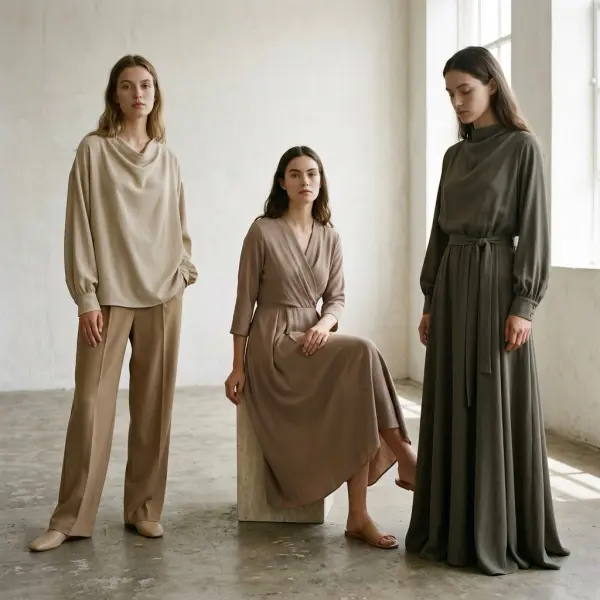
Crepe works across multiple apparel categories because it is not one narrowly defined fabric construction. It is a broad textile family whose members can range from lightweight and fluid to more substantial and controlled. That flexibility allows product developers to use a crepe-like surface language while selecting different weights, fibers, stretch characteristics, and degrees of opacity for different garments.
The Museum of Fine Arts Boston's CAMEO textile database describes crepe as a lightweight, soft fabric with a finely crinkled surface and records silk, rayon, cotton, wool, and synthetic versions. It also documents historical uses that include dresses, blouses, undergarments, kimonos, and sleeping garments. Cameo This breadth is significant: crepe has never been limited to one silhouette or one occasion category.
For contemporary fashion businesses, that versatility can reduce the distance between design concept and commercially usable fabric. A brand can source one crepe family for a relaxed blouse, another for a formal maxi dress, and a denser version for a long modest silhouette without abandoning the understated textured appearance that ties the collection together.
That does not mean one quality should be used for every product. The strategic value lies in the range within the family, not in treating crepe as a universal substitute.
The Combination of Texture and Drape Is Particularly Useful
Many dress fabrics emphasize either visual surface or movement. Crepe often provides some of both.
Its irregular surface breaks up light differently from a completely smooth textile. As a result, a solid-colored garment can gain visual depth without relying on print, embroidery, sequins, or pronounced shine. The effect can be particularly useful in minimalist garments where silhouette and cloth behavior carry much of the design.
At the same time, many crepe constructions drape well enough to create soft folds around the body. A blouse can fall from the shoulder rather than standing stiffly away from it; a long dress can move through the skirt without needing the extreme transparency of chiffon; a modest outer layer can maintain length and coverage while still appearing visually fluid.
That balance is one reason crepe works across both everyday and more polished categories. The material can look refined without automatically reading as formal eveningwear.
The distinction from chiffon is especially useful here. Chiffon typically emphasizes sheerness, lightness, and floating movement, whereas the crepe category extends into substantially more opaque and structured territory. That technical comparison is discussed in detail in Crepe vs Chiffon: What Makes These Dress Fabrics Different?.
Why Crepe Works Particularly Well for Blouses
Blouses require fabric to negotiate several different areas at once. It must fall attractively through the torso, behave around shoulders and sleeves, support details such as cuffs or necklines, and remain comfortable enough for repeated movement.
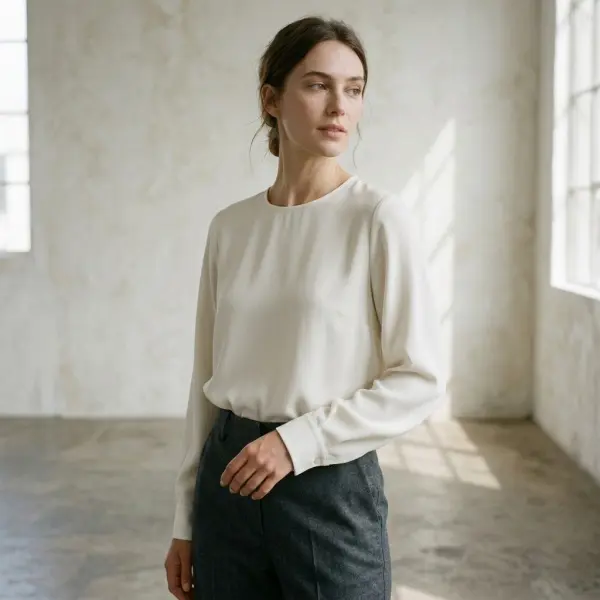
An appropriate lightweight or medium-light crepe can meet those requirements without looking overly crisp. This makes it suitable for relaxed shirts, gathered blouses, tie-neck styles, long sleeves, soft peplums, draped fronts, and other designs where the fabric should move rather than hold a rigid geometric shape.
The textured surface also changes how a simple blouse reads visually. A plain black or ivory crepe blouse can appear more dimensional than the same silhouette in a completely flat smooth weave, even when no print or decorative trim is added.
Georgette illustrates the lighter end of this relationship. CAMEO describes it as a sheer fabric with a non-shiny crepe surface made using alternating S- and Z-twisted yarns and documents its use for blouses, dresses, and gowns. Cameo A designer seeking greater opacity can move toward a denser crepe while retaining some of the same dry surface character.
Crepe supports softness without requiring extreme sheerness
This is commercially useful because not every fluid blouse is intended to be transparent. Chiffon can create beautiful movement, but many chiffon garments require camisoles, lining, double layers, or deliberate underwear styling. A sufficiently opaque crepe can deliver softer movement while allowing the blouse itself to provide more coverage.
The exact result still depends on weight, color, fiber, weave density, and finishing. Pale crepes may become noticeably more translucent under strong light, and some lightweight crepes remain sheer enough to require another layer. Opacity should always be tested on the actual fabric.
Surface texture can make simple shapes feel less basic
A fashion business does not always need complex construction to create perceived product differentiation. Material choice can perform some of that work.
On a blouse with clean lines, crepe's fine surface can add enough visual variation to prevent the garment from looking flat. This is particularly useful for solid-color collections, workplace clothing, capsule ranges, and modest fashion where the design may intentionally avoid excessive embellishment.
For smaller brands, that can also simplify product development. Instead of introducing additional trims or surface decoration, the fabric itself contributes to the finished visual character.

Why Crepe Is So Common in Dresses
Dresses amplify fabric behavior because more material is usually visible at once. The way a textile falls through the bodice, waist, hips, skirt, and hem can determine whether the finished garment looks fluid, stiff, clingy, bulky, or balanced.
Crepe offers designers a broad range of answers. Lightweight versions can support slip-like or softly draped silhouettes. Medium-weight crepes may work for wrap dresses, A-line dresses, sheath styles, occasionwear, or relaxed maxi dresses. Stretch crepes can support closer-fitting designs when recovery and garment engineering are appropriate.
The fabric's generally textured surface can also make large uninterrupted areas of a dress visually interesting. A long monochrome dress has considerable fabric area, so surface behavior becomes more noticeable than it would on a small accessory or narrow panel.
Current modest-fashion retail provides practical examples. Modanisa lists crepe garments across abaya and modest-evening-dress categories, including long-sleeved designs, cape details, embellished styles, and simpler belted forms. Modanisa These examples do not prove that every modest-fashion consumer prefers crepe, but they do demonstrate ongoing commercial use across multiple dress formats.
Crepe Can Support Both Minimal and Decorative Dresses
One reason crepe remains useful is that it does not force a collection into one aesthetic.
A clean matte crepe can support minimalist tailoring, monochromatic dressing, workwear, or restrained occasionwear. Because the surface is relatively quiet, the silhouette remains visually dominant.
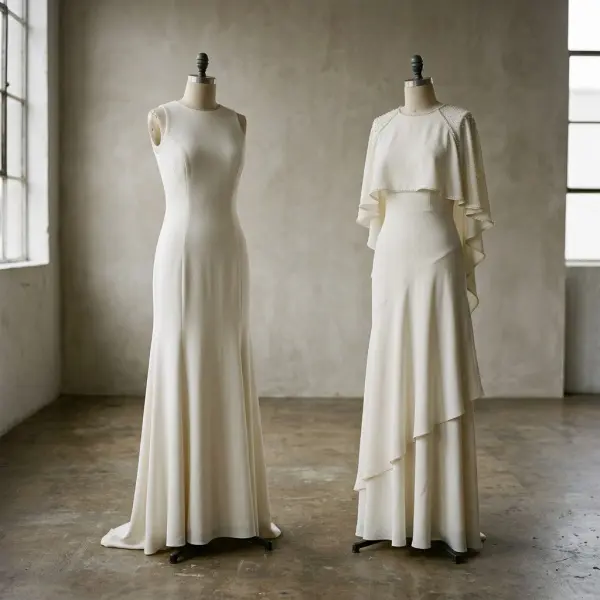
The same material family can also act as a background for embroidery, beading, lace, cape details, pleating, gathers, or statement sleeves. The texture gives the base fabric presence without competing as aggressively with embellishment as a highly reflective satin might.
Current retail examples show both directions. Modanisa carries crepe abayas with relatively simple belted or zip-front construction as well as crepe occasion dresses incorporating pearl, bead, cape, or lace details. Modanisa
This flexibility can be valuable for brands that want to extend a recognizable material direction across daywear and occasionwear without making every garment look identical.
Why Is Crepe Relevant to Modest Fashion?
Crepe is relevant to modest fashion because many crepe constructions can align with several practical requirements that frequently appear in covered silhouettes: length, movement, opacity, layering, restrained surface appearance, and compatibility with loose or semi-fitted shapes.
None of those properties is uniquely modest, and modest fashion is not a single standardized garment category. Consumers interpret modest dressing differently across cultures, personal preferences, climates, religions, occasions, and markets. A maxi dress, abaya, tunic, long blouse, kimono-style layer, coordinated set, or formal gown may all enter a modest wardrobe under different circumstances.
What matters from the fabric perspective is that long silhouettes magnify textile behavior. A fabric that works across 60 centimeters of a blouse may behave differently across a 140-centimeter dress. Weight accumulates, fold depth changes, hems move more visibly, and static or cling can become more consequential.
Crepe can be useful because designers can choose among multiple weights rather than being confined to a single lightweight construction.
The commercial context is also significant. The State of the Global Islamic Economy 2025/26 report estimates Muslim consumer spending on clothing and footwear at US$347 billion in 2024, up from US$327 billion in 2023, with the report projecting US$444 billion by 2029. These figures describe Muslim consumer apparel and footwear spending used within the report's modest-fashion sector analysis; they should not be interpreted as sales of crepe garments specifically. Salaam Gateway
Coverage Is About More Than Garment Length
One of the easiest mistakes in modest-fashion product development is to treat coverage purely as a pattern issue.
A long dress can still become visually revealing if the fabric is highly transparent, stretches dramatically over the body, clings through static, or becomes translucent under backlighting. Conversely, a shorter garment made from an opaque material may provide stronger coverage in the area it actually occupies.
Fabric behavior therefore needs to be assessed together with silhouette.
For crepe, buyers should specifically evaluate:
- Opacity: Does one layer provide enough coverage in all intended colors?
- Drape: Does the cloth fall away from or follow the body more closely than intended?
- Stretch: Will movement make the garment more body-defining?
- Static and cling: Does the fabric attach to hosiery, lining, or skin during movement?
- Weight: Does a long garment become uncomfortable or distort under its own mass?
- Surface: Is the intended appearance appropriately matte, textured, or lustrous for the collection?
- Layer compatibility: Does the outer fabric move cleanly over slips, dresses, trousers, or underlayers?
These checks are more useful than assuming that the word "crepe" automatically guarantees modesty.
Why Matte and Low-Luster Surfaces Can Be Useful
Many crepes have a matte or low-luster appearance because their irregular surface scatters reflected light rather than producing the uninterrupted shine seen on a smooth satin face. CAMEO similarly describes georgette as having a non-shiny crepe surface. Cameo
That visual restraint can work particularly well for long garments. Because modest silhouettes may contain larger continuous areas of fabric, strong shine can become a dominant design feature. A lower-luster surface allows color, cut, proportion, pleating, and movement to remain more prominent.
This does not mean matte is always preferable. Occasionwear may deliberately use satin, metallic finishes, sequins, or reflective embroidery. Nor is every crepe completely matte; crepe-backed satin demonstrates that crepe constructions can coexist with highly lustrous surfaces.
The practical advantage is simply that crepe gives brands access to an understated surface language that can transition relatively easily between daily wear, office dressing, occasionwear, and layered styling.
Crepe Can Create Movement Without Excessive Visual Volume
Long garments need enough ease for walking, sitting, stairs, and everyday motion, but increasing garment width does not always need to produce a dramatically voluminous appearance.
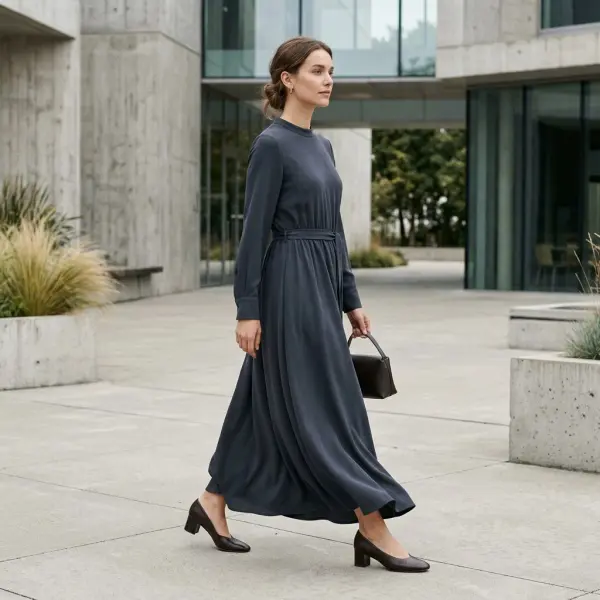
A fluid crepe can collapse into relatively narrow folds when the wearer is still, then open and move as the wearer walks. This makes it useful for A-line maxi dresses, flared abayas, relaxed skirts, long tunics, and wide-leg coordinated sets where designers want physical ease without a permanently inflated silhouette.
The effect is highly dependent on fabric weight and stiffness. A dense heavy crepe may pull more vertically and create stronger folds, while a lightweight construction may move more visibly. The pattern must be developed around the actual material.
This is one reason garment-scale sampling matters so much in modest wear. A small swatch cannot show how several meters of cloth behave around the body.
The Role of Crepe in Layered Modest Dressing
Layering is a practical part of many modest wardrobes, but it introduces fabric-engineering challenges. An outer dress may be worn over a slip; an open abaya over a blouse and trousers; a sheer layer over an opaque base; or a long outer garment over several different seasonal combinations.
Crepe can function on either side of that system. An opaque medium-weight crepe may serve as the main outer garment, while a lighter crepe can become the inner layer. SHUKR currently sells a crepe-blend slip dress specifically positioned for wear under kimono abayas, sheer overlays, and open-front pieces, illustrating how the material can be used as a modular wardrobe component rather than only as a statement outer garment. Shukr Clothing
Layer compatibility still requires testing. Two fabrics can individually drape beautifully yet interact poorly because their surfaces grip each other. Static electricity can also cause one layer to migrate or cling.
For product developers, the relevant question is therefore not "Does this crepe drape?" but "Does this crepe drape correctly over the other materials in the complete outfit?"
Blouses, Dresses, and Modest Wear Share a Common Design Requirement
These categories may look different commercially, but they often share one material requirement: the fabric must create shape through falling rather than through rigid structure.
A blouse needs to move around the torso and arms. A dress must negotiate a much larger vertical silhouette. Many modest garments add further length and ease, making fabric movement even more central to the finished appearance.
Crepe can work across all three because its surface and drape do not depend on extreme stiffness. Yet unlike very sheer fabrics, many crepes can also provide enough density to function as primary garment material.
This middle ground is commercially useful. It allows designers to create relaxed clothes that still look deliberate rather than limp.
Why Crepe Works Well With Solid Colors
Crepe is particularly effective in solid-color products because the texture provides subtle variation without changing the color story.
On smooth fabrics, large uninterrupted areas of one color can sometimes appear visually flat unless the garment includes strong tailoring, print, sheen, or embellishment. Crepe's fine texture introduces micro-level variation in reflected light, giving the surface greater depth.
This can support collection strategies built around neutral palettes, tonal dressing, coordinated separates, or repeated core colors. Black, navy, beige, brown, jewel tones, and muted seasonal colors can each behave differently depending on fabric texture.
For modest-fashion retailers, this is especially practical because long dresses and abayas provide large visible fields of color. Current crepe-abaya assortments include a wide spectrum of neutrals and fashion colors rather than treating the fabric as limited to black formalwear. Modanisa
Crepe Can Support Repeated Core Silhouettes
Fashion businesses frequently need continuity as much as novelty. Rebuilding the entire material and fit system every season increases sampling, testing, supplier coordination, and production risk.
A brand that identifies a reliable crepe quality can potentially reuse it across several core silhouettes or color drops. A blouse may return in seasonal colors; a long dress may receive new sleeve details; a modest outer layer may evolve through trims or closures without changing the underlying fabric platform.
This approach is particularly attractive for direct-to-consumer businesses or specialist retailers that rely on recognizable bestsellers. A validated fabric base makes it easier to compare performance across production runs and allows customers who already know the material to buy additional colors with more confidence.
There is an important limit, however. Reusing "crepe" is not the same as approving any crepe from another supplier. Weight, construction, finishing, stretch, handfeel, opacity, and dye behavior must remain within acceptable tolerances if the garment is expected to perform consistently.
Crepe Does Not Automatically Mean Easy-Care
Retail descriptions frequently associate particular crepe products with comfort or practical use, but those claims belong to the specific fabric, not the entire crepe category.
A polyester crepe may have different wash, drying, wrinkle, and heat behavior from a silk crepe. A viscose-rich crepe can require different dimensional-stability controls. Some occasion garments made in crepe are dry-clean only, while other commercial crepe abayas are labeled for machine washing at 30°C. Current product listings demonstrate both care approaches. Modanisa
This variability matters in blouses and modest wear because these garments may be worn frequently. A beautiful fabric can become commercially problematic if its care requirements conflict with customer expectations.
Brands should validate care during product development rather than allowing the marketing team to infer washability from the fabric name.
How Fiber Choice Changes the Crepe Experience
The popularity of crepe does not imply that all crepes deliver the same comfort, maintenance, durability, or price.
Polyester crepe is widely available and can be engineered for repeatable performance across large production volumes, but its exact hand, moisture behavior, static tendency, and heat sensitivity depend on construction and finishing. Viscose-based crepes can deliver soft drape but may require more careful shrinkage and wet-stability testing. Silk crepes can provide low weight and refined movement at a significantly different material and care position. Wool crepe offers yet another performance profile.
This matters particularly for long garments because more fabric is in contact with or surrounding the wearer. Fiber choice can influence garment mass, thermal experience, static behavior, care, and cost at a scale that is less noticeable in a small accessory.
The correct sourcing question is therefore never simply, "Which crepe is best?" It is, "Which fiber and construction deliver the required silhouette, comfort, price, care, and production performance for this product?"
How Fashion Businesses Can Use Crepe Strategically
Using crepe strategically means moving beyond the generic material label and building a small set of clearly defined fabric roles.
A brand does not necessarily need dozens of near-identical qualities. It may benefit more from a disciplined material library, for example:
- Light blouse crepe: fluid enough for sleeves and gathered details, with acceptable opacity for tops.
- Core dress crepe: more substantial, with reliable drape and enough density for one-layer dresses where appropriate.
- Modest-wear crepe: selected specifically for long silhouettes, coverage, low cling, movement, and repeated-wear requirements.
- Stretch crepe: reserved for garments where mobility or closer fit requires controlled extensibility.
- Occasion crepe: chosen for richer surface, weight, embellishment compatibility, or more formal presentation.
The value of this system is operational. Pattern blocks, seam specifications, pressing methods, costing assumptions, and quality standards can gradually be developed around each known fabric rather than restarted with every design.
A material library also helps merchandising teams communicate differences more accurately. Instead of labeling every product "premium crepe," the brand can explain why one crepe is fluid, another structured, and another optimized for layering.
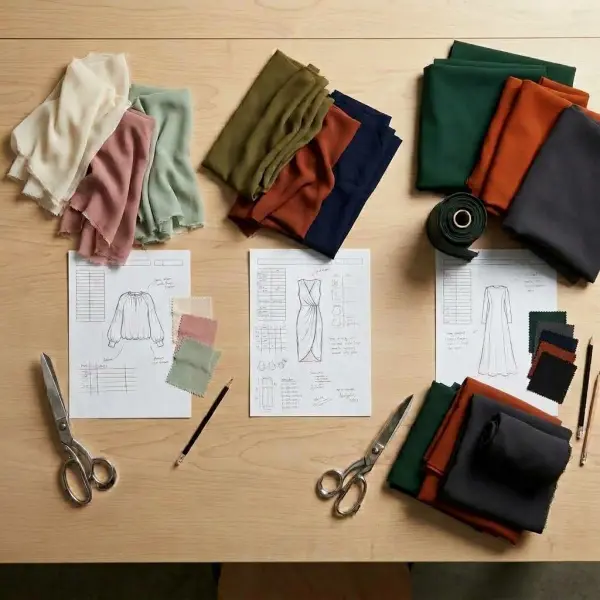
What Should Brands Test Before Approving Crepe for Long Garments?
Long garments deserve more rigorous fabric evaluation because small weaknesses can become magnified by greater fabric consumption and length.
A development team should examine the material both flat and in motion. Useful checks include opacity under front and back lighting, vertical drape, static cling, seam puckering, hem behavior, dimensional change, surface consistency, snagging where relevant, and whether the fabric stretches under its own weight after hanging.
Garments intended for layering should be tested over realistic underlayers rather than directly on a smooth mannequin. This can reveal friction or static that does not appear during an isolated fabric test.
Color also matters. A white or pastel version of the same crepe quality may require lining when navy or black does not. Costing should therefore be confirmed by color family when opacity is commercially important.
For production, fabric relaxation before cutting may need to be standardized if the material is prone to distortion. Long side seams and full-length zippers can also reveal feed problems that a small sewing trial misses.
The goal is not to make crepe unnecessarily complicated. It is to test the properties that become important because the garment uses a lot of it.
Crepe and Commercial Scalability
A fabric becomes commercially useful when it can be sourced and reproduced consistently enough for the brand's scale.
Some synthetic crepes are available through broad supplier networks, which can make them attractive for brands requiring repeatable bulk orders. Other specialized silk, wool, or highly finished crepes may involve different minimum orders, lead times, prices, or supplier capabilities.
Scalability also depends on color. Maintaining a core black or navy crepe may be easier than reproducing a seasonal pale shade with exact opacity and shade consistency across several batches.
Brands planning repeat programs should therefore evaluate supplier continuity along with the fabric itself. Relevant questions include whether the mill intends to keep the construction active, whether greige availability is stable, what minimum dye quantity applies, how shade approvals are managed, and how changes to finishing will be communicated.
A strong fabric platform is only valuable if the supply chain can support it.
Crepe Is Not Automatically a Sustainable Choice
Crepe should not be marketed as sustainable simply because it is durable-looking, matte, natural-feeling, or used in timeless silhouettes.
Crepe describes a fabric effect or family rather than an environmental certification. Its environmental profile depends on the fiber, raw-material source, manufacturing technology, dyeing and finishing, chemical management, energy, durability, care, logistics, and eventual disposal or recycling pathway.
A polyester crepe, silk crepe, wool crepe, and viscose crepe therefore require different sustainability questions.
For brands making environmental claims, specific evidence is more defensible than broad language. Claims can relate to verified recycled content, certified fiber sourcing, traceability, manufacturing standards, tested durability, or another substantiated attribute—but not merely to the word "crepe."
Common Mistakes When Using Crepe in These Categories
Assuming crepe automatically creates a modest silhouette
Fabric alone cannot define modesty. A very fluid crepe may closely follow the body if the pattern has insufficient ease, and a lightweight version may become translucent under strong light. Silhouette, opacity, stretch, lining, color, and styling all contribute to the finished result. Brands should evaluate the complete garment rather than treating crepe as a shortcut to coverage.
Using the same crepe for every product type
A blouse, stretch sheath dress, and full-length abaya place different demands on fabric. The material that works beautifully in a gathered sleeve may become too heavy across a long skirt, while an opaque dress crepe may be too bulky for delicate blouse details. Building several deliberate crepe tiers is usually more reliable than forcing one quality across an entire collection.
Choosing crepe only because it feels soft on a swatch card
Handfeel is useful, but a 15-centimeter swatch reveals little about full-garment behavior. Long dresses magnify fabric weight, folds, stretch, and movement. A larger hanging sample or prototype gives the design team much more meaningful information.
Ignoring static and friction in layered garments
This problem may only appear when the final garment is worn over another textile. An outer crepe can cling to a slip or trousers, causing the hem to climb or the fabric to gather awkwardly around the legs. Layer testing should replicate the actual wardrobe system, particularly for open abayas, long dresses, and coordinated sets.
Treating "wrinkle resistant" as a crepe-wide property
Some crepes can visually disguise minor creasing because their surface is already textured, but that is different from being inherently resistant to wrinkles. Fiber composition and finishing strongly influence recovery. Product claims should be based on the actual cloth and care testing, not the category name.
Overusing vague "premium crepe" language
"Premium" does not tell the customer whether the fabric is polyester, viscose, silk, stretch, heavyweight, lightweight, opaque, or lined. Better product communication identifies the properties that actually affect wear: for example, medium-weight matte crepe, lightly textured stretch crepe, or fluid crepe with full lining.
Important Technical Caveats
Crepe's strong fit with blouses, dresses, and modest fashion should not be interpreted as proof that every crepe is suitable for these categories.
First, opacity varies considerably. Some crepes are deliberately sheer, including constructions closely related to georgette and crepe chiffon. Cameo
Second, drape varies with weight and construction. A lightweight crepe may flow dramatically, while another quality can provide substantially more body.
Third, care cannot be generalized. Current crepe garments range from machine-washable commercial products to dry-clean-only occasionwear. Modanisa
Fourth, modest fashion is not defined by one textile or one standardized interpretation of coverage. Fabric selection should support the intended customer, garment architecture, cultural context, comfort requirements, and brand proposition rather than assuming a universal formula.
Finally, the existence of many crepe products in current modest-fashion retail supports the observation that the material remains commercially relevant, but it does not prove that crepe is universally preferred over other fabrics such as jersey, cotton, linen, chiffon, satin, or blends.
FAQ: Crepe in Blouses, Dresses, and Modest Wear
Why is crepe often used for blouses?
Crepe can work well for blouses because many lightweight versions combine fluid movement with enough surface texture to prevent simple designs from looking visually flat. Depending on the construction, crepe can support gathered sleeves, soft collars, ties, pleats, and relaxed body shapes. It may also provide greater opacity than chiffon, although this should never be assumed without testing. Brands should choose the specific weight and fiber according to the blouse design rather than sourcing "crepe" generically.
Is crepe a good fabric for maxi dresses?
It can be an excellent option when the selected crepe has appropriate weight, opacity, drape, and recovery. Long dresses amplify material behavior because more fabric is involved, so a crepe that feels light in a swatch may become substantially heavier across a full garment. Designers should test the fabric at garment scale, particularly for long skirts, gathers, bias sections, and layered styles.
Why is crepe used in abayas and other modest garments?
Crepe can provide a useful combination of drape, coverage, subdued surface texture, and movement for long silhouettes. Contemporary retailers continue to sell crepe abayas in numerous cuts and colors, indicating that the material remains an active commercial choice within modest fashion. Modanisa However, the category includes both opaque and sheer crepes, so fabric selection still needs to account for coverage, lining, stretch, static, and climate.
Is crepe always non-clingy?
No. Cling depends on fiber, fabric weight, surface characteristics, static electricity, garment ease, humidity, and what the garment is worn over. Some commercial brands intentionally select crepes they describe as non-clingy for specific products, but that property should not be extended to all crepe fabrics. Shukr Clothing Testing the finished garment over realistic underlayers is the safest approach.
Is polyester crepe suitable for modest wear?
Polyester crepe can be suitable when its weight, opacity, drape, static behavior, and comfort match the garment's requirements. Current modest-fashion retail includes many polyester-crepe products, including long dresses and abayas. Modanisa Polyester content alone does not establish quality, however; yarn construction, finishing, density, garment ventilation, and care all affect the wearing experience.
Does crepe need lining in a modest dress?
Sometimes. A dense medium-weight crepe may provide sufficient opacity without lining, while lightweight, pale, or loosely constructed crepes may need an underlayer. Lining may also be added for improved hang, comfort, seam coverage, or occasionwear structure rather than opacity alone. Because lining changes cost, thermal comfort, garment weight, and drape, the decision should be made during early sampling rather than after production costing is complete.
Is crepe better than chiffon for modest clothing?
Neither is universally better. Crepe usually offers a broader range of weights and opacity, which can simplify one-layer dresses and long garments. Chiffon excels where designers want transparency, soft overlays, floating sleeves, or layered volume. Many modest garments actually combine fabric roles—for example, an opaque crepe body with chiffon sleeves or cape panels. The correct choice depends on silhouette and coverage requirements rather than the category name alone.
What should a fashion brand look for when sourcing crepe for a long dress?
Prioritize composition, weight, width, opacity, drape, stretch and recovery where relevant, surface consistency, dimensional stability, color performance, care, seam behavior, static tendency, and supplier repeatability. Then produce a full or near-full prototype rather than relying only on a small swatch. For long silhouettes, the way the fabric behaves after several hours of hanging can be just as important as its appearance immediately after sewing.
Conclusion
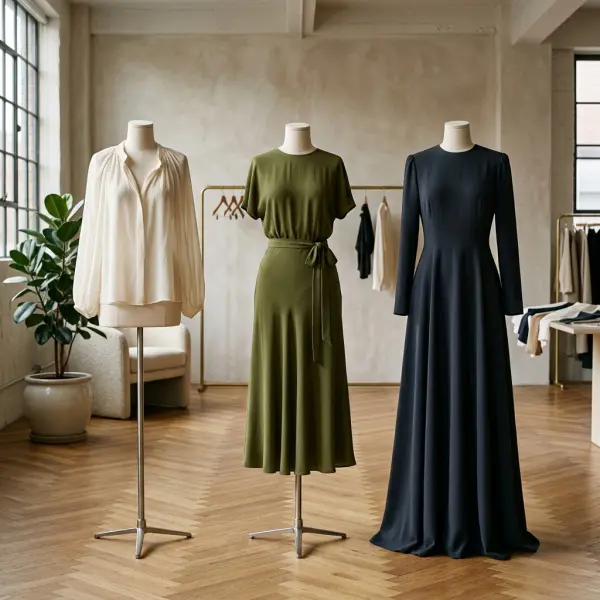
Crepe remains relevant to blouses, dresses, and modest wear because it occupies an unusually useful middle ground. Many crepe constructions can move softly without requiring chiffon's level of transparency, create visual interest without strong shine, and support both relaxed and polished silhouettes.
Its versatility is especially valuable in garments where fabric behavior is highly visible. A blouse depends on how cloth moves around the shoulders and sleeves. A dress exposes drape across a much larger surface. Long modest garments add further demands around opacity, layering, ease, and movement.
But the commercial strength of crepe also creates its biggest sourcing risk: the name covers too many different fabrics to function as a specification.
For fashion businesses, the useful strategy is therefore not simply to "use crepe." It is to identify which crepe construction performs a defined role—light blouse quality, core dress quality, stretch quality, occasion quality, or long-garment quality—and then control that material consistently through sampling, testing, supplier communication, and bulk production.
That distinction turns crepe from a familiar fabric label into a practical product-development platform.





Comments 0
Leave a CommentSend Comment
Anda harus Login terlebih dahulu untuk dapat memberikan komentar.