

Apparel Production Planning Explained for Manufacturers
Quick Answer
Apparel production planning is the process of organizing garment manufacturing so that the right styles, materials, machines, labor, approvals, and delivery timelines are aligned before and during production. For manufacturers, it connects buyer orders, product specifications, material availability, factory capacity, production lines, quality checkpoints, and shipment commitments into one coordinated operating plan.
In practical terms, apparel production planning helps factories decide what to produce, when to produce it, how much capacity is needed, which materials must arrive first, which lines should handle each style, and how production progress should be monitored. A strong plan does not remove uncertainty entirely. Fabric delays, sample revisions, absenteeism, machine downtime, and changing buyer priorities can still affect execution. But planning gives manufacturers a structured way to anticipate constraints, reduce idle time, control work-in-progress, protect quality, and improve on-time delivery.
For fashion brands and sourcing teams, production planning matters because it directly affects lead time, cost reliability, product consistency, and supplier performance. For factories, it is the operational bridge between commercial promise and manufacturing reality.

What Is Apparel Production Planning?
Apparel production planning is the structured coordination of resources, timelines, materials, and processes required to manufacture garments according to an agreed order, quality standard, cost target, and delivery date. It translates a buyer’s purchase order or brand production requirement into a workable factory plan.
In garment manufacturing, planning is more complex than simply assigning a style to a sewing line. Apparel products are sensitive to fabric behavior, size ratios, colorways, trims, construction methods, approvals, washing or finishing processes, packaging requirements, and buyer compliance standards. A T-shirt, tailored blazer, denim jacket, activewear legging, and embroidered dress may all be “garments,” but each creates a different planning challenge.
A practical apparel production plan usually connects several layers of decision-making:
- order quantity, style, color, and size breakdown;
- bill of materials, trims, labels, packaging, and fabric consumption;
- sample approval and production readiness;
- cutting, sewing, finishing, inspection, packing, and shipment sequence;
- line loading, machine allocation, labor availability, and skill requirements;
- quality checkpoints, rework allowance, and risk buffers;
- delivery dates, buyer priorities, and logistics cut-offs.
The purpose is not to create a perfect document that never changes. The real purpose is to create a reliable operating system that helps factory teams make better decisions when conditions change.
Why Production Planning Matters in Apparel Manufacturing
Apparel manufacturing sits at the intersection of fashion demand, material supply, labor-intensive operations, and strict delivery expectations. Compared with many other manufacturing categories, garment production often involves high SKU complexity, frequent style changes, seasonal peaks, and buyer-specific requirements. That is why weak planning can quickly become expensive.
A manufacturer may have enough sewing machines and workers, yet still miss shipment because fabric was released late, trims were not approved, cutting output was uneven, or one complex operation created a bottleneck. In apparel, production failure often comes from coordination failure rather than from one isolated technical problem.
Production planning matters because it gives structure to this coordination. It helps manufacturers balance commercial commitments with actual factory capability. It also gives sourcing teams and brands a clearer view of what is realistic before they push for aggressive lead times.
The global apparel and textile sector remains a major employment and supply chain industry, and responsible production cannot be separated from realistic workload planning. The International Labour Organization highlights ongoing concerns around safety, decent work, and changing work conditions in textiles, clothing, leather, and footwear. Planning that overloads factory capacity can increase pressure on working hours, quality, and compliance risk. ILO textiles, apparel, leather and related products
The business impact is direct
For manufacturers, production planning affects delivery performance, cost control, efficiency, buyer trust, and cash flow. A poorly planned factory often experiences excessive overtime, frequent line changes, late material chasing, quality rework, and shipment delays. These issues reduce margin even when the order price looks acceptable on paper.
For brands, production planning influences launch timing, inventory availability, wholesale commitments, retail drops, campaign schedules, and customer satisfaction. A late production order can disrupt an entire seasonal calendar.
This is why apparel production planning should not be treated as a back-office administrative task. It is a commercial capability.
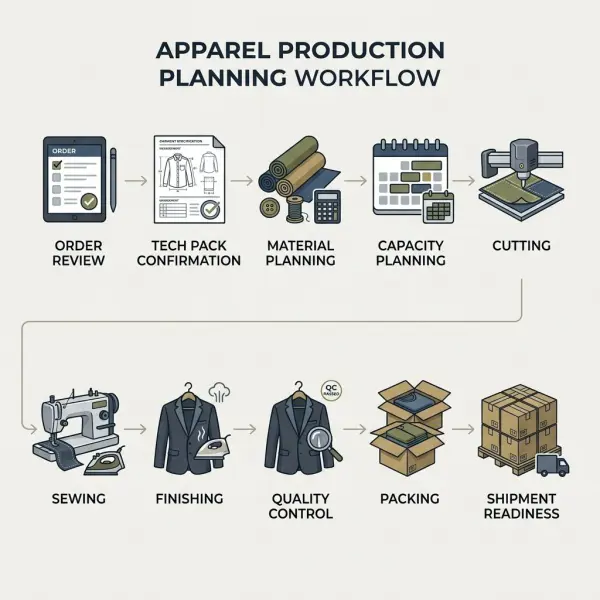
The Core Elements of an Apparel Production Plan
A good apparel production plan connects demand, materials, capacity, process flow, quality expectations, and shipment commitments. If one element is missing, the plan may look organized but fail during execution.
1. Order and demand confirmation
Planning begins with a clear understanding of what must be produced. This includes purchase order quantity, style number, colorways, size breakdown, delivery date, packing method, destination, and any buyer-specific requirements.
This step sounds simple, but it is often where future problems begin. A factory may receive an order before all technical details are finalized. Size ratios may change. A color may still be awaiting lab dip approval. A trim may not yet be nominated. If planning proceeds without separating confirmed information from pending information, the factory can build a schedule on weak assumptions.
The better approach is to classify order information into three groups: confirmed, pending, and high-risk. This allows the planning team to move forward where possible while still protecting the factory from hidden uncertainty.

2. Product specification and bill of materials
The bill of materials, or BOM, is central to apparel production planning because it defines what materials, components, and trims are required to make the garment. In fashion manufacturing, the BOM may include shell fabric, lining, interlining, buttons, zippers, thread, labels, care labels, hangtags, polybags, cartons, and specialty trims.
The BOM must connect with the tech pack, approved sample, costing sheet, and purchase plan. If the BOM is inaccurate, the production plan becomes unreliable. A missing interlining, incorrect zipper length, or wrong label placement may seem minor during planning, but it can stop production once bulk sewing begins.
Modern manufacturing planning systems often rely on material requirements planning logic. MRP calculates what materials are needed, in what quantities, and when they should be available to support production plans and customer demand. SAP explanation of material requirements planning
3. Material availability and lead time
In apparel, material readiness is one of the biggest drivers of production success. Fabric lead time, dyeing, printing, testing, washing compatibility, shrinkage, shade variation, and inspection results can all affect whether production can begin as planned.
A realistic production plan should not assume that fabric is ready simply because it has been ordered. It should verify purchase order placement, supplier confirmation, expected arrival date, fabric inspection status, lab testing, color approval, and shrinkage data.
For manufacturers, material planning should answer several practical questions:
- Has the fabric been ordered and confirmed by the mill or supplier?
- Are trims nominated, approved, and available in the correct quantity?
- Has fabric shrinkage been tested before marker making and cutting?
- Are color lots and shade bands manageable for the production order?
- Is there enough buffer for inspection failure, replacement, or shortage?
- Are packaging materials aligned with buyer and destination requirements?
A production plan is only as strong as its material assumptions. If material readiness is unclear, the plan should show that uncertainty visibly rather than hide it inside a fixed schedule.
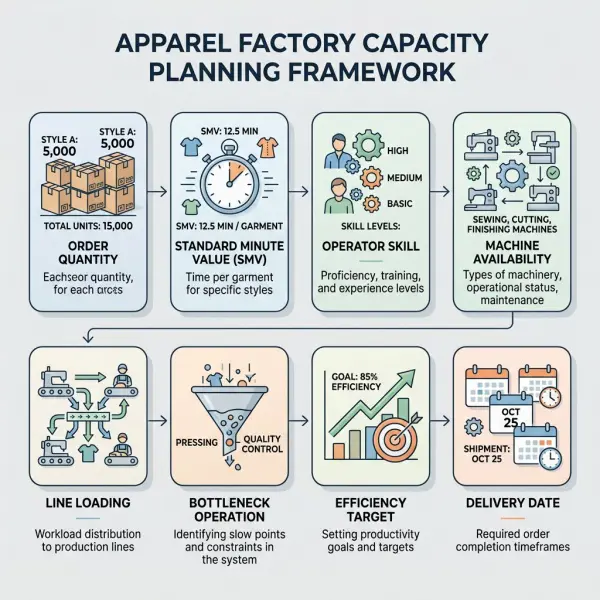
4. Capacity planning
Capacity planning determines whether the factory has enough resources to produce the order within the required timeline. In apparel, capacity is not only about the number of machines. It also depends on operator skill, line efficiency, style complexity, working hours, changeover time, absenteeism, and bottleneck operations.
A factory may technically have 20 sewing lines, but not all lines can produce every style equally well. A simple knit top and a structured jacket require different skill sets, machine attachments, quality controls, and production rhythm. Capacity planning must therefore consider both available minutes and capability fit.
ASCM’s APICS CPIM body of knowledge recognizes production planning, master scheduling, material requirements planning, capacity requirements planning, scheduling, and production order tracking as core competencies in manufacturing and inventory management. ASCM APICS CPIM certification overview
5. Production route and process sequence
Every garment follows a route through the factory. A basic route may include fabric inspection, spreading, cutting, bundling, sewing, finishing, pressing, final inspection, packing, and shipment. More complex products may add embroidery, printing, washing, bonding, pleating, garment dyeing, special finishing, or external subcontracting.
Production planning must map this route before scheduling begins. If an external embroidery process takes four days, it cannot be treated as a small detail inside the sewing plan. If denim washing requires approval after bulk wash, the schedule must allow for that decision point.
A strong route plan clarifies:
- which processes happen in-house and which are subcontracted;
- which processes can run in parallel and which must happen sequentially;
- where quality approval is required before moving forward;
- which process has the highest delay risk;
- where rework is most likely to occur.
The route plan is where production planning becomes operationally realistic. It prevents teams from assuming that all garments move through the factory in the same way.
Apparel Production Planning Process: From Order to Shipment
While every factory has its own system, apparel production planning usually follows a sequence of decisions. The exact terminology may differ, but the logic is broadly similar across export factories, domestic manufacturers, and private-label production units.
Step 1: Review the order and technical package
The planning team first reviews the order quantity, delivery date, product details, construction requirements, size breakdown, and buyer instructions. This stage should involve merchandising, production, industrial engineering, purchasing, quality, and sometimes compliance or logistics.
The goal is to identify whether the order is ready for planning or still depends on unresolved information. A plan created before sample approval, material confirmation, or measurement finalization may need repeated revision.
Step 2: Check material and approval status
Before a factory commits to a production start date, it must check whether fabric, trims, labels, and packaging are available or realistically scheduled to arrive. This step should also include testing and approval status.
In many factories, production delays are not caused by sewing inefficiency but by late approvals or incomplete materials. A realistic planning system tracks these dependencies before they become production emergencies.
Step 3: Estimate production time
Production time depends on order quantity, garment complexity, standard minute value, line efficiency, operator skill, and the number of lines allocated. Industrial engineering data is valuable here because it helps the factory estimate how many minutes are required to produce the order.
For example, a style with a higher standard minute value may require more operators, more days, or a more skilled line. If the factory ignores this complexity and schedules only by order quantity, the plan may become unrealistic.
Step 4: Allocate lines and resources
Line allocation is where planning meets factory reality. The planner must decide which production line will handle each style and when the style will enter the line. This decision should consider current line workload, operator capability, machine attachments, expected efficiency, and shipment priority.
The more styles a factory runs, the more important line allocation becomes. Frequent style changes can reduce efficiency because operators need time to learn construction details and line balance must be adjusted.
Step 5: Build the production timeline
The timeline should include all major stages: material arrival, cutting start, sewing start, finishing, inspection, packing, and shipment. For complex orders, the plan should also show sample approvals, subcontracting windows, washing, testing, and buyer inspection.
This timeline becomes the reference point for production control. It allows teams to see whether the factory is ahead, on track, or behind.
Step 6: Monitor production and adjust
No production plan survives execution unchanged. The value of planning is not that it eliminates change. The value is that it helps teams respond to change with visibility.
Production monitoring should compare planned output with actual output. If cutting is late, sewing will be affected. If sewing output is below target for two consecutive days, finishing and packing may be compressed. If final inspection finds recurring defects, rework capacity must be planned quickly.
This monitoring discipline connects naturally with the next article in this cluster, how production scheduling improves garment efficiency, where the focus moves deeper into daily scheduling, line balancing, output tracking, and efficiency improvement.
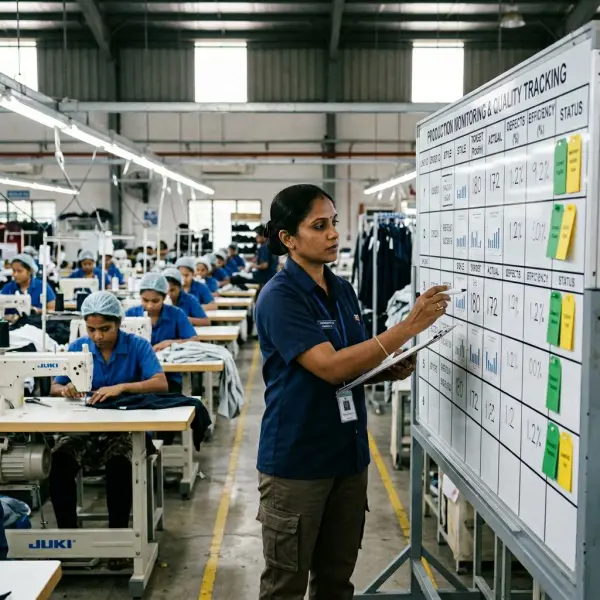
The Role of Data in Production Planning
Apparel production planning depends on data, but not all data is equally useful. A factory may collect many reports and still make poor planning decisions if the information is late, inaccurate, or disconnected from action.
The most useful planning data is practical and decision-oriented. It helps answer questions such as: Can we accept this order? Which line should produce it? Will materials arrive on time? Where is the bottleneck? Can we ship as promised? What should be escalated today?
Key data points often include:
- style number, order quantity, color, and size breakdown;
- standard minute value and estimated efficiency;
- line capacity and available production minutes;
- material order status and actual warehouse receipt;
- cutting output, sewing output, finishing output, and packing status;
- defect rate, rework quantity, and inspection results;
- planned versus actual production progress;
- shipment date, logistics booking, and buyer inspection date.
Data standards also matter when manufacturers exchange information with brands, retailers, and logistics partners. GS1 US notes that standardized color and size codes create a common language for product attributes and can support clearer product data sharing for merchandising and inventory decisions. GS1 US Color and Size Codes
The strategic point is simple: production planning improves when the factory works from one reliable version of the truth. When merchandising, purchasing, production, quality, and logistics each maintain separate spreadsheets, the plan becomes vulnerable to mismatched assumptions.
Production Planning and Responsible Manufacturing
Responsible manufacturing is often discussed through compliance audits, material sourcing, labor standards, or sustainability programs. Production planning deserves a place in that conversation because unrealistic planning can create pressure throughout the factory.
When delivery dates are too aggressive or capacity is overbooked, factories may rely on excessive overtime, rushed quality checks, subcontracting without proper visibility, or last-minute material decisions. These choices can increase operational and social risk.
The OECD’s guidance for responsible supply chains in the garment and footwear sector emphasizes due diligence across the supply chain to identify and address potential negative impacts. OECD Due Diligence Guidance for Responsible Supply Chains in the Garment and Footwear Sector
Production planning does not solve every responsible sourcing issue. But it supports better decision-making by making capacity, lead time, and production risk more visible. For brands, this means responsible purchasing should include realistic order timelines and timely approvals. For manufacturers, it means accepting orders based on real capability rather than optimistic assumptions.
How Apparel Manufacturers Can Apply Production Planning Strategically
Production planning becomes more powerful when it is treated as a management system, not merely as a production calendar. For manufacturers, the goal is to create a planning discipline that connects merchandising, purchasing, production, quality, finance, and logistics.
Start with production readiness
Before bulk production begins, the factory should confirm whether the style is truly ready. Production readiness includes approved samples, finalized measurements, confirmed materials, clear construction methods, machine requirements, and quality standards.
A useful production readiness checklist may include:
- approved pre-production sample;
- final tech pack and measurement specification;
- confirmed BOM and material consumption;
- fabric inspection and shrinkage results;
- trims and packaging availability;
- approved artwork, embroidery, print, or wash standard;
- line layout and machine attachments;
- quality control points and defect prevention notes.
This checklist protects both the factory and the buyer. It reduces the chance of starting production only to discover that a critical decision is still pending.
Plan capacity before accepting orders
Manufacturers often feel commercial pressure to accept orders quickly. But accepting orders without checking capacity can damage delivery performance and profitability.
A more disciplined approach is to review capacity by month, by line, and by skill category. Basic products, complex products, small orders, repeat orders, and high-risk new styles should not be treated the same. A factory that understands its capacity profile can negotiate more confidently with buyers.
Connect planning with costing
Production planning and costing should inform each other. If a style requires special machines, low efficiency during the learning curve, extra finishing, or higher inspection effort, the cost should reflect that reality.
When costing ignores production complexity, the manufacturer may win the order but lose margin during execution. Planning data helps factories understand which orders are profitable, which lines perform best for certain product categories, and where operational improvements are needed.
Use planning reviews as management routines
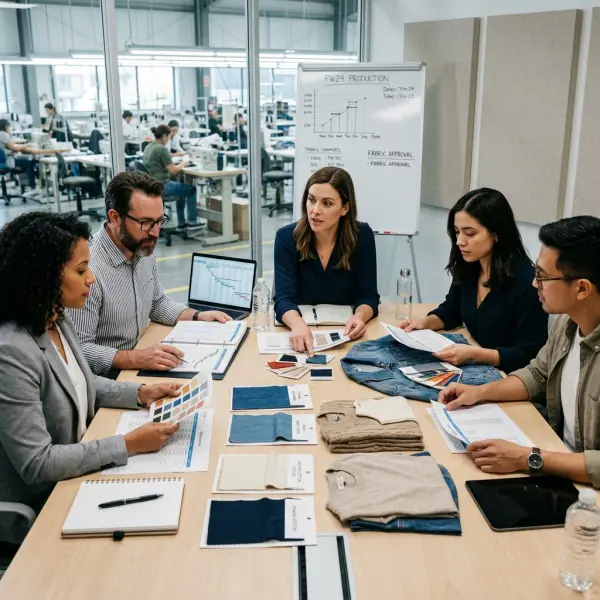
A production plan should not be created once and forgotten. Strong factories use daily or weekly planning reviews to identify risk early. These reviews should focus on exceptions, not just reporting.
The most useful questions are practical:
- Which orders are at risk of missing shipment?
- Which materials are late or not approved?
- Which line is below planned efficiency?
- Which quality issue may create rework?
- Which buyer decision is blocking production?
- Which shipment needs escalation today?
This turns planning into a live decision system. It also creates accountability across departments.
Common Mistakes in Apparel Production Planning
Production planning problems are rarely caused by one bad decision. They usually come from repeated habits that make the plan less realistic over time.
Mistake 1: Planning from delivery date only
Many factories begin with the shipment date and work backward. This is necessary, but not sufficient. If the backward plan does not account for material lead time, approval delays, actual capacity, quality risk, and finishing requirements, it becomes a wish list rather than a production plan.
A better approach is to build the plan around constraints. The delivery date matters, but the plan must also reflect what can realistically happen inside the factory.
Mistake 2: Treating all styles as equal
A 5,000-piece order of a simple knit top is not the same as a 5,000-piece order of a lined blazer. Style complexity affects machine requirements, operator skill, line balance, learning curve, inspection time, and rework risk.
Factories that plan only by quantity often overload lines with complex styles. The result is lower efficiency, missed daily targets, and pressure near shipment.
Mistake 3: Ignoring approval dependencies
Sample approval, lab dip approval, print approval, wash approval, and trim approval can all affect production timing. If these dependencies are not visible in the plan, teams may assume production is ready when it is not.
A better planning system shows approval status clearly and escalates pending decisions before they delay bulk production.
Mistake 4: Separating planning from quality
Quality is often treated as a final inspection issue. In reality, quality must be planned into production. Complex operations need inline checkpoints. New styles need operator guidance. Risky fabrics may need special handling. High-defect operations may need early monitoring.
When quality is separated from planning, defects are discovered late. Late defects create rework, delay shipment, and reduce profitability.
Mistake 5: Depending too heavily on manual spreadsheets
Spreadsheets can be useful, especially for smaller factories. The problem begins when spreadsheets become disconnected across departments. If merchandising, purchasing, cutting, sewing, finishing, and logistics all maintain different versions of the truth, planning accuracy declines.
Digital systems do not automatically solve planning problems, but they can improve visibility when the underlying process and data discipline are strong.
For a deeper discussion of recurring operational barriers, the next cluster article on common production planning challenges in fashion manufacturing should focus specifically on delay causes, coordination gaps, capacity conflicts, and execution risks.
What Manufacturers Should Verify Before Acting
Production planning decisions should be based on verified information, not assumptions. This is especially important when working with new buyers, new materials, new styles, or tight delivery windows.
Before confirming a production plan, manufacturers should verify:
- whether the purchase order and delivery date are final;
- whether the approved sample reflects the actual bulk production method;
- whether the BOM is complete and aligned with costing;
- whether material lead times are confirmed by suppliers;
- whether fabric testing and shrinkage results are available;
- whether the factory has enough skilled operators and machines;
- whether subcontracted processes have confirmed capacity;
- whether quality standards and inspection requirements are clear;
- whether logistics timing supports the promised shipment date.
This verification process may feel slower at the beginning, but it reduces expensive disruption later. In apparel manufacturing, speed without readiness often creates delay rather than efficiency.
Apparel Production Planning vs. Production Scheduling
Production planning and production scheduling are closely related, but they are not the same.
Production planning defines the broader manufacturing approach: what must be produced, what resources are needed, when key stages should happen, and whether the factory can meet the order requirements. Production scheduling turns that plan into more detailed timing: which line runs which style, on which dates, with what daily output target, and in what sequence.
A simple distinction is useful:
|
Area |
Production Planning |
Production Scheduling |
|
Main question |
Can we produce this order realistically? |
How exactly will we run production day by day? |
|
Time horizon |
Wider, often weekly or monthly |
More detailed, often daily or shift-based |
|
Focus |
Materials, capacity, process flow, readiness, delivery |
Line loading, output targets, sequence, bottlenecks |
|
Users |
Planning, merchandising, purchasing, production, management |
Production control, supervisors, line managers |
|
Risk addressed |
Unclear readiness and unrealistic commitments |
Inefficient execution and missed daily targets |
A factory needs both. Planning without scheduling remains too broad. Scheduling without planning becomes reactive. The strongest apparel manufacturers connect the two into one operating rhythm.
FAQ: Apparel Production Planning
What is the main goal of apparel production planning?
The main goal of apparel production planning is to align orders, materials, factory capacity, labor, production processes, quality standards, and shipment timelines so garments can be manufactured efficiently and delivered as promised. It helps manufacturers avoid starting production without the required fabric, trims, approvals, machines, or skilled operators. A good plan also makes risks visible early, allowing teams to escalate material delays, capacity shortages, or quality concerns before they become shipment problems.
Who is responsible for production planning in a garment factory?
Production planning is usually led by a planning or production control team, but it depends on input from merchandising, purchasing, industrial engineering, quality control, warehouse, production, and logistics. In smaller factories, one manager may handle several of these roles. In larger factories, planning is more specialized. The key point is that planning cannot work in isolation. It requires accurate information from every department involved in order confirmation, material readiness, production execution, and shipment.
What information is needed before making an apparel production plan?
A manufacturer needs the confirmed purchase order, style details, size and color breakdown, delivery date, tech pack, approved sample status, BOM, material lead times, production process route, capacity data, standard minute value, quality requirements, and packing instructions. For complex garments, the factory may also need wash standards, print or embroidery approvals, testing requirements, and subcontracting schedules. If these inputs are incomplete, the plan should clearly show what is still pending.
How does production planning reduce garment manufacturing delays?
Production planning reduces delays by identifying constraints before production begins. It checks whether materials will arrive on time, whether the right line has capacity, whether approvals are complete, and whether the production route includes all required processes. During execution, planned versus actual tracking helps teams detect delays early. Planning does not prevent every disruption, but it gives the factory a structured way to respond before delays become uncontrollable.
What is the difference between production planning and line planning?
Production planning is broader. It covers order readiness, material planning, capacity, process flow, quality checkpoints, and shipment timing. Line planning is more specific to assigning styles to sewing lines based on capacity, skill, machine availability, and delivery priority. Line planning is one part of production planning. If line planning is done without material and approval visibility, the factory may allocate a line to a style that is not actually ready to sew.
Can small apparel manufacturers use production planning without expensive software?
Yes. Small manufacturers can start with disciplined spreadsheets, clear order tracking, material status reports, capacity calendars, and daily production monitoring. Software can help, but it is not a substitute for accurate data and consistent routines. The first priority is to create one reliable planning system used by merchandising, purchasing, production, and quality teams. As order volume and complexity grow, ERP, MRP, or production planning tools may become more valuable.
How does production planning affect apparel quality?
Production planning affects quality by allowing enough time and resources for proper preparation, inline checks, operator guidance, finishing, inspection, and rework if needed. When planning is unrealistic, factories may rush cutting, skip preventive checks, overload sewing lines, or compress final inspection. This increases defect risk. Good planning integrates quality control into the production route instead of treating quality as something checked only at the end.
Why is production planning important for fashion brands, not only factories?
Fashion brands depend on production planning because factory performance affects product launches, retail delivery, inventory flow, wholesale commitments, campaign timing, and customer experience. If a brand gives late approvals, changes specifications after planning, or pushes unrealistic delivery dates, the factory plan becomes unstable. Strong production planning requires collaboration between brand and manufacturer. It is not only a factory responsibility.
Conclusion
Apparel production planning is the discipline that turns fashion orders into manufacturable reality. It connects commercial ambition with factory capacity, material readiness, technical accuracy, quality control, and delivery execution.
For manufacturers, planning protects margin and buyer trust. It reduces avoidable disruption, improves resource use, and makes operational risk visible before it becomes expensive. For brands and sourcing teams, planning provides a clearer understanding of what is realistic inside the factory. It also encourages better purchasing behavior, earlier approvals, and more responsible lead time decisions.
The best production plans are not static documents. They are living management tools. They help teams coordinate decisions, monitor progress, and adjust intelligently when materials are late, output is below target, or quality issues appear.
In a fashion industry shaped by speed, complexity, and accountability, apparel production planning is no longer just an internal factory function. It is a strategic capability that supports efficiency, delivery reliability, responsible manufacturing, and long-term business confidence.





Comments 0
Leave a CommentSend Comment
Anda harus Login terlebih dahulu untuk dapat memberikan komentar.