
Fashion B2B Sales Explained for Apparel Brands and Suppliers
Fashion B2B sales allow apparel brands, garment manufacturers, textile suppliers, and fashion businesses to sell products or production services to other companies rather than directly to individual consumers. These commercial relationships can involve wholesale clothing, private-label manufacturing, corporate uniforms, retail distribution, and long-term supply agreements.
Unlike consumer-facing fashion sales, B2B transactions depend on more than product appearance or brand appeal. Buyers evaluate commercial margins, product specifications, order quantities, delivery reliability, payment terms, and whether a supplier can support their business requirements consistently.
For fashion companies, understanding B2B sales means learning how product development, pricing, production capacity, logistics, and account relationships fit into a commercially sustainable sales model.
Quick Answer: What Is Fashion B2B Sales?
Fashion business-to-business (B2B) sales is a commercial model in which apparel brands, manufacturers, and fashion suppliers sell garments, materials, accessories, or related services to other businesses for resale, production, organizational use, or distribution.
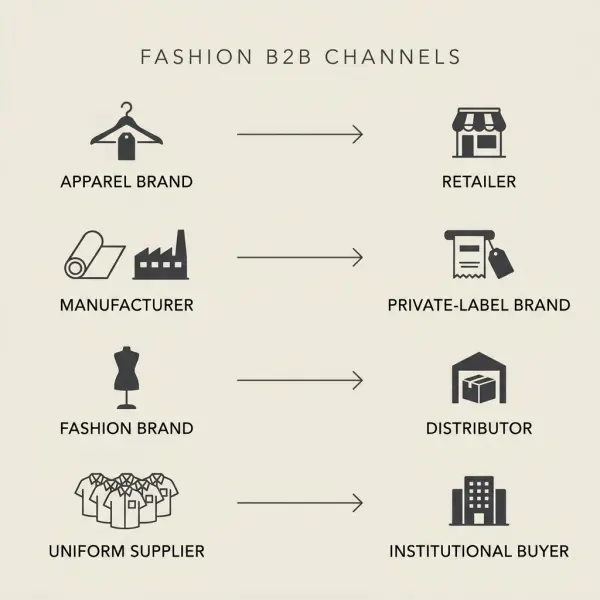
A fashion brand might supply seasonal collections to independent boutiques, while a garment manufacturer may produce private-label clothing for a retail company. Textile mills sell fabrics to apparel manufacturers, and uniform suppliers provide workwear to hotels, hospitals, schools, and corporate organizations.
The main distinction from business-to-consumer (B2C) sales is the purchasing purpose. Consumer buyers typically select clothing for personal use, while business buyers make purchasing decisions based on commercial requirements, inventory planning, quality standards, and expected financial outcomes.
Fashion B2B sales may involve larger orders and longer purchasing cycles, but neither is guaranteed. Some retailers purchase limited quantities, while institutional contracts may require phased deliveries over an extended period.
Successful B2B selling therefore depends on matching a buyer's operational and commercial needs with products, pricing, and services the supplier can reliably deliver.

Understanding the Role of B2B Sales in the Fashion Industry
Fashion businesses operate through interconnected commercial relationships. Fabric mills supply manufacturers, manufacturers produce garments for brands, distributors move products into retail networks, and retailers sell finished collections to consumers.
B2B sales connect these activities through commercial transactions. They determine not only who purchases a product, but also how inventory, pricing, production commitments, and commercial risks are distributed between businesses.
For an emerging apparel brand, direct-to-consumer sales may provide useful feedback about product preferences and consumer behavior. However, developing wholesale accounts can create another route to market without requiring the brand to operate every retail location itself.
A garment manufacturer approaches B2B sales differently. Its customers may be fashion labels that need dependable production partners rather than finished garments carrying the manufacturer's own brand. The commercial offering is built around technical capability, production quality, delivery performance, and the ability to meet the customer's specifications.
These differences matter because B2B sales strategies cannot be reduced to selling more products at lower prices. The right model depends on where the business sits in the fashion value chain and what the customer is purchasing.
Fashion B2B Sales Involve Multiple Business Relationships
One apparel company may simultaneously participate in several B2B relationships.
Consider a small clothing brand producing casualwear. It might purchase knitted fabric from a textile supplier, contract a cut-and-sew factory to manufacture garments, and sell the resulting collection to independent retailers.
The same business is a B2B buyer when purchasing materials and manufacturing services, but a B2B seller when supplying finished garments to stores.
This creates an important operational reality: decisions made during sourcing and production directly influence the brand's ability to meet wholesale customer expectations.
Late fabric deliveries, inconsistent sizing, or unexpected manufacturing costs can affect pricing commitments and fulfillment schedules downstream.
Brands that understand both sides of the transaction are better positioned to design commercially realistic B2B offers.
The Main Fashion B2B Sales Models
Fashion B2B sales include several commercial arrangements with different responsibilities, buyer expectations, and revenue structures.
The most suitable model depends on whether a company owns finished inventory, manufactures products to order, distributes another brand's merchandise, or develops products for a specific organizational customer.
Wholesale Apparel Sales
Wholesale apparel sales involve selling finished clothing products to another business, commonly a retailer or reseller, at agreed trade prices.
A contemporary womenswear brand might offer dresses, blouses, and trousers to independent boutiques through a seasonal wholesale collection. The boutiques purchase selected styles and quantities, then resell the garments to their customers.
Under a conventional wholesale purchase, the retailer buys the agreed inventory and assumes the commercial risk of selling it, subject to the contract's return, defect, and cancellation provisions.
This model can help brands reach customers through existing retail networks. However, wholesale pricing generally leaves less revenue per garment than the brand's own full-price retail sales, making cost control and channel economics particularly important.
Private-Label and Contract Manufacturing
In private-label manufacturing, a business arranges for another company to produce goods that will be sold under its own brand.
A fashion retailer may work with a factory to develop a clothing range using its preferred fabrics, measurements, colors, labeling, and packaging.
The manufacturing partner may offer existing designs that can be adapted or provide more extensive product development and production services.
The commercial relationship is primarily based on manufacturing capability, product specifications, order volumes, quality expectations, and agreed production terms.
Private-label manufacturing should not automatically be treated as ordinary wholesale. The buyer may be commissioning production rather than purchasing an existing collection, and responsibilities for design ownership, materials, sampling, and production risk can differ substantially.
For a deeper explanation of this business structure, see private label fashion business models.
Fashion Distribution and Agency Sales
Distributors and sales agents help fashion suppliers reach business customers, although their commercial roles differ.
An independent distributor generally purchases products for resale, or acts under another agreed distribution arrangement. It may manage regional customer relationships, inventory, logistics, and sales activities.
A sales agent typically represents a brand or supplier and receives a commission or other agreed compensation for generating business. The agent does not necessarily purchase or own the merchandise.
These arrangements can make market entry more manageable when a fashion brand lacks direct relationships with local retailers.
However, manufacturers and brands must clarify territory rights, exclusivity, pricing authority, customer ownership, inventory responsibilities, and termination conditions before entering such agreements.

Institutional and Corporate Apparel Supply
Institutional apparel supply involves selling products to organizations for operational or organizational use rather than conventional retail resale.
Examples include employee uniforms, hospitality workwear, healthcare apparel, school uniforms, event merchandise, and promotional clothing.
Buyers may prioritize durability, consistent sizing, repeat availability, customization, and documented product specifications over seasonal fashion trends.
A hotel group purchasing uniforms for several locations, for example, may require the same garment design to remain available for future employee replacements. That changes how suppliers approach materials, pattern control, stock planning, and repeat production.
Some institutional purchases involve formal procurement procedures or competitive tenders, while others are negotiated directly. Requirements vary by organization, purchasing policy, and jurisdiction.
How Is Fashion B2B Different From Direct-to-Consumer Sales?
Fashion B2B sales involve organizational purchasing decisions, while direct-to-consumer sales involve selling products to the final individual customer.
Both channels require appealing products and reliable service, but their commercial logic differs.
A consumer might purchase a jacket based on its silhouette, fit, price, and personal styling preferences. A retail buyer evaluating the same jacket must also consider the purchase cost, expected selling price, available size range, inventory turnover, delivery date, and whether the product fits the store's assortment.
The difference affects almost every part of the sales process.
|
Business Factor |
Fashion B2B Sales |
Fashion B2C Sales |
|
Primary customer |
Businesses and organizations |
Individual consumers |
|
Purchasing purpose |
Resale, manufacturing, operations, or distribution |
Personal or household use |
|
Order quantity |
Negotiated quantities; may be small or large |
Usually individual items or small baskets |
|
Pricing |
Trade prices, contract pricing, or negotiated quotations |
Published consumer prices and promotions |
|
Purchase decision |
Commercial, technical, and operational evaluation |
Personal preferences, perceived value, and affordability |
|
Sales cycle |
May require negotiations, samples, approvals, and purchase orders |
Often shorter, particularly for available products |
|
Fulfillment |
Scheduled deliveries, bulk shipments, or production orders |
Individual consumer fulfillment |
|
Relationship management |
Account service, replenishment, and contract performance |
Customer service, retention, and consumer engagement |
These are typical distinctions rather than universal rules. A small boutique may purchase a limited test assortment, while a consumer purchasing made-to-measure clothing may undergo a lengthy consultation and fitting process.
The practical lesson is that B2B sales materials must answer commercial questions beyond what ordinary consumer product pages provide.
What Do Fashion B2B Buyers Actually Look For?
Business buyers evaluate whether a supplier can help them meet a defined commercial or operational objective.
For retailers, this often means selecting merchandise with a credible opportunity to sell profitably. For manufacturers purchasing textiles, the focus may be material performance, supply continuity, and production suitability. Institutional buyers may emphasize compliance with specifications, delivery schedules, and service reliability.
Several factors regularly influence the evaluation process.
Product Relevance and Assortment Fit
A clothing collection must make sense within the buyer's intended market.
A boutique specializing in understated premium essentials is unlikely to purchase a large assortment of heavily embellished occasionwear simply because the garments are well made.
Buyers consider product category, design direction, size availability, price positioning, and whether the collection complements existing merchandise.
For branded apparel, product differentiation can also matter. A recognizable design identity, consistent fit, or distinctive material selection may give a retailer a reason to introduce a new brand rather than purchase additional products from existing suppliers.
The supplier's task is to demonstrate commercial relevance, not simply showcase its entire catalog.
Pricing and Expected Commercial Margin
Retail buyers need sufficient margin to cover operating costs, inventory risk, potential markdowns, and other expenses associated with selling merchandise.
A product with a desirable design may still be commercially unsuitable if the wholesale price leaves little room for profitable resale.
Manufacturers face related but different calculations. Their quotations must account for materials, labor, factory overhead, waste allowances, packaging, and the cost of meeting the customer's requirements.
A supplier that wins orders through unsustainably low prices may struggle to maintain quality or fulfill later production commitments.
Commercially viable pricing must work for both parties.
Delivery Reliability and Product Consistency
Fashion purchasing is sensitive to timing, particularly when merchandise is linked to a seasonal collection, promotional campaign, or scheduled launch.
A retailer receiving summer merchandise late in the season may have less time to sell the products at their intended prices.
For a manufacturer, delivery reliability depends on realistic production capacity, confirmed material availability, approved samples, and workable production schedules.
Consistency also matters. A buyer that approves a garment sample expects production units to conform to the agreed specifications within defined tolerances.
Clear expectations around inspection, defect handling, and delivery performance help prevent costly misunderstandings.
Information Quality and Supplier Credibility
Professional buyers need product information they can use in their purchasing systems and internal decision-making.
A credible fashion supplier should be able to explain what is available, what can be produced, when goods can be delivered, and what conditions apply to an order.
For product-based wholesale sales, a line sheet commonly summarizes styles, product identifiers, available variants, trade prices, and ordering information. Manufacturers may instead rely more heavily on technical specifications, samples, capacity information, and formal quotations.
When a buyer requests additional documentation, the supplier should distinguish verified capabilities from services that remain conditional on materials, capacity, or subcontractor availability.

How Does the Fashion B2B Sales Process Work?
A typical fashion B2B sales process moves from identifying a suitable business customer to agreeing on commercial requirements, fulfilling an order, and managing the relationship afterward.
The exact sequence depends on the business model. A wholesale brand selling available inventory may complete a transaction relatively quickly, while a contract manufacturer developing a new product may require several sampling and approval cycles.
The central objective is to reduce uncertainty before either party commits significant inventory, production resources, or working capital.
From Initial Interest to a Commercial Agreement
A structured sales process helps both sides identify whether the opportunity is practical.
A typical sequence includes:
- Buyer identification and qualification: Determine whether the prospective customer matches the supplier's product positioning, production capability, and commercial requirements.
- Product or capability presentation: Introduce relevant collections, technical expertise, samples, or manufacturing services.
- Requirement clarification: Confirm product specifications, quantities, delivery expectations, packaging, and other conditions.
- Quotation and negotiation: Agree on pricing, minimum order quantities, payment arrangements, responsibilities, and applicable commercial terms.
- Order confirmation: Document the agreed transaction through an accepted purchase order, sales contract, or other appropriate agreement.
- Production or order fulfillment: Prepare and deliver the goods according to the confirmed requirements.
- Post-delivery account management: Resolve discrepancies, review performance, and assess potential future orders.
This sequence is a practical framework, not a compulsory industry standard. Some steps may overlap, while others require additional approval stages.
A new private-label order, for example, may include development samples, fit samples, pre-production approval, and inspection arrangements before bulk delivery.
The important principle is that product, financial, and delivery commitments should be sufficiently clear before the transaction becomes difficult or expensive to change.
Why Repeat Orders Matter
B2B sales relationships can become commercially valuable when buyers place repeat orders or develop broader purchasing programs.
Repeat business may reduce the need to acquire a completely new customer for every production cycle. It can also provide better information for material forecasting, production planning, and inventory decisions.
However, reorders are not automatic. Retailers may discontinue a product because of poor sell-through, changing customer preferences, or excessive stock. Institutional buyers may change suppliers when contracts expire or procurement requirements change.
A supplier should therefore measure account quality through actual purchase history and profitability rather than treating every initial order as evidence of a long-term relationship.
Understanding Wholesale Pricing, Margins, and Commercial Terms
Pricing is one of the most consequential parts of a fashion B2B strategy because it determines whether both supplier and buyer can participate in the transaction profitably.
Wholesale prices are not simply retail prices with an arbitrary discount applied. A workable price must reflect the supplier's cost structure, the buyer's expected economics, the sales channel, and the risks covered by the agreement.
The Difference Between Wholesale Price and Retail Price
A wholesale price is the agreed price charged to a business customer. A retail price is the amount charged to the final consumer.
For an illustrative garment transaction, consider the following figures.
|
Financial Element |
Example Amount |
|
Supplier's unit product cost |
$30 |
|
Wholesale selling price |
$55 |
|
Retail selling price |
$100 |
|
Supplier's initial gross profit per unit |
$25 |
|
Retailer's initial gross profit per unit |
$45 |
|
Supplier's initial gross margin |
45.5% |
|
Retailer's initial gross margin |
45.0% |
Illustrative example only. Prices exclude sales taxes. The supplier's $30 unit cost is assumed to include the product costs recognized in its cost of goods sold. Additional freight, duties, selling expenses, discounts, returns, or allowances may affect actual margins depending on how the transaction is structured.
The supplier's gross margin is calculated as:
($55 − $30) ÷ $55 × 100 = 45.5%
The retailer's initial gross margin is:
($100 − $55) ÷ $100 × 100 = 45.0%
Gross margin should not be confused with markup. Margin uses the selling price as the denominator, while markup uses cost.
The example also shows why the highest apparent revenue per garment is not always the most profitable commercial decision. The costs and risks involved in selling through each channel can differ significantly.
A direct-to-consumer sale may generate a higher selling price but also involve advertising, fulfillment, customer acquisition, returns, and consumer service costs that would not arise in exactly the same way under a wholesale arrangement.
Minimum Order Quantity and Production Economics
Minimum order quantity, commonly abbreviated as MOQ, is the minimum quantity a supplier agrees to sell or manufacture under specified commercial terms.
For apparel manufacturers, MOQ may reflect material minimums, fabric dyeing quantities, production setup, cutting efficiency, and factory scheduling.
A ready-stock wholesaler may establish minimums differently, using order value, pack quantities, or inventory allocation policies.
MOQs should be connected to actual operational constraints rather than treated as fixed industry-wide numbers.
A manufacturer may be able to produce smaller batches at a higher unit price when suitable materials are already available. Conversely, a technically complex garment requiring custom fabric or trims may have a higher minimum even when the factory itself is capable of small-batch sewing.
Buyers and suppliers should examine the underlying cost implications before accepting or rejecting a proposed MOQ.
Payment Terms Affect Cash Flow and Risk
Payment arrangements influence how much working capital each party must commit and when cash becomes available.
Common arrangements include deposits, payment before shipment, payment against agreed documents, and open-account terms where the buyer pays after delivery.
International transactions may also use letters of credit or documentary collections. The appropriate choice depends on creditworthiness, transaction size, country risk, relationship history, and banking costs.
The International Trade Administration explains the relative payment risks in its guide to international trade payment methods.
For a small clothing manufacturer, accepting a large order with extended payment terms can create pressure if wages, fabric purchases, and factory expenses must be paid before customer funds arrive.
Sales growth and positive cash flow are not the same thing. A commercially attractive order can still be difficult to fulfill if its financing requirements exceed the supplier's available resources.
The Operational Foundation of a Reliable Fashion B2B Business
A successful sales presentation can secure an order, but operational capability determines whether that order becomes a sustainable commercial relationship.
Fashion B2B activities require coordination across product development, material sourcing, manufacturing, inventory, fulfillment, and customer service.
When these functions operate independently, the sales team may offer delivery dates or product specifications that the business cannot consistently support.
Product Specifications and Sample Approval
For manufactured apparel, product specifications translate the buyer's requirements into instructions for production.
Depending on the order, documentation may cover fabric composition, garment measurements, grading, construction methods, trims, labeling, colors, packaging, and acceptable tolerances.
Approved samples provide a physical reference for evaluating production. However, sample approval alone is not a substitute for complete specifications or agreed inspection criteria.
A factory may produce an attractive development sample yet encounter difficulties during bulk production if the fabric behaves differently across batches or the construction is inefficient at scale.
The quality of the B2B commitment therefore depends on both accurate documentation and realistic manufacturing capability.
Production Capacity and Delivery Planning
Suppliers should distinguish theoretical capacity from capacity that is genuinely available during the required production period.
A factory may have enough sewing machines to produce a particular volume under ideal conditions, but its actual output will depend on existing orders, labor availability, product complexity, material readiness, and production efficiency.
For fashion brands sourcing from external manufacturers, understanding these limitations helps prevent unrealistic commitments to retail customers.
Supplier selection is therefore closely connected to sales performance. A related discussion of evaluating fabric suppliers and production partners provides additional context for building dependable sourcing relationships.
Inventory Accuracy and Product Identification
Fashion inventory is particularly sensitive to variation because a single clothing style may contain multiple colors and sizes.
Suppliers need reliable product records to prevent incorrect shipments, incomplete orders, and confusion between similar variants.
A stock keeping unit (SKU) is a company's internal identifier for managing merchandise. A Global Trade Item Number (GTIN) is a standardized product identifier used in commercial supply chains.
GS1 explains that each distinct size-and-color product variation requires its own GTIN when identified using the GS1 system. Its guidance on GTINs for product variants clarifies this requirement.
Not every small B2B transaction requires a GTIN. Whether standardized barcodes are needed depends on the buyer, selling channel, and applicable system requirements.
Nevertheless, consistent product identification becomes increasingly useful when businesses manage more customers, product variants, and fulfillment locations.
How Can Apparel Brands and Suppliers Build a Practical B2B Sales Strategy?
A practical fashion B2B strategy starts with identifying the type of customer a business can serve profitably and reliably.
The first objective is not necessarily to reach the largest possible number of buyers. For an emerging brand or manufacturer, a smaller set of commercially compatible accounts may be more manageable than a broad network of customers with conflicting requirements.
Define the Right Customer Profile
Fashion businesses should identify customers based on the products or services they can genuinely deliver.
For a branded clothing company, this involves considering retail positioning, product category, price level, consumer audience, and geographic coverage.
For a manufacturing company, customer fit depends more heavily on technical capabilities, order quantities, development requirements, and production schedules.
A factory specializing in straightforward knitted basics may not be suitable for a buyer requiring highly structured tailoring with complex internal construction.
Likewise, an independent boutique with a carefully edited assortment may not be the right customer for a supplier designed around high-volume commodity apparel.
Customer qualification reduces time spent on opportunities that are unlikely to become viable orders.
Prepare Commercially Useful Sales Materials
Effective B2B sales materials should allow buyers to evaluate the offer without repeatedly requesting essential information.
For an apparel brand selling finished collections, a basic wholesale package may include:
- A concise brand and collection presentation.
- A product line sheet with style information, size ranges, and available colors.
- Wholesale prices and relevant order minimums.
- Product photography and material descriptions.
- Expected availability, lead times, and delivery conditions.
- Payment terms, ordering procedures, and applicable policies.
Manufacturing suppliers may require a different presentation emphasizing machinery, garment categories, production capabilities, technical services, quality procedures, and quotation requirements.
The goal is not to produce the most elaborate presentation. It is to give buyers enough reliable information to determine whether further discussions are worthwhile.
Build Pricing Around Sustainable Unit Economics
Before committing to B2B prices, suppliers need to understand the economics of the proposed transaction.
This includes direct product costs, manufacturing overhead allocation, packaging, logistics responsibilities, sales commissions, credit exposure, and anticipated commercial allowances.
A manufacturer developing customized garments may need to recover sampling, pattern development, or specialized material costs. A brand selling finished goods through retailers may need to account for marketing support, markdown participation, or returns if those obligations are included in its agreements.
Not every cost should be built into every quotation in the same way. Some charges can be itemized, while others may be included in the unit price.
What matters is that the business understands the difference between quoted revenue and its expected contribution after fulfilling the agreed obligations.
Start With Controlled Commercial Commitments
A limited initial order can help a new buyer and supplier evaluate their working relationship before agreeing to a larger commitment.
For a wholesale brand, this might involve a selected group of styles rather than a complete collection. For a manufacturer, it may involve a small production program with clearly defined specifications and quality criteria.
A smaller first order is not always practical. Custom fabric production, tooling, development costs, or factory setup requirements may make a larger minimum commercially necessary.
The appropriate approach is to match the scale of the commitment to the economic and operational risk.
Measure the Quality of B2B Sales Performance
Total revenue alone provides an incomplete picture of B2B performance.
A fashion business can generate significant sales while experiencing late deliveries, unprofitable accounts, excessive payment delays, or high levels of customer disputes.
Useful performance measures may include:
|
Performance Indicator |
What It Helps Evaluate |
|
Qualified lead-to-order conversion |
Whether sales opportunities match the company's offer |
|
Gross margin by customer |
Whether accounts support acceptable product economics |
|
On-time, in-full delivery |
Whether orders arrive complete and within agreed delivery windows |
|
Repeat-order rate |
Whether customers continue purchasing |
|
Order discrepancy and claim rate |
Whether delivered goods meet agreed commercial and product requirements |
|
Days sales outstanding |
How efficiently the business collects receivables |
|
Customer concentration |
How dependent revenue is on a small number of accounts |
These metrics should be interpreted together.
A high repeat-order rate, for instance, may appear positive until the business discovers that its largest repeat customer consistently purchases at prices that generate weak margins or requires unusually long payment terms.
The purpose of measurement is to identify commercially sustainable relationships, not simply maximize order volume.

Common Misconceptions That Weaken Fashion B2B Sales
Several misconceptions can lead apparel companies to develop sales strategies that appear attractive commercially but create operational difficulties.
Understanding these limitations helps prevent avoidable disagreements between buyers and suppliers.
Assuming Bigger Orders Automatically Mean Better Business
Larger orders can improve production efficiency and generate more revenue, but they can also increase material commitments, working capital requirements, customer concentration, and delivery risk.
A manufacturer accepting an unusually large order at a weak margin may consume capacity that could have supported more profitable customers. A clothing brand may face similar problems if a major retailer requests substantial discounts and extended payment terms.
The better approach is to evaluate contribution, capacity utilization, payment exposure, and operational feasibility alongside order value.
Treating B2B Pricing as a Simple Discount
Offering trade customers a fixed discount from the retail price may be convenient, but it does not necessarily reflect the economics of a wholesale relationship.
Different products can have substantially different manufacturing costs, packaging requirements, delivery expenses, and expected markdown exposure.
A consistent discount may therefore produce acceptable margins on one garment and losses on another.
A more dependable approach is to establish price structures that account for product economics, channel responsibilities, and the buyer's commercial needs.
Assuming a Strong Product Will Sell Itself
Product appeal matters, but B2B buyers also evaluate the practical consequences of working with a new supplier.
A well-designed collection may struggle to secure retail orders if product information is incomplete or delivery schedules are uncertain.
Similarly, a technically capable garment factory may lose prospective customers because it cannot produce clear quotations, explain its processes, or respond consistently to questions.
Product quality and commercial credibility need to support one another.
For a more focused discussion of buyer hesitation and avoidable commercial errors, see common B2B sales mistakes that make fashion buyers hesitate.
What Fashion Businesses Should Verify Before Entering B2B Agreements
B2B sales agreements should clarify commercial expectations before products are manufactured, transferred, or delivered.
Requirements vary across countries, products, purchasing organizations, and contract types. Suppliers should avoid assuming that a successful agreement with one buyer can be reused unchanged with another.
Product Compliance and Labeling Requirements
Apparel products may be subject to labeling, consumer protection, product safety, customs, and other requirements in their destination markets.
For example, the United States Federal Trade Commission explains that most textile and wool products must carry specified information such as fiber content, country of origin, and the identity of the manufacturer or another responsible business. Applicable care-label requirements also need consideration. See the FTC's official apparel labeling guidance.
In the European Union, clothing and other textile products generally need labels stating textile fiber composition, subject to the applicable product rules and exceptions.
These examples illustrate why sellers should check requirements for each destination market and product category rather than relying on a generic international labeling checklist.
Buyer-specific standards may also exceed minimum legal requirements.
International Delivery and Responsibility for Costs
For cross-border orders, suppliers and buyers need to understand who arranges transportation, handles relevant customs procedures, pays agreed charges, and bears the risk of loss or damage at different stages.
The International Chamber of Commerce's Incoterms rules provide standardized trade terms for allocating specified delivery obligations, costs, and risks.
However, Incoterms do not replace a complete sales contract and do not, by themselves, determine matters such as transfer of ownership, payment timing, or remedies for breach.
A contract should identify the appropriate rule and version, the named place or port, and other commercial responsibilities.
Ethical Sourcing and Supply Chain Transparency
Business buyers may request information about manufacturing locations, labor conditions, material sourcing, and environmental practices.
The level of documentation required depends on the buyer and applicable regulations. Small boutique buyers may use relatively straightforward supplier evaluations, while larger organizations may operate formal due diligence programs.
The OECD's guidance for responsible garment and footwear supply chains provides a framework for identifying and addressing risks affecting workers, human rights, and the environment.
Fashion suppliers should avoid claiming full sustainability or guaranteed ethical production solely because they possess selected certificates or have passed an individual audit.
Credible B2B communication distinguishes documented performance, ongoing risk management, and claims that still require verification.
Contractual and Financial Risk
Fashion businesses should confirm essential conditions covering product acceptance, defects, returns, cancellations, delayed delivery, intellectual property, payment, and dispute resolution.
For branded wholesale arrangements, policies concerning territory, exclusivity, online distribution, and recommended retail pricing may also require attention.
Competition laws differ between jurisdictions, so restrictions affecting a retailer's independent pricing decisions should not be introduced without appropriate legal review.
Suppliers should also examine a prospective customer's payment history, creditworthiness, and commercial reliability before extending substantial credit or committing significant production resources.
The aim is not to eliminate every commercial risk. It is to identify material risks and allocate responsibilities in ways that both parties understand.




Comments 0
Leave a CommentSend Comment
Anda harus Login terlebih dahulu untuk dapat memberikan komentar.