

Fashion Returns Management Explained for Online Apparel Brands
Quick Answer
Fashion returns management is the coordinated system an online apparel brand uses to authorize, transport, inspect, refund, exchange, restock, repair, resell, or otherwise disposition returned products. It connects customer service with logistics, inventory, finance, product data, and compliance.
The goal is not simply to block returns. A workable system gives customers a fair resolution, recovers product value, and distinguishes sizing problems from damage, misleading imagery, fulfillment errors, late delivery, or preference.
Execution matters because returned garments lose value quickly. A clean current-season item may return to full-price stock, while slow processing, damage, hygiene issues, or seasonality can force a markdown or write-off. The right workflow depends on category, market, channel, legal obligations, and item condition.

What Is Fashion Returns Management?
Fashion returns management is a form of reverse commerce operations that moves apparel, footwear, or accessories from the customer back into a controlled business workflow so the company can resolve the customer claim, assess the product, recover value, update records, and learn from the reason for return. Reverse logistics is one component of that system, but returns management is broader: it also includes the return interface, eligibility rules, exchanges, refunds, fraud controls, inventory status, accounting, customer communication, and product feedback.
That distinction matters. A carrier can move a parcel back, but transportation alone does not determine the refund, inventory status, resale condition, or whether similar cases indicate a product problem. The process is complete only when the customer, merchandise, money, inventory record, and data trail reach a defined outcome.
Returns are especially sensitive in fashion because fit, handfeel, color, and silhouette are difficult to evaluate through a screen. The European Environment Agency estimates that around 20% of clothing and 30% of footwear bought online in Europe is returned, while acknowledging data limitations; fit and style account for a large share. These are contextual estimates, not universal targets. Category, market, price, sizing, promotion mix, and measurement method can change the result materially. European Environment Agency briefing on returned and unsold textiles
In broader US retail, the National Retail Federation's 2025 study estimated that 19.3% of online sales would be returned and reported that 82% of consumers considered free returns important when shopping online. These are not apparel-specific benchmarks, but they illustrate the tension between cost and purchase confidence. NRF 2025 Retail Returns Landscape
A Return Is Not the Same as a Refund, Exchange, or Cancellation
These terms are often used interchangeably in dashboards and customer conversations, which creates weak data. A return describes merchandise coming back or being declared for return. A refund is the financial reimbursement. An exchange replaces the original item with another product or variant. A cancellation stops an order before fulfillment or shipment, so it should normally sit outside the physical return rate.
The operational differences are easier to see when each event is tied to its business consequence.
|
Event |
What happens |
Main operational effect |
Data treatment |
|
Return for refund |
The customer sends the item back and receives money |
Inbound handling, inspection, refund, inventory disposition |
Record returned units, value, reason, condition, and refund outcome |
|
Size or color exchange |
The original item comes back and a replacement is issued |
Return workflow plus a new fulfillment movement |
Link both order lines; do not hide the original fit or variant signal |
|
Store-credit resolution |
Value is retained for a later purchase |
Merchandise may still return, but cash leaves later or not at all |
Separate customer resolution from physical product disposition |
|
Order cancellation |
The order is stopped before shipment or handover |
Inventory is released without reverse transport |
Track separately from customer returns |
|
Refused or undeliverable parcel |
The order returns through the carrier network |
Carrier exception, possible address or delivery issue |
Use a logistics reason, not a product-fit reason |
|
Warranty or defect claim |
The customer reports a quality or performance problem |
Quality investigation, repair, replacement, or refund |
Connect the claim to SKU, batch, supplier, and defect evidence where possible |
If exchanges are excluded from return reporting, the brand may underestimate product or fit problems. If cancellations and undeliverable parcels are included, the apparent return rate may be inflated by fulfillment issues. The solution is not one perfect number; it is a data model that keeps different events distinct and then rolls them up intentionally.

Why Returns Management Matters to an Online Apparel Brand
It protects contribution margin, not just revenue
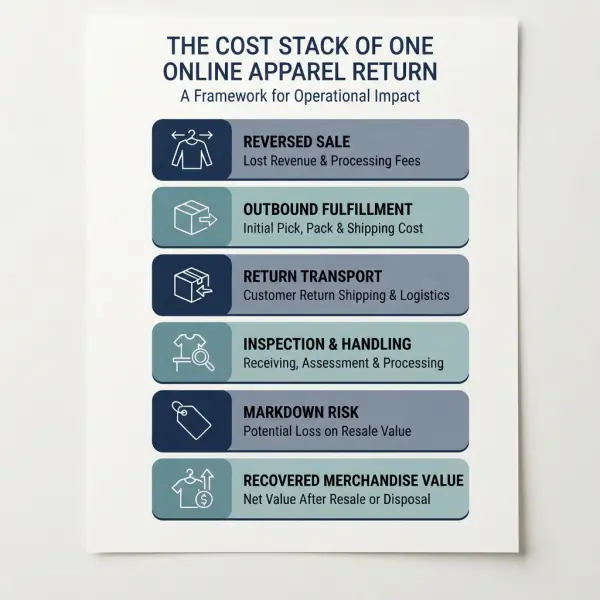
A refunded sale reverses revenue, but the impact may also include non-recoverable outbound fulfillment, return transport, payment fees, service time, receiving labor, remediation, markdown risk, and inventory carrying cost.
The more useful question is how much contribution returned orders removed and how much merchandise value was recovered. Two products with the same return rate can have different economics: a year-round T-shirt may be resold readily, while an occasion dress returned after its selling window may require a markdown.
A practical return-cost model can be expressed as:
Return impact = reversed net sales + non-recoverable fulfillment and processing costs + merchandise value loss - fees or value legitimately recovered
This is an internal decision model, not an accounting standard. Finance should define its scope and prevent double-counting.
It determines how quickly inventory becomes sellable again
In e-commerce, a returned unit is often physically present but commercially invisible. It may be in transit, waiting in a cage, under inspection, pending a refund decision, or held because its system status does not match its physical condition. During that time, the brand cannot confidently promise the unit to another customer.
This delay is particularly expensive for limited drops, seasonal collections, fragmented size curves, and low-stock bestsellers. One returned size may be the only unit available for a waiting buyer. A fast refund is important to the customer; a fast and accurate restock is equally important to the merchant. They are related service levels, but they are not the same metric.
It influences customer confidence
Customers assess the returns experience before and after purchase. Before checkout, they want to know whether an unsuitable item can be resolved. After initiating a return, they expect understandable instructions, status visibility, and a timely outcome. The precise commercial balance between generosity, cost, fraud exposure, and customer trust belongs in the related guide to how return policies shape customer trust and profit margins. Operationally, however, even a well-written policy fails if warehouse rules, customer-service scripts, system logic, and refund timing contradict one another.
It creates a product-development feedback loop
A reason such as “too small” becomes more useful when linked to SKU, size, order, measurements, batch, and customer comments. A cluster around one trouser may indicate tolerance, grading, shrinkage, production variance, or incorrect product data; evenly distributed preference comments suggest a different investigation.
Returns data does not prove causation on its own. It identifies where product, content, quality, and merchandising teams should investigate.
How Does the Fashion Returns Workflow Operate?
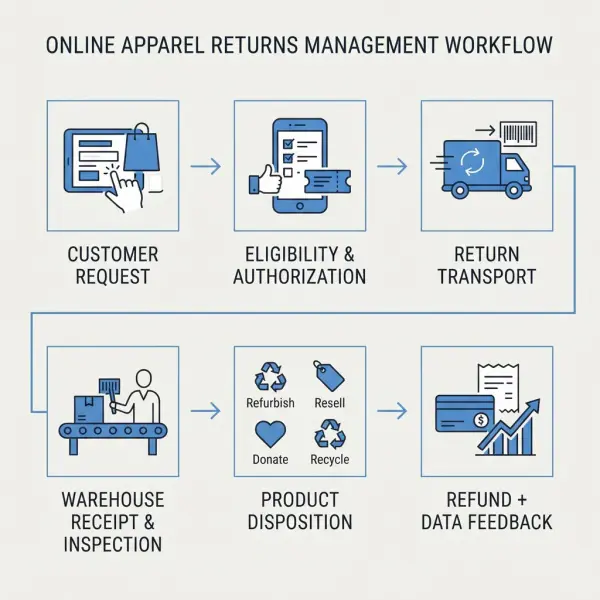
A robust workflow usually has six connected stages: request, authorization, inbound movement, receipt and inspection, disposition, and financial and data closure. Small brands may handle several stages in one room and one platform, while larger retailers may use a returns portal, order management system (OMS), warehouse management system (WMS), carrier integrations, enterprise resource planning system (ERP), and separate resale or liquidation partners.
1. Return request and reason capture
The request may begin through a portal, marketplace, email, store, or agent. The system should locate the correct order line and capture a reason meaningful to both customer and business. A long internal taxonomy creates friction; an oversimplified list produces weak insight.
A short customer-facing selection can reveal conditional detail—for example, “fit was not right” followed by size, length, or proportion. Wording should not push customers toward an inaccurate reason merely because one option qualifies for free shipping.
2. Eligibility, authorization, and resolution
The brand checks the request against policy and law, including dates, category, condition, channel, geography, promotion, and exceptions. If accepted, it issues instructions and, where used, a Return Merchandise Authorization (RMA) number linking the parcel to the order, resolution, and expected item.
The workflow may branch into a refund, exchange, credit, warranty assessment, or approved replacement. A returnless refund should consider item value, fraud risk, safety, customer history, and realistic recovery value; it is not automatically more sustainable.
3. Inbound transport and tracking
The return may travel through a carrier, consolidation point, store, locker, or third-party network. Label, handover, transit, and delivery events support customer communication and the chosen refund trigger.
There is no universally correct refund trigger. Earlier refunds can reduce customer anxiety, while inspection-first controls can be necessary for high-value products, suspected fraud, hygiene-sensitive categories, or items frequently returned in an altered condition. The choice should be explicit and consistent with local requirements.
4. Receiving and condition inspection
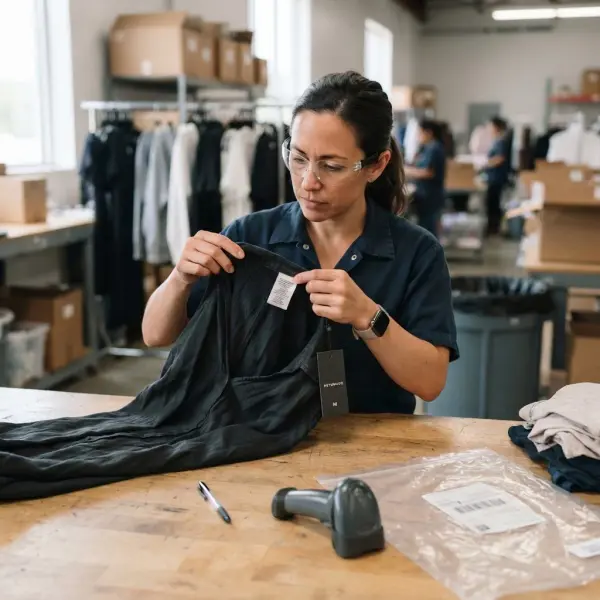
At receipt, staff match the parcel to the expected order and identify exceptions such as a wrong item, missing component, or unreadable authorization. The garment is then assessed against category-specific criteria rather than a vague “good” or “bad” judgment.
An apparel checklist may cover identity, size, labels, odor, stains, wear, alteration, laundering, fabric damage, seam failure, and detachable parts. Footwear also needs pair, outsole, insole, box, and accessory checks. Hygiene, law, and resale requirements differ by product and region.
5. Product grading and disposition
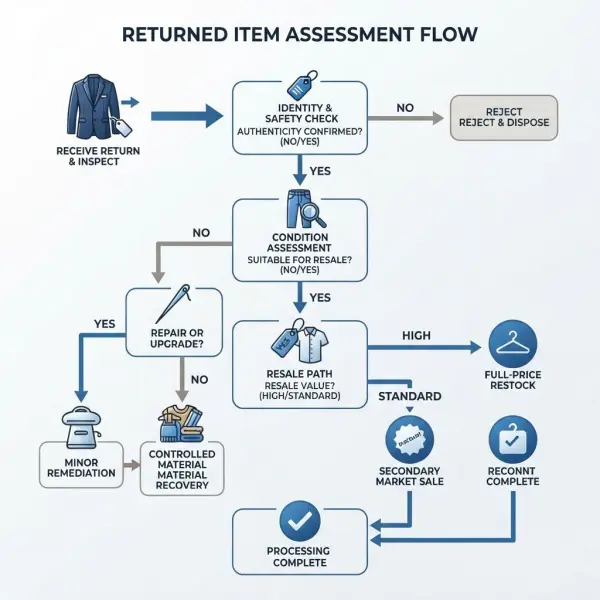
Disposition is the decision about what happens to the physical unit. A clear grade should lead to a controlled destination. The exact hierarchy depends on product safety, condition, cost, market, and legal requirements, but value retention generally improves when a suitable item can remain in use rather than becoming waste.
Common disposition paths include:
- Grade A: return to full-price stock. The item is authentic, complete, clean, undamaged, current, and meets the brand's resale standard.
- Grade B: minor remediation. Steaming, lint removal, folding, repackaging, or replacement of non-product packaging may restore the item, provided the process is safe, lawful, and economically justified.
- Secondary sale. A disclosed outlet, open-box, archive, sample, or recommerce channel may be suitable when the item is wearable but not eligible for new full-price stock.
- Repair or refurbishment. Selected higher-value products may justify repair, component replacement, or specialist cleaning.
- Donation or preparation for reuse. This requires an appropriate partner, traceability, product suitability, and an understanding of what the recipient can realistically use.
- Material recovery or disposal. Damaged, contaminated, recalled, counterfeit, or unsafe items may require a controlled route. Brands should not describe recycling as guaranteed circularity; fiber composition, trims, contamination, local infrastructure, and recycler capability affect the outcome.
The decision tree should prevent both premature value loss and unsafe or materially altered goods re-entering full-price stock.
Disposition is also becoming a compliance issue, not only a cost choice. Since 19 July 2026, the European Union's Ecodesign for Sustainable Products Regulation prohibits large companies from destroying unsold apparel, clothing accessories, and footwear, subject to defined derogations; medium-sized enterprises are scheduled to come within the prohibition in 2030, while micro and small enterprises are excluded from the general prohibition. The regulation's technical definition is important because recycling is treated as destruction for this purpose, while discarding solely for preparation for reuse is excluded. Businesses selling into the EU should obtain qualified advice on their scope, documentation, and permitted exceptions rather than relying on a generic sustainability policy. European Commission announcement on the EU destruction ban
6. Refund, inventory, accounting, and data closure
Carrier delivery does not close a return. The refund or exchange, taxes, discounts, inventory status, reconciliation, and customer notice must be completed, with an escalation path for exceptions.
Keep the customer's reason, inspection finding, and final disposition in separate fields. Overwriting “defective” with a warehouse finding removes evidence needed to compare perception with physical condition.
What Data and Metrics Should Brands Track?
Return rate alone is insufficient. A reliable dashboard separates customer behavior, operational performance, merchandise recovery, and financial effect, while documenting the denominator and period.
The core metrics typically include:
- Unit return rate: returned units divided by eligible sold or shipped units.
- Value return rate: returned value divided by eligible net merchandise sales.
- Order return rate: orders containing at least one return divided by eligible orders.
- Exchange or retained-revenue rate: resolutions that retain revenue, reported separately from physical returns.
- Cost per return: defined transport, service, handling, and remediation cost per processed return.
- Time to refund: elapsed time from the chosen start event to completed reimbursement.
- Time to restock: elapsed time from receipt to sellable status.
- Recovery rate: returned value recovered through a defined resale or reuse path.
- Reason rate by SKU and size: each reason relative to sales of that product or variant.
- Inspection-to-reason variance: difference between customer reason and warehouse finding.
Lag matters. Dividing this month's returns by this month's sales can distort performance because the original purchase may be older. Cohort reporting matches returns to the sales period; a calendar view remains useful for workload and cash planning.
Build reason codes that lead to action
A reason code should point to an owner and a possible investigation. “Did not like it” is sometimes honest, but it is not enough for every preference-related return. At the other extreme, dozens of overlapping options reduce completion quality and produce inconsistent data.
A useful hierarchy can connect customer language to internal domains:
- fit and sizing: too small, too large, length, proportion, support, or ease;
- product expectation: color, fabric, transparency, weight, drape, or styling differed from expectation;
- quality: damaged, seam issue, hardware failure, finish, print, or contamination;
- fulfillment: wrong SKU, wrong size, missing component, duplicate, or transit damage;
- delivery: late arrival, missed occasion, address problem, or undeliverable parcel;
- preference or changed mind: no specific product fault identified.
The brand should review free text and images periodically rather than assuming the taxonomy captures every issue. New failure modes often appear in comments before they become visible in aggregate codes.

The Systems Behind a Scalable Returns Operation
Technology should connect decisions with clear ownership. A portal cannot repair inconsistent size data, undefined grading, or unclear refund authority. Reliable data flow usually matters more than an elaborate interface.
The main components may include:
- the e-commerce platform for order and customer records;
- an OMS for order status, channel rules, and exchanges;
- a returns portal or RMA module for request capture and authorization;
- carrier or drop-off integrations for labels and tracking events;
- a WMS for receipt, inspection location, stock status, and disposition;
- payment and tax systems for accurate financial resolution;
- ERP or accounting tools for reconciliation and inventory valuation;
- analytics tools for product, cohort, reason, and cost reporting.
Each return needs a stable identifier across systems. Integration need not be real-time everywhere, but the timing and system of record for each field must be documented.
Automation suits predictable, low-risk decisions such as eligibility, labels, status, and standard exchanges. Ambiguous condition, suspected fraud, high-value items, safety issues, repeated defects, and legal exceptions still merit human review. Rules should be testable and auditable.
How Can a Fashion Brand Build a Practical Returns Management System?
Implementation should start with visibility and control. A small brand may gain more from a consistent intake form, inspection standard, and SKU-level coding than from enterprise software. The model can be automated as volume grows.
Phase 1: Establish the baseline and governance
First, define and measure a return consistently. Map marketplace cases, service exceptions, refused parcels, warranty claims, and store drop-offs; then assign owners for authorization, logistics, inspection, refund, inventory, and feedback.
At this stage, the brand should produce four basic controls:
- a documented event taxonomy for return, exchange, refund, cancellation, and delivery exception;
- a short but actionable reason-code hierarchy;
- a category-specific inspection and grading standard;
- a disposition matrix with named owners and permitted destinations.
This baseline exposes whether operations can execute every promise in the public policy.
Phase 2: Standardize the customer and warehouse workflow
Next, create one traceable path from request to closure. Define automatic authorization, label issuance, status events, refund triggers, and escalation. Warehouse grades should remain consistent across people and shifts.
Track response, authorization, receipt-to-inspection, refund, restock, and exception age separately. One “processing time” can conceal a fast refund but slow restock, or the reverse.
Phase 3: Connect returns to commercial and product decisions
Once data is credible, review SKU, size, supplier, batch, campaign, channel, geography, and cohort. Thresholds should trigger investigation, not automatic conclusions: clustered zipper failures suggest quality review, while a promotion may change customer mix as well as product performance.
This is where returns management becomes an input to product development, buying, content, and forecasting. The related article on reducing fashion returns without damaging customer experience examines prevention strategies in depth. The operational system described here provides the evidence needed to choose those interventions responsibly.
Common Returns Management Mistakes
Treating every returned item as the same event
Combining exchanges, defects, undeliverable parcels, warranty claims, and preference returns prevents diagnosis. Separate event types first, then create an intentional executive roll-up.
Optimizing the refund but ignoring the garment
A brand may refund quickly while units wait unprocessed. Manage two clocks—customer resolution and merchandise recovery—with owners, targets, and exceptions.
Using return reasons without validating them
Customer reasons can be influenced by wording or label eligibility; warehouse findings can vary by inspector. Compare both, audit samples, and read comments.
Measuring a rate without defining the denominator
Order-, unit-, and value-level rates tell different stories. Every dashboard should display its formula, scope, channel, and cohort method.
Sending too much inventory to the lowest-value channel
Unclear grading can push sellable products prematurely toward liquidation, donation, recycling, or disposal. Use a controlled hierarchy supported by legal review and partner verification.
Buying automation before defining decisions
Software cannot define “resellable” across a silk blouse, swimsuit, sneaker, and handbag. Document category logic, exceptions, owners, and data fields before automating.
What Should Brands Verify Before Acting?
Returns management crosses law, accounting, product safety, data protection, and environmental claims. Brands should verify four areas in every market where they sell.
First, confirm consumer rights, required disclosures, refund deadlines, warranty obligations, and permissible exceptions. For example, EU consumers generally have a 14-day right of withdrawal for online and other distance purchases, subject to conditions and exceptions. That rule should not be generalized to every country or every product category. EU guidance on consumer guarantees and online withdrawal rights
Second, validate tax, payment, marketplace, gift-card, and accounting treatment with qualified advisers; effects vary across systems and jurisdictions.
Third, establish product-specific safety and hygiene criteria. Intimates, swimwear, children's goods, and contaminated or recalled items may require different handling. Recovery must not override safety or lawful resale.
Fourth, test sustainability claims against the actual route. Recycling and donation do not guarantee fiber-to-fiber recovery or useful redistribution; verify the partner, process, material compatibility, and outcome.
Frequently Asked Questions
What is the difference between returns management and reverse logistics?
Reverse logistics focuses on the physical movement of goods from the customer or sales channel back to a warehouse, store, repair center, consolidator, or another destination. Returns management includes that movement but also covers eligibility, customer communication, exchanges, refunds, inspection, inventory status, accounting, fraud controls, product disposition, and analytics. An apparel brand can have an efficient carrier contract yet still have poor returns management if parcels are not matched to orders, refunds stall, grading is inconsistent, or returned units remain unavailable for resale. The two concepts overlap, but returns management is the wider operating system.
What is a good return rate for an online fashion brand?
There is no universal good return rate. A useful benchmark must match product category, market, price, customer segment, channel, return window, promotion mix, and measurement method. Footwear, fitted occasionwear, basics, accessories, and made-to-measure products can behave very differently. Brands should compare their own products using stable cohort definitions and investigate meaningful changes by SKU, size, and reason. External industry figures can provide context, but they should not become a target without confirming that the denominator and assortment are comparable. Margin impact and merchandise recovery may be more decision-useful than one headline rate.
Should a refund be issued when the carrier first scans the return?
It depends on customer promise, local law, product value, fraud exposure, inspection needs, and operational capability. Refund-at-scan can shorten the customer's wait and reduce service contacts, but it transfers more condition and parcel-content risk to the merchant. Inspection-first may be appropriate for high-value goods, repeated abuse, hygiene-sensitive categories, or items that are often returned worn or incomplete. Some brands use risk-based rules, but those rules should be explainable, monitored for unfair outcomes, and supported by a clear exception process. The public policy and actual system behavior must agree.
How quickly should returned apparel be restocked?
As quickly as the brand can inspect and grade it accurately. The correct target depends on warehouse volume, category complexity, seasonality, and staffing, but measuring receipt-to-sellable time is essential. A same-day refund does not mean the merchandise has been recovered. For limited inventory or seasonal fashion, even a short queue can cause missed full-price sales. Brands should separate normal items from exceptions so an unreadable RMA or suspected defect does not hold up clean, easily verified products. Accuracy remains necessary because an unsafe, worn, or incomplete item should not re-enter sellable stock merely to meet a speed target.
Can returned garments always be resold as new?
No. Resale depends on applicable law, product category, hygiene and safety requirements, actual condition, completeness, authenticity, and the brand's disclosed standards. An unworn garment with intact labels and undamaged packaging may qualify after inspection, while an item with odor, stains, alteration, laundering, wear, missing components, or a safety concern may require a different route. Minor repackaging or steaming may be acceptable in some contexts, but it should follow documented category rules. Brands should not use a single visual check for all apparel, footwear, intimates, accessories, and children's products.
Does offering exchanges remove the original return from the data?
It should not remove the physical return or its product signal. An exchange may retain revenue and preserve the customer relationship, but the original unit still came back and may reveal a sizing, color, quality, or expectation issue. The system should link the original item, return reason, replacement variant, new shipment, and final outcome. Management can then view physical return rate, exchange rate, and retained revenue separately. Combining them into one net number may be useful for finance, but it can hide recurring fit problems from product and merchandising teams.
Is donating or recycling all non-restockable returns the most sustainable approach?
Not automatically. Donation is useful only when the item is suitable and the receiving system has a realistic use for it. Recycling outcomes depend on fiber composition, blends, trims, contamination, sorting, technology, and local capacity; some material may be downcycled, exported, stored, or rejected. Repair, refurbishment, secondary sale, or preparation for reuse may retain more product value where they are safe and practical. Brands should document actual routes and avoid broad environmental claims based only on the first handover. Local waste and product rules also need to be checked.
Conclusion
Fashion returns management is a connected operating system, not a customer-service afterthought. It begins with event definitions and authorization, and ends when customer resolution, merchandise disposition, inventory, finance, and data are complete.
The most valuable early improvements are consistent reason codes, category-specific inspection, separate refund and restock clocks, controlled disposition, and cohort reporting. These foundations make automation more reliable and give teams usable evidence.
The balance is not “returns versus no returns.” Customers need a fair resolution; the business must protect margin, recover inventory, prevent abuse, and meet legal and environmental responsibilities. A disciplined operation makes the trade-offs visible.





Comments 0
Leave a CommentSend Comment
Anda harus Login terlebih dahulu untuk dapat memberikan komentar.