
Twill Fabric Explained: Weave Structure, Texture, and Uses
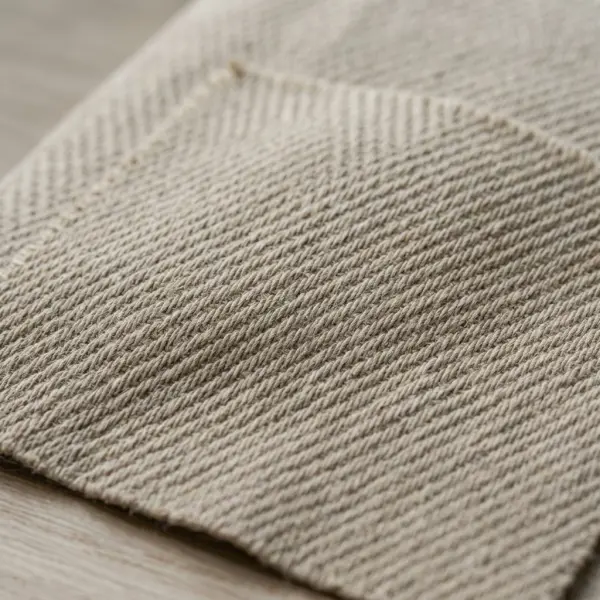
Twill fabric is easy to recognize once you know what to look for: instead of the simple checkerboard effect associated with a basic plain weave, the surface usually shows diagonal lines running across the cloth. Those lines are not printed or added during finishing. They come directly from the way warp and weft yarns interlace.
That structural distinction matters far beyond appearance. A twill construction can change how prominently warp or weft yarns appear on the surface, how flexible the cloth feels, how densely yarns can be packed, and how the material behaves during garment development. This is why twill constructions appear across very different products—fr om soft fashion fabrics to denim, trousers, tailoring materials, uniforms, and heavier utility fabrics.
The word twill, however, describes a weave structure rather than a fiber. Cotton can be woven as twill, but so can wool, polyester, viscose, linen blends, and many other yarn systems. Two fabrics can therefore both be twills and still have very different weight, handfeel, drape, strength, appearance, price, and end use.
For fashion teams, understanding that distinction is more useful than simply memorizing fabric names.
Quick Answer: What Is Twill Fabric?
Twill fabric is a woven textile made with a staggered interlacing pattern that creates characteristic diagonal lines, often called twill lines, across the fabric surface. Unlike plain weave, where warp and weft usually alternate over and under one another at every intersection, a twill structure allows yarns to pass over or under multiple opposing yarns before the next interlacement, with the pattern shifted progressively across successive rows.
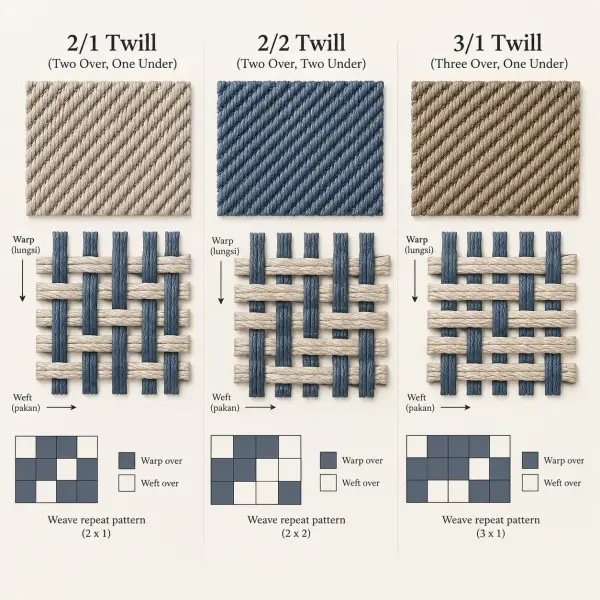
Common structures include 2/1 twill, 2/2 twill, and 3/1 twill. The notation describes how yarns float over and under other yarns within the weave repeat. CottonWorks, an industry education resource from Cotton Incorporated, identifies the diagonal pattern as the defining visual characteristic of twill and explains common constructions including 2/1, 2/2, and 3/1 twills.
In practical apparel development, this means “twill” alone does not tell a sourcing team exactly how a fabric will perform. Fiber composition, yarn characteristics, weave density, fabric weight, finishing, and the specific twill construction all need to be considered together.
What Actually Makes a Fabric a Twill?
The defining characteristic of twill is not thickness, stiffness, fiber content, or garment category. It is the pattern of interlacement between warp and weft.
In ordinary weaving, warp yarns run lengthwise on the loom while weft—or filling—yarns are inserted across them. A fabric structure is created by controlling which warp yarns are raised or lowered as each weft yarn passes through.
In a basic plain weave, that relationship alternates frequently. Twill changes the sequence.
Instead of repeating the same intersection directly above the previous one, the interlacement shifts—or “steps”—across successive picks. The accumulation of these shifted intersections creates the diagonal visual line.
CottonWorks describes a 2/1 twill, for example, as a construction in which each warp end floats over two picks and under one, with a three-by-three repeat. A 2/2 twill has an equal over-two, under-two arrangement and repeats over four warp and four weft yarns.
The important point for non-textile specialists is simpler: the yarns themselves are generally still running in warp and weft directions; it is the sequence of their intersections that produces the apparent diagonal.
That distinction prevents a surprisingly common misunderstanding. A twill line does not mean that the yarns have literally been woven diagonally through the cloth.
Understanding twill notation: 2/1, 2/2, and 3/1
Twill structures are commonly described using numerical notation. While textile engineers may work with full weave plans, fashion product teams can learn a great deal from these basic numbers.
|
Twill structure |
Simplified construction |
Surface implication |
|
2/1 twill |
Over two, under one |
Unequal construction with one yarn system more prominent on a given face |
|
2/2 twill |
Over two, under two |
Balanced twill with equal float lengths in the basic repeat |
|
3/1 twill |
Over three, under one |
Longer floats and fewer interlacements than 2/1 or 2/2 |
|
1/3 twill |
Over one, under three |
Reverse relationship of a 3/1 construction, changing which yarn system dominates the face |
This notation describes the weave architecture rather than fabric quality. A 3/1 twill is not automatically “better” than a 2/1 twill. The appropriate construction depends on the required appearance, weight, yarn system, finishing process, garment category, and performance target.
Why Does Twill Have a Diagonal Texture?
Twill develops its diagonal appearance because each successive yarn intersection is displaced from the previous one. When that displacement repeats consistently, the eye reads the sequence as a diagonal ridge or line.
The line may be visually pronounced in a heavy cotton twill and much subtler in a fine wool suiting. Yarn color can make it even more obvious. In traditional denim, for example, the contrast between colored warp yarns and lighter filling yarns can reinforce the visual effect of the weave.
But not every twill looks equally textured.
A fabric's visible diagonal depends on several variables working together: yarn thickness, yarn twist, warp and weft density, fiber type, color contrast, finishing, and the weave repeat itself. Brushing, raising, coating, sanding, washing, calendaring, or other surface treatments can soften or partially obscure the original woven texture.
This is why identifying a fabric solely from a product photograph can be unreliable. A sourcing team should confirm the construction specification rather than assuming that every fabric with a diagonal appearance is the same type of twill.

Right-hand and left-hand twill
The diagonal can also travel in different directions.
CottonWorks classifies a twill as left-hand or right-hand according to the direction in which its diagonal line rises across the fabric face. The direction is a construction variable, not merely an optical accident.
For many commercial buyers, handedness is less important than fiber, weight, finish, or overall performance. In specialized textile development, however, it may be deliberately specified because yarn twist direction and twill direction can interact with the appearance and hand of the finished fabric.
The practical lesson is not that every fashion entrepreneur needs to become a weaving technician. It is that “twill” is a family of constructions rather than one standardized fabric.
Warp-Faced, Weft-Faced, and Balanced Twill
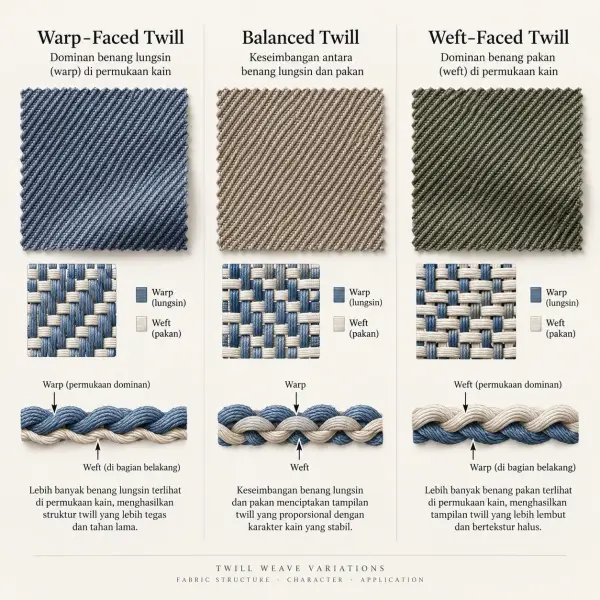
One of the most useful distinctions for product developers is whether a twill is warp-faced, weft-faced, or balanced.
A warp-faced twill exposes more warp yarn on the fabric face. A weft-faced twill exposes more weft. A balanced twill, such as a basic 2/2 construction, brings comparable amounts of both yarn systems to the surface.
This affects far more than textile terminology.
If warp and weft use different colors, yarn counts, fibers, or treatments, changing which system dominates the face can substantially alter the visible fabric. Denim is a familiar illustration: many conventional denim constructions use colored warp yarns with undyed or differently colored filling yarns. The weave architecture determines how much of each is visible on each side.
CottonWorks notes that a 2/2 twill is balanced because the same amount of warp and filling is shown, while its discussion of 3/1 constructions explains how longer warp floats can dominate the fabric face.
For sourcing teams, this is a reminder to examine both sides of a swatch. The reverse of a twill can look substantially different from its technical face, particularly when the construction or yarn colors are unbalanced.
How Does Twill Structure Influence Fabric Performance?
The weave is one important part of fabric performance, but it should never be treated in isolation.
Compared with a basic 1/1 plain weave, many twill constructions have fewer interlacing points and longer yarn floats. Academic textile teaching materials similarly describe twill as having fewer interlacements than plain weave, with lower yarn crimp depending on construction.
That structural difference can allow fabrics to be engineered with different combinations of density, flexibility, surface character, drape, and mechanical behavior. CottonWorks also notes that the longer floats of a 3/1 construction create fewer interlacing points and are used in heavier bottom-weight fabrics.
Still, it is risky to turn that into a universal statement such as “twill is stronger than plain weave.”
A lightweight viscose twill and a dense cotton workwear twill are both twills, yet their abrasion resistance, dimensional stability, tear behavior, wash performance, and useful lifespan can be dramatically different.
Fabric performance also depends on:
- fiber type and blend ratio;
- staple or filament characteristics;
- yarn count and yarn twist;
- warp and weft density;
- fabric mass and thickness;
- dyeing and finishing;
- mechanical or chemical treatments;
- garment construction and seam design;
- intended laundering and use conditions.
The weave should therefore be considered part of a textile system rather than a standalone quality rating.
Twill can accommodate relatively long yarn floats
“Float” refers to the length over which a yarn travels before interlacing again with the opposing yarn system.
A 3/1 twill has longer floats than a basic 2/1 construction. Fewer intersections may allow greater yarn mobility and can influence drape and mechanical behavior, but longer floats can also change snagging, abrasion behavior, surface appearance, and finishing response.
There is no universal ideal.
For a tailored trouser fabric, a smoother surface and controlled drape may be desirable. For a rugged utility garment, density, abrasion performance, seam strength, and dimensional stability may matter more. A fashion blouse using a lightweight twill may be selected primarily for fluidity and surface character.
Same weave family. Very different specification priorities.
Is Twill Always a Heavy or Structured Fabric?
No. Twill is a weave structure, not a fabric-weight category.
The association between twill and structured garments comes partly from familiar products such as denim jeans, chinos, drill workwear, jackets, uniforms, and some tailoring fabrics. These applications often use medium- or heavyweight twills because the weave can be engineered effectively for substantial apparel.
But lightweight twills also exist.
CottonWorks' denim guidance, for example, describes finished denim across a broad weight range and notes that lighter denim can be used for shirts and tops while heavier constructions are commonly used for trousers, jeans, and jackets.
The same principle applies more broadly. Weight is determined by the complete fabric specification, not simply by naming the weave.
A lightweight twill may feel soft and fluid. A densely woven bottom-weight twill may feel firm and compact. A wool twill used in tailoring can combine structure with sophisticated drape. A synthetic twill can be engineered around entirely different performance requirements.
For fashion buyers, asking only “Is this twill?” is therefore inadequate. A more useful specification discussion asks what kind of twill, at what weight, using which fibers and yarns, with which finish, for which garment.
Common Types of Twill Fabric Used in Fashion
Twill appears in many commercially familiar textiles, although individual fabric names should not be treated as perfect synonyms for a single weave specification.
Denim
Most conventional denim uses a twill construction, with 3/1, 2/1, 2/2, and broken twill among structures documented by CottonWorks. The familiar diagonal texture is therefore structural rather than decorative.
Yet “denim” communicates more than weave alone. Yarn coloration, fiber content, fabric weight, finishing, washing, and stretch components can all change the final product.
A rigid 100% cotton denim and a lightweight stretch denim may share a twill foundation while behaving very differently during cutting, sewing, washing, and wear.
Gabardine
Gabardine is associated with a pronounced twill surface and is used across trousers, tailoring, uniforms, outerwear, and other structured apparel depending on fiber and weight.
For fashion teams, the useful distinction is that specifying “gabardine” communicates a more particular fabric character than simply requesting “twill.” Suppliers may nevertheless offer gabardines in different fiber blends, weights, densities, finishes, and quality levels.
A swatch and technical specification remain essential.
Drill
Drill is another fabric commonly built around a strong twill structure, particularly in utility, uniform, workwear, and casual applications. Cotton drill may range from relatively refined apparel cloth to much heavier utility materials.
Again, the name should not substitute for testing. Two suppliers may both sell “cotton drill” while offering meaningfully different GSM, shrinkage behavior, colorfastness, surface finish, and sewing performance.
Chino cloth and trouser twills
Cotton and cotton-blend twills are common in casual trousers and chino-style garments because product developers can engineer them across a useful range of weights, finishes, stretch levels, and surface appearances.
The subject deserves more detailed treatment because garment category changes which properties matter most. Why twill fabrics are common in workwear, pants, and jackets examines those end-use decisions specifically.
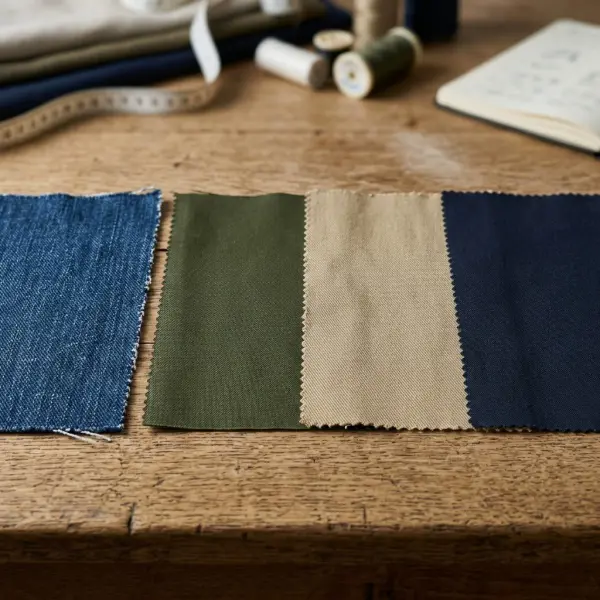
Twill Texture Is Not the Same as Fabric Handfeel
This distinction is easy to overlook.
Texture describes visible or tactile surface characteristics. Handfeel, or simply hand, refers more broadly to how a material feels when handled—softness, firmness, smoothness, body, flexibility, fullness, and other tactile impressions.
Twill creates a structural surface pattern, but it does not dictate one fixed handfeel.
A compact cotton twill can feel dry and firm. A washed lyocell-rich twill may feel soft and fluid. A fine wool twill can feel smooth and resilient. A brushed twill may have a softer, fuzzier surface because finishing has altered the exposed fibers.
This distinction matters commercially because product briefs often use subjective language such as “soft twill,” “premium twill,” or “structured twill.” Those descriptions are useful for creative direction but insufficient for manufacturing control.
A reliable sourcing brief should translate the desired experience into measurable or inspectable parameters wherever possible: composition, fabric weight, weave construction, width, density, stretch, finishing, shrinkage tolerance, colorfastness requirements, and relevant physical testing.
The tactile adjective can remain in the brief. It just should not be the entire brief.
Twill vs Plain Weave: The Structural Difference in One Sentence
The simplest distinction is this: plain weave generally interlaces warp and weft at every alternating yarn, while twill uses a progressively offset sequence of longer floats that forms diagonal lines.
That change in construction affects the visual surface and can influence flexibility, yarn packing, drape, tear behavior, and other characteristics depending on the complete fabric specification.
It would be misleading, however, to reduce the comparison to “plain weave is weak and twill is strong” or “twill is always softer.” Different fibers, densities, yarn systems, weights, and finishes can outweigh the effect of weave alone.
For readers evaluating these constructions side by side, Twill vs Plain Weave: How Fabric Construction Changes Performance explores the comparison in greater depth without treating either structure as universally superior.
What Twill Means for Fashion Product Development
For a designer, the diagonal surface may be the first attraction. For a product developer or sourcing manager, twill raises a wider set of questions.
Imagine a small brand developing a new range of trousers. The design team requests a “premium cotton twill.” Three mills respond with fabrics that look similar in digital swatches. One is a compact 2/1 cotton twill, another a heavier stretch 3/1 cotton-elastane construction, and the third a garment-washed blended twill.
All three satisfy the generic description.
They will not necessarily cut, sew, shrink, stretch, recover, wash, age, or drape the same way.
That is why the sourcing conversation should move from fabric family to measurable specification.
For sourcing teams
Confirm at least the core structural and commercial characteristics rather than relying entirely on the supplier's fabric name.
A useful fabric specification may include fiber composition, weave, finished width, weight, color or dye method, stretch characteristics, finish, minimum order quantity, lead time, tolerances, and relevant physical test requirements.
For larger orders, consistency between lab dip, sample yardage, pre-production material, and bulk fabric becomes just as important as selecting an attractive initial swatch.
For design and product development
Designers should evaluate how the twill behaves in the actual garment silhouette.
A rigid twill that creates an excellent utility jacket may feel inappropriate in a wide-leg trouser designed around fluid movement. A soft twill may create the desired drape but provide less visual structure than the sketch implies.
Sampling is where that mismatch becomes visible.
The most reliable process is to assess the fabric together with pattern shape, seam construction, interfacing, garment wash, hardware, and intended fit rather than approving the textile in isolation.
For manufacturing teams
Dense twills can affect spreading, cutting, needle selection, seam formation, pressing, and handling. Directional surface character can also make marker planning or panel orientation more important when a visible diagonal must remain consistent.
Actual production requirements depend on the specific textile. There is no single sewing rule for all twill fabrics.
A factory that has handled heavy denim successfully may still need different machine settings for a lightweight synthetic twill or a fine wool twill.
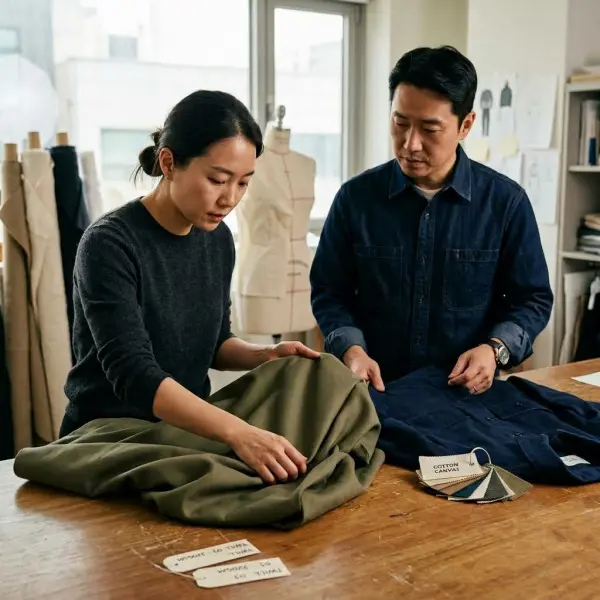
How Fashion Businesses Can Source Twill More Strategically
The first decision should not be “Which twill is best?” It should be “What does the garment need the fabric to do?”
That question immediately makes sourcing more precise.
For trousers, a product team may prioritize dimensional stability, comfort, recovery, abrasion performance, clean pressing, opacity, and the desired balance between structure and drape. For jackets, body and shape retention may matter more. For fashion shirts, the priority may shift toward softness, weight, movement, and skin comfort.
From there, fashion businesses can connect creative intent with measurable requirements.
A practical sourcing sequence is:
- Define the garment function. Identify silhouette, season, climate, expected wear conditions, care method, target retail price, and intended customer experience.
- Specify the fabric system. Confirm fiber composition, twill construction, weight, stretch requirement, width, color strategy, and desired finish.
- Review physical swatches. Assess both face and reverse, diagonal prominence, handfeel, drape, opacity, surface defects, recovery, and visual consistency.
- Sample the garment. Evaluate sewing behavior, seam appearance, pressing, fit, movement, and interaction with trims or interfacing.
- Test what matters for the product. Appropriate tests may cover dimensional stability, colorfastness, tensile or tear properties, abrasion, pilling, stretch and recovery, or other buyer-specific requirements.
- Verify bulk consistency. Make sure approved standards and tolerances carry into production rather than assuming the first sample represents every delivery.
This process is less glamorous than choosing fabrics by swatch appeal, but it prevents a costly category of product-development problems: discovering too late that a beautiful material is operationally wrong for the garment.
Common Mistakes When Working With Twill Fabrics
Mistake 1: Treating twill as a fiber
“Twill” tells you how yarns are woven, not what those yarns are made from.
A cotton twill, polyester twill, wool twill, and blended twill can have substantially different moisture behavior, thermal properties, resilience, shrinkage, dye response, care requirements, and cost.
A fabric brief therefore needs both composition and construction.
Mistake 2: Assuming all twills are heavy and durable
The reputation comes from familiar garments such as jeans and workwear, but lightweight fashion twills exist as well.
Even among heavy fabrics, durability cannot be inferred from weave name alone. Yarn quality, fiber strength, density, finishing, garment construction, and the type of wear all influence real performance.
Mistake 3: Selecting by GSM alone
Fabric mass is useful, but two textiles with similar grams per square metre can feel and perform differently.
Weave density, yarn size, fiber type, finishing, thickness, compression, and stretch can alter the final experience. A numerical weight should therefore be paired with physical evaluation and other specifications.
Mistake 4: Ignoring the back of the fabric
Unequal twills may present very different faces and backs.
That difference can matter when a garment exposes the reverse at cuffs, hems, collars, unlined interiors, vents, or rolled sleeves. It can also influence which side a factory treats as the technical face during cutting.
Mistake 5: Approving appearance without testing the finished garment
Fabric behavior changes once it is cut, sewn, pressed, washed, finished, and worn.
This is especially relevant when garment washing, enzyme treatment, stretch fibers, coatings, brushing, or other post-weaving processes are involved. The swatch is the beginning of evaluation, not the end.
Important Technical Caveats: What Should Brands Verify?
The most important caveat is straightforward: weave structure predicts tendencies, not complete garment performance.
A technical description such as “3/1 cotton twill” gives valuable information, but it does not tell a buyer everything needed to approve production.
Before placing significant orders, verify the variables that affect your actual product:
|
Verify |
Why it matters |
|
Fiber composition |
Changes comfort, moisture behavior, care, resilience, dyeing, and cost |
|
Twill construction |
Influences surface appearance and interlacement structure |
|
Fabric weight |
Helps determine body and category suitability |
|
Yarn and fabric density |
Affect compactness, appearance, and physical performance |
|
Finish |
Can substantially alter handfeel, shrinkage, surface texture, and appearance |
|
Stretch and recovery |
Critical for many fitted or movement-dependent garments |
|
Dimensional stability |
Helps manage shrinkage and finished garment measurements |
|
Colorfastness |
Important when products are washed, rubbed, exposed to perspiration, or combined with lighter materials |
|
Bulk tolerance |
Determines whether production fabric remains close to the approved standard |
Testing requirements should match the garment, buyer specification, intended use, market, and applicable regulatory or commercial requirements rather than relying on a generic test package.
FAQ About Twill Fabric
Is twill a fabric or a weave?
Twill is fundamentally a weave structure. In everyday trade language, people often say “twill fabric” to describe cloth made with that structure, which is perfectly normal. The important distinction is that twill does not specify the fiber. Cotton, wool, polyester, viscose, and blended yarns can all be woven in twill structures. This is why purchasing “twill” without specifying composition, weight, construction, finish, and performance requirements leaves substantial room for variation.
How can you identify twill fabric?
Look first for diagonal lines across the fabric face. They may be bold and obvious or fine and subtle depending on yarn size, density, color, weave repeat, and finishing. The reverse may also look different from the face, particularly in unbalanced twills. Visual identification is useful for screening, but commercial sourcing decisions should be confirmed against a supplier specification or weave information rather than appearance alone.
Is denim always twill?
Most conventional denim is woven using twill structures, and CottonWorks documents common denim constructions including 3/1, 2/1, 2/2, and broken twills. However, “denim” represents a broader fabric category with its own yarn-coloring, construction, finishing, and product-development conventions. Calling denim a twill is structurally useful, but saying all twills are denim would obviously be incorrect.
Is 3/1 twill better than 2/1 twill?
Not universally. A 3/1 twill has longer floats and fewer interlacements in its basic repeat than a 2/1 twill, which changes its surface and mechanical behavior. CottonWorks notes that 3/1 structures are used in heavier bottom-weight materials, but suitability still depends on the intended garment, fiber, yarn, density, weight, finish, and required performance. A lighter or finer product may have entirely different priorities.
Does twill wrinkle less than plain weave?
It can in some fabric constructions, but weave alone is not enough to make that prediction reliably. Wrinkling and crease recovery are influenced by fiber properties, yarn construction, fabric density, finishing, moisture, heat, and garment use. A polyester-rich twill, cotton twill, and wool twill may behave quite differently. Brands should evaluate the actual fabric instead of treating “twill” as a wrinkle-resistance claim.
Why are twill fabrics commonly used for trousers and jackets?
Twill can be engineered across useful combinations of body, surface smoothness, density, drape, and mechanical performance, which makes the weave suitable for many bottom-weight and outerwear constructions. That does not mean every twill works for those categories. Garment type, fabric weight, fiber composition, stretch, finishing, durability requirements, and climate still need to be matched carefully. The product-specific logic is explored further in twill fabrics for workwear, pants, and jackets.
What information should a brand request from a twill supplier?
At minimum, request the fiber composition, fabric weight, finished width, weave construction where available, stretch specification if applicable, finish, color information, minimum order quantity, lead time, and relevant test data. For production orders, also clarify tolerances, shade management, shrinkage requirements, inspection standard, and whether the quoted fabric matches the approved sample. These details are more commercially useful than relying on a marketing description such as “premium twill.”
Conclusion
Twill is best understood as a structural platform rather than a single type of fabric.
Its characteristic diagonal line comes from a progressively offset sequence of warp and weft interlacements. Within that basic idea sits a broad family of constructions: 2/1, 2/2, 3/1, warp-faced, weft-faced, balanced, right-hand, left-hand, and numerous derived structures.
That versatility explains why twill appears across apparel categories that otherwise have little in common. A soft fashion twill, fine wool suiting, cotton trouser cloth, workwear drill, and heavyweight denim may share a structural principle without sharing the same performance.
For fashion businesses, this is the commercially important takeaway. Do not buy the category name. Buy the specification.
Start with what the garment needs to achieve, then evaluate weave alongside fiber, yarn, density, weight, finishing, testing, cost, manufacturaability, and customer expectations. When those variables are aligned, twill provides textile developers with an unusually broad design space. When they are ignored, the word twill alone says far less than many product briefs assume.





Comments 0
Leave a CommentSend Comment
Anda harus Login terlebih dahulu untuk dapat memberikan komentar.