

What Fashion Businesses Should Know Before Adopting Inspection Technology
Fabric inspection technology is easy to admire in a demonstration. A camera scans a roll, software draws boxes around defects, and a dashboard produces a quality report within seconds. The harder question is whether those findings will improve decisions inside a particular textile mill, garment factory, sourcing office, or fashion brand.
Adoption succeeds when the business has a defined quality problem, representative materials, agreed defect rules, reliable roll traceability, people who will act on alerts, and a realistic way to measure value. Without those foundations, automation may document more defects without reducing cutting loss, rework, claims, or customer risk.
Quick Answer
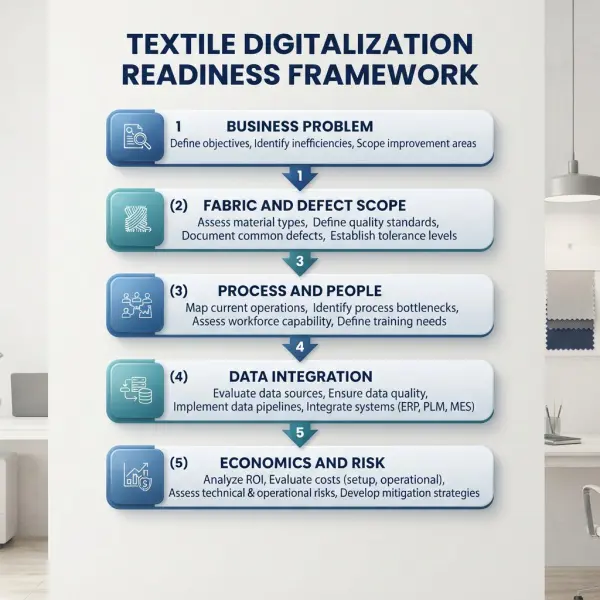
Before adopting fabric inspection technology, a fashion business should verify five things: the quality problem is costly enough to solve; the system performs on its actual fabrics and critical defects; inspection data can reach the people who make grading, sourcing, spreading, or cutting decisions; employees can operate and challenge the results; and the expected benefit justifies the full lifecycle cost.
A supplier demonstration or laboratory accuracy figure is not sufficient. Validation should use representative rolls, real production speed, accepted fabric variation, rare but commercially serious defects, and the intended downstream workflow. The pilot should measure missed defects, false alerts, location accuracy, inspection coverage, operational downtime, recutting, usable yield, claim value, and review time.
Not every fashion company needs to own an inspection system. Brands and smaller manufacturers may gain more from requiring digital roll reports, strengthening incoming inspection, or using a third-party service. Ownership becomes more compelling when inspection volume, defect-related loss, supplier inconsistency, response speed, and data reuse are substantial enough to support dedicated equipment, integration, maintenance, and trained staff.

Start With the Business Problem, Not the Technology
Inspection technology should solve a defined operational loss. “Improving quality” is too broad to guide a purchase. A useful business case identifies where fabric-related problems occur, what they cost, which decisions arrive too late, and which part of that loss an optical inspection system could reasonably influence.
The problem may be frequent recutting caused by missed holes or stains. It may be inconsistent roll grading across suppliers, long incoming-inspection queues, recurring textile defects discovered only after value-added finishing, or weak evidence during claims. A mill may want earlier process feedback, while an apparel factory may want accurate defect positions before spreading. These are related but different requirements.
Before contacting vendors, establish a baseline for at least the relevant material families and production periods. Useful evidence can include:
- volume of fabric inspected and cut;
- inspector hours and queue time;
- defect-related spreading stops and recuts;
- cut-panel rejection attributed to fabric faults;
- first-quality, downgraded, held, returned, or claimed rolls;
- usable fabric loss and replacement purchases;
- supplier response time and disputed claims;
- delivery delays linked specifically to fabric quality.
The baseline does not have to be perfect. It must be consistent enough to distinguish a recurring material problem from general production inefficiency, including cutting-room problems that increase fabric waste. If the factory cannot identify which losses are caused by fabric defects, it will struggle to prove whether inspection automation changed anything.
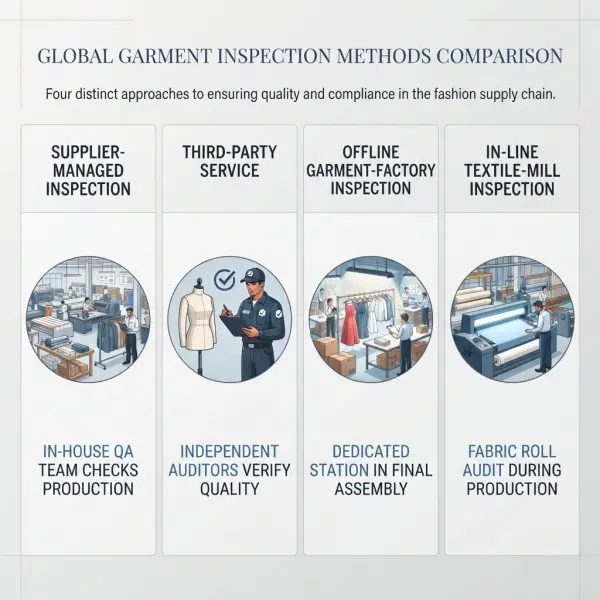
Does the Business Need to Own the System?
Adoption does not always mean purchasing and installing equipment. The appropriate model depends on where control is needed, inspection volume, supplier capability, lead-time pressure, and the value of the resulting data.
|
Operating model |
When it may fit |
Main trade-off |
|
Supplier-managed inspection |
Reliable mills already inspect rolls and can share agreed digital reports |
Brand or factory depends on supplier methods, settings, and data integrity |
|
Third-party inspection service |
Multiple suppliers, variable volumes, or limited internal technical capacity |
Adds coordination, transport or scheduling, and service cost |
|
Offline system at the apparel factory |
Incoming rolls require independent verification before spreading |
Adds handling and inspection time before production |
|
In-line or end-of-line system at a textile mill |
Rapid process feedback and high continuous volume justify integration |
Higher installation, process, maintenance, and change-management demands |
|
Hybrid model |
High-risk materials receive independent checks while routine rolls use supplier data |
Requires clear rules to avoid duplication and inconsistent grading |
For a smaller fashion brand, the first improvement may be contractual rather than technical: specify the inspection method, require defect images and roll maps, define data fields, and audit selected shipments. Owning a machine makes sense only when direct control or response speed creates enough value to absorb the fixed and recurring cost.

What Technical Fit Should Buyers Verify?
The technical question is not whether the system detects fabric defects in general. It is whether the proposed optical setup, software, and workflow detect the business’s critical faults on its production materials at its required speed.
The buyer should create a material-and-defect matrix covering fabric construction, color range, pattern, surface, width, weight, finish, stretch behavior, end use, and critical fault types. Smooth plain woven fabric is a different vision problem from mélange jersey, lace, brushed fleece, jacquard, sequined material, reflective coating, or a large engineered print.
The technical review should verify:
- minimum critical defect size in millimetres;
- inspection speed and full-width coverage;
- reflected, transmitted, angled, or combined lighting needs;
- ability to handle fabric edges, joins, wrinkles, and normal surface variation;
- performance by defect class rather than only an average score;
- false-negative and false-positive behavior;
- physical position accuracy after rewinding or handling;
- setup and changeover requirements for new fabric styles;
- color or shade capability, if claimed;
- what the system cannot inspect.
The deeper optical and algorithmic questions are covered in how machine vision detects fabric defects before cutting. For adoption decisions, the key principle is simple: every performance claim needs a stated material, defect, speed, imaging condition, dataset, and acceptance threshold.
A 2024 primary study using images from a real textile manufacturing environment illustrates the gap between research and deployment. It trained models on around 2,800 samples across seven defect classes and reported approximately 84.8% mean average precision for YOLOv8, while describing high-speed real-time production testing as future work. The study’s factory-derived dataset and stated deployment boundary show why a model result should not be mistaken for a completed operational installation.
Quality Rules Must Be Agreed Before They Are Automated
Detection identifies a suspected irregularity. Grading and disposition decide whether it is acceptable, repairable, downgraded, claimable, or unsuitable for a particular product. A camera cannot resolve an undefined commercial standard.
Teams should align defect terminology, severity bands, continuous-defect treatment, roll length and width calculation, penalty method, acceptance threshold, and review authority. Rules may vary by product: a subtle surface mark may be tolerable in a hidden component but unacceptable on a plain luxury garment front.
ASTM D5430-26 describes procedures for visual examination and grading and allows them to support roll or shipment acceptance when purchaser and seller agree. Its official scope also notes that results can differ when different point-assignment options are used. The ASTM D5430-26 grading framework therefore supports a practical procurement requirement: the vendor configuration, supplier agreement, and buyer specification must use compatible grading logic.
The system should preserve event-level data as well as a total score. Two rolls with similar penalty points can create different cutting risks if one contains a continuous line and the other has isolated marks near the selvedge. Summary scores support comparison; images and coordinates support decisions.
Check Process Readiness Before Installing Equipment
Automated inspection depends on material presentation and operating discipline. Fabric must move through the inspection zone in a predictable condition, and staff need procedures for cleaning, calibration, style setup, roll identification, alert review, and system downtime.
Uster’s implementation guidance for its optical system identifies smooth tension-controlled flow, crease-free presentation, stable light, and freedom from dust or lint as operating prerequisites. It also describes in-line and offline configurations and the need to plan data flow. This vendor implementation guidance is product-specific, but the operational lesson is wider: optics cannot compensate for unstable fabric presentation indefinitely.
Readiness questions should include:
- Is there enough floor space and a suitable material-flow route?
- Who loads, unloads, rewinds, and identifies each roll?
- Can the process maintain suitable tension without damaging stretch or delicate fabric?
- Who creates and approves a new style setting?
- How are optics, lights, rollers, and reference samples maintained?
- What happens to production when the system is unavailable?
- Who can override a result, and how is that action recorded?
- How will a disputed or unfamiliar alert be escalated?
An operation that regularly loses roll identity, changes grading rules informally, or does not act on manual inspection findings is not ready simply because it has budget. Improving those controls first may make the later automation smaller, safer, and more valuable.
Integration Determines Whether Data Becomes Useful
An inspection system can be technically accurate and operationally isolated. Before purchase, map how the data will travel from roll inspection to the next decision. Relevant destinations may include quality management, enterprise resource planning, warehouse records, supplier portals, spreading systems, cut optimization, business intelligence, or a simple operator worklist.
At minimum, the record should maintain a stable roll identifier, inspected length and width, defect image, class, severity, longitudinal and cross-width position, inspection configuration, timestamp, reviewer action, and grading result. If fabric is rewound, split, relabelled, relaxed, or issued to another order, the relationship between the digital map and physical material must remain traceable.
Businesses should ask vendors to demonstrate the complete round trip:
- create or import a roll identity;
- inspect and record defects;
- review or correct a classification;
- export or transmit the result;
- locate the same event after normal warehouse handling;
- use it during spreading or cutting;
- return downstream outcomes for analysis.
File format, application programming interface access, field definitions, synchronization frequency, network dependency, data retention, user permissions, audit logs, and export rights belong in the commercial discussion. A proprietary dashboard is not the same as usable data.
Some commercial solutions connect defect maps with cut-position planning and operator aids. These possibilities are explained in the foundational guide to automated fabric inspection, but an adopter should verify its own systems, fabric flow, and marker constraints rather than assume integration from a product diagram.
People and Governance Are Part of the System
Automation changes roles. Inspectors may spend less time watching a moving surface and more time validating uncertain findings, setting styles, auditing false negatives, investigating patterns, and communicating with production. Cutting teams may receive digital alerts instead of handwritten defect tickets. Quality managers gain more data but also more responsibility to decide which signals deserve action.
The adoption plan should name owners for:
- defect taxonomy and acceptance rules;
- style setup and model configuration;
- calibration and preventive maintenance;
- data quality and roll traceability;
- alert review and override;
- supplier communication and claims;
- performance monitoring and retraining decisions;
- incident response and fallback operation.
If the system uses machine learning, monitoring should continue after commissioning. NIST’s voluntary AI Risk Management Framework organizes work around Govern, Map, Measure, and Manage, while its core guidance includes post-deployment monitoring, override, incident response, recovery, and change management. The NIST AI Risk Management Framework 1.0 is cross-sectoral rather than textile-specific, but its lifecycle principle is directly relevant: a validated model can become less reliable when materials, lighting, processes, or user behavior change.
Operators should be able to challenge the system without making it meaningless. A good override process records who changed the result, why, which evidence supported the decision, and whether the event should update future settings or training data.
Safety, Connectivity, and Data Risk Need Early Review
Installing an inspection frame or integrating cameras, lighting, rollers, drives, guards, controls, and operator access can alter machinery risk. Safety review should cover loading and unloading, nip and entanglement points, unexpected start-up, emergency stops, maintenance access, electrical work, ergonomics, and interaction with existing equipment. Requirements vary by jurisdiction and machine design.
ISO 12100:2010 sets out terminology, principles, and a methodology for machinery risk assessment and risk reduction. The ISO 12100 machinery-safety overview does not replace applicable local law or equipment-specific standards, but it reinforces why safety belongs in design and procurement rather than after installation.
Connectivity creates another risk surface. Systems may connect to production networks, accept remote vendor support, store proprietary fabric images, or exchange data with enterprise and cutting applications. Procurement should address user authentication, least-privilege access, remote-support approval, patch responsibility, backup, logging, vulnerability handling, network segmentation, and a recovery plan.
NIST’s guidance for manufacturing control systems specifically highlights secure remote access, authentication and authorization, protection of historical data, detection of anomalous network behavior, and control over software or firmware changes. The manufacturing control-system security guidance is useful when an inspection installation touches operational technology, although the exact controls should match the factory’s architecture and risk.
Calculate Total Cost of Ownership, Not Only Purchase Price
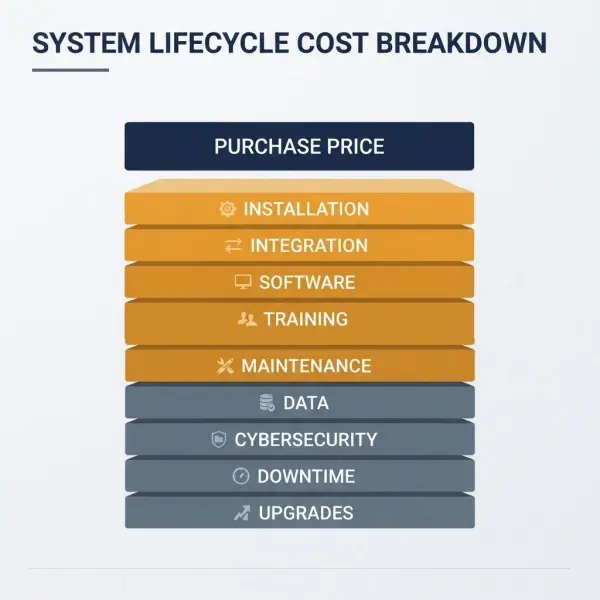
The purchase quotation is only one part of the investment. Total cost of ownership should cover the full period used for the business case and state which costs are confirmed, estimated, or contingent.
Common cost layers include:
|
Cost category |
Items to include |
|
Equipment |
Inspection frame, cameras, lights, drives, encoders, controllers, computers, monitors, marking or synchronization devices |
|
Site preparation |
Floor work, electrical supply, network, environmental control, guarding, material-flow changes, installation access |
|
Software and data |
Licences, subscriptions, storage, analytics, interfaces, database, backups, upgrades |
|
Integration |
ERP, quality, warehouse, spreading, cutting, reporting, identity mapping, testing |
|
Implementation |
Process mapping, sample preparation, annotation, configuration, validation, commissioning, project management |
|
People |
Training, operator time, specialist support, changeover, review, data administration |
|
Lifecycle support |
Maintenance, calibration, replacement lights or cameras, spare parts, vendor service, travel, cybersecurity, retraining |
|
Disruption and contingency |
Pilot downtime, slower initial throughput, parallel inspection, fallback process, unsuccessful integration |
Benefits should be equally disciplined. Avoid counting the same outcome twice—for example, treating recovered usable fabric and lower material purchase as separate benefits when they represent the same saving. Separate cash savings, avoided cost, capacity released, quality-risk reduction, and information value.
A reasonable financial model can include reduced inspection labor where work genuinely disappears, fewer defect-related recuts, improved usable yield, lower claim leakage, earlier process correction, shorter inspection queues, and better evidence for supplier recovery. Each assumption needs a baseline, owner, measurement method, and sensitivity range.
Design a Pilot That Can Support a Real Decision
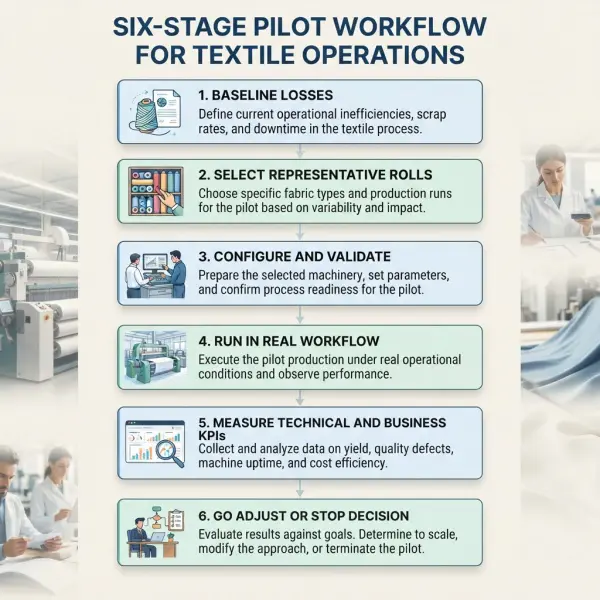
A pilot should reduce uncertainty, not produce a promotional demonstration. It needs a written scope, baseline, representative materials, defined success criteria, named owners, and a decision date. Vendor staff can support execution, but the adopter should control sample selection and outcome verification.
The pilot should include easy, difficult, and commercially serious cases:
- several representative fabric constructions, colors, patterns, finishes, and suppliers;
- known defects across different sizes, severities, and roll positions;
- acceptable variations that could cause false alerts;
- actual operating speed, width, shift conditions, and changeovers;
- roll rewinding, storage, issue, spreading, and cutting steps;
- temporary equipment or network failure;
- manual review and override scenarios.
Success criteria should combine detection and business outcomes. A pilot that finds defects but cannot preserve their positions through the warehouse has not proven pre-cutting value. Likewise, a system with strong recall but an unmanageable false-alert rate may move labor from inspection to review rather than reducing it.
Useful pilot KPIs include:
|
KPI |
What it tests |
|
Recall by critical defect class |
Whether serious known faults are found |
|
False-positive rate and review time |
Whether alerts remain operationally manageable |
|
Position error after normal handling |
Whether the cutting team can find mapped faults |
|
Inspection coverage and throughput |
Whether the system handles planned volume |
|
Availability and changeover time |
Whether operations remain practical across shifts and styles |
|
Downstream defect escape |
Whether inspected faults still reach cut panels or garments |
|
Recut and fabric-loss change |
Whether the workflow reduces measurable production loss |
|
User adoption and override quality |
Whether employees use and govern the system correctly |
Run the pilot long enough to encounter normal variation, but do not confuse duration with quality. A shorter pilot with well-selected rolls and verified ground truth can be more informative than months of uncontrolled data.
Vendor Questions That Reveal Operational Fit
Product specifications matter, but procurement questions should force the proposal into the buyer’s context. Ask vendors to answer in writing and distinguish standard capability, optional module, integration service, customization, and future roadmap.
Key questions include:
- Which of our fabrics and defect types have been validated, at what speed and minimum size?
- Which materials or quality attributes are outside the system’s reliable scope?
- How are new styles configured, and who owns that task after handover?
- What training and test data are required, and who owns the images, labels, and resulting model configuration?
- How are false negatives discovered and investigated?
- What is the guaranteed or expected position accuracy after rewinding and downstream handling?
- Which grading methods, data exports, APIs, and cutting integrations are available today?
- What happens during internet, server, camera, lighting, or encoder failure?
- Which maintenance tasks require vendor intervention, and what are response times and spare-part lead times?
- How are software updates tested, rolled back, and documented?
- What remote access does the vendor require, and how is it controlled and logged?
- Which acceptance tests, performance commitments, and exit provisions will appear in the contract?
Answers should be compared with pilot evidence. “Supported” can mean technically possible, previously integrated elsewhere, available through paid customization, or merely planned. Procurement should record which meaning applies.
Common Adoption Mistakes
Buying against a generic quality objective
Without a quantified baseline and named decision, the team cannot distinguish value from activity. The system may generate more records while defect-related loss remains unchanged. Start with one measurable problem and expand after evidence.
Allowing the vendor to choose only demonstration fabric
Easy samples create an optimistic view of performance. Include difficult surfaces, normal variation, rare critical faults, multiple batches, and actual production conditions. The adopter should retain a blind or independently labelled validation subset.
Treating accuracy as the business case
Model metrics do not establish yield improvement, labor saving, or claim reduction. Detection must remain synchronized with the physical roll and reach a person or system capable of acting before cutting.
Underestimating style proliferation
A garment factory may handle many constructions, shades, prints, and finishes in small runs. Configuration, sample collection, validation, and changeover can consume more time than a high-volume mill experiences. Include style setup in capacity and cost calculations.
Removing manual control before performance is understood
Prematurely eliminating human verification can hide model misses or create unnecessary rejection. Use staged autonomy: parallel inspection, then targeted review, then greater reliance only where evidence supports it.
Ignoring an exit strategy
Data formats, ownership, model portability, hardware compatibility, subscription terms, and access to historical reports affect switching cost. Contract for data export and continued safe operation if support, connectivity, or the vendor relationship changes.
A Simple Go, Adjust, or Stop Decision Framework
At the end of the pilot, management should not force every result into “buy” or “reject.” Three outcomes are more useful:
- Go: critical defects are detected within agreed limits, false alerts are manageable, roll positions remain usable, the workflow is accepted, risks are controlled, and the economics remain credible.
- Adjust: the use case is valuable but requires narrower fabric scope, better lighting, different handling, more training data, integration work, revised thresholds, or another pilot.
- Stop: the system cannot reliably address the critical faults, operational complexity exceeds the value, safety or integration risk remains unresolved, or a supplier-managed alternative is more economical.
A stop decision is not a failure if the pilot prevented a poor capital commitment. The same evidence may point to a simpler improvement: better manual inspection discipline, supplier reporting, roll traceability, focused lighting upgrades, or third-party inspection.
What This Technology Does Not Guarantee
Automated inspection does not guarantee defect-free fabric, zero recutting, universal material compatibility, a fixed labor reduction, or a specific return on investment. It does not replace physical and chemical tests, nor does it settle subjective appearance disputes without agreed standards.
The technology can make visible surface information more consistent, traceable, and actionable. Whether that produces business value depends on upstream process control and downstream response. A factory that ignores recurring defect trends or continues cutting through mapped faults will not gain the same benefit as one that changes supplier, machine, roll allocation, or marker decisions.
Frequently Asked Questions
When is fabric inspection technology most likely to justify investment?
Investment is more plausible when fabric volume is substantial, defect-related losses recur, manual inspection is a bottleneck or inconsistent, quality data can influence production, and the organization has staff to maintain the system. High-value or quality-sensitive materials can also justify adoption at lower volume if a missed fault is expensive. The conclusion should come from a baseline and pilot rather than a generic threshold. Smaller brands may achieve a better return by requiring supplier roll maps, improving incoming inspection, or using an independent service instead of owning equipment.
Should a garment factory choose in-line or offline inspection?
An apparel factory usually receives finished fabric rolls rather than producing the fabric continuously, so an offline incoming-inspection station may fit its material flow. In-line installation is more natural where a textile producer wants immediate feedback during weaving, knitting, finishing, or final roll processing. The choice depends on where corrective action remains possible, available floor space, speed, handling, inspection coverage, and whether another pass adds delay. Businesses should compare the whole process, including rewinding, warehousing, spreading, and roll-map synchronization, rather than judging the inspection frame alone.
How long should an inspection-technology pilot run?
There is no universal duration. The pilot should continue until it covers representative materials, batches, shifts, changeovers, operators, known critical defects, acceptable variation, downstream handling, and realistic system faults. A calendar target is useful for project control, but evidence coverage is the stronger criterion. Seasonal or rare fabrics may require a staged pilot or retained test rolls. Set the decision date and minimum sample coverage before starting, then extend only when a specific unresolved uncertainty justifies more data—not because success criteria were never defined.
What ROI period should a fashion business use?
The appropriate period depends on the organization’s capital policy, equipment life, contract term, production stability, and risk tolerance. Build cash flows using the same period and assumptions for costs and benefits, then test conservative, expected, and favorable scenarios. Include installation, integration, licenses, maintenance, training, downtime, upgrades, and working-capital effects. Avoid treating avoided risk as guaranteed cash. Management should also test what happens if volume falls, material mix changes, vendor support costs rise, or only part of the expected yield improvement is achieved.
Who should own the implementation project?
Ownership should sit with a cross-functional business lead who can coordinate quality, production, cutting, sourcing, maintenance, information technology, safety, finance, and procurement. A quality manager may lead the use case, but cannot resolve every integration, safety, or commercial issue alone. Assign one accountable sponsor, a project manager, and named owners for defect rules, technical validation, data, maintenance, training, and benefits measurement. Vendor engineers support implementation; they should not be the only party defining acceptance or confirming success.
Can a small fashion brand adopt inspection technology without a factory?
Yes, but adoption may mean using the capability through suppliers or inspection partners rather than owning machinery. The brand can standardize defect terminology, require digital inspection reports and images, define roll acceptance rules, audit high-risk orders, and ask factories to preserve roll identity through cutting. It can also analyze claims and fabric-related returns to determine where independent inspection is worthwhile. Direct equipment ownership is less compelling when volume is fragmented across suppliers and the brand lacks control over material handling or cutting decisions.
Conclusion
Fabric inspection technology should be adopted as an operating system for quality decisions, not as a camera project. Technical capability matters, but so do defect definitions, material flow, roll identity, human review, integration, safety, cybersecurity, vendor support, and the economics of acting on the result.
The strongest business case begins with a recurring loss and ends with verified change in production—not a headline accuracy figure. A representative pilot should show that critical defects are found, mapped positions survive real handling, teams use the output, and downstream losses move in the intended direction.
For some businesses, that evidence will support ownership and integration. For others, it will favor supplier reports, third-party inspection, or better manual controls. The strategic decision is not whether automated inspection is advanced technology. It is whether a specific operating model improves quality and cost reliably enough for the business that must run it.





Comments 0
Leave a CommentSend Comment
Anda harus Login terlebih dahulu untuk dapat memberikan komentar.