

Manual Cutting vs Automated Cutting: Key Differences for Fashion Teams
Manual cutting vs automated cutting is not simply a choice between old and modern. The right method depends on volume, style stability, fabric behavior, accuracy, skills, delivery pressure, and operating cost. Manual teams may suit samples, short runs, frequent changes, and difficult materials. Integrated automation can be stronger when repeatability, throughput, digital traceability, and consistent multi-ply production matter.
Quick Answer
Manual fabric cutting relies on an operator to guide shears, a rotary cutter, straight knife, band knife, or another tool along a marker or pattern. It usually requires less capital, changes over quickly, and can suit samples, short orders, irregular work, and materials that need close human handling. Its results, however, depend heavily on cutter skill, lay stability, tool condition, and fatigue control.
Automated cutting uses a computer-controlled cutting head and a digital cut file to execute planned paths on single, low, or multiple plies. It can improve repeatability, production data, and throughput when files, material preparation, settings, maintenance, and workflow are controlled. It does not automatically guarantee accurate panels or lower total cost. An incorrect pattern, unstable lay, poor vacuum hold-down, unsuitable blade, or unplanned downtime can still create expensive problems.
For fashion teams, the best choice is the method that produces accepted garment sets at the required rate and cost—not the machine with the highest advertised speed. Many factories benefit from a hybrid arrangement: automated equipment for stable bulk work and manual capacity for samples, exceptions, recuts, delicate materials, or urgent small batches.
What Do Manual and Automated Cutting Actually Mean?
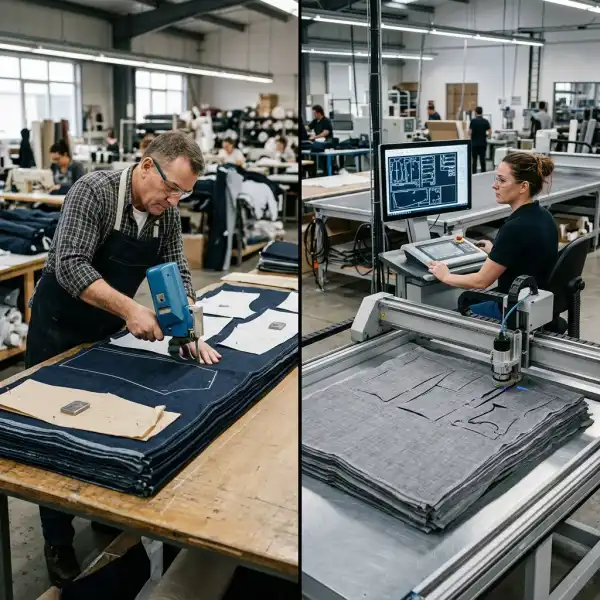
Manual cutting is a method in which a person directs the tool or material along the required component shapes. It covers more than hand scissors: production teams may use rotary shears, round knives, straight knives for stacked lays, or a stationary band knife. The blade may be powered, but the operator controls the path.
Automated cutting is a computer-controlled process in which a digital file directs the path, tool actions, and sequence. Depending on the system, it may process single, low, or compressed multi-ply material and perform selected marking, punching, drilling, or labeling. Vacuum commonly stabilizes the material while software manages speed, acceleration, tools, and sequence.
The boundary is not perfectly binary. A factory may spread manually and cut automatically, combine an automatic spreader with a manual knife, or use digital markers for operator-guided cutting. A single-ply conveyor also serves a different need from a multi-ply reciprocating-knife cutter.
A purchase decision should therefore cover the workflow, not compare hand shears with a fully integrated room. Eastman Machine Company's categories illustrate the range: its manual cutting equipment overview includes several operator-guided tools, while its automated cutting overview covers computerized single-, low-, and high-ply systems. These manufacturer descriptions clarify categories, not universal performance.
How Do the Two Workflows Differ?
Both methods sit inside the broader fabric cutting process in garment production. Fabric still has to be identified, prepared, spread or positioned, cut, inspected, and organized for the next operation. What changes is how production information becomes a physical cutting path and where process risk is concentrated.
The manual cutting workflow
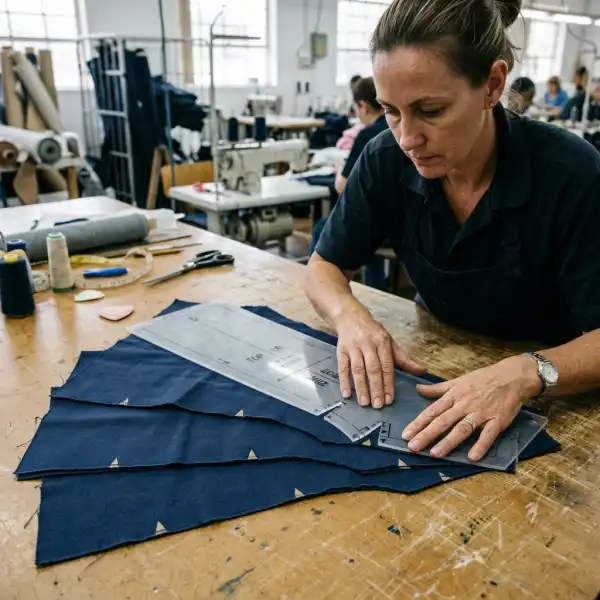
In conventional multi-ply work, the team spreads the lay, places or transfers the marker, stabilizes the material, and confirms key references. An operator guides the knife around the outlines; tight curves, internal corners, notches, and small parts may require different handling or a secondary tool.
The cutter continuously judges resistance, layer movement, difficult corners, and blade condition. This adaptability is useful, but it connects output to individual technique; two cutters may not reproduce every turn, notch, or top-to-bottom profile identically.
The automated cutting workflow
Automation moves path control upstream. The team validates the digital pattern and marker, creates the cut path, assigns tools and material settings, and releases the job. After material is positioned and held down, the operator confirms the file, settings, and safety conditions.
People remain responsible for preparation, file control, setup, observation, offloading, identification, and quality. Software can store material settings and control speed, acceleration, tools, start points, and sequencing. Eastman's cutPRO documentation shows why automation is a machine-software-material system rather than a self-sufficient blade.
This workflow can reduce variation in how a defined path is executed. It also creates new failure modes. The machine will repeat an incorrect cut file with consistency, and a poorly prepared lay can move even when the programmed geometry is correct.
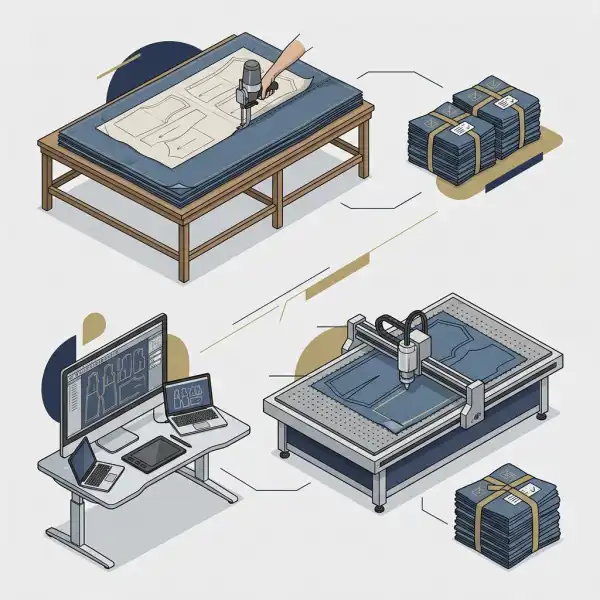

Manual Cutting vs Automated Cutting at a Glance
The practical differences are best read as operating trade-offs rather than absolute advantages. Actual results depend on machine model, lay height, material, product complexity, maintenance, operator capability, and how well cutting is connected to planning and sewing.
|
Decision factor |
Manual cutting |
Automated cutting |
What fashion teams should verify |
|
Path control |
Operator guides the tool |
Digital file and machine control guide the tool |
Who approves the pattern, marker, and cut path? |
|
Initial investment |
Usually lower |
Usually higher, with infrastructure and software costs |
What is included beyond the machine price? |
|
Changeover |
Often quick for one-off or unusual work |
Can be quick once valid files and settings exist |
How much preparation does each new style require? |
|
Repeatability |
Depends strongly on skill and working conditions |
Can repeat a validated path consistently |
How are calibration, blade condition, and material movement controlled? |
|
Throughput |
Suitable capacity varies with tool, lay, and team |
Often stronger for repeatable production at suitable utilization |
What is the output of accepted sets, not nominal cutting speed? |
|
Short runs and samples |
Commonly practical |
Possible, especially with single-ply systems, but economics vary |
Does setup and idle cost make sense for the batch? |
|
Multi-ply work |
Straight knives can cut stacked lays within validated limits |
Dedicated systems can cut compressed multi-ply lays |
What top-to-bottom accuracy is achieved on the actual material? |
|
Complex or changing materials |
Skilled operators can adapt during the cut |
Requires suitable tools, settings, hold-down, and trials |
Has this fabric-style combination been tested? |
|
Labor profile |
Relies on skilled cutting and physical handling |
Shifts work toward digital preparation, operation, maintenance, and exception handling |
Are the required roles and training available? |
|
Data and traceability |
Often depends on manual records |
Can generate or integrate more machine and job data |
Is the data reliable, accessible, and used in decisions? |
|
Downtime exposure |
A tool failure may be easier to cover with another unit |
A central-system failure can interrupt significant capacity |
What service, spare-parts, and backup plan exists? |
|
Safety profile |
Direct proximity to blades and physical exertion require strong controls |
Barriers, sensors, interlocks, and safe access remain essential |
Does the site comply with local rules and manufacturer instructions? |
The table does not identify one universal winner. It shows where each method places dependency. Manual cutting concentrates dependency in cutter skill and physical execution. Automated cutting concentrates more dependency in upstream data, equipment availability, parameter discipline, and technical support.
Which Method Produces Better Cutting Accuracy?
Automated cutting generally offers stronger path repeatability after the digital file, material setup, tools, and machine parameters have been validated. Manual cutting can still produce accurate components, especially with experienced cutters, manageable lays, suitable tools, and realistic tolerances. The difference is not “accurate versus inaccurate”; it is how accuracy is created, sustained, and measured.
In manual multi-ply work, the knife can deflect, lower plies can differ from the top, fabric can shift, and corners can distort. A taller lay increases parts per cycle but may be harder to control, especially around intricate shapes.
An automated multi-ply cutter coordinates motion, blade reciprocation, sharpening, vacuum, and corner behavior. Execution can be more consistent within its proven range, but worn blades, weak vacuum, poor cutting-surface condition, unsuitable speed, excessive height, or inaccurate calibration still affect results.
The best comparison uses accepted production data from the factory's own styles. Teams should measure:
- dimensional conformity at defined points on top, middle, and bottom plies;
- notch, drill, and internal-mark accuracy;
- edge quality, fraying, fusing, or distortion;
- first-pass acceptance and recut rate by reason;
- bundle completeness after parts are removed and sorted.
A demonstration on an easy woven fabric is insufficient if production centers on stretch knits, coated material, small lingerie pieces, or matched checks. Test representative fabric, geometry, lay configuration, and speed.
How Do Speed, Volume, and Style Variety Change the Decision?
Automation becomes compelling when the operation can feed it enough suitable work. Stable orders, repeat markers, disciplined spreading, and predictable materials reduce waiting for files, fabric, maintenance, or decisions—especially when one cutter supports several sewing lines.
Manual cutting remains competitive where volume is low or styles change constantly. A sample room may cut one garment, pause for a pattern adjustment, and cut again that afternoon. Here, flexibility can matter more than maximum cycle speed.
Material can override the volume logic. An International Labour Organization case study of an Indonesian lingerie producer reported three automated cutting machines while manual cutting remained in use for more slippery and delicate fabrics and shorter runs; see the ILO Indonesia automation case study. This is one company case, not a rule for every lingerie factory, but it demonstrates why hybrid operations persist even after automation investment.
Teams should also distinguish machine speed from cutting-room throughput. An automated cutter can finish its programmed path quickly and still sit idle because the next lay is not ready. Manual cutters can complete a lay but create a queue at inspection or bundling. The meaningful capacity measure is accepted, complete sets delivered to the next operation within the production schedule.
Does Automated Cutting Reduce Labor Requirements?
Automated cutting can reduce direct blade-guiding effort on repeatable work. It does not remove labor from the cutting room and should not be judged only by headcount reduction.
The work changes. People still plan orders, release files, spread or load material, select settings, monitor cycles, identify parts, inspect output, manage exceptions, maintain equipment, and coordinate with sewing.
The skills mix also changes. Manual cutters need material, blade, lay, geometry, and safety knowledge. Automated operators need enough production judgment to stop an unsuitable job, plus competence in file selection, setup, alarms, maintenance, and quality response. Support may require electrical, mechanical, pneumatic, vacuum, or software expertise.
Reducing manual roles without developing those capabilities can leave an expensive machine underused. A responsible transition therefore includes job mapping, training, supervised practice, revised standard operating procedures, maintenance ownership, and clear progression for existing employees. Automation investment and workforce development should be planned together.
What Does Each Option Really Cost?
Manual cutting normally has a lower entry cost, but not necessarily a lower cost per accepted part. Labor, skill scarcity, maintenance, marker handling, recuts, ergonomic exposure, and capacity constraints still count.
Automated cutting needs a broader ownership calculation. Beyond the machine, costs may include software and file capability, vacuum or compressed air, electrical and floor work, installation, training, service, blades, sharpeners, filters, cutting surfaces, labels, and updates.
Downtime needs its own cost line. If one system carries most capacity, failure can affect several sewing lines. Include service response, parts lead time, diagnostic support, internal maintenance skills, and contingency capacity.
A useful business case separates costs and benefits into four groups:
- Fixed ownership costs: purchase or lease, installation, software, financing, facility modification, and depreciation policy.
- Operating costs: labor, energy, compressed air or vacuum, consumables, preventive maintenance, and technical support.
- Quality and material effects: accepted-panel yield, recuts, remnants, damage, and any verified improvement in marker-to-cut execution.
- Capacity effects: accepted sets per staffed hour, changeover time, queue time, equipment availability, and overtime avoided or added.
Model returns across realistic order mixes, not only the largest repeat order. Test lower utilization, higher energy cost, delayed service, and a shift toward smaller batches. A credible case should survive more than the best month.

How Fabric and Product Type Affect Suitability
No cutting technology performs identically across every fabric and garment. The material must be stable enough for the chosen handling and hold-down method, while the tool and settings must produce acceptable edges and geometry.
Single-ply automation can suit samples, made-to-order work, printed components, or materials that should not be stacked. Multi-ply systems may suit repeat bulk lays after compression, vacuum, blade control, and quality are proven. Manual straight knives can process stacked lays with limited digital preparation, provided height and geometry remain controllable.
Several conditions need specific trials:
- slippery, lightweight, or delicate materials that may shift, snag, or mark;
- stretch knits that can distort under spreading tension or hold-down;
- pile, nap, one-way prints, and face-sensitive surfaces;
- stripes, checks, engineered prints, or placement graphics requiring visual matching;
- thick, lofty, coated, laminated, or compressed constructions;
- heat-sensitive synthetics whose edges may fuse under friction or thermal tools;
- very small parts, tight concave curves, holes, or narrow internal features.
Cameras, alternate tools, parameter control, or specialized handling can address some challenges, but capability varies. “Automated” is not a material specification. Test actual fabric and production files, then inspect rested output before accepting claims.
Why a Hybrid Cutting Room Is Often the Practical Answer
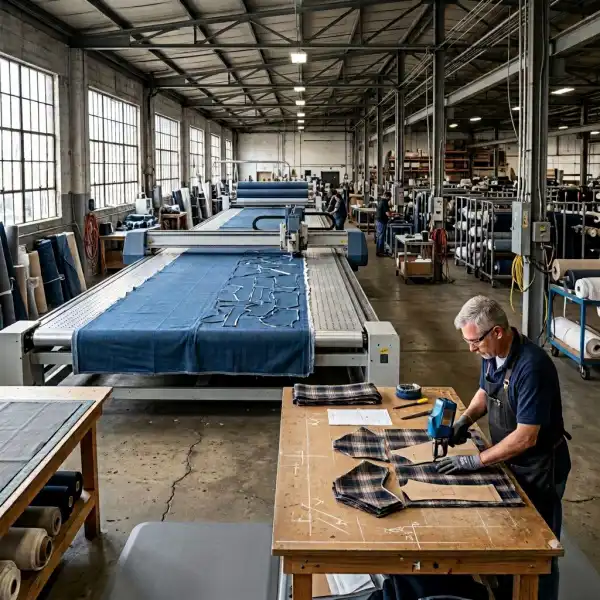
A hybrid cutting room assigns work according to risk and economics instead of forcing every order through one method. Automated equipment may handle stable bulk markers, while manual stations cover development samples, urgent replacements, small batches, remnant use, unusual materials, and work awaiting a validated digital process.
This arrangement also provides resilience. If automated capacity stops, limited manual equipment may protect samples or critical recuts, although it may not replace full bulk capacity. Conversely, automation can absorb repeat work so skilled cutters focus on material exceptions and complex jobs rather than spending every shift on routine paths.
Hybrid does not mean unmanaged. The same revision, shade, quantity, inspection, and bundle controls must apply to both routes. Factories need a rule for assigning jobs, such as:
- Confirm the approved pattern, order quantity, and delivery requirement.
- Classify the fabric and geometry risk using trial results.
- Estimate setup, cutting, handling, inspection, and expected exception time for each route.
- Check available capacity, technical support, and downstream schedule.
- Select the route, record the reason, and review actual performance after production.
Over time, this creates a material-style knowledge base grounded in the factory's own evidence.
A Decision Framework for Fashion Teams
The useful question is: “Which system can deliver our forecast mix of accepted parts reliably, safely, and at a defensible total cost?” The answer requires production evidence, not one department's technology preference.
Start with representative data. Group orders by style, fabric, batch size, marker length, lay height, changeover, quality requirement, and delivery pattern. Record recuts and downtime instead of assuming every lay becomes acceptable output.
Then ask five decision questions:
1. Is there enough suitable demand?
Estimate the share of work that can realistically run on the proposed system. Do not count orders whose files, fabric, matching rules, or batch economics would routinely send them back to manual cutting.
2. Is upstream information production-ready?
Automated execution depends on controlled patterns, markers, quantities, material codes, and cut parameters. If multiple file revisions circulate or marker approval is informal, data control should be improved before high-speed execution is added.
3. Can the factory support the equipment?
Verify power quality, vacuum or compressed-air needs, floor loading and space, environmental conditions, network access where required, preventive maintenance capability, consumables, parts, and service coverage. A machine that fits the budget but not the facility is not production-ready.
4. Does the financial case use accepted output?
Compare cost per accepted set across realistic utilization and product mixes. Include manual handling retained around the machine, inspection, training time, planned maintenance, downtime, financing, and residual or replacement assumptions.
5. What is the transition and fallback plan?
Define who owns files, setup, quality approval, maintenance, troubleshooting, and production prioritization. Pilot representative jobs, set acceptance criteria, train operators and technicians, and decide how critical work will continue during a system outage.
For a brand sourcing from external manufacturers, these questions are still useful. The brand may not buy the equipment, but cutting capability influences minimum order flexibility, sampling speed, quality risk, traceability, and the supplier's ability to handle growth. This evaluation complements a broader fashion sourcing strategy for growing apparel brands.
Common Mistakes When Comparing Cutting Methods
Comparing advertised machine speed with operator output
Machine speed is only one part of a cycle. File preparation, spreading, loading, vacuum setup, cutting, offloading, sorting, inspection, maintenance, and waiting all affect throughput. Compare accepted sets per shift for representative work.
Treating automation as a remedy for uncontrolled patterns
Automation executes the released data; it does not decide whether the pattern revision is correct. Weak version control can turn a small information error into a repeatable bulk defect. Establish approval and release discipline first.
Building the case only on direct labor savings
This overlooks new roles, training, maintenance, consumables, infrastructure, and the value of flexibility. It can also encourage understaffing around loading, quality, or preventive maintenance, reducing the very utilization used to justify the purchase.
Assuming all fabrics belong on the same route
A successful trial on stable cotton shirting does not prove performance on slippery satin, stretch jersey, coated outerwear fabric, or matched plaid. Material-style trials should define the operating envelope.
Removing manual capability too early
Samples, recuts, repairs, unusual components, and urgent exceptions may still need a manual route. Eliminating it before the automated workflow is stable can create dependence on a central machine and delay small but critical work.
Expecting automation alone to eliminate fabric waste
Cutting execution is only one source of material loss. Marker planning, actual width, end allowances, defects, shade grouping, spreading, remnants, and recuts all matter. The cluster's next article examines cutting-room problems that increase fabric waste without reducing the issue to one equipment choice.
Important Technical and Safety Caveats
Automated cutting does not mean unattended cutting. Access control, emergency stops, sensors, guards, lockout procedures, blade handling, cleaning, training, and safe maintenance remain necessary. Manual equipment requires equally serious control because operators work close to moving blades and physically guide the tool.
The UK Health and Safety Executive advises measures such as restricting danger areas, fitting warning signals on motorized and automatic tables, using adjustable blade guards, checking guards and fittings, controlling lint and offcuts, and documenting safe blade changing and disposal; see its fabric-cutting machinery guidance. Applicable legal requirements differ by country, so factories must follow local law and the manufacturer's instructions rather than treating this guidance as a complete global compliance standard.
Ergonomics also belongs in the comparison. The United States Occupational Safety and Health Administration notes repeated grip force, awkward wrist posture, bending, and extended reach in manual scissor work, while suggesting maintained tools, adjustable tables, work rotation, and partially automated tools among possible controls; see the OSHA scissor-work guidance. Automation may reduce some repetitive manual exposure, but loading rolls, pulling lays, offloading parts, clearing tables, and maintenance can introduce other physical risks. A site-specific risk assessment is still required.
Frequently Asked Questions
Is automated fabric cutting always faster than manual cutting?
No. The automated cutting cycle may execute a validated file faster and more consistently, especially on repeatable production, but total throughput includes file preparation, spreading, loading, setup, offloading, inspection, maintenance, and waiting. For a single sample or an urgent replacement panel, a skilled operator may start and finish before an automated job is prepared. For a stable bulk program feeding several sewing lines, automation may provide much greater usable capacity. Compare accepted garment sets per shift on representative styles, not maximum head speed or an isolated demonstration cycle.
Can automated cutters handle short production runs?
Yes, particularly single-ply and flexible digital systems, but technical capability does not guarantee favorable economics. Short runs may benefit from eliminating paper markers and quickly changing digital files, while frequent material changes and setup can reduce utilization. The decision depends on order frequency, file readiness, material handling, nesting, offloading, and whether the machine would displace higher-priority bulk work. Samples, made-to-order products, digitally printed panels, and personalized garments may justify automated single-ply cutting for reasons other than volume, including repeatability or digital workflow integration.
Is manual cutting less accurate than automated cutting?
Not inherently in every situation. Skilled manual cutters can achieve accurate results within a validated lay height and tolerance, and they can respond immediately to visible material behavior. Automated systems usually offer stronger repeatability of an approved digital path, but their accuracy still depends on file scale, calibration, hold-down, blade condition, tool settings, material stability, and maintenance. The fair test compares top-, middle-, and bottom-ply dimensions, notches, edge quality, first-pass acceptance, and recuts on the same fabric and pattern.
How much production volume is needed to justify automation?
There is no reliable universal minimum. The break-even point changes with equipment price, financing, wages, electricity, service, consumables, utilization, product mix, current quality losses, and the value of extra capacity. A factory should model monthly hours of suitable work, not total cutting-room hours, and test conservative utilization scenarios. A supplier quote or another factory's payback period cannot substitute for this calculation. If suitable demand is uncertain, contract cutting, leasing, phased automation, or a hybrid operation may reduce commitment while the business gathers real production data.
What skills are needed for an automated cutting room?
The team needs more than a machine operator. Core capabilities typically include digital pattern and marker control, job and material setup, safe equipment operation, cut-quality inspection, routine cleaning and preventive maintenance, fault escalation, production planning, and traceable part handling. Depending on the system, the business may also need software administration and electrical, mechanical, pneumatic, or vacuum-system support. Experienced manual cutters can be valuable during the transition because their knowledge of fabric behavior and cutting defects helps teams recognize when a programmed job is producing an unacceptable result.
Should a small fashion brand require suppliers to use automated cutting?
Usually not as a blanket requirement. The brand should define output requirements—correct pattern revision, component accuracy, matching, shade integrity, bundle completeness, traceability, safety, and delivery—and assess whether the supplier's process can meet them. Automated equipment may be valuable for scalable repeat orders, but a disciplined manual or hybrid supplier can be better suited to development work and small batches. Ask for evidence from comparable products, including trial cuts, inspection records, recut reasons, capacity assumptions, maintenance coverage, and a fallback plan.
What should be tested before purchasing an automated cutting system?
Test representative production files and actual fabrics, including the most difficult high-volume materials and several frequent small jobs. Evaluate setup time, cut time, offloading, top-to-bottom accuracy where relevant, edge quality, notches and marks, material movement, noise, energy and air requirements, consumable use, cleaning, changeover, and recovery from interruptions. Confirm file compatibility, training scope, software terms, service response, spare-parts availability, preventive maintenance, safety compliance, and facility modifications. The acceptance test should use written criteria and accepted-part output, not appearance alone.
Conclusion
Manual and automated cutting solve different combinations of production problems. Manual cutting offers accessible capacity, fast practical changeover, and human adaptability. Automated cutting can strengthen repeatability, data control, and throughput when the work is suitable and the surrounding system is ready. Neither method compensates for incorrect patterns, unstable material preparation, weak shade control, or poor quality discipline.
For fashion teams, the most defensible decision starts with the order mix and works backward. Identify which styles and materials are stable enough to automate, calculate cost using accepted sets and realistic utilization, test actual production conditions, and protect the skills needed for exceptions. A hybrid model is not a halfway measure when it deliberately assigns bulk, samples, difficult fabrics, and recovery work to the route that handles each most reliably.
The strongest cutting room is therefore not necessarily the most automated one. It is the one that converts approved information and fabric into accurate, complete components at the required pace—with controlled cost, safe work, and enough resilience to keep sewing supplied when conditions change.





Comments 0
Leave a CommentSend Comment
Anda harus Login terlebih dahulu untuk dapat memberikan komentar.