

How Pressing Affects Garment Shape, Drape, and Perceived Quality
Quick Answer
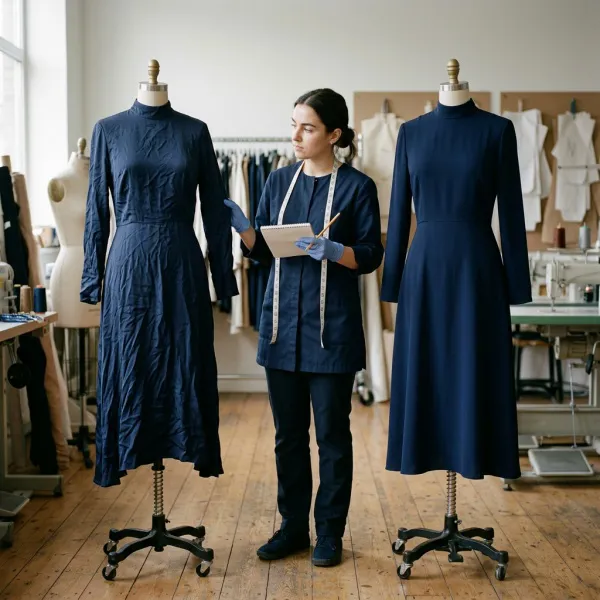
Pressing affects garment shape by relaxing unwanted wrinkles, flattening or directing seam allowances, defining edges, and helping constructed areas settle into their intended three-dimensional form. It affects visible drape more selectively: pressing can change how folds begin, how seams release, and how the garment hangs immediately after production, but the underlying drape still depends mainly on fabric mechanics, garment pattern, construction, finishes, and supporting components.
These changes influence perceived quality because buyers judge apparel through visible and tactile cues such as symmetry, surface smoothness, edge definition, seam appearance, collar balance, pleat consistency, and freedom from shine or press marks. A well-pressed garment can communicate control and make the design easier to understand. It does not prove durability, fit accuracy, colorfastness, or superior material quality.
The practical goal is therefore not maximum flatness or stiffness. It is an approved appearance appropriate to the product: crisp where structure is intended, soft where movement matters, and consistent across units. That result requires style-specific trials on the complete garment, followed by cooling, relaxation, movement, and packaging checks before bulk settings are approved.
What Do Shape, Drape, and Perceived Quality Mean?
Garment shape is the three-dimensional form created by the pattern, cut, seams, darts, pleats, interlinings, padding, elastic, closures, and the way the finished product sits on a body or form. Pressing supports that engineered form by controlling seam direction, easing fullness, sharpening or softening edges, and removing distortions introduced during handling.
Drape describes how a textile or garment deforms and falls under its own weight or in response to the body and movement. It is influenced by fabric mass, bending and shear behavior, thickness, elasticity, surface friction, construction, finishing, seams, and garment geometry. Drape is measurable, but consumers usually experience it visually and physically: a skirt swings, a blouse collapses softly, or a jacket holds away from the body.
Perceived quality is the observer’s assessment of how good a product appears or feels. It may draw on real construction quality, but it also includes interpretation. A clean placket, balanced collar, smooth seam, and consistent crease can suggest care and precision. Conversely, shine, rippling, crushed texture, or asymmetry may reduce confidence even when the garment remains technically wearable. Research on apparel quality treats appearance, fabric performance, construction, and other product cues as related but distinct parts of consumer evaluation; a consumer-based apparel quality scale illustrates why perceived quality should not be reduced to one visible feature.
The three concepts interact, but they are not interchangeable. A softly draping dress is not poorly shaped, a crisp shirt is not automatically high quality, and an immaculate final press cannot prove that the product will retain its appearance after care.
Pressing Reveals Shape More Often Than It Creates It
Most garment shape is established before final pressing. The pattern determines volume and balance; cutting controls grain and component accuracy; sewing joins the pieces; interlinings and internal structures support selected areas. Pressing then helps those elements settle into the form the designer intended.
This distinction is critical in production. If a jacket lapel rolls poorly because the canvas, tape, pad stitching, fusible interlining, or pattern is wrong, a strong final press may force it into place for inspection. The defect can reappear after hanging, packing, wear, or care. By contrast, when the construction is sound, correctly sequenced underpressing can shape the lapel progressively and make the final press a controlled finishing step rather than a rescue attempt.
Pressing has the greatest legitimate influence in four areas:
- Seam architecture: opening, closing, or directing allowances so that panels lie as designed.
- Edge definition: controlling collars, cuffs, plackets, pocket edges, waistbands, hems, and lapels.
- Localized volume: shrinking or easing manageable fullness where the material and construction allow it, especially in tailored products.
- Designed folds: establishing pleats, creases, tucks, and roll lines without flattening adjacent areas that should remain soft.
The amount of shaping that remains after cooling or care depends on material response and process design. Wool tailoring, thermoplastic pleats, cotton shirting, laminated outerwear, and jersey knitwear cannot share one assumption about permanence.
How Heat, Moisture, Pressure, and Cooling Change Appearance
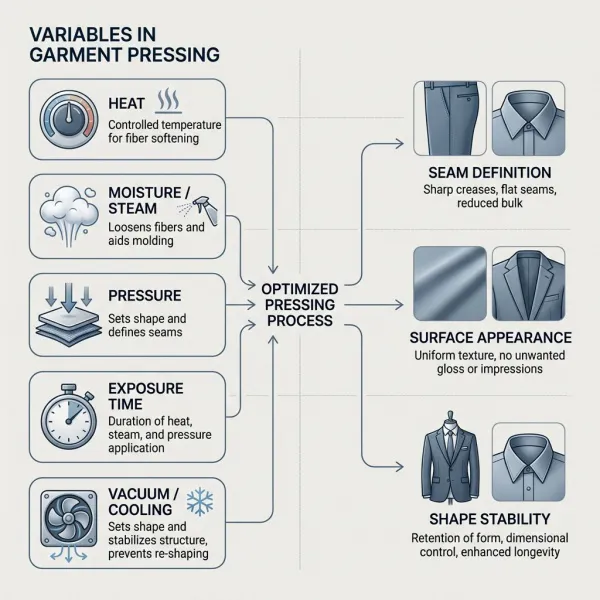
Pressing uses several inputs at once. Heat helps textile structures respond; moisture or steam assists relaxation in suitable materials; pressure brings layers into contact or defines an area; time controls exposure; vacuum and cooling remove moisture and help stabilize the presented form. The result depends on their combination, not on temperature alone.
Heat Makes Reshaping Possible—and Damage Possible
Heat can make wrinkles easier to remove and edges easier to define. In thermoplastic fibers, sufficiently high and controlled heat can also influence shape memory, although industrial heat setting is a distinct textile-finishing process and should not be confused with an ordinary final press. Cotton Incorporated notes that high temperatures may be used to heat-set thermoplastic fibers during mechanical textile finishing. A garment factory should not assume that longer or hotter pressing will reproduce that controlled fabric process.
Excess heat can alter color, surface reflection, texture, coatings, prints, adhesives, elastic recovery, or trims. On a dark synthetic trouser, even a small flattened area may reflect light differently and look shiny. On a structured garment, excessive exposure may soften or move a fusible bond. The same setting can therefore improve one component and harm another.
Moisture and Steam Help Relax Structure
Steam is valuable when the material, finish, and construction tolerate it. It can help release handling wrinkles, ease shaped areas, and prepare fibers or yarn structures for pressing. Woolmark’s guidance for worsted finishing describes methods involving steaming, vacuuming, and pressing, showing that moisture, extraction, and pressure work as a sequence rather than as isolated inputs.
More steam is not necessarily better. A garment that retains moisture may change dimensions temporarily, develop new wrinkles during stacking, or lose shape as it cools. Some coatings, adhesives, decorations, water-sensitive surfaces, and acetate-containing materials may need restricted moisture or special handling.
Pressure Defines Surfaces and Can Flatten Character
Pressure is useful for flattening seams, controlling bulky intersections, and producing clean edges. It can also force seam allowances, pocket bags, zippers, buttons, or press-bed contours through to the face of the garment. On wool, velvet, corduroy, brushed fabrics, boucle, padding, and lofted knits, too much pressure can remove the very surface character or volume the design requires.
This is why a visually flat garment is not always a correctly pressed garment. Tailored shoulders need support and volume. Velvet needs its pile protected. A soft blouse should not acquire hard seam edges simply because the press can produce them.
Cooling and Vacuum Determine Whether the Result Holds
Vacuum draws steam and moisture through the garment, supports drying, and can hold an area in position as it cools. The stabilized result should be evaluated after this stage. Moving a warm garment onto a dense rack, measuring it while damp, or folding it immediately can introduce distortion and make the approved appearance misleading.
Cooling does not make every pressed form permanent. It simply allows the team to judge the product in a more stable production state. Care, wear, humidity, and transport may still change it later.
How Pressing Changes Seam and Edge Geometry
Seams add layers, thread, tension, and directional stiffness to fabric. They do not behave exactly like an unsewn textile sample. Research on sewn materials has found that seams can change bending rigidity, which matters when evaluating garment drape and digital simulation. One study on bending rigidity in fabrics with seams highlights why seam structure and allowance treatment must be considered alongside the base fabric.
Pressing influences how those layers occupy space. An opened seam may distribute bulk to both sides; a seam pressed to one side may create a different ridge and bending direction. A collar edge pressed over an appropriate form can roll smoothly, while the same edge flattened on a hard table may appear sharp but sit unnaturally when worn.
Curves Need Support, Not Just Force
Princess seams, sleeve caps, collars, waist shaping, and tailored lapels convert flat pieces into curved forms. Effective pressing supports the curve with a shaped buck, ham, sleeve board, or form. Pressing a convex garment area against a flat surface can create new creases or flatten the intended volume.
Operator movement matters here. Dragging the iron can stretch an edge or shift a layer. Lifting and placing, working in the approved direction, and controlling small areas separately usually produce more predictable geometry. These are process controls, not stylistic preferences.
Seam Puckering Cannot Be Solved Reliably at the End
Light pressing may reduce temporary waviness, but seam puckering can originate from thread tension, differential feeding, unsuitable stitch or needle selection, fabric instability, seam construction, or shrinkage differences. Applying more heat and pressure may hide the symptom during final inspection while leaving the cause untouched.
The more useful diagnostic is persistence. If the seam appears smooth only while warm or under tension, the product is not truly corrected. Route the issue back to sewing, material, or pattern control before bulk finishing turns into repeated rework.
Does Pressing Change Garment Drape?
Yes, but usually within limits. Pressing can remove accidental wrinkles, release seam bulk, direct folds, and change the immediate way a garment hangs. It may also alter local stiffness or surface behavior if the process affects the material. It does not replace the intrinsic mechanical properties and construction choices that govern the garment’s broader drape.
Fabric drape is strongly related to resistance to bending and shear, among other variables. Experimental textile research continues to measure these relationships; a study describing fabric drape as influenced by bending and shear resistance provides useful context. Pattern shape, panel dimensions, grain direction, seams, linings, interlinings, trims, and the wearer’s body then translate fabric behavior into garment behavior.
This explains a common development disappointment. A fabric may look fluid when held as a swatch but become much more controlled after it is cut into narrow panels, joined with dense seams, lined, fused, hemmed, and attached to a zipper. Pressing can improve how those elements settle, but it cannot restore the drape of the original unsupported swatch.
Pressing Can Improve Visible Drape
Visible drape often improves when unwanted construction and handling distortions are removed. Seam allowances lie in the intended direction, hems release evenly, panel joins stop twisting, and folds begin from approved points. The garment can then express the drape already available from its material and pattern.
For ecommerce photography, this difference can be substantial. A dress that has been compressed in a sample bag may photograph with diagonal wrinkles and an uneven hem. After correct steaming, hanging, cooling, and light pressing where appropriate, the same garment presents its intended lines more clearly. This is presentation recovery, not a change in fabric grade.
Overpressing Can Make Drape Look Artificial
A heavy press can make a soft garment look board-like, create a hard crease where movement should be fluid, or flatten natural texture. Conversely, insufficient seam control can leave bulky intersections that interrupt otherwise soft drape. The target should be product-specific: a formal trouser may need a precise crease, while a bias-cut skirt should retain continuous movement without a forced fold.
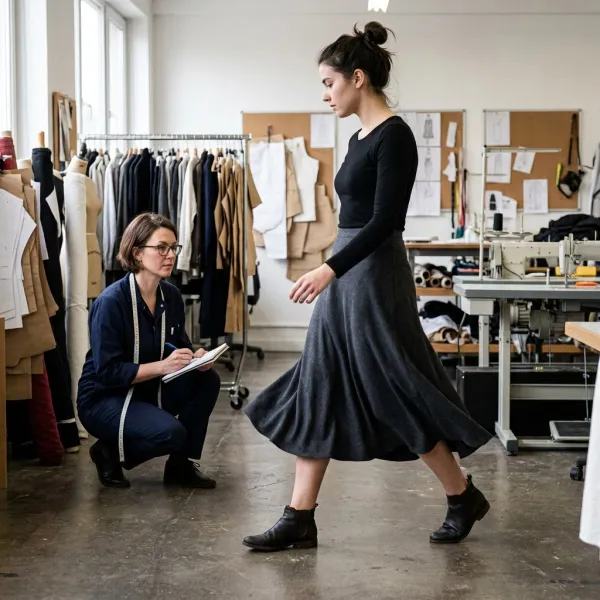
Brands should approve drape on a mannequin or person in motion, not only on a flat table. Static flatness is a poor proxy for how the garment behaves when worn.
Why Pressed Appearance Influences Perceived Quality
Customers do not inspect garments with factory instruments. They scan visible relationships: whether paired components are symmetrical, whether a front opening hangs straight, whether seams lie cleanly, whether the surface is free from accidental shine and crushing, and whether the silhouette resembles the product image or display sample.
Pressing influences many of those cues at once. It can make precise construction visible, but it can also expose inconsistency. If three shirts on one retail rack have different collar angles or placket shapes, the variation may be interpreted as poor manufacture even if each is within a broad technical tolerance.
Visual judgment is only one part of apparel evaluation. Research on denim shopping, for example, has examined how visual and tactile inputs influence product evaluation. This supports a cautious business conclusion: presentation matters, but fabric feel, fit, construction, color, price, brand expectations, and the shopping context also shape perceived quality. Pressing should not be treated as an independent guarantee of value.
Crispness Is a Product Code, Not a Universal Standard
In classic shirting or formal tailoring, controlled edges and smooth surfaces may align with customer expectations. In washed linen, garment-dyed workwear, crinkled fabrics, distressed denim, or relaxed knitwear, irregularity may be intentional. Pressing those products into uniform flatness can erase the design language and make them look less authentic.
The approved standard should distinguish intentional texture from production defects. “Wrinkle-free” is rarely an adequate instruction. A better reference identifies which surfaces should be smooth, which folds should remain, how soft an edge should look, and how much natural variation is acceptable.
Perception Changes With Lighting and Channel
Shine and seam impressions are more visible under directional lighting than under diffuse factory light. Fine wrinkles that disappear on a shop floor can become prominent in high-resolution ecommerce photography. A product pressed for a hanging store presentation may behave differently when folded into direct-to-consumer packaging.
Approval should therefore include the conditions in which the customer will encounter the garment. For important launches, brands may need separate sample-preparation instructions for production packing, wholesale showrooms, campaign photography, marketplace flat lays, and store steaming. The product is the same; the presentation task is not.
Material Responses That Change the Pressing Decision
Fiber labels are too broad to define appearance behavior by themselves. Fabric structure, yarn, weight, color, finish, surface, previous heat exposure, and garment components all matter. The following table describes common risks without pretending to provide universal recipes.
|
Material or construction |
Desired appearance effect |
Pressing risk to control |
What to validate |
|
Wool tailoring |
Smooth shaping, controlled roll, supported volume |
Shine, flattened texture, water marking, distorted internal structure |
Steam response, pressure, shaped support, vacuum, recovery |
|
Cotton or linen shirting |
Clean placket, collar, cuff, and seam definition |
Scorching, dark-color shine, seam impressions, excessive stiffness |
Finish, color, moisture, press cloth, folding behavior |
|
Polyester woven fabric |
Wrinkle removal and consistent silhouette |
Glazing, melting, color change, unwanted crease memory |
Full heat-pressure-time combination and trim compatibility |
|
Viscose dress fabric |
Released seams and fluid fall |
Water marks, distortion, seam show-through, stretching while damp |
Moisture method, support, cooling, hanging recovery |
|
Knitwear |
Restored dimensions and balanced shape |
Growth, flattening, rib distortion, hanger marks |
Form dimensions, low-tension handling, relaxation time |
|
Velvet, corduroy, or brushed fabric |
Preserved pile direction and volume |
Crushed nap, pressure marks, localized shine |
Non-crush support, reverse-side method, minimal contact |
|
Bonded, coated, or embellished garment |
Controlled presentation without component damage |
Delamination, adhesive movement, surface change, trim deformation |
Complete assembly trial, protected zones, restricted exposure |
Consumer-care guidance can help identify sensitivity, but production conditions still require independent validation. For example, GINETEX warns that some low-temperature articles may be damaged by steam and specifies maximum soleplate conditions in its official ironing-symbol guidance. Factory presses may use different contact, pressure, steam, and dwell conditions from home irons.
How to Evaluate Shape and Drape After Pressing
Approval should compare the garment with a defined reference after it has reached a stable state. Inspecting only on the press bed encourages teams to reward surface flatness while missing balance, movement, and recovery.
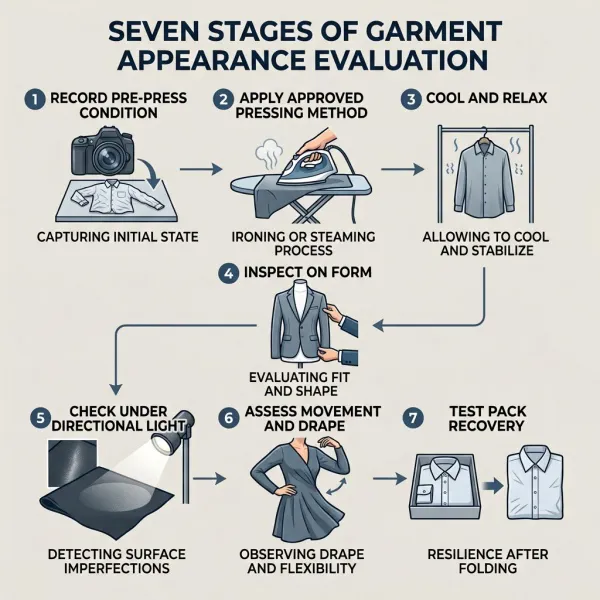
A practical evaluation sequence is:
- Record the garment’s pre-press condition, including measurements and known construction observations.
- Apply the proposed pressing sequence using production-equivalent equipment and settings.
- Cool or vacuum the garment as specified, then allow the agreed relaxation period.
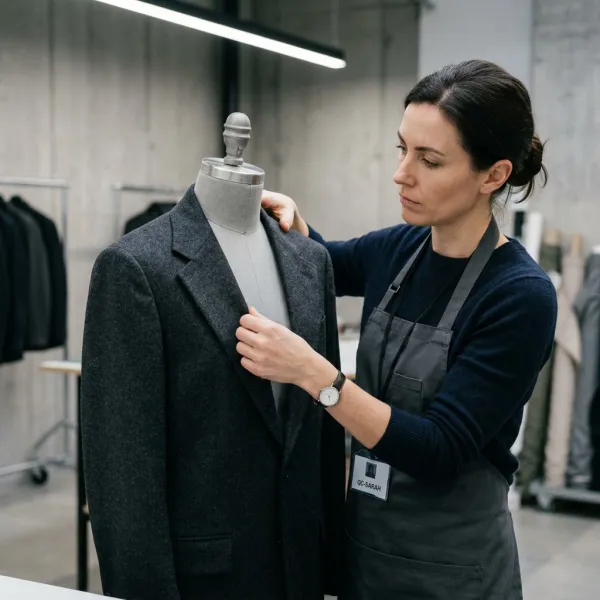
- Inspect on a flat surface, hanger, mannequin, and fit model where the product requires it.
- View under diffuse and directional light to detect shine, seam impressions, crushing, and shade change.
- Move the garment or wearer to assess fold continuity, hem behavior, and recovery.
- Pack the garment as intended, reopen it after a realistic simulation, and reassess its presentation.
The evaluation criteria should be specific enough to train operators and inspectors. “Good drape” is subjective. “Side seams hang vertically without twisting; hem falls evenly; no hard vertical crease in the front panel; approved pleat begins at the waistband and remains defined to the marked point” is actionable.
How Fashion Businesses Can Apply These Insights
For product development, define the intended silhouette and surface character before discussing equipment settings. Mark critical areas on the approved sample: lapel roll, shoulder volume, collar stance, placket flatness, pleat termination, trouser crease, hem release, or sections that must remain unpressed. This converts aesthetic direction into a production reference.
For sourcing and supplier approval, ask whether the factory has appropriate shaped supports, vacuum capacity, steam control, clean padding, trained operators, and enough cooling or hanging space for the product category. Machine ownership alone is not evidence of capability. Review actual results on the full size and color range, especially where dark shades, prints, interlinings, or embellishments change risk.
For quality control, create separate defect codes for incorrect shape, unstable press result, surface shine, seam impression, crushed pile, residual moisture, and packing wrinkles. If all are recorded as “poor ironing,” the factory cannot identify whether the root cause is sewing, material, pressing, maintenance, cooling, or logistics.
For merchandising and ecommerce, align factory finishing with the presentation channel. A garment may need a transport-resilient fold for delivery and a controlled refresh before photography or display. Product images should represent the shape and drape customers can reasonably recover, not an artificially pinned or over-styled silhouette that the delivered garment cannot reproduce.
For cost and capacity planning, measure first-pass acceptance and re-pressing rather than only units per operator-hour. A fast cycle that produces recurring touch-up, damage, and delayed packing may be less economical than a slightly slower validated process. The broader operating framework is covered in garment pressing and finishing explained.
Important Technical Caveats
Pressing results are context-dependent. A successful setting on a fabric swatch does not prove compatibility with the assembled garment. A result approved immediately after pressing may not remain after cooling. A presentation that survives hanging may not survive compression in a parcel. These are different tests.
Perceived quality also varies by category, price position, design language, customer, and market. Crispness may support a formal uniform but conflict with a deliberately washed overshirt. Brands should not convert one aesthetic preference into a universal quality rule.
Finally, pressing should not be used to stretch garments temporarily into measurement tolerance or conceal sewing defects. The article on common finishing mistakes that make apparel look less professional examines those failure modes in more depth.
Frequently Asked Questions
Can pressing permanently change garment shape?
Sometimes, but permanence depends on the material, finish, construction, process, and later care. A tailored wool area may retain controlled shaping when steam, pressure, support, and cooling are correctly managed. Thermoplastic materials can acquire stronger heat-set effects under validated conditions. Other changes are temporary and relax with humidity, wear, washing, or dry cleaning. Final pressing should not be assumed to create a durable shape unless the full product has been tested through its expected care and use cycle. Pressing an unstable or incorrectly constructed garment into position is presentation correction, not proof of permanent conformity.
Does heavier pressing produce a sharper silhouette?
It may produce a flatter or harder surface, but that is not necessarily a sharper or better silhouette. Excess pressure can flatten tailored volume, crush pile, reveal seam allowances, glaze dark fabrics, distort interlinings, or force creases into areas intended to remain fluid. Silhouette depends on pattern balance, construction, internal support, material behavior, and appropriate shaping surfaces. The effective method uses only the exposure needed to reach the approved result. A shaped buck with moderate pressure may create better form than a heavy press against a flat table.
What is the difference between fabric drape and garment drape?
Fabric drape describes how a textile specimen falls under defined conditions, while garment drape is the behavior of the completed product. The latter includes pattern geometry, grain direction, panel size, seams, linings, interlinings, hems, closures, trims, and interaction with the body. Pressing can help the assembled elements settle and remove accidental distortion, but it cannot make garment drape identical to an unsupported swatch. Brands should evaluate fabric during material selection and then reassess the finished garment on a form or wearer in movement.
Why does a garment look good immediately after pressing but poor later?
It may have been inspected while warm, damp, stretched, or temporarily held by pressure. As the garment cools and moisture redistributes, unstable dimensions, seam tension, weak fusing, or residual wrinkles can return. Dense stacking and premature folding can also impose new creases. Another possibility is that pressing concealed an upstream construction defect rather than correcting it. Approval should occur after the specified vacuum, cooling, and relaxation period, followed when relevant by hanging, movement, care, and pack-recovery checks. Record the time and conditions so repeated assessments remain comparable.
Can pressing improve the drape of a stiff fabric?
It can reduce accidental wrinkles, settle seams, and improve the way a stiff fabric presents, but it usually cannot convert the material into a fundamentally fluid one. Drape is strongly influenced by bending and shear behavior, mass, thickness, finish, and construction. Aggressive heat or steam may alter some materials, but the change may be inconsistent, damaging, or temporary unless it is part of a validated finishing process. If fluidity is central to the design, the more reliable solution begins with material selection, pattern engineering, seam construction, and interlining choice.
How should ecommerce teams prepare garments without misrepresenting them?
Use the approved care and pressing method, allow full cooling, and present the garment in a condition customers can reasonably reproduce. Light steaming to remove transport wrinkles is usually different from pinning, clamping, padding, or reshaping a garment beyond its normal fit. Record sample-preparation instructions so colorways and reshoots remain consistent. For drape-focused products, include movement or multiple angles. The goal is to reveal the intended product accurately, not to create a photographic silhouette that the delivered garment cannot achieve.
Should every colorway use the same pressing settings?
Not automatically. The nominal fabric construction may be the same, but dyes, pigments, prints, coatings, wash effects, surface depth, and trim combinations can change heat sensitivity or make shine and marks more visible. Dark shades often reveal surface reflection differences more readily, while prints and transfers may introduce local restrictions. Test materially different colorways and components during pre-production, document any approved variation, and ensure operators can identify it. A single recipe is acceptable only after evidence shows that it produces equivalent, damage-free results across the range.
Conclusion
Pressing affects garment appearance most effectively when it supports decisions already made in material selection, pattern engineering, construction, and finishing. It can release unwanted wrinkles, direct seam bulk, define edges, shape tailored areas, and help the finished product express its intended silhouette and drape.
Its limits are equally important. Pressing does not rewrite the fundamental mechanics of a fabric, prove product durability, or permanently correct faulty construction. An appearance that exists only while the garment is warm, tensioned, or carefully staged is not a stable quality result.
For fashion businesses, the right standard is product-specific rather than universally crisp. Approve shape, softness, surface, and movement together; validate them on the complete garment; and assess the result after cooling, wear-like movement, and pack recovery. That is how pressing strengthens perceived quality without turning presentation into concealment.





Comments 0
Leave a CommentSend Comment
Anda harus Login terlebih dahulu untuk dapat memberikan komentar.