
Why Vacation Dressing Influences Everyday Fashion Choices
Quick Answer
Vacation dressing influences everyday fashion because travel changes the context in which people choose, wear, photograph, and evaluate clothing. Away from normal routines, consumers may experiment with brighter colours, looser silhouettes, bolder prints, different accessories, or more relaxed combinations than they usually wear at home.
Some of those choices remain temporary. A highly transparent beach cover-up or statement destination dress may have little relevance after the trip. Others reveal practical preferences that transfer easily into daily life: breathable fabrics, coordinated separates, adjustable fits, comfortable tailoring, packable dresses, flat sandals, and garments that move between daytime and evening settings.
Vacation clothing can also carry memories. A shirt worn throughout a meaningful trip or a locally purchased accessory may continue to feel valuable because it represents an experience, not only a trend.
For fashion businesses, the important opportunity is not simply to reproduce holiday aesthetics. It is to identify which vacation behaviours signal durable wardrobe needs. Products with genuine rewear potential can support summer collections, relaxed workwear, weekend dressing, occasionwear, and lifestyle merchandising long after the customer returns home.
What Is Vacation Dressing?
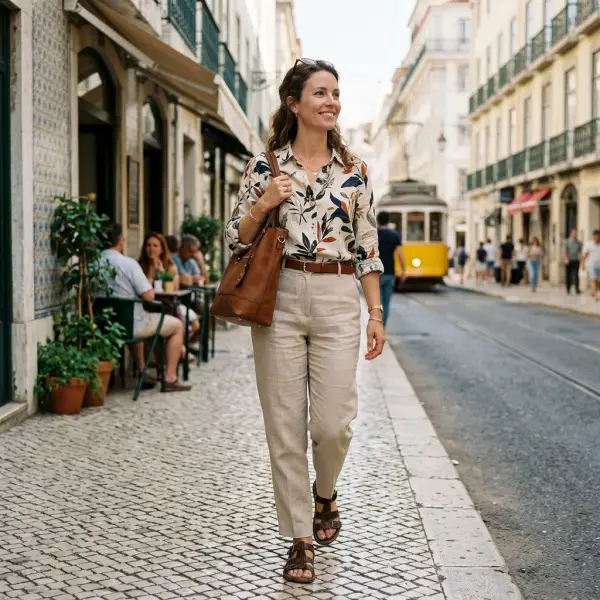
Vacation dressing is the selection and styling of clothing for travel, leisure, destination activities, and temporary changes in climate or routine. It often prioritises comfort, adaptability, visual expression, and suitability for specific occasions such as sightseeing, swimming, dining, events, or transit.
The term describes consumer behaviour rather than one fixed fashion category.
A traveller visiting a tropical island may choose swimwear, linen separates, sun-protective layers, and sandals. Someone taking a city break may pack comfortable tailoring, walking shoes, a compact jacket, and one evening outfit. A destination wedding guest may prioritise formal clothing that can survive luggage, heat, photography, and several days of related events.
Resortwear is one product category that serves these needs, but vacation dressing is broader. It includes how consumers assemble a travel wardrobe from resort collections, existing clothes, sportswear, occasionwear, accessories, local purchases, and practical travel items.
The foundation of the category is explained in resortwear fashion from holiday style to lifestyle trend. This article focuses on a different question: why clothing choices made for temporary travel contexts often return home and influence everyday wardrobes.
Why Does Travel Change the Way People Dress?
Travel changes clothing decisions because it alters climate, activities, social expectations, visibility, and routine. A person may temporarily step outside the practical or cultural boundaries that normally shape their wardrobe.
At home, clothing decisions are often constrained by commuting, workplace norms, school schedules, caregiving, weather, repeated social contact, laundry routines, and the need to appear appropriate within familiar communities. During a vacation, some of those constraints weaken while new ones emerge.
The traveller may still need to respect local customs, weather conditions, safety, and activity requirements. Yet the change of environment can create space for experimentation.
This makes vacation dressing a useful observation point for fashion businesses. It can reveal what consumers might wear more often if products offered the right combination of confidence, comfort, versatility, and social acceptability.
Vacation Clothing Creates Space for a Different Version of the Self
Clothing is not only functional. It can help people express, test, or manage different aspects of identity.
Research published through the University of Manchester on dress and identity found that different dress styles can be associated with different versions of the self, including an everyday self, an aspirational self, and a socially expected self. This does not mean every clothing choice has a deep psychological explanation. It does support the broader point that consumers may use dress to explore how they see themselves and how they want to be perceived. Readers can review the research summary on dress styles and identity.
Vacation creates a particularly clear setting for this behaviour. Someone who normally wears dark office separates may choose a colourful wrap dress while travelling. A customer who rarely wears jewellery at home may buy large earrings for evening dinners. Another may discover that relaxed linen shirts suit both their comfort needs and preferred personal image.
The change can be small rather than dramatic. Vacation dressing may simply give a consumer permission to wear:
- A brighter colour
- A looser trouser shape
- A more open neckline
- A coordinated set
- A hat or woven bag
- Flat shoes with a dress
- A shirt worn open over a base layer
- Jewellery that feels too expressive for a normal workday
Some experiments remain connected to the trip. Others become evidence that the customer’s everyday wardrobe has been narrower than their actual preferences.
That distinction is commercially important. Brands should not assume that every visually striking vacation choice represents long-term demand. The more useful question is which elements continue to solve real needs after the novelty of travel has passed.
How Does Vacation Dressing Move Into Everyday Fashion?
Vacation style usually transfers into daily wardrobes through adaptation rather than direct replication.
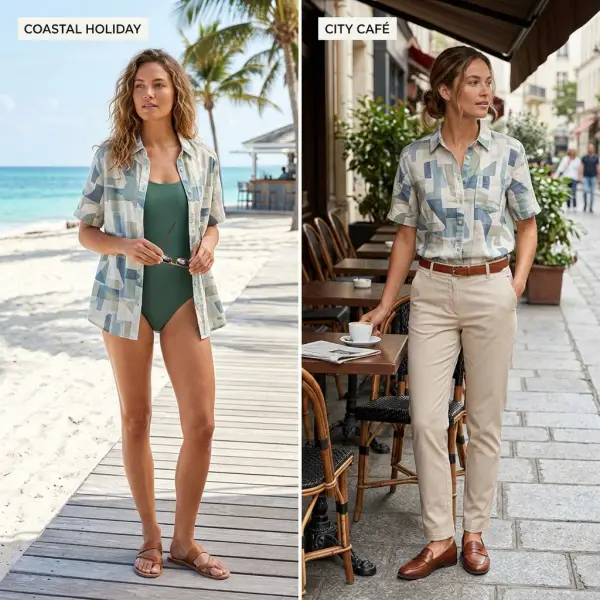
A beach look may be inappropriate for an office or city commute, but its individual components can be recontextualised. A printed sarong-inspired skirt may be paired with a plain shirt. A loose resort dress may gain a light jacket and closed shoes. A camp-collar shirt bought for travel may become part of a weekend wardrobe.
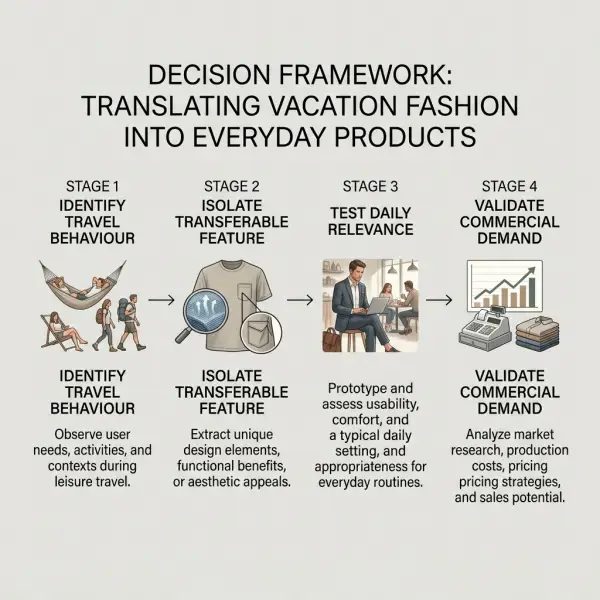
The process often follows four stages:
|
Stage |
Consumer behaviour |
Everyday fashion implication |
|
Exploration |
The customer tries unfamiliar colours, shapes, or styling while travelling |
New preferences become visible |
|
Validation |
The outfit feels comfortable, receives positive feedback, or photographs well |
Confidence in the style increases |
|
Adaptation |
Individual pieces are combined with familiar wardrobe items |
Holiday style becomes more practical |
|
Integration |
The garment or styling idea enters repeated everyday use |
A temporary experiment becomes a lasting preference |
This is rarely a conscious step-by-step decision. The customer may simply keep reaching for the same relaxed shirt after returning home.
For retailers, the pattern suggests that vacation edits should show two contexts: how a product works during travel and how it can be used afterwards. This expands the proposition without pretending that every holiday garment is universally versatile.
Seven Reasons Vacation Dressing Shapes Everyday Choices
1. Travel Encourages Controlled Experimentation
Consumers often feel more willing to test a new style when the social risk is limited. A person travelling among strangers may be less concerned about appearing inconsistent with the identity known by colleagues, neighbours, or friends.
Vacation also creates an occasion that justifies change. Buying or packing a new colour can feel reasonable because the customer is preparing for a different climate, activity, or visual environment.
This does not mean travellers abandon all social expectations. Cultural norms, body confidence, destination safety, family roles, and practical needs still influence choices. The experimentation is usually controlled rather than unlimited.
The business implication is that travel-related merchandising can introduce unfamiliar products by placing them within a clear use case. A customer who would ignore an orange shirt in a standard product grid may understand it more easily when shown as part of a coordinated warm-weather capsule.
2. Vacation Wardrobes Prioritise Ease
Travel exposes inconvenience quickly.
A garment that requires complicated undergarments, constant ironing, difficult closures, or careful handling may become frustrating when the customer is living from a suitcase. By contrast, products that are comfortable, easy to coordinate, and appropriate across several settings can earn repeated use.
These experiences can reset expectations at home.
Once a consumer discovers that an elasticised trouser can look polished, that a loose shirt can provide both sun coverage and styling flexibility, or that a simple dress can work with several shoe types, they may seek the same qualities in everyday apparel.
The influence therefore extends beyond visual style. It affects expectations around:
- Mobility
- Fit flexibility
- Layering
- Care
- Packability
- Pocket function
- Footwear compatibility
- Day-to-evening use
For fashion brands, ease should not be confused with lack of design. The most useful vacation-inspired products often contain careful pattern engineering, considered proportions, stable closures, and fabric choices that make ease possible.
3. A Limited Suitcase Makes Coordination More Important
Most travellers cannot bring an unlimited wardrobe. Luggage capacity forces editing.
The customer begins to evaluate products not only as individual objects but as parts of a small system. A shirt becomes more valuable when it works with trousers, shorts, a skirt, and swimwear. A dress becomes more useful when it can be worn during the day and restyled for dinner.
This capsule logic can continue after the trip. Consumers may become more aware of wardrobe compatibility, repeat wear, and outfit planning.
A vacation wardrobe does not automatically create more responsible consumption. Some people buy many one-time outfits specifically for travel. However, luggage constraints make the benefits of coordinated design especially visible.
Brands can translate this insight into everyday merchandising through:
- Clearly coordinated colour palettes
- Repeat fabrics across categories
- Outfit-based product pages
- Mix-and-match sets
- Styling guidance for several occasions
- Consistent proportions between tops and bottoms
- Accessories designed to work across multiple looks
A strong capsule is not simply a group of products released at the same time. The pieces must genuinely combine.
4. Vacation Outfits Are Closely Connected to Memory
Clothing worn during a meaningful experience may acquire emotional value. The garment becomes associated with a place, celebration, relationship, or personal milestone.
This helps explain why a simple holiday shirt can remain important long after its original trend relevance declines. Its value is partly functional and partly autobiographical.
The connection can encourage repeated wear, careful storage, repair, or a preference for similar products in the future. It can also influence brand recall when a customer associates a label with a positive experience.
Brands should handle this carefully. Emotional storytelling can support a product, but it cannot manufacture genuine attachment on demand. The garment still needs to perform well enough to remain part of the customer’s life.
A dress that looks good in one photograph but feels uncomfortable for the rest of the trip is less likely to become a valued memory object.
5. Travel Creates More Visual Documentation
Vacations are frequently photographed. Travellers record destinations, meals, activities, family gatherings, and outfits, whether for private archives or public platforms.
This greater visual attention can change purchasing decisions. Customers may consider how a colour will appear against a destination, whether an outfit feels distinctive across several days of photographs, or whether a garment can transition between multiple documented occasions.
Current fashion editorial also reinforces this occasion-based view. For example, Vogue’s 2026 vacation-dress coverage organised outfits around specific settings including daytime excursions, city shopping, destination weddings, boat days, and beach-to-bar transitions. This demonstrates how fashion media translates travel into a sequence of dressable moments rather than one generic holiday aesthetic. See the Vogue vacation dress styling guide.
Social media can also influence purchase intention. A 2025 study examining fashion influencers found that perceived relatability and emotional value could positively influence purchase intention within the study context. This should not be generalised to every audience or platform, but it supports the practical importance of showing clothing in believable, relatable scenarios.
For brands, the lesson is not that every campaign needs an exotic destination. A realistic visual narrative may be more persuasive than an inaccessible fantasy.
Customers often need to see:
- What to wear during transit
- How a garment behaves outdoors
- What works over swimwear
- How an outfit changes for dinner
- Whether the product suits walking
- How it can be styled again at home
6. Different Climates Introduce New Material Preferences
Travel can expose consumers to weather conditions that differ from those at home. Heat, humidity, wind, strong sun, air conditioning, rain, or cool evenings can make fabric behaviour more noticeable.
A traveller may discover the value of breathable woven fabrics, lightweight layers, quick-drying swim materials, wider silhouettes, or sun coverage. They may also learn that certain “summer” products perform poorly when they become transparent, cling with moisture, crease excessively, or dry slowly.
These discoveries can influence future purchases.
A customer living in a temperate city may begin wearing loose linen-blend shirts during increasingly warm summers. Someone accustomed to synthetic workwear may seek lighter fabrics after experiencing greater comfort while travelling. Another may learn that a thin cardigan is useful not only on flights but in air-conditioned offices.
The exact lesson depends on fabric construction, garment design, personal comfort, and climate. Fibre names alone do not predict performance.
7. The Boundary Between Leisure and Everyday Dressing Has Become More Flexible
Many vacation-associated products fit naturally into contemporary casual wardrobes. Relaxed tailoring, drawstring trousers, open shirts, matching sets, flat sandals, lightweight dresses, and woven accessories can move between leisure, home, hospitality, and informal urban settings.
Resort collections also show this broader transition. Vogue’s Resort 2026 trend overview included leather jackets, tailoring, denim, turtlenecks, track pants, and other products that extend far beyond traditional beach imagery. This illustrates how the fashion calendar’s “resort” label often functions as a bridge-season platform rather than a literal dress code for resorts.
The transfer is strongest when products balance relaxation with enough structure for normal public life.
A pyjama-inspired set may work as city dressing when the fabric is opaque, the cut is controlled, and accessories provide definition. A beach kaftan may remain destination-specific if it is extremely sheer or voluminous.
The difference lies in construction and styling, not merely the product name.
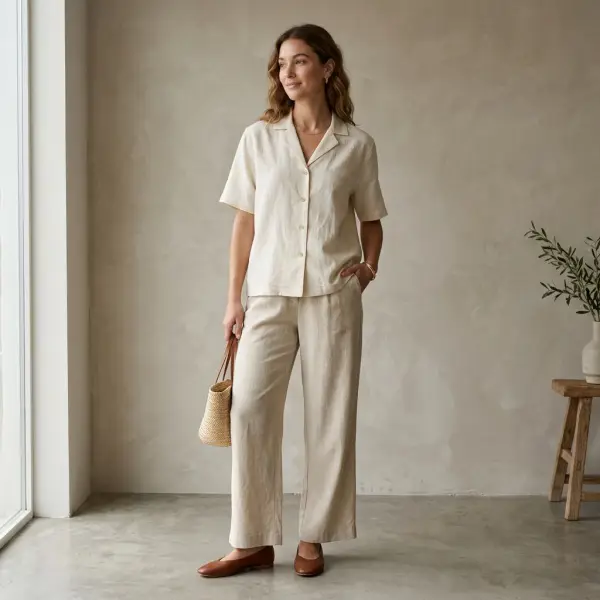
Which Vacation Trends Transfer Most Easily Into Daily Wardrobes?
Not every holiday trend has equal staying power. The easiest transfers usually solve practical needs while remaining compatible with clothes the customer already owns.
|
Vacation-influenced choice |
Why it transfers |
Everyday application |
|
Relaxed shirts |
Easy layering and broad styling range |
Work-from-home, weekend, casual office, warm-weather outer layer |
|
Coordinated sets |
Outfit simplicity with separate rewear |
Travel, lunch, informal meetings, events |
|
Fluid trousers |
Comfort with a polished silhouette |
Office, dinner, commuting, social occasions |
|
Lightweight dresses |
One-piece dressing with minimal coordination |
City summer, weekend, events, casual work settings |
|
Flat sandals |
Practical movement and relaxed styling |
Daily summer wear, restaurants, errands |
|
Woven bags |
Texture and seasonal character |
Weekend and warm-weather city use |
|
Bold prints |
Strong expression and easy focal point |
Used selectively with neutral wardrobe items |
|
Lightweight tailoring |
Polish without heavy structure |
Warm-climate workwear, travel, social occasions |
|
Adjustable details |
Greater fit flexibility |
Weight fluctuation, shared sizing, all-day comfort |
|
Layering pieces |
Adaptation between sun, shade, and air conditioning |
Offices, transport, changing daily weather |
The products that transfer poorly are usually those tied too closely to one environment or requiring significant styling compromise.
Examples include highly sheer cover-ups, floor-length garments that drag during commuting, fragile embellishment, impractical sleeves, very specialised swim items, or novelty prints that conflict with the customer’s existing wardrobe.
These products can still be commercially successful. They should simply be positioned as occasion-specific rather than falsely described as universal.
How Vacation Dressing Influences Colour Choices
Vacation settings often encourage consumers to wear colours they associate with light, nature, energy, or escape. Blues, greens, citrus shades, warm neutrals, white, terracotta, and saturated prints frequently appear in travel wardrobes.
The influence continues when one of those colours proves easier to wear than expected.
A customer may return home and combine a bright vacation shirt with denim. A coral dress may inspire smaller colour accents through scarves or accessories. A previously unfamiliar green may become part of the customer’s normal seasonal palette.
This is one way fashion trends move from aspirational imagery into daily use: not necessarily as a complete runway or holiday look, but through fragments.
Brands should recognise that colour adoption occurs at different intensities. One consumer may buy a full printed dress. Another may choose only a coloured bag. A third may prefer the same silhouette in a neutral tone.
Offering several entry points can broaden the commercial relevance of a colour story. The relationship between forecasting, seasonal palettes, and consumer adoption is discussed further in how seasonal color palettes influence consumer buying decisions.
How Vacation Dressing Influences Silhouette and Fit
Silhouette is often more transferable than print.
Customers who experience the comfort of wide-leg trousers, unstructured shirts, elasticised waists, wrap closures, or flowing dresses may begin to expect greater movement from everyday clothes.
This does not mean all consumers will abandon fitted garments. Vacation may instead clarify when and where different fits are useful.
A person may continue wearing structured tailoring for formal meetings while choosing softer trousers for commuting or hybrid workdays. A fitted evening dress may remain relevant, but the customer may prefer an adjustable wrap silhouette for travel and informal events.
The strongest product opportunities often sit between two extremes:
- Relaxed without appearing shapeless
- Adjustable without looking temporary
- Lightweight without becoming transparent
- Comfortable without resembling sleepwear
- Structured without excessive stiffness
- Expressive without limiting repeat styling
Achieving this balance requires pattern development, fit testing, and material control. It cannot be solved through styling language alone.
The Role of Travel Scale and Global Tourism
Travel remains a large global activity, although participation, frequency, spending power, and destination choice vary substantially.
UN Tourism reported approximately 1.52 billion international tourist arrivals in 2025, 4% higher than in 2024. The data represents overnight international arrivals rather than the number of unique individual travellers, and it does not include all domestic tourism. It nevertheless confirms the continuing scale of travel-related consumer contexts. See the UN Tourism report on 2025 international arrivals.
Fashion businesses should not interpret this figure as proof that travel clothing demand will grow automatically. Tourism volume does not directly reveal how much travellers spend on apparel, what they bring from home, or whether they buy destination-specific clothing.
Commercial demand will vary according to:
- Consumer income
- Trip purpose
- Destination climate
- Length of stay
- Cultural expectations
- Baggage restrictions
- Existing wardrobe
- Retail access
- Exchange rates
- Travel season
- Social or family context
Tourism data can help establish market scale, but brands still need product-level evidence.
What Does This Mean for Fashion Brands?
The central business opportunity is to convert temporary vacation preferences into products with lasting use.
Design for the Return Home
Every product does not need to be suitable for daily wear, but the collection should clearly distinguish between occasion pieces and high-rewear pieces.
A practical assortment might include:
- One visually distinctive destination dress
- Several versatile shirts and separates
- A cover-up that can also function as a tunic
- A lightweight jacket for travel and urban use
- Accessories that work beyond the beach
- Neutral foundations that support stronger prints
This creates an emotional holiday story without making the entire range dependent on one trip.
Merchandise by Situation
Traditional category navigation—dresses, tops, trousers, accessories—remains useful. Vacation customers may also benefit from situation-based merchandising.
Examples include:
- Travel day
- Pool and beach
- Daytime exploration
- Lunch and shopping
- Sunset drinks
- Casual dinner
- Destination event
- Back in the city
This approach reflects the way customers plan trips. It also helps brands demonstrate rewear without claiming that one outfit is appropriate everywhere.
Show Styling Transitions
A product page can show the same shirt over swimwear and with tailored trousers. A dress can be styled with flat sandals for daytime and a light jacket for evening.
The objective is not to generate more images for their own sake. Each image should answer a practical question.
Useful supporting content might explain:
- Whether the fabric is sheer
- What undergarments work
- Whether the item fits over swimwear
- How it behaves after packing
- Which other products coordinate
- How the garment can be worn after the holiday
Clear information can be more persuasive than generic lifestyle language.
Use Customer Data to Identify Lasting Preferences
Brands can compare vacation-edit performance with later customer behaviour.
Useful questions include:
- Which travel products are purchased again in other colours?
- Which items receive reviews mentioning everyday use?
- Do customers combine resort pieces with workwear or casual categories?
- Which styles maintain low return rates?
- Which prints sell quickly but generate little repeat demand?
- Which products perform across several regional climates?
- Are customers buying coordinated sets together or as individual separates?
This evidence can separate a photogenic campaign success from a sustainable product opportunity.
Develop Regional Merchandising
Vacation dressing is not a single global uniform.
Customers travelling in Southeast Asia, Southern Europe, the Caribbean, the Middle East, East Africa, Australia, or domestic coastal regions may face different expectations around heat, rain, sun, modesty, social settings, and retail pricing.
The product may require regional adjustment in:
- Sleeve and hem length
- Fabric weight
- Lining
- Colour
- Size curve
- Sun coverage
- Delivery timing
- Footwear
- Occasion level
- Cultural references
The brand’s visual identity can remain consistent while product decisions respond to real market conditions.
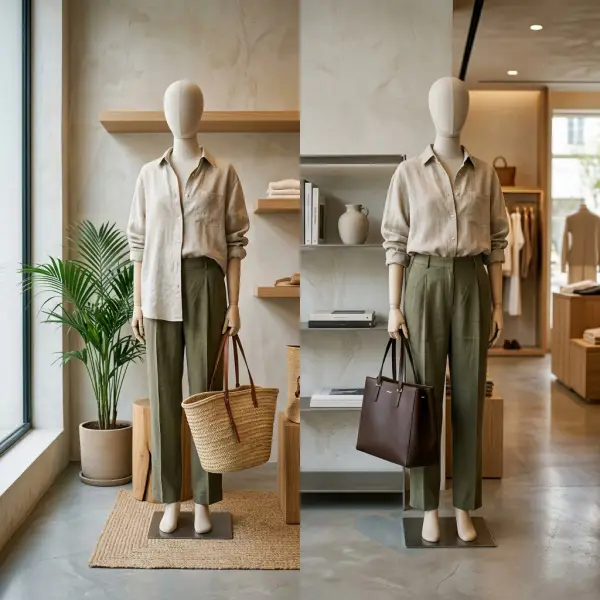
How Retailers Can Use Vacation Behaviour Without Encouraging Disposable Purchases
Vacation can encourage unnecessary consumption when shoppers feel they need a completely new identity for each trip. Brands should avoid building the proposition entirely around one-time photographs or “must-have” outfits for every destination.
A commercially effective alternative is to make rewear part of the value proposition.
This can be done through:
- Capsule packing guides based on fewer coordinated pieces
- Outfit repetition shown openly in campaign content
- Products styled across travel and home settings
- Rental or resale options for highly specific occasion pieces
- Clear durability and care guidance
- Repair support where operationally realistic
- Accessories that refresh existing clothing
- Pre-order or demand-led production for uncertain styles
These measures do not automatically make a collection sustainable. Their value depends on whether customers actually use products more frequently and whether the business model supports appropriate quality.
Brands should avoid claiming that versatility alone eliminates environmental impact. A “five ways to wear” message is useful only when the garment is durable, wanted, and realistically compatible with the customer’s life.
Common Strategic Mistakes
Mistaking Social-Media Visibility for Durable Demand
A dramatic vacation outfit may generate strong engagement because it photographs well. That does not prove customers will wear it repeatedly or accept its price.
The mistake happens when brands assess creative content without examining sales conversion, returns, reviews, repeat purchases, or styling behaviour after the campaign.
A better approach is to separate content performance from product performance. Both matter, but they answer different questions.
Designing for an Imagined Traveller
Brands sometimes build a collection around an idealised customer who spends every holiday moving between a private villa, yacht, and formal restaurant.
Real travellers may be carrying children, walking long distances, using public transport, complying with religious or cultural expectations, protecting themselves from strong sun, or managing limited luggage.
Product development should begin with an evidence-based itinerary rather than a generic luxury image.
Overstating Versatility
A garment is not automatically versatile because it can technically be styled in two photographs.
True versatility depends on comfort, dress codes, climate, care, fit, and compatibility with the customer’s wardrobe.
A sheer maxi dress may move from pool to beach bar but remain unsuitable for the customer’s normal city life. It should be marketed honestly as an occasion product.
Treating Relaxed Fit as Easy Fit
Loose garments still require accurate grading, neckline control, sleeve proportion, pocket placement, and length decisions.
Vacation products are often worn in wind, strong light, and active outdoor conditions. Fit failures may become more visible, not less.
A one-size strategy should be validated across the intended body range rather than used as a shortcut.
Copying Destination Culture Superficially
Using local craft, traditional patterns, sacred symbols, or indigenous design references without adequate understanding can create ethical and reputational risk.
The problem is not inspiration itself. The problem is extracting cultural value without proper collaboration, permission, attribution, or benefit sharing where these are appropriate.
Brands should research references and avoid reducing a destination to decorative clichés.
Building an Entire Collection Around One Trip
A brand may invest heavily in destination-specific prints, specialist trims, photography, and inventory without confirming repeat demand.
A narrower capsule offers a more controlled test. The wider development process is examined in how fashion brands design collections for travel and leisure.
What Brands Should Verify Before Acting
Before converting vacation inspiration into an everyday range, brands should test the following assumptions.
|
Assumption |
What to verify |
|
Customers want holiday style at home |
Look for reviews, repeat purchases, customer styling, and cross-category sales |
|
A relaxed silhouette will fit broadly |
Conduct fit trials across sizes, heights, and body proportions |
|
Bright colours will remain relevant |
Offer different colour intensities and examine regional demand |
|
The garment is versatile |
Test it across realistic climates, occasions, shoes, layers, and undergarments |
|
A successful campaign predicts strong sales |
Separate engagement, traffic, conversion, returns, and repeat use |
|
Travel growth guarantees category growth |
Analyse the target customer’s actual travel and apparel-spending behaviour |
|
A natural fibre is automatically suitable |
Test opacity, care, shrinkage, stability, drying, and comfort |
|
Destination imagery improves credibility |
Confirm that the location and cultural references align with the product and brand |
The most important test is whether the product remains desirable when removed from the destination photograph.
Important Caveats
Vacation dressing does not influence all consumers in the same way. Travel frequency, disposable income, climate, age, work requirements, religion, culture, disability, family responsibilities, and personal interest in fashion all shape behaviour.
Several caveats should remain close to any business recommendation:
- Travel clothing demand is not identical to tourism volume.
- Social-media engagement does not prove repeat wear.
- Vacation experimentation may remain temporary.
- Relaxed silhouettes do not remove fit requirements.
- Bright colour adoption varies by consumer and market.
- Packability can conflict with fabric quality, structure, or appearance.
- Versatility should be tested rather than asserted.
- Destination inspiration requires cultural care.
- Rewear messaging should not be treated as proof of sustainability.
These limitations do not weaken the commercial opportunity. They help define it more accurately.
Frequently Asked Questions
Why do people dress differently on vacation?
People may dress differently because travel changes their climate, activities, social context, and daily routine. A holiday can provide a reason to try colours, prints, silhouettes, or accessories that feel less practical or familiar at home.
The change is not always about attracting attention. It may be driven by heat, walking, swimming, events, photography, cultural expectations, or the need to pack a small coordinated wardrobe.
Fashion businesses should avoid assuming that vacation behaviour reveals a completely new identity. It is better understood as a temporary environment in which different preferences become easier to test.
Does vacation style always become an everyday trend?
No. Many vacation styles remain specific to beaches, resorts, events, or travel photographs. Highly sheer clothing, extreme volume, fragile embellishment, and destination-specific novelty pieces may have limited relevance at home.
Transfer is more likely when the product provides practical value beyond the trip. Breathable shirts, fluid trousers, lightweight dresses, adjustable fits, coordinated separates, and comfortable footwear often move more easily into normal wardrobes.
Brands should examine repeat wear and customer styling rather than assuming that strong holiday sales automatically create an everyday trend.
What is the difference between vacation dressing and resortwear?
Vacation dressing describes how people select and style clothing for travel. Resortwear is a fashion product category developed around leisure, destination, and warm-weather contexts.
A vacation wardrobe may include resortwear, activewear, formalwear, basics, jackets, technical clothing, and garments already owned by the traveller. Resortwear is therefore one possible component of vacation dressing, not the whole behaviour.
For brands, this distinction matters because a customer journey may extend beyond the resort collection. Travel-day clothing, weather protection, footwear, luggage, occasionwear, and accessories can all influence the total wardrobe.
Which vacation pieces have the greatest everyday rewear potential?
Relaxed shirts, lightweight dresses, fluid trousers, coordinated sets, simple sandals, compact outer layers, and adaptable accessories often have strong rewear potential.
Their success depends on fabric, transparency, fit, care, climate, and compatibility with the customer’s existing wardrobe. A well-cut shirt in a bold print may be easier to rewear than a neutral cover-up that is too sheer for public settings.
Brands should evaluate the full garment rather than relying on broad category assumptions. Styling the product with ordinary wardrobe items can reveal whether versatility is genuine.
How can brands make vacation clothing feel relevant after the trip?
Brands can prioritise coordinated separates, restrained proportions, practical closures, adaptable layers, and colours that work with common wardrobe foundations. Product pages can show the same item in both destination and everyday settings.
Specific information also helps. Customers need to know whether a garment is lined, sheer, adjustable, washable, packable, or suitable for different shoes and layers.
The objective is not to make every product universal. A collection can include special occasion pieces as long as their narrower use is communicated honestly.
Does social media make vacation dressing more influential?
Social media can increase the visibility of destination outfits and expose consumers to new styling ideas. Fashion influencers, travel creators, hotels, wedding content, and user-generated photographs all contribute to the circulation of vacation aesthetics.
The effect is not uniform. Purchase behaviour depends on audience trust, relevance, affordability, body representation, climate, and product practicality. High engagement may reflect admiration rather than purchase intent.
Brands should use social platforms as one evidence source and compare content performance with conversion, returns, customer reviews, and repeat purchasing.
Can vacation-inspired fashion be suitable for work?
Some vacation-inspired elements can fit informal or warm-weather workplaces. Relaxed tailoring, fluid trousers, modest dresses, camp-collar shirts, lightweight jackets, and coordinated sets may work when fabric opacity, fit, coverage, and styling match the workplace.
Beach-specific products are less transferable. Swim cover-ups, very short hems, open backs, or transparent fabrics may not meet professional dress expectations.




Comments 0
Leave a CommentSend Comment
Anda harus Login terlebih dahulu untuk dapat memberikan komentar.