
Why Social Media Changes How Fashion Trends Are Named and Adopted
Quick Answer
Social media changes fashion trends by changing who can name a style, how quickly the name circulates, who sees it, and how easily other people can participate. Fashion trends once associated primarily with runway collections, magazines, celebrities, retailers, and street culture now also emerge through creators, online communities, recommendation feeds, resale platforms, and consumers themselves.
A memorable label such as an “-core,” “-girl,” or other aesthetic name can bundle several garments, colors, cultural references, and styling behaviors into one searchable idea. Recommendation systems can then expose users to related content even when they do not already follow the original creator. TikTok, for example, states that its For You feed uses signals including viewing behavior, likes, shares, searches, follows, and interactions to recommend content and creators. TikTok explanation of the For You recommendation system
But social platforms do not manufacture every fashion trend from nothing. Runways, celebrities, subcultures, music, historical dress, product innovation, retailers, and existing consumer preferences remain influential. What social media changes most dramatically is the speed, visibility, fragmentation, feedback, and vocabulary of fashion adoption.
How Did Fashion Trends Spread Before Social Media?
Fashion trends have never had a single source.
Designers, couture houses, manufacturers, department stores, youth cultures, music scenes, film, television, celebrities, magazines, street style, sports, political movements, and technological changes have all influenced clothing adoption at different points in fashion history.
For much of the twentieth century, however, fashion information moved through comparatively concentrated gatekeepers.
Seasonal runway collections were interpreted by fashion editors and buyers. Magazines photographed influential looks. Retailers translated selected directions into commercial assortments. Celebrities and musicians brought others into popular culture. Consumers adapted those ideas according to local taste, affordability, climate, and availability.
Even that description is an oversimplification. Trends have also moved upward from subcultures and streets into luxury fashion, sideways between communities, and across countries through migration and cultural exchange.
What has changed is the density of the network.
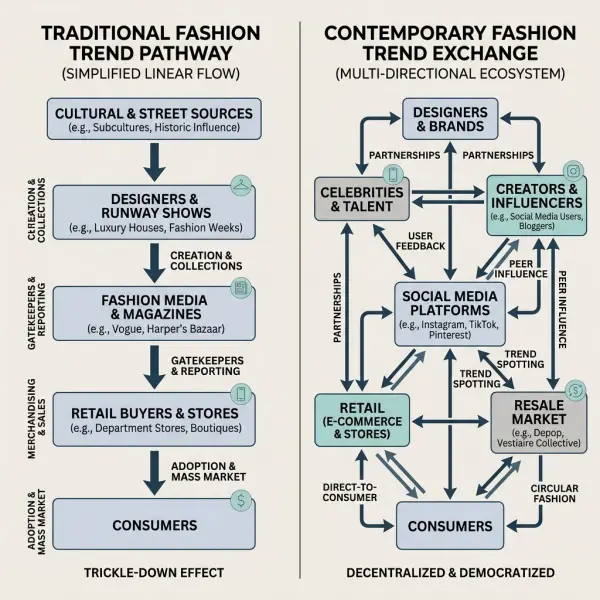
A 2024 study in Fashion and Textiles examined runway collections, fashion influencer outfits, and best-selling products from online retailers. The researchers found relationships among all three information sources, while retailer best items showed greater similarity to fashion influencer outfits in some measures than to runway imagery. Their conclusion was not that runways had ceased to matter, but that contemporary fashion trend information circulates through multiple sources rather than one simple top-down pathway. academic research on diffusion of fashion trend information
That is a more accurate starting point for understanding social media's influence.
Social Media Turns Trend Diffusion Into a Feedback Loop
The old metaphor for fashion diffusion is often a funnel: an idea enters through influential designers or cultural figures and eventually moves toward broader retail adoption.
Modern digital fashion is better understood as a feedback network.
A runway look may inspire a creator. A creator may style it with a second-hand item. That combination can attract attention from an online community. A retailer notices increased searches for the product. More creators receive or purchase similar items. Consumers post their interpretations. A celebrity wears a related look. Fashion publications give the emerging pattern a name. Retailers create category pages around it. The resulting visibility introduces the trend to another audience.
The process can then repeat.
Vogue Business documented this changing “trend funnel” as early as 2020, noting how TikTok and resale platform Depop were contributing to the rapid circulation of aesthetics such as cottagecore and dark academia alongside traditional fashion-industry sources. Vogue Business analysis of fashion's changing trend funnel
Why Does Social Media Give Fashion Trends So Many New Names?
Social media rewards language that makes visual ideas easy to identify and discuss.
Before a recognizable look has a name, users may describe it using several disconnected phrases. Once someone produces a memorable label that feels accurate—or simply entertaining—the label can become a shared shortcut.
That helps explain terms such as cottagecore, balletcore, blokecore, tomato girl, quiet luxury, old money, mob wife, clean girl, coastal grandmother, and dozens of shorter-lived variations.
Not all of these describe completely new fashion.
Vogue's review of internet aesthetics observed that many apparently new microtrends simply repackage familiar styles: minimalism can be reframed as “stealth wealth,” while familiar sportswear combinations can acquire another aesthetic label. The names themselves are part of the cultural appeal because they suggest a coherent world that extends beyond one product. Vogue analysis of internet aesthetics and microtrend naming
A name compresses visual information
Consider the difference between these descriptions:
“Outdoor performance garments worn as urban fashion.”
“Gorpcore.”
The first is clearer to someone unfamiliar with the term, but the second is easier to repeat.
Once the meaning becomes culturally established, a short aesthetic name can stand in for many individual attributes: silhouettes, footwear, materials, brands, styling combinations, activities, references, and mood.
In information terms, the label performs compression.
That makes it commercially attractive as well. Editors can publish explainers. Creators can create “how to wear” videos. Retailers can build product edits. Consumers can search for inspiration. Brands can test campaigns around the term.
A name also creates something people can participate in
A garment is an object.
A named aesthetic can become a prompt.
“What is your version of this?”
That question invites user-generated interpretation.
One person may adopt only the shoes. Another builds a complete outfit. Someone else recreates the look entirely from second-hand clothing. Another mixes it with an opposing aesthetic.
This participatory flexibility is central to the spread of fashion micro-aesthetics such as cottagecore, gorpcore, and balletcore.
Recommendation Feeds Change Who Gets to Discover a Trend
One of the most significant changes introduced by modern social platforms is that users do not need to follow someone before seeing that person's content.
This matters enormously for fashion diffusion.
TikTok explains that its For You recommendation system learns from signals such as whether users like, share, favorite, comment on, finish watching, or search for related content. The platform also says the system is designed partly to introduce users to creators and topics beyond those they already know.
Instagram operates recommendation and ranking systems as well. Meta describes Instagram Feed ranking as predicting actions such as likes, saves, comments, and profile interactions, while its recommendation infrastructure can surface content outside a user's existing social connections. Meta explanation of Instagram recommendation systems
The practical consequence is not simply “algorithms make things viral.”
The more precise point is that distribution can become partially interest-based rather than exclusively follow-based.
A creator with a comparatively small audience can theoretically reach people interested in similar content when the recommendation system identifies relevant signals. Conversely, two users on the same platform can receive very different impressions of what fashion is currently “everywhere.”
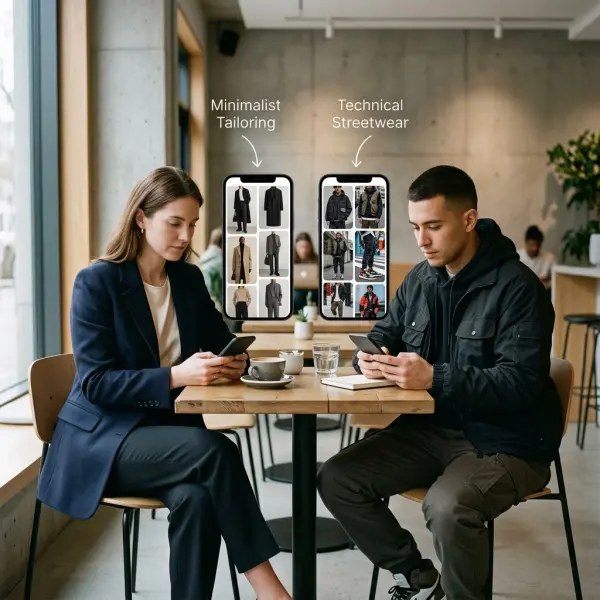
The Fashion Trend You See May Not Be the Trend Everyone Sees
Personalized feeds fragment fashion culture.
A consumer who watches vintage styling, saves second-hand outfits, follows archive-fashion accounts, and searches for retro footwear may progressively encounter more related material.
Another consumer might inhabit a feed dominated by running shoes, technical jackets, fitness creators, and outdoor clothing.
A third might see modest fashion, occasionwear, traditional textiles, or luxury handbags.
Each can develop the impression that a particular direction dominates fashion.
This is one reason claims such as “everyone is wearing this” should be treated cautiously.
The platform can show strong evidence that a specific community is highly engaged without proving equivalent adoption across the broader market.
For brands, this creates both opportunity and measurement risk.
Niche audiences can now be commercially meaningful without universal adoption. But marketers can also mistake their own professionally curated feeds for representative consumer research.
A merchandiser who follows dozens of fashion editors and trend creators is not experiencing the same recommendation environment as an average customer.
That distinction should influence trend forecasting.
Social Media Makes Fashion Trends More Visible Before They Become Mass Trends
Traditionally, spotting emerging consumer adoption at scale could require store observation, sales data, street photography, buyer feedback, market visits, trade publications, or specialized forecasting services.
Social media adds another layer: visible cultural behavior.
Fashion teams can now observe people styling the same item, repeating a particular silhouette, using similar language, discussing comfort or fit, comparing brands, modifying vintage garments, or complaining that a trend is already over.
That visibility can be useful.
It is also noisy.
A fast-growing stream of outfit videos may indicate:
- genuine product demand;
- creator seeding by brands;
- a visually interesting content format;
- imitation of celebrity styling;
- a niche community becoming more active;
- existing products receiving a new name;
- humorous participation;
- curiosity without purchase intention;
- or several of these simultaneously.
Therefore, social data is a signal, not automatically a sales forecast.
Creators Have Become Trend Translators
Fashion influencers are often described as if they simply make followers purchase products.
Their role is more complex.
Creators frequently translate fashion ideas into practical, relatable contexts.
A runway silhouette may appear commercially extreme. A creator shows how to wear a softer version with jeans.
A technical jacket designed for outdoor activity becomes part of an urban outfit.
A vintage aesthetic is recreated with thrifted garments.
A luxury styling idea is translated into a lower-price wardrobe.
A micro-aesthetic is blended with local fashion preferences.
This translation function can matter because consumers often need to see not merely what a product looks like, but how it fits into an achievable outfit.
Academic evidence supports treating influencers as meaningful—but not solitary—participants in fashion diffusion. The 2024 Fashion and Textiles study found connections among influencer imagery, runway collections, and online retailer best items rather than a simple one-way causal chain.
Research in the Journal of Retailing and Consumer Services has also found relationships among fashion influencer credibility, content characteristics, engagement, and purchase intention. Such studies support the commercial relevance of influencer communication, but they should not be interpreted as proof that any creator exposure guarantees a sale. research on fashion influencer content, engagement, and purchase intention
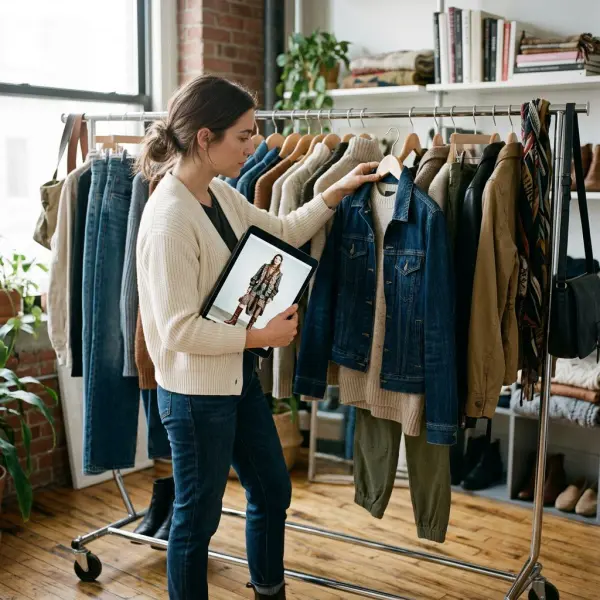
Consumers Are No Longer Only the End Point of Fashion Adoption
A consumer can now become a distributor of the trend immediately after adopting it.
Imagine a shopper purchases a pair of shoes after seeing them online.
Previously, the transaction might have ended largely in private use.
Now that shopper can:
- post an unboxing;
- create an outfit video;
- review comfort and sizing;
- give the style a new description;
- tag or mention the retailer;
- answer questions from other shoppers;
- resell the item;
- create another styling variation.
Each activity produces additional information that can influence future discovery.
The consumer has become part of the communication infrastructure.
This is why contemporary fashion adoption cannot be separated neatly into “industry produces” and “consumer receives.”
Consumers interpret the product publicly.
Social Media Shortens the Distance Between Observation and Response
The biggest operational effect may be time.
When teams can watch an emerging look develop almost daily, the temptation is to respond immediately.
That creates a mismatch with traditional apparel production.
A social trend can gain visibility faster than a company can:
design a garment → approve fabric → source trims → make samples → revise fit → place an order → manufacture → inspect → ship → distribute → merchandise.
By the time the product reaches stores, the aesthetic name may already have faded.
Vogue Business has repeatedly highlighted the acceleration and fragmentation of microtrend cycles, while also noting growing fatigue around the constant creation of new trend labels. Vogue Business analysis of the accelerating microtrend cycle
This does not mean fashion companies should adopt dramatically faster manufacturing at any cost.
The smarter response is to use different operational speeds for different types of signals.
A four-speed response model
|
Signal |
Appropriate response |
Typical commitment |
|
Content signal |
Social post, styling story, email, creator activation |
Very low inventory risk |
|
Merchandising signal |
Re-edit existing assortment, landing page, store display |
Low product-development risk |
|
Product test |
Small capsule, limited buy, accessory update, selected color |
Controlled inventory exposure |
|
Structural product shift |
Integrate into seasonal assortment or core product strategy |
Highest evidence requirement |
A viral aesthetic does not automatically justify the fourth response.
For many fashion businesses, the first two are considerably more rational.
Why Trend Names Can Change Faster Than the Products
The internet frequently renames familiar products.
Ballet flats have existed for decades. Technical shells existed before gorpcore. Cardigans, pleated skirts, loafers, cargo trousers, lace tops, denim, and trench coats regularly move in and out of different cultural narratives.
A new name can therefore peak and disappear while the garment remains commercially relevant.
This creates an important distinction:
Trend vocabulary is often more volatile than product demand.
A retailer that understands this can avoid throwing away useful merchandising intelligence when the language changes.
Suppose “quiet luxury” loses cultural momentum.
Customers may still want understated tailoring, neutral knitwear, high-quality leather accessories, low-logo design, or classic outerwear.
The phrase and the product signal do not necessarily have the same lifecycle.
That principle also explains why fashion aesthetics can shape personal style without permanently defining it.
Social Media Can Also Create False Signals
The visibility of trend data creates an illusion of precision.
Brands can count views, likes, saves, shares, mentions, searches, and comments.
But measurement does not automatically mean interpretation is correct.
Virality may be concentrated
A trend can be enormous inside one age group, city, community, platform, or creator network and barely visible elsewhere.
That does not make it commercially irrelevant.
It simply makes the market narrower than the headline suggests.
Negative attention still generates visibility
People sometimes engage with clothing because they dislike it.
A controversial shoe or styling combination can produce enormous comment activity without equivalent positive demand.
Sentiment therefore matters.
Content creators may be responding to each other
Twenty creators posting the same product does not automatically represent twenty independent discoveries.
They may share inspiration, belong to the same creator network, respond to the same celebrity moment, or participate in a paid or gifted campaign.
Brands should investigate the source structure behind the apparent trend.
A highly visual idea can outperform a commercially useful one
Social media rewards content that makes people stop, watch, react, or share.
A dramatically oversized silhouette may perform extremely well as content partly because it is unusual.
A commercially safer garment might look less spectacular in a short video yet sell more consistently.
Social performance and product performance are related only under certain conditions.
How Fashion Businesses Should Monitor Social-Media Trends
The useful discipline is not “trend chasing.”
It is signal interpretation.
1. Track the language and the product separately
Record the aesthetic term, but also identify what people are actually wearing.
For example:
Trend label: balletcore
Observable product signals: ballet flats, wrap knits, fitted cardigans, soft layering, ribbon details.
Six months later, the label may weaken while ballet flats remain strong.
If the company tracks only the hashtag, it may miss the underlying product continuity.
2. Look for independent confirmation
One viral creator is interesting.
A stronger signal appears when several independent sources begin aligning:
- organic creator styling;
- customer searches;
- product-page traffic;
- retailer sell-through;
- store inquiries;
- user-generated outfits;
- resale activity;
- editorial coverage;
- search trend movement.
No single combination guarantees future demand, but convergence improves confidence.
3. Analyze who is participating
Ask:
Is this mainly teenagers?
Luxury consumers?
Outdoor enthusiasts?
Fashion professionals?
A specific geographic community?
Existing customers?
The answer determines commercial relevance more effectively than total view count.
4. Measure behavior after attention
The most useful metrics come later in the funnel:
content view → product visit → save → cart → conversion → return → repeat purchase.
A trend that generates huge reach but weak product engagement should be treated differently from a smaller community that consistently converts.
5. Monitor rejection as well as adoption
Fashion cycles contain fatigue.
Once consumers begin describing an aesthetic as overexposed, overly commercial, or repetitive, that conversation is itself a trend signal.
The appearance of counter-trends can also be informative.
An excessively polished aesthetic may encourage deliberately messy styling. Maximalism can develop partly in contrast with minimalism. Hyper-feminine fashion can coexist with renewed interest in utility or androgyny.
Trend forecasting improves when teams monitor tension, not only growth.

What Social Media Means for Fashion Product Development
For product teams, social media is most useful during observation, validation, and merchandising, not as an unquestioned design brief.
Product development still needs to consider:
- target customer;
- fit;
- fabric availability;
- minimum order quantities;
- supplier capability;
- cost;
- margin;
- production lead time;
- product quality;
- seasonality;
- climate;
- returns;
- brand identity;
- existing assortment.
A trend does not cancel those fundamentals.
Consider a brand seeing increased interest in sheer layered skirts.
A weak response is:
“Everyone is wearing sheer skirts. Add them to the collection.”
A stronger analysis asks:
Which lengths?
What level of transparency?
Are customers layering them over briefs, trousers, slips, or dresses?
Which fabrics?
Are they buying them or only saving styling posts?
Can the product meet local modesty expectations?
Does the brand already sell compatible tops and footwear?
What return issues might transparency create online?
That is the difference between noticing a trend and developing a commercially viable product.
What Social Media Means for Retail Merchandising
Retail can respond faster than manufacturing.
This is one of the biggest advantages brands already possess.
A retailer may discover that existing products suddenly fit an emerging aesthetic. Instead of waiting for new production, it can reorganize what it already has.
A collection of loafers, button-down shirts, knitwear, and pleated skirts can become a preppy edit.
Technical jackets and trail shoes can be grouped into an outdoor-inspired styling story.
Ballet flats and fitted cardigans can participate in a dance-inspired edit.
No new SKU is required.
This turns aesthetic awareness into a merchandising layer rather than an inventory gamble.
What Social Media Means for Brand Communication
Brands face a delicate choice when adopting internet terminology.
Using the current label can improve relevance and discoverability.
Using it too aggressively can make communication feel opportunistic.
A useful rule is:
Use trend language when it helps customers understand the product; do not let the trend language replace the brand's own voice.
A heritage outdoor company does not need to suddenly describe its entire identity as gorpcore.
A footwear brand can acknowledge renewed ballet-flat interest without pretending the product was created by a recent aesthetic.
Fashion communication becomes more credible when the brand understands both the trend and the product's longer history.
Common Mistakes Brands Make With Social Fashion Trends
Mistake 1: Assuming the algorithm created the trend
Recommendation systems influence distribution.
They do not necessarily originate the underlying fashion idea.
A trend may begin with runway collections, celebrities, communities, archive references, music scenes, established consumer behavior, or older garments that suddenly receive renewed attention.
Better approach: investigate origin and amplification separately.
Mistake 2: Treating every aesthetic name as a new market
A new term can describe an old customer preference.
Creating another customer segment for every “-core” can make strategy unnecessarily fragmented.
Better approach: map new language back to stable customer attributes such as silhouette, price, fit, category, color, function, and lifestyle.
Mistake 3: Using the marketing team's feed as market research
Employees working in fashion often consume unusually high volumes of fashion content.
Their feeds can therefore exaggerate the apparent scale of trends.
Better approach: combine qualitative observation with customer and commercial data.
Mistake 4: Manufacturing at social-media speed
Reacting to every rising trend with new inventory can create excess stock if cultural attention moves faster than supply.
Better approach: respond first with styling, merchandising, existing inventory, or limited tests.
Mistake 5: Ignoring the original context of a trend
Some aesthetics draw from specific subcultures, professions, ethnic dress, religious practices, regional traditions, or marginalized communities.
Turning them into generic marketing language can erase context or create reputational problems.
Better approach: research cultural origins before commercializing the references.
Mistake 6: Believing a trend is dead because the name disappeared
The phrase may disappear while underlying products remain strong.
Better approach: track the product signal independently from the terminology.
What Brands Should Verify Before Acting on a Social Trend
Before converting social visibility into a product or inventory decision, verify:
Origin. Where did the style or product actually come from?
Audience. Which consumers are participating?
Scale. Is the activity broad or concentrated in a niche?
Independence. Are multiple communities adopting it independently, or is exposure coming from the same creator network or campaign?
Commercial behavior. Are people clicking and buying, not merely watching?
Product persistence. Does the underlying item have value beyond the current name?
Operational timing. Can the business respond while the opportunity remains relevant?
Brand fit. Does the product make sense inside the brand's established identity?
Risk. What happens if demand drops before stock arrives?
These questions are deliberately less exciting than watching a viral video.
They are also considerably more useful for merchandise planning.
Social Media Has Not Eliminated Fashion Gatekeepers—It Has Multiplied Them
One common narrative says social media democratized fashion by removing traditional gatekeepers.
There is some truth in that, but the reality is more complicated.
Editors and buyers no longer control fashion visibility to the extent they once did. Independent creators and consumers can reach large audiences.
At the same time, new forms of mediation now matter:
- recommendation systems;
- creator networks;
- platform moderation;
- celebrity accounts;
- brand seeding;
- advertising;
- affiliate commerce;
- online retail rankings;
- search interfaces;
- community norms.
The result is not a world without gatekeepers.
It is a world with more pathways through which fashion attention can be filtered and amplified.
That is why the contemporary trend system feels both more open and more difficult to interpret.
Frequently Asked Questions
How has social media changed fashion trends?
Social media has made fashion trend diffusion faster, more participatory, more personalized, and more fragmented.
Consumers can now discover styles through creators and recommendation feeds, reinterpret them publicly, create new names, and redistribute them to other users. Platforms such as TikTok and Instagram use recommendation systems that personalize what people see based partly on interaction and interest signals.
This does not mean social media replaced designers, celebrities, retailers, or subcultures. It added new routes through which those influences circulate.
Does TikTok create fashion trends?
TikTok can help amplify, organize, and accelerate fashion trends, but saying that it simply “creates” them is often too strong.
Some trends originate with creators, while others emerge from runway collections, celebrities, music, existing subcultures, vintage fashion, retailers, or older products that gain renewed attention.
TikTok's recommendation system can expose users to content beyond accounts they already follow, which can significantly assist discovery.
A more accurate description is that TikTok has become one important trend-distribution and reinterpretation environment.
Why do fashion trends now have names like cottagecore and balletcore?
Short aesthetic labels make complicated visual ideas easier to communicate.
A single name can connect several garments, colors, accessories, activities, historical references, and styling behaviors into one recognizable concept. Users can then search, discuss, imitate, modify, or parody that concept.
Many such names repackage older fashion references rather than describing completely new clothing. Vogue has documented this pattern across numerous internet aesthetics.
Do algorithms make fashion trends spread faster?
Recommendation systems can contribute to faster distribution by showing relevant content to users based on predicted interests rather than relying only on accounts they already follow.
TikTok and Meta both publicly describe personalized ranking and recommendation systems that use behavioral or interest signals to select content.
However, speed also depends on the trend itself: visual recognizability, creator participation, celebrity exposure, media attention, product availability, and cultural context all matter. Algorithms should therefore be understood as part of the distribution system, not a complete explanation.
Are social-media fashion trends becoming shorter?
Some internet-driven microtrends can rise and fall rapidly, and fashion media have documented concerns about accelerated microtrend cycles.
There is no single universal lifespan, however.
A trend name can disappear while products associated with it remain popular. Conversely, a widely discussed aesthetic may produce very little durable purchasing behavior.
Brands should therefore measure the lifecycle of both the cultural label and the underlying product attributes.
How can fashion brands tell whether a social-media trend is commercially relevant?
Look for convergence between attention and behavior.
A stronger signal combines social engagement with customer searches, product-page traffic, add-to-cart activity, conversion, full-price sell-through, repeat purchases, user-generated styling, store feedback, and possibly resale activity.
The audience also matters. A smaller trend strongly aligned with the brand's customers may be commercially more valuable than a global viral aesthetic with little customer overlap.
Should fashion brands use trending aesthetic names in SEO and content?
They can, when the terminology genuinely describes the products or styling being discussed.
Trend names may provide useful search and discovery vocabulary while consumers recognize them. However, content architecture should also target more durable entities such as garment categories, silhouettes, materials, styling techniques, and use cases.
This prevents the page from becoming obsolete when the aesthetic terminology changes and supports stronger long-term topical authority.
Can social media replace professional fashion forecasting?
No.
Social media can provide valuable real-time cultural signals, but it is only one source of evidence. Fashion forecasting also requires analysis of runways, retail performance, historical cycles, consumer behavior, economic context, material development, cultural movements, climate, regional differences, product lead times, and business data.
The 2024 Fashion and Textiles study supports this multi-source view by showing relationships among runway imagery, influencer outfits, and online retailer best items rather than identifying a single dominant source for all trend information.
Conclusion
Social media has not changed the basic human behavior behind fashion: people still observe one another, borrow ideas, signal belonging, experiment with identity, rediscover old garments, and turn cultural references into dress.
What changed is the infrastructure around that behavior.
Fashion ideas can now acquire names before the industry formally defines them. Small creator communities can reach people outside their follower networks. Consumers can publicly reinterpret the same trend they have just adopted. Retailers and brands can observe the reaction almost immediately. Recommendation systems can expose different audiences to different versions of what appears to be the same fashion moment.
The result is a fashion trend system that is faster, more fragmented, more participatory, and less linear.
For fashion businesses, this creates an enormous amount of useful information—and an equally large amount of noise.
The strategic task is therefore not to react to every viral name.




Comments 0
Leave a CommentSend Comment
Anda harus Login terlebih dahulu untuk dapat memberikan komentar.