
How Fashion Brands Design Collections for Travel and Leisure
Quick Answer
Fashion brands design collections for travel and leisure by translating real travel situations into a coordinated product range. The process usually begins with a defined customer, destination context, climate, activity pattern, and price position—not with tropical prints or a generic holiday mood board.
Design teams then build a range around practical wardrobe needs such as transit, sightseeing, swimming, dining, events, sun coverage, and changing temperatures. Each style must be assessed for comfort, fit, packability, opacity, care, fabric performance, coordination, production feasibility, and potential use after the trip.
A commercially sound travel collection also requires disciplined assortment planning. Brands must decide how many statement pieces, versatile separates, swim products, accessories, and entry-price items they can support without creating excessive stock or operational complexity.
The strongest collections balance three elements: a recognisable brand identity, believable destination relevance, and products customers can actually use. For smaller labels, a tightly edited capsule is often more realistic than launching multiple unfamiliar categories at once. The goal is not to design an imaginary holiday wardrobe. It is to create a coherent offer for specific travel and leisure occasions while protecting margin, quality, and inventory control.

What Is a Travel and Leisure Fashion Collection?
A travel and leisure fashion collection is a coordinated range of apparel and accessories designed around the practical, social, and emotional needs of people travelling, relaxing, attending destination occasions, or spending time in leisure-oriented environments.
It may be presented as resortwear, a cruise collection, a holiday capsule, a summer edit, a destination collection, a travel wardrobe, or a leisure line. These labels overlap, but they are not always interchangeable.
At luxury fashion houses, a resort or cruise collection can function as a major bridge season positioned between traditional spring/summer and autumn/winter collections. Such collections may include tailoring, knitwear, leather goods, evening pieces, and outerwear rather than only warm-weather clothing. Vogue describes modern resort or cruise collections as an established intermediate season that developed from travel clothing into a major presentation and marketing format. Readers can review its overview of the resort and cruise fashion season.
For a smaller brand, the meaning is usually more practical. The collection may consist of six to fifteen coordinated styles intended for a particular customer journey, such as a tropical holiday, coastal weekend, wellness retreat, cruise, destination wedding, or warm-climate city break.
The category foundation is explored in resortwear fashion from holiday style to lifestyle trend. This article focuses on what happens behind the finished imagery: research, range planning, materials, sampling, sourcing, costing, manufacturing, and commercial launch.
Why Do Brands Develop Collections Around Travel?
Travel gives fashion brands a clear occasion around which to organise products, imagery, and customer communication. Rather than marketing an isolated dress or shirt, the brand can present a complete wardrobe for a recognisable sequence of activities.
Travel also remains a substantial global context. UN Tourism estimated 1.52 billion international tourist arrivals in 2025, representing overnight international arrivals rather than unique travellers. The figure does not reveal apparel spending by itself, but it confirms the scale of travel-related occasions that can influence fashion demand. The source is available through the UN Tourism World Tourism Barometer update.
A travel collection can support several business objectives:
- Create a focused seasonal or bridge-season product story
- Introduce new colours, prints, or lightweight constructions
- Encourage coordinated purchases across categories
- Enter hotel, destination, airport, or coastal retail
- Support partnerships with hospitality and tourism businesses
- Extend the relevance of summer products
- Test lifestyle positioning without changing the entire brand
- Create editorial content around places, occasions, and itineraries
These opportunities do not guarantee commercial success. Travel volume, social-media interest, and attractive campaign locations are not substitutes for product demand.
A brand still needs to determine who is travelling, what they actually wear, what they already own, how much they spend, and whether the proposed products remain useful after the trip.
The Design Process Should Begin With a Traveller, Not a Destination Image
One of the most common product-development errors is beginning with a location photograph and then designing garments that resemble its colours or atmosphere.
A visual concept can provide direction, but it does not define a customer need.
A more reliable process begins with a traveller profile. The profile should be specific enough to guide product decisions but not so fictional that it becomes impossible to validate.
For example:
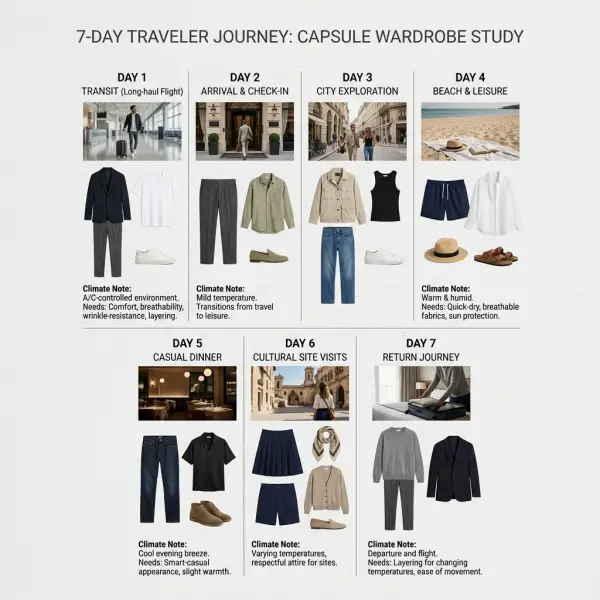
A professional woman aged 30–45 is taking a seven-day warm-weather trip. She expects two travel days, three casual daytime activities, one beach visit, and two dinners. She prefers modest coverage, carries one checked or cabin-size suitcase, and wants clothes she can wear again in her home city.
That description immediately creates product implications. The collection may need wrinkle-tolerant dresses, a lightweight layering shirt, versatile trousers, covered shoulders, flat footwear, a compact evening option, and a restrained colour palette that supports multiple combinations.
Compare that with a different traveller:
A younger customer is attending a three-day destination wedding and wants distinctive outfits for a welcome dinner, daytime ceremony, beach gathering, and social-media photographs.
This collection may require stronger visual impact, occasion-level fabrics, coordinated accessories, and a clearer distinction between event dressing and casual leisurewear.
The destination still matters, but it is only one input.
What Should a Brand Research Before Designing?
Travel collection research should connect customer behaviour with climate, activity, pricing, and distribution. Generic trend research is not enough.
Customer and Wardrobe Research
The brand needs to understand how the target customer currently prepares for travel.
Useful research questions include:
- Which clothes do customers already pack?
- Which products do they buy specifically for trips?
- What do they repeatedly complain about?
- Which garments remain unworn during travel?
- How important are photographs and social events?
- Do they prefer cabin luggage or checked baggage?
- How much outfit repetition will they accept?
- Do they expect to wash clothing during the trip?
- Which modesty, body-coverage, or cultural requirements apply?
- Will the clothes be worn again at home?
Brands can gather these insights through interviews, customer-service records, product reviews, social content, return reasons, surveys, styling appointments, and past sales data.
A small sample should not be treated as proof of an entire market. Its value is to reveal patterns and questions that can be tested through product trials or limited releases.
Itinerary and Activity Research
A travel wardrobe should reflect actual activities rather than a general atmosphere.
A beach holiday can involve:
- Airport transfers
- Hotel check-in
- Walking through a town
- Swimming
- Outdoor meals
- Air-conditioned interiors
- Religious or cultural sites
- Boat travel
- Evening events
- Sudden rain or wind
Each activity creates different requirements for coverage, footwear, fabric, pockets, closures, layering, and care.
A dress that works beside a pool may not work on a motorbike transfer or during a long restaurant meal. A floor-length garment may appear elegant but become impractical on uneven streets. A lightweight shirt may provide useful sun coverage but become uncomfortable if the fabric has poor moisture behaviour.
Climate Research
“Warm weather” is not one condition.
Dry heat, high humidity, intense ultraviolet exposure, tropical rain, cool coastal wind, and heavily air-conditioned interiors create different apparel needs. Brands should review average temperature, humidity, rainfall, wind, and likely indoor conditions for the intended market or travel period.
The collection does not need to solve every possible weather scenario. It should be clear about the conditions it is designed to handle.
Cultural and Social Context
Travel products must account for the environments in which customers will wear them. Dress expectations can differ between beaches, resorts, restaurants, cities, places of worship, family gatherings, cruise dining rooms, and destination events.
Brands should avoid treating destinations as culturally interchangeable. The same sleeveless dress, swim cover-up, or sheer fabric may be acceptable in one environment and unsuitable in another.
This is not only a marketing issue. It affects neckline depth, sleeve length, lining, hem length, layering options, and product descriptions.
Competitive and Price Research
Competitor research should examine more than visual style.
The brand should compare:
- Product categories
- Retail prices
- Fabric composition
- Size ranges
- Fit approach
- Lining and finishing
- Country of manufacture
- Product reviews
- Delivery timing
- Discount patterns
- Repeat styles
- Best-selling colour families
- Styling and product information
- Channel positioning
A lower-priced competitor may use a very different fabric, production scale, margin structure, or distribution model. Price comparison without understanding these differences can lead to unrealistic costing targets.
How Brands Translate a Travel Journey Into a Product Brief
Once the customer and itinerary are defined, the brand can build a product brief. The brief connects the creative idea with measurable product requirements.
A useful brief should specify:
|
Brief component |
Practical question |
|
Customer |
Who is expected to buy and wear the product? |
|
Occasion |
Where and during which activity will it be worn? |
|
Climate |
What temperature, humidity, wind, rain, or indoor conditions are expected? |
|
Fit |
Should the garment be relaxed, fitted, adjustable, layered, or supportive? |
|
Coverage |
What neckline, sleeve, length, opacity, and movement requirements apply? |
|
Material |
Which drape, weight, stretch, drying, wrinkle, or care characteristics are required? |
|
Coordination |
Which other items in the range must work with it? |
|
Price |
What target retail price and cost ceiling apply? |
|
Channel |
Will it be sold online, wholesale, in hotels, or through destination retail? |
|
Testing |
Which risks must be checked before bulk production? |
|
Rewear |
Can the product remain useful outside the original trip? |
This document helps prevent creative drift.
Without a clear brief, a design can gradually become more expensive, less wearable, or less relevant as print, trims, embellishment, and sample changes accumulate.
How Is a Travel Collection Assortment Planned?
Assortment planning determines how many products the brand will offer, how they work together, and which commercial role each style performs.
A collection should not consist entirely of statement dresses. It also should not become so practical that it loses any emotional or visual distinction.
Start With the Customer’s Outfit Needs
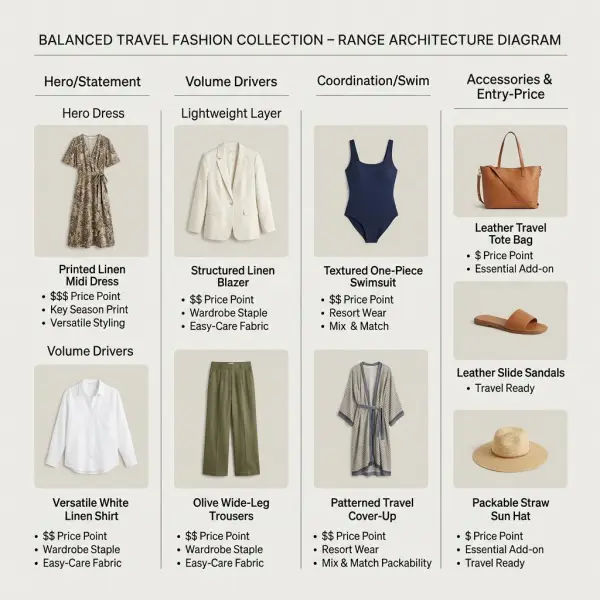
A simple seven-day capsule may require fewer garments than days because products can be coordinated and repeated.
One possible architecture is:
- Two versatile tops
- One statement shirt or blouse
- Two bottoms
- Two dresses
- One layering garment
- One swim or leisure product
- One cover-up
- Two accessory categories
This is an example, not a universal formula. A destination wedding capsule may require more event pieces. A modest travel line may allocate more range space to layering. A men’s collection may rely more heavily on shirts, shorts, trousers, and lightweight outerwear.
Assign a Commercial Role to Every Style
Each product should have a reason to exist within the range.
|
Product role |
Purpose in the assortment |
|
Hero product |
Creates campaign recognition and expresses the collection concept |
|
Volume driver |
Has wider appeal, practical use, and scalable sales potential |
|
Coordinating product |
Connects several outfits and supports basket size |
|
Entry-price product |
Allows customers to access the collection at a lower spend |
|
Margin product |
Supports profitability through favourable cost-to-price structure |
|
Destination-specific item |
Solves a particular travel or leisure need |
|
Repeatable core |
Can continue across seasons in new colours or prints |
|
Experimental product |
Tests a new category, material, or customer behaviour |
A hero product may attract attention while a simpler shirt or trouser produces most of the repeat sales. Brands should not confuse campaign visibility with expected unit volume.
Control the Number of Colours and Prints
Travel collections often rely on strong visual stories, but excessive colour and print variation increases fabric minimums, sample costs, production complexity, and leftover stock.
A controlled palette allows more products to coordinate.
For example, one collection could use:
- Two foundation neutrals
- One primary seasonal colour
- One supporting accent
- One print combining the palette
This gives the customer styling flexibility while simplifying production.
The commercial relationship between seasonal colour and consumer choice is discussed in how seasonal color palettes influence consumer buying decisions.
Decide Which Categories Should Be Made Internally or Sourced
A clothing brand may be capable of producing dresses and shirts but have no technical expertise in swimwear, footwear, hats, or bags.
Adding a category requires new suppliers, patterns, components, quality standards, testing, fit knowledge, and inventory commitments.
The brand has several options:
- Develop the category internally
- Source finished products from a specialist supplier
- Collaborate with another brand
- Use private-label production
- Limit the range to existing competencies
- Introduce the category only after testing demand
A smaller but credible collection is usually stronger than a broad range with uneven quality.
How Brands Select Fabrics for Travel and Leisure Products
Fabric selection must connect the desired aesthetic with the garment’s expected environment. Fibre content alone is not enough.
Two fabrics labelled as cotton can differ substantially in weight, yarn, weave, finish, shrinkage, opacity, handle, wrinkle behaviour, and drying time. The same is true for linen, viscose, lyocell, polyester, nylon, and blended materials.
Begin With the End Use
A fabric for a fluid dinner dress may need drape, opacity, colour depth, and comfortable movement. A travel shirt may prioritise crease recovery, breathability, washability, and stability. Swimwear requires suitable stretch, recovery, lining, and resistance to likely exposure conditions.
The design team should evaluate:
- Weight
- Drape
- Air permeability
- Opacity
- Stretch and recovery
- Dimensional stability
- Wrinkle appearance
- Drying behaviour
- Colourfastness
- Abrasion or snagging risk
- Seam compatibility
- Care requirements
- Lining needs
- Handfeel in heat or humidity
No fabric will optimise every factor. A linen fabric may provide attractive texture but crease heavily. A synthetic blend may improve recovery and drying but create a different handfeel or environmental profile. A delicate regenerated-cellulose fabric may drape beautifully while requiring additional stability testing.
Test According to the Product Risk
Testing should be selected based on the expected use and the consequences of failure.
The American Association of Textile Chemists and Colorists lists recognised test methods covering issues such as colourfastness to crocking, perspiration, light, laundering, chlorinated pool water, appearance after laundering, and wrinkle recovery. Brands do not need every available test for every product, but the range shows why generic “quality checked” language is insufficient. Relevant methods should be chosen according to the garment and market. See the AATCC standards and test-method directory.
For travel and leisure products, testing may include:
- Colourfastness to washing
- Colour transfer through rubbing
- Colourfastness to perspiration
- Light exposure
- Chlorinated pool water for relevant products
- Saltwater or swim-use evaluation where appropriate
- Shrinkage and dimensional change
- Appearance after laundering
- Seam strength or seam slippage
- Stretch recovery
- Pilling or abrasion
- Print durability
- Hardware corrosion
- Opacity in wet and dry conditions
ASTM’s apparel seam test methods also recognise that seam performance varies according to fabric and seam assembly. This matters for lightweight woven fabrics that may look suitable during sample review but later show seam opening or slippage during wear.
Laboratory testing should be supported by wear trials. A technical result cannot fully show whether a neckline shifts during movement, a hem becomes difficult on stairs, a tie loosens, or a fabric feels uncomfortable in humid conditions.
Evaluate Sustainability Claims Carefully
Material decisions should not be reduced to “natural is good” and “synthetic is bad.” Environmental performance depends on raw-material production, processing, energy, chemistry, durability, use, care, and end-of-life conditions.
Textile Exchange’s Fiber and Materials Matrix is one example of a framework that evaluates multiple impact areas and the availability of supporting evidence. It also cautions that a low or absent score does not necessarily prove that an impact area is unaddressed; evidence quality and programme documentation matter. Brands can consult the Textile Exchange Fiber and Materials Matrix when developing a broader material strategy.
A travel collection should therefore use narrow and verifiable claims. “Made with 60% recycled polyester” is more specific than “planet-friendly holiday wear,” although the fibre-content claim still needs supporting documentation.
Fit and Construction Matter More Than the Relaxed Aesthetic Suggests
Travel clothing is often described as effortless, loose, or easy. Those terms can hide significant technical requirements.
A relaxed dress still needs correct armhole depth, neckline stability, garment balance, and hem control. A wide-leg trouser must work while walking, sitting, climbing stairs, and using transport. An oversized shirt needs sleeve and shoulder proportions that remain intentional across sizes.
Design for Movement
Travel garments should be tested during realistic movements:
- Sitting for extended periods
- Walking at different speeds
- Climbing stairs
- Bending and reaching
- Carrying a bag
- Entering vehicles
- Wearing a backpack
- Moving in wind
- Layering over swimwear or base garments
- Transitioning between flat shoes and heels
Movement testing may reveal issues that are invisible on a static mannequin.
Verify Coverage and Opacity
Strong sunlight, backlighting, perspiration, and wet conditions can change the appearance of a fabric.
Brands should test:
- Whether undergarments are visible
- Whether pockets create obvious outlines
- Whether a garment becomes sheer when stretched
- Whether swim or cover-up products change when wet
- Whether necklines or wrap closures open during movement
- Whether side slits expose more than intended
- Whether lighter colours require lining
Product information should state whether a garment is lined or sheer. Customers should not have to discover these details after purchase.
Use Adjustability Carefully
Elastic waists, wraps, drawcords, ties, and adjustable straps can improve fit flexibility, but they do not remove the need for sizing.
A wrap dress may fit several waist measurements while producing very different neckline coverage across bust sizes. An elastic waist can improve comfort but create poor proportions if rise and hip grading are weak.
“One size” should not be used as a substitute for proper fit development.
Designing for Packability Without Oversimplifying Quality
Packability is valuable, but it is often used as a vague marketing term.
A garment may be physically easy to fold while still emerging from a suitcase heavily creased, losing shape, snagging, or requiring special care.
Brands should define what packability means for the product:
- Low bulk
- Low weight
- Acceptable appearance after folding
- Easy wrinkle release
- Resistance to crushing
- Compact storage
- Quick drying
- Limited need for specialist care
- Ability to coordinate with several outfits
The most relevant criteria depend on the garment.
A tailored jacket will not pack like a jersey dress. Its value may instead come from lightweight construction and the ability to recover after hanging. A linen shirt may wrinkle visibly, but the brand can decide that the natural creasing is acceptable within its design language.
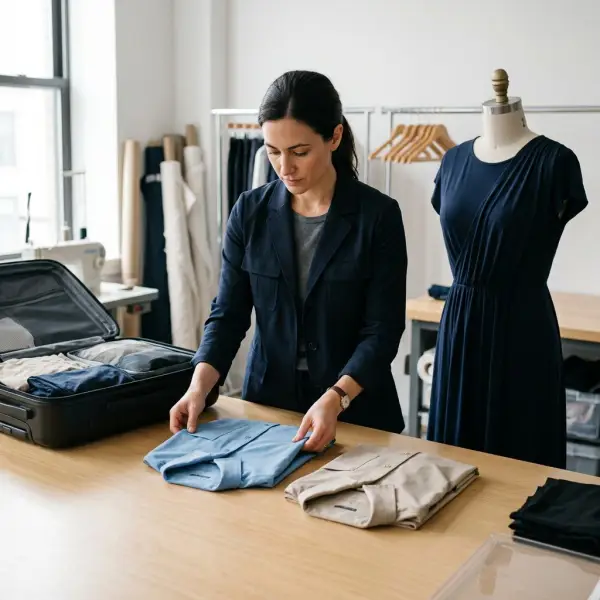
Brands should test packing claims by folding products into realistic luggage, leaving them compressed, unpacking them, and assessing their appearance. Steam, hanging time, and care requirements should be communicated honestly.
How Sourcing Decisions Shape the Collection
The creative concept must be compatible with supplier capability, lead time, minimum order quantity, and quality control.
Match Suppliers to the Product
A supplier experienced in basic cotton shirts may not be suitable for delicate bias-cut dresses. A swimwear factory may understand stretch fabrics and lining but not structured woven tailoring.
Brands should evaluate:
- Product-category experience
- Machinery and technical capability
- Pattern and sample support
- Fabric-sourcing network
- Print or embroidery capability
- Minimum order quantities
- Quality-management processes
- Lead times
- Communication
- Testing support
- Social and environmental documentation
- Capacity during the required season
The lowest quotation is not automatically the lowest commercial risk.
Understand Minimum Order Quantities
Custom prints, yarn-dyed fabrics, trims, buttons, hardware, and packaging may each have separate minimums.
A collection containing eight styles may require many more material commitments if each design uses different fabrics and colours.
Design teams can reduce unnecessary complexity by:
- Repeating fabrics across several styles
- Sharing trims
- Limiting colourways
- Using stock-supported materials
- Designing prints that work across multiple garments
- Negotiating greige or fabric commitments carefully
- Consolidating production where technically appropriate
These decisions may be less visible than silhouette design, but they strongly influence cost and inventory exposure.
Treat Destination Craft Collaboration as a Long-Term Relationship
Some travel collections draw on local weaving, embroidery, print, or craft traditions. When handled well, collaboration can create product distinction and economic opportunity. When handled poorly, it can become superficial extraction.
Vogue’s reporting on Dior’s Cruise 2025 development in Scotland described collaboration with businesses including Harris Tweed, Johnstons of Elgin, and Robert Mackie, showing how a destination concept can connect with actual supplier and craft relationships rather than serving only as a show backdrop. This example operates at luxury-house scale, but the underlying principle is relevant: local inspiration should be tied to real knowledge, attribution, and production relationships where appropriate.
Smaller brands should confirm:
- Who owns or controls the design
- Whether permission or licensing is required
- How makers are credited
- How prices and payment terms are set
- Whether lead times reflect manual production
- Whether quality variations are understood
- Whether the partnership can scale responsibly
- How cultural meaning will be communicated
A one-season marketing story may be incompatible with the time required to build a respectful craft partnership.
How Are Travel Collections Costed and Priced?
Costing should begin during design development, not after the final sample is approved.
Travel and leisure products can accumulate cost through custom prints, low production volumes, lining, handwork, trims, packaging, campaign photography, freight, testing, and destination retail margins.
The total product cost may include:
- Main fabric
- Lining
- Interlining
- Trims and hardware
- Labels and packaging
- Printing, dyeing, embroidery, or washing
- Cutting and sewing labour
- Quality control
- Testing
- Sampling and development allocation
- Freight and duty
- Warehousing
- Payment costs
- Wholesale or marketplace margin requirements
- Expected returns
- Markdown exposure
A garment with a simple silhouette may still be expensive if it uses low-volume custom fabric or significant hand finishing.
The principles behind direct materials, labour, and overhead are explained further in how fabric, labor, and overhead affect apparel costs.
Build a Price Architecture
The collection should contain more than one price level where the market and brand positioning permit it.
For example:
|
Price role |
Possible products |
|
Entry |
Scarf, hat, simple top, sarong, or small accessory |
|
Core |
Shirt, skirt, trouser, day dress, or cover-up |
|
Premium |
Tailored set, occasion dress, specialty knit, or detailed outer layer |
|
Statement |
Limited embroidery, artisanal piece, or campaign hero |
This gives customers different ways to enter the collection.
The brand must still protect clarity. A low-priced item that feels unrelated to the rest of the range may increase transactions without strengthening the product story.
Model Channel Margins Before Confirming the Design
A product sold through direct e-commerce may tolerate a different cost structure from one sold through wholesale, a hotel boutique, a department store, or a marketplace.
Before approving expensive details, the brand should model:
- Direct-to-consumer margin
- Wholesale margin
- Retail commission
- Distributor margin
- Promotional discount
- Returns
- Freight
- Taxes and duties
- Currency risk
- End-of-season markdown
A product that appears profitable at full direct retail may become unviable through wholesale.
Production Planning for Seasonal and Destination Demand
Travel collections are sensitive to timing. Late delivery can eliminate much of the intended selling window.
Work Backward From the Customer’s Shopping Period
Customers often shop before departure, not when the travel date begins.
The planning sequence may include:
- Target customer shopping window
- E-commerce or retail launch
- Warehouse receipt
- Freight and customs
- Bulk production
- Pre-production approval
- Fabric and trim production
- Final sampling and testing
- Pattern and fit development
- Range confirmation
- Initial concept and research
Wholesale brands need additional time for market appointments, buyer orders, order confirmation, and retailer delivery.
Distinguish Fashion Calendar From Customer Calendar
The formal fashion calendar can help coordinate industry events and buyer activity. The Council of Fashion Designers of America maintains a Fashion Calendar covering multiple international fashion periods and events, illustrating the continued organisational role of seasonal schedules.
However, a brand’s customer calendar may be more important than the conventional industry calendar.
Relevant demand periods may include:
- Year-end holidays
- Northern or Southern Hemisphere summer
- School holidays
- Lunar New Year travel
- Eid or other religious holiday travel
- Cruise seasons
- Wedding periods
- Domestic long weekends
- Regional dry seasons
- Festival or event calendars
A collection should arrive when the target customer is planning and buying, not simply because “resort” appears at a particular point in the global fashion cycle.
Use Phased Deliveries When Appropriate
Instead of releasing the entire collection at once, a brand can divide it into smaller deliveries.
For example:
- Early travel essentials
- Swim and beach products
- Occasion and celebration pieces
- Transitional products for returning home
Phased releases can extend storytelling and reduce the operational pressure of one large launch. They also create more opportunities to adjust later deliveries based on early results, although production commitments may already limit flexibility.
How Brands Merchandise and Communicate the Collection
Travel collections are easier to understand when customers can see how products work across a journey.
Merchandise by Occasion as Well as Category
Standard categories remain useful, but the brand can also group products around situations:
- In transit
- Pool or beach
- Exploring the destination
- Lunch and shopping
- Sunset and evening
- Destination event
- Return to the city
This helps the customer build outfits rather than purchase disconnected pieces.
Show Real Styling Relationships
If the collection claims to be coordinated, campaign and product images should demonstrate that coordination.
The same shirt might be shown:
- Open over swimwear
- Buttoned with shorts
- Tucked into trousers
- Layered under a jacket
- Worn again in an everyday city setting
This approach also supports the transition from vacation to everyday dressing, examined more deeply in why vacation dressing influences everyday fashion choices.
Provide Operational Product Information
Descriptions should answer practical questions:
- Is the garment lined?
- Is it sheer in sunlight?
- Does it stretch?
- Is the waist adjustable?
- Can it be worn over swimwear?
- Does the fabric wrinkle easily?
- How should it be washed?
- Is the fit oversized?
- Which size is the model wearing?
- Which products coordinate with it?
- Is the hardware suitable around water?
- Does the garment include pockets?




Comments 0
Leave a CommentSend Comment
Anda harus Login terlebih dahulu untuk dapat memberikan komentar.