

Why Poor Asset Management Slows Down Fashion Marketing Workflows
A fashion campaign may be creatively complete but still not ready to launch. The photography has been delivered, the collection is scheduled for release, and the marketing team has prepared its promotional calendar. Yet the e-commerce manager is searching for the correct product images, the designer is waiting for an approved campaign visual, and the social media team is unsure which files can be published.
Nothing is necessarily wrong with the creative work itself. The problem lies in how that work has been stored, identified, approved, and shared.
Fashion marketing depends on a continuous flow of visual content between photographers, designers, merchandisers, creative directors, e-commerce teams, and external partners. When digital assets are poorly managed, small uncertainties at one stage can interrupt several downstream activities.
Poor digital asset management slows fashion marketing because employees spend time locating files, resolving version conflicts, repeating creative work, and verifying content that should already be ready for use. These interruptions can delay product launches, complicate campaigns, and increase operational costs.
Understanding where these bottlenecks originate helps fashion brands improve marketing execution without automatically increasing headcount or creative production budgets.
Quick Answer: How Does Poor Asset Management Affect Fashion Marketing?
Poor asset management slows fashion marketing workflows by making creative files difficult to locate, verify, approve, and distribute. When product photographs, lookbooks, campaign visuals, and advertising materials are scattered across disconnected systems, employees may need to search manually, request files repeatedly, or recreate content that already exists.
The consequences extend beyond administrative inconvenience. Missing product images can interrupt e-commerce publication, conflicting versions can delay campaign approvals, and unclear usage rights can prevent creative assets from being released to external channels.
These problems become more visible when several departments depend on the same content or when a seasonal collection must launch within a fixed marketing window.
A structured Digital Asset Management (DAM) process can reduce these interruptions through searchable metadata, clear asset ownership, version control, approval records, and controlled distribution.
However, software alone does not guarantee faster execution. The underlying processes must establish which assets are required, who validates them, and when they become ready for publication.
The practical objective is to reduce the time and uncertainty between creative production and commercial use.

Why Fashion Marketing Depends on Reliable Digital Assets
Fashion marketing is unusually dependent on visual material because customers and commercial partners often evaluate garments through photographs before handling the actual products.
Product images communicate silhouette, color, fit presentation, and construction details. Lookbooks explain how garments belong to a collection, while campaign photographs and videos establish broader creative direction.
These assets frequently travel through several departments before reaching customers. A product photographer may deliver images to a creative coordinator, who passes selected files to a retoucher. Merchandising then verifies the product associations, the creative director approves the finished treatment, and marketing prepares different versions for advertising and retail channels.
Each handoff introduces a potential dependency. If the receiving team cannot identify the correct asset or determine its readiness, the next activity may stop until someone resolves the uncertainty.
This is why asset management should be understood as part of marketing operations rather than simply a file storage responsibility.
Creative Completion Is Not the Same as Publication Readiness
A completed photograph is not automatically a usable marketing asset.
It may still require product identification, color accuracy checks, retouching approval, licensing confirmation, or conversion into the technical format required by a publishing channel.
A fashion brand may have a full set of visually attractive images while lacking the approved files needed for e-commerce listings or paid advertisements. In operational terms, the assets exist, but they have not completed the necessary release process.
The distinction matters because marketing calendars are usually based on publication dates rather than photography completion dates. A shoot delivered on schedule does not protect a launch if the resulting assets remain unverified.
Small Delays Can Accumulate Across Departments
A delay in asset preparation rarely affects only the person handling the file.
When approved images are unavailable, designers may postpone layout production, e-commerce teams may leave product pages incomplete, and marketing coordinators may be unable to finalize advertising materials.
These dependencies can create a queue of unfinished activities, particularly when work must pass through a small number of approvers.
The severity depends on workflow design. Some tasks can proceed using provisional materials, while others require final approval before publication. Brands should distinguish these situations rather than treating every missing asset as equally critical.
Where Poor Asset Management Creates Marketing Bottlenecks
Asset-related delays tend to appear at specific points in the creative-to-commercial workflow. Identifying those points is more useful than treating all organizational problems as a general lack of efficiency.
The following examples illustrate common failure patterns and their operational consequences.
|
Workflow stage |
Common asset problem |
Potential business consequence |
|
Creative intake |
Files arrive without clear product or campaign references |
Additional identification and verification |
|
Asset retrieval |
Photographs are scattered across folders and accounts |
Longer preparation and coordination |
|
Editing |
Several conflicting versions circulate |
Rework and inconsistent deliverables |
|
Approval |
Ownership or review status is unclear |
Campaign release delays |
|
E-commerce publishing |
Images are linked to incorrect product variants |
Incorrect listings and corrective work |
|
Channel adaptation |
Approved masters are unavailable or unsuitable |
Repeated exports and redesign |
|
External distribution |
Partners receive outdated or unauthorized files |
Inconsistent brand presentation or rights exposure |
These problems often overlap. A missing product identifier, for example, can make files harder to retrieve while also increasing the likelihood of incorrect image assignments later.
1. Employees Spend Too Much Time Searching for Files
One of the clearest symptoms of weak asset management is repeated searching.
A social media manager may need a photograph of a particular jacket but know only its collection name. If the image library is organized by photographer, shooting date, or loosely named folders, locating the correct file may require help from several colleagues.
The same problem appears when a campaign manager requests previously approved imagery but cannot distinguish the approved version from unfinished alternatives.
Manual searching does not necessarily require a large amount of time in any single instance. Its operational impact becomes more significant when similar requests occur repeatedly across departments and collections.
Adobe's asset search documentation describes how searchable metadata, filters, collections, and version information support asset retrieval. It also explains why metadata quality affects search effectiveness.
For a fashion brand, the practical lesson is that retrieval needs to reflect how employees identify garments and campaigns, not merely where source files were originally saved.

2. Duplicate Assets Create Confusion About the Correct Version
Fashion creative production frequently generates multiple files with similar appearances.
A photograph may exist as a camera original, edited master, retouched revision, approved image, marketplace export, and social media adaptation. These versions may all be legitimate, but problems emerge when the relationships between them disappear.
Employees may download an outdated photograph because its filename contains the word "final," while the actual approved image is stored elsewhere. A designer could unknowingly develop an advertisement using a superseded treatment, creating further corrections during review.
Duplicate detection can help identify redundant files, although it is not identical to version management. Adobe's duplicate asset detection documentation describes a checksum-based approach that can identify duplicate file content even when filenames differ.
That capability does not automatically establish whether visually similar but differently edited photographs represent legitimate creative variations. Brands still need rules for masters, revisions, renditions, and approval status.
3. Missing Product Associations Delay E-Commerce Publication
Fashion product imagery must correspond to the merchandise being sold.
Suppose a brand produces the same dress in black, ivory, and olive. The photography may look nearly identical in composition, but each colorway represents a different product presentation.
If images arrive without reliable product references, the e-commerce team may need to compare garment photographs manually against product records, contact merchandising, or request additional validation.
This work becomes more complicated when several related styles share similar silhouettes.
Incorrect associations can also create downstream problems. Google's Merchant Center image requirements specify that product images should accurately reflect the submitted item and its variations. For product submissions, incorrect image associations may require correction and can affect listing eligibility.
The root problem is often not poor photography. It is the absence of a reliable connection between the image and the authoritative product record.

4. Unclear Approval Ownership Creates Waiting Time
Creative approval is necessary, but an undefined approval process can create delays even when the actual review is straightforward.
A campaign image may need approval from the creative director, while the merchandising team must confirm garment accuracy and another authorized person must verify external usage permissions.
If employees do not know who is responsible for each decision, files may circulate through informal email or messaging conversations without a clear conclusion.
The problem is not necessarily excessive oversight. It may be that different approval responsibilities have never been distinguished.
Adobe's asset review workflow guidance illustrates a structured approach in which reviewers can approve or reject assets and the system records review outcomes.
Fashion brands do not need to replicate a particular enterprise workflow, but they should identify the appropriate decision-maker, expected outcome, and release conditions for each approval stage.
5. Channel-Specific Requirements Trigger Repeated Work
A fashion campaign may use the same approved photography across an online store, email, social media, digital advertising, and wholesale communications.
However, these channels often have different image dimensions, aspect ratios, file formats, and composition requirements.
If the brand retains only a small exported image or cannot locate the approved high-quality master, designers may need to reconstruct assets or request new exports from an external agency.
Even when the source file is available, an automatic crop may remove important garment details or disrupt the intended composition. A channel-specific creative adjustment may therefore require additional review.
Poor asset management makes this process less predictable because employees cannot easily determine which version should serve as the source.
There is also a technical performance dimension. Google's web.dev guidance on responsive images explains how delivering appropriately sized images can reduce transferred data and potentially improve image-related loading performance.
This does not mean DAM alone improves website speed. It means reliable source assets and properly configured delivery processes make appropriate image optimization easier to maintain.
6. Unclear Usage Rights Interrupt Campaign Distribution
Fashion marketing assets may include work produced by photographers, videographers, models, creative agencies, and other contributors.
Usage conditions can differ between owned websites, paid advertising, retailer distribution, international campaigns, or extended commercial use.
If licensing information is missing, a marketing employee may be unable to determine whether an otherwise approved photograph can be used for a particular advertisement.
The brand then faces a choice between delaying publication while verifying permissions or proceeding without adequate confirmation. The second option may create legal or contractual exposure.
The IPTC Photo Metadata User Guide explains fields for copyright ownership, licensing conditions, rights usage terms, and other information supporting image administration.
Those fields should reflect verified agreements. They do not themselves grant permissions or settle legal ownership questions.
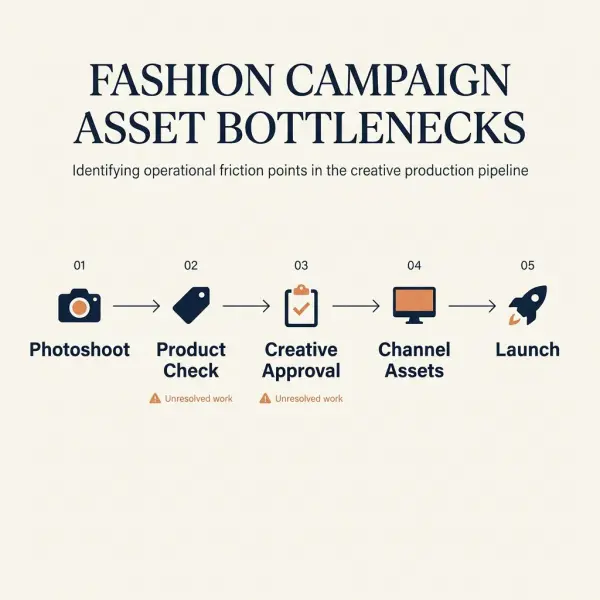
How Asset Problems Disrupt a Fashion Collection Launch
The operational consequences become easier to understand when several asset-related problems occur during one launch.
Consider a hypothetical fashion brand preparing a new ready-to-wear collection. The brand plans to introduce its products through an online store, email campaign, social channels, and selected wholesale partners.
The creative team has completed its photoshoot, and the marketing calendar is already established. But the product photographs are stored under shooting-session numbers, the lookbook designer has a separate image folder, and the e-commerce team cannot confirm which retouched files are final.
The First Bottleneck: Product Images Are Not Ready
The e-commerce manager begins preparing product listings but discovers that several images cannot be reliably matched to their colorways.
Rather than publishing the affected listings, the team requests clarification from merchandising and the photographer.
Other tasks may proceed, but the product pages cannot be considered ready until the associations are confirmed.
This is a critical distinction: the images are available, but their commercial identity is not sufficiently reliable.
The Second Bottleneck: Campaign Materials Depend on Unapproved Files
Meanwhile, the designer prepares social media graphics using photographs selected earlier in the process.
During final review, the creative director identifies a newer approved image treatment. The previous graphics must be corrected or regenerated.
The amount of rework depends on how extensively the images were incorporated into the designs. A simple image replacement may be quick, whereas complex compositions or videos may need substantial revision.
The delay originated upstream, where version information and approval status were not clearly maintained.
The Third Bottleneck: Distribution Readiness Remains Uncertain
Once the marketing team receives corrected assets, it begins preparing files for the various publication channels.
Some assets need additional crops. Others require usage-rights verification before they can be provided to retail partners.
The launch coordinator now has several activities moving at different speeds, with no single view showing which deliverables are actually ready.
A late correction in one shared source file may affect several downstream outputs.
This example is illustrative, not a documented company case or a quantified industry outcome. It demonstrates how disconnected asset handling can create multiple dependencies during a single campaign.
The Hidden Operational Costs of Poor Asset Management
The cost of poor asset management is not limited to time spent opening folders. It can appear through repeated tasks, additional coordination, external production requests, and delayed completion of dependent work.
These costs are often distributed across teams, making them difficult to identify in ordinary marketing budgets.
A photographer may receive a request to re-export an image that already exists. A designer may rebuild an advertisement using a corrected visual. An e-commerce employee may spend time verifying product imagery instead of preparing the next collection.
Individually, these activities may look like normal creative operations. Repeatedly performing them because reliable asset records are missing represents avoidable work.
Rework Consumes Creative Capacity
When employees repeatedly correct assets or recreate existing deliverables, their available capacity for new campaigns decreases.
This does not mean all revisions are wasteful. Creative development naturally involves experimentation, feedback, and refinement.
The relevant distinction is between necessary creative iteration and avoidable operational rework.
Changing a campaign image because the creative direction has evolved may be legitimate. Rebuilding a finished advertisement because the designer was given an obsolete photograph is an asset-control failure.
Measuring these situations separately gives managers a clearer understanding of where improvement is possible.
Coordination Overhead Increases With Team Complexity
As more departments participate in a campaign, asset-related questions may require additional communication.
An employee may need to contact the photographer to identify a file, merchandising to confirm its product code, and marketing management to establish whether it is approved.
When information exists only in individual conversations, similar questions may be repeated whenever another employee needs the asset.
Centralized records can reduce those repeated dependencies, although teams still need communication for creative decisions and genuine exceptions.
Marketing Opportunities Can Be Affected by Timing
Fashion campaigns frequently depend on scheduled collection releases, retail promotions, seasonal buying periods, or collaborations.
If publication-ready assets are unavailable at the planned time, the business may need to revise its launch schedule, reduce channel coverage, or prioritize certain products.
The commercial impact varies. A delayed campaign does not automatically result in lost sales, and a later launch can sometimes be managed without material consequences.
However, when asset-related problems affect time-sensitive activities, they can reduce the brand's ability to execute its intended marketing plan.

Why Asset Problems Become More Difficult as Fashion Brands Grow
A small fashion label may manage its creative library through shared folders and direct conversations. This can work when a limited number of people handle a relatively small catalog.
As the business introduces more collections, channels, product variants, and external partners, informal processes may become harder to maintain.
The challenge is not simply that there are more files. There are more relationships between assets, products, campaigns, users, approvals, and publishing destinations.
For example, an image may need to be associated with a style, a colorway, an editorial campaign, a retailer, and a geographic usage restriction. If those relationships are managed manually in disconnected records, maintaining consistency becomes more demanding.
More Channels Create More Asset Dependencies
An independent label selling only through its own website has fewer distribution relationships than a brand operating through its website, marketplaces, retail partners, and international campaigns.
Each additional channel may introduce different content requirements or approval responsibilities.
A brand cannot always solve this by creating a separate asset library for every channel. That approach may increase duplicated files and create uncertainty when a shared source image changes.
A better architectural principle is to maintain identifiable approved source assets and manage channel-specific outputs as related deliverables.
External Collaboration Increases Governance Requirements
Fashion businesses often depend on external photographers, production studios, agencies, freelancers, and retailers.
These partners may need access to selected content without requiring unrestricted access to the entire creative archive.
If external access is handled through uncontrolled file copies, the brand may lose visibility into which versions partners possess.
Controlled sharing and clear distribution records can reduce this uncertainty, but they need to be supported by appropriate permissions and contractual arrangements.
The business should also establish who is responsible for communicating updates when previously distributed assets are replaced or withdrawn.
How Can Fashion Brands Measure Asset-Related Delays?
Fashion businesses cannot reliably assess the value of asset management improvements without understanding the problems they are trying to solve.
Useful measurement should focus on workflow outcomes rather than simply the number of files stored in the repository.
For example, a library containing thousands of organized photographs is not necessarily operationally effective if employees still cannot identify approved images for publication.
A more useful measurement framework combines retrieval, readiness, error, and workflow indicators.
|
Metric |
What it measures |
Practical interpretation |
|
Asset retrieval time |
Time required to locate the correct usable file |
Indicates search and identification friction |
|
First-pass asset acceptance rate |
Share of submitted assets accepted without correction |
Reflects intake and quality readiness |
|
Approval turnaround time |
Time from review submission to decision |
Shows potential review bottlenecks |
|
Asset-related rework |
Corrections caused by wrong or outdated files |
Identifies preventable repeated work |
|
Metadata completeness |
Share of required fields completed correctly |
Supports search and product mapping quality |
|
Publication-ready asset coverage |
Share of required assets cleared before launch |
Indicates campaign readiness |
|
Wrong-asset incidents |
Incorrect or unauthorized files distributed |
Measures governance failures |
These metrics should be defined consistently before comparisons are made.
Separate Asset Search Time From Approval Waiting Time
Retrieval and approval problems require different interventions.
If employees cannot locate files, the brand may need better metadata, naming conventions, or search functionality.
If files can be found immediately but remain unapproved, the more relevant issues may involve unclear ownership, reviewer availability, or unnecessary approval stages.
Combining both problems into a single measure of delay can obscure the appropriate solution.
Track Readiness at the Campaign Level
Individual file status is useful, but campaign managers also need to understand whether the collection has enough approved material to proceed.
An effective readiness review compares the required deliverables against those actually available and authorized.
For example, the campaign owner may verify whether all launch-priority products have their required photographs, whether paid advertising creatives have been approved, and whether wholesale assets are ready for authorized partners.
The percentage of complete assets should not be interpreted without considering criticality. A missing hero campaign image may be more consequential than several optional social media variations.
Establish a Baseline Before Claiming Improvements
A brand implementing new DAM software or revised processes should measure its existing operations first.
The baseline may include average retrieval time, recurring approval delays, correction requests, and the number of campaign assets requiring additional verification before publication.
After changes are introduced, the same definitions should be used to evaluate performance.
Observed improvements should be interpreted carefully. Different collection sizes, campaign complexity, staffing levels, and production conditions can affect the results.
Without comparable measurements, claims that a particular platform dramatically improves marketing productivity remain difficult to substantiate.
Practical Ways to Remove Asset Management Bottlenecks
Fashion brands can address many asset-related delays without redesigning their entire technology infrastructure.
The strongest approach is to identify the most disruptive failure points, stabilize the immediate workflow, and introduce more sophisticated controls only where they provide operational value.
Prioritize Publication-Critical Assets
During a collection launch, not every image has the same urgency.
Primary product photographs, approved campaign hero images, and essential advertising materials may be required before the launch can proceed. Optional editorial alternatives or additional lifestyle photographs may be less time-sensitive.
A brand should identify these dependencies in advance and focus review capacity on the assets that determine launch readiness.
This approach does not eliminate the need to complete the remaining content. It creates a clearer distinction between critical requirements and supplementary deliverables.
Establish One Authoritative Asset Reference
Employees should be able to determine where the official asset record exists and which version is approved.
That reference may be maintained in dedicated DAM software, a controlled content repository, or a simpler shared system appropriate to the company's scale.
The essential requirement is consistency across departments.
If the creative team, e-commerce team, and marketing agency each maintain independent copies without a reliable relationship to the approved source, version ambiguity is likely to persist.
Standardize Required Metadata at Intake
The most cost-effective time to identify an asset is often when it enters the organization.
A photographer delivering product imagery should receive clear instructions about the expected product references, source files, and required accompanying information.
For campaign materials, the intake process may include campaign identifiers, creators, intended usage, and relevant rights documentation.
The specific fields should be proportionate to the workflow. Requiring excessive metadata can slow intake rather than improve it.
The goal is to capture the information needed for reliable identification, review, and distribution before it becomes difficult to reconstruct.
Clarify Approval Ownership
Every publication-critical asset should have a defined approval responsibility.
For product images, merchandising may verify garment identity while the creative team approves visual treatment. Marketing or another authorized role may then confirm the intended distribution scope.
These responsibilities may be combined in a small business, but their purpose should remain clear.
Approval processes should also specify how corrections are requested and what happens when the designated reviewer is unavailable.
An approval workflow that depends entirely on one person's informal availability can become a bottleneck even when the asset repository itself is well organized.
Improve Distribution Without Losing Version Control
Once an asset is approved, authorized employees should be able to retrieve the appropriate version without requesting repeated manual exports.
Depending on scale, this may involve curated download collections, approved campaign packages, channel-specific renditions, or integrations with e-commerce and marketing systems.
Automation can be useful when the underlying product references, approval states, and publishing rules are reliable.
If those inputs remain inconsistent, automated distribution can propagate errors more quickly rather than prevent them.
For a broader foundation, see digital asset management explained for fashion brands. The related article on organizing product photos, lookbooks, and campaign assets covers the detailed file and workflow organization practices supporting these improvements.

Common Mistakes When Fixing Poor Asset Management
Buying DAM Software Before Identifying the Actual Bottleneck
A fashion brand may assume that purchasing specialized software will automatically resolve campaign delays.
However, if the primary problem is unclear product ownership or an approval process with no accountable reviewer, a new repository may simply reproduce the same operational weaknesses.
The better approach is to document where work becomes delayed and determine which problems require process changes, software capabilities, or both. A targeted pilot can provide more useful evidence than a broad implementation based on assumptions.
Reorganizing the Entire Archive During an Active Campaign
A complete restructuring may sound attractive when teams become frustrated with disorganized files.
However, moving files, changing identifiers, or replacing shared links during active production can introduce additional uncertainty. This is particularly risky when published assets or integrated systems depend on existing references.
A safer approach is to stabilize current campaign assets first, then migrate historical material in controlled stages. Priority should be given to active content and frequently reused assets rather than attempting to perfect the entire archive immediately.
Treating Every Delay as a Search Problem
Not every asset-related delay occurs because a file is difficult to find.
A photograph may be easy to retrieve but lack approval. Another may have complete metadata but require additional rights verification. A third may be approved yet unsuitable for the intended platform format.
These problems need different interventions. Search improvements help retrieval, but governance and publication readiness require their own controls.
Allowing Exceptions to Become the Normal Workflow
Creative production inevitably requires exceptions, particularly during urgent campaigns.
A marketing manager may occasionally authorize a manual file transfer or expedited review to meet a deadline. The problem arises when these exceptions become routine and no longer leave a reliable record.
Repeated workarounds may undermine the very approval and version controls the organization has established.
Brands should define how urgent releases are handled, who can authorize them, and how the resulting asset records are updated afterward.
Measuring Success Only Through Storage or File Counts
A growing asset repository may indicate that the organization is producing more content, but it does not demonstrate that workflows have improved.
Large libraries can remain difficult to use when metadata is inconsistent or approval information is missing.
A more meaningful evaluation considers how readily employees can retrieve approved content, how often corrective work is necessary, and whether required assets are available for scheduled activities.
The purpose of asset management is operational reliability, not simply accumulation.
What Poor Asset Management Does Not Automatically Mean
Poor asset management can contribute to marketing delays, but it should not be treated as the explanation for every campaign problem.
A launch may also be delayed by incomplete product development, supplier issues, advertising review, changes in inventory availability, or strategic decisions unrelated to digital files.
Similarly, improved DAM does not guarantee higher conversion rates, stronger brand awareness, or lower customer acquisition costs. Those outcomes depend on many additional factors, including product relevance, pricing, creative effectiveness, media strategy, and market conditions.
AI Automation Cannot Reliably Resolve Every Asset Error
AI-assisted tagging, visual similarity search, and automated categorization may help users work with large asset libraries.
However, recognizing that an image contains a blue jacket does not establish its approved commercial color name, exact product identifier, fabric composition, or licensing status.
These attributes often require information from product records or verified business documentation.
Fashion brands should distinguish visual recognition from authoritative product and rights information. Automated suggestions can support classification but should not silently replace validated records.
Rights Metadata Is Not Proof of Permission
A DAM repository may contain copyright fields, licensing notes, or expiration dates, but these records are only useful when they reflect valid underlying agreements.
A photographer's contract may limit distribution to specific channels or territories, and an image approval process does not override those restrictions.
Brands should verify rights independently where necessary and keep the appropriate contractual evidence accessible.
More Automation May Introduce New Operational Risks
Integrating DAM with product information systems, content management platforms, and publishing channels can reduce repeated file handling.
However, integrations introduce dependencies on identifiers, API behavior, permissions, synchronization, and platform availability.
If a product reference changes or an approval status is mapped incorrectly, automated processes may deliver inappropriate content to several destinations.
For this reason, automation should include validation, error handling, monitoring, and a defined correction process. The goal is not simply to move files faster, but to move the correct files reliably.
Frequently Asked Questions
1. Why does poor digital asset management delay fashion campaigns?
Poor digital asset management delays fashion campaigns because employees may be unable to locate, verify, or distribute the approved creative materials required for publication. Product images may lack correct style references, campaign photographs may exist in conflicting versions, and reviewers may not know which files need approval.
These problems create dependencies between teams. A designer may be unable to complete an advertisement until the correct photograph is identified, while an e-commerce manager may need product validation before publishing listings. The impact depends on the campaign schedule and whether affected tasks can proceed independently. Improving asset readiness and ownership can reduce these avoidable interruptions.
2. What is the biggest asset management problem for fashion marketing teams?
There is no single problem that is universally the most expensive or disruptive. The most significant issue depends on the company's workflow, product catalog, distribution channels, and team structure.
For an e-commerce-focused apparel brand, incorrect product image associations may be particularly damaging because they affect merchandising accuracy. A campaign-led luxury label may face greater difficulty with creative approvals, external agency coordination, or usage rights. A business with many retail partners may struggle with distributing current versions. Rather than assuming the problem is file storage, managers should examine where repeated delays or corrections occur and prioritize the issue with the greatest operational consequence.
3. Can digital asset management software make fashion marketing faster?
Digital asset management software can make selected marketing processes more efficient when it reduces asset searching, repeated file preparation, version confusion, or approval uncertainty. Features such as metadata search, controlled sharing, version history, and workflow integration can support these improvements.
However, the result depends on data quality, staff adoption, workflow design, and the capabilities of the selected platform. A poorly configured system may introduce administrative work without solving the original problem. Brands should establish measurable workflow goals before implementation and compare results against a relevant baseline. Software should support a reliable process rather than substitute for one.
4. How can incorrect product images affect fashion e-commerce?
Incorrect product images can create discrepancies between what customers see and what is actually being sold. For apparel, the mismatch may concern color, silhouette, construction details, or another visible product characteristic.
These errors can require product page corrections, additional customer communication, or review of affected listings. They may also conflict with the image requirements of certain sales and advertising platforms. The precise commercial impact cannot be assumed without business data. A preventive approach connects approved photography to authoritative product identifiers and verifies variant associations before publication. The responsibility should be clear between creative, merchandising, and e-commerce teams.





Comments 0
Leave a CommentSend Comment
Anda harus Login terlebih dahulu untuk dapat memberikan komentar.