

Fabric Pilling Explained: Causes, Prevention, and Clothing Quality
A sweater can feel exceptionally soft when purchased, yet develop small clusters of tangled fibers after several weeks of wear. A pair of leggings may retain its original fit while becoming visibly rough around the inner thighs. Even a relatively expensive cardigan can lose its refined appearance long before the fabric begins to show signs of structural failure.
These changes are often associated with fabric pilling, a textile performance issue that affects both the appearance of clothing and the way customers perceive garment quality. Although pilling is frequently associated with inexpensive fabrics, its occurrence is more complicated than price, fiber composition, or manufacturing cost alone.
For fashion businesses, understanding fabric pilling means looking beyond the appearance of newly finished garments. Fiber characteristics, yarn construction, fabric structure, finishing treatments, and everyday wearing conditions all influence how a textile surface changes over time. Managing these factors during product development can help brands produce clothing that better meets customer expectations throughout its useful life.
Quick Answer
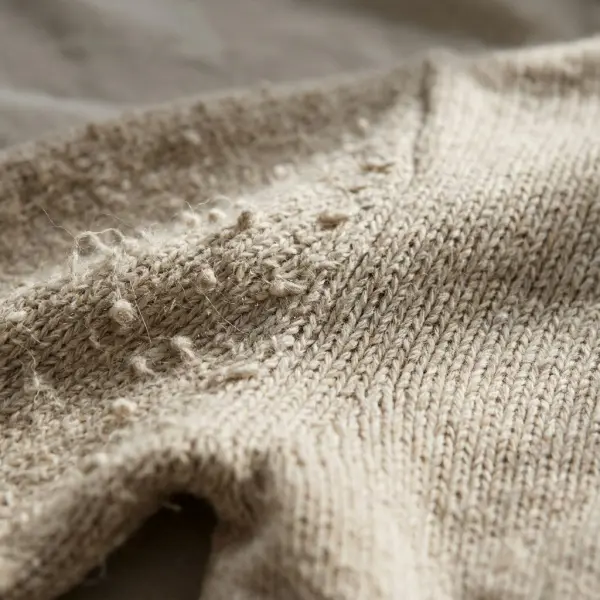
Fabric pilling is a form of textile surface deterioration in which protruding fibers become entangled into small balls, known as pills, that remain attached to the fabric. It typically develops through repeated friction during wearing, washing, drying, or contact with other materials.
Pilling resistance depends on several interconnected factors, including fiber length and strength, yarn twist, fabric density, surface hairiness, and textile finishing. Natural fibers, synthetic fibers, and blended fabrics can all experience pilling, although the rate of formation and persistence of pills vary according to material characteristics and construction.
Fashion brands can reduce pilling through appropriate fiber and yarn selection, optimized fabric construction, suitable finishing treatments, and performance evaluation before bulk production. Consumers can help minimize its occurrence by following garment care instructions and reducing unnecessary friction.
Pilling does not automatically indicate poor overall garment quality or significant structural damage. Nevertheless, excessive or premature pilling can negatively affect perceived durability, customer satisfaction, and brand reputation. The most effective approach is to develop fabrics with pilling resistance appropriate to their intended application rather than expecting every textile to remain completely free from surface changes.
What Is Fabric Pilling?
Fabric pilling is a textile surface phenomenon that occurs when exposed or loosened fibers become entangled into small, compact clusters that remain connected to the underlying fabric. These clusters are commonly called pills, bobbles, or lint balls, although technically a pill differs from loose lint because it remains anchored to the textile surface.
Pilling can develop on both knitted and woven fabrics. It is particularly noticeable on garments with soft, hairy, brushed, or relatively open textile structures, where fibers may have greater freedom to move toward the surface.
A common misunderstanding is that pilling represents the complete breakdown of a fabric. In many cases, the initial problem is primarily aesthetic. A garment can remain wearable and structurally functional while its surface becomes increasingly uneven. Severe or prolonged wear, however, may involve pilling alongside fiber loss and other forms of textile deterioration.
How Fabric Pilling Develops
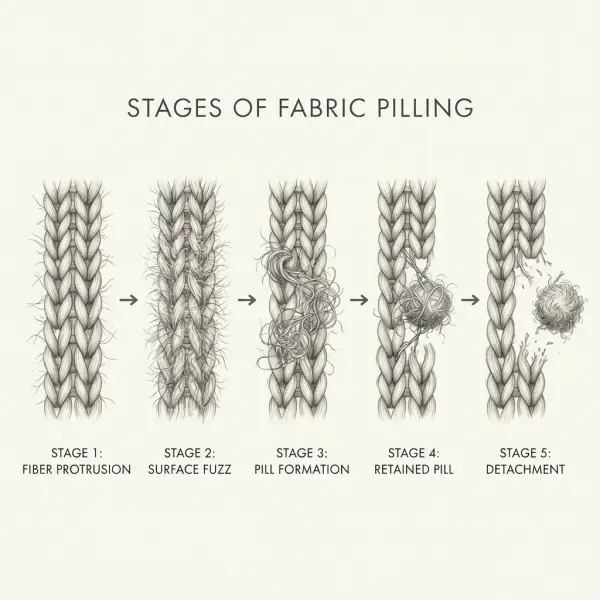
Pilling generally involves several overlapping stages rather than a single event. Repeated mechanical action causes fibers to protrude from yarns or become increasingly exposed at the fabric surface. These fibers then interact with neighboring fibers, creating tangled clusters that may grow as friction continues.
The strength of the remaining fibers connecting a pill to the fabric determines, in part, how long that pill remains visible. Some pills eventually detach, while others remain firmly anchored and accumulate over time.
A simplified representation of the process includes four stages:
|
Stage |
Textile Surface Changes |
|
Fiber protrusion |
Fiber ends extend or migrate toward the fabric surface. |
|
Fuzz formation |
Exposed fibers create a fine, irregular surface layer. |
|
Pill formation |
Protruding fibers become entangled into compact clusters. |
|
Pill retention or detachment |
Pills remain attached or gradually break away through continued wear. |
These stages do not necessarily occur at a uniform rate. A fabric may develop substantial fuzz without immediately forming visible pills, while another material may produce persistent pills after relatively limited exposure to friction.
This explains why assessing clothing quality requires more than counting visible fiber balls. The underlying changes in the textile surface also deserve attention.
Where Does Pilling Commonly Occur on Clothing?
Pilling frequently develops in areas exposed to repeated contact with other parts of a garment, accessories, furniture, or external surfaces. On knitwear, for example, the sides of the body may experience repeated rubbing against the sleeves. On trousers and leggings, the inner thigh area can experience continuous fabric-to-fabric friction during movement.
Common locations include:
- Underarms and garment side panels.
- Elbows and lower sleeve areas.
- Inner thighs of trousers, leggings, and shorts.
- Shoulders exposed to handbag or backpack straps.
- Waistline areas in contact with belts or bags.
- Seat areas of trousers and skirts.
- Cuffs and other frequently handled garment sections.
The location of pilling can provide useful information about its possible cause. A concentrated patch beneath a shoulder strap suggests a different exposure pattern from widespread pilling across the entire front of a sweater.
The Woolmark Company's guidance on pilling in wool clothing identifies rubbing during wear as a major contributor and highlights several common friction-prone areas. For product development teams, these locations provide a practical starting point when evaluating garment performance under realistic wearing conditions.
What Causes Fabric Pilling?
Fabric pilling results from the interaction between textile characteristics and mechanical exposure. While friction is a major trigger, the tendency of fibers to migrate, become entangled, and remain attached determines how a particular fabric responds to that friction.
Two garments with identical fiber composition labels can therefore exhibit substantially different pilling behavior. Differences in yarn quality, knitting or weaving parameters, and finishing may be just as significant as the fiber composition itself.
Fiber Length and Fiber Characteristics
Fiber length influences how securely individual fibers can be incorporated into a spun yarn. Shorter staple fibers generally create more fiber ends for a comparable yarn structure, which may increase opportunities for fibers to become exposed at the surface.
Longer staple fibers can often be incorporated more securely, particularly when yarn construction and spinning quality are appropriately controlled. This is one reason why fiber selection matters in developing smooth, appearance-sensitive garments.
Fiber strength introduces a less intuitive consideration. Strong fibers may resist breaking away after a pill has formed, allowing visible pills to remain attached for longer periods. Consequently, a fabric made with mechanically strong fibers does not necessarily maintain a smoother surface than one made with fibers that detach more readily.
Textile research discussing pilling-resistant knitwear describes pilling as a complex interaction involving fiber characteristics, yarn structure, fabric construction, finishing, and garment use. Evaluating only one material property is unlikely to provide a reliable prediction of performance.

Yarn Twist and Yarn Hairiness
Yarn twist helps hold fibers together within a spun yarn. When fibers are adequately secured, they may have less opportunity to migrate toward the fabric surface during repeated rubbing.
Yarns with relatively low twist are sometimes selected to achieve a softer, fuller, or more delicate handfeel. Depending on fiber characteristics and construction, that same design choice can make surface fiber movement more likely.
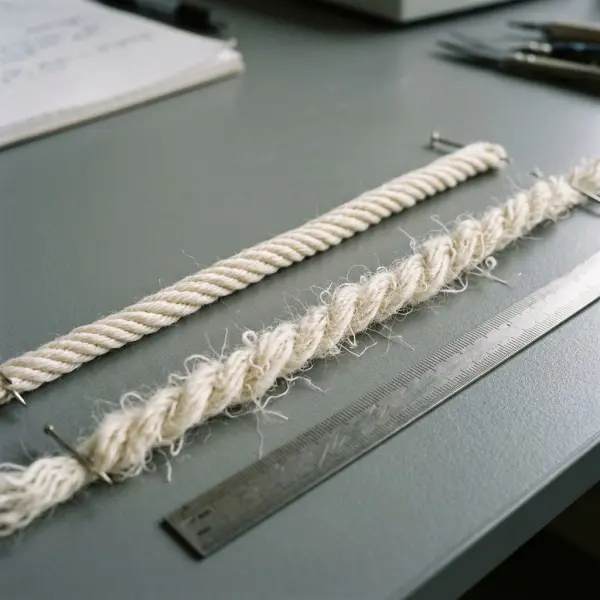
Yarn hairiness is another relevant property. Hairiness describes the extent to which fibers protrude from the main body of a yarn. A hairy yarn provides more exposed material that can potentially participate in fuzz and pill formation.
For a knitwear designer, the challenge is not simply maximizing yarn twist or eliminating all surface hairiness. Excessive changes to yarn construction may alter softness, fullness, flexibility, and drape. The preferred yarn is one that balances the desired aesthetic with the expected wearing performance.
Fabric Construction and Surface Density
Fabric construction influences how easily yarns and fibers can move under mechanical stress. A relatively open knitted structure may allow greater fiber mobility than a more compact construction, although actual performance also depends on the yarn and finishing process.
Increasing fabric cover or adjusting stitch density can sometimes help improve surface stability. The trade-off is that these adjustments may change stretch, weight, breathability, and tactile characteristics.
Consider two knitted cardigans made from comparable fiber blends. One uses an open, loosely constructed knit intended to create a relaxed silhouette, while the other uses a more compact structure with a smoother surface. Their pilling performance may differ considerably even though their composition labels are nearly identical.
Fabric construction should therefore be considered an active part of durability engineering, rather than merely a visual or stylistic decision.
Friction During Everyday Wear
Everyday clothing is continuously exposed to mechanical interaction. Walking, sitting, carrying bags, adjusting sleeves, and wearing layered outfits all create varying levels of contact between textiles and external surfaces.
A lightweight knit top worn beneath a structured jacket, for instance, may encounter repeated friction against the jacket lining. A sweater worn with a rough canvas shoulder bag may develop concentrated pilling near the strap.
The resulting wear pattern depends not only on how often the garment is worn but also on the nature of the contact. Surface roughness, movement, pressure, and the duration of rubbing influence how fibers respond.
These variables explain why two customers who purchase the same garment may report different experiences. One may wear it occasionally in relatively low-friction settings, while another incorporates it into a demanding daily routine.
Laundering and Drying Conditions
Washing and drying expose garments to mechanical movement, contact with other textiles, and potentially additional surface friction. These conditions can contribute to fiber protrusion, fuzz formation, and pilling, depending on the material and cleaning process.
Garments washed alongside rough-textured items or exposed to unsuitable cleaning cycles may encounter greater mechanical stress than garments cleaned using an appropriate care method. Nevertheless, there is no single laundering procedure that is optimal for every fabric.
A delicate wool sweater and a performance sportswear garment may require different approaches because of their fiber characteristics, construction, finishes, and dimensional stability.
For fashion brands, care instructions should be developed alongside material specifications. An effective care label must reflect both the textile's requirements and the practical cleaning expectations of the intended customer.
Which Fabrics Are Most Likely to Experience Pilling?
Fabrics with exposed staple fibers, relatively hairy yarns, loose construction, or raised surfaces may be susceptible to pilling. However, no broad fiber category can be classified as universally resistant or universally prone to the problem.
Wool, cotton, polyester, acrylic, viscose, and blended textiles can all develop pills under certain conditions. The differences often lie in how readily pills form, how noticeable they become, and how long they remain attached.
Wool and Cashmere
Wool and cashmere garments are frequently valued for their softness, warmth, and tactile richness. Some constructions use relatively soft yarns or intentionally raised surfaces to emphasize these characteristics.
Such design choices can increase the availability of exposed fibers that may become involved in pilling. Cashmere knitwear, particularly when developed with a very soft surface, can experience visible pilling in areas of repeated friction.
This does not mean that wool or cashmere is inherently low quality. Fiber length, spinning quality, yarn twist, knitting density, and finishing all influence the outcome.
For premium knitwear businesses, improving pilling resistance must be balanced carefully against preserving the handfeel that customers expect from these materials.
Polyester and Acrylic
Polyester and acrylic fabrics can experience pilling, particularly when constructed from staple-fiber yarns or developed with hairy and brushed surfaces. Depending on fiber characteristics, the fibers anchoring a pill may resist breaking, allowing the pill to remain visible for an extended period.
This creates a potentially confusing situation for customers. A garment can possess good resistance to certain forms of mechanical damage while still developing an unattractive pilled surface.
Polyester filament fabrics with smooth constructions may behave differently from polyester staple-fiber knits. It would therefore be misleading to make purchasing or sourcing decisions based solely on the word polyester.
Cotton and Other Cellulosic Fabrics
Cotton fabrics may develop surface fuzz and pills through repeated wear and laundering. Their performance depends on the characteristics of the staple fibers, spinning system, yarn construction, fabric structure, and finishing.
Cotton jerseys made with different yarn specifications can demonstrate noticeably different surface behavior despite having the same composition and fabric weight.
Regenerated cellulosic fibers, including viscose and lyocell, also require consideration of their specific fiber characteristics and textile construction. Certain surface changes, such as fibrillation, may contribute to a fuzzy appearance without necessarily representing exactly the same mechanism as conventional pilling.
Blended Fabrics
Fiber blending can be used to combine characteristics such as softness, strength, elasticity, moisture management, and cost efficiency. Its influence on pilling, however, depends on how the different fibers interact within the yarn and fabric.
In some blended constructions, fibers that readily form surface fuzz may become entangled around stronger fibers that help anchor the resulting pills. Other blends may perform well because of controlled yarn construction and appropriate finishing.
A cotton-polyester sweatshirt, for example, cannot be accurately evaluated for pilling resistance simply by knowing its blend ratio. The sourcing team also needs information about the yarn, surface treatment, and intended use.
The following table summarizes material-related considerations rather than providing a universal ranking of fabric performance.
|
Fabric or Fiber Category |
Potential Pilling Considerations |
What Brands Should Evaluate |
|
Wool knitwear |
Surface fiber migration and soft yarn construction |
Fiber length, twist, knit density, and finishing |
|
Cashmere |
Delicate handfeel and exposed fibers |
Yarn quality, construction, and high-friction wear performance |
|
Acrylic |
Hairy yarn surfaces and potentially persistent pills |
Fiber properties and yarn construction |
|
Polyester staple fabrics |
Potentially persistent pills due to fiber strength |
Staple characteristics, hairiness, and finishing |
|
Cotton jersey |
Surface fuzz and exposed staple fibers |
Yarn quality, spinning system, and knit structure |
|
Viscose blends |
Construction-dependent surface changes |
Fiber behavior, blend compatibility, and finishing |
|
Brushed fleece |
Intentionally raised fibers and repeated surface contact |
Face and reverse surface performance |
|
Smooth filament fabrics |
Often limited exposed staple ends, but not immune to surface wear |
Filament integrity, construction, and snagging resistance |
For fashion businesses, the most reliable approach is to evaluate the specific finished fabric rather than relying on generalized assumptions about individual fibers.
Why Fabric Pilling Matters for Clothing Quality
Fabric pilling matters because clothing quality is experienced over time, not only at the point of purchase. Customers evaluate garments through appearance retention, comfort, fit, functionality, and the extent to which a product continues to meet expectations after repeated use.
A garment may pass an initial visual inspection, feel pleasant to the touch, and photograph well for an ecommerce listing. If its surface deteriorates rapidly during ordinary use, however, customers may interpret the change as evidence of inadequate product quality.
Appearance Retention and Perceived Durability
Appearance retention refers to a textile or garment's ability to preserve its intended visual characteristics during use and care. Pilling can compromise this characteristic by creating an uneven, fuzzy, or visibly aged surface.
The effect can be particularly significant for garments developed around a clean, refined aesthetic. A smooth black office cardigan, for example, may appear less polished when surface pills accumulate around the elbows and sides, even if the garment remains structurally intact.
Customers do not necessarily distinguish between aesthetic deterioration and mechanical failure. Both may contribute to a perception that a garment has reached the end of its desirable wearing life.
Customer Satisfaction and Brand Reputation
Premature pilling can create a mismatch between customer expectations and actual garment performance. This is especially relevant when a fashion brand positions its products around premium materials, lasting quality, or everyday versatility.
A customer who purchases a relatively expensive knit garment may reasonably expect its appearance to remain acceptable under normal conditions of use. If substantial pilling develops unusually early, the brand may face complaints, return requests, unfavorable reviews, or reduced customer confidence.
These outcomes are not inevitable consequences of every pilling incident. Customer expectations, the garment category, the severity of the change, and the brand's response all influence the commercial impact.
The operational lesson is that material performance should support the product promise. A brand marketing a sweater as an everyday wardrobe essential should evaluate it differently from a brand offering delicate knitwear intended for occasional use.

Product Longevity and Sustainability Considerations
Pilling resistance can contribute to product longevity when improved appearance retention encourages customers to continue wearing a garment. A structurally functional item that no longer looks acceptable may be removed from active wardrobe use earlier than necessary.
This connection is relevant to fashion businesses pursuing durability-oriented product development. Nevertheless, improved pilling resistance should not automatically be interpreted as proof that a garment has a lower environmental impact.
The environmental outcome depends on material production, finishing processes, garment lifespan, cleaning requirements, repairability, and actual consumer behavior. An additional finishing treatment may improve surface performance while introducing other resource or chemical management considerations.
Brands should also distinguish between pilling and textile fiber shedding. Although both involve changes in fiber behavior, a pilling grade alone does not quantify the amount of fiber fragments released during washing or wearing.
Fabric Pilling, Fuzzing, and Other Surface Changes
Pilling is only one type of visible textile surface deterioration. Distinguishing it from related phenomena helps fashion businesses investigate complaints, specify appropriate performance requirements, and avoid inaccurate conclusions about fabric quality.
Fuzzing describes the development of protruding fibers that create a hairy or irregular appearance. These fibers may subsequently form pills, but visible fuzzing does not necessarily mean that pill formation has already occurred.
Other surface changes, such as snagging, matting, and abrasion-related thinning, involve different mechanisms or outcomes.
|
Surface Condition |
Typical Appearance |
Main Distinguishing Feature |
|
Pilling |
Small tangled fiber balls |
Fiber clusters remain attached to the textile |
|
Fuzzing |
Diffuse hairy surface |
Protruding fibers without necessarily forming compact pills |
|
Matting |
Flattened or tangled surface fibers |
Loss of the intended surface definition |
|
Snagging |
Pulled yarns or extended loops |
Local displacement of fibers or yarns |
|
Abrasion-related wear |
Thinning, flattening, or material loss |
Progressive surface or structural wear |
|
Loose lint |
Detached fiber fragments |
Fibers are no longer anchored to the fabric |
These conditions can occur simultaneously. A heavily worn textile may exhibit pilling, fuzzing, thinning, and color changes within the same area.
For a more detailed understanding of how different mechanical wear mechanisms affect apparel performance, see Fabric Pilling vs Abrasion: Understanding Different Types of Textile Wear.
How Fashion Brands Can Prevent and Reduce Fabric Pilling
Preventing fabric pilling requires coordinated decisions across material sourcing, textile engineering, finishing, garment development, and quality assurance. Although complete prevention cannot be guaranteed under every wearing condition, brands can reduce the likelihood of excessive or premature pilling through appropriate product specifications.
The most effective interventions generally begin before garment production. Attempting to correct a fundamentally unsuitable fabric after bulk garments have been manufactured is likely to be more difficult than addressing the underlying material characteristics during development.
Selecting Appropriate Fibers and Yarns
Material selection should begin with an understanding of the garment's intended use and the surface appearance that customers expect it to maintain. A daily-wear school sweater, for instance, may require different yarn characteristics from a luxury cardigan designed for occasional use.
Where suitable, longer staple fibers, controlled yarn hairiness, and optimized yarn twist may help reduce the availability of fibers that can participate in pilling.
The development team should discuss these characteristics directly with textile suppliers rather than specifying fiber composition alone. Yarn specifications, spinning methods, and production consistency can provide additional information for comparing materials.
These choices may affect procurement costs and fabric handfeel. Brands should evaluate whether the resulting improvement in surface performance justifies those trade-offs for the particular product category.
Optimizing Knitted and Woven Fabric Construction
Fabric construction can be adjusted to improve fiber stability without necessarily changing the basic material composition. In knitwear, adjustments to stitch density, yarn selection, or knitting parameters may influence how readily surface fibers move during wear.
In woven textiles, yarn characteristics and fabric cover can similarly affect surface behavior.
Increasing compactness is not an appropriate solution for every product. A lightweight summer cardigan may depend on an open structure for its visual identity and comfort, while a soft sweatshirt may intentionally feature a raised surface.
The objective is to optimize the construction around the product's intended characteristics rather than pursue maximum pilling resistance at the expense of all other qualities.
Using Appropriate Anti-Pilling Finishes
Anti-pilling finishing refers to textile processing intended to reduce a fabric's tendency to form or retain surface pills. The appropriate treatment depends on fiber composition, fabric construction, desired appearance, and manufacturing capability.
Some approaches reduce exposed surface fibers, while others aim to improve fiber retention or modify surface behavior.
|
Finishing Approach |
Intended Function |
Important Consideration |
|
Singeing |
Remove protruding surface fibers through controlled thermal processing |
Suitability depends on fiber composition and construction. |
|
Shearing or cropping |
Remove selected protruding or uneven surface fibers |
May alter texture and intended surface appearance. |
|
Enzymatic biopolishing |
Reduce accessible surface fibers on suitable cellulosic textiles |
Processing conditions must be controlled to limit unwanted strength loss. |
|
Anti-pilling chemical finishes |
Modify surface characteristics or improve fiber retention |
Effects on handfeel and performance after laundering should be verified. |
|
Controlled surface finishing |
Manage the extent and uniformity of raised fibers |
May involve trade-offs for deliberately soft or brushed textiles. |
No single treatment provides the best outcome across every fabric. An enzyme-based treatment suitable for a cotton jersey cannot automatically be applied to an acrylic sweater with equivalent results.
Brands should request evidence of finished-fabric performance and assess whether the improvement remains acceptable following the intended care process. Descriptions such as anti-pilling or easy-care should be supported by measurable product performance rather than treated solely as commercial labels.
Evaluating Fabric Performance Before Bulk Production
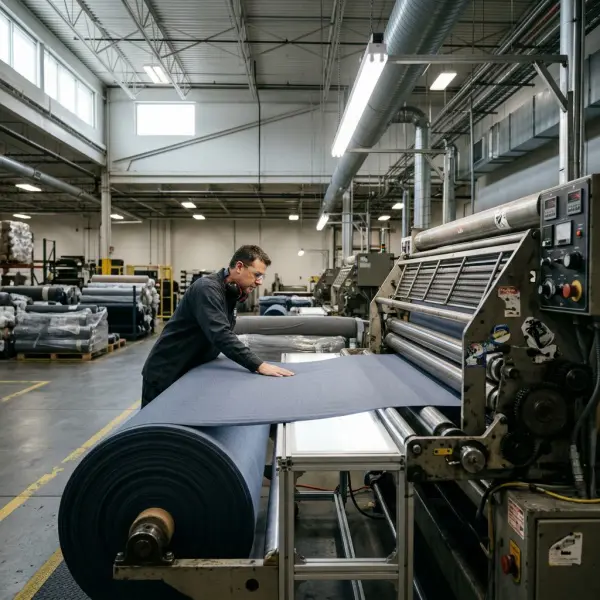
Fashion businesses should evaluate pilling resistance using an appropriate test method before committing to large production volumes, particularly when developing unfamiliar fabrics or products with demanding everyday-use requirements.
Recognized methods include the ISO 12945-2 modified Martindale method, which evaluates textile susceptibility to pilling and related surface changes. Other methods may be appropriate depending on the material and buyer specification.
A useful evaluation process should establish the selected method, test exposure, specimen preparation, assessment criteria, and acceptable performance level. These details make supplier comparisons more meaningful and help ensure that subsequent production is evaluated consistently.
For a deeper discussion of laboratory methods, performance specifications, and quality assurance procedures, refer to How Textile Durability Testing Helps Fashion Brands Evaluate Fabric Quality.
How Consumers Can Reduce and Remove Fabric Pilling
Consumers can reduce pilling by following appropriate garment care instructions, minimizing avoidable friction, and using suitable methods to remove existing pills. These practices can help preserve appearance, but they cannot completely eliminate the effects of an inherently susceptible textile construction.
The responsibility for managing pilling should therefore be shared appropriately. Consumers can care for garments correctly, while fashion businesses must develop products capable of performing acceptably under their intended conditions of use.
Reducing Friction During Garment Care
Care practices that limit unnecessary mechanical interaction may help preserve a textile's surface. Turning a suitable garment inside out before washing, for example, can reduce direct exposure of its outer surface to contact with other items.
Practical care measures include:
- Following the garment's specified washing and drying instructions.
- Turning suitable garments inside out before laundering.
- Separating delicate clothing from rough-textured items and exposed abrasive fasteners.
- Using an appropriate washing cycle and detergent.
- Avoiding unnecessary aggressive rubbing or scrubbing.
- Following material-specific drying recommendations.
These practices should be adapted to the garment rather than applied indiscriminately. Wool, delicate knitwear, coated textiles, and performance fabrics may have different care requirements.
For fashion retailers, communicating these distinctions through product pages and after-sales guidance can help customers maintain clothing appearance without relying on overly complicated care routines.
Removing Existing Fabric Pills
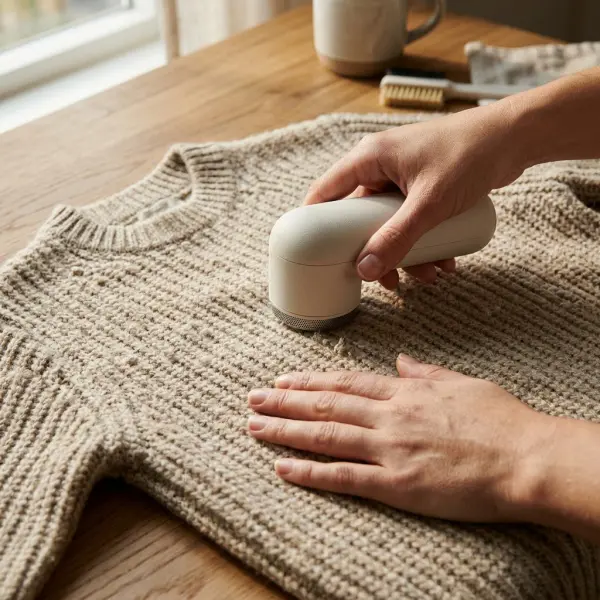
Fabric pills can sometimes be removed using a suitable fabric shaver or garment comb. These tools remove or separate surface pills, improving the garment's visual appearance without necessarily changing its underlying tendency to develop new ones.
The choice of removal method should depend on the textile. A fabric shaver may be suitable for certain smooth and stable fabrics, while delicate knitwear may require particularly gentle treatment or a different tool.
Repeated or aggressive depilling can remove additional surface fibers or damage the textile. Loose knitted loops, decorative yarns, and intentionally raised surfaces require particular care.
Customers should avoid pulling firmly attached pills with excessive force. When using a depilling tool, it is sensible to follow the manufacturer's instructions and first assess an inconspicuous area of the garment.
Practical Application for Fashion Businesses
Managing fabric pilling becomes commercially useful when surface performance is incorporated into routine product development and sourcing decisions. Rather than treating pilling as an isolated quality control issue, fashion businesses should establish a clear relationship between intended garment use, material specifications, performance expectations, and customer feedback.
This approach can be implemented at different business scales. A small fashion startup may begin with supplier documentation, selected laboratory tests, and structured wear trials. A larger apparel business may integrate comparable requirements into material approval procedures, production monitoring, and supplier scorecards.
Establish Performance Expectations by Product Category
A suitable pilling requirement should reflect what customers reasonably expect from a particular garment. Different apparel categories encounter different wearing conditions and place different levels of importance on surface appearance.
For everyday uniforms, repeated laundering and frequent use may justify relatively demanding appearance-retention requirements. For delicate luxury knitwear, the development team may need to accommodate a degree of natural surface change while still preventing excessive or premature deterioration.
|
Product Category |
Typical Performance Concern |
Development Priority |
|
Everyday knitwear |
Repeated wearing and visible surface deterioration |
Balance softness with appearance retention |
|
Activewear |
Friction during movement and frequent laundering |
Evaluate high-contact areas and textile performance |
|
Workwear and uniforms |
Repeated use, equipment contact, and cleaning |
Establish consistent material performance |
|
Premium sweaters |
Maintaining refined appearance and handfeel |
Optimize yarn characteristics without sacrificing tactile quality |
|
Children's clothing |
Frequent movement and repeated washing |
Develop practical durability and care requirements |
|
Loungewear |
Soft surfaces exposed to regular use |
Balance comfort, surface texture, and pilling resistance |
Establishing category-specific requirements prevents a common sourcing error: applying one material performance target to every product regardless of use.
Incorporate Pilling Requirements into Supplier Communication
Suppliers should receive sufficiently detailed information to understand how the fabric will be evaluated. A request for better quality or anti-pilling fabric is unlikely to provide the precision needed for consistent material development.
A practical fabric specification should communicate:
- Intended garment application and anticipated wearing conditions.
- Fiber composition and relevant yarn characteristics.
- Fabric construction and required surface appearance.
- Agreed pilling test method and assessment conditions.
- Required performance level and any applicable laundering pretreatment.
- Approval procedures for material or processing changes.
The exact level of documentation can vary with business scale. Nevertheless, the essential requirements should be established before the supplier begins bulk production, particularly where changes to yarn or finishing could affect the approved fabric's performance.
Balance Material Performance Against Commercial Costs
Improving pilling resistance may introduce additional costs through fiber selection, yarn development, finishing, laboratory evaluation, or tighter manufacturing controls.
Not every improvement will deliver the same commercial value. A brand producing basic apparel at a competitive retail price may prioritize achieving an appropriate minimum performance level. A premium brand may place greater emphasis on long-term appearance retention because it forms a central part of its product positioning.
These decisions should consider the wider cost of inadequate performance, including complaint handling, replacement products, returns, and potential damage to customer confidence.
For smaller businesses, selectively testing high-risk fabrics and frequently reordered products may be a practical starting point. Materials with known performance concerns, raised surfaces, or unfamiliar supplier specifications deserve particular attention.
Use Customer Feedback as Product Development Information
Customer complaints about pilling can provide useful evidence when they are recorded systematically. Instead of treating each incident as an isolated service issue, fashion businesses can look for recurring patterns associated with a particular product, material, production batch, or garment location.
A useful complaint investigation may document the approximate period of use, care practices, affected areas, product identification, and photographs of the textile surface. Where appropriate, returned garments can be examined alongside retained production samples.
This information does not automatically establish the cause of the problem. It can, however, identify which materials or product categories require further evaluation.
For example, repeated complaints about concentrated pilling near the sides of a specific cardigan may justify additional wear trials or a review of yarn and fabric construction. Widespread complaints across several garment styles using the same fabric may instead indicate a material-level issue.
Over time, connecting customer feedback with sourcing and quality assurance records can help brands make more informed material decisions.
Common Mistakes When Managing Fabric Pilling
Pilling-related quality problems are often associated with decisions that appear reasonable when considered individually. A softer fabric may improve the immediate customer experience, a lower-cost supplier may support pricing objectives, and an anti-pilling finish may appear to solve an existing concern.
The difficulties arise when these decisions are made without considering how the completed garment will perform during actual use.
Assuming Pilling Only Occurs in Cheap Fabrics
Pilling is sometimes interpreted as direct evidence that a garment was manufactured from inexpensive materials. This assumption overlooks the fact that premium fibers and deliberately soft textile constructions may also be susceptible to surface changes.
A high-quality cashmere sweater, for example, can develop pills in friction-prone areas without necessarily indicating that its stated fiber composition is inaccurate. Conversely, a comparatively affordable fabric can demonstrate good pilling resistance when its yarn, construction, and finishing are appropriately controlled.
Brands should define acceptable performance according to product characteristics and customer expectations rather than using retail price as a substitute for material evaluation.
Choosing Fabrics Based on Fiber Composition Alone
Composition labels provide important information about the materials used in a garment, but they reveal relatively little about yarn twist, surface hairiness, fabric density, or finishing.
A sourcing team may assume that replacing one fiber with another will solve a pilling problem. Without understanding the existing construction, the replacement may introduce a different surface behavior or compromise another desirable characteristic.
The better approach is to evaluate the fabric as an engineered textile system. Fiber composition should form one part of the specification alongside yarn, construction, finishing, and demonstrated performance.
Prioritizing Initial Softness Without Evaluating Wear Performance
Softness is commercially attractive because customers can evaluate it immediately. Appearance retention is more difficult to judge until a garment has been worn or tested.
Product development teams may therefore approve a particularly soft fabric based on sample-room assessments without investigating how the surface responds to repeated contact. This can create a gap between the garment's initial appeal and its longer-term performance.





Comments 0
Leave a CommentSend Comment
Anda harus Login terlebih dahulu untuk dapat memberikan komentar.