

Digital Color Matching Explained for Textile and Apparel Production
Quick Answer
Digital color matching is a technology-supported process that uses color measurement instruments, numerical color standards, and specialized software to develop, compare, and control textile colors throughout apparel production. It helps fashion brands, textile mills, dye houses, and garment manufacturers communicate color requirements more consistently and evaluate whether materials meet agreed specifications.
Rather than relying entirely on visual judgment or physical color swatches, digital color matching converts measurable color characteristics into data. Spectrophotometers capture how textile samples reflect light, while color management software helps teams compare samples, calculate color differences, and make production decisions.
The process typically connects digital color standards, laboratory dye formulation, lab dip approval, bulk production, and quality control.
Its practical value lies in reducing ambiguity between designers, suppliers, and production teams. Digital workflows may also reduce repeated sampling, unnecessary dye corrections, and avoidable material rejection when measurement procedures and production controls are properly managed.
However, digital measurements do not guarantee that every fabric will appear identical under all lighting conditions. Fiber composition, textile structure, finishing, measurement settings, and visual evaluation remain essential to reliable color approval.
Introduction: Why Matching Textile Colors Is More Complicated Than It Looks
A fashion designer may approve a particular shade of muted blue for a new clothing collection, but reproducing that color consistently across multiple fabrics and manufacturing locations is not necessarily straightforward.
The original design might use cotton jersey, while another garment uses polyester woven fabric. A jacket may also combine outer fabric, ribbing, lining, and matching trims. Even when suppliers work toward the same color reference, differences in fiber composition, dye chemistry, surface texture, and finishing can affect the final appearance.
Color disagreements can become expensive when they are discovered after materials have been dyed, finished, or cut. A fabric that appears acceptable during laboratory development may look noticeably different beside another component during garment assembly.
Traditional textile color approval has often relied on physical standards, laboratory samples, and visual comparison. Those methods remain valuable, but disagreements can arise when samples are evaluated under different lighting conditions or when people interpret small color differences differently.
Digital color matching introduces an additional level of control by establishing measurable color targets and using consistent evaluation procedures.
The objective is not to eliminate human judgment. It is to give designers, colorists, sourcing teams, and manufacturers a shared technical basis for making color decisions.
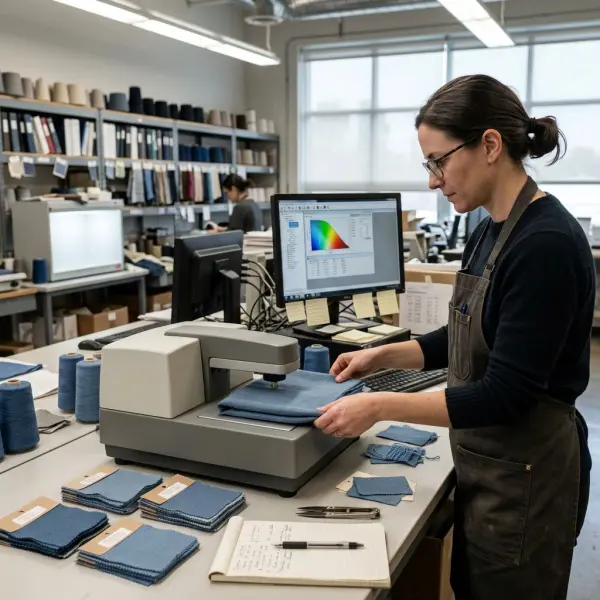
What Is Digital Color Matching in Textile Manufacturing?
Digital color matching is a color management process that uses instrument-measured color data and software-assisted evaluation to reproduce and assess textile colors against defined standards.
In textile manufacturing, the process connects an approved color target with the materials, dyeing methods, and production conditions required to achieve an acceptable result. Instead of describing a sample simply as too dark, too red, or insufficiently saturated, colorists can use numerical measurements to describe the direction and magnitude of its difference from the reference.
This does not mean that fabric color is created entirely on a computer. The textile still needs to be manufactured using suitable dyes, pigments, fibers, and processing conditions. Digital technology supports the decisions that guide those physical processes.
A complete digital color matching program therefore combines three interconnected activities: establishing measurable standards, developing colors that approach those standards, and confirming whether production materials remain within agreed tolerances.
The Difference Between Digital Color Matching and Digital Color Visualization
Digital color matching should not be confused with displaying a fashion color on a computer screen.
Digital design tools can communicate an intended palette through RGB values, hexadecimal codes, and visual renderings. However, a color displayed on a monitor is produced through emitted light, while a dyed textile is generally viewed through light reflected from its surface.
As a result, identical-looking screen colors do not automatically translate into identical textile colors.
A digital textile color standard may contain spectral reflectance information measured from a physical reference. This information is more appropriate for instrument-based textile evaluation than relying only on a screen color value.
For sourcing teams, the distinction matters when translating a designer's color concept into a production-ready specification. An attractive screen rendering is useful for visual communication, but the supplier also needs an approved physical or measurable color target and clearly defined acceptance conditions.
How Does Digital Color Matching Work?
Digital textile color matching works by measuring an approved reference, communicating its color data, developing a suitable dye formulation, measuring production samples, and comparing the results with established acceptance criteria.
The workflow connects creative design with laboratory development and manufacturing control. Although equipment and approval responsibilities differ between companies, the underlying sequence remains relatively consistent.
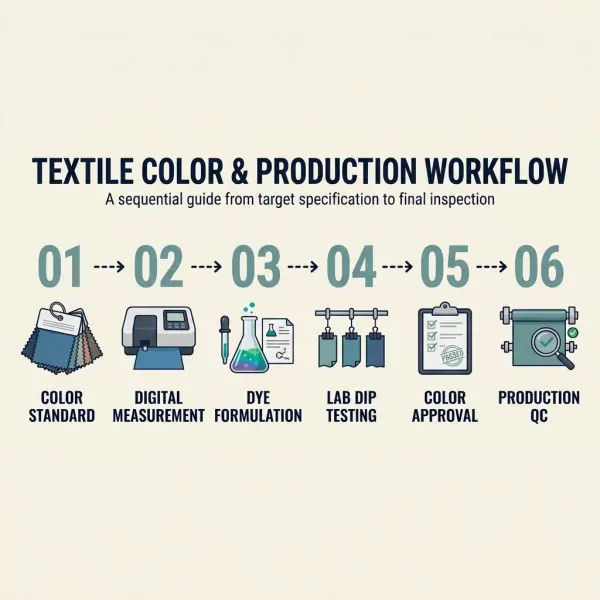
Step 1: Establish an Approved Color Standard
The first requirement is defining exactly which color the manufacturer is expected to reproduce.
A fashion brand may select a color from a recognized textile color reference system, approve a custom-dyed fabric sample, or maintain its own library of physical color standards. The selected reference becomes the basis for development and approval.
A physical reference should be suitable for the intended application and sufficiently stable for repeated evaluation. Ideally, the brand also documents its color measurements so that different suppliers can access the same numerical target.
The specification should identify relevant material and viewing requirements, because a color target alone does not resolve every potential difference in textile appearance.
This stage also establishes who has the authority to approve a color and whether the approval applies to one specific substrate or several different materials.
Step 2: Capture and Communicate Color Data
Once a reference has been established, it can be measured using an appropriate color measurement instrument.
A spectrophotometer measures the spectral characteristics of light reflected by the sample under defined instrument conditions. Color management software can then calculate color coordinates under selected illuminant and observer conditions.
For reflective textile materials, these measurements provide a more consistent basis for comparing samples than subjective descriptions alone.
The resulting data can be stored and communicated to manufacturing partners. However, suppliers must use compatible measurement practices and agreed calculation settings for the data to be meaningfully comparable.
Instrument differences, inconsistent backing materials, textile orientation, and sample preparation can otherwise introduce variation into the results.

Step 3: Develop a Dye Formulation
After receiving the target color information, the dye house develops a formulation suitable for the selected textile substrate and production process.
Color formulation software can assist this stage by using previously characterized dye information and the substrate's optical properties to estimate combinations of colorants that may achieve the required shade.
For example, a cotton fabric dyed with reactive dyes requires a different formulation approach from a polyester fabric dyed with disperse dyes. The software must operate within the technical constraints of the material and manufacturing process.
A calculated recipe is therefore a starting point rather than a guarantee.
Dye concentration, water conditions, processing temperature, machine characteristics, pretreatment, and finishing can all influence the final color. The laboratory must validate the proposed formulation through actual dyeing trials.
Step 4: Produce and Evaluate Laboratory Samples
The dye house produces a small textile sample, commonly called a lab dip, to assess whether the proposed formulation achieves the desired color.
After dyeing and the required sample preparation, the lab dip is measured and compared with the approved reference.
The evaluation may identify differences in lightness, hue, or chroma. These findings help the colorist determine whether a correction is necessary and guide the next formulation attempt.
A sample might appear slightly lighter than the reference but still be commercially acceptable, depending on the agreed tolerance and visual requirements. Another sample might have a similar overall difference value but show an objectionable shift in hue.
This is why the numerical difference should be interpreted together with the specific color direction and visual appearance.
Step 5: Complete Color Approval
Color approval is the point at which the brand or authorized quality team decides whether the proposed shade is acceptable for production.
An effective approval process considers instrument measurements, agreed tolerances, material characteristics, and visual comparison under controlled lighting.
Digital color data allows suppliers and brands to communicate precisely about a sample's deviation. It can reduce disagreements caused by vague descriptions and help reviewers distinguish between acceptable variation and a genuine color problem.
Nevertheless, some products require direct physical evaluation. Textured, shiny, pile, or highly structured fabrics may create appearance differences that cannot be fully described by a single numerical color measurement.
The approval record should identify the reference, approved sample or measurement, evaluation settings, material, decision-maker, and applicable production conditions.
Step 6: Monitor Bulk Production
An approved lab dip does not automatically ensure that the corresponding production batch will match.
Bulk dyeing introduces additional process variables, including material loading, equipment characteristics, chemical dosing, temperature uniformity, and finishing conditions. Even a formulation that performed well in laboratory trials may require controlled adjustment during scale-up.
Manufacturers can measure representative production samples and compare them with the approved standard. The results help quality teams identify potential deviations before materials are released for downstream manufacturing.
Where relevant, checks may be conducted after dyeing, after finishing, and before garment cutting.
Digital records also help distinguish isolated production problems from recurring patterns. For example, repeated shade deviations associated with a specific machine, material lot, or finishing process may indicate a need for broader process investigation.
The value of the system comes from connecting measurement data to corrective action, rather than merely collecting color readings.
The Technologies Behind Digital Textile Color Matching
A digital color matching system usually combines measurement hardware, color calculation methods, formulation software, and quality management tools. Each component performs a different function.
|
Technology or Component |
Primary Function |
Practical Limitation |
|
Spectrophotometer |
Measures spectral reflectance or other relevant optical characteristics |
Measurement quality depends on instrument suitability and sample preparation |
|
Color management software |
Calculates and compares color values against approved references |
Results depend on consistent settings and reliable input data |
|
Dye formulation software |
Estimates colorant combinations and supports recipe correction |
Requires appropriate dye characterization and process validation |
|
Digital color standard library |
Stores approved color references for reuse and communication |
Standards require version control and clear material applicability |
|
Controlled lighting equipment |
Supports consistent visual evaluation of physical samples |
Visual results still depend on illumination, observers, and material appearance |
|
Production quality records |
Tracks approvals, batch measurements, deviations, and corrective actions |
Data must be linked to actual production decisions |
These technologies work best as a coordinated system. A factory may own an advanced spectrophotometer but still struggle with color consistency if its standards, sample preparation, and approval responsibilities are poorly defined.
Likewise, formulation software cannot compensate for an unstable dyeing process or incorrect assumptions about the substrate.
Understanding Spectral Reflectance and CIELAB Values
The optical foundation of textile color matching is the relationship between a material and the light it reflects.
A spectrophotometer can record reflectance values across a range of wavelengths. These measurements describe the sample's spectral response rather than simply assigning it a visual color name.
Using a specified illuminant and standard observer, software can derive coordinates in a color space such as CIE L*a*b*, commonly called CIELAB.
CIELAB represents color using three main coordinates:
- L* represents lightness, from black toward white.
- a* represents position along the green-to-red axis.
- b* represents position along the blue-to-yellow axis.
These values help colorists describe how one sample differs from another. For example, a difference in a* may indicate a shift toward red or green, while a difference in L* indicates a lightness change.
The calculation principles are defined by the ISO/CIE 11664-4:2019 CIELAB standard.
The practical significance is that a team can communicate measurable differences rather than relying entirely on interpretations such as "not quite the right blue."
For a more detailed discussion of measurement instruments and evaluation practices, see how spectrophotometers help measure fabric color consistency.

What Does Delta E Mean in Textile Color Matching?
Delta E, written as ΔE, is a numerical measure of color difference between two color stimuli under specified evaluation conditions. It allows textile professionals to quantify how closely a sample matches its reference.
A smaller color-difference value generally indicates a closer calculated match under the selected method. However, the number must be interpreted within a defined measurement and evaluation system.
Different formulas can produce different numerical results for the same pair of samples. Common approaches include CIE 1976 ΔE*ab, CMC color difference, and CIEDE2000.
The ISO/CIE 11664-6:2022 standard defines the CIEDE2000 color-difference formula. Meanwhile, AATCC EP14 addresses small color differences and discusses both CIEDE2000 and CMC methods for instrumental evaluation.
A tolerance specified using one formula should not be treated as automatically equivalent to a tolerance expressed using another.
There is also no universal Delta E threshold that guarantees acceptance for every textile product. Appropriate limits depend on the color, material, viewing conditions, customer requirements, and intended application.
For this reason, a useful color specification identifies both the permitted difference and the method used to calculate it.
Traditional Versus Digital Textile Color Matching
Traditional and digital methods are sometimes presented as competing approaches. In practice, many manufacturers use a combination of both.
Physical swatches and controlled visual evaluation remain useful because the final product is a material that people see and handle. Digital tools strengthen that process by introducing repeatable measurements, standardized communication, and traceable approval records.
|
Evaluation Factor |
Primarily Visual Workflow |
Digitally Supported Workflow |
|
Color reference |
Physical swatch or approved lab dip |
Physical reference supported by measurable digital data |
|
Sample assessment |
Visual comparison under selected lighting |
Instrument measurement combined with visual assessment |
|
Correction communication |
Descriptions of perceived differences |
Numerical direction and magnitude of differences |
|
Supplier coordination |
Physical samples and written feedback |
Shared standards, measurement files, and physical samples when required |
|
Approval records |
Signed samples and written decisions |
Digital results, traceable decisions, and physical references as needed |
|
Production monitoring |
Visual checks and sample comparison |
Recorded measurement trends and controlled visual checks |
The distinction is not that traditional methods are inaccurate while digital methods are automatically accurate. A well-controlled visual assessment can be highly valuable, while poorly managed digital measurements can create false confidence.
The stronger approach integrates objective measurement with trained color evaluation and appropriate manufacturing controls.
Why Digital Color Matching Matters Across Apparel Production
Color approval is not limited to the dye laboratory. It influences purchasing, production planning, material coordination, product presentation, and supplier relationships.
For a fashion business, the consequences of inconsistent color often appear outside the department where the original mistake occurred.
Product Development and Collection Coordination
Fashion collections frequently use related colorways across multiple garment categories.
A coordinated collection might include a navy blouse, trousers, lightweight jacket, and accessories. Each item may use materials with different optical properties, which can make achieving a visually harmonious result difficult.
Digital color matching gives product development teams a common reference for evaluating those materials. It helps identify which color differences are caused by dye formulation and which may relate to inherent material appearance.
However, a shared numerical target does not guarantee that every substrate will look identical. A matte cotton surface and a glossy synthetic surface can appear different even when measured color coordinates are close.
Collection development therefore requires both technical color evaluation and an understanding of how different fabrics interact visually.
Sourcing and Supplier Communication
International apparel production often involves multiple suppliers responsible for different components.
A brand may source shell fabric from one mill, ribbing from another, and sewing thread from a specialist manufacturer. If each supplier works from a different reference or uses inconsistent measurement conditions, visible color variation can emerge during garment assembly.
Shared digital standards can improve coordination by communicating a measurable target and agreed evaluation requirements.
This is especially useful when suppliers are geographically separated and approvals involve several teams. Digital communication may reduce some unnecessary physical sample exchanges, although physical approval samples can still be required.
The real operational benefit is clearer decision-making across the supply chain rather than eliminating every traditional approval step.
Dyeing Efficiency and Production Control
Repeated dye adjustments can consume additional production time, labor, chemicals, water, and energy.
Color formulation systems may help colorists identify suitable starting recipes and guide corrections more precisely. When paired with stable processing conditions, these tools can reduce avoidable trial-and-error work.
The scale of any efficiency benefit depends on the existing dyeing process, formulation accuracy, fiber type, and personnel expertise.
A poorly characterized dye database or unstable production system may limit the advantages of digital matching.
For manufacturers, investing in color technology should therefore be connected to process control, staff capability, and clearly defined production objectives.
Quality Assurance and Commercial Risk
A color discrepancy discovered before bulk fabric approval is usually easier to address than one discovered after garments have been cut or assembled.
Digital measurements can support earlier detection by allowing teams to compare representative samples with approved standards at defined production checkpoints.
They also provide records that can help investigate disputes between buyers and suppliers. Rather than relying exclusively on conflicting visual opinions, both parties can review measurements and the documented approval criteria.
This does not eliminate the need for judgment. A material may meet the numerical acceptance limit but still create an undesirable visual contrast when combined with another component.
More broadly, consistent color decisions can support the reliability of a fashion brand's products. The wider operational implications are explored in why digital color accuracy matters in fashion manufacturing.
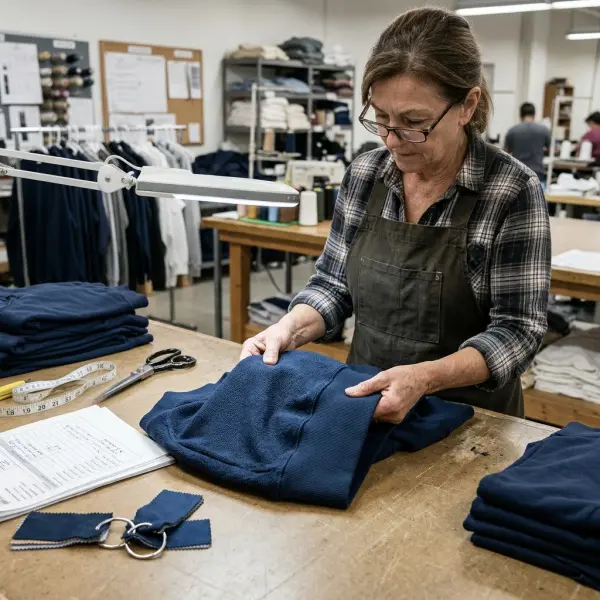
Why Fabric Type and Surface Appearance Still Matter
Color measurement is highly useful, but textiles are not optically uniform materials. Their appearance depends on more than the colorants used during production.
Fiber properties, yarn construction, weave or knit structure, surface finish, and directional texture influence the way light interacts with fabric.
A tightly woven polyester fabric may have a different surface reflectance and sheen from a brushed cotton fabric. Velvet and other pile textiles may appear lighter or darker when viewed from different directions because the pile orientation changes how light is reflected.
Similarly, translucent or loosely constructed fabrics may be influenced by the background beneath them during measurement.
These characteristics make sample preparation and material-specific evaluation essential.
Metamerism: When Fabrics Match Under One Light but Not Another
Metamerism occurs when two color samples appear to match under one set of viewing conditions but fail to match under another.
In textile manufacturing, this may become apparent when fabrics that look similar under laboratory lighting are examined under a different light source.
Two materials may produce similar color coordinates under one illuminant while having different spectral reflectance characteristics. Their visual relationship can change when the lighting spectrum changes.
This is particularly relevant when a garment contains components made from different fiber types or produced using different colorant systems.
The appropriate response is not simply to tighten the tolerance under one light source. Teams may need to evaluate the materials under multiple agreed illuminants and review whether the underlying spectral differences create an unacceptable risk.
Controlled light booths provide a practical environment for this type of assessment.
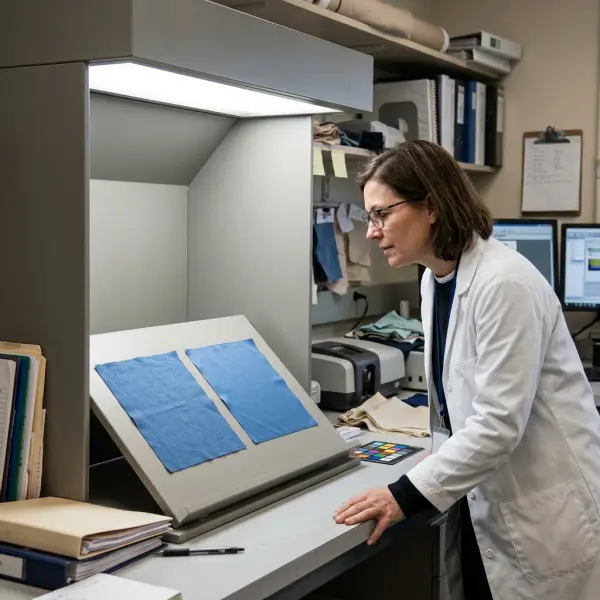
Measurement Conditions Must Be Consistent
Digital measurements are most useful when the procedures used to obtain them are standardized.
A change in the number of fabric layers, backing color, measurement aperture, specimen orientation, or instrument configuration can affect the result. Fluorescent materials and optical brightening agents may require particular attention to ultraviolet measurement conditions.
The AATCC EP6 Instrumental Color Measurement procedure provides a reference for instrumental measurement and specimen handling. The ISO 105-J01 standard also addresses general principles for measuring textile surface color.
For manufacturers operating across several locations, defining a shared measurement protocol is just as important as sharing the approved color data.
Without consistent procedures, two laboratories may report different results even when they believe they are evaluating the same target.
How Fashion Businesses Can Implement Digital Color Matching
Successful implementation does not necessarily require every apparel brand to own a complete color laboratory.
The appropriate operating model depends on production volume, product complexity, supplier capabilities, and the organization's responsibility for color approval.
A smaller fashion brand may begin by requiring its manufacturing partners to provide instrument-based color reports and clear lab dip documentation. A large manufacturer or vertically integrated textile business may operate its own spectrophotometers, formulation software, and digital approval platform.
Both approaches can work if standards and responsibilities are clearly defined.
Begin With a Controlled Color Approval Process
The first priority is establishing a repeatable decision process.
Before purchasing advanced equipment, fashion businesses should determine how colors are selected, approved, communicated, revised, and released into production.
A practical foundation includes the following operational requirements:
- Create authoritative color references. Define the approved physical or digital standard and maintain clear version control.
- Agree on measurement conditions. Document the required instrument setup, sample preparation, illuminants, observers, and color-difference calculations.
- Define acceptance tolerances. Establish realistic criteria appropriate to the material, product, and customer's requirements.
- Assign approval responsibilities. Identify which team can approve lab dips, authorize exceptions, and release materials.
- Record decisions consistently. Store sample identifiers, measurement results, approval status, and relevant production information.
- Connect approval with bulk quality control. Ensure that production measurements refer to the correct approved standard and that deviations trigger defined actions.
These controls provide a foundation for adopting more sophisticated technology later. Without them, digital tools may reproduce existing communication problems in a more complicated format.
Example: Coordinating One Color Across Multiple Garments
Consider a fashion brand developing a coordinated capsule collection featuring an olive-green shirt, trousers, and lightweight outerwear.
The shirt uses woven cotton, the trousers use a cotton-blend fabric, and the outerwear uses a polyester-based material. The brand wants the garments to feel visually coordinated, even though each substrate requires different colorant chemistry and manufacturing processes.
The product team begins with an approved color reference and measurable specifications. Each supplier then develops an appropriate dye formulation and submits laboratory results for evaluation.
The brand compares the samples numerically and visually under agreed lighting conditions. The objective is to identify an acceptable visual relationship across the collection, rather than assuming that identical dye recipes or identical numerical values will produce the same appearance on all fabrics.
Once samples are approved, the suppliers monitor their respective production batches using the agreed requirements.
This illustrative workflow shows why digital color matching is a coordination system as much as a measurement technology. It connects independent manufacturing processes to a common product development objective.
Evaluate the Investment Beyond Equipment Price
The cost of adopting digital textile color matching extends beyond purchasing a spectrophotometer.
Businesses may need software licenses, instrument maintenance, calibration and verification resources, staff training, suitable sample preparation facilities, and integration with existing quality management systems.
A dye house also needs reliable colorant characterization and process data if it plans to use computer-assisted formulation.
The investment case should consider the organization's current operational problems. Frequent lab dip resubmissions, shade-related rejection, inconsistent supplier approvals, and repeated production adjustments may justify more systematic controls.
For a brand with relatively small production volumes, obtaining reliable measurement services from established suppliers or independent laboratories may be more practical than building an internal technical facility.
The appropriate goal is not acquiring the most sophisticated system available. It is establishing the level of color control that matches the organization's product requirements and commercial exposure.
Common Digital Color Matching Mistakes in Textile Production
Treating a Screen Color as a Complete Textile Specification
A common mistake is assuming that a hexadecimal or RGB value provides enough information for a dye house to reproduce a color accurately.
These values describe colors within digital display systems and do not independently define all the physical characteristics of a dyed textile. Differences in monitors, rendering conditions, and fabric properties can create significant interpretation problems.
A better approach is to use an approved physical reference or appropriate measurable textile color standard, supported by clear viewing and acceptance requirements.
Assuming Every Low Delta E Value Means an Acceptable Fabric
Color teams sometimes treat a numerical tolerance as the only requirement for approval.
Although a color-difference calculation provides useful information, it does not fully describe surface texture, gloss, directional appearance, or every lighting-related difference. Two fabrics may have a small calculated difference while still appearing unsuitable when assembled together.
A stronger approval process uses the agreed color metric alongside controlled visual assessment and the specific requirements of the finished product.
Ignoring Differences in Measurement Procedures
Suppliers may use compatible color management software but obtain inconsistent data because their sample preparation or instrument settings differ.
For example, measuring a thin fabric over different backing materials can produce misleading comparisons. The same problem may occur when one laboratory measures a textured sample in a different orientation from another.
Manufacturers should standardize measurement procedures, train operators, and verify instrument performance before interpreting differences as manufacturing defects.
Assuming Laboratory Approval Guarantees Bulk Production
A lab dip represents a controlled development sample, not an automatic guarantee of bulk dyeing performance.
Differences in processing equipment, material batches, chemical conditions, and finishing may influence production color. Factories that skip representative bulk checks risk discovering unacceptable variation too late.
Color approval should therefore be connected to production quality control, with clear checkpoints and corrective-action procedures.
Buying Software Without Improving Color Management Discipline
Digital color tools are sometimes introduced before a company has established reliable color reference management, approval authority, or production traceability.
This can create multiple versions of color standards, inconsistent acceptance decisions, and confusion over which data should control manufacturing.
Technology should reinforce a defined workflow. A disciplined approval process supported by appropriate instruments is often more useful than a sophisticated software installation with poorly maintained data.
Important Technical Limitations and What Brands Should Verify
Digital color matching can significantly improve the structure of textile color decisions, but its capabilities should not be confused with universal control over every aspect of fabric appearance.
Several technical distinctions deserve particular attention.
Color Matching Is Not the Same as Colorfastness
A textile can closely match an approved color standard when it leaves the factory but still lose color or transfer dye during subsequent use.
Colorfastness refers to resistance to color change or staining under specified conditions, including laundering, rubbing, perspiration, and light exposure.
These properties require separate evaluation. For example, ISO 105-C06:2010 provides methods for assessing textile colorfastness to domestic and commercial laundering.
A satisfactory digital color match should therefore not be interpreted as evidence that a garment will retain its color throughout its expected service life.
Dye Formulation Accuracy Depends on Physical Manufacturing Conditions
Color formulation software can estimate suitable dye combinations, but the resulting prediction depends on the quality of the colorant database and the assumptions used in the calculation.
Actual production outcomes may differ because of substrate variation, dye uptake, processing conditions, and finishing effects.
Laboratory testing and production validation remain necessary, particularly when transferring recipes between machinery, facilities, or materials.
A Digital Color Standard Is Not Automatically Universal
Digital standards can improve communication, but they still require appropriate interpretation.
Color data obtained under one set of measurement conditions may not be directly comparable with data collected using different instrument geometry, specimen preparation, illuminant, or observer settings.
Moreover, a single target color may require different approval strategies for a smooth woven fabric, brushed knit, textured outerwear, or reflective trim.
Businesses should confirm how the standard was created and whether the specified evaluation method is suitable for each material.
Environmental Benefits Should Be Evaluated Carefully
Digital color matching may reduce resource consumption when it prevents unnecessary lab dips, repeat dyeing, rejected materials, or avoidable sample transportation.
These potential benefits are operationally plausible, but they are not automatic.
The actual environmental outcome depends on whether the system changes manufacturing behavior, how much rework is avoided, and the resource requirements of the processes involved.
A credible sustainability assessment should use facility-specific production data rather than assuming that adopting digital color technology automatically makes textile production environmentally sustainable.
Frequently Asked Questions About Digital Textile Color Matching
1. Can digital color matching completely replace physical fabric samples?
Digital color matching can reduce reliance on repeated physical sample exchanges, but it does not necessarily eliminate the need for physical fabric evaluation. Instrumental measurements are valuable for comparing color data, communicating corrections, and checking tolerances. However, physical samples may still be required to evaluate texture, gloss, transparency, surface direction, and the visual relationship between garment components. Some brands and manufacturers can make intermediate decisions using shared digital standards and measurements, while final approval requirements may remain more demanding. The appropriate balance depends on material complexity, supplier capability, product specifications, and the brand's quality assurance policy.
2. Is digital color matching suitable for small fashion brands?
Yes. Smaller fashion brands can benefit from digital color matching without necessarily purchasing specialized laboratory equipment. They can begin by working with suppliers that already use reliable color measurement systems and requesting clearly documented color approvals. The brand should maintain authoritative references, define who approves samples, and agree on the evaluation method and acceptance tolerance before production. For businesses producing limited quantities or relatively simple collections, external laboratory services may be sufficient. Internal equipment becomes easier to justify when color development volume, material complexity, or recurring shade-related problems create a clear operational need.
3. What is the difference between digital color matching and computer color matching?
The terms overlap, but digital color matching generally refers to the broader workflow of communicating, developing, measuring, approving, and controlling color using digital information. Computer color matching often refers more specifically to software-assisted formulation, where a system calculates dye or colorant combinations intended to reproduce a target. A textile manufacturer may use computer color matching within its laboratory while also operating a wider digital color management system for supplier communication and quality assurance. The distinction matters when evaluating technology providers because formulation software alone does not necessarily include digital approvals, production monitoring, or complete color standard management.
4. Why can two fabrics have similar color measurements but look different?
Two fabrics can produce similar calculated color values while differing in texture, gloss, directional reflectance, or spectral characteristics. A matte cotton fabric and a smooth synthetic material may therefore look different when placed beside each other, even if their color coordinates are close under the specified measurement conditions. Certain materials may also exhibit metamerism, appearing similar under one light source but different under another. Measurement geometry and specimen preparation can further influence the recorded data. For garments containing multiple fabrics, evaluating the components together under controlled lighting helps identify appearance differences that a single numerical result may not fully communicate.
5. Does a lower Delta E always indicate better textile quality?
No. A lower Delta E generally indicates a closer calculated color match under the selected formula and measurement conditions, but it does not measure overall textile quality. Fabric strength, dimensional stability, dye fastness, construction, finishing, and other performance requirements must be evaluated separately. Even for color approval, the numerical result requires context. Different color-difference formulas produce different values, and an acceptable tolerance depends on the product and customer requirements. A technically sound decision considers the specified color-difference method, visual appearance, material characteristics, and any other relevant quality criteria rather than using Delta E as a universal quality score.
6. How can brands manage color matching across different suppliers and countries?
Brands can improve cross-supplier color consistency by distributing controlled color standards, specifying compatible measurement procedures, and maintaining a centralized approval record. The specification should identify the target color, applicable substrates, calculation method, illuminant, observer, and acceptance conditions.





Comments 0
Leave a CommentSend Comment
Anda harus Login terlebih dahulu untuk dapat memberikan komentar.