

How Textile Durability Testing Helps Fashion Brands Evaluate Fabric Quality
A fabric can look exceptional in a supplier's showroom, feel comfortable during garment sampling, and meet every visual requirement in a design brief. None of these observations necessarily establishes how well the material will perform after months of repeated wear, friction, laundering, and everyday movement.
This is where textile durability testing becomes particularly valuable. It allows fashion businesses to evaluate specific aspects of fabric performance under controlled conditions, providing evidence that supports material selection, product development, supplier approval, and quality assurance.
For apparel brands, the challenge is not simply obtaining favorable laboratory results. It is identifying which performance characteristics matter for a particular garment, selecting appropriate testing methods, interpreting the results correctly, and translating those findings into commercially realistic product requirements.
Pilling resistance and abrasion resistance are especially relevant because they address two common ways in which clothing deteriorates during use. Together with other textile performance assessments, they help fashion businesses evaluate whether a material is suitable for its intended application rather than relying exclusively on its initial appearance, composition, or price.

Quick Answer
Textile durability testing is the systematic evaluation of a fabric's ability to withstand specified forms of mechanical stress, repeated use, and care-related exposure without developing unacceptable changes in appearance or functionality. Relevant assessments may include pilling resistance, abrasion resistance, tensile strength, tear strength, bursting strength, dimensional stability, and appearance retention after laundering.
Fashion brands use durability testing to compare candidate materials, establish product performance requirements, identify potential quality problems before bulk production, and verify whether supplied fabrics meet agreed specifications.
Recognized testing procedures include the ISO 12945 series for pilling and related surface changes, the ISO 12947 series for Martindale abrasion resistance, ASTM D4970/D4970M for Martindale-based pilling assessment, and ASTM D4966 for Martindale abrasion testing.
However, laboratory results are meaningful only when interpreted alongside the selected method, test conditions, assessment criteria, material construction, and intended garment application. A favorable result in one assessment does not establish overall fabric durability or guarantee a particular garment lifespan.
The most effective approach is to establish a risk-based testing program that connects measurable textile performance with realistic customer expectations, supplier capabilities, product positioning, and commercial requirements.
What Is Textile Durability Testing?
Textile durability testing is a controlled assessment of how textile materials respond to specified forms of stress or repeated exposure, helping businesses determine whether fabrics maintain acceptable appearance, structural integrity, and functional performance under relevant conditions.
Durability is not a single measurable property. A garment may resist tearing effectively while developing substantial surface pilling. Another may maintain a smooth appearance while gradually losing material through abrasion. A third may possess adequate mechanical strength but change dimensions after repeated washing.
These differences explain why textile durability testing normally involves a selection of complementary assessments rather than one universal test.
For fashion businesses, the purpose is to identify potential weaknesses that may not be apparent during ordinary fabric inspection. The results can inform whether a material should be approved, modified, restricted to a particular application, or rejected before substantial production expenditure occurs.
Durability Testing vs Conventional Fabric Inspection
Conventional fabric inspection and durability testing serve different but complementary purposes.
Visual fabric inspection generally focuses on the condition of the material as supplied. Inspectors may identify weaving defects, knitting irregularities, stains, shade variation, holes, contamination, or other visible inconsistencies.
Durability testing investigates how the material behaves when subjected to defined exposure or mechanical conditions. A fabric that appears free from visible defects may nevertheless demonstrate unsuitable pilling resistance, limited abrasion performance, or unacceptable changes after washing.
|
Evaluation Aspect |
Conventional Fabric Inspection |
Textile Durability Testing |
|
Primary objective |
Identify existing material defects |
Evaluate performance under specified conditions |
|
Typical assessment |
Visual appearance and production consistency |
Mechanical, surface, and care-related behavior |
|
Timing |
Before cutting or during production inspection |
During development, approval, and production verification |
|
Common findings |
Stains, holes, uneven construction, shade differences |
Pilling, abrasion-related wear, strength limitations, dimensional changes |
|
Business application |
Prevent defective material from entering production |
Assess suitability for intended garment use |
|
Main limitation |
Cannot reliably predict future wear behavior |
Cannot reproduce every real-world wearing condition |
Neither approach replaces the other. Fashion brands need confidence that the supplied material is free from unacceptable production defects and capable of delivering the performance expected from the finished garment.
Fabric Performance Is Different From Finished Garment Performance
Fabric durability testing provides information about textile specimens, but finished garment performance also depends on pattern design, fit, seam construction, reinforcement, trims, and the way different materials interact.
A fabric may demonstrate suitable abrasion resistance in laboratory testing yet experience localized wear in a tightly fitted garment where repeated contact is concentrated in a particular area. Conversely, appropriate reinforcement or garment construction may help manage localized mechanical exposure.
This distinction matters during product development. Fabric testing can support material approval, while finished garment evaluation helps determine whether the approved material performs appropriately within the completed product.
Brands should avoid assuming that a favorable fabric test automatically validates every garment made from that fabric.
Why Textile Durability Testing Matters for Fashion Businesses
Textile durability testing matters because it provides evidence about product performance before fashion businesses commit to large material purchases, bulk manufacturing, or commercial claims.
A sourcing decision based exclusively on appearance, handfeel, composition, and cost may overlook weaknesses that become apparent only after repeated wearing or cleaning. Discovering those weaknesses after products reach customers can create expenses that extend well beyond the original fabric price.

Reducing the Risk of Premature Product Deterioration
Premature textile deterioration can undermine a garment's intended appearance or functionality before customers consider the product to have delivered reasonable value.
For example, a fashion brand developing everyday knitwear may approve a particularly soft fabric during sampling. If subsequent evaluation reveals substantial surface pilling under the agreed test conditions, the development team has an opportunity to investigate yarn characteristics, finishing, or alternative materials before production begins.
The same principle applies to abrasion-sensitive products. A trouser fabric that experiences relatively early specimen breakdown during a relevant assessment may require further investigation before being selected for demanding workwear.
Testing does not eliminate every quality risk, but it allows specific concerns to be identified at a stage when corrective decisions may be less costly.
Supporting More Objective Supplier Comparisons
Different suppliers may offer fabrics with similar compositions, weights, and visual characteristics. Their actual performance can nevertheless differ because of variations in fiber quality, spinning systems, textile construction, and finishing.
Durability testing provides an additional basis for comparing these materials. When candidate fabrics are evaluated using sufficiently consistent methods and conditions, sourcing teams can make more informed decisions about the relationship between price and performance.
A lower-priced fabric should not automatically be rejected because of its cost. Likewise, a more expensive material should not automatically be approved because its price suggests superior quality.
Testing helps establish whether the commercial differences between candidate materials are supported by relevant performance differences.
Managing Customer Complaints and Returns
When customers report excessive pilling, localized thinning, or unexpectedly rapid deterioration, a brand with documented material performance requirements has a stronger basis for investigating the issue.
Test reports, retained samples, supplier records, and product specifications can help quality assurance teams determine whether additional evaluation is necessary. These records may also help identify whether complaints are concentrated around a particular material, production batch, or garment construction.
Laboratory documentation does not automatically establish the cause of an individual customer complaint. Actual wearing conditions, laundering practices, garment design, and other factors must still be considered.
Nevertheless, the absence of documented performance requirements makes it more difficult to distinguish an isolated incident from a broader material quality problem.
Supporting Credible Product Quality Claims
Fashion brands frequently communicate product attributes such as durability, resistance to wear, premium quality, or long-lasting performance. These descriptions are more defensible when supported by evidence relevant to the specific claim.
A favorable abrasion result may support a carefully qualified statement about resistance to mechanical wear under the evaluated conditions. A suitable pilling assessment may provide evidence about the fabric's ability to maintain its surface appearance.
Neither result, on its own, establishes that a garment will last for a specified number of years or perform favorably under every wearing condition.
Durability testing is therefore not merely a quality control activity. It can also help align product communication with the evidence available to the business.
Main Types of Textile Durability Testing
Textile durability testing encompasses several assessment categories, each addressing a different potential weakness in a fabric or garment. The appropriate combination depends on product application, material characteristics, and the consequences of premature deterioration.
Within fashion apparel, mechanical wear and appearance retention are particularly relevant because garments are exposed to repeated movement, contact, and care throughout their useful lives.
Pilling Resistance Testing
Pilling resistance testing evaluates a textile's tendency to develop attached balls of entangled fibers under specified mechanical conditions. Depending on the method, assessment may also include related surface changes such as fuzzing and matting.
Pilling can make a garment appear substantially worn even when its structural integrity remains acceptable. Consequently, testing is particularly relevant to knitwear, sweatshirts, fleece, loungewear, and other appearance-sensitive products.
Recognized laboratory procedures expose fabric specimens to controlled mechanical action and subsequently evaluate the resulting surface characteristics.
Fashion businesses use these assessments to investigate whether a material is likely to maintain an acceptable appearance relative to a defined performance requirement.
For a detailed explanation of the underlying mechanism and prevention strategies, see Fabric Pilling Explained: Causes, Prevention, and Clothing Quality.
Abrasion Resistance Testing
Abrasion resistance testing evaluates how a textile responds to repeated rubbing under specified conditions. Depending on the selected method, the assessment may focus on specimen breakdown, loss of material, or changes in appearance.
This type of evaluation is especially relevant to garments exposed to repeated contact with other textiles, accessories, furniture, equipment, or working surfaces.
For example, a workwear manufacturer may assess whether a proposed trouser fabric can withstand a defined mechanical exposure before reaching the selected breakdown criterion. A fashion brand developing outerwear may instead be interested in appearance changes associated with repeated surface contact.
The selected assessment endpoint should reflect the actual performance question. A test concerned with material breakdown does not necessarily establish that the fabric remains visually unchanged throughout the exposure.
Tensile and Tear Strength Testing
Tensile strength testing evaluates how a textile responds to an applied pulling force. Relevant measurements may include maximum force and elongation under the conditions defined by the selected method.
Tear strength testing addresses resistance to tearing, commonly including the propagation of an existing tear under specified test conditions.
These assessments provide different information from abrasion testing. A textile may demonstrate favorable tensile properties while experiencing comparatively rapid surface wear, or resist repeated rubbing while having limitations in tear performance.
Fashion brands should select these tests according to fabric construction and anticipated garment stresses. Woven trousers, jackets, and other garments subject to mechanical loading may require consideration of multiple strength characteristics.
Bursting Strength Testing
Bursting strength testing evaluates a textile's resistance to multidirectional pressure that causes the specimen to expand and eventually rupture.
This approach can be useful for textile constructions such as knitted fabrics, where forces during use may act in several directions rather than exclusively along a single yarn direction.
The ISO 13938-2 pneumatic bursting strength standard describes a method for determining bursting strength and the associated distension of textile fabrics.
For fashion businesses developing stretch garments, knitted apparel, or performance products, bursting assessment may provide useful information that complements other mechanical evaluations. It should not, however, be treated as a replacement for pilling, abrasion, stretch recovery, or garment-specific testing.
Dimensional Stability and Appearance After Laundering
Garments may experience changes in dimensions, texture, surface appearance, or construction following repeated washing and drying. These changes can affect fit and customer satisfaction even when the fabric retains adequate mechanical strength.
Dimensional stability assessment helps determine whether a textile or garment changes size under specified care conditions. Appearance evaluation may investigate other changes, including surface deterioration, distortion, or alterations to the intended material character.
These characteristics are particularly relevant to everyday clothing, uniforms, children's apparel, and other products expected to undergo frequent laundering.
The appropriate washing and drying procedure should reflect the material, intended care instructions, and applicable testing requirements rather than assuming that all apparel is cleaned under identical conditions.
|
Testing Category |
Main Performance Question |
Relevant Apparel Applications |
|
Pilling resistance |
Does the textile maintain an acceptable surface appearance? |
Knitwear, fleece, sweatshirts, loungewear |
|
Abrasion resistance |
How does the textile withstand repeated rubbing? |
Workwear, trousers, activewear, outerwear |
|
Tensile properties |
How does the textile respond to applied tension? |
Woven garments and mechanically loaded materials |
|
Tear resistance |
How does the material resist specified tearing forces? |
Jackets, trousers, workwear |
|
Bursting strength |
How does the textile withstand multidirectional pressure? |
Knitted and selected stretch fabrics |
|
Dimensional stability |
Does the textile retain acceptable dimensions after care? |
Everyday clothing, uniforms, children's wear |
|
Appearance after laundering |
Does the product maintain its intended visual characteristics? |
Frequently washed and appearance-sensitive garments |
|
Seam performance |
Do garment seams withstand relevant mechanical stresses? |
Finished garments with demanding construction requirements |
The table represents a selection framework rather than a mandatory testing program for every garment. The final test requirements should be based on the characteristics most relevant to the product.

How Pilling Resistance Testing Works
Pilling resistance testing generally involves preparing textile specimens, exposing them to controlled mechanical action, and evaluating the resulting surface appearance according to the selected procedure.
The mechanical exposure is intended to encourage surface changes that may occur during use. However, different testing methods introduce different forms of movement and contact, meaning their results should not automatically be considered equivalent.
The purpose of the assessment is not to reproduce every possible wearing condition. It is to establish a controlled basis for evaluating material behavior and comparing performance against defined requirements.
Modified Martindale Pilling Method
The modified Martindale method subjects textile specimens to controlled rubbing using an appropriately configured Martindale instrument. The fabric is subsequently evaluated for surface changes after the prescribed exposure.
The ISO 12945-2:2020 standard establishes a modified Martindale procedure for determining a fabric's propensity to develop pilling, fuzzing, or matting.
ASTM International also publishes ASTM D4970/D4970M, a separate method addressing pilling resistance and related surface changes using a Martindale tester.
Although both procedures use Martindale-based equipment, they should not be assumed to have identical operating conditions, assessment requirements, or reporting conventions.
Fashion brands specifying this form of evaluation should identify the exact applicable standard rather than requesting a generic Martindale pilling test.
Pilling Box Method
The pilling box method introduces controlled tumbling movement to prepared textile specimens within a defined testing apparatus.
Under the procedure described in ISO 12945-1:2020, fabric specimens are subjected to mechanical exposure using a pilling box to investigate their propensity for surface pilling and related changes.
The method provides another way of evaluating textile surface behavior, but its mechanical action differs from the rubbing exposure produced by a Martindale instrument.
A material may therefore produce different results under the two procedures. The method should be selected according to its applicability, buyer requirements, and the performance characteristics being investigated rather than convenience alone.
Random Tumble Pilling Method
Random tumble pilling testing exposes textile specimens to movement and repeated interaction within a specialized test chamber.
Recognized procedures include ISO 12945-3:2020 and ASTM D3512/D3512M. These methods investigate pilling and related surface changes under their respective defined testing conditions.
The resulting assessment can provide useful information about textile surface performance, but brands should pay attention to the limitations of the selected procedure. For example, ASTM's documentation for D3512/D3512M cautions about between-laboratory variability when the method is used for commercial acceptance purposes.
For sourcing teams comparing results from several suppliers or laboratories, consistency in the selected method is particularly important.
|
Pilling Test Method |
Recognized Standard |
General Assessment Approach |
|
Pilling box |
ISO 12945-1:2020 |
Controlled tumbling exposure in a pilling box |
|
Modified Martindale |
ISO 12945-2:2020 |
Controlled mechanical rubbing |
|
Random tumble |
ISO 12945-3:2020 |
Controlled movement within a test chamber |
|
Martindale pilling |
ASTM D4970/D4970M |
Martindale-based assessment of surface changes |
|
Random tumble pilling |
ASTM D3512/D3512M |
Random tumble assessment of textile surface behavior |
The relevant method identifiers are documented in the ASTM International textile standards catalogue and the ISO textile testing catalogue.
These methods should be treated as distinct procedures. Their results are not automatically interchangeable merely because they investigate similar forms of surface deterioration.
How Pilling Grades Are Interpreted
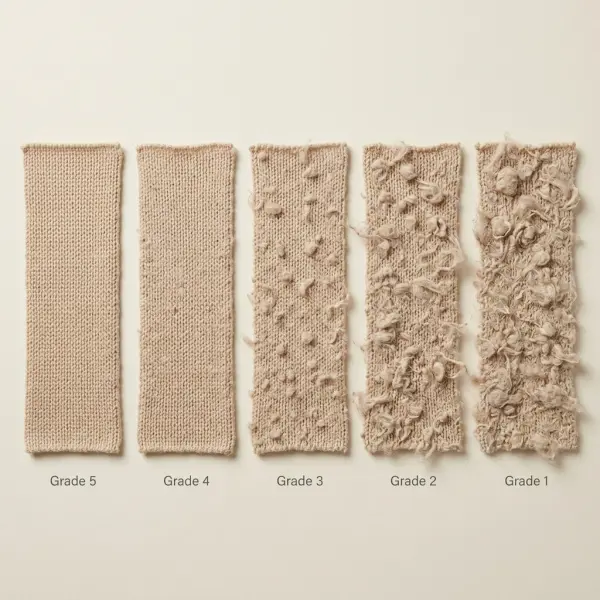
Pilling assessment commonly uses visual grading systems that describe the severity of observed surface changes. In a conventional five-grade system, Grade 5 represents the most favorable condition, while Grade 1 represents the most severe condition.
The precise grade descriptions, reference materials, assessment conditions, and reporting rules depend on the applicable procedure.
|
Illustrative Grade |
General Surface Condition |
|
Grade 5 |
No observed pilling |
|
Grade 4 |
Slight pilling |
|
Grade 3 |
Moderate pilling |
|
Grade 2 |
Pronounced pilling |
|
Grade 1 |
Severe pilling |
This table provides a simplified explanation of the grading direction. It is not a substitute for the formal assessment criteria established by a particular testing standard.
The ISO 12945-4:2020 visual assessment standard provides procedures for assessing pilling, fuzzing, and matting through visual analysis.
A pilling grade should always be interpreted alongside the associated mechanical exposure. Grade 4 after one assessment interval does not necessarily establish performance equivalent to Grade 4 after a substantially different interval or test method.
Where fuzzing and matting are separately relevant, those characteristics should also be considered rather than relying exclusively on the reported pilling grade.
How Abrasion Resistance Testing Works
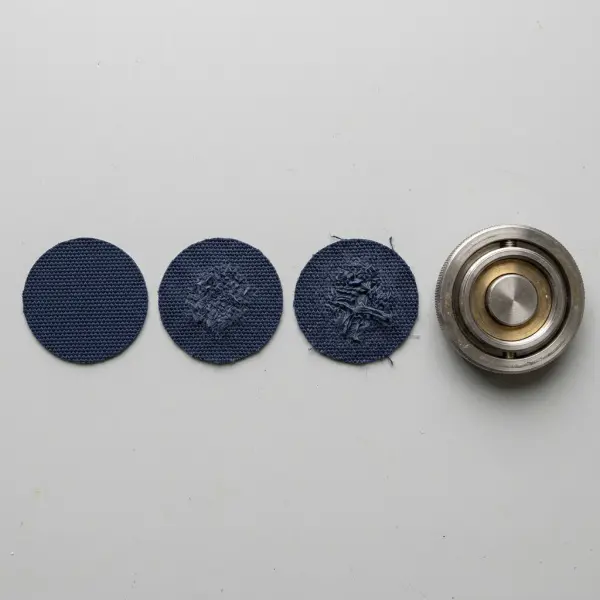
Abrasion resistance testing evaluates how textile specimens respond to controlled mechanical rubbing. The procedure establishes the contacting material, loading conditions, movement, inspection requirements, and assessment endpoint appropriate to the selected method.
A central consideration is that abrasion resistance can be evaluated through different outcomes. Some procedures investigate the exposure required to reach a defined breakdown condition, while others examine material loss or changes in appearance.
For fashion brands, understanding this distinction is essential when interpreting laboratory reports and establishing acceptance criteria.
Martindale Abrasion Testing
The Martindale abrasion method subjects textile specimens to a controlled multidirectional rubbing pattern. Depending on the applicable procedure, specimens are examined at specified intervals or assessed after a defined exposure.
The ISO 12947 series provides several procedures for evaluating abrasion resistance using the Martindale method.
|
Standard |
Assessment Objective |
Practical Business Application |
|
ISO 12947-2 |
Determination of specimen breakdown |
Evaluate resistance to a defined mechanical failure condition |
|
ISO 12947-3 |
Determination of mass loss |
Evaluate material removed during specified abrasion exposure |
|
ISO 12947-4 |
Assessment of appearance change |
Evaluate visible changes associated with abrasion |
|
ASTM D4966 |
Martindale abrasion resistance testing |
Evaluate abrasion performance according to the ASTM procedure |
The ISO 12947-2:2016 standard specifically addresses the determination of specimen breakdown through inspection at fixed intervals. The applicability and endpoint requirements should be checked for the material being evaluated.
ASTM D4966 provides a separate Martindale abrasion testing procedure. As with pilling assessment, the instrument name alone does not establish which standard, configuration, or reporting approach has been used.
Understanding Specimen Breakdown
Specimen breakdown refers to a defined failure condition established by the applicable test method. Depending on textile construction, the assessment may involve yarn breakage, hole formation, or another specified criterion.
This means that breakdown should not be interpreted as an identical visual event across every textile.
A woven fabric and a knitted fabric may exhibit different damage characteristics because their yarn systems and structural behavior differ. Raised or pile fabrics may require additional consideration of their surface construction.
When a laboratory reports an abrasion breakdown result, the sourcing team should understand which criterion has been applied. Without this information, a numerical exposure count may provide an incomplete picture of material performance.
Assessing Material Loss and Appearance Change
A textile may experience substantial surface changes before reaching the defined specimen breakdown condition. Depending on the material, repeated rubbing may alter surface texture, remove fibers, flatten raised structures, or change the visual character of the fabric.
Mass-loss assessment investigates the amount of material removed under specified exposure. Appearance-change assessment instead addresses how the textile looks after the defined mechanical action.
These approaches can be useful where structural breakdown alone does not adequately describe the product's quality requirements.
For example, a brushed fashion fabric may lose its intended tactile character before developing broken yarns or holes. An appearance-related assessment may therefore provide information that complements a conventional breakdown result.
What Does a Higher Abrasion Cycle Count Mean?
A higher exposure count before a defined breakdown condition generally indicates greater resistance to that particular form of abrasion, provided the materials were assessed under sufficiently comparable conditions.
It does not necessarily mean that the textile performs better in every respect.
A material may withstand extensive mechanical exposure while developing visible pilling or unacceptable appearance changes. Another may meet the product's actual durability requirements despite having a lower breakdown count than a more expensive alternative.
Fashion businesses should also avoid directly comparing exposure counts across different instruments or procedures without an appropriate technical basis.
The relationship between pilling resistance and abrasion resistance is explored in Fabric Pilling vs Abrasion: Understanding Different Types of Textile Wear. The distinction is particularly important when interpreting laboratory results that address different aspects of mechanical textile performance.
What Makes Textile Durability Test Results Reliable?
A textile test result is only as useful as the conditions under which it was obtained and the information available to interpret it.
Even when a recognized testing standard is used, differences in sampling, specimen preparation, environmental conditions, pretreatment, or assessment can influence the reported outcome. Fashion businesses should therefore evaluate the quality of the testing process rather than treating every laboratory report as automatically equivalent.
Representative Material Sampling
A test specimen should represent the material that the business intends to purchase or approve.
This becomes particularly important when suppliers produce multiple colorways, fabric batches, finishing variations, or revised constructions under a similar product description.
Testing a specially prepared development sample may provide useful initial information, but it does not automatically establish that subsequent bulk material will perform identically. Changes in yarn source, production parameters, dyeing, or finishing can affect material behavior.
Brands should establish sampling requirements appropriate to the product risk and production arrangement. Where performance is commercially critical, samples from relevant bulk production lots may be needed to verify consistency.
Specimen Preparation and Conditioning
Textile fibers can respond differently to environmental conditions such as temperature and humidity. Specimen conditioning helps establish a defined environment before testing, where required by the relevant procedure.
The ISO 139 standard for textile conditioning and testing atmospheres establishes standard atmospheric conditions used in determining textile physical and mechanical properties.
The applicable test method also determines relevant specimen preparation requirements. These may include dimensions, orientation, mounting, pretreatment, and the number of specimens.
For sourcing teams, the important consideration is that materials intended for direct comparison should be evaluated using appropriately consistent preparation and conditioning procedures.
Equipment Configuration and Mechanical Exposure
A testing instrument may support several procedures, each requiring a particular configuration. The relevant standard determines which operating conditions should be used.
For abrasion and pilling assessment, factors such as the contacting material, applied load, specimen mounting, movement, and exposure intervals can affect the resulting surface or mechanical changes.
This is one reason why a report that simply states Martindale tested provides insufficient information for a meaningful technical comparison.
Brands should request the applicable method designation and relevant test conditions, particularly when comparing results from multiple suppliers.
Laundering Pretreatment
Some textile finishes and surface characteristics change following washing and drying. Assessing only the fabric in its original supplied condition may therefore provide limited information about its subsequent performance.
Depending on the product and buyer requirements, a testing program may include an agreed laundering pretreatment before evaluating pilling or abrasion resistance.
The ISO 6330:2021 standard provides standardized domestic washing and drying procedures for textile testing.
The selected laundering procedure, drying method, and number of treatments should be defined according to the product requirements. A brand should not assume that every durability method automatically includes the same laundering pretreatment.
Laboratory Competence and Scope of Accreditation
Laboratory competence is an important consideration when test results are used for commercial acceptance, supplier qualification, or external performance claims.
The ISO/IEC 17025:2017 standard establishes requirements related to the competence, impartiality, and consistent operation of testing and calibration laboratories.
Accreditation to ISO/IEC 17025 can provide confidence in a laboratory's competence for activities included within its accredited scope. However, the existence of accreditation does not automatically establish that every service offered by the laboratory is covered.
Fashion businesses should verify whether the relevant testing methods fall within the laboratory's scope of accreditation, particularly where independent or accredited testing is contractually required.
How Fashion Brands Should Establish Fabric Acceptance Criteria
Fabric acceptance criteria are defined performance requirements used to determine whether a textile is suitable for approval under an agreed specification.
They translate broad expectations, such as maintaining a refined appearance or resisting premature material breakdown, into conditions that can be evaluated using defined procedures.
A testing standard and an acceptance criterion are not the same thing. The testing standard establishes how a characteristic is assessed. The acceptance criterion establishes what result is considered acceptable for the particular product or commercial agreement.
Start With the Intended Garment Application
The intended use of a garment should determine which performance characteristics receive the greatest attention.
A luxury cardigan may place considerable emphasis on pilling resistance because a refined surface is central to its product positioning. Work trousers may require stronger consideration of abrasion, tear performance, and seam integrity because localized mechanical failure can affect their functional suitability.
Similarly, children's apparel and uniforms may require attention to performance following repeated laundering because frequent cleaning forms part of their expected use.
The following framework illustrates how testing priorities can vary across product categories.
|
Product Category |
Primary Durability Concerns |
Testing Priorities to Consider |
|
Premium knitwear |
Surface appearance and softness retention |
Pilling, fuzzing, appearance after care |
|
Activewear |
Repeated movement and fabric contact |
Abrasion, pilling, stretch recovery, relevant mechanical strength |
|
Everyday trousers |
Localized material wear |
Abrasion, tear, tensile and seam performance |
|
Office uniforms |
Professional appearance after repeated use |
Pilling, dimensional stability, abrasion |
|
Industrial workwear |
Demanding mechanical exposure |
Abrasion, tear resistance, tensile and seam performance |
|
Children's clothing |
Frequent movement and laundering |
Abrasion, pilling, dimensional stability |
|
Outerwear |
Surface contact and structural reliability |
Abrasion, tear performance, application-specific functional properties |
|
Loungewear |
Softness and acceptable surface appearance |
Pilling, appearance after laundering, dimensional stability |
These priorities are illustrative rather than mandatory. Actual requirements should reflect the specific garment, material, target market, and relevant safety or regulatory obligations.
Define Measurable Requirements Before Testing
A fabric specification should identify both the performance characteristic and the conditions under which acceptance will be determined.
For a pilling assessment, this may involve the required visual grade after a defined exposure. For abrasion testing, it may involve a minimum exposure before breakdown, a maximum allowable mass loss, or an acceptable appearance condition.
A practical durability specification may contain the following information:
- The property being evaluated and applicable test method.
- The required mechanical exposure or assessment endpoint.
- The minimum or maximum acceptable result.
- Relevant specimen preparation and laundering pretreatment.
- The material, colorway, or production batch being assessed.
- Reporting requirements and the agreed acceptance decision rule.
- Procedures for handling nonconforming or inconclusive results.





Comments 0
Leave a CommentSend Comment
Anda harus Login terlebih dahulu untuk dapat memberikan komentar.