

Why Open-Structure Fabrics Are Used in Sportswear, Lingerie, and Layering
A running shirt with ventilated panels, a lace-trimmed bra with supportive mesh, and a sheer top layered over a camisole may look like unrelated products. Yet all three can use the same basic textile principle: an open network of yarns that leaves intentional spaces within the fabric.
The reasons for using these materials are remarkably different. Sportswear designers may want air to move through selected garment areas. Lingerie manufacturers may need a fabric that combines controlled stretch, recovery, and transparency. Fashion designers working with layered outfits may choose open structures because they reveal colors and silhouettes underneath without creating a completely opaque surface.
These applications show why open-structure fabrics cannot be evaluated through breathability alone. Their value depends on how the openings interact with fiber properties, garment construction, body movement, and other materials.
For fashion brands, choosing the right mesh or net fabric means understanding what the textile contributes to the finished product, where its limitations become important, and how to translate its intended function into reliable manufacturing specifications.
Quick Answer: Why Are Open-Structure Fabrics Used in Fashion?
Open-structure fabrics are used in sportswear, lingerie, and layered clothing because their interconnected yarn networks can provide ventilation, controlled elasticity, transparency, and distinctive surface texture. The exact benefit depends on fabric construction, fiber composition, finishing, and garment design.
In sportswear, open knitted structures are often positioned where additional airflow is desirable, such as selected back panels or side sections. However, airflow does not automatically guarantee effective sweat management or thermal comfort.
In lingerie, elastic mesh and power net can help control fabric tension and fit while creating lightweight or transparent panels. Support depends on the entire garment construction, not the presence of mesh alone.
In fashion layering, sheer meshes and nets allow underlying colors, textures, and garments to remain visible, giving designers more control over visual depth and silhouette.
The central advantage is versatility. By adjusting openness, stretch, stiffness, and fabric placement, apparel developers can assign different functions to selected garment areas. The challenge is ensuring those functions remain effective after sewing, wearing, and laundering.
One Textile Principle, Three Different Design Objectives
The characteristic shared by open-structure fabrics is the deliberate presence of spaces between yarns. These spaces influence how air, light, and mechanical forces interact with the textile.
However, the relationship between openness and performance is not straightforward. A highly open fabric may permit substantial airflow while providing limited coverage. Another fabric may have smaller openings but enough elasticity and recovery to perform a supportive role.
The purpose of the material therefore changes according to the product category.
|
Application |
Primary design objective |
Common material direction |
Main concern |
|
Sportswear |
Ventilation and freedom of movement |
Fine knitted mesh, engineered mesh, elastic mesh |
Airflow, moisture behavior, durability |
|
Lingerie |
Fit control, support, and aesthetic transparency |
Power mesh, power net, soft elastic mesh |
Stretch resistance, recovery, skin comfort |
|
Fashion layering |
Transparency, texture, and visual depth |
Fine mesh, tulle, fishnet, decorative net |
Opacity, drape, styling, snagging |
|
Hybrid garments |
Combine functional and aesthetic properties |
Zoned mesh, elastic net, mixed-material panels |
Compatibility between materials and intended performance |
These objectives frequently overlap. A sports bra may use mesh for ventilation, support, and visual styling in different locations. A fashion top may require sufficient stretch to be worn comfortably while still delivering a deliberately transparent appearance.
The material should therefore be selected according to its role in each garment component, rather than assigned a single function because it is described as mesh or net.
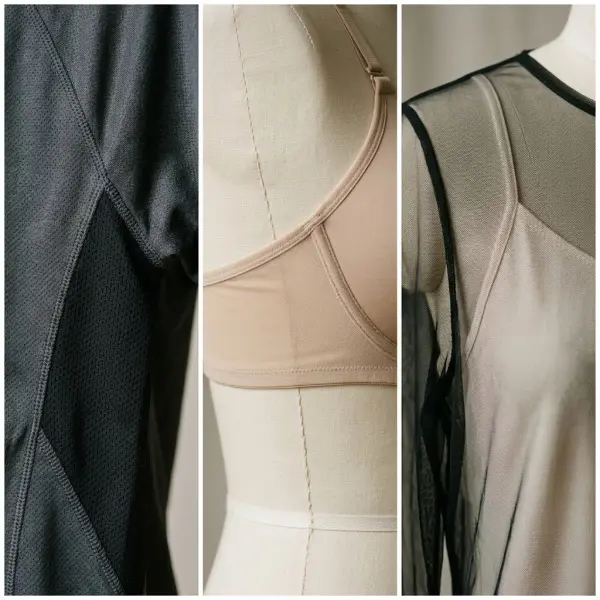
Why Open-Structure Fabrics Matter in Sportswear
Sportswear places unusual demands on textiles because the garment moves with the body while the wearer produces heat and perspiration. The fabric must accommodate movement, maintain sufficient coverage, and provide an acceptable experience under the intended activity conditions.
Open-structure fabrics are useful because their construction can create pathways for air movement without requiring the entire garment to be made from the same highly open material.
Their main contribution is not that they make every athletic garment cooler. It is that they allow designers to adjust local fabric behavior, including ventilation, flexibility, and coverage.
Ventilation Through Selected Garment Areas
A training top may use a more compact knitted fabric across most of the body and introduce mesh panels under the arms, along the sides, or across portions of the back.
The intention is to provide greater potential airflow through these selected areas while maintaining a different balance of coverage and durability elsewhere.
This design approach can be useful when an athletic garment does not require the same material properties in every location.
For example, a lightweight running shirt may need a smooth front surface, sufficient opacity, and seams that remain comfortable during arm movement. Introducing fine mesh to an appropriate back or side panel gives the designer another way to manage ventilation without changing the entire garment.
However, panel placement alone does not establish a proven thermal benefit. Air movement depends on external airflow, garment fit, movement, and whether additional layers obstruct the openings.
Fabric Structure Influences Thermal Comfort
Research on knitted sportswear materials demonstrates that fiber characteristics and textile construction influence air permeability and heat-related behavior.
The peer-reviewed study Material and Structural Functionalization of Knitted Fabrics for Sportswear examined the effects of yarn properties, fabric structure, density, thickness, and composition on air permeability and thermal resistance.
Its findings support an important development principle: designers should evaluate the combined fabric structure rather than assume that one fiber type or a visibly open surface will automatically deliver the required performance.
A fine mesh with a compact loop arrangement may behave differently from a larger-opening mesh made with thicker yarns. Finishing treatments and garment construction can create further differences.
The correct fabric is the one whose measured characteristics match the intended wearing conditions.
Airflow and Sweat Management Are Different Requirements
One of the most persistent misconceptions in performance apparel is that a breathable material must also be effective at moving liquid perspiration.
Air permeability measures the ability of air to pass through a textile under specified conditions. Liquid moisture management concerns what happens when sweat contacts the fabric, including wetting, transport, spreading, and related behavior.
A mesh with substantial open space may allow air to pass through relatively easily while offering limited liquid transport through its yarn network.
Conversely, a less visibly open fabric may be engineered to distribute moisture across its surface.
A study titled Comparative Analysis of Thermophysiological Comfort-Related Properties of Elastic Knitted Fabrics for Cycling Sportswear assessed multiple properties, including air permeability, moisture management, drying time, and thermal behavior. Its findings illustrate why evaluating these characteristics together is more informative than relying on a single measure.
For brands developing athletic garments, this distinction matters when writing product specifications and performance claims.
Engineered Ventilation and Zoned Construction
Some performance garments use different knitted structures within the same fabric or incorporate separate fabrics into selected panels.
These techniques allow developers to vary openness, stretch, and coverage according to design requirements. They may also reduce the need for certain cut-and-sew panel transitions when an appropriate integrated knit construction is available.
For example, a knitted athletic top might contain denser areas where opacity is required and more open zones where additional ventilation is desirable.
Producing such a fabric requires controlled knitting design and manufacturing capability. It can also complicate quality inspection because fabric properties may intentionally vary across the material.
For smaller brands, using separately cut mesh panels may be more practical than commissioning specialized engineered fabrics. The choice depends on order volume, supplier capability, product positioning, and development budget.
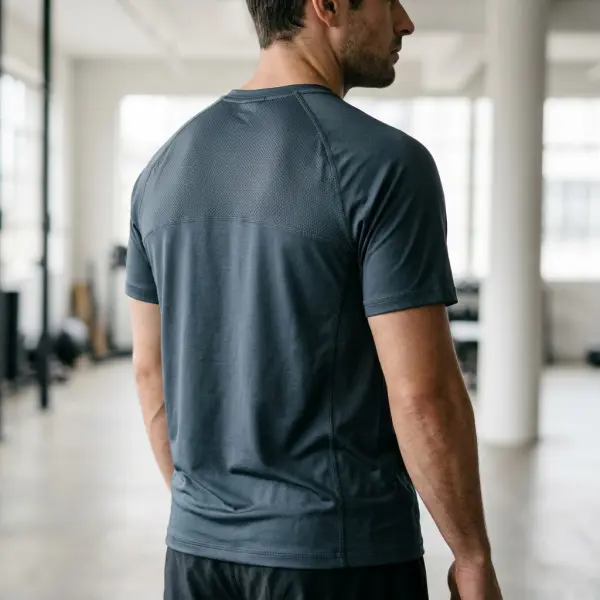
The Trade-Offs of Open Mesh in Athletic Clothing
Increasing the openness of a fabric may support airflow, but it can also change the garment's appearance and mechanical behavior.
A large-opening mesh may be more transparent than the brand intends. It may also catch on rough equipment or expose the underlying skin more directly to sunlight and environmental conditions.
The amount of stretch can introduce another complication. In knitted mesh, extending the material changes the shape and spacing of loops. This can alter opacity and potentially affect air permeability.
A fitted athletic garment therefore needs to be evaluated under realistic extension, not just in a relaxed state.
Durability During Repeated Movement
Athletic garments experience repeated tension, friction, and laundering. Mesh panels located near waistbands, equipment straps, or other high-contact areas may be exposed to more mechanical stress than a decorative panel on a fashion garment.
Yarn displacement, snagging, seam distortion, and loss of recovery can become commercially significant if the material was selected only for ventilation.
A development team should examine where the mesh is placed and what it touches during use.
For a training top, this may mean checking how the fabric behaves beneath a running vest or across a frequently stretched seam. The appropriate test conditions should reflect those interactions.
Comfort Depends on the Whole Garment
A mesh panel cannot independently determine the comfort of an athletic shirt. Fabric softness, seam placement, pattern fit, surface friction, and moisture behavior all influence the final result.
A shirt with highly permeable mesh but bulky seams near moving joints may feel less comfortable than a garment with more moderate ventilation and better construction.
This is why performance fabric approval should lead to garment-level trials rather than serve as the final stage of testing.
Wear testing is particularly useful when it evaluates realistic movement, intended underlayers, laundering, and repeated use.
Why Lingerie Uses Elastic Mesh and Power Net
Lingerie uses open-structure textiles for a different combination of reasons: fit control, localized support, flexibility, and visual delicacy.
In a bra, bodysuit, or fitted undergarment, the textile often needs to work with the garment pattern to manage tension around the body.
Unlike a decorative fabric that hangs freely, elastic mesh may remain under continuous extension during wear. This makes stretch resistance and recovery particularly important.
Stretch and Recovery Help Control Fit
An elastic mesh can extend as the body moves and recover when the applied tension is reduced. This behavior can help the garment accommodate movement while maintaining its intended fit.
Power mesh and power net are commercial terms commonly associated with elastic open knitted fabrics used in support and close-fitting applications.
A technical review, Compression Garments for Medical Therapy and Sports, describes elastic knit constructions, including warp-knitted and Raschel power-net structures, used in garments requiring controlled extension.
The relevance for lingerie is the relationship between fabric force-extension behavior and garment design.
A textile that stretches easily may feel comfortable but provide insufficient resistance for a particular support panel. A firmer construction may offer greater restraint but create excessive pressure if the pattern and sizing are inappropriate.
Neither extreme is automatically desirable.
Support Comes From the Garment System
The presence of power mesh does not automatically make a bra supportive.
Support depends on the interaction between the fabric, pattern dimensions, band construction, cup design, straps, closures, seams, and the wearer's fit.
Mesh may serve as a side wing, lining, reinforcing layer, or selected support panel. Its role can differ between garment styles and support requirements.
Research examining breast motion in bras with varying support levels demonstrates that different completed bra designs can produce different movement-control outcomes.
The study does not establish a universal relationship between power mesh content and support. Instead, it reinforces why manufacturers must assess the finished garment.
For product development, fabric-level stretch results should inform sampling, but support claims require evaluation of the actual bra design.
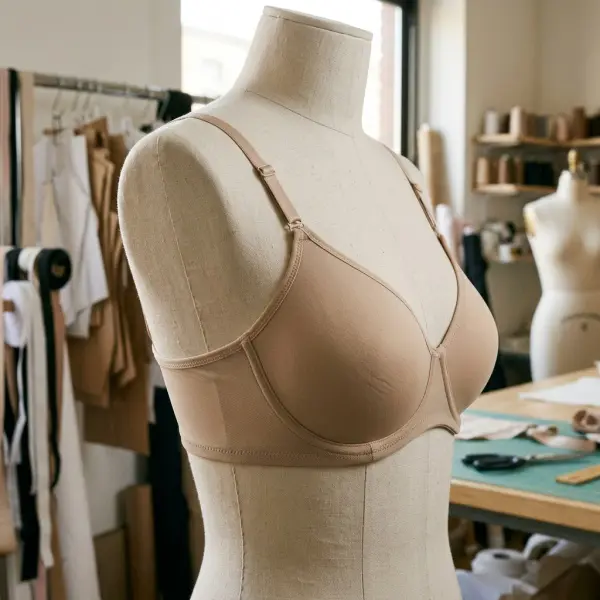
Transparency Without Heavy Visual Coverage
Lingerie design frequently balances decorative appearance with functional requirements. Open-structure fabrics can create subtle transparency while allowing underlying construction details or skin tone to remain visible.
A soft elastic mesh may be used as an outer decorative layer, whereas a firmer power net may be incorporated in an area where tension control is required.
The same garment can contain both, but the materials are not necessarily interchangeable.
A decorative mesh panel may provide the desired visual effect without having suitable recovery for a supportive wing. A structurally appropriate power net may deliver the intended elastic resistance while feeling too firm for a delicate overlay.
Designers need to specify each component according to its actual function.
Skin Comfort and Seam Placement
Lingerie is often worn in prolonged contact with the skin, making tactile comfort especially relevant.
Fine filaments, yarn texture, finishing chemicals, seam bulk, elastic tension, and garment fit can influence the wearer's experience.
A visually smooth mesh may still feel abrasive at a seam or under repeated movement. More open constructions can also expose the skin to direct contact with stitches, decorative components, or other garment layers.
Brands should assess both the fabric surface and the assembled garment.
A mesh that feels soft when handled may behave differently when stretched, folded, bound, or sewn next to a stronger elastic component.
How Open Fabrics Balance Support and Comfort in Lingerie
The central technical challenge in supportive lingerie is managing extension and pressure without sacrificing wearability.
A supportive mesh must create appropriate resistance under tension, but the required resistance varies across body locations and garment sizes.
Two fabrics with identical fiber percentages can behave differently because their knit structures and yarn arrangements differ.
For example, a nylon-elastane power mesh used in a bra wing may not produce the same fit when substituted with another fabric containing the same proportion of elastane.
The difference may become apparent during wear trials, after laundering, or when the design is graded across sizes.
Why Pattern Grading Matters
Lingerie patterns are not simply enlarged or reduced uniformly without considering fit requirements.
As garment dimensions change, the relationship between fabric extension, circumference, and the desired level of support can also change.
A material that performs adequately in one sample size may require additional evaluation in other sizes, especially where the same fabric provides substantial support.
This creates a practical implication for brands: fabric approval and size grading should be coordinated.
Where feasible, fitting should include representative sizes and real movement conditions, rather than relying exclusively on a single fit model and static visual inspection.
Why Elastic Recovery Must Survive Laundering
Repeated stretching and laundering can change the performance of an elastic knitted textile.
For supportive garments, gradual changes in recovery may contribute to looser fit or altered tension, even when the fabric remains visually intact.
Manufacturers should therefore test the material after relevant care cycles, particularly when its function depends on controlled extension.
The appropriate acceptance criteria should reflect the intended product, expected use, care instructions, and material construction.
A fabric selected for decorative transparency may not require the same recovery performance as one forming a substantial support panel.
Why Open-Structure Fabrics Work So Well for Fashion Layering
Fashion layering uses mesh and net fabrics primarily to create visual relationships between garments.
An opaque textile generally conceals much of what lies beneath it. An open-structure fabric allows the underlying color, print, silhouette, or texture to remain partially visible.
This gives designers a way to introduce additional surface detail without fully hiding the base garment.
Unlike sportswear, where airflow may be a primary objective, layering can use open structures mainly for aesthetic reasons.
Transparency Creates Visual Depth
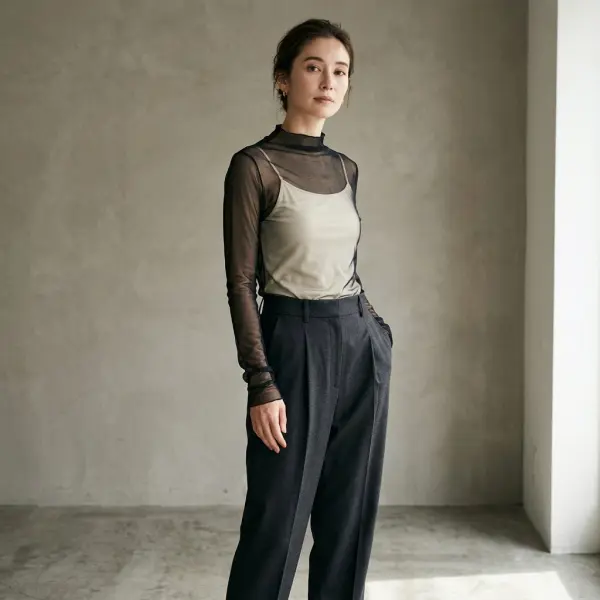
A sheer mesh top worn over an opaque camisole creates two visible surfaces. The outer layer contributes texture and shape, while the inner garment provides color and coverage.
The resulting appearance changes with the color contrast between those layers.
A black fine mesh over a pale underlayer creates a different visual effect from the same mesh over black fabric. Similarly, a larger-opening net produces a more pronounced geometric pattern than a fine mesh of similar color.
The desired outcome should be evaluated on the complete outfit.
A fabric that appears almost invisible when held against a neutral background may become visually dominant when placed over contrasting clothing.
Lightness Helps Preserve the Underlying Silhouette
Many open-structure fabrics are lightweight, allowing designers to add an outer textile layer without necessarily creating the volume associated with a heavier fabric.
This can be useful for sheer sleeves, overlays, extended hems, and layered tops.
However, openness does not guarantee softness or a fluid silhouette. A firm net can stand away from the body, while a soft fine mesh may drape closely.
The appropriate material depends on whether the design calls for a subtle surface or a distinct shape.
For example, a fitted long-sleeve mesh top requires different elasticity and drape from a structured tulle overskirt.
Layering Supports Styling Variations
Transparent outer garments can offer styling flexibility because the same piece may be combined with different opaque garments underneath.
A fashion brand might develop a fine mesh blouse that can be styled over a camisole for everyday wear or with a more structured underlayer for an occasion-focused look.
This does not guarantee that customers will use the product in multiple ways. Successful styling flexibility depends on garment fit, transparency, color compatibility, and clear communication.
For retail teams, photographs showing realistic combinations can help customers understand what is included and how the item is intended to be worn.
Layering Does Not Automatically Improve Thermal Comfort
One common misunderstanding is that adding a breathable mesh layer will necessarily keep an outfit cool.
Although an individual open fabric may permit substantial airflow, its contribution to comfort changes when other layers are added.
A mesh top worn over an impermeable lining cannot create substantial airflow through the lining simply because the outer fabric has visible openings.
The opposite situation is also possible. Layering can introduce additional air spaces and change the overall insulation behavior of the clothing system.
A review titled Measurement Methods of the Thermal Resistance of Materials Used in Clothing explains how garment configuration, air gaps, posture, body coverage, and airflow influence thermal resistance.
For apparel businesses, the implication is straightforward: the behavior of one fabric does not fully describe the behavior of the complete layered outfit.
A technical evaluation may examine thermal and water-vapor resistance using the current ISO 11092:2026 standard, which includes provisions for textile materials and multilayer assemblies.
The standard provides laboratory measurement methods, but its test conditions do not directly establish comfort for every real-world situation.
This distinction is important when a fashion brand wants to describe a sheer layered garment as breathable or suitable for warm weather.
How Fabric Openness Influences Aesthetics and Performance
The degree of openness affects several textile characteristics at once. Designers cannot usually adjust one property without at least considering its consequences for other properties.
A more open material may provide greater transparency and potential airflow. Depending on construction, it may also become more susceptible to snagging, localized distortion, or reduced coverage.
A finer and more compact mesh may provide smoother visual texture but a different combination of ventilation and flexibility.
|
Fabric characteristic |
Sportswear implication |
Lingerie implication |
Layering implication |
|
Opening size |
Influences potential ventilation and coverage |
Influences transparency and surface behavior |
Controls visibility of underlying garments |
|
Elasticity |
Accommodates body movement |
Helps establish fit and controlled tension |
Determines whether the overlay can follow body contours |
|
Recovery |
Helps maintain fit during repeated use |
Important for supportive components |
Helps fitted sheer garments retain shape |
|
Stiffness |
Affects drape and movement |
Can affect comfort and panel behavior |
Determines whether layers fall softly or hold volume |
|
Yarn texture |
Influences tactile comfort and durability |
Particularly relevant to skin contact |
Affects visual texture and snagging |
|
Fabric weight |
Contributes to overall garment weight |
Influences handling and construction |
Helps control the bulk of layered outfits |
|
Transparency |
May affect desired coverage |
Can serve both functional and aesthetic goals |
Often a central design feature |
The table highlights why a single mesh specification cannot serve every garment category.
A sportswear developer may prioritize airflow and abrasion behavior, while a lingerie developer places greater emphasis on extension and recovery. A fashion designer creating a sheer overlay may primarily evaluate drape, transparency, and visual consistency.
The same physical characteristic can therefore be desirable in one product and problematic in another.
Combining Open-Structure Fabrics With Other Materials
Most garments using open-structure textiles contain additional materials, including denser knitted fabrics, woven fabrics, elastics, linings, or decorative components.
These combinations introduce construction challenges because different materials may respond differently to stretching, handling, and laundering.
Matching Stretch Across Fabric Panels
A highly elastic mesh sewn to a stable woven fabric may distort if the two materials are assembled without controlling the difference in extension.
The problem may appear as puckering, twisting, or uneven tension along the seam.
In sportswear, this can affect movement. In lingerie, it can alter fit and support. In layered fashion, it can disrupt the intended silhouette.
Manufacturers should examine material compatibility before bulk cutting.
This may require adjustment to seam construction, pattern dimensions, feeding techniques, or the selection of supporting components.
Reinforcing Areas Under Tension
Open knitted structures may require reinforcement where concentrated loads occur.
Bra wings, strap connections, fitted garment openings, and highly stressed athletic seams are examples where fabric and seam performance need to be evaluated together.
A mesh can perform adequately in isolation but fail at an attachment point if the stitching or joining method creates excessive local tension.
For this reason, quality control should include inspection of assembled components and not only the raw textile.
Managing Decorative and Functional Layers
Decorative net overlays and functional garment layers can create unexpected differences in movement.
If the underlying fabric stretches substantially but the decorative net does not, the outer layer may restrict movement or develop distortion.
The reverse arrangement can also require careful handling, particularly when a stable decorative component is attached to a soft elastic foundation.
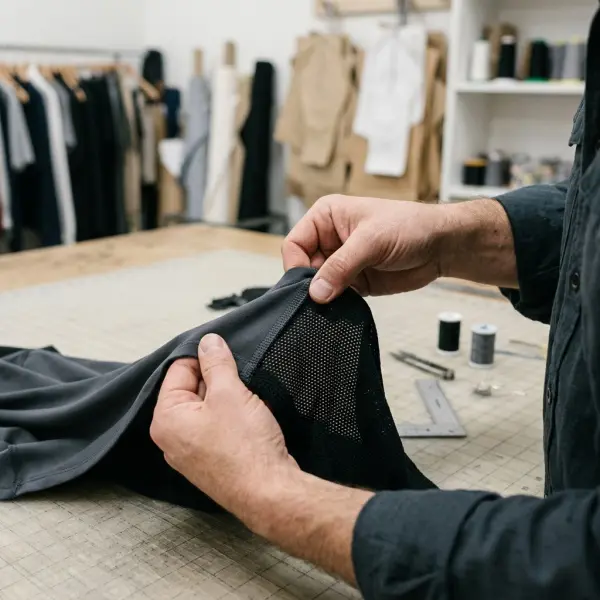
During sampling, developers should examine whether the materials move together as intended when worn, rather than approving the design only in a static position.
What Fashion Brands Should Test Before Production
Testing should reflect the reason a material was selected. A sportswear mesh does not need exactly the same evaluation program as a decorative tulle overlay or a supportive power-net panel.
A practical test plan identifies the properties that would create product failure if they fell outside acceptable limits.
Sportswear: Airflow, Moisture, and Wear Durability
Sportswear evaluation may include air permeability, liquid moisture management, drying behavior, stretch recovery, and resistance to relevant forms of wear.
For air permeability, ISO 9237:1995 provides a method for measuring the permeability of fabrics to air.
Where liquid perspiration handling is important, AATCC TM195 addresses liquid moisture management properties.
These are different measurements. Brands should avoid combining them into a single undefined "breathability" score.
A finished athletic garment should also be assessed for fit, seam comfort, and realistic movement under the intended use conditions.
Lingerie: Extension, Recovery, and Fit
For lingerie, developers should evaluate fabric extension and recovery in the directions relevant to the garment.
Testing may also address seam strength, dimensional change after laundering, tactile comfort, and the behavior of supporting elastic components.
Where a product claims support, fit and movement testing of the completed garment becomes especially important.
The required criteria will vary by product type. A decorative bralette and a high-support sports bra should not automatically be judged against identical performance expectations.
Research on compression garments further illustrates the importance of correctly characterizing garment pressure rather than assuming that fabric elasticity alone establishes a particular support or compression level. A systematic scoping review of compression garment research also found mixed evidence for performance-related benefits, reinforcing the need for carefully qualified claims.
Layering: Transparency, Drape, and Care Performance
Layered fashion often requires visual evaluation as well as conventional textile testing.
Developers should inspect the intended garment combination under realistic lighting, including how transparency changes over different underlayer colors and when the fabric stretches.
Drape, edge appearance, snagging, and compatibility between garment layers are also relevant.
For laundering-related dimensional changes, ISO 5077:2007 provides a method for determining dimensional change after specified washing and drying procedures.
However, laboratory results should be interpreted alongside garment trials. A decorative layer may remain within its dimensional tolerance yet become visually distorted or handle differently after care.
Practical Material Selection for Fashion Businesses
The strongest material decisions begin with a functional brief, not a supplier's catalog photograph.
A brand developing multiple product categories should avoid using a single material evaluation checklist for every open-structure textile. Instead, the company can establish a shared sourcing framework with different priorities for each application.
For a training top, the brief might specify a fine mesh panel that balances ventilation, opacity, and movement. For a fitted undergarment, it might call for a particular range of extension and recovery. For a sheer fashion top, the critical requirements may be transparency, drape, skin comfort, and the stability of decorative seams.
Once those requirements are clear, the sourcing team can compare materials more efficiently.
A useful development sequence includes:
- Identify the garment function. Decide whether the fabric is primarily for ventilation, controlled stretch, structural support, or visual layering.
- Define the performance requirements. Specify measurable properties and realistic acceptance tolerances.
- Shortlist suitable materials. Compare commercial mesh, net, power mesh, or engineered fabrics according to the actual application.
- Develop complete garment samples. Evaluate interaction with other fabrics, seams, trims, and pattern dimensions.
- Conduct relevant tests and wear trials. Focus on the likely failure risks rather than testing every available property.
- Approve the production reference. Retain a physical sample and technical specification for future quality control.
This approach is particularly useful for smaller fashion brands with limited sample-development budgets. A targeted comparison of a few suitable fabrics may provide more useful information than selecting from a much larger range without clear requirements.
Consider the Total Production Cost
Mesh and net fabric prices vary according to construction, yarn composition, finishing, supplier, and purchasing volume.
An inexpensive material may create additional costs if it is difficult to cut accurately, requires extra reinforcement, or produces inconsistent results during sewing.
Conversely, a more expensive engineered material is not automatically justified if a simpler textile meets the product's functional and commercial requirements.
Brands should evaluate usable width, cutting yield, sewing time, quality losses, material consumption, and expected product life.
The objective is to establish which fabric delivers the required product performance at an acceptable total cost.
Translate Material Properties Into Customer Benefits
Customers do not necessarily interpret technical textile terminology in the same way as sourcing teams.
For example, describing a garment as having "engineered mesh panels" does not explain whether the intended benefit is ventilation, stretch, support, or decoration.
Product descriptions become more useful when they connect a visible design feature to a realistic function.
A sportswear brand might describe fine mesh panels as allowing additional airflow in selected areas. A lingerie brand may explain where a supportive elastic panel is positioned without claiming an unverified compression level. A fashion retailer can describe a sheer mesh top as intended for layering over an opaque garment.
These explanations help align product expectations with the actual design.

Common Mistakes When Using Open-Structure Fabrics
Mistaking Ventilation for Overall Comfort
Brands sometimes assume that adding mesh automatically makes a garment comfortable in warm conditions. This overlooks moisture behavior, garment fit, underlayers, skin friction, and the effect of airflow.
A training shirt with a poorly positioned mesh insert may not produce the intended experience, particularly if its seams create discomfort during repeated movement.
The better approach is to evaluate the complete garment under realistic conditions rather than rely on a single fabric characteristic.
Assuming Elastic Mesh Automatically Provides Support
Power mesh and power net may contribute controlled extension, but support is generated by the interaction between the fabric and garment construction.
Using a firm elastic textile without appropriate pattern development can create discomfort, while a very flexible material may not deliver the intended tension.
For lingerie and supportive garments, sample fitting and relevant movement evaluation should inform fabric approval.
Ignoring Transparency Under Real Wearing Conditions
A mesh that appears sufficiently opaque in a flat swatch can look more transparent when stretched over the body or viewed under strong lighting.
This can affect sportswear, lingerie, and layered fashion differently, but the commercial consequence is similar: customers may receive a product with more exposure than expected.
Testing should include realistic fit and lighting conditions, while product photography should represent actual coverage.
Combining Fabrics With Incompatible Stretch
A sheer overlay or mesh insert may behave differently from the underlying garment material.
When the stretch properties are poorly matched, the finished garment can pucker, distort, restrict movement, or develop seam-related problems.
Material compatibility should be assessed during sampling, and any substitution should trigger a review of the relevant pattern and construction details.
Treating Decorative Mesh as a Durable Performance Material
A visually attractive net may not be suitable for repeated friction, high tension, or frequent laundering.
Using it in an athletic panel or heavily stressed lingerie component without testing may result in snagging or loss of shape.
The solution is not to avoid decorative mesh altogether. It is to use it where its properties are appropriate and verify any functional role before production.
Overlooking Maintenance and Long-Term Appearance
Open textiles can be vulnerable to snagging, distortion, or damage during washing and handling. Elastic fabrics may also change their recovery behavior over time.
Care requirements need to reflect the finished product, particularly where multiple materials are combined.
If the garment's appearance depends on delicate transparency or controlled stretch, laundering tests and accurate care instructions become part of the product-development process rather than an afterthought.
Important Caveats About Performance and Sustainability
Open-structure fabrics are not automatically lightweight, breathable in the complete garment, durable, or environmentally preferable.
Their behavior depends on fiber composition, yarn geometry, construction, finishing, fabric weight, and how they are assembled with other materials.
A highly open mesh can allow substantial airflow while providing limited protection from wind or ultraviolet exposure. Similarly, a transparent fabric does not necessarily offer reliable sun protection, even if it feels comfortable in warm conditions.
Claims about compression, improved athletic performance, moisture management, or support should be tied to appropriate evidence. The presence of power mesh, for example, is not sufficient to establish a specific level of support or pressure.
Environmental claims require similar care.
An open fabric may use less yarn per unit area than some denser alternatives, but this alone does not prove a smaller environmental footprint. Additional linings, fabric waste, finishing processes, product durability, and material composition all affect the outcome.
Many commercial meshes use polyester, nylon, or elastane blends. Recycled content may be relevant to material sourcing, but it does not automatically resolve issues associated with textile processing, microfiber release, or end-of-life management.





Comments 0
Leave a CommentSend Comment
Anda harus Login terlebih dahulu untuk dapat memberikan komentar.