

Fabric Pilling vs Abrasion: Understanding Different Types of Textile Wear
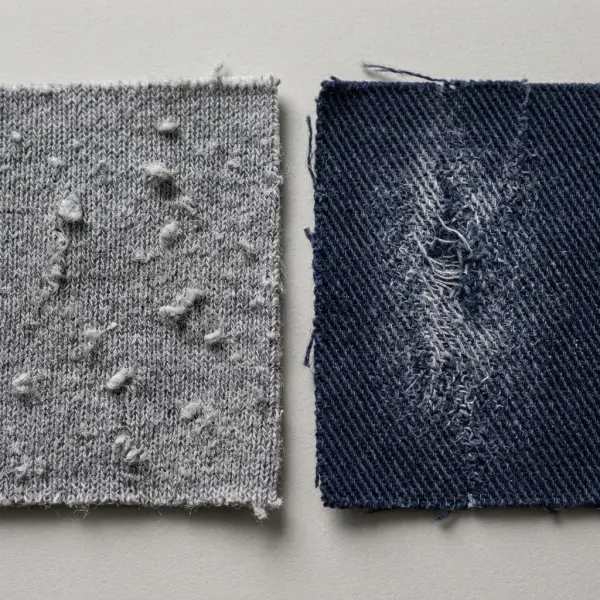
Two garments can show signs of wear after months of regular use, yet the underlying textile problems may be entirely different. A knitted sweater may develop small balls of tangled fibers across its surface, while a pair of work trousers may gradually become thinner around the knees. Both changes result from mechanical interaction, but they do not represent the same type of material deterioration.
The distinction between fabric pilling and abrasion is particularly important for fashion brands, garment manufacturers, and textile sourcing teams. Although both are associated with friction and repeated use, they affect fabric performance in different ways and require different approaches to material selection, product development, and quality evaluation.
A fabric that performs well against abrasion may still develop visible pills. Conversely, a textile with relatively good pilling resistance may gradually lose material or structural integrity under repeated rubbing.
Understanding these differences helps fashion businesses move beyond generalized claims about fabric durability and establish performance requirements that reflect how garments are actually worn, maintained, and evaluated by customers.
Quick Answer
Fabric pilling and abrasion are related but distinct forms of textile wear. Fabric pilling occurs when exposed fibers become entangled into small balls that remain attached to the fabric surface. Abrasion refers to mechanical wear caused by repeated rubbing or contact, which can result in surface changes, fiber loss, yarn damage, fabric thinning, or eventual structural breakdown.
Pilling primarily affects surface appearance and perceived garment quality, particularly during its earlier stages. Abrasion can affect both appearance and functional durability, depending on the severity of the material deterioration.
The two phenomena are interconnected because abrasive action can contribute to the formation and eventual removal of fabric pills. Nevertheless, pilling resistance and abrasion resistance are separate performance characteristics and should not be treated as interchangeable.
For fashion businesses, the appropriate priority depends on garment application. Premium knitwear may require particular attention to pilling resistance, while workwear and frequently used trousers may require greater emphasis on resistance to material loss and structural wear. Many everyday garments require both.
Effective textile quality management involves evaluating these characteristics independently, selecting materials according to realistic wearing conditions, and establishing performance expectations that support the intended product lifespan.
What Is Fabric Pilling?
Fabric pilling is a textile surface phenomenon in which exposed or loosened fibers become entangled into compact clusters, known as pills, that remain attached to the underlying fabric.
These small fiber balls often develop through repeated contact during wearing, laundering, or rubbing against other materials. Their formation and persistence depend on fiber characteristics, yarn construction, textile structure, finishing treatments, and the nature of the mechanical exposure.
Pilling is particularly relevant to garments whose commercial appeal depends on maintaining a refined or consistent surface. A premium knitted cardigan may remain warm, comfortable, and structurally functional while becoming visually less attractive because of accumulated pills.
Unlike a hole or a broken seam, pilling does not necessarily indicate immediate functional failure. Its significance lies largely in how it changes the textile surface and affects the customer's perception of quality.
How Pilling Changes the Fabric Surface
Pill formation generally begins when fibers protrude from the textile surface and become increasingly entangled through mechanical movement. Continued rubbing may cause these fibers to form compact clusters that remain connected to the fabric through anchoring fibers.
The development of visible pills represents a balance between formation and detachment. Some pills remain attached for extended periods, while others eventually break away as the connecting fibers deteriorate.
This behavior explains why a fabric can appear more heavily pilled at one stage of use and less heavily pilled at another. A reduction in visible pills does not necessarily mean that the textile has become more resistant to wear; some of the accumulated pills may simply have detached.
For a more detailed explanation of fiber migration, material susceptibility, and prevention strategies, see Fabric Pilling Explained: Causes, Prevention, and Clothing Quality.
What Is Fabric Abrasion?
Fabric abrasion is mechanical wear that occurs when a textile repeatedly rubs against itself or another surface, potentially causing changes in appearance, fiber damage, material loss, or structural deterioration.
Abrasion resistance describes a textile's ability to withstand this type of wear under specified conditions. It is particularly relevant to garments exposed to repeated movement, contact with furniture, equipment, accessories, or demanding working environments.
Unlike pilling, which describes a particular visible surface condition, abrasion describes a mechanical wear process that can produce several different outcomes.
A woven fabric may gradually lose its surface finish. A knitted garment may become thinner in areas of repeated friction. A pile textile may experience changes in surface height or texture. Under sufficiently severe exposure, individual fibers and yarns may break, eventually compromising fabric integrity.
These outcomes make abrasion resistance an important consideration for garments expected to maintain their functionality during frequent or demanding use.
How Abrasion Damages Textile Materials
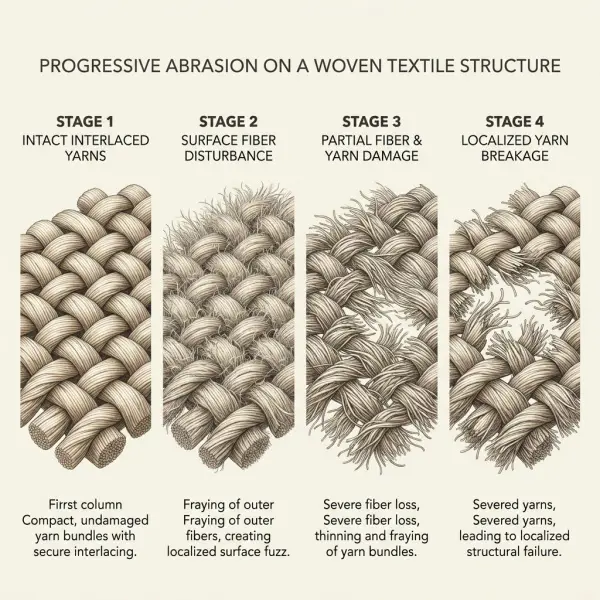
Abrasion involves repeated mechanical interaction between a textile and a contacting surface. Depending on the material characteristics and exposure conditions, this interaction may produce fiber displacement, fatigue, fragmentation, or progressive removal of material.
The process does not always begin with visible damage. A fabric may initially exhibit subtle changes in texture or surface appearance before more substantial deterioration becomes apparent.
Several possible manifestations of abrasion include:
- Flattening or disturbance of the original textile surface.
- Removal of selected surface fibers or raised structures.
- Changes in surface gloss, color appearance, or texture.
- Progressive fiber and yarn damage.
- Localized reduction in fabric thickness.
- Formation of broken yarns or holes under severe wear.
These changes do not necessarily occur in a fixed sequence. The dominant wear mechanism depends on the textile construction, contacting material, pressure, movement, and duration of exposure.
Research published in the Journal of Engineered Fibers and Fabrics on the damaging mechanisms of different textile abrasion test procedures illustrates how different mechanical testing approaches can produce different forms of material damage. This is an important consideration when interpreting abrasion resistance as a performance characteristic rather than an absolute property.

Where Does Abrasion Commonly Occur on Clothing?
Abrasion frequently develops in garment areas that experience repeated contact or mechanical loading during ordinary movement. Its location varies according to garment design, wearer activity, fabric construction, and the surrounding environment.
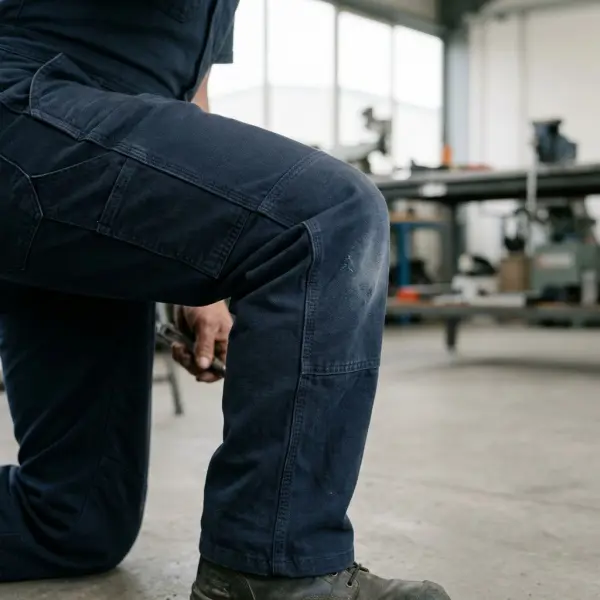
Trousers may experience abrasion around the knees, seat, and inner thighs. Workwear can encounter additional contact with tools, machinery, protective equipment, or rough working surfaces. Outerwear may experience concentrated wear beneath backpack straps or around cuffs.
These locations provide useful clues during garment quality investigations. A localized worn area may indicate repeated exposure to a particular surface, whereas widespread deterioration may suggest a different combination of material characteristics and use conditions.
For product developers, identifying these high-contact areas during the design stage can help determine whether changes in textile selection, reinforcement, garment fit, or construction are appropriate.
Fabric Pilling vs Abrasion: Key Differences
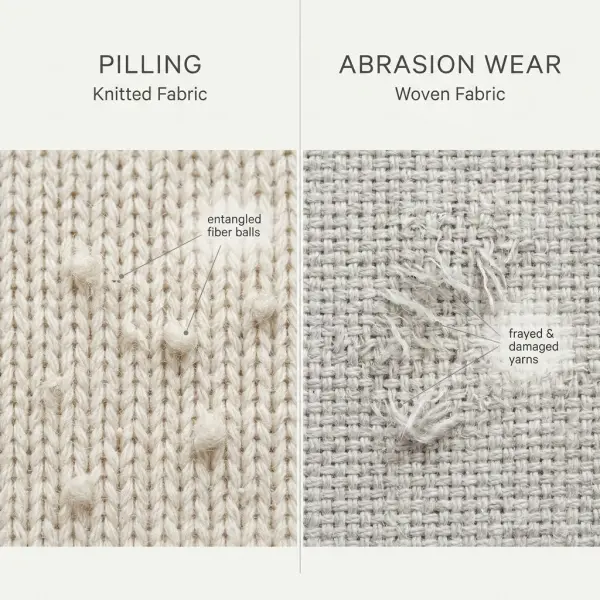
The main difference between fabric pilling and abrasion lies in what each term describes. Pilling refers to the formation of attached fiber balls on a textile surface, while abrasion refers to mechanical wear that can cause a broader range of surface and structural changes.
Although abrasive action can contribute to pilling, a textile does not need to develop pills in order to experience abrasion-related deterioration. A smooth woven fabric may gradually thin through repeated contact without forming substantial visible fiber balls.
The distinction becomes clearer when the two characteristics are compared according to their mechanisms, appearance, commercial implications, and evaluation methods.
|
Comparison Factor |
Fabric Pilling |
Fabric Abrasion |
|
Definition |
Formation of attached balls of entangled fibers |
Mechanical wear caused by repeated rubbing or contact |
|
Primary mechanism |
Fiber protrusion, entanglement, retention, and detachment |
Mechanical disturbance, fatigue, damage, or removal of textile material |
|
Typical appearance |
Small fiber balls and uneven surface texture |
Surface flattening, thinning, worn yarns, or other changes |
|
Main initial concern |
Appearance retention |
Surface wear and material durability |
|
Structural impact |
Often limited during early stages, but may coexist with structural wear |
Can become substantial as deterioration progresses |
|
Common garment locations |
Underarms, sides, cuffs, inner thighs |
Knees, seat, elbows, cuffs, high-contact areas |
|
Common performance measurement |
Visual surface grading under specified conditions |
Specimen breakdown, mass loss, or appearance change |
|
Typical development priority |
Maintaining an acceptable textile surface |
Preserving material integrity under repeated contact |
|
Maintenance possibilities |
Suitable depilling may improve appearance |
Lost material cannot generally be restored through ordinary care |
|
Commercial relevance |
Perceived quality, aesthetics, customer satisfaction |
Functional lifespan, reliability, and appearance retention |
Neither characteristic is inherently more important than the other. Their relative significance depends on the product category and the consequences of deterioration.
A soft fashion sweater may become commercially unacceptable because of severe pilling even though it remains structurally sound. A pair of industrial work trousers may remain relatively free from pills but become unsuitable for continued use because its fabric has worn through.
The relevant performance question is therefore not simply whether a textile is durable. It is whether the textile resists the specific forms of deterioration that matter for its intended application.
How Are Fabric Pilling and Abrasion Related?
Fabric pilling and abrasion are related because both can develop through repeated mechanical contact. Abrasive action may expose fibers, encourage entanglement, and eventually contribute to the breakage of fibers anchoring pills to a textile.
However, this relationship does not mean that pilling and abrasion resistance improve or deteriorate together in every material.
A textile's visible pilling behavior depends partly on whether protruding fibers form persistent clusters. Its abrasion resistance depends on how the textile responds to repeated mechanical stress and how that response affects the selected performance criterion.
Abrasion Can Contribute to Pill Formation
When fabrics rub against each other, surface fibers may become increasingly exposed. These fibers can interact with neighboring fibers and form tangled clusters if the material characteristics and mechanical conditions favor entanglement.
This explains why areas exposed to repeated friction frequently develop pilling. The sides of a sweater, for example, may experience regular contact with the sleeves, encouraging surface changes and eventual pill formation.
Nevertheless, friction does not guarantee that a fabric will develop visible pills. A textile with a relatively smooth and stable surface may instead exhibit changes in gloss, fiber damage, or localized material loss.
The CottonWorks garment durability guidance treats pilling and abrasion as distinct aspects of textile performance, reflecting the need to evaluate multiple characteristics when assessing durability.
Abrasion Can Also Remove Existing Pills
Once pills have formed, continued rubbing may damage the fibers that connect them to the fabric. Some pills eventually detach, potentially reducing the number of visible fiber balls.
A fabric that forms pills readily but releases them relatively quickly may therefore show a different visual wear pattern from a textile that retains its pills for longer periods.
This introduces an important limitation when judging textile wear by appearance alone. A relatively smooth surface does not necessarily demonstrate that little material deterioration has occurred.
From a quality assurance perspective, the disappearance of visible pills should not automatically be interpreted as improved fabric performance. The underlying material may have experienced additional fiber loss during the same period.
Strong Fibers Can Create Persistent Surface Pills
Fiber strength can influence pilling and abrasion behavior in different ways. Strong fibers may contribute to resistance against certain forms of mechanical damage, depending on their characteristics and the textile construction.
Those same fibers may also help keep pills attached once surface entanglement has occurred.
For example, certain synthetic staple-fiber constructions may maintain their structural integrity during repeated rubbing while developing persistent visible pills. This does not mean that synthetic fibers inherently perform poorly, but it demonstrates why mechanical strength and surface appearance must be evaluated separately.
A sourcing decision based exclusively on fiber strength may therefore overlook a commercially significant appearance-retention problem.
Can a Fabric Have Good Abrasion Resistance but Poor Pilling Resistance?
Yes. A textile can resist substantial structural deterioration under repeated rubbing while developing visible surface pills relatively easily.
This combination is possible because pilling resistance and abrasion resistance measure different aspects of textile behavior. The factors that help a fabric resist material breakdown do not necessarily prevent fibers from protruding, becoming entangled, or remaining attached to the surface.
Consider a hypothetical blended knitted fabric developed for everyday sweatshirts. Its construction may provide acceptable resistance to yarn breakage, yet its hairy surface may encourage pill formation during regular use.
The material could remain functionally wearable for a considerable period while failing to maintain the visual appearance expected by the brand.
For product development teams, this is a reminder that favorable abrasion performance cannot substitute for pilling evaluation.
The Opposite Can Also Occur
A textile may exhibit relatively little visible pilling while experiencing significant abrasion-related deterioration.
A smooth woven construction, for instance, may have relatively few protruding fibers available to form persistent pills. Repeated mechanical contact can nevertheless damage individual fibers or yarns, eventually producing thinning or localized structural failure.
Similarly, a textile may form pills that detach readily, leaving fewer visible clusters despite ongoing material loss.
Both situations demonstrate the limitations of describing a fabric as durable without identifying which performance characteristics have been evaluated.
Understanding Four Possible Performance Profiles
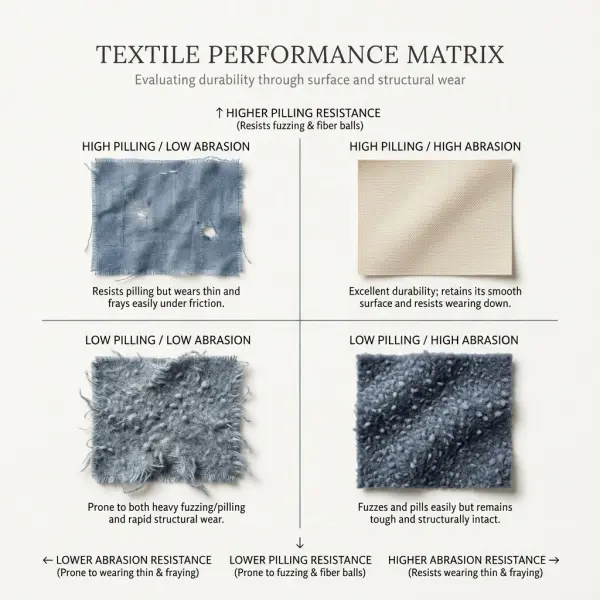
Fashion businesses can use a simplified performance matrix to distinguish between fabrics that offer different combinations of appearance retention and mechanical durability.
|
Pilling Resistance |
Abrasion Resistance |
Practical Interpretation |
|
Relatively high |
Relatively high |
Potentially suitable for applications requiring both surface consistency and resistance to mechanical wear |
|
Relatively high |
Relatively low |
May maintain a relatively smooth surface but experience material deterioration under demanding friction |
|
Relatively low |
Relatively high |
May remain structurally functional while developing visible surface pills |
|
Relatively low |
Relatively low |
May experience both aesthetic deterioration and material wear under relevant conditions |
These classifications are conceptual rather than standardized performance categories. Whether a material qualifies as having high or low resistance depends on the selected test methods, acceptance criteria, and intended end use.
The matrix is useful because it encourages sourcing teams to consider multiple performance dimensions instead of attempting to rank fabrics through a single durability score.
What Determines Resistance to Pilling and Abrasion?
Resistance to pilling and abrasion depends on the interaction between fiber properties, yarn characteristics, fabric construction, finishing, and the conditions under which the material is exposed to mechanical contact.
Although several factors influence both characteristics, their effects are not necessarily identical. A material adjustment intended to improve surface stability may change fabric flexibility or strength, while a construction optimized for mechanical durability may introduce different surface behavior.
Understanding these relationships helps fashion businesses evaluate trade-offs rather than assuming that one technical improvement will automatically resolve every wear-related concern.
Fiber Properties
Fiber length, fineness, strength, flexibility, and surface characteristics can influence how a textile responds to repeated rubbing.
For pilling, the availability of protruding fibers and the ability of those fibers to remain entangled are particularly relevant. Staple-fiber constructions contain fiber ends that may migrate toward the fabric surface, although the extent depends heavily on spinning quality and yarn structure.
Abrasion resistance also depends on how fibers tolerate mechanical contact, repeated deformation, and damage. Fiber strength is relevant, but it is not the only determinant. The interaction between fibers, yarns, and the surrounding textile structure influences whether the material maintains its integrity.
Consequently, a fiber that offers favorable mechanical properties does not necessarily produce the best pilling resistance in every fabric construction.
Yarn Construction
Yarn construction determines how individual fibers or filaments are arranged and held together. Relevant characteristics include yarn twist, hairiness, linear density, spinning system, and the consistency of the yarn structure.
A yarn with substantial surface hairiness may provide more exposed fibers that can become involved in pill formation. A relatively compact yarn may reduce this opportunity, although the resulting behavior still depends on the completed fabric.
For abrasion resistance, yarn cohesion and the distribution of mechanical stress are important considerations. Repeated contact may damage exposed portions of yarns, while differences in construction influence how those forces are distributed.
A loosely consolidated yarn designed for an exceptionally soft handfeel may therefore present a different combination of pilling and abrasion performance from a more compact yarn developed for demanding daily use.
Fabric Structure and Density
Knitted and woven fabrics distribute mechanical forces differently because of their construction. Knitted fabrics are formed from interconnected loops, while woven fabrics consist of interlaced yarn systems.
These structural differences influence fiber mobility, stretch, surface exposure, and the way localized damage develops. Nevertheless, it would be inaccurate to claim that knitted fabrics always pill more or woven fabrics always resist abrasion better.
A compact knitted textile developed for activewear may offer suitable mechanical performance, while a loosely constructed woven fabric containing exposed yarn floats may experience considerable surface wear.
Other relevant characteristics include stitch density, weave pattern, fabric cover, yarn spacing, and surface texture. Fabric weight may also influence performance, but heavier materials should not automatically be considered more abrasion-resistant.
The construction must be assessed as a complete system.
Textile Finishing
Finishing processes can modify how fibers behave at the textile surface and how the fabric responds to mechanical exposure.
Treatments such as singeing, cropping, and appropriate biopolishing may reduce accessible surface fibers, potentially improving pilling performance. Other finishing treatments may be developed to improve mechanical durability or alter surface friction.
The effects of finishing are not necessarily positive across every performance characteristic. A treatment that reduces surface fuzz may introduce unwanted changes in material strength if processing conditions are unsuitable. A finish designed to enhance durability may affect handfeel, flexibility, or garment care requirements.
This is why performance verification should be conducted on the relevant finished material rather than relying exclusively on information about unfinished fabric or raw fibers.
Wearing and Contact Conditions
The severity of textile wear depends partly on the mechanical environment in which the garment is used. Repeated fabric-to-fabric contact differs from contact with rough furniture, backpack straps, industrial equipment, or abrasive external surfaces.
Pressure, movement, moisture conditions, contact duration, and the characteristics of the opposing material can influence the resulting damage.
For example, a fabric that performs acceptably in a loose-fitting casual garment may experience a different wear pattern when used in fitted trousers exposed to continuous inner-thigh contact.
These differences should inform both material selection and garment design. A textile's suitability cannot be determined independently of its anticipated application.
Why Pilling and Abrasion Matter Differently Across Garment Categories
The commercial importance of pilling and abrasion varies considerably across fashion product categories. Some garments are purchased primarily for their refined appearance and tactile qualities. Others are expected to withstand intensive movement, repeated cleaning, or contact with demanding working environments.
Most clothing requires a combination of aesthetic and functional performance, but the consequences of each type of deterioration differ.
For sourcing teams, identifying the dominant wear risks of a garment category is more useful than attempting to select the fabric with the highest generalized durability rating.
Premium Knitwear and Fashion Sweaters
Premium knitwear often derives much of its value from softness, texture, drape, and the appearance of the yarn surface. Visible pills can undermine these characteristics even when the garment remains warm and comfortable.
Pilling resistance may therefore receive particular attention during the development of fine sweaters, cardigans, and appearance-sensitive knitted garments.
Abrasion resistance remains relevant, especially around elbows, cuffs, and areas exposed to accessories. Excessive reinforcement or increased construction density, however, may compromise the delicate handfeel that makes the product commercially attractive.
The development challenge is to preserve the intended material character while maintaining acceptable appearance and functional performance.
Activewear and Performance Apparel
Activewear frequently experiences repeated movement, body-related friction, and contact with external equipment. Leggings, training tops, cycling apparel, and similar products may encounter both surface pilling and abrasion-related deterioration.
A pair of leggings can develop visible pills around the inner thighs while maintaining stretch and coverage. More advanced wear may involve material thinning or damage that affects the garment's functional suitability.
For performance apparel brands, pilling resistance supports appearance retention, while abrasion resistance contributes to preserving the textile under demanding mechanical conditions.
Neither characteristic should be evaluated in isolation from other relevant properties, such as stretch recovery, seam performance, and dimensional stability.
Denim, Trousers, and Everyday Bottoms
Trousers frequently experience localized mechanical wear around the knees, seat, pockets, and inner thighs. Denim garments may also develop intentional appearance changes as part of their visual character.
Not every visible change in denim represents unacceptable deterioration. Fading or changes in surface texture may be compatible with the product's intended aesthetic, while progressive thinning or yarn breakdown may become a more substantial functional concern.
For everyday bottoms, abrasion resistance is often an important sourcing consideration because these garments may be exposed to frequent friction during sitting and walking.
Pilling remains relevant, particularly for fabrics containing hairy staple yarns, brushed surfaces, or blends susceptible to persistent fiber clusters.
Workwear and Uniforms
Workwear and uniforms may be required to maintain both professional appearance and functional reliability during frequent use.
An employee's uniform can become visually unacceptable because of extensive pilling, even when the material has not worn through. Conversely, trousers or jackets that remain visually smooth may develop localized structural wear in areas exposed to equipment or rough surfaces.
Businesses developing uniforms should therefore assess wearing conditions associated with the specific job rather than applying identical specifications to all employees.
An office uniform, for example, may place greater emphasis on consistent appearance, whereas garments used in demanding operational environments may require more extensive evaluation of mechanical durability.
Where clothing serves a protective function, appropriate safety requirements and product-specific standards must be considered independently of general pilling and abrasion performance.
Loungewear and Children's Clothing
Loungewear often combines soft textile surfaces with frequent everyday use. Brushed knits, fleece, and other tactile constructions may require careful consideration of surface changes because their softness forms an important part of the product experience.
Children's clothing may encounter different challenges associated with active movement, frequent contact with surrounding surfaces, and repeated cleaning.
Both categories benefit from evaluating the textile after conditions representative of anticipated use. A fabric that feels particularly attractive before washing may exhibit a different surface appearance after repeated care.
For brands serving these markets, material performance requirements should reflect the practicality expected by customers rather than focusing exclusively on the characteristics of newly manufactured garments.
The following table provides a general decision framework for prioritizing the two performance characteristics.
|
Garment Category |
Pilling Resistance Considerations |
Abrasion Resistance Considerations |
|
Premium knitwear |
Preserving a refined and consistent surface |
Maintaining integrity in areas of repeated contact |
|
Activewear |
Limiting visible fiber clusters in friction-prone areas |
Supporting textile integrity during movement |
|
Denim and trousers |
Managing surface changes associated with construction and blends |
Reducing premature thinning and yarn breakdown |
|
Office uniforms |
Maintaining professional appearance |
Supporting repeated everyday wear |
|
Industrial workwear |
Preserving acceptable appearance |
Addressing demanding mechanical exposure |
|
Loungewear |
Balancing softness and surface stability |
Maintaining performance during frequent use |
|
Children's clothing |
Supporting appearance after wear and care |
Managing repeated movement and surface contact |
These priorities are illustrative, not universal. The final performance requirements should be determined according to the specific garment, textile construction, target market, and conditions of use.
How Pilling and Abrasion Resistance Are Evaluated Differently
Pilling resistance and abrasion resistance are evaluated using different standardized procedures because they address different material performance questions.
Pilling evaluation generally focuses on changes in textile surface appearance after controlled mechanical exposure. Abrasion evaluation may focus on the extent of material wear, the development of structural breakdown, or other specified changes.
Although certain instruments can be configured for both purposes, the resulting measurements are not interchangeable.
Pilling Resistance Evaluation
Pilling resistance assessment typically involves exposing a textile specimen to controlled mechanical action and subsequently evaluating the resulting surface condition.
Depending on the selected method, assessment may include the extent of pilling, fuzzing, or matting. Results are commonly expressed using visual grades, with higher grades generally representing more favorable surface appearance under the defined assessment conditions.
The International Organization for Standardization's ISO 12945-2 modified Martindale method addresses the propensity of fabrics to develop pilling and related surface changes.
The accompanying ISO 12945-4 visual assessment standard provides a standardized basis for evaluating these appearance characteristics.
For fashion businesses, the principal question is whether the material maintains an acceptable surface after the specified mechanical exposure.
Abrasion Resistance Evaluation
Abrasion resistance testing evaluates how textile specimens respond to controlled rubbing or comparable mechanical exposure.
The selected procedure determines what constitutes the relevant result. Some approaches identify the point at which a specimen reaches a defined breakdown condition. Others assess changes in appearance or the loss of material following a specified exposure.
The ISO 12947 series illustrates these distinct approaches:
|
Standard |
Main Assessment Objective |
|
ISO 12947-2 |
Determination of specimen breakdown |
|
ISO 12947-3 |
Determination of mass loss |
|
ISO 12947-4 |
Assessment of appearance change |
The official ISO 12947-2 abrasion resistance standard addresses specimen breakdown under the Martindale method. Other parts of the series provide different perspectives on abrasion-related performance.
This distinction matters because abrasion resistance does not always refer exclusively to the number of rubbing cycles before a hole develops. The appropriate endpoint depends on what the assessment is intended to establish.
Why the Martindale Instrument Can Be Used for Both
The Martindale is a textile testing instrument that produces controlled rubbing movement between a specimen and a contacting material. Depending on its configuration and the applicable procedure, it can be used for different types of mechanical surface evaluation.
This shared equipment sometimes creates confusion. A supplier may provide a Martindale result without clearly identifying whether the evaluation concerns pilling or abrasion.
The instrument name alone is insufficient. Test configuration, contact materials, loading conditions, exposure, and assessment criteria can differ according to the selected standard.
ASTM International likewise distinguishes between Martindale-based abrasion and pilling procedures through separate standards, including those listed in its textile performance testing methods.
A fashion brand receiving a Martindale result should therefore confirm the actual method before drawing conclusions about material performance.
For a more comprehensive discussion of laboratory evaluation, test selection, acceptance criteria, and supplier approval procedures, see How Textile Durability Testing Helps Fashion Brands Evaluate Fabric Quality.

How Fashion Businesses Can Use These Differences in Product Development
Distinguishing pilling from abrasion allows fashion businesses to establish more meaningful product requirements. Instead of asking whether a textile is generally durable, development teams can identify the specific ways in which the garment may become aesthetically unacceptable or functionally unsuitable.
This approach is valuable during material sourcing, sampling, garment construction, supplier evaluation, and post-purchase quality investigations.
It does not necessarily require a complex development system. The essential improvement is to connect anticipated garment use with specific material performance objectives.
Define What Unacceptable Wear Means for the Product
Before selecting a textile, fashion brands should identify which changes would make the intended garment unsuitable for continued use.
For a premium knitted top, substantial visible pilling may represent a commercially important failure because surface appearance is central to the product's appeal. For a pair of operational trousers, localized thinning or yarn breakdown may have more significant functional consequences.
A fitted activewear garment may require both characteristics to be controlled because visible pilling and progressive material loss can affect different aspects of customer satisfaction.
These distinctions should be established during product development rather than after complaints emerge. Clear definitions of unacceptable wear help sourcing teams communicate more effectively with suppliers and select appropriate evaluation methods.
Evaluate Material Performance According to Garment Use
Fabric performance information becomes more useful when interpreted alongside the garment's anticipated mechanical environment.
Consider a fashion business developing two garments from different knitted materials. One is a relaxed sweater intended for occasional use, while the other is an everyday pair of fitted leggings. Both may require attention to pilling, but their exposure to mechanical contact and the consequences of abrasion-related deterioration differ.
The leggings may require greater emphasis on repeated friction in specific areas, while the sweater may prioritize preserving its intended tactile characteristics and appearance.
This does not mean that every product needs an extensive testing program. A risk-based approach can identify where additional material evaluation is commercially justified.
Consider Construction Changes Before Replacing the Entire Fabric
When abrasion-related deterioration occurs in a specific garment area, replacing the entire textile may not be the only available solution.
Product developers can investigate whether pattern design, garment fit, seam placement, reinforcement, or localized material selection contributes to the problem.
For example, work trousers may benefit from an appropriately designed reinforced knee area when the intended activities involve repeated kneeling. Such reinforcement must be evaluated carefully because it can introduce additional stiffness, bulk, or stress around adjoining seams.
Pilling presents a different design challenge. If a particular garment shape creates repeated fabric-to-fabric rubbing, changes in fit or surface contact may help manage the problem. Nevertheless, design adjustments cannot completely compensate for a textile that is fundamentally unsuitable for its intended use.
The appropriate intervention should address the identified wear mechanism rather than treating every issue as a general fabric defect.
Improve Communication Between Sourcing and Quality Teams
A specification that simply requests a durable or abrasion-resistant fabric leaves substantial room for interpretation.
Suppliers may focus on material strength, while product developers expect a smooth surface after repeated wear. Quality assurance teams may subsequently apply an evaluation method that does not fully reflect either expectation.
To reduce these misunderstandings, material specifications should identify:
- The intended garment category and wearing environment.
- The textile surface characteristics that must be maintained.
- The areas likely to experience repeated mechanical contact.
- Relevant pilling and abrasion performance requirements.
- The agreed evaluation methods and conditions.
- Any restrictions concerning finishing, handfeel, weight, or flexibility.
This information helps suppliers understand the intended performance balance. It also provides a more defensible basis for material approval and subsequent quality investigations.





Comments 0
Leave a CommentSend Comment
Anda harus Login terlebih dahulu untuk dapat memberikan komentar.