

Common Trade Show Mistakes That Limit Wholesale Opportunities
Quick Answer
The most damaging fashion trade show mistakes usually happen when brands treat the event as a visibility exercise instead of a wholesale sales process. A strong-looking booth can still produce weak commercial results if the wrong buyers attend, appointments were not arranged, samples or pricing are unclear, sales staff cannot answer operational questions, or promising conversations disappear into poor follow-up.
For growing apparel brands, the biggest risks generally fall into four areas: event selection, pre-show preparation, buyer interaction, and post-show conversion. Each affects a different part of the wholesale funnel. Choosing the wrong show reduces access to relevant retailers. Weak product and commercial preparation makes buyers hesitate. Generic pitching wastes limited meeting time. Poor lead capture and follow-up allow genuine interest to fade.
Trade show success should therefore be judged by more than booth traffic or compliments. The stronger indicators are qualified buyer meetings, relevant account progression, credible orders, follow-up activity, and whether the resulting wholesale business is profitable and operationally deliverable.
The objective is not to avoid every imperfection. It is to remove the mistakes that make it unnecessarily difficult for the right buyer to say yes.
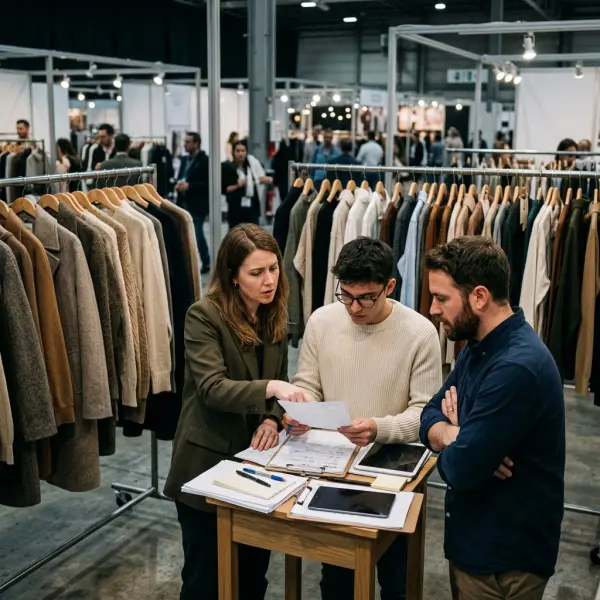
Why Can a Busy Trade Show Still Produce Weak Wholesale Results?
A busy booth and a commercially productive booth are not the same thing.
Traffic can come from other exhibitors, press, service providers, students, stylists, potential collaborators, or buyers who are simply outside the brand's target market. Even verified trade events can contain many types of professionals. COTERIE, for example, describes its event as serving buyers ranging from boutiques and e-commerce retailers to chain stores, big-box retailers, and department stores, while all attendees are verified as fashion-industry professionals. That still leaves substantial variation in retailer type, assortment, price point, and purchasing authority. COTERIE attendee qualification
That distinction explains why one exhibitor can leave a large event with meaningful orders while another leaves with a thick stack of business cards but almost no viable pipeline.
The mistake is often not one dramatic failure. It is a chain:
poor event fit → weak buyer targeting → generic meetings → unclear commercial information → incomplete lead notes → slow follow-up
By the time management evaluates the show, it may appear that "buyers were not interested." The real problem may have started weeks before anyone entered the booth.
As explained in fashion trade shows for growing apparel brands, trade shows work best as one component of a larger wholesale sales system. The mistakes below matter because each one damages a particular stage of that system.
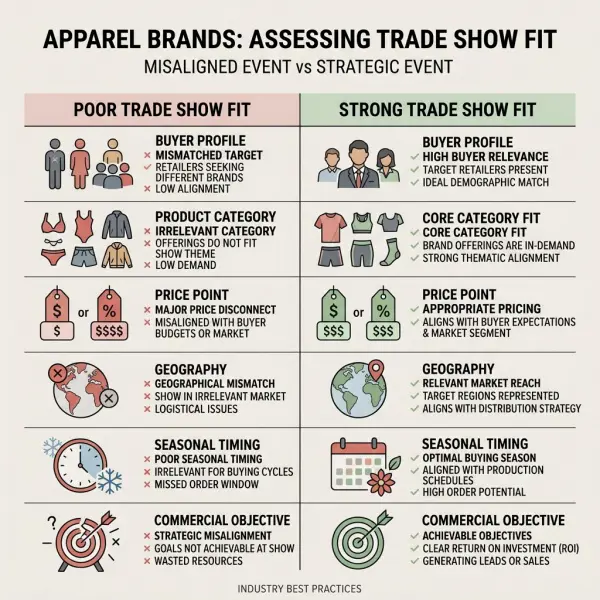
Mistake 1: Choosing a Trade Show Because It Is Famous
Prestige is not the same as commercial fit.
A brand may want to exhibit at a well-known show because competitors participate, because the event generates social-media visibility, or because appearing there feels like evidence that the company has reached a new level.
None of those reasons establishes buyer relevance.
Trade shows often have specific category, price, geographic, and merchandising positions. COTERIE, for example, currently describes its New York event around contemporary and advanced contemporary women's fashion at moderate-to-designer price points. Its exhibitor inquiry also asks brands for information including product category, wholesale price point, current retailer relationships, and the type of business opportunity they are seeking. COTERIE exhibitor application criteria
That type of segmentation should remind brands that the right show depends on what they sell and whom they need to meet.
Imagine a commercially priced resortwear label entering a market dominated by premium urban fashion. Attendance could be excellent. Buyer seniority could be excellent. The label could still produce weak results because the buyers are building different assortments.
The consequence is larger than the booth fee. Management time, sample development, travel, shipping, accommodation, and sales attention have all been directed toward the wrong audience.
Better approach
Evaluate the event around:
- retailer profile;
- product category;
- price positioning;
- geographic reach;
- buying calendar;
- competing and complementary exhibitors;
- retailer qualification process; and
- realistic account potential.
The correct question is not, "Is this a good trade show?"
It is, "Is this a good trade show for this brand, collection, season, and commercial objective?"
Mistake 2: Assuming Buyer Traffic Will Happen Automatically
Brands sometimes invest heavily in exhibition space and then rely on the organizer to supply all commercially relevant traffic.
Trade show organizers can create the marketplace. They cannot guarantee that the specific retailers a brand wants will walk into its booth at the right moment.
Modern fashion events increasingly offer matchmaking and appointment programs precisely because structured connection has value. COTERIE's Brand Curation program, for example, uses curated one-to-one meetings between selected buyers and brands rather than depending entirely on unplanned floor discovery. COTERIE Brand Curation program
For a growing label, relying only on walk-ins creates two problems.
First, the most important buyers may already have tightly scheduled market calendars. Second, random traffic makes sales-team capacity difficult to allocate. The booth may be quiet for an hour and suddenly crowded when a valuable buyer arrives.
Better approach
Build the meeting calendar before the show.
Identify priority accounts, research the correct buyer or category manager, contact existing relationships, use organizer networking tools where available, and communicate clearly where the brand will be located.
This does not eliminate walk-in selling. It gives spontaneous discovery a stronger foundation.
A useful show might therefore contain three layers:
scheduled priority appointments + existing-account meetings + qualified discovery traffic
The mistake is assuming the third layer can reliably replace the first two.
Mistake 3: Treating Booth Design as the Main Sales Strategy
Visual presentation matters in fashion. Buyers make rapid judgments, and a cluttered or poorly merchandised space can make the collection difficult to understand.
But booth aesthetics can become a distraction.
A young brand may spend heavily on custom structures, decorative walls, furniture, flowers, signage, or elaborate displays while line sheets are unfinished, product prices are being changed, sample availability is uncertain, and buyer outreach remains incomplete.
The booth looks prepared because the physical space is prepared.
Commercially, the brand is not.
This is particularly risky for smaller companies because exhibition design competes with the same cash that may be needed for samples, freight, travel, sales staffing, production deposits, or post-show working capital.
A restrained booth that makes the product easy to review can outperform a visually elaborate booth that turns the collection into decoration.
Better approach
Use booth design to answer practical selling needs:
- Can buyers see the collection clearly?
- Can garments be removed and inspected easily?
- Is there space for a focused conversation?
- Can products be re-merchandised during the show?
- Are line sheets or digital catalogs easily accessible?
- Can sales staff move efficiently?
- Does the space communicate the brand without competing with the garments?
Design should support the wholesale interaction.
It should not become the interaction.
Mistake 4: Bringing a Collection Without a Clear Assortment Story
A large rack can create the impression of depth while making the buyer's job harder.
Wholesale buyers are not simply deciding whether they like individual garments. They are often evaluating how products could work together inside a store assortment: category balance, price architecture, color relationships, delivery timing, customer relevance, and potential merchandising combinations.
If the rack contains too many disconnected ideas, the buyer must perform the editing work.
This can happen when brands bring every available sample because they fear leaving a potential sale behind.
The result may be visual and commercial noise.
Instead of seeing a strong collection, the buyer sees twenty-five unrelated options.
Better approach
Build an intentional hierarchy.
The assortment should make it easy to identify:
- hero products;
- commercial core styles;
- entry price points;
- higher-value pieces;
- important color stories;
- complementary items;
- newness; and
- products with meaningful wholesale potential.
This does not mean every retailer should receive exactly the same presentation.
The collection can be edited again during the meeting according to the buyer's needs.
The deeper operational work behind organizing samples, line sheets, and appointments is covered in how brands prepare line sheets, samples, and buyer meetings.
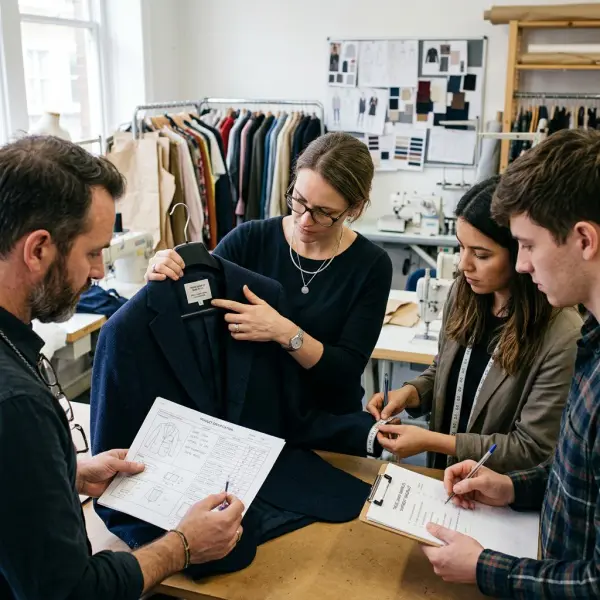
Mistake 5: Using Samples That Misrepresent What Will Be Delivered
A trade show sample may still be part of product development, but the buyer should understand what is being evaluated.
Problems begin when an unfinished or substitute sample is presented as though it accurately represents production.
Examples include:
- a different fabric from the planned bulk material;
- provisional trims;
- unapproved color;
- temporary labels;
- hand-finished details that will not exist in production;
- fit that has not yet been corrected; or
- construction that the selected factory has not confirmed.
The immediate consequence may simply be confusion.
The later consequence can be more serious: what arrives does not match what the buyer believes was ordered.
Better approach
Inspect the selling collection before departure and classify anything that is not production-representative.
The sales team needs to know:
what is final → what is provisional → what will change → what still requires confirmation
Do not hide meaningful uncertainty.
A buyer can usually understand that a development-stage detail will change. What damages confidence is discovering that the brand itself does not know which details are final.
Mistake 6: Pricing the Collection for Retail Appeal but Not Wholesale Economics
One of the more dangerous trade show mistakes can remain invisible during the show.
The collection sells.
Then the brand discovers that the orders are financially difficult to fulfil.
Wholesale pricing has to support more than product manufacturing. Depending on the business model, the brand may also carry packaging, freight, sales commissions, warehousing, payment fees, product development, markdown support, returns, financing costs, and overhead.
At the same time, the retailer needs enough economic room to operate the product at retail.
That creates a two-sided constraint.
A wholesale price that looks attractive to buyers but leaves insufficient contribution for the brand can turn apparent trade show success into working-capital stress.
Better approach
Finalize price architecture before presenting the collection.
For each style, management should understand at least:
landed or relevant product cost → wholesale selling price → expected contribution → intended retail positioning
The calculation can become more sophisticated as the business grows, but those fundamentals cannot remain unknown.
This is also why brands should be cautious about improvising discounts during meetings. A spontaneous reduction across a large order may affect economics much more than the salesperson realizes in the moment.
Mistake 7: Giving Every Buyer the Same Pitch
A standard collection story is useful.
A standard conversation is not.
JOOR's wholesale guidance explicitly recommends tailoring pitches to individual retailers rather than using an identical pre-written script for every buyer. JOOR guidance on pitching fashion buyers
The reason is practical.
A multi-store retailer considering dresses has different questions from an independent boutique looking for accessories. A buyer who already carries the brand should not receive the same introduction as someone encountering it for the first time.
Generic pitches also waste time.
If a buyer says early that she needs retail price points below a certain threshold and the salesperson spends fifteen minutes presenting products far above that range, both parties lose a potentially useful meeting.
Better approach
Use the opening minutes to establish context.
Understand what the buyer is responsible for, what categories matter, what customer they serve, what price levels are relevant, and what problem they are trying to solve.
Then edit the presentation.
The core brand identity remains consistent. The commercial emphasis changes.
Mistake 8: Talking Too Much and Learning Too Little
Founders often know their products extremely well. That can become a disadvantage when enthusiasm turns the meeting into a monologue.
The buyer hears the brand history, inspiration, materials, design process, founder journey, sustainability ambitions, and collection concept—but the brand learns almost nothing about the retailer.
This leaves valuable information unused.
A buyer conversation can reveal:
- categories currently selling;
- missing price points;
- customer preferences;
- delivery needs;
- assortment gaps;
- objections;
- competing brands;
- reasons a retailer will not buy; and
- what would need to change for a future season.
This information is commercially valuable even when no order is placed.
Better approach
Treat the meeting as discovery plus selling.
Ask enough questions to understand the account, listen carefully to objections, and record recurring patterns across buyers.
There is an important distinction here.
One buyer saying a sleeve is too long is an opinion.
Multiple relevant retailers raising the same fit concern may be a product-development signal.
Trade shows become much more useful when feedback is captured systematically rather than remembered selectively.
Mistake 9: Being Unable to Answer Basic Commercial Questions
A buyer may love the product and still hesitate if the business behind it appears uncertain.
Typical questions can include:
- What is the wholesale price?
- What is the size range?
- Which colors are available?
- What is the opening minimum?
- When can the order ship?
- Can this style be reordered?
- What are the payment terms?
- Is the product already sold in my territory?
- What happens if delivery slips?
- Who manages the order after the show?
A salesperson does not need to know every possible answer.
In fact, guessing is worse than saying that a specific detail requires confirmation.
The problem arises when basic information has not been established internally or different staff members give conflicting answers.
Better approach
Create a shared commercial reference before the show.
The sales team should know which answers are fixed, which vary by account, and which require approval.
If an exception needs authorization, staff should know exactly who can approve it.
Consistency signals operational control.
Mistake 10: Chasing Orders Without Checking Whether the Business Can Deliver Them
Trade shows create an unusual psychological pressure: the brand has paid to be there, so every possible order feels valuable.
That can encourage overcommitment.
A growing apparel company may accept larger quantities, shorter timelines, new colors, special packaging, altered payment terms, or product changes because it does not want to lose the account.
Each promise may appear manageable individually.
Together they can create a production plan the company cannot execute.
The risk becomes more serious when orders require materials to be purchased before customer payment is received.
Wholesale growth often consumes working capital before it produces cash.
Better approach
Set commercial boundaries before the show.
Know:
- realistic production capacity;
- material constraints;
- minimum viable production quantities;
- cash requirements;
- supplier lead times;
- latest acceptable order dates;
- delivery commitments; and
- which custom requests require production approval.
A smaller order delivered correctly can be more valuable than a larger order that damages the first retailer relationship.
Mistake 11: Treating Every Lead as Equally Valuable
After a successful show, a brand may have dozens or hundreds of new contacts.
Without qualification, the sales team faces a flat list.
The retailer that discussed a specific 40-piece opening order sits beside someone who scanned a QR code while passing the booth.
Both are called "leads."
That makes follow-up inefficient.
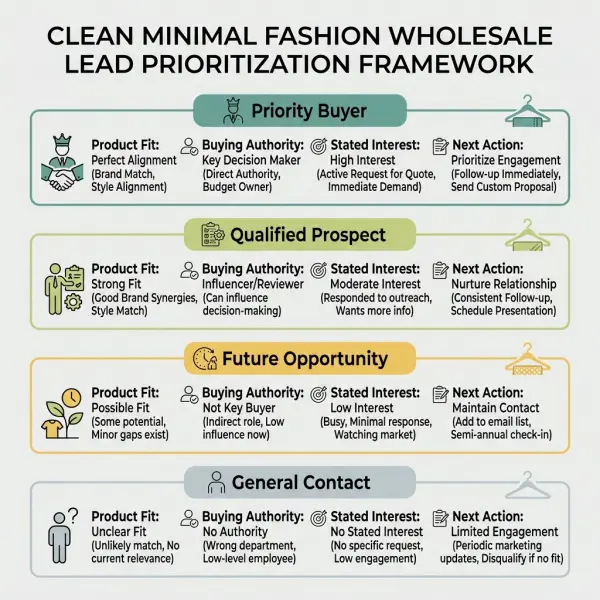
JOOR's current trade show guidance recommends capturing leads digitally and categorizing them by priority so sales teams know where to focus after the event. JOOR trade show planning guidance
Better approach
Classify contacts while the context is still fresh.
A simple model could use:
A — active commercial opportunity
Buyer discussed specific products, quantities, timing, or next commercial step.
B — qualified prospect
Strong retailer fit and genuine interest, but no immediate order discussion.
C — future opportunity
Relevant account but wrong timing, season, category, or budget.
D — general contact
Useful industry connection without a clear wholesale opportunity.
The labels themselves do not matter.
Prioritization does.
Mistake 12: Collecting Contact Details Without Recording the Conversation
A business card tells you who someone is.
It rarely tells you what happened.
Three days after a busy show, a sales representative may remember that someone from a certain boutique liked "the blue one." A week later, even that memory becomes unreliable.
The business has technically captured the lead but lost the sales context.
Better approach
Record short structured notes immediately.
At minimum:
retailer → buyer → styles discussed → specific interest → objection → delivery requirement → next action → follow-up owner
This takes very little time when the process is standardized.
The information becomes especially useful when more than one salesperson works the booth, because ownership can be transferred without forcing the next person to reconstruct the meeting.
Mistake 13: Sending Generic Follow-Up—or No Follow-Up at All
Trade shows create temporary concentration.
After the show, buyers return to normal work, inboxes fill, new collections compete for attention, and memories of specific booths begin to fade.
Follow-up therefore converts event activity into an ongoing sales process.
Faire's January 2026 market-season guidance explicitly emphasizes intentional post-market follow-up and recommends re-engaging retailers while the interaction remains recent. Its trade-show guidance similarly encourages brands to upload and organize leads promptly and personalize outreach around what interested the retailer. Faire market season follow-up guidance
The common mistake has two forms.
The first is silence.
The second is a generic blast:
"Thank you for visiting our booth. Please see our collection attached."
That message ignores everything learned during the meeting.
Better approach
Follow up according to the conversation.
For example:
- send the styles the buyer actually reviewed;
- answer the question that remained open;
- confirm a delivery window;
- provide the promised line sheet;
- summarize an agreed next step;
- send a sample if requested; or
- arrange a longer appointment.
Automation can help manage volume, but personalization should be preserved where the account warrants it.
Fast follow-up is useful.
Relevant follow-up is better.
Mistake 14: Confusing Buyer Enthusiasm With Forecast Revenue
Trade show conversations often produce positive language.
"Love this."
"This could work for us."
"Send me the line sheet."
"We should definitely talk."
All are encouraging.
None is necessarily a purchase order.
Treating expressions of interest as revenue can distort forecasting and create premature production decisions.
A retailer may still need internal approval. Budget can move. Another brand may fill the assortment slot. Delivery timing may change. The buyer may simply reconsider after market week.
Better approach
Separate the pipeline by commercial stage.
For example:
|
Pipeline stage |
What it actually means |
|
Booth visitor |
Contact occurred |
|
Qualified retailer |
Account fits the target profile |
|
Product interest |
Buyer responded to specific products |
|
Active follow-up |
Concrete information or action requested |
|
Order discussion |
Commercial terms are being developed |
|
Confirmed order |
Agreed order exists under appropriate terms |
This gives management a more realistic view of trade show performance.
Optimism belongs in selling.
Discipline belongs in forecasting.
Mistake 15: Measuring Success Mainly by Foot Traffic
"We had a busy booth" is an observation, not a performance metric.
Large traffic counts may be useful for brand exposure, but a wholesale strategy requires commercial measures.
A smaller event where a brand meets 15 highly relevant retailers may outperform a major show producing 150 loosely qualified contacts.
JOOR's trade show checklist similarly recommends reviewing leads, sales, conversions, retailer relationships, and actual return against goals after the event. trade show results measurement guidance
Better approach
Build the scorecard before the event.
Track factors such as:
- priority buyer meetings;
- total qualified accounts;
- orders written;
- credible potential order value;
- follow-up requests;
- new-account progression;
- existing-account meetings;
- recurring buyer objections;
- total event cost; and
- contribution generated by converted orders.
The final metric deserves emphasis.
Revenue alone can overstate success if the orders create weak margin, excessive service requirements, or difficult production commitments.
Mistake 16: Failing to Conduct a Post-Show Review
Without a structured review, companies tend to remember the emotional version of the event.
The booth was exciting.
Friday was slow.
One major retailer stopped by.
The team liked the location.
Competitors looked busy.
Those memories can influence the next year's spending even when they do not explain commercial performance.
Better approach
Review the show after enough follow-up has occurred to see what progressed.
Compare:
objectives → actual buyer activity → pipeline → confirmed orders → cost → operational lessons
Then ask harder questions.
Did priority buyers attend?
Which outreach method produced meetings?
Which categories attracted the most commercially relevant interest?
Which objections repeated?
Did buyers understand the pricing?
Did the samples represent the final offer?
Were delivery commitments realistic?
Which leads converted after the event?
Would the company exhibit again under the same conditions?
This turns each trade show into data for the next decision rather than an isolated annual ritual.

Which Trade Show Mistakes Matter Most?
Not all mistakes deserve equal management attention.
A slightly imperfect booth graphic is usually less damaging than exhibiting at the wrong event.
A missing decorative display is less consequential than incorrect wholesale pricing.
A slow first morning may matter less than losing high-intent buyer information after the show.
For growing apparel brands, the highest-priority risks can be ranked roughly like this:
|
Risk |
Why it matters |
|
Wrong event / buyer fit |
Limits the entire opportunity pool |
|
Weak wholesale economics |
Can make successful orders financially unattractive |
|
Unreliable delivery commitments |
Creates retailer and operational risk |
|
Poor buyer targeting |
Leaves access to chance |
|
Unclear samples or commercial data |
Creates friction at decision point |
|
Weak lead capture |
Loses context after meetings |
|
Poor follow-up |
Prevents interest from progressing |
|
Overfocus on booth aesthetics |
Misallocates attention and budget |
This ranking is not universal.
For an established brand with mature wholesale systems, lead volume or event selection may dominate. For a first-time exhibitor, pricing, production capacity, and sample readiness may matter more.
The strategic principle is simple: fix the mistakes closest to revenue quality and delivery reliability first.
A Practical Trade Show Risk-Control Framework
Brands can reduce many of these problems by checking four stages before committing the full budget.
1. Market fit
Verify event audience, retailer types, category, price positioning, geography, season, and target-account attendance.
2. Commercial readiness
Verify prices, margins, minimums, terms, delivery windows, production capacity, and working-capital implications.
3. Selling readiness
Verify buyer targets, appointments, samples, line sheets, staff knowledge, meeting process, and lead capture.
4. Conversion readiness
Verify follow-up ownership, account prioritization, CRM or tracking process, order confirmation, and post-show measurement.
If one stage is weak, more expenditure on another stage may not solve the problem.
A larger booth does not repair weak margins.
More samples do not repair poor buyer fit.
More leads do not repair absent follow-up.
That is the practical discipline behind a strong trade show strategy.
What Brands Should Verify Before Exhibiting Again
A repeat booking should be based on evidence rather than habit.
Before signing the next contract, review:
Commercial outcome:
Did relevant opportunities convert into profitable business?
Buyer quality:
Were the right accounts present and accessible?
Cost:
What was the true all-in investment?
Operational impact:
Could the company fulfil orders without destabilizing production or cash flow?
Learning value:
Did the show produce useful product, pricing, market, or retailer insight?
Alternative channels:
Could equivalent accounts be reached more effectively through direct outreach, showrooms, agents, distributors, or digital wholesale platforms?
Trade shows are valuable when concentrated physical access improves the economics or quality of buyer acquisition.
They should not become automatic calendar commitments simply because the brand attended previously.
Frequently Asked Questions
What is the biggest mistake fashion brands make at trade shows?
There is no single mistake for every brand, but choosing an event without validating buyer fit can undermine everything that follows.
Even excellent samples, a polished booth, and strong salespeople cannot convert retailers whose category, customer, price range, or buying needs do not match the collection.
Brands should therefore evaluate trade shows around target accounts rather than prestige or total attendance. Once event fit is established, pricing, samples, buyer outreach, commercial readiness, and follow-up become the next priorities.
Is poor booth design a major reason brands fail at fashion trade shows?
It can hurt performance, but booth design is rarely the only issue.
A confusing display can reduce product visibility, make conversation difficult, or weaken brand presentation. However, a beautiful booth cannot compensate for the wrong buyer audience, unclear pricing, poor samples, weak preparation, or absent follow-up.
For most growing brands, the booth should first function as an effective wholesale selling environment. Visual identity matters, but it should support garment presentation and buyer interaction rather than absorb disproportionate budget and attention.
Why do buyers show interest at trade shows but never place an order?
Buyer interest can stop for many legitimate reasons.
The collection may not fit the final assortment, internal budget may change, another brand may fill the same category, delivery timing may not work, price may be difficult, or the buyer may need internal approval.
Poor brand follow-up can also contribute.
For this reason, brands should distinguish positive reaction from commercial progression. A buyer asking for pricing or a line sheet is a lead. It becomes forecastable business only when the opportunity moves into a meaningful order process.
How quickly should brands follow up after a trade show?
Follow-up should begin while conversations are still recent, but there is no universal deadline that applies to every buyer or market.
Faire's 2026 guidance recommends intentional follow-up soon after market activity and specifically discusses re-engaging leads within the post-show period rather than allowing them to go cold. (faire.com)
More important than sending a generic message immediately is completing the action the buyer actually requested—whether that is pricing, samples, delivery confirmation, an order form, or another meeting.




Comments 0
Leave a CommentSend Comment
Anda harus Login terlebih dahulu untuk dapat memberikan komentar.