
Basic Pattern Blocks Every Beginner Should Understand
Quick Answer
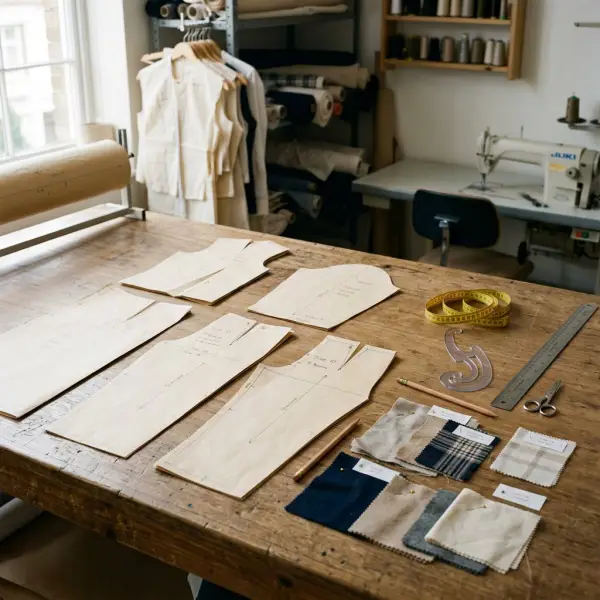
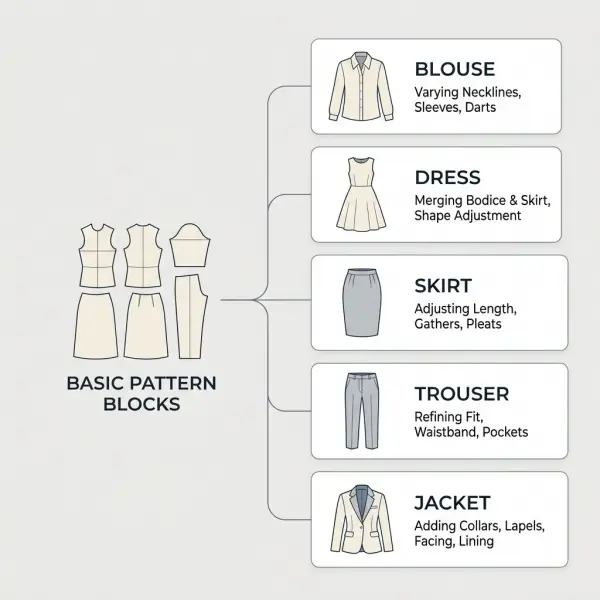
Basic pattern blocks are simple foundation patterns used as starting points for creating many garment styles. In fashion and garment production, a block provides a controlled base shape before design details such as collars, pockets, panels, pleats, flares, and style lines are added.
For beginners, the most important blocks to understand are the bodice block, sleeve block, skirt block, trouser block, dress block, shirt block, and jacket block. Each block represents a different part of garment construction and teaches a different fit relationship: the bodice teaches the upper body, the sleeve teaches arm movement, the skirt teaches waist-to-hip shaping, and the trouser block teaches crotch, rise, and leg balance.
A block is not the final fashion pattern. It is usually plain, close to the body, and free from decorative styling. Its main purpose is to help pattern makers create new designs with more consistency, instead of drafting every garment from zero.
The better the block, the easier it becomes to develop accurate, repeatable, production-ready patterns.
What Is a Pattern Block?
A pattern block is a basic foundation pattern used to develop other garment patterns. It usually represents a simple garment shape without decorative style details, so the pattern maker can manipulate it into different designs.
In some pattern making systems, the term “block” is used interchangeably with “sloper,” especially in American sewing and pattern drafting references. Merriam-Webster defines a sloper in garment making as a basic pattern that indicates measurements for each size without fullness or design details. sloper definition
The wording may differ across countries, schools, studios, and factories. Some professionals use “block” for an industry base pattern and “sloper” for a close-fitting personal fitting shell. Others use the two terms more loosely. For beginner learning, the key idea is the same: a block is a starting template, not a finished fashion style.
A pattern block becomes useful when it has been tested and corrected. If the block does not fit the target body or size standard, every pattern developed from it may carry the same mistake forward.
Why Pattern Blocks Matter for Beginners
Pattern blocks matter because they help beginners understand how garment shapes are built before styling details are added. Instead of seeing each pattern as a completely separate object, beginners can start to recognize the underlying structure behind tops, dresses, skirts, trousers, shirts, and jackets.
This is important because fashion design often changes on the surface while the body relationship remains similar. A blouse may have a different neckline, sleeve, hem, or closure from another blouse, but both may begin from the same bodice foundation. A straight skirt, A-line skirt, panel skirt, and flared skirt may all begin from a basic skirt block. A dress pattern may combine bodice and skirt logic.
Blocks also teach cause and effect. When a dart is moved, the garment shape changes. When ease is added, the silhouette changes. When the armhole is adjusted, sleeve movement changes. When the crotch curve is modified, trouser comfort and balance change.
For a beginner, blocks reduce guesswork. For a fashion business, they reduce inconsistency.
Pattern Block vs Finished Pattern
A pattern block is a foundation. A finished pattern is the specific pattern used to make a particular garment style.
This distinction is important because beginners often expect a block to look like a fashion design. It usually does not. A block may look plain, even boring. That is the point. It is designed to capture fit and structure before styling begins.
A finished pattern includes the style details needed for production. It may contain collar shapes, pocket pieces, button stands, pleats, facings, linings, seam placements, flare, gathers, cuff pieces, waistband details, and other garment-specific components.
|
Aspect |
Pattern Block |
Finished Garment Pattern |
|
Main purpose |
Provides a fit foundation |
Produces a specific garment style |
|
Design details |
Minimal or none |
Includes style and construction details |
|
Fit role |
Establishes body relationship |
Applies fit to a design |
|
Typical use |
Reused and manipulated |
Used for sampling or production |
|
Beginner value |
Teaches structure and fit logic |
Teaches garment construction and style execution |
A useful way to think about it: the block gives the pattern maker a reliable starting body map, while the finished pattern gives the sewing team a complete garment instruction.
The Core Pattern Blocks Beginners Should Know
Most beginners do not need to learn every possible block at once. It is more useful to understand the core blocks and what each one teaches. A common basic block set includes bodice, sleeve, skirt, and trouser blocks; many pattern making educators describe these as foundational blocks for further drafting. pattern block as a foundation pattern
In fashion business practice, brands may also develop shirt blocks, dress blocks, jacket blocks, knit blocks, activewear blocks, children’s wear blocks, uniform blocks, or category-specific base patterns. The exact block library depends on what the brand produces.
Bodice Block
A bodice block is the foundation pattern for the upper body. It usually covers the shoulder, neckline, armhole, bust, waist, and back areas. It may be used to develop tops, blouses, dresses, shirts, vests, and some jacket styles.
For beginners, the bodice block is one of the most valuable blocks because it introduces several important fit relationships at once. The shoulder slope affects how the garment hangs. The armhole affects comfort and sleeve attachment. The bust dart or shaping affects how fabric moves from a flat surface to a curved body. The waist shaping controls how close or relaxed the garment feels.
A bodice block can be used as a starting point for many top-half garments, including tops and dresses. basic bodice block
In a fashion brand, a reliable bodice block can help maintain fit consistency across different blouse or dress designs. If customers like how the brand’s tops sit at the shoulder and bust, the block becomes part of the brand’s fit identity.
Sleeve Block
A sleeve block is the foundation for developing sleeve patterns. It controls sleeve cap height, bicep width, elbow shaping, wrist opening, grainline, and how the sleeve joins the armhole.
Sleeves are often difficult for beginners because they must balance appearance and movement. A sleeve that looks smooth when the arm is down may feel restrictive when the wearer reaches forward. A sleeve with too much cap ease may be difficult to sew cleanly. A sleeve with too little room may pull across the upper arm.
The sleeve block should relate to the bodice block. It cannot be developed in isolation. The armhole and sleeve cap must work together, especially for woven garments where stretch is limited.
For garment production, sleeve accuracy matters because sleeve setting is a common source of sewing difficulty. Good notch placement, correct cap shape, and appropriate ease can make the difference between efficient sewing and repeated rework.
Skirt Block
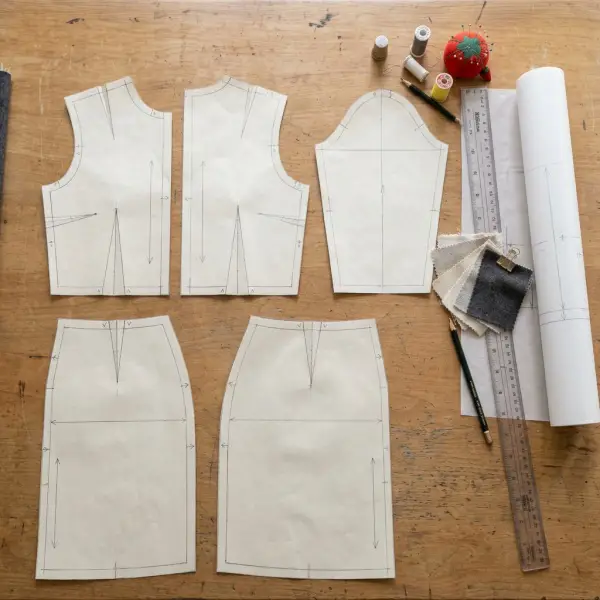
A skirt block is the foundation pattern for garments that cover the waist, hip, and lower body without a crotch seam. It usually teaches waist shaping, hip curve, dart intake, side seam balance, hem width, and length control.
Beginners often find the skirt block easier to understand than the bodice because it has fewer complex body zones. But it is still important. A basic skirt block helps explain how fabric moves from the waist to the hip and how darts remove excess fabric to create shape.
From one skirt block, a pattern maker can develop many styles: straight skirt, pencil skirt, A-line skirt, flared skirt, panel skirt, wrap skirt, pleated skirt, and gathered skirt. Each style begins with a different manipulation of width, dart control, seam placement, and hem shape.
In production, a skirt block can help a brand maintain consistent waist and hip fit across seasonal variations.
Trouser Block
A trouser block is the foundation for pants, trousers, shorts, and some jumpsuit bottoms. It controls waist, hip, rise, crotch curve, thigh width, knee position, leg shape, and hem balance.
For many beginners, the trouser block is more challenging than the skirt block because it must account for the body in both standing and sitting positions. The crotch curve is especially sensitive. A small change can affect comfort, drag lines, and movement.
The trouser block also teaches balance. If the front and back rise are not managed correctly, trousers may pull, tilt, wrinkle, or feel uncomfortable even when the waist and hip measurements seem correct.
For fashion brands, trouser fit can strongly affect customer satisfaction. A well-developed trouser block can reduce repeated fit problems across styles such as wide-leg trousers, tapered pants, shorts, culottes, and uniform pants.
Dress Block
A dress block usually combines bodice and skirt logic into one garment foundation. Depending on the system, it may be drafted as a connected bodice-and-skirt block or developed from separate bodice and skirt blocks.
Dress blocks are useful because dresses must balance upper body fit, waist position, hip allowance, skirt shape, and garment length. A dress can be fitted, semi-fitted, relaxed, or loose, but the relationship between the top and bottom sections still matters.
For beginners, the dress block helps show how waist placement changes the overall proportion of the garment. A waist seam that is too high or too low can change the visual balance and comfort of the dress.
For brands, dress blocks are useful when developing collections with repeated fit standards, such as work dresses, casual dresses, modestwear dresses, occasionwear, or uniforms.
Shirt Block
A shirt block is usually more relaxed than a close-fitting bodice block. It may include more ease through the chest, back, shoulder, and armhole to support movement and layering.
This block is especially useful for button-up shirts, tunics, shirt dresses, casual tops, uniforms, and overshirts. It also helps beginners understand the difference between a fitted bodice foundation and a production-friendly shirt foundation.
A shirt block often needs practical construction details such as button stand allowance, collar and collar stand compatibility, yoke development, sleeve placket, cuff, and hem shaping. These are style-specific details, but the block still controls the fit base.
In commercial production, a shirt block can become very valuable because shirt fit is highly repeatable across seasons. A brand may change fabric, collar shape, pocket style, or hem design while keeping a consistent shoulder and body fit.
Jacket Block
A jacket block is a foundation for outerwear or structured upper-body garments. It usually includes more ease than a bodice block because jackets are worn over other clothing and may require shoulder pads, lining, interfacing, or internal structure.
Jacket blocks teach beginners that not all fit should be close to the body. A good jacket needs room for layering, movement, and construction support. The shoulder, armhole, sleeve, lapel, front opening, and balance lines all become important.
In fashion production, jacket blocks can be more complex because structure and fabric behavior matter. Wool suiting, denim, twill, faux leather, lightweight linen, and padded outerwear all require different handling. A jacket block should be evaluated with the intended garment category in mind.
Close-Fitting Blocks vs Ease-Based Blocks
Not all blocks are meant to fit the body tightly. Some blocks are close-fitting, while others include more ease for comfort, layering, styling, or production practicality.
A close-fitting block is useful for understanding body shape and developing fitted garments. An ease-based block is more useful for categories such as shirts, jackets, coats, uniforms, casualwear, and relaxed silhouettes.
The difference matters because beginners may accidentally use the wrong block for the wrong garment. A fitted bodice block can be manipulated into a blouse, but if the final style is meant to be relaxed, the pattern maker must add appropriate ease and adjust armhole, shoulder, sleeve, and body width.
A simple comparison helps clarify the role of each block type.
|
Block Type |
Typical Purpose |
Common Garments |
Key Risk |
|
Close-fitting bodice block |
Understands body shape and fit foundation |
fitted tops, dresses, fitted shells |
may be too restrictive for relaxed garments |
|
Shirt block |
Supports movement and practical construction |
shirts, tunics, shirt dresses, uniforms |
may look too loose if not balanced |
|
Jacket block |
Allows layering and structure |
blazers, jackets, outerwear |
may become bulky if ease is uncontrolled |
|
Knit block |
Works with stretch fabric behavior |
T-shirts, jersey dresses, activewear |
depends heavily on fabric stretch and recovery |
The lesson is not to choose the “best” block. The lesson is to choose the right block for the garment category, target customer, and fabric behavior.
Woven Blocks and Knit Blocks Are Not the Same
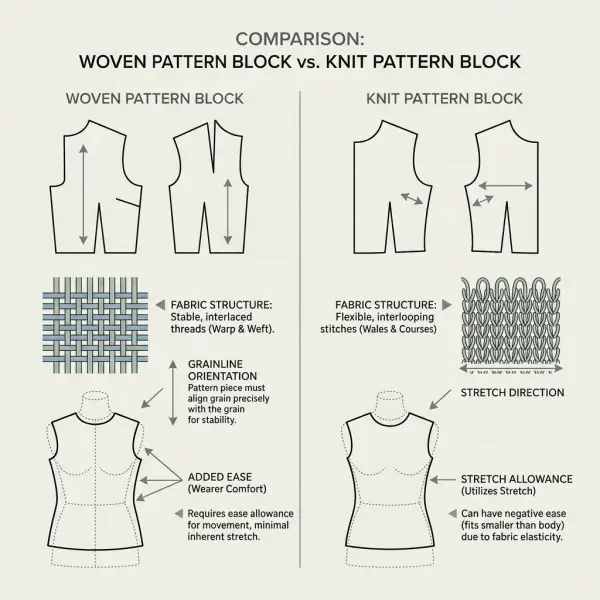
Woven blocks and knit blocks should be developed differently because woven fabrics and knit fabrics behave differently. Woven fabrics usually have more structure and less natural stretch, unless they include elastane or are cut on the bias. Knit fabrics often stretch more and recover differently depending on yarn, construction, weight, and finishing.
This affects ease. A woven blouse may need added wearing ease so the wearer can move comfortably. A knit top may need less ease, or even negative ease, depending on the fabric stretch and intended fit. But negative ease should be used carefully because not all knits recover well after stretching.
A beginner who uses a woven bodice block for a stretch jersey top may create a garment that looks too loose. A beginner who uses a close knit block for a non-stretch woven fabric may create a garment that cannot move comfortably.
In business terms, this difference affects product quality. Fit complaints may not come from measurement mistakes alone. They may come from using the wrong block for the fabric category.
How Blocks Help Create New Garment Styles
Blocks help pattern makers create new styles by providing a tested base that can be manipulated. This process is called flat pattern manipulation when the pattern maker changes the block on paper or digitally to create style features.
For example, a bodice block can be changed by moving a dart into a shoulder seam, converting it into gathers, creating a princess seam, lowering the neckline, adding a yoke, or widening the body. A skirt block can become an A-line skirt by adding flare at the hem. A sleeve block can become a puff sleeve by adding volume at the cap and hem.
This is where pattern making starts to feel creative. The block provides control, but the manipulation creates design.
Some common block manipulations include:
- moving darts into different positions,
- converting darts into seams or gathers,
- adding flare or volume,
- changing neckline shape,
- adding panels or yokes,
- changing sleeve length or width,
- adding fullness for pleats,
- extending a bodice into a dress,
- adjusting ease for relaxed silhouettes.
After manipulation, the new pattern still needs checking. Seamlines must match, notches must be added, grainlines must be confirmed, and the sample must be sewn and fitted. A block reduces risk, but it does not remove the need for technical review.
How Blocks Support Fit Consistency for Fashion Brands
Pattern blocks support fit consistency by giving a brand a repeatable foundation across related styles. This is especially important for brands that want customers to recognize and trust their fit.
A fashion brand may develop a core trouser block, then use it to create wide-leg trousers, tapered trousers, shorts, and culottes. The designs differ, but the waist, hip, rise, and core balance can remain consistent. A modestwear brand may develop a relaxed tunic block and use it across seasonal fabrics. A workwear label may keep a standard shirt block for uniforms while changing collar, pocket, or sleeve details.
This consistency can improve product development efficiency. It can also support customer loyalty when buyers know what size and fit to expect.
But there is a caveat. A block should not be reused blindly. Fabric changes, garment function, target customer, styling direction, and size range can all require adjustment. A block is a foundation, not a fixed rule that works in every context.
What Makes a Good Pattern Block?
A good pattern block fits the intended body or size standard, supports the garment category, and can be manipulated without creating repeated technical problems. It should be accurate enough to serve as a reliable foundation, but not so rigid that it prevents design development.
A good block usually has clear markings and balanced proportions. It should include center lines, grainlines, darts or shaping points, waistline, bustline or hipline references where relevant, and enough information for the pattern maker to use it confidently.
For business use, a good block should also be documented. The team should know which customer, size range, garment type, and fabric category the block was designed for.
Useful block documentation may include:
- block name and category,
- base size,
- target customer or fit model,
- measurement specification,
- intended fabric type,
- ease level,
- date created,
- revision history,
- fit notes,
- approved sample reference.
This type of documentation may sound simple, but it prevents confusion. Without it, a team may not know whether a block was created for woven shirts, knit tops, oversized jackets, or fitted dresses.

How Beginners Should Practice With Pattern Blocks
Beginners should practice with pattern blocks by starting simple, sewing test samples, and observing how pattern changes affect garment fit. The fastest way to understand blocks is not only to draft them, but to test them.
A useful practice sequence is to begin with a skirt block, then move to bodice and sleeve, then trousers, and later shirts or jackets. This order is not mandatory, but it helps many learners progress from simpler body relationships to more complex ones.
The beginner should avoid rushing into complex designs before understanding the base shape. A dramatic sleeve, asymmetric neckline, or multi-panel dress may look exciting, but it becomes difficult to diagnose problems if the foundation block is not understood.
A practical learning method can look like this:
- Draft or trace a basic block.
- Mark all important reference lines.
- Sew a test sample in suitable inexpensive fabric.
- Fit the sample on the intended body or dress form.
- Mark tightness, looseness, drag lines, or balance issues.
- Correct the block.
- Repeat the test if necessary.
- Use the corrected block to create a simple style.
The most valuable learning happens during fitting and correction. That is where the beginner sees how a flat pattern becomes a three-dimensional garment.
Common Beginner Mistakes With Pattern Blocks
Pattern blocks are useful, but they can also create confusion when beginners misunderstand their purpose. Many early mistakes come from treating blocks as finished patterns or assuming one block can solve every garment problem.
Using a Block Without Testing It
A drafted block is not automatically correct. Measurements can be taken inaccurately, formulas may not suit the body, and posture can change the fit. If a beginner develops several patterns from an untested block, the same fit issue may appear again and again.
The better approach is to sew a toile or test sample first. The block should be corrected before it becomes the foundation for other styles.
Confusing Close Fit With Good Fit
A block may be close-fitting, but that does not mean every garment should be close-fitting. Good fit depends on the garment’s purpose. A fitted dress, relaxed shirt, sportswear top, and tailored jacket need different ease and movement allowances.
Beginners sometimes remove too much ease because they want a “clean” fit. The result may look smooth when standing still but feel uncomfortable during movement.
Ignoring Fabric Type
A block developed for a stable woven fabric should not be automatically used for a stretch knit. A block tested in muslin may not behave the same in satin, denim, jersey, chiffon, or coated fabric.
Fabric changes the garment. Pattern blocks must be interpreted through fabric behavior, not treated as universal templates.
Forgetting That Blocks Need Maintenance
Bodies, customers, products, and brand positioning can change. A block that worked for one collection may need revision after customer feedback, size expansion, new fabric categories, or a shift in target market.
For fashion businesses, a block library should be reviewed periodically. Old blocks should not keep circulating simply because “this is what we always use.”
What Fashion Businesses Should Verify Before Building a Block Library
A block library can become a valuable asset for a fashion business, but only if it is built with clear standards. A folder full of inconsistent patterns is not a true block library. It is just storage.
Before investing time in a block system, a brand should verify several points:
- Who is the target customer?
- What body measurements or size standard will be used?
- Which garment categories need blocks first?
- Which fabrics are most common in the product range?
- Who approves fit?
- How will revisions be documented?
- How will suppliers receive pattern information?
- How will graded sizes be checked?
- How will old blocks be archived?
These questions matter because blocks influence repeated product decisions. If the foundation is unclear, the brand may scale inconsistency rather than quality.
For most small brands, the first priority is not building a huge block library. It is developing a few reliable blocks for the product categories they sell most often.
Basic Blocks in Manual and Digital Pattern Making
Basic blocks can be created manually on paper or digitally using pattern making software. The concept remains the same: the block is a foundation pattern that supports further style development.
Manual blocks are excellent for learning because beginners can physically see the relationship between measurement, line, shape, and correction. Drawing, cutting, folding, slashing, spreading, and walking seams by hand builds technical intuition.
Digital blocks are useful when the workflow requires version control, grading, file sharing, digital storage, or faster style manipulation. In modern apparel technology, digital garment research increasingly connects sewing patterns with 3D garment simulation and pattern-level editing. For example, computational pattern making research explores how 3D garment forms can be converted into 2D sewing patterns while considering tailoring constraints such as seams, darts, and grain alignment. computational pattern making from 3D garment models
Still, beginners should remember that software does not make pattern decisions by itself. Digital tools can speed up editing, but the maker still needs to understand fit, ease, balance, fabric behavior, and construction logic.
FAQ
What are the most important pattern blocks for beginners?
The most important pattern blocks for beginners are the bodice block, sleeve block, skirt block, and trouser block. These blocks teach the main body areas used in many garment categories. After that, beginners can study dress, shirt, jacket, and knit blocks depending on their goals. A beginner interested in womenswear may start with bodice and skirt blocks, while someone interested in casualwear may prioritize shirt, trouser, and knit blocks.
Is a block the same as a sloper?
A block and a sloper are closely related terms, and they are sometimes used interchangeably. In many contexts, both refer to a basic foundation pattern without decorative style details. Some pattern makers use “sloper” for a close-fitting personal fitting pattern and “block” for a production or design-development base. The exact usage depends on country, school, and industry practice, so beginners should focus on function rather than terminology.
Can I make clothes directly from a basic block?
You can sew a test garment from a basic block to check fit, but a block is usually not intended as a finished fashion pattern. It often lacks style details, final seam treatments, closures, facings, hems, pockets, collars, and production instructions. To make a finished garment, the block must be developed into a style pattern and checked for construction, seam allowance, grainline, notches, and fabric behavior.
Do I need different blocks for different fabrics?
Yes, in many cases. Woven and knit fabrics behave differently, so they often need different block logic. Stable woven fabrics usually require enough ease for movement, while stretch knits may use less ease depending on stretch and recovery. Heavy, fluid, slippery, structured, or bias-cut fabrics may also require pattern adjustments. A block should always be tested with fabric behavior in mind.
Why do brands create their own blocks?
Brands create their own blocks to maintain fit consistency, speed up product development, and reduce repeated sampling problems. A brand with a reliable shirt block, trouser block, or dress block can develop new styles without starting from zero each time. This can help preserve a recognizable fit identity across collections, although each new fabric and design still needs review.
How do I know if my pattern block is correct?
A pattern block is correct when it fits the intended body or size standard, balances properly, allows appropriate movement, and supports the garment category it was designed for. The best way to check is to sew a test sample, fit it carefully, mark problems, and correct the block. A block should not be considered reliable only because it was drafted from measurements.
Should beginners learn manual blocks before digital blocks?
Many beginners benefit from learning manual blocks first because hand drafting builds understanding of measurement, shaping, grainline, darts, and seam relationships. Digital tools are useful later for speed, grading, editing, and storage. However, the most important skill is not the tool itself. It is understanding how the pattern shape affects the finished garment.
How many blocks does a fashion brand need?
A fashion brand does not need every block at the beginning. It should start with blocks for its most important product categories. A blouse brand may prioritize bodice, sleeve, and shirt blocks. A modestwear brand may need tunic, dress, and relaxed trouser blocks. A uniform brand may need shirt, trouser, skirt, and jacket blocks. The right number depends on product range, fit strategy, fabric categories, and production scale.
Conclusion
Basic pattern blocks are the quiet foundation behind many successful garment patterns. They may look simple, but they carry important decisions about body shape, fit, ease, balance, garment category, and production consistency.
For beginners, blocks make pattern making easier to understand because they reveal the structure behind garment styles. For fashion brands, blocks can become a practical product-development asset. A reliable block library helps reduce guesswork, protect fit identity, and make new style development more controlled.
The most important lesson is not to collect as many blocks as possible. It is to understand what each block is for, test it properly, document it clearly, and use it with judgment.
A block is only a starting point. The skill is knowing how to develop it.





Comments 0
Leave a CommentSend Comment
Anda harus Login terlebih dahulu untuk dapat memberikan komentar.