

Corduroy Fabric Explained: Texture, Structure, and Fashion Uses
Quick Answer
Corduroy is a woven cut-pile fabric characterized by parallel raised ridges called wales. These ridges are typically produced by weaving additional weft yarns into a ground fabric, cutting the resulting floats, and finishing the exposed fibers to create a soft, textured surface. Cotton is a common fiber choice, although corduroy can also contain polyester, elastane, or other fibers depending on its intended performance and application.
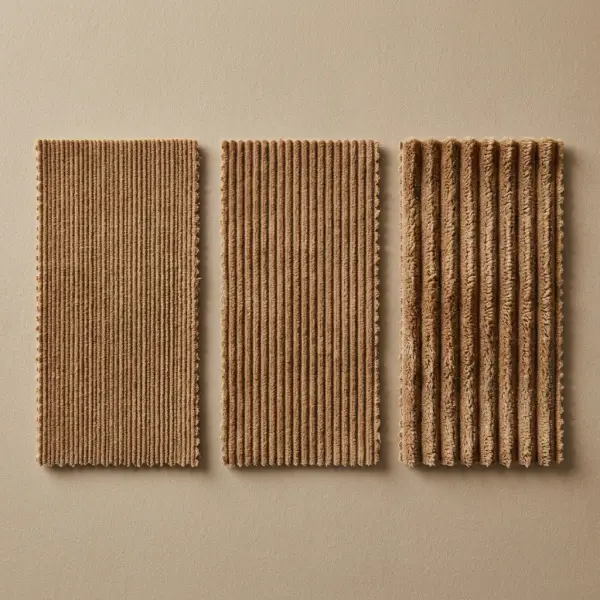
The fabric's appearance varies considerably according to wale count, pile height, construction, weight, and finishing. Fine-wale corduroy has narrow, closely spaced ridges that can create a relatively subtle texture, while wide-wale varieties feature broader, more prominent cords. These differences influence how the material looks, feels, drapes, and behaves during garment production.
Corduroy is commonly used for trousers, jackets, overshirts, skirts, dresses, and accessories. Its textured surface provides visual depth without requiring a printed pattern, making it useful for casual apparel and collections that emphasize material character.
For fashion businesses, selecting corduroy requires more than choosing a color or rib width. Fiber composition, fabric weight, directional pile, dimensional stability, and finishing consistency all affect product quality, manufacturing efficiency, and customer expectations.
What Is Corduroy Fabric?
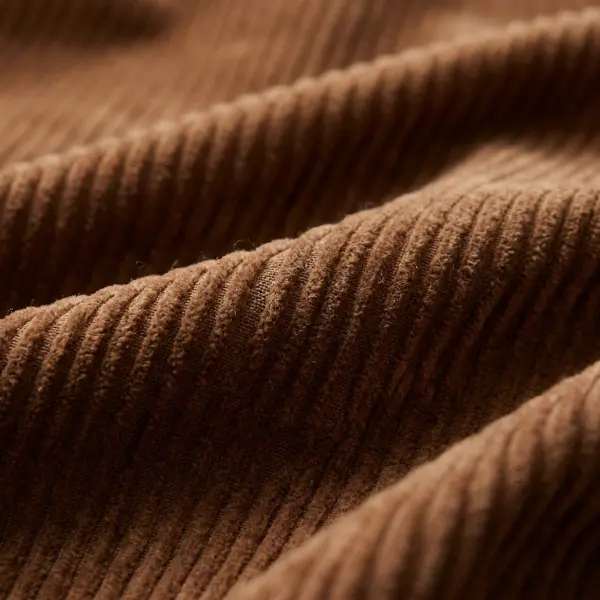
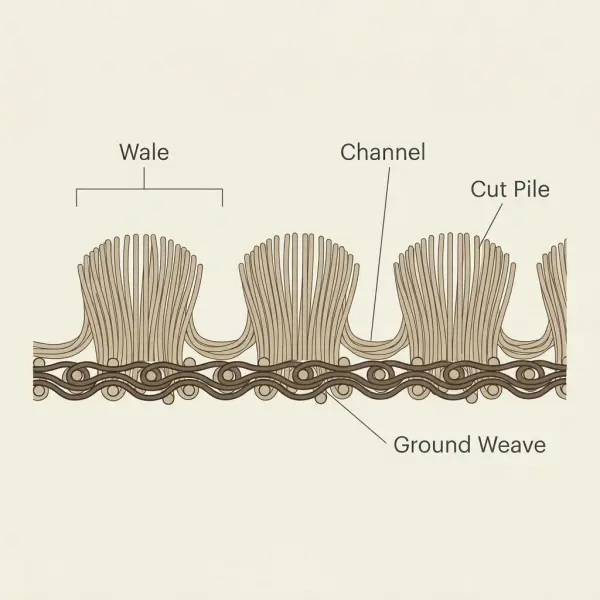
Corduroy belongs to the family of pile fabrics, meaning its surface contains yarns or fiber ends that project above the underlying cloth. Unlike a flat woven material, corduroy has a recognizable three-dimensional surface composed of lengthwise ridges separated by narrower channels. The raised areas feel comparatively soft because they contain cut yarn ends, while the ground weave provides the foundation that holds the fabric together.
The CottonWorks Textile Encyclopedia defines corduroy through its cut-pile construction, in which woven filling floats are cut to produce the vertical ribs known as wales. This distinction matters because corduroy's texture is created through textile construction and finishing rather than simply being printed onto a flat surface.
Although corduroy is frequently associated with heavier garments, it is not one standardized material. A lightweight fine-wale cotton corduroy intended for a shirt may behave very differently from a dense, wide-wale fabric developed for a winter jacket. Even two fabrics with the same wale count can differ in softness, flexibility, opacity, pile stability, and overall durability.
For designers and sourcing teams, corduroy is therefore best understood as a fabric construction category with multiple possible specifications. Its defining feature is the raised corded surface, not a particular fiber, thickness, or fashion aesthetic.
Why Is It Called a Ribbed Fabric?
The term ribbed describes the visible series of raised parallel lines running along the fabric surface. In corduroy, these ridges are called wales, and their spacing determines whether the texture appears fine, medium, or especially prominent.
However, not every ribbed-looking textile is corduroy. Rib-knit jersey, for example, develops its ribbed appearance through alternating knitted stitch structures. Corduroy instead uses a woven ground fabric and a cut-pile surface. Understanding this distinction is useful when buyers compare samples that appear similar in product photography but behave differently when stretched, sewn, or worn.
Readers exploring the wider relationship between textile construction and surface appearance can also refer to knit fabric structures and their properties, particularly when comparing woven corduroy with knitted rib fabrics.
How Is Corduroy Fabric Constructed?
The characteristic surface of corduroy results from a combination of weaving and pile-finishing operations. Its raised ribs are not separate strips attached to a finished cloth. Instead, the surface is integrated into the woven fabric through additional yarns that are subsequently cut and processed.
The Ground Weave Provides Structural Support
Corduroy begins with a ground fabric made from interlaced warp and weft yarns. Warp yarns run lengthwise through the woven fabric, while weft yarns, also called filling yarns, are inserted across its width. The ground construction provides the structural support needed to anchor the additional yarns that will form the pile.
Many conventional corduroy constructions use plain or twill ground weaves, although specific designs can vary. The choice of ground weave, yarn characteristics, fabric density, and finishing affects the stability and flexibility of the finished material.
A substantial ground fabric may support a firm pair of trousers or structured jacket, while a lighter construction may be better suited to shirts, dresses, or softer layering pieces. The surface texture alone does not reveal how the underlying material will perform.
Additional Weft Yarns Create the Pile
During weaving, extra weft yarns are arranged to form floats over selected groups of warp yarns. These floating sections are later cut, releasing yarn ends that can stand above the fabric surface.
In conventional weft-pile corduroy, the cutting process follows the length of the fabric to produce continuous raised lines. Brushing and related finishing operations help open and arrange the cut fibers into the familiar corded texture.
This construction explains an important difference between corduroy and a fabric with raised ribs produced entirely through weave geometry. Corduroy's surface contains exposed pile fibers, which influence its softness, directional appearance, and response to abrasion.
Cutting, Brushing, and Finishing Shape the Surface
After weaving and pile cutting, corduroy generally undergoes additional finishing to establish the desired appearance and handfeel. Depending on the manufacturing route, these processes may include brushing, shearing, dyeing, washing, softening, or other treatments. The sequence is not identical for every product, and some treatments may occur at different stages.
Finishing quality matters because the pile must look reasonably consistent across the fabric while remaining properly anchored to the ground structure. Uneven cutting or finishing can produce irregular ridges, inconsistent surface height, or unexpected visual differences between fabric areas.
For apparel manufacturers, such variation becomes particularly visible on large garment panels. A jacket front or trouser leg may expose subtle pile irregularities that were difficult to notice on a small sourcing swatch. Reviewing both the fabric surface and its behavior after washing or handling is therefore more reliable than approving a material solely by touch.
Understanding Corduroy Wale Count and Rib Width
Wale count refers to the number of raised cords measured across one inch of fabric width. It is one of the most useful descriptors for identifying the visual character of corduroy.
A higher wale count means more, narrower ribs per inch, while a lower wale count means fewer, wider ribs. An 18-wale fabric therefore has a finer rib pattern than a 6-wale fabric, assuming the values are measured using the same convention.
Wale count is a surface-geometry measurement rather than a direct measure of quality. It does not independently establish fabric weight, stretch, warmth, durability, or suitability for a particular garment. Fabric suppliers may also use different commercial labels for similar wale counts, so numerical specifications are more dependable than descriptions such as fine cord or jumbo cord.

Common Corduroy Wale Categories
|
Corduroy category |
Indicative wales per inch |
Visual characteristics |
Potential garment uses |
|
Wide-wale corduroy |
Approximately 3–7 |
Broad, prominent raised cords |
Jackets, structured trousers, overshirts, statement pieces |
|
Medium-wale corduroy |
Approximately 8–14 |
Distinct but moderately sized ribs |
Casual trousers, skirts, jackets, everyday separates |
|
Fine-wale or needlecord |
Approximately 15 or more |
Narrow, closely spaced ribs |
Shirts, dresses, lighter skirts, children's apparel |
These are indicative commercial groupings, not standardized performance classifications. Terms and boundaries vary among suppliers; the finished fabric specification and approved sample take precedence.
For a fashion label developing a corduroy capsule, the difference can be significant. Broad ribs make the fabric texture more visually prominent, potentially giving a simple silhouette a stronger material identity. Narrower ribs can create a quieter surface that works with smaller pattern pieces, finer garment details, or more understated products.
Neither approach is inherently superior. A collection designed around relaxed, substantial outerwear may benefit from wide-wale corduroy, while a brand producing tailored casual shirts may prefer a finer construction. The right choice depends on the complete fabric specification and the intended garment rather than wale count alone.
What Are the Main Characteristics of Corduroy Fabric?
Corduroy's recognizable appearance comes from the interaction between its raised pile, underlying weave, fiber composition, and finishing. These characteristics explain why the fabric can suit different apparel categories, but they also determine its limitations.
Soft, Raised Texture With Visual Depth
The most recognizable characteristic of corduroy is its three-dimensional surface. Unlike a smooth cotton twill or plain-weave fabric, corduroy has repeated ridges that create alternating highlights and shadows when exposed to light.
This surface gives solid-colored garments visible detail without requiring additional prints, embroidery, or decorative stitching. A relatively simple overshirt, for example, can gain much of its character from the texture itself. The effect changes with wale width, color, pile density, and lighting conditions, making physical sample evaluation important when developing a collection.
Warmth and Surface Comfort
Many corduroy fabrics feel warm because their raised pile and relatively substantial construction can help trap air close to the textile surface. However, insulation is not guaranteed simply because a fabric is corduroy. Overall thickness, density, fiber composition, garment fit, lining, and layering affect thermal comfort.
A heavy cotton corduroy jacket may be appropriate for cooler conditions, while a lightweight fine-wale version may be comfortable in milder weather. Brands should avoid describing every corduroy garment as winter clothing without considering the actual material and intended climate.
Variable Weight, Structure, and Drape
Corduroy can have a firm, substantial handfeel or a comparatively soft, flexible character. Its drape depends on the fabric's mass per unit area, ground weave, yarns, pile construction, and finishing rather than the raised ribs alone.
A dense material may retain a structured shape in jackets, trousers, or skirts. A lighter construction can follow body movement more closely, making it suitable for shirts or softer silhouettes. Designers need to evaluate whether the cloth supports the intended shape, especially when a garment includes pleats, gathers, curved seams, or multiple fabric layers.
Durability Depends on More Than Thickness
Corduroy can perform well in garments designed for regular use, but its durability is not uniform. The ground weave may remain structurally sound while the exposed pile becomes flattened, abraded, or visually uneven in areas that experience repeated friction.
High-contact locations such as elbows, knees, seat panels, and pocket edges deserve particular attention during material selection. A thick, wide-wale appearance does not automatically mean better abrasion resistance, just as a fine-wale construction does not necessarily indicate fragility.
Fabric quality, yarn characteristics, pile anchoring, garment fit, and finishing all influence the result. For product development teams, repeated-wear evaluation and appropriate laboratory testing provide stronger evidence than assumptions based on the fabric's appearance.
How Fiber Composition Changes Corduroy Performance
Corduroy describes a textile structure rather than a specific fiber. Although cotton is widely associated with the material, manufacturers can use different fibers or blends to achieve particular properties.
Cotton corduroy is commonly selected for its familiar textile handfeel and suitability for casual clothing. Depending on construction and finishing, it can offer a balance of softness, body, and moisture absorption. Cotton-rich materials may also exhibit shrinkage or creasing, so preshrinking, dimensional stability, and care requirements need to be considered.
Cotton-polyester corduroy may be developed to modify aspects of stability, handling, drying behavior, or cost. The result depends on the blend ratio, yarn construction, and processing route. Polyester content does not automatically make a corduroy fabric more durable or suitable for every application.
Stretch corduroy incorporates elastic components, often elastane, to provide additional extensibility. This can be useful in fitted trousers, skirts, and garments that require greater freedom of movement. However, stretch performance must be assessed alongside recovery, dimensional stability, and the fabric's behavior after laundering.
Other fiber compositions are possible, including regenerated cellulose fibers and specialty blends. These may produce different levels of softness, fluidity, or surface appearance, although the characteristics must be evaluated from the actual fabric rather than inferred from fiber content alone.
From a sourcing perspective, material composition should be documented precisely. A product labeled simply as cotton corduroy may leave important questions unanswered about its ground fabric, pile yarns, blend percentages, and finishing.
Where Is Corduroy Used in Fashion and Apparel?
Corduroy's combination of visual texture and variable construction makes it useful across several clothing categories. Its applications range from relatively lightweight everyday garments to more structured outerwear, depending on the chosen material.
Trousers and Casual Bottoms
Corduroy trousers are among the fabric's most familiar applications. The raised surface provides texture to straight-leg, relaxed, tapered, and other trouser silhouettes, while the underlying woven construction can support garment shape.
Fabric selection matters considerably for this category. A rigid, heavy corduroy may suit a relaxed silhouette but feel restrictive in closely fitted trousers. Stretch corduroy can improve flexibility, although designers must also evaluate recovery, seam movement, and surface wear at the knees and seat.
Jackets, Overshirts, and Casual Outerwear
Corduroy is commonly used for casual jackets, shirt jackets, overshirts, and selected outerwear styles. Its textured surface allows uncomplicated garment designs to appear visually substantial, particularly when paired with details such as patch pockets, collars, or visible stitching.
For outerwear, the relationship between fabric weight and garment construction becomes especially important. Heavy corduroy can create bulky intersections at collars, cuffs, and pocket openings, while lighter versions may require supporting materials to achieve the intended shape.
Brands must therefore assess the full garment construction rather than relying on the visual appeal of the fabric alone.
Shirts, Dresses, and Skirts
Fine-wale corduroy can be suitable for shirts, shirt dresses, pinafore dresses, and casual skirts when the selected material has the appropriate flexibility and weight. Narrow ribs often create a quieter surface, allowing garment details and silhouette to remain visually prominent.
A fine-wale cotton dress, for example, may work with a relatively simple pattern, while a more substantial version could be better suited to structured skirts or garments requiring greater body. Designers should check how the material behaves at gathers, pleats, waist seams, and curved areas because the pile and fabric thickness may influence bulk and drape.
Accessories and Smaller Fashion Products
Corduroy also appears in caps, bags, bucket hats, and other textile accessories. The fabric provides recognizable texture on relatively small products, sometimes allowing a simple design to stand out without extensive decoration.
For accessories, the intended use determines the necessary construction. A soft casual bag may prioritize drape and surface feel, while a structured cap or reinforced bag requires attention to interfacing, seam stability, and resistance to abrasion.
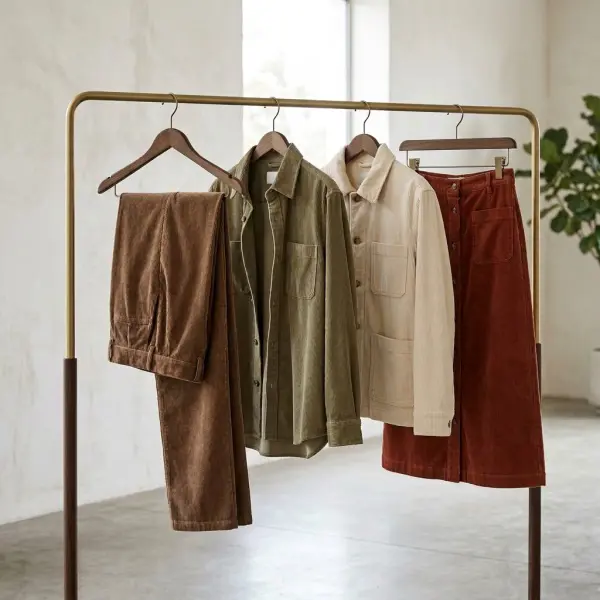
These applications demonstrate the practical versatility of corduroy, but they should not be treated as interchangeable uses for the same fabric specification. A material developed for heavyweight trousers may not have the drape required for a shirt, while a soft shirting corduroy may lack the body desired for a structured jacket.
The broader relationship between ribbed surfaces and garment aesthetics will be explored in why ribbed and raised textures add character to apparel design. For the present discussion, the key consideration is how corduroy's construction supports a particular garment rather than texture alone.
Corduroy vs Other Ribbed and Pile Fabrics
Corduroy shares visual characteristics with several other textiles, but similar appearance does not necessarily mean similar construction or performance.
|
Fabric |
Main construction |
Surface characteristics |
Important distinction |
|
Corduroy |
Woven cut-pile construction |
Parallel raised pile ridges |
Defined by its corded, cut-pile surface |
|
Rib knit |
Knitted loop structure |
Alternating raised and recessed knitted columns |
Often has substantial widthwise stretch |
|
Velveteen |
Generally woven weft-pile construction |
More continuous, relatively even pile surface |
Does not usually display corduroy's distinct separated wales |
|
Bedford cord |
Ribbed woven structure without conventional cut pile |
Firm, lengthwise woven ridges |
Raised appearance comes from weave structure rather than cut pile |
The most important distinction for apparel sourcing is the relationship between surface appearance and structural behavior. Rib knit may provide natural extensibility through its loop arrangement, while conventional corduroy is comparatively stable unless stretch has been engineered into the fabric.
Velveteen and corduroy are more closely related because both can use weft-pile construction. However, corduroy organizes its pile into separated raised lines, whereas velveteen generally produces a more continuous velvet-like surface. Bedford cord offers another useful comparison because its lengthwise ribs can resemble corduroy from a distance without sharing the same cut-pile character.
These distinctions help prevent substitutions based solely on photographs. A supplier offering a fabric described as ribbed cotton may be proposing something quite different from the corduroy specified in a garment design.
What Should Fashion Brands Consider When Sourcing Corduroy?
Sourcing corduroy requires evaluating both its visual properties and the specifications that affect production performance. A fabric can have the desired color and rib pattern while still creating problems during cutting, sewing, finishing, or consumer use.
Define the Fabric Beyond Its Wale Count
A technical specification should identify the characteristics that are relevant to the product rather than relying on commercial fabric names. Wale count is useful, but it should be considered alongside construction, composition, width, weight, and finishing.
A practical sourcing brief should normally include:
- Fiber composition: Actual fiber content and percentages, including any elastic components.
- Wale count: Finished number of ribs per inch, supported by a physical sample.
- Fabric weight: Mass per unit area, commonly expressed in grams per square meter (GSM).
- Usable width: Width available for production after accounting for unsuitable edge areas.
- Pile characteristics: Nap direction, pile uniformity, and any relevant appearance requirements.
- Performance requirements: Appropriate dimensional stability, colorfastness, stretch recovery, abrasion, or other tests.
- Finishing and care: Approved finish, laundering limitations, and expected post-wash appearance.
These details form the basis for comparing suppliers and approving production materials. They also help prevent a mill from replacing one corduroy quality with a superficially similar alternative that behaves differently.
For businesses managing several styles, maintaining a material specification record can make repeat orders more reliable. It supports consistent communication among design, merchandising, sourcing, manufacturing, and quality teams.
Account for Nap Direction During Cutting
Corduroy has a directional pile, commonly called nap. When the fabric is stroked in different directions, the pile can reflect light differently, changing its perceived brightness or depth of color.
This becomes a manufacturing issue when pattern pieces are rotated during marker making. If the front and back of a garment are cut with opposing pile directions, the finished panels may appear to be different shades even when they came from the same fabric roll.
The University of California Agriculture and Natural Resources guidance on fabric construction and handling explains why pile fabrics require consistent directional layout and why this decision can affect both appearance and wear.
For manufacturers, this means one-way cutting may be necessary to achieve the approved appearance. Such layouts can restrict marker efficiency because pattern pieces cannot always be rotated freely to fill unused areas. The resulting fabric consumption should be evaluated during costing rather than treated as an unexpected cutting-room problem.
Test Sewing and Pressing Before Bulk Production
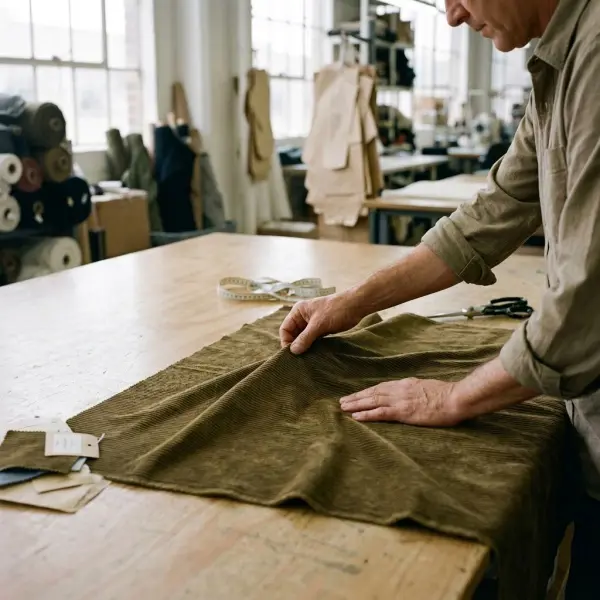
Corduroy's pile and thickness can affect fabric feeding, seam bulk, and pressing results. Thick intersections may require adjustments to pattern construction or seam allowances, while pile movement during sewing can cause layers to shift relative to one another.
The appropriate needle, stitch length, presser-foot arrangement, and feeding method should be confirmed through sampling. These settings depend on fabric weight, stretch, machine type, and the garment's construction rather than following one universal corduroy setting.
Pressing presents a separate challenge because direct pressure on the raised surface can flatten or mark the pile. Factories may use reverse-side pressing, protective padding, steam, or other controlled methods, but these techniques must be tested for compatibility with the selected material and finish.
Establish Quality Controls for Pile and Color
Visual inspection is particularly relevant for corduroy because the fabric's directional pile can make small differences more noticeable. Inspection should consider the material under suitable lighting, with the pile direction controlled, so genuine color variation can be distinguished from normal directional shading.
Quality teams may need to assess pile uniformity, visible streaks, flattened areas, rib consistency, surface contamination, and differences between fabric rolls. Relevant testing should also be selected according to the garment's expected use.
For example, ISO 105-X12:2016 specifies a method for evaluating colorfastness to rubbing, including dry and wet rubbing conditions. This can be relevant for dark-colored corduroy garments where color transfer to other materials is a concern. However, the standard does not establish that a particular corduroy fabric will pass; actual testing and buyer-defined acceptance criteria are necessary.
A satisfactory rubbing-colorfastness result also does not prove resistance to pile flattening or mechanical wear. Those properties require separate evaluation.
Common Mistakes When Developing Corduroy Apparel
Choosing Corduroy Only by Its Appearance
A frequent product development mistake is approving corduroy because its color and rib width match the design reference without testing the material's behavior. Two visually similar fabrics may differ in weight, stiffness, stretch, and surface durability, which can produce very different finished garments.
This becomes costly when a fabric approved from a small swatch is used in a design that requires substantial drape or complex construction. Brands can reduce this risk by assessing a larger fabric sample, completing a representative garment prototype, and evaluating its appearance after handling and washing.
Ignoring Pile Direction in the Cutting Plan
Inconsistent nap direction can cause visible shading differences between garment panels. The problem may not become apparent until components are sewn together, when the front, back, sleeve, or pocket appears darker than an adjacent section.
Correcting this after cutting can require replacement panels and additional material, particularly when the fabric has limited availability. A more reliable approach is to establish nap direction during sample approval, document it in production instructions, and verify marker orientation before cutting begins.
Assuming Thick Corduroy Is Automatically More Durable
A substantial fabric can appear robust, but thickness alone does not establish resistance to abrasion or pile loss. Corduroy may develop flattened or worn-looking areas under repeated friction, and its performance depends on the pile structure and the supporting cloth.
This assumption becomes particularly risky for trousers and work-oriented garments exposed to regular contact with seating, equipment, or other surfaces. Developers should evaluate durability against expected wear conditions, paying attention to the pile as well as the underlying fabric.
Overlooking Bulk at Seams and Construction Details
A heavy corduroy fabric may work well as a flat panel but become difficult to manage where several layers meet. Pocket corners, collars, waistbands, cuffs, and plackets can develop excessive bulk, affecting appearance, comfort, and manufacturing efficiency.
Design teams sometimes discover these issues only during sewing because the fabric selection stage focused on the material's surface. Reviewing seam construction and supporting components during prototyping helps identify where bulk reduction, pattern adjustments, or alternative finishing methods may be required.
Important Technical Caveats About Corduroy
Several assumptions about corduroy are reasonable at first glance but can become misleading when applied to commercial product decisions.
First, corduroy is not automatically a heavyweight or cold-weather fabric. The category includes constructions with different weights and levels of flexibility. Thermal comfort depends on the complete garment, making it inappropriate to infer insulation performance from wale count or texture alone.
Second, wale count is not a quality grade. A higher wale count identifies finer rib spacing, not superior material performance. Consistency, pile integrity, dimensional stability, and suitability for the intended garment are more meaningful quality criteria.
Third, a naturally derived fiber does not automatically make corduroy environmentally preferable. Cotton cultivation, polyester production, dyeing, finishing, manufacturing efficiency, garment longevity, and end-of-life handling all contribute to environmental outcomes. Broad sustainability claims require product-specific evidence rather than assumptions based on the material's name.
Finally, corduroy's directional appearance is not necessarily a defect. Differences in light reflection are characteristic of pile textiles, but manufacturers still need clear standards to distinguish acceptable directional shading from inconsistent dyeing, irregular pile formation, or other production problems.
These caveats reinforce the importance of treating corduroy as a technically specified fabric rather than a single aesthetic category.
How Can Fashion Businesses Use Corduroy Strategically?
The commercial value of corduroy depends on how well the material supports the product concept, customer expectations, manufacturing capabilities, and intended retail price. Texture alone may help differentiate a garment, but it cannot compensate for unsuitable fit, poor construction, or inconsistent material quality.
For a small apparel brand, corduroy may provide an opportunity to develop recognizable products using relatively simple silhouettes. A coordinated range of trousers, overshirts, and skirts could share related fabrics or colors while differing in wale scale and garment construction. This approach can simplify the visual identity of a collection, although it still requires separate fabric validation where garment functions differ.
For manufacturers, the main challenge is converting design intent into repeatable specifications. Fabric approval, marker planning, sewing trials, finishing methods, and quality inspection need to be coordinated. Inconsistent handling can reduce the commercial advantage of an otherwise attractive material through rework, fabric waste, or visible defects.
Retail teams have a different responsibility: communicating what the material actually offers. Product pages should ideally identify relevant fabric composition, texture, fit, stretch characteristics, and care instructions rather than relying on descriptions such as premium corduroy or luxury soft fabric without supporting detail.
Corduroy can also support different collection identities. Its potential role in casual, vintage-inspired, and cooler-weather wardrobes is examined more closely in how corduroy supports casual, vintage, and cold-weather styling. These styling applications should nevertheless be grounded in the actual fabric qualities and climate needs of the target market.
How Should Corduroy Garments Be Cared For?
Corduroy care depends on fiber composition, dyeing, finishing, and garment construction. There is no single laundering method appropriate for every corduroy product, particularly when garments contain linings, interfacings, or trims with different care requirements.
For washable corduroy, turning the garment inside out and avoiding unnecessarily aggressive abrasion may help protect its raised surface. Lower-temperature washing and restrained mechanical action may also be appropriate for certain fabrics, but manufacturers should determine instructions through material and garment testing.
Drying and pressing require similar care. Excessive heat or direct pressure can affect the pile, while some garments may benefit from careful reverse-side pressing or steaming to reduce the risk of surface marks. Any method should first be assessed against the approved care instructions.
For fashion businesses, validated care guidance is part of product quality communication. Customers need realistic expectations about pile flattening, washing, shrinkage, and appearance changes, particularly for garments intended for repeated everyday wear.
Frequently Asked Questions About Corduroy Fabric
Is Corduroy Made From Cotton or Polyester?
Corduroy can be made from cotton, polyester, or blends containing these and other fibers. Cotton is a familiar choice, but the term corduroy describes the raised cut-pile structure rather than a required fiber composition.
A cotton-rich corduroy and a polyester-blend version may have similar-looking wales while differing in moisture behavior, dimensional stability, handfeel, and care requirements. The actual result depends on the blend, yarns, fabric construction, and finishing. Buyers should request a complete fiber-content specification and approved physical sample rather than assuming that every corduroy fabric offers the same performance.
What Is the Difference Between Fine-Wale and Wide-Wale Corduroy?
Fine-wale corduroy has more narrow ribs per inch, while wide-wale corduroy has fewer, broader ribs. The distinction primarily describes the visual scale of the raised texture and does not establish fabric thickness or quality on its own.
Fine-wale fabrics can suit garments that benefit from subtler texture, such as shirts, dresses, and lightweight separates. Wide-wale versions may be selected when the surface texture is intended to be more prominent, including certain jackets and casual trousers. Both categories contain different weights and constructions, so designers should evaluate drape, softness, stretch, and pile quality before selecting a material.
Is Corduroy Fabric Stretchy?
Traditional woven corduroy is not necessarily stretchy, although some constructions have limited mechanical give. Stretch corduroy can contain elastane or other elastic components that increase extensibility, making it suitable for garments requiring additional movement.
For fitted trousers, stretch alone is not enough. Recovery matters because a fabric that extends comfortably but fails to return toward its original dimensions may develop unwanted bagging at the knees or seat. Brands should examine the direction and degree of stretch, recovery after extension, and performance after laundering. These characteristics are material-specific and cannot be determined from the corduroy label.
Is Corduroy Suitable for Summer Clothing?
Some lightweight corduroy fabrics can be used for garments intended for mild or warmer conditions, but heavier constructions may feel uncomfortable in hot or humid environments. The material's suitability depends on weight, fiber composition, fabric density, garment design, and local climate.
A lightweight fine-wale shirt worn loosely may provide a different experience from heavy corduroy trousers or a lined jacket. Designers targeting warm-weather markets should assess air permeability, moisture comfort, garment fit, and real wearing conditions. Corduroy should not be categorized as exclusively winter fabric, but neither should all corduroy qualities be marketed as suitable for summer use.
Does Corduroy Fabric Wear Out Easily?
Corduroy's resistance to wear varies with its construction, fiber quality, pile anchoring, finishing, and the type of use. The exposed pile may gradually flatten or experience abrasion at high-contact areas even when the underlying woven fabric remains intact.
For everyday trousers, this can be noticeable at the knees or seat, while outerwear may experience wear at cuffs, elbows, or bag-contact areas. Such changes are not identical across all corduroy fabrics. Manufacturers should evaluate representative samples under relevant abrasion and laundering conditions, particularly for products marketed for frequent use. Fabric appearance, structural strength, and pile retention should be considered separately.
What Is the Best Corduroy Fabric for a Fashion Brand?
The most suitable corduroy is the one whose construction and performance match the intended garment, target customer, production capabilities, and commercial requirements. There is no universally best wale count or fiber composition.
A brand developing structured jackets may prioritize body, surface consistency, and seam performance, while a brand making fitted trousers may need greater attention to stretch recovery and abrasion. Buyers should compare approved samples using relevant specifications, garment prototypes, and quality tests. Material cost also needs to be assessed alongside cutting efficiency, production complexity, and expected returns or quality risks. This provides a more dependable basis for sourcing decisions than appearance alone.
Conclusion: Understanding Corduroy Beyond Its Ribbed Appearance
Corduroy demonstrates how textile construction can become a defining element of apparel design. Its raised wales create an immediately recognizable surface, while variations in rib width, fiber composition, ground weave, weight, and finishing allow the material to serve different garment categories.
For fashion businesses, the central challenge is translating that surface character into consistent product performance. Choosing an attractive fabric is only the beginning. Nap direction, pile durability, dimensional stability, garment construction, and care requirements must also support the intended design.
Corduroy's value is therefore not limited to its visual association with casual or vintage clothing. It lies in the relationship between material structure, product suitability, and controlled manufacturing. Brands that understand these connections are better equipped to use corduroy thoughtfully, communicate its characteristics accurately, and develop apparel that performs as intended.





Comments 0
Leave a CommentSend Comment
Anda harus Login terlebih dahulu untuk dapat memberikan komentar.