

Twill vs Plain Weave: How Fabric Construction Changes Performance
Two fabrics made from the same fiber can behave surprisingly differently when their weave structures change.
A cotton poplin shirt, for example, may use a plain weave that feels crisp, stable, and relatively flat. A cotton trouser fabric may use twill, producing a more visible diagonal surface, different drape, and a structure that can accommodate longer yarn floats. Both are woven cotton fabrics, yet the way their warp and weft yarns interlace changes how the textile looks, handles, and performs.
That is the central difference between plain weave and twill.
Plain weave uses frequent alternating intersections between warp and weft. Twill shifts those intersections progressively, creating characteristic diagonal lines and typically reducing the number of interlacing points compared with an equivalent basic plain weave structure. CottonWorks, the textile education platform from Cotton Incorporated, describes plain weave as having more crossover points than the other basic weave structures and notes that this contributes to high fabric stability, while twill constructions use longer floats and fewer interlacements depending on the specific weave. CottonWorks guide to basic woven fabric designs
For fashion businesses, however, the useful question is not simply which weave is “better.” It is how each structure changes the balance between stability, flexibility, drape, surface character, tear behavior, snag risk, fabric density, manufacturability, and garment suitability.
The answer depends on more than weave alone.
Quick Answer: What Is the Difference Between Twill and Plain Weave?
Plain weave interlaces each warp yarn alternately over and under successive weft yarns, usually in a 1/1 pattern. Twill uses a staggered sequence such as 2/1, 2/2, or 3/1 that produces diagonal lines and generally creates longer yarn floats with fewer interlacing points.
That structural difference changes fabric behavior.
Plain weave generally provides strong dimensional and structural stability because warp and weft cross frequently. It often produces a flatter surface and may feel relatively firm when other variables are similar. Twill can provide more yarn mobility and often allows fabrics with greater drape, more pronounced surface texture, and different tear behavior.
The distinction should not be turned into a universal performance ranking. A heavy canvas in plain weave can be far more durable than a lightweight fashion twill, while a dense 3/1 workwear twill can outperform a delicate plain-weave fabric in demanding use.
Fiber composition, yarn strength, yarn count, fabric density, weight, finishing, stretch components, and garment construction all interact with weave.
For sourcing teams, weave tells you how the fabric is built—not everything the finished garment will do.
The Structural Difference Starts With Interlacing
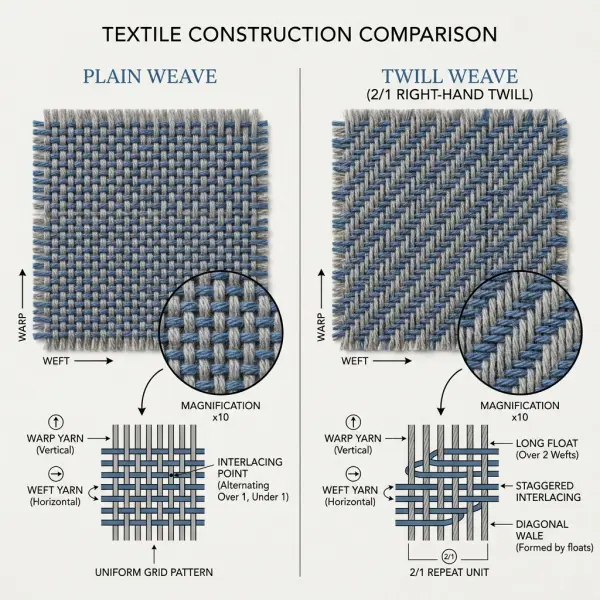
Woven fabrics are formed by interlacing two sets of yarns. Warp yarns run in the length direction, while weft—or filling—yarns travel across the width. During weaving, selected warp yarns are raised and lowered so that each inserted weft yarn passes through a controlled opening.
The sequence of those intersections creates the weave.
CottonWorks identifies plain, twill, and satin as the three basic woven structures from which many other woven designs are developed. CottonWorks weaving basics
In a basic plain weave, every warp yarn alternates over one and under one weft yarn. The neighboring warp follows the opposite sequence. The resulting repeat is extremely compact: two warp yarns by two weft yarns.
Twill changes that rhythm.
A 2/1 twill might pass a warp yarn over two weft yarns and under one. The next warp yarn follows the same pattern but begins at a different point. This gradual displacement produces the diagonal twill line.
A 3/1 twill extends the float further: a warp yarn passes over three weft yarns before interlacing beneath the next one.
Those seemingly small changes in yarn path have practical consequences.
Interlacement frequency matters
Every time warp and weft cross, the yarn path changes direction.
Plain weave has a high frequency of those crossover points. Twill generally has fewer, depending on its repeat.
This affects how tightly yarns are locked into position and how freely they can move within the fabric.
More interlacements often increase structural stability but can also constrain yarn movement. Longer floats reduce some of that restraint, which can contribute to a more flexible structure and different drape characteristics.
CottonWorks consequently describes basic plain-weave fabrics as tending to be stiffer and less drapable while also being highly stable, with fewer tendencies toward problems such as skew, seam slippage, picking, or snagging compared with structures containing longer floats.
These are tendencies rather than guarantees.
A very lightweight, loosely woven plain-weave fabric can still drape softly, while a densely constructed heavyweight twill can feel highly structured.
Plain Weave vs Twill at a Glance
The most useful comparison separates structural tendencies from absolute performance claims.
|
Characteristic |
Plain Weave |
Twill Weave |
|
Basic interlacement |
Commonly 1/1 |
Commonly 2/1, 2/2, 3/1 or related variations |
|
Surface appearance |
Usually flat and relatively even |
Characteristic diagonal lines |
|
Interlacing frequency |
High |
Generally lower |
|
Yarn floats |
Short |
Longer, depending on construction |
|
Structural stability |
Generally high |
Depends on twill type and density |
|
Drape tendency |
Often firmer when variables are comparable |
Often more flexible or drapable |
|
Snag exposure |
Short floats generally limit exposure |
Longer floats may increase susceptibility depending on construction |
|
Tear behavior |
Depends strongly on complete specification |
Some twills, particularly longer-float structures, can provide higher tear strength |
|
Visual texture |
Often subtle |
Frequently more pronounced |
|
Common apparel examples |
Poplin, voile, broadcloth, chambray, some canvas and shirting |
Denim, gabardine, drill, chino cloth, suiting and trouser twills |
The phrase “when variables are comparable” matters here.
A comparison between a 100 GSM plain-weave viscose fabric and a 400 GSM cotton twill tells us very little about the effect of weave itself because too many other variables have changed.
For meaningful product development, fabrics should be evaluated as complete constructions.

How Does Weave Structure Affect Fabric Stability?
Plain weave generally has an advantage in structural stability because its yarns interlace frequently.
Each warp yarn is repeatedly locked against the weft, reducing the length over which individual yarns can move freely. CottonWorks specifically identifies plain weave as highly stable because of its large number of interlacing points.
This can be useful when a product requires a controlled, predictable fabric structure.
Think of a crisp cotton shirt. The pattern depends on relatively stable panels, sharp seam lines, consistent button plackets, and a fabric that does not shift excessively during cutting or sewing.
Plain weave is well suited to many such applications.
Twill gives the yarns more room between intersections. Depending on density and yarn properties, that can make the cloth more flexible, but the structure may also allow greater yarn movement.
For apparel teams, this matters during more than wear. Stability affects spreading, cutting, seam performance, pressing, and dimensional control.
A highly stable cloth may be easier to keep aligned through production. A more mobile cloth may require greater handling control, particularly when it is lightweight or loosely constructed.
Still, weave should not be considered in isolation. A densely woven twill can be extremely stable, while a loosely woven plain structure can distort.
Why Does Twill Often Drape Differently?
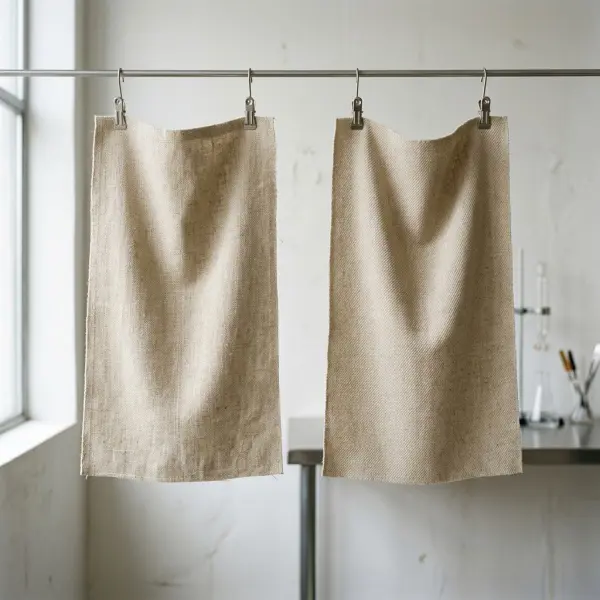
Drape describes the way a fabric deforms and hangs under its own weight.
Twill frequently develops greater flexibility than an otherwise comparable plain weave because the yarns have fewer crossover points constraining them. Longer floats can allow more movement within the structure.
That is one reason twill can create an appealing balance between body and movement.
A tailored trouser fabric, for example, may need enough structure to maintain a clean silhouette while still falling smoothly from the hip. A suitable twill can provide that combination.
Plain weave often feels more direct and crisp because its frequent interlacements restrict yarn mobility.
But saying “twill drapes better” would be misleading.
Drape also depends heavily on:
- fiber flexibility;
- yarn size and twist;
- fabric thickness;
- fabric mass;
- warp and weft density;
- chemical and mechanical finishing;
- elastomeric components;
- moisture content and testing conditions.
A fine plain-weave silk fabric can have much more fluid drape than a dense cotton twill.
Weave influences drape. It does not determine it alone.
Does Twill Have Better Tear Strength Than Plain Weave?
This is one area where simplified fabric advice often creates confusion.
Tear strength is not the same as tensile strength.
Tensile strength concerns the force required to pull a material apart under tension. Tear strength concerns the resistance to propagation of an existing tear or cut. Yarn mobility within the structure can influence how forces are distributed during tearing.
Some longer-float twill structures can develop higher tear strength than comparable tightly interlaced constructions because yarns have more opportunity to move and group together as the tear progresses.
CottonWorks specifically notes that 3/1 twill, with its longer floats and fewer interlacing points, produces fabrics with higher tear strength and is commonly used for heavier bottom-weight fabrics. CottonWorks technical explanation of 3/1 twill
That does not mean every twill is stronger than every plain weave.
A high-density plain-weave fabric made from strong yarns may outperform a loosely constructed twill in multiple mechanical tests.
The business implication is important: do not translate a weave designation into a durability guarantee.
Specify the relevant test.
If tear resistance is critical, request tear-strength testing appropriate to the product or buyer specification. If tensile strength matters, test that separately. If the garment will experience surface rubbing, abrasion testing may be more informative than either.
What About Abrasion Resistance?
Abrasion performance is also frequently oversimplified.
Twill is strongly associated with jeans, uniforms, work trousers, and utility garments, so it is tempting to conclude that twill itself automatically has better abrasion resistance.
That conclusion goes too far.
Many durable twill fabrics are engineered with substantial yarns, relatively high density, suitable fibers, and robust finishing. Their performance comes from the entire construction.
The weave contributes to how yarns are presented on the surface. Longer floats may create smoother surface coverage, but they also expose longer sections of yarn before the next interlacement. How that surface responds to rubbing depends on yarn strength, fiber type, yarn twist, density, finish, and abrasion direction.
This is why performance specifications matter more than category assumptions.
For a fashion brand developing cargo trousers, abrasion resistance might justify laboratory testing because knees, seat areas, pockets, and edges experience repeated friction. For a fashion blouse, the same test may be less commercially important than drape, pilling, dimensional stability, or seam appearance.
The right question is not “Which weave resists abrasion better?”
It is “What type of wear will this product experience, and what test best represents that use?”
Surface Texture: Flat Geometry vs Diagonal Character
The visual difference between plain weave and twill is often more immediately obvious than the mechanical difference.
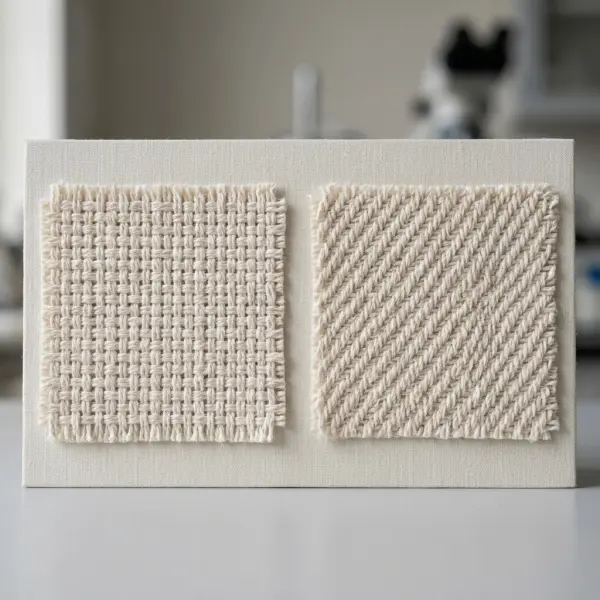
Plain weave typically creates a relatively regular, flat grid because warp and weft alternate frequently. The surface can still vary enormously—compare crisp poplin, sheer organza, rough canvas, and chambray—but the weave itself does not create a dominant diagonal line.
Twill does.
Its stepped interlacement creates a diagonal progression that can range from extremely subtle to highly visible.
That texture can become part of the product identity.
A pronounced cotton twill can support a casual or utilitarian aesthetic. Fine wool twills can create sophisticated surfaces for tailoring. Denim relies heavily on its twill architecture, especially when differently colored warp and filling yarns make the structure visually apparent.
Readers who need the construction fundamentals can refer to Twill Fabric Explained: Weave Structure, Texture, and Uses.
In product development, texture also affects color perception.
Because a warp-faced twill exposes more warp yarn on the surface, the face may visually emphasize one yarn system. Plain weave normally presents warp and weft more evenly because of its alternating structure, although differences in yarn size, color, density, and finishing can still create strong effects.
How Do Plain Weave and Twill Affect Wrinkling?
There is no reliable rule that says one weave will always wrinkle more than the other.
Wrinkle behavior involves how easily a textile deforms under compression and how effectively the fibers and yarns recover afterward.
Weave can contribute because yarn mobility and interlacement influence deformation. But fiber properties often have a major effect. Wool, cotton, polyester, viscose, and blends do not respond identically to bending, moisture, heat, and compression.
Finishing can change the result again.
A treated cotton plain weave may recover from creasing better than an untreated cotton twill. A wool twill may recover well because of the properties of the wool fiber itself. A lightweight cellulosic twill may crease visibly despite having a twill construction.
For fashion businesses, wrinkle resistance should therefore be treated as a fabric-level performance characteristic rather than a weave-level promise.
This distinction is especially important in product copy.
Describing a garment as “wrinkle resistant because it uses twill” can overstate what the textile structure actually guarantees.
Which Structure Handles Snagging and Yarn Movement Better?
Short floats generally leave less exposed yarn length on the surface.
That gives basic plain weave an inherent structural advantage against some forms of snagging, picking, and yarn displacement. CottonWorks specifically identifies plain weave as having relatively few problems with picking or snagging because of its high number of interlacements.
Twill uses longer floats.
As float length increases, larger sections of yarn remain exposed between crossover points. Depending on yarn and density, this can make them more vulnerable to catching.
Again, context matters.
A dense 3/1 denim is not normally considered a delicate snag-prone fabric simply because it contains longer floats than plain weave. Its substantial yarns and compact construction change the practical outcome.
By contrast, a fine twill woven from delicate filament yarns could behave very differently.
This is why the structural principle is useful, but the actual product must still be tested.
How Fabric Density Changes the Comparison
One reason direct weave comparisons become difficult is that changing the weave can also change how closely yarns can be packed.
Frequent plain-weave intersections constrain yarn placement. Longer floats in twill can allow different packing arrangements because individual yarns are not forced to bend around the opposing yarn system at every intersection.
This gives textile engineers additional freedom when designing dense twill fabrics.
But density is not simply a function of weave. Yarn diameter, twist, loom settings, desired weight, finishing shrinkage, and manufacturing limits all contribute.
Two fabrics labeled “100% cotton twill” may therefore have very different constructions.
One may be relatively open and soft. Another may be compact, heavy, and highly structured.
This becomes especially relevant when purchasing material from multiple suppliers. Matching fiber content and GSM does not necessarily reproduce the original fabric if yarn count, thread density, weave repeat, and finishing differ.
For brands trying to replicate an approved textile, a more complete technical specification reduces surprises.
Does Plain Weave Mean Lightweight and Twill Mean Heavyweight?
No.
Both structures can be engineered across different weight ranges.
Plain weave appears in extremely light fabrics as well as substantial materials such as canvas. Twill appears in lightweight fashion fabrics, medium-weight tailoring materials, and heavy denim or utility cloth.
The strong association between twill and heavier apparel comes partly from the fact that certain twill constructions work well for bottom-weight fabrics. CottonWorks identifies 3/1 twill as a structure used in heavier materials including denim, chino, and gabardine.
But weave and weight are separate specification dimensions.
A product developer should therefore distinguish:
weave — how the yarns interlace;
fabric weight — how much the fabric weighs per unit area;
thickness — the physical depth of the fabric;
density — how tightly yarns are packed;
handfeel — how the textile feels when handled;
stiffness or bending behavior — how readily it resists deformation.
These characteristics interact, but none can be substituted perfectly for another.
How Does Weave Choice Affect Garment Manufacturing?
Fabric selection does not end with appearance and performance. It also changes what happens on the cutting and sewing floor.
A stable plain weave can be straightforward to spread and cut when other characteristics are controlled. Its frequent interlacements tend to keep yarns well positioned.
Twill may introduce additional considerations.
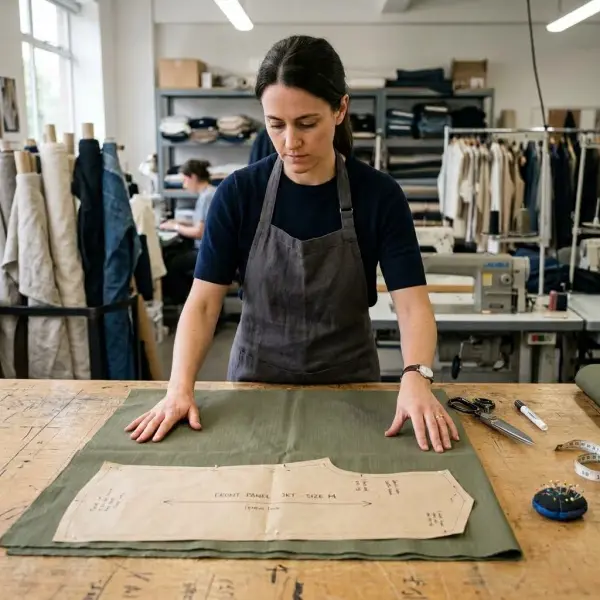
Visible diagonal lines can make panel orientation more noticeable. If pieces are rotated carelessly during marker planning, the twill direction can become inconsistent across a garment. This may be visually undesirable, particularly in fabrics with a strong directional appearance.
Depending on the material, twill can also behave differently under pressing, edge handling, topstitching, or garment washing.
None of this means twill is inherently difficult to manufacture. Jeans factories process enormous volumes of twill-based denim precisely because the production systems, machinery, patterns, and operator skills are designed around it.
Manufacturability depends on alignment between textile and factory capability.
For a small fashion brand, that makes sampling essential. A supplier swatch cannot reveal every issue that will appear once the textile is layered, cut, stitched, pressed, washed, and assembled into a three-dimensional garment.
Plain Weave and Twill in Real Apparel Categories
End use makes the structural differences easier to understand.
Shirts and lightweight tops
Many classic shirting materials use plain or plain-derived weaves because stability, smooth surfaces, relatively crisp handling, and predictable sewing can be useful.
Examples include broadcloth and many poplin constructions.
Twill shirtings also exist. They may be selected when designers want a softer surface, diagonal texture, or different drape.
Neither weave owns the category.
Trousers
Twill is particularly common in trousers because it can be engineered to combine surface coverage, body, drape, and practical mechanical performance across a wide range of weights.
Chino fabrics, denim, gabardine, and many tailored trouser materials use twill structures.
This application is covered in greater operational detail in Why Twill Fabrics Are Common in Workwear, Pants, and Jackets.
Dresses
Both structures can work.
A plain-weave cotton dress may feel crisp and architectural. A soft twill may create more fluid movement while retaining more body than some extremely lightweight constructions.
The silhouette should drive the decision.
Jackets
Structured fashion jackets can use either weave depending on the design.
Plain-weave fabrics may provide a clean, stable base. Twills can provide more visible surface interest, density, and different drape characteristics.
For tailored garments, interfacing, lining, pressing behavior, and pattern engineering can ultimately matter as much as the base weave.
How Fashion Businesses Should Choose Between Plain Weave and Twill
The decision should begin with garment requirements rather than fabric terminology.
A sourcing team should first define what the finished product must achieve.
For example, imagine a brand developing two pieces for the same collection: a crisp oversized shirt and a structured casual trouser.
Using the same fiber family does not mean the same weave is appropriate.
The shirt may benefit from a stable plain weave with a clean surface and enough body to hold its shape.
The trouser may benefit from twill if the development team wants stronger diagonal character, greater fabric density, controlled drape, or the performance profile associated with a suitable bottom-weight construction.
A practical evaluation should consider five areas.
1. Start with silhouette
Ask how the garment should behave on the body.
Should it stand away from the body, fall vertically, contour the figure, fold softly, or maintain a strong shape?
The answer narrows the useful fabric range quickly.
2. Define the real performance requirement
Avoid vague objectives such as “durable.”
Durable against what?
A children's garment may need excellent wash resistance. Work trousers may face abrasion and tearing. A dress may need dimensional stability and pilling control. A uniform may need repeated laundering and colorfastness.
Different performance problems require different tests.
3. Evaluate construction, not only composition
“100% cotton” does not describe a fabric sufficiently.
Review weave, yarn count where available, density, weight, stretch, finish, width, and test results.
This is particularly important when comparing supplier alternatives.
4. Make a garment sample
A fabric that performs beautifully as a swatch may disappoint once sewn.
Seams change stiffness. Interfacing changes body. Gathering changes drape. Washing alters dimensions. Topstitching influences edge behavior.
Prototype the textile in a representative garment before final bulk commitment whenever the scale and risk justify it.
5. Test according to commercial risk
Not every style requires an enormous laboratory program.
Testing should be proportionate to garment use, order size, customer expectations, buyer requirements, applicable regulations, and the consequences of failure.
The important point is to test the property you actually need rather than relying on weave reputation.
Common Mistakes When Comparing Twill and Plain Weave
Mistake 1: Saying twill is simply “stronger”
Strength is not one property.
A textile may perform well in tear testing but differently in tensile strength, abrasion, seam slippage, puncture, or flexing.
Calling an entire weave universally stronger hides the mechanism that actually matters.
The better approach is to define the expected stress and test accordingly.
Mistake 2: Assuming plain weave is always stiff
Plain weave has many interlacements, which can contribute to structural firmness when materials are otherwise comparable.
But a lightweight plain weave made from fine, flexible yarns can be extremely soft and fluid.
Voile and other lightweight constructions make this obvious.
Mistake 3: Choosing twill only because it looks more premium
A diagonal surface may support a particular aesthetic, but “premium” is not a technical property.
Customer perception also depends on fiber quality, color, finishing, garment construction, fit, stitching, trims, and overall product execution.
An inappropriate twill will not become premium simply because its weave is visually richer.
Mistake 4: Comparing fabrics with completely different specifications
If one textile is twice the weight of another and uses different fibers, yarns, density, and finishes, attributing all observed performance differences to weave is misleading.
For development purposes, comparison is most useful when major variables are controlled or at least clearly documented.
Mistake 5: Ignoring finishing
Finishing can significantly alter stiffness, softness, shrinkage, surface texture, wrinkle response, and dimensional behavior.
A heavily washed twill and an unfinished loom-state twill are not equivalent products even if their weave structures began identically.
What Brands Should Verify Before Making a Fabric Decision
A weave name is useful information, but it is only one line on the specification sheet.
Before substituting plain weave for twill—or twill for plain weave—confirm whether the change affects the properties that matter to the product.
|
Verification point |
Why it matters |
|
Fiber composition |
Strongly affects comfort, strength, moisture behavior, recovery and care |
|
Weave construction |
Changes interlacement, surface appearance and yarn mobility |
|
Fabric weight |
Influences body, opacity and garment suitability |
|
Yarn count and density |
Affect compactness, appearance and mechanical behavior |
|
Finish |
Can substantially alter softness, shrinkage and surface character |
|
Drape and stiffness |
Determine whether the fabric supports the intended silhouette |
|
Dimensional stability |
Helps control garment measurements after laundering |
|
Tear and tensile properties |
Address different forms of mechanical failure |
|
Abrasion or pilling |
Relevant for products exposed to repeated surface friction |
|
Seam behavior |
Important because fabric strength alone does not guarantee strong seams |
|
Bulk consistency |
Prevents production fabric from drifting too far from the approved sample |
The precise specification should reflect the end use.
A lightweight fashion shirt and industrial work trouser should not be evaluated against identical priorities simply because both use woven fabric.
FAQ: Twill vs Plain Weave
Is twill better than plain weave?
Neither weave is universally better. Plain weave provides frequent yarn interlacing and generally high structural stability, while twill uses longer floats and fewer intersections that can provide different drape, surface character, density, and tear behavior. The better option depends on the garment, fiber, yarn, fabric weight, finishing, manufacturing process, expected use, and required performance. Fashion teams should therefore specify the outcome they need before selecting the weave.
Which is more durable, twill or plain weave?
Durability cannot be determined reliably from weave name alone. Some heavy twills are highly durable because their weave is combined with strong yarns, substantial weight, high density, and suitable finishing. Plain-weave canvas can also be extremely robust. Depending on the product, durability may involve abrasion, tear strength, tensile strength, seam performance, pilling, colorfastness, or repeated laundering. The most useful approach is to identify the likely failure mode and test the actual fabric.
Why does twill usually show diagonal lines while plain weave does not?
Twill shifts its yarn intersections progressively across successive picks, producing a diagonal sequence through the fabric. Plain weave alternates warp and weft over one and under one in a regular grid, so it does not create the same diagonal progression. The visibility of a twill line still varies according to yarn size, color, density, weave repeat, and finishing.
Which weave is better for trousers?
Twill is widely used for trousers because suitable twill constructions can provide useful combinations of body, drape, density, surface coverage, and mechanical performance. Denim, chino cloth, drill, and gabardine are familiar examples. That does not make twill mandatory. A fashion trouser can use plain weave when the intended silhouette, weight, texture, and performance support it. The fabric should be selected around product requirements rather than category convention alone.
Is plain weave more breathable than twill?
Not automatically. Air permeability depends strongly on fabric density, yarn size, fiber, thickness, finishing, and how much open space exists within the construction. A lightweight open plain weave may allow considerable airflow, but a dense plain weave can be less permeable. Similarly, twill can be engineered at different densities. Weave contributes to the structure, but breathability should be evaluated from the complete fabric rather than predicted solely from the words “plain” or “twill.”
Does twill stretch more than plain weave?
Not necessarily. Ordinary woven twill and plain weave have limited true yarn-direction stretch unless stretch fibers, textured yarns, mechanical construction effects, or special finishing are introduced. A twill may feel more flexible because of its interlacement structure, but flexibility should not be confused with elastic stretch and recovery. If garment fit depends on stretch, brands should specify and test extension and recovery rather than relying on weave type.
Can the same yarn create both plain weave and twill fabric?
Yes. In principle, the same fiber and yarn system can be woven into different structures, including plain and twill, although practical production specifications such as density and loom settings may also change. Comparing fabrics made from similar yarns is one of the clearest ways to see how weave architecture changes appearance and behavior. In commercial sourcing, however, fabrics rarely differ by only one variable, so specifications should be reviewed carefully.
Conclusion
The difference between twill and plain weave begins with a simple structural choice: how often warp and weft yarns intersect.
Plain weave interlaces them frequently, creating a compact and generally stable woven architecture. Twill reduces the frequency of some intersections and uses progressively shifted floats, creating diagonal lines and giving textile designers a different balance of yarn mobility, density, surface character, drape, and mechanical behavior.
Those tendencies explain why the two weave families often appear in different apparel contexts.
They do not create a universal hierarchy.
A plain weave can be light, heavy, soft, rigid, refined, or rugged. So can a twill. Fiber, yarn, density, fabric weight, finishing, and garment engineering can change the final outcome substantially.
For fashion businesses, the strategic lesson is to stop asking whether twill or plain weave is “better” in the abstract.
Ask what the garment has to do.
Then choose the weave—and the complete fabric specification—that makes that performance realistic.





Comments 0
Leave a CommentSend Comment
Anda harus Login terlebih dahulu untuk dapat memberikan komentar.