
How Fit Problems Affect Customer Satisfaction in Apparel Products
Quick Answer
Fit problems affect customer satisfaction because they create a gap between what a customer expects from an apparel product and what the garment actually delivers in comfort, appearance, movement, and size consistency.
A garment may be beautifully designed and well sewn, yet still disappoint the customer if the waistband presses when sitting, the shoulder restricts movement, the hem falls at an unintended position, or the purchased size fits differently from previous products by the same brand. Online, this risk becomes greater because customers cannot physically assess the garment before ordering.
The commercial effects extend beyond one return. Poor fit can increase exchanges, customer-service contacts, negative reviews, size bracketing, markdown exposure, and hesitation during future purchases. Repeated inconsistency may weaken trust in the brand’s entire sizing system.
Not every fit complaint indicates a defective pattern. Body shape, posture, personal preference, styling intention, and product-page expectations also influence how fit is perceived. Brands therefore need more precise data than a generic “too small” or “did not fit” return code.
The most effective response combines sound pattern development, representative fitting, controlled grading, production measurement checks, clear fit communication, and structured analysis of returns and reviews.

What Is a Fit Problem in Apparel?
A fit problem is a mismatch between a garment’s dimensions, shape, balance, construction, or material behaviour and the wearer’s body, intended movement, fit preference, or reasonable product expectation.
This definition is broader than “the size was wrong.” A customer may select the most appropriate labelled size and still experience a fit problem because the garment does not accommodate their proportions.
For example:
- a shirt may fit the chest but remain too narrow across the shoulders;
- trousers may fit the hip but gap significantly at the waist;
- a jacket may look correct while standing but restrict forward arm movement;
- a dress may have sufficient circumference but insufficient front length over the bust;
- a stretch top may fit initially but lose shape during wear;
- two products carrying the same size label may have noticeably different finished dimensions.
Understanding these distinctions matters because each problem requires a different business response. A shoulder-width problem cannot necessarily be solved by recommending one size larger. A grading inconsistency cannot be corrected merely by rewriting the size chart. Fabric growth during wear requires a material or construction review rather than a new body-measurement table.
The technical foundations of size and fit should therefore remain separate. The ISO 8559-1 anthropometric measurement framework provides standardized descriptions for body measurements that can support population analysis, size profiles, and fit mannequins. It does not determine the final dimensions, ease, silhouette, or construction of an individual garment. Those remain product-development decisions.
Why Fit Problems Have Such a Strong Effect on Satisfaction
Fit is unusually personal. Colour, print, and styling can be judged from a photograph, but fit is experienced through the body.
The customer evaluates several outcomes at once:
- Does the garment feel comfortable?
- Does it create the expected silhouette?
- Can the wearer move normally?
- Does it stay in position?
- Does the size correspond with previous experience?
- Does the customer feel confident wearing it?
- Is the garment practical for its intended activity?
A weakness in one area can alter the perception of the whole product. A customer may describe a jacket as “poor quality” when the visible problem is actually sleeve pitch or shoulder balance. Trousers may be described as “cheap” because the side seams twist after washing. The customer’s language may not be technically precise, but the dissatisfaction is real.
This makes fit a bridge between objective product engineering and subjective customer experience. Measurements and construction can be tested, yet the final judgment still occurs on a diverse human body with individual preferences.
Fit Problems Can Begin Before the Purchase
Customer dissatisfaction does not always begin when the garment arrives. It can start while the customer is trying to decide which size to order.
Online shoppers must translate body measurements, product photographs, size charts, model information, fabric descriptions, and previous brand experience into a prediction: “Will this garment fit me in the way I expect?”
When those signals are unclear or contradictory, the customer faces fit uncertainty.
A product page may state that a dress has a “regular fit” but show it styled closely on one model. The general size chart may list body measurements, while the dress itself has limited room through the bust. The fabric may contain elastane, but the page does not explain whether the garment has slight comfort stretch or substantial extension.
The customer then has several options:
- delay the purchase;
- leave the site;
- contact customer service;
- order more than one size;
- choose a size based on guesswork;
- purchase while accepting a higher risk of return.
This uncertainty directly affects conversion. The customer is not merely evaluating whether the garment is attractive. They are evaluating the probability of avoidable inconvenience.
Research on fashion e-commerce has identified size and fit as major sources of online return difficulty, while a production-tested recommendation model described fit-related returns as harmful to customer experience and platform profitability. Its authors evaluated the system through large-scale experimentation across 14 countries, illustrating the commercial value of treating fit as a structured prediction problem rather than a generic product attribute.

The Main Ways Fit Problems Reduce Customer Satisfaction
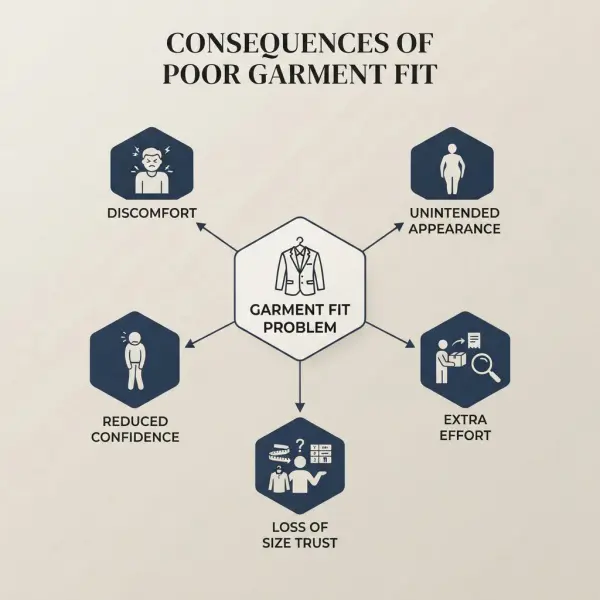
Physical Discomfort
Poor fit can create pressure, restriction, friction, instability, or excess fabric in areas where it interferes with movement.
Examples include:
- a waistband that feels acceptable when standing but presses when sitting;
- an armhole that cuts into the underarm;
- sleeves that restrict reaching;
- a trouser rise that pulls downward during movement;
- a neckline that shifts or gaps;
- a coat that does not accommodate the intended layers;
- seams that sit on sensitive areas;
- a loose garment that twists or requires continual adjustment.
Comfort should not be equated with looseness. A garment can be oversized and uncomfortable when its geometry is wrong. A close-fitting garment can be comfortable when the fabric, ease, seam construction, and pressure distribution are appropriate.
The customer usually experiences discomfort as a failure of the finished product, regardless of whether the root cause lies in pattern shape, material selection, sewing, shrinkage, grading, or incorrect size guidance.
An Unintended Appearance
Customers purchase fashion partly for the visual result. When the garment does not create the silhouette shown or described, dissatisfaction can appear even if the product technically closes and allows movement.
A fit problem may cause:
- horizontal or diagonal strain lines;
- unintended fabric pooling;
- side seams that swing forward;
- a front hem that rises;
- pockets that flare open;
- a collar that stands away from the neck;
- a waist seam that sits above or below its intended position;
- a dropped crotch that was not part of the design;
- an oversized shape that looks accidental rather than deliberate.
Appearance is especially sensitive to expectation. A customer who orders a relaxed shirt may accept generous volume but still reject sleeves that are disproportionately long. A fitted dress may be expected to follow the body, but visible pulling around the zipper can make the product look too small or poorly constructed.
Reduced Confidence in the Product
Clothing is worn publicly. A fit issue can therefore affect not only physical comfort but also the wearer’s confidence.
A customer may repeatedly check a gaping neckline, pull down a rising hem, cover a pulling button, or avoid certain movements. The product may remain technically wearable, yet the wearer does not feel secure enough to use it regularly.
This is an important distinction for brands. A retained product is not necessarily a successful product. Customers sometimes keep low-priced or inconvenient-to-return garments but rarely wear them. Such products may not appear in return data even though they failed to create satisfaction.
Greater Customer Effort
A fit problem shifts work from the business to the customer.
The customer may need to:
- remeasure their body;
- contact support;
- order another size;
- repack the garment;
- arrange a return;
- wait for a refund;
- visit a store;
- pay for alteration;
- search for another product.
Even when the return process works correctly, the original purchase has consumed more time than expected.
The service recovery can partly influence how the customer judges the retailer. Recent apparel-return research has examined how responsibility for a return and the quality of return handling affect later repurchase behaviour. The evidence supports treating returns not only as logistics events but also as customer-relationship events.
Loss of Trust in Size Consistency
One disappointing product may be attributed to a particular style. Repeated inconsistencies can change how the customer sees the entire brand.
A customer who reliably wears one size expects that information to reduce risk during the next purchase. Some variation between fitted, regular, relaxed, and oversized products is legitimate. The problem appears when the brand does not explain the variation or when similar products fit unpredictably.
Once trust is weakened, the customer may:
- check every measurement more carefully;
- order multiple sizes;
- avoid unfamiliar categories;
- wait for extensive reviews;
- purchase only in physical stores;
- switch to a brand with more predictable fit.
Consistency does not require identical garment measurements across the range. It requires a coherent relationship between size, silhouette, product category, and customer communication.
Not All Fit Problems Are the Same
A generic fit return code hides several technically different situations.
|
Fit-problem category |
Customer experience |
Likely business area to investigate |
|
Overall size mismatch |
Garment feels generally too small or too large |
Size recommendation, size chart, product measurements |
|
Shape or proportion mismatch |
One area fits while another does not |
Base block, target body profile, category-specific pattern |
|
Length mismatch |
Sleeves, torso, rise, inseam, or hem position feels unsuitable |
Stature assumptions, length options, grading |
|
Ease distribution problem |
Total circumference appears sufficient, but movement or balance is poor |
Pattern geometry, armhole, crotch, darts, front-to-back distribution |
|
Material behaviour problem |
Garment grows, shrinks, binds, or loses shape |
Fabric testing, relaxation, shrinkage, stretch and recovery |
|
Production inconsistency |
Units of the same style or size fit differently |
Cutting, sewing, finishing, measurement tolerances |
|
Expectation mismatch |
Product fits as designed but differently from what the customer expected |
Photography, styling, fit description, model and garment information |
|
Preference mismatch |
Customer prefers a closer or looser result |
Fit guidance and recommendation logic |
|
Functional mismatch |
Garment does not support the intended activity or layering |
Product brief, mobility testing, category requirements |
This distinction helps prevent overcorrection.
If many customers say a shirt is “too small,” the brand should not immediately increase every measurement. The problem may be concentrated in the upper arm, shoulder, or front length. Adding width to the entire body could solve one complaint while creating a loose neckline, excessive back volume, and wider-than-intended hem.
Likewise, if customers repeatedly describe trousers as “too large,” the actual issue may be waist gaping over an otherwise appropriate hip. Reducing the whole size would make the hip and thigh less suitable.
Size Mismatch and Shape Mismatch Require Different Responses
A size mismatch occurs when the customer would probably obtain a better result by moving to another size within the same product.
A shape mismatch occurs when the garment’s proportions do not align well with the customer’s proportions, even if a different size is selected.
This is one of the most important distinctions in fit analysis.
Suppose a customer finds a blouse tight across the bust but correct at the shoulder and waist. Sizing up may provide more bust circumference, but it may also create dropped shoulders, longer sleeves, and excess waist volume. The customer does not necessarily need a larger version of the same shape. They may need a different bust distribution or block.
For the business, the possible responses differ:
- Size mismatch: improve recommendation, measurement clarity, or stock availability.
- Shape mismatch: review the pattern block, target body profile, fit options, or product positioning.
- Preference mismatch: explain whether the style is fitted, regular, relaxed, or oversized.
- Production mismatch: investigate measurement and manufacturing variation.
A brand that classifies every problem as “wrong size ordered” transfers too much responsibility to the customer and loses useful product-development information.
Static Fit Can Hide Dynamic Dissatisfaction
Product photography and fitting-room mirrors show static fit. Customers live in garments dynamically.
A jacket may look smooth while the arms rest at the sides but pull sharply when the wearer drives. A skirt may appear appropriate while standing yet ride upward during walking. Trousers may look balanced but become uncomfortable after sitting for an hour.
Dynamic fit depends on intended use. Relevant tests may include:
- sitting and standing;
- reaching forward or overhead;
- walking and climbing stairs;
- bending or squatting;
- fastening and unfastening the garment;
- placing objects in pockets;
- wearing normal underlayers;
- performing category-specific movements.
A 2024 study of professional apparel fit sessions found that fit models provided tactile, comfort, movement, and placement feedback while standing and changing posture. The researchers emphasized that human fit models contribute information that remains difficult to reproduce completely through current digital simulation, especially around tactile sensation and lived comfort.
For customers, this means a garment can pass a size check and still fail during actual use. For brands, it means fit approval should include movement rather than rely only on photographs and point-of-measurement specifications.
How Fit Problems Affect Returns and Exchanges
A return is one possible expression of dissatisfaction, but it is not the only one.
Customers may also:
- exchange for another size;
- keep the garment but wear it rarely;
- alter the garment;
- give it away;
- resell it;
- leave a negative review;
- avoid purchasing from the brand again.
Return data therefore captures only part of the experience.
When a fit-related return does occur, the operational impact extends beyond refunding the selling price. The item may need to be transported, received, inspected, repackaged, steamed, relabelled, repaired, discounted, or removed from sale. During processing, the size may be unavailable to another customer. Seasonal or trend-sensitive inventory can also lose relevance while it moves through the reverse-logistics process.
Returns-management research describes product returns as a recurring operational process involving registration, inspection, potential refurbishment, restocking, and decisions about resale or disposal. It also identifies economic, customer-service, and environmental consequences, although the scale varies substantially by retailer, market, product value, and fulfilment model.
The more useful business question is therefore not simply, “What is our return rate?” It is:
Which fit problems generate avoidable returns, for which customers, in which products, and at what operational cost?
Why Online Apparel Is Especially Sensitive to Fit Problems
In a physical store, the customer can try a garment, compare sizes, feel the fabric, move, and ask for assistance before purchasing.
Online, most of that evaluation occurs after delivery.
The product page has to carry more of the decision-making burden through:
- accurate body-size guidance;
- useful garment measurements;
- clear silhouette descriptions;
- model measurements and worn size;
- fabric stretch and structure information;
- front, side, and back views;
- category-specific fit notes;
- customer reviews;
- size recommendation where appropriate.
When this information is incomplete, customers may use bracketing—ordering multiple sizes or variants with the intention of keeping only the most suitable one. Bracketing can reduce the customer’s pre-purchase risk but increases handling, inventory, and return activity for the retailer.
The problem is not solved by adding more information indiscriminately. A page containing a long generic size chart, ten marketing phrases, and no product-specific measurements may still leave the essential question unanswered.
The best fit communication tells the customer what is distinctive about this garment.
Product-Specific Fit Information Is More Useful Than Generic Labels
Terms such as “regular fit,” “slim fit,” and “oversized” are useful only when they are applied consistently and supported by visual or measurement context.
A stronger product page might explain:
- designed close through the shoulder and loose through the body;
- high-rise waist with a relaxed thigh;
- non-stretch woven fabric;
- cropped body length;
- intended to fit over a lightweight knit;
- customers between sizes may prefer the larger size for upper-arm room.
These statements reduce ambiguity because they explain where and how the garment fits.

Negative Fit Reviews Can Influence More Than One Product
Fit reviews serve two audiences: the business and future customers.
A review stating “too small” gives limited diagnostic value. A review stating “waist fits, but the upper thigh is tight and the rise becomes uncomfortable when sitting” is much more useful.
Fine-grained review analysis can identify recurring concerns that aggregate sentiment scores miss. Research published through Springer demonstrated that customer reviews can be analysed for both broad labels such as “too big” and specific issues such as short jean length or looseness in a sleeve area.
These comments can affect future purchasing in several ways.
A potential customer may:
- choose a different size;
- decide the garment suits another body shape;
- abandon the product;
- question the accuracy of the brand’s size chart;
- search for more reviews;
- avoid buying a similar style.
A cluster of fit complaints can therefore reduce conversion even among shoppers who never purchase or return the item.
Brands should not hide or dismiss this feedback. They should translate it into clearer guidance and, where evidence is strong, product correction.
Fit Problems Can Distort Inventory Decisions
Fit issues do not remain inside customer-service reports. They can change sales and inventory signals.
A style may show high initial demand because the design is attractive, followed by a wave of exchanges. One size may sell out because customers are sizing up to compensate for a narrow shoulder or short rise. Another size may appear slow-moving because customers who would normally choose it have learned to order differently.
Without fit context, the merchandising team might conclude that:
- the size curve was forecast incorrectly;
- larger or smaller customers are more numerous than expected;
- the style itself is losing demand;
- a particular colour or market is underperforming.
The actual cause may be a product-specific fit bias.
For this reason, size-level sales should be analysed with:
- exchange direction;
- return reason;
- customer comments;
- garment measurements;
- production batch;
- region and channel;
- repeat-purchase behaviour;
- availability at the time of purchase.
Sales alone show what customers ordered. They do not always show what customers wanted to keep.
How Fit Problems Affect Perceived Quality
Customers do not separate pattern engineering, textile performance, grading, sewing, and finishing as neatly as an apparel technical team does.
They evaluate the complete garment.
A twisting leg may be perceived as poor sewing, even if fabric spirality contributed to the issue. A collar that sits away from the neck may be called “cheap,” although the visible result could stem from pattern shape, fusing, sewing, or pressing. A garment that becomes loose during wear may be interpreted as low quality, even if it initially matched its specification.
Fit therefore influences perceived quality through several visible cues:
- garment balance;
- seam position;
- smoothness of set;
- stability during wear;
- consistency with the product image;
- symmetry where intended;
- maintenance of silhouette after laundering;
- ease of dressing and movement.
This does not mean every wrinkle or relaxed area is a defect. Linen, draped fabrics, oversized styling, and washed finishes naturally create visual irregularity. The issue is whether the result aligns with the design and customer expectation.
How Fit Problems Affect Repeat Purchase and Loyalty
A customer who finds a reliable fit has gained valuable knowledge. They know which size to choose, how the garment feels, and whether the brand accommodates their proportions.
That knowledge lowers the perceived risk of future purchases.
A fit failure does the opposite. It turns previous experience into an unreliable guide.
The effect on loyalty depends on several conditions:
- Was the problem limited to one unusual style?
- Was the product description accurate?
- Did customer service provide useful guidance?
- Was the exchange easy?
- Did the replacement solve the problem?
- Has the customer experienced similar inconsistency before?
- Does the brand acknowledge the issue?
A single fit problem does not necessarily end the relationship. A customer may remain satisfied when the retailer resolves the issue fairly and efficiently. Repeated unexplained inconsistencies are more damaging because they remove the practical reason to return to the brand.
Customer satisfaction is not created by generous return policies alone. The customer still prefers to receive a suitable garment the first time.
How Fashion Businesses Should Diagnose Fit Problems
Build a More Precise Return-Reason Taxonomy
Return forms often use categories such as:
- too small;
- too large;
- did not fit;
- did not like;
- not as expected.
These categories are convenient for reporting but weak for technical diagnosis.
A stronger system captures the body area and type of problem:
- shoulder too narrow or wide;
- sleeve too short or long;
- upper arm too tight;
- bust or chest too tight;
- waist too tight or loose;
- hip or seat too tight;
- thigh too narrow;
- rise too short or long;
- inseam too short or long;
- neckline gaping;
- restricted movement;
- garment twists or shifts;
- fabric grows during wear;
- fit differs from description;
- fit differs from previous products.
The customer should not be forced through an exhausting questionnaire. A concise first-level reason can be followed by one optional body-area question.
Separate Product Failure From Preference
A close-fitting product may be technically correct but unsuitable for a customer who prefers more ease. An oversized product may match the design but disappoint someone who expected a conventional fit.
Preference data still matters. It can improve recommendations and communication. It should not automatically be treated as proof of a pattern defect.
A useful classification distinguishes:
- technical fit issue;
- size recommendation issue;
- personal fit preference;
- product-description mismatch;
- production inconsistency;
- material-performance issue;
- customer measurement or ordering error;
- insufficient size availability.
The purpose is not to assign blame. It is to identify the correct intervention.
Analyse Problems by Style and Body Area
Aggregate return rates can hide severe local problems.
A brand should review fit feedback by:
- style;
- category;
- size;
- colour or material where construction differs;
- production batch;
- supplier;
- market;
- sales channel;
- customer segment where responsibly available;
- body area;
- exchange direction.
A repeated upper-arm complaint in one blouse requires a different response from a general increase in returns across the entire category.
Compare Returns With Garment Measurements
Before changing a pattern, confirm whether returned or retained production units match the approved specification.
A fit complaint may originate from:
- incorrect pattern geometry;
- incorrect grading;
- fabric shrinkage;
- cutting variation;
- sewing tension;
- excessive seam consumption;
- finishing;
- measurement outside tolerance;
- an inaccurate size chart;
- customer expectation.
If the bulk garment does not match the approved measurements, redesigning the base block would treat the wrong cause.
Read Review Language as Product Data
Reviews should be coded beyond positive and negative sentiment.
Useful variables include:
- body area mentioned;
- direction of mismatch;
- movement involved;
- comparison with another brand or previous style;
- fabric behaviour;
- customer’s selected and exchanged size;
- whether the customer kept the product;
- whether alteration was required.
Review analysis can reveal dissatisfaction that return forms do not capture, including garments that were kept but rarely worn.

A Practical Fit Improvement Framework
1. Define the Intended Fit Clearly
Every product should have an internal fit brief covering:
- target wearer;
- base size;
- intended silhouette;
- critical body regions;
- wearing and design ease;
- layering;
- movement;
- fabric behaviour;
- key points of measurement;
- expected visual lines.
The fit brief gives design, technical development, sourcing, merchandising, and e-commerce teams the same reference.
2. Use Representative Body Data and Fit Models
Body-measurement standards provide terminology and structure, but brands still need data relevant to their own market. The target customer may differ from the population represented by an inherited size chart or supplier block.
Fit models should align as closely as practical with the intended base-size profile. One model cannot represent the full customer base, so critical products and extended sizes may require additional validation.
The role of the fit model is not simply to stand still while measurements are checked. Professional fit assessment includes movement, tactile feedback, functional placement, and comparison with earlier samples.
3. Validate Grading Across the Range
A good base-size sample does not prove that all sizes fit correctly.
Grade rules should be reviewed where body proportions and product geometry do not scale uniformly, including:
- shoulders;
- neckline;
- armhole depth;
- bust or chest shaping;
- waist-to-hip relationship;
- rise;
- crotch extension;
- pocket position;
- garment and sleeve length.
Critical edge sizes should be sampled, virtually assessed, or physically tested according to product complexity and commercial risk.
4. Test Production-Representative Materials
Fit should be approved in fabric that reflects the production material’s weight, drape, thickness, stretch, recovery, and shrinkage.
A substitute fabric may make the sample appear suitable while hiding a later problem. A soft prototype fabric may collapse more easily than the approved cloth. A high-recovery test knit may perform better than the bulk fabric. A washed product may change dimensions after the fitting session.
Material approval and fit approval should not operate as isolated workflows.
5. Protect Fit During Manufacturing
Production quality control should verify more than a few circumference measurements.
Relevant checks include:
- fabric relaxation;
- cutting accuracy;
- panel symmetry;
- seam placement;
- shrinkage;
- washing and finishing;
- garment balance;
- critical lengths;
- stretch recovery;
- measurement distribution across the batch.
A pattern can be correct while production units become inconsistent.
6. Improve Product-Specific Communication
The customer needs enough information to predict the garment, not a technical specification sheet copied onto the product page.
High-value information includes:
- how the style fits in specific body areas;
- garment measurements at decision-critical points;
- model measurements and worn size;
- fabric stretch and structure;
- intended layering;
- product length;
- comparison with familiar brand fits;
- advice for customers between sizes.
The underlying concept is explained more fully in garment fit and why good fit matters.
7. Use Fit Technology With Appropriate Expectations
Size recommendation, body scanning, virtual try-on, review analysis, and machine-learning systems can reduce uncertainty when their data and assumptions are suitable.
They do not remove the need for:
- accurate product measurements;
- reliable body inputs;
- consistent size architecture;
- representative training data;
- material understanding;
- physical validation;
- clear privacy practices.
A recommendation system can select the most likely size from those available. It cannot create a suitable shape when none of the available sizes fits the customer well.
The same limitation applies to AR virtual try-on technology in fashion retail. Visualization can improve confidence, but visual appearance alone may not fully represent pressure, tactile comfort, or dynamic movement.
8. Provide Practical Resolution Options
Depending on product category and business model, brands may offer:
- straightforward exchanges;
- alternative length options;
- petite, tall, or proportion-specific fits;
- adjustable design features;
- alteration support;
- in-store fitting;
- fit consultation;
- clearer alternative-style recommendations.
Alteration is useful when the garment is fundamentally suitable and the mismatch is local. The feasibility of specific adjustments is covered in common clothing alterations that improve comfort and appearance.
9. Create a Closed Feedback Loop
Fit data should flow from customers back to:
- technical design;
- pattern making;
- sourcing;
- quality assurance;
- merchandising;
- e-commerce;
- customer service;
- inventory planning.
The loop should distinguish immediate corrections from longer-term block changes.
One product page may need a new fit note immediately. A pattern revision may be appropriate for the next production run. A new base block requires stronger evidence across several styles and customer groups.





Comments 0
Leave a CommentSend Comment
Anda harus Login terlebih dahulu untuk dapat memberikan komentar.