

Fashion Export Readiness Explained for Growing Apparel Brands
Quick Answer
Fashion export readiness is a brand’s ability to sell and deliver apparel across borders consistently, profitably, and in compliance with the requirements of its target market. It covers far more than finding an overseas buyer or arranging international shipping. A genuinely export-ready fashion business needs products suited to the destination market, reliable production capacity, controlled quality, accurate costing, compliant labelling, traceable documentation, workable payment terms, and a clear process for handling delays, claims, or repeat orders.
For growing apparel brands, readiness is best understood as an operating capability rather than a one-time administrative milestone. A company may successfully send samples abroad yet remain unprepared for a commercial order involving hundreds of units, multiple size runs, strict delivery windows, destination-specific labelling, or a buyer inspection.
The most practical test is simple: can the business reproduce the agreed product, margin, documentation, and delivery performance when the order becomes larger or more frequent? If the answer depends heavily on last-minute problem-solving, the brand has export potential, but its export system is not yet mature.

What Is Fashion Export Readiness?
Fashion export readiness is an organizational capability that enables an apparel business to meet the commercial, operational, regulatory, financial, and logistical requirements of selling products in foreign markets.
The phrase is sometimes interpreted too narrowly. Registering as an exporter, obtaining a customs document, or opening an account on an international marketplace may be necessary in certain situations, but none of these actions proves that a brand can fulfil export orders reliably.
Export readiness sits at the intersection of several business functions:
- Market selection and commercial positioning
- Product development and technical specifications
- Manufacturing and quality assurance
- Product safety, composition, and labelling compliance
- Export costing and working-capital management
- Customs classification and shipping documentation
- Buyer communication and contract management
- Risk control and post-shipment support
A weakness in one area can undermine otherwise strong performance. A well-designed collection may fail commercially because its landed price is uncompetitive. A manufacturer may produce excellent garments but lose buyer confidence through inconsistent documentation. A brand may receive substantial interest from overseas retailers yet struggle because its production partners cannot repeat approved measurements across a larger order.
This is why export readiness should be evaluated as a system.
Export Potential and Export Readiness Are Not the Same
Export potential means that a product or brand appears capable of attracting demand outside its domestic market. Export readiness means that the business can convert that potential into controlled commercial execution.
A contemporary modest-wear label, for example, may receive enquiries from customers in several countries through social media. The designs may have international appeal, and the brand may already ship individual parcels abroad. That demonstrates market interest, but it does not automatically establish readiness for wholesale export.
A wholesale buyer may require the brand to provide:
- A consistent size specification and grading system
- Product composition and care information
- Wholesale and recommended retail prices
- Minimum order quantities
- Production lead times
- Packaging and carton specifications
- Country-of-origin information
- Commercial invoices and packing lists
- Agreed defect and claims procedures
These requirements change the nature of the transaction. The brand is no longer simply fulfilling individual online orders. It is committing to a repeatable business-to-business supply arrangement.
The distinction matters because many small brands enter export conversations through opportunity rather than preparation. A buyer appears, the team agrees to a price, and operational questions are addressed only after the purchase order arrives. That approach can work for a small trial, but it becomes increasingly risky as order value and buyer expectations rise.
Why Export Readiness Becomes More Important as a Brand Grows
Growth exposes inconsistencies that are easy to hide at a small scale.
When a brand makes 30 garments, a founder may personally check every piece, correct packaging errors, contact the workshop, and explain delays directly to customers. When an overseas buyer orders 1,000 units across several styles, colours, and sizes, the same informal control system is unlikely to be sufficient.
Export transactions also introduce variables that domestic sales may not involve:
- Longer transport distances and less flexible delivery schedules
- Customs classification and import procedures
- Destination-market product rules
- Currency exposure
- Freight, insurance, duty, and brokerage costs
- Formal purchase orders and contractual specifications
- Greater consequences when delivery or quality fails
International trade procedures are partly structured around the Harmonized System, an international product nomenclature maintained by the World Customs Organization. The system uses internationally standardized six-digit classifications as the basis for customs tariffs and trade statistics, although individual countries may extend those codes with additional digits. Apparel classification can depend on factors such as garment type, fibre composition, construction, gender category, and intended use. World Customs Organization explanation of the Harmonized System
Incorrect classification does not necessarily mean that a shipment will fail, but it can lead to incorrect duties, documentation queries, clearance delays, or disputes over who bears the additional cost. Classification should therefore be verified for the actual product and destination rather than copied from a superficially similar garment.
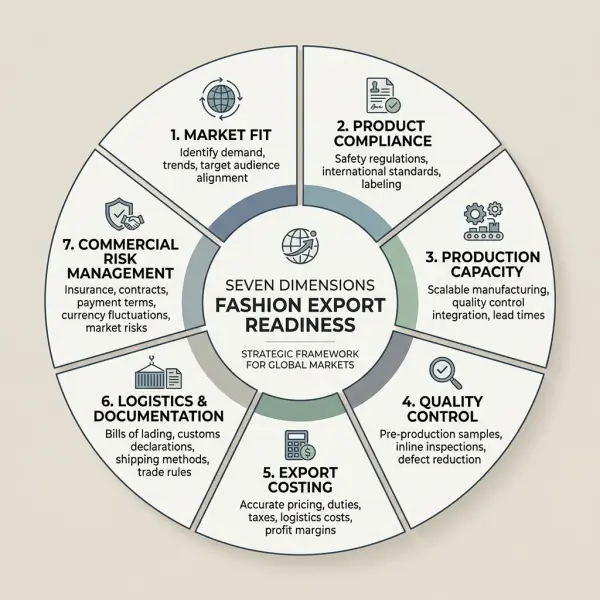
The Seven Dimensions of Fashion Export Readiness
A growing apparel brand does not need to become perfect in every area before testing international demand. It does, however, need enough control to understand where its risks are and how those risks will be managed.
The following seven dimensions provide a practical framework.
1. Market and Channel Readiness
An export-ready brand has a defined reason for entering a particular market. “International expansion” is too broad to guide product, pricing, or operational decisions.
The brand should understand who is expected to purchase the product, through which channel, and under what commercial model. Selling directly to consumers through cross-border e-commerce creates different requirements from supplying a department store, independent boutique, distributor, sourcing agent, or private-label client.
Channel choice affects almost every subsequent decision. A wholesale retailer may expect seasonal line sheets, standard margin structures, delivery windows, and stock availability. A distributor may seek territorial rights or volume discounts. A direct-to-consumer model gives the brand more pricing control but may require stronger capabilities in fulfilment, returns, customer service, taxation, and digital acquisition.
Market readiness also requires evidence that the assortment fits local demand. This does not mean redesigning everything to imitate the destination market. It means checking whether the current offer makes commercial sense in relation to climate, size expectations, styling preferences, price levels, seasonal calendars, and competing products.
A useful export hypothesis should identify:
- The target customer
- The destination country or regional market
- The intended sales channel
- The initial product category
- The expected retail and wholesale price range
- The reason the product may be differentiated
This hypothesis should then be tested with buyer conversations, marketplace data, small campaigns, samples, or pilot orders before the brand commits to a large collection.
A more detailed operational checklist belongs in what fashion businesses should prepare before entering global markets. At this stage, the priority is to establish that the market choice is deliberate rather than opportunistic.

2. Product and Compliance Readiness
A garment that can legally and commercially be sold in one country may require different labelling, warnings, documentation, or product information in another.
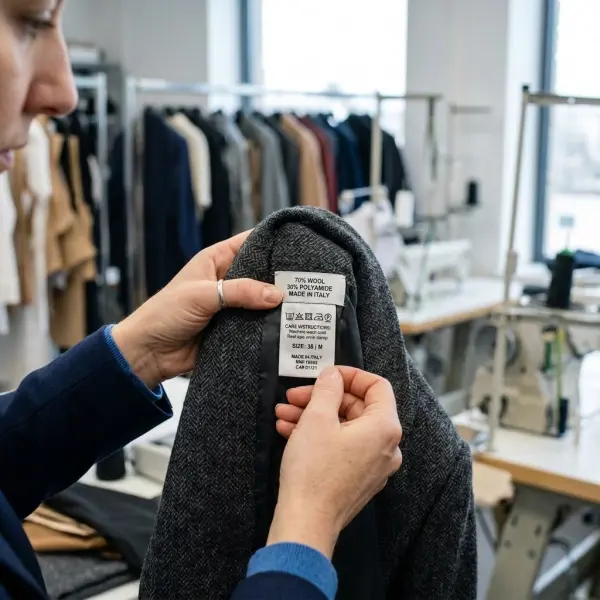
For textile products sold in the European Union, for example, Regulation (EU) No 1007/2011 establishes requirements concerning textile fibre names and fibre-composition labelling. Multi-fibre textile products generally need to identify constituent fibres by name and percentage by weight in descending order, while required information must be durable, legible, visible, accessible, and presented in the appropriate language of the market. EU rules on textile fibre names and labelling
In the United States, the Federal Trade Commission’s Textile Fiber Rule requires covered textile products to disclose information including generic fibre names, fibre percentages by weight, the manufacturer or marketer identity, and the country where the product was processed or manufactured. Other rules may apply to wool, fur, care instructions, children’s products, or specific product claims. FTC Textile Fiber Rule
These examples should not be treated as a universal compliance checklist. Requirements vary by destination, product category, material composition, age group, sales channel, and the role of each economic operator.
An export-ready product system should be able to produce reliable information about:
- Fibre composition
- Country of origin
- Size and measurement standards
- Care instructions
- Trims, coatings, embellishments, or animal-origin components
- Product safety considerations
- Test reports or certifications when required
- Supplier and manufacturing records
- Claims made in product descriptions or marketing
The International Trade Centre notes that exporters need current information about both mandatory technical requirements and voluntary buyer requirements in target markets. Businesses must then adapt their products or processes and, where necessary, demonstrate conformity through appropriate testing or assessment. ITC guide to export quality management
The key editorial judgment is straightforward: certification should follow a defined requirement. A small brand should not pay for multiple certificates merely because they sound internationally credible. It should first determine what the law, buyer, platform, or product category actually requires and whether the testing body will be accepted in the destination market.
3. Production and Quality Readiness
Export quality is not simply “good workmanship.” It is conformity to an agreed specification.
A garment can look attractive yet still fail an inspection because its measurements exceed tolerance, the approved colour is inconsistent, a trim has been substituted, seam construction differs from the sample, or the packing ratio does not match the purchase order.
For this reason, an export-ready brand should translate design intent into controlled production information. Depending on the product and business model, that may include:
- Technical drawings
- Bill of materials
- Fabric and trim specifications
- Measurement charts
- Grading rules
- Construction details
- Colour standards
- Labelling placement
- Packaging instructions
- Acceptable tolerances
- Sample approval records
A tech pack alone does not guarantee quality. The factory, workshop, or production team must understand it, use the latest approved version, and have a process for resolving discrepancies before bulk production continues.
The brand should also know its realistic capacity. Stated capacity and dependable capacity are not always the same. A workshop may technically sew 2,000 units per month, but that number becomes less useful if capacity is shared with other clients, fabric arrives late, specialist machines are limited, or quality falls when overtime increases.
Production readiness therefore requires answers to practical questions:
- How many units can be completed without compromising current domestic orders?
- Which operations create bottlenecks?
- How quickly can defects be reworked?
- Is there an approved alternative for critical materials?
- Who authorizes substitutions?
- How are in-line and final inspections documented?
- Can production records be traced back to a specific order or batch?
This is closely connected to apparel quality control systems. For export purposes, the goal is not to eliminate every possible defect. It is to establish measurable specifications, detect variation early, and prevent unacceptable goods from reaching the buyer.
4. Costing and Financial Readiness
Domestic product costing is rarely sufficient for an export quotation.
The export selling price may need to account for additional packaging, testing, labelling, documentation, inland transport, freight, insurance, customs handling, commissions, payment fees, currency movement, inspection costs, and potential claims. Which costs belong to the seller depends partly on the commercial agreement and selected delivery term.
The International Chamber of Commerce’s Incoterms® 2020 rules define important obligations, risks, and cost responsibilities between buyers and sellers under contracts for the sale of goods. They do not, by themselves, determine ownership, payment timing, product specifications, or remedies for breach, so those matters still need to be addressed in the commercial contract. official ICC Incoterms 2020 overview
A quoted price should therefore identify the Incoterms rule and named place clearly—for example, “FCA [named location], Incoterms® 2020”—rather than using an informal statement such as “shipping included.”
Export readiness also depends on working capital. A profitable order can still create financial pressure when the business must pay deposits for fabric, trims, labour, testing, and packaging weeks or months before receiving the buyer’s final payment.
Consider a simplified example. A buyer places a large order with a 30% deposit and the remaining balance payable after shipment. The deposit may not cover the brand’s full production outlay. If suppliers require immediate payment while the buyer has negotiated longer terms, the brand carries the financing gap.
Before accepting the order, the company should model:
- Total production cash requirement
- Timing of supplier payments
- Buyer deposit and balance dates
- Freight and clearance responsibilities
- Currency used in the contract
- Expected gross margin after export-related costs
- Financial effect of delay, rejection, or partial payment
A lower international wholesale price is not automatically attractive simply because the order is large. Volume can amplify losses just as effectively as it amplifies profit.

5. Customs, Documentation, and Logistics Readiness
Export documentation needs consistency. Product descriptions, quantities, values, weights, country-of-origin information, purchase-order references, and shipping terms should align across the relevant documents.
The exact document set varies by transaction, destination, product, transport mode, and trade agreement. Common documents may include:
- Commercial invoice
- Packing list
- Transport document
- Export declaration
- Certificate of origin when required
- Preference documentation where applicable
- Insurance certificate
- Inspection or test documentation
- Product-specific permits or declarations
The presence of a document does not prove that it is accurate. A packing list can be professionally formatted yet still cause problems if carton quantities do not match the physical shipment. Similarly, a certificate of origin should not be confused with qualification for preferential tariffs. Preferential treatment depends on the applicable trade agreement and its specific rules of origin.
Logistics readiness also means selecting a shipping method that fits the commercial promise. Air freight may support urgent or low-volume orders but can erode margin. Sea freight may be more economical for larger shipments but requires earlier planning and greater tolerance for transit variability. Courier services may be practical for samples or small direct-to-consumer parcels but may not suit every commercial shipment.
The brand should establish clear ownership for:
- Booking transport
- Preparing documents
- Confirming carton dimensions and weights
- Coordinating pickup
- Checking customs status
- Communicating delays
- Retaining proof of shipment
- Resolving shortages, damage, or delivery discrepancies
A freight forwarder or customs broker can provide specialist assistance, but outsourcing the task does not remove the exporter’s responsibility to supply correct product and transaction information.
6. Commercial and Buyer-Service Readiness
Export relationships depend heavily on clarity.
A buyer needs to know what the brand is offering, what is included in the price, when the goods will be ready, what quality standard applies, how changes will be approved, and what happens if something goes wrong.
This requires more than conversational fluency. It requires a disciplined commercial process.
An export-ready sales file may include:
- Brand and company profile
- Product catalogue or line sheet
- Wholesale price list
- Minimum order quantities
- Size and colour availability
- Production lead times
- Sample policy
- Payment terms
- Delivery terms
- Quality and claims policy
- Relevant test or certification information
These materials should reflect actual operational capability. Publishing a four-week lead time because it appears competitive is risky when the business normally needs six weeks before export packing and inspection are included.
Communication records also matter. Changes to fabric, colour, quantity, labelling, delivery date, or packaging should be documented rather than confirmed only through fragmented chat messages. A simple approval log can prevent expensive disagreements later.
The strongest buyer service is not constant agreement. It is early, precise communication. An exporter who identifies a production issue quickly and offers realistic options is generally in a stronger position than one who remains silent until the shipping deadline has passed.
7. Risk Management and Scalability Readiness
Export readiness includes the ability to absorb disruption without losing control of the entire business.
The risks are not limited to damaged cargo. They may include:
- Buyer cancellation
- Late payment
- Currency movement
- Material shortage
- Production delay
- Failed inspection
- Incorrect documentation
- Regulatory non-compliance
- Intellectual-property disputes
- Excess inventory after an order change
- Dependence on one overseas customer
Not every risk can or should be insured. Some are better managed through deposits, contract terms, buyer verification, production milestones, documented approvals, backup suppliers, or conservative order acceptance.
Scalability is equally important. A brand may fulfil one export order by relying on extraordinary effort from the founder and production team. That is evidence of commitment, not necessarily evidence of a scalable system.
A repeatable model should reduce dependence on memory and informal intervention. It should define who approves samples, who checks documentation, who communicates with the buyer, who releases goods for shipment, and where records are stored.
What Does Export Readiness Mean in Practice?
The following table converts the concept into observable business evidence.
|
Readiness area |
Early-stage condition |
More export-ready condition |
|
Market |
General interest from overseas followers |
Defined market, channel, customer, and tested offer |
|
Product |
Designs and samples are available |
Product specifications, labels, claims, and requirements are verified |
|
Production |
Orders depend on informal workshop coordination |
Capacity, critical path, approvals, and production records are controlled |
|
Quality |
Founder visually checks finished garments |
Measurable standards, tolerances, inspections, and defect procedures are documented |
|
Costing |
Domestic cost plus estimated shipping |
Full export cost, margin, cash-flow timing, and delivery responsibilities are modelled |
|
Documentation |
Documents are prepared when requested |
Standard templates, verified data, responsible staff, and record retention are established |
|
Buyer management |
Terms are discussed mainly through chat |
Purchase orders, changes, approvals, payment terms, and claims processes are recorded |
|
Scale |
One order can be completed with intensive effort |
The process can be repeated without destabilizing domestic operations |
Readiness is not binary. A brand may be strong in product development but weak in finance, or experienced in production but unfamiliar with destination-market rules. The purpose of assessment is to identify the constraint that could cause the greatest commercial damage.
How Can a Fashion Brand Assess Its Export Readiness?
A useful assessment begins with evidence rather than confidence.
Instead of asking, “Are we ready to export?” the management team should test specific scenarios:
- Can the team produce an accurate quotation for a defined product, quantity, destination, and delivery term?
- Can it identify the technical and labelling requirements relevant to that product?
- Can production reproduce the approved sample within agreed tolerances?
- Can the business finance the order under the proposed payment schedule?
- Can all shipment data be traced to reliable source records?
- Can the team explain how defects, delays, changes, and claims will be handled?
- Can the order be fulfilled without disrupting existing customers?
The answers should be supported by documents, calculations, process records, or test results.
A brand that says “our workshop can handle it” should be able to show capacity assumptions. A company that says “the product meets international standards” should specify which requirement, standard, test, or buyer protocol it means. A team that says “shipping is included” should know which party bears each cost and when the risk transfers.
This evidence-based approach prevents readiness from becoming a vague expression of ambition.
A Practical Export-Readiness Path for Growing Apparel Brands
The safest route is usually a controlled progression from market testing to repeat orders.
Stage 1: Define a Narrow Export Case
Begin with one target market, one primary sales channel, and a limited product range. This makes it easier to verify requirements, calculate costs, and identify operational gaps.
A brand does not need to prepare its entire catalogue for every country. It may be more effective to start with three commercially proven styles that share similar materials, production processes, and packaging requirements.
Stage 2: Build the Product Record
Create a reliable file for each selected style. At minimum, this should connect the approved sample with its measurements, materials, trims, colour references, labels, packing method, cost, and production instructions.
The objective is to create one source of truth. Export errors frequently occur when sales, design, production, and logistics teams work from different versions of the same product information.
Stage 3: Verify the Market Requirements
Confirm applicable legal obligations, customs information, buyer standards, platform policies, and contract requirements. Use official sources and qualified advisers where necessary.
Do not assume that a supplier statement such as “export quality” or “international standard” answers this question. Those expressions are commercially common but technically incomplete.
Stage 4: Run a Cost and Cash-Flow Simulation
Model the transaction before quoting. Include both direct costs and the timing of cash movements.
Test several scenarios:
- Planned delivery
- Freight cost increase
- Production delay
- Partial rejection or rework
- Currency movement
- Buyer request for extended payment terms
The goal is not to predict every outcome. It is to see whether the order remains manageable when conditions are less favourable than expected.
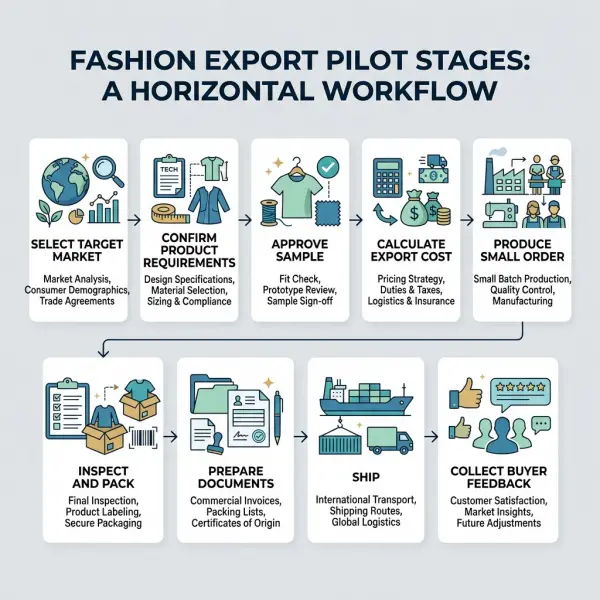
Stage 5: Conduct a Pilot Shipment
A pilot should be commercially meaningful but small enough to contain risk. Samples alone are not a full export test because they rarely reproduce the complexity of bulk production, assortment packing, formal documentation, and buyer acceptance.
The pilot should evaluate the complete workflow from order confirmation to delivery and feedback.
Stage 6: Review the System, Not Only the Sale
A pilot should not be judged only by whether the buyer paid or the shipment arrived.
The team should review:
- Planned versus actual margin
- Planned versus actual production time
- Defect and rework levels
- Documentation corrections
- Freight and clearance issues
- Buyer questions or complaints
- Internal workload
- Changes required before repetition
This turns the pilot into organizational learning rather than a one-off success story.
Common Export-Readiness Mistakes
Treating Buyer Interest as Proof of Readiness
An enquiry, sample request, or marketplace message confirms interest, not purchasing commitment or operational feasibility.
This mistake often occurs because overseas attention feels like validation. The brand moves quickly to secure the opportunity and agrees to quantities, prices, or timelines before conducting a complete review.
The consequence may be an order that appears valuable but cannot be produced at the promised margin or standard. A better response is to treat interest as the start of qualification: verify the buyer, scope the requirement, calculate the offer, and confirm operational capacity before making commitments.
Quoting Before Understanding the Delivery Terms
A price can look profitable until the seller discovers that it is expected to cover additional transport, insurance, destination charges, or import-related responsibilities.
Incoterms rules should be selected according to the actual transaction, transport mode, control capability, and negotiation—not because a familiar abbreviation has been used in previous quotations. They allocate defined delivery obligations, costs, and risks, but do not replace a complete sales contract.
The better approach is to quote a named product, quantity, currency, validity period, Incoterms rule, named place, lead time, and payment structure.
Assuming One Label Works Everywhere
Many brands develop a single care and composition label and expect it to be universally acceptable.
That assumption can fail because markets may differ in required fibre terminology, language, business identification, country-of-origin presentation, safety information, or online product-information obligations. The EU and United States, for example, have separate textile labelling frameworks, even though some required information overlaps.
The more reliable approach is to maintain a core product record and create destination-specific label versions where required.
Accepting Large Orders Without Testing Repeatability
A large first order may be commercially attractive, especially for a brand seeking rapid growth. It can also magnify weaknesses in grading, material supply, cutting consistency, workshop capacity, quality inspection, and cash flow.
The problem is not scale itself. It is scaling an untested process.
A staged order, pre-production sample, defined inspection plan, or limited initial assortment may protect both parties while the supply relationship is being established.
Collecting Certifications Without a Requirement Map
Certifications and test reports can help demonstrate conformity, responsible practices, or buyer eligibility. They also cost money and have defined scopes, validity periods, product coverage, and recognition conditions.
The mistake is treating certification as a general symbol of export readiness. A certificate may be useful for one buyer or product but irrelevant to another. Exporters should first map mandatory rules, contractual requirements, and voluntary market expectations, then obtain evidence that addresses those specific needs. This aligns with the ITC’s emphasis on identifying applicable technical requirements and recognized conformity-assessment services.
Depending on One Person to Hold the Entire Process Together
Small fashion businesses often rely on the founder to approve products, negotiate prices, communicate with buyers, monitor production, check documents, and resolve shipping issues.
This may work during early experimentation, but it creates bottlenecks and continuity risk. Export knowledge should gradually be converted into templates, approval procedures, shared records, and assigned responsibilities.
The objective is not bureaucracy. It is dependable execution.
What Brands Should Verify Before Acting
Export rules are market-specific and subject to change. No general article can confirm the complete legal, customs, tax, product-safety, or labelling obligations for every apparel product and destination.
Brands should verify at least five matters for the actual transaction:
- Product classification: Confirm the appropriate customs code based on the garment’s construction, fibre content, category, and destination tariff schedule.
- Market-access requirements: Check product-safety, chemical, textile-labelling, packaging, and online-information rules.
- Economic-operator responsibilities: Establish which company acts as manufacturer, importer, distributor, authorized representative, or other responsible party where relevant.
- Trade agreement eligibility: Confirm whether the product satisfies applicable rules of origin before claiming preferential treatment.
- Commercial allocation: Document payment, delivery, inspection, claims, intellectual-property, and cancellation terms in addition to the selected Incoterms rule.
For products made available in the European Union, the General Product Safety Regulation has applied since 13 December 2024. It establishes general safety and economic-operator obligations, including product-identification and manufacturer contact-information requirements, with specific responsibilities depending on the supply-chain role and product. Apparel brands selling into the EU should determine how the regulation interacts with textile-specific rules and their own distribution model. EU General Product Safety Regulation overview
Specialist advice may be appropriate where product safety, children’s apparel, protective clothing, restricted substances, intellectual property, tax exposure, or complex origin rules are involved.
Frequently Asked Questions
Can a small fashion brand become export-ready?
Yes. Export readiness depends more on process control than company size.
A small brand may be export-ready for a limited product range and order volume when it has accurate specifications, stable production partners, realistic capacity, compliant product information, controlled costs, and clear commercial terms. A larger company can still be unprepared if its product records are inconsistent or its departments do not coordinate effectively.
The practical approach is to define the scale at which the business can perform reliably. A brand that can fulfil 200 units consistently should not present itself as ready for 5,000 units without validating materials, labour, quality control, financing, and lead times at that level.
Does a brand need an overseas distributor to begin exporting?
No. A brand may export through distributors, agents, wholesalers, retailers, marketplaces, its own e-commerce site, or direct business-to-business relationships.
The right model depends on the brand’s resources and target market. A distributor may provide local market access, relationships, warehousing, and sales support, but will usually require commercial margin and may seek territorial control. Direct selling gives the brand greater control over positioning and customer data but increases its responsibility for logistics, customer service, returns, tax handling, and local marketing.
The decision should be based on channel economics and operational capability rather than an assumption that one route is universally easier.
Is international shipping experience enough to prove export readiness?
Not by itself.
Shipping occasional consumer parcels abroad demonstrates that the brand can complete a basic cross-border transaction. Commercial export orders may introduce more demanding requirements, including bulk production, buyer-specific specifications, formal documentation, product testing, negotiated delivery terms, wholesale pricing, and structured claims procedures.
A brand should evaluate the type of export it intends to pursue. Direct-to-consumer shipping, wholesale export, private-label production, and distributor supply are related but operationally different models. Experience in one provides useful knowledge, but it does not automatically cover the requirements of another.
What is the most important document for apparel export?
There is no single document that is always the most important. The required set depends on the shipment and destination.
The commercial invoice is central because it describes the transaction and is commonly used in customs processing. However, it must remain consistent with the packing list, transport document, customs declaration, origin information, and any product-specific evidence.
For production control, the approved specification and sample may be just as important because they define what the buyer expects to receive. Export readiness therefore depends less on possessing one document than on maintaining accurate, consistent information across the commercial, product, and shipment records.
Should a fashion brand use FOB for every export shipment?
No. FOB—Free On Board—is an Incoterms rule intended for sea or inland-waterway transport and may not be the most appropriate choice for containerized or multimodal shipments in every situation.
The selected rule should reflect the transport method, delivery point, ability to control carriage, insurance needs, buyer agreement, and allocation of risk and costs. ICC publishes 11 Incoterms® 2020 rules, including rules suitable for any mode of transport and rules specifically designed for sea and inland-waterway transport.
A freight forwarder can explain logistics implications, while commercial or legal advisers may be needed to ensure the term aligns with the wider sales contract.
Does export readiness require an international certification?
Not universally.
Some products, buyers, markets, or supply-chain programmes require specific testing, certification, audit results, or conformity documentation. In other cases, a certification may be voluntary and commercially useful but not legally mandatory.
The brand should identify the exact requirement, who issued it, what product or facility it covers, whether the destination or buyer recognizes it, and how long it remains valid. Paying for a broad collection of certificates without this analysis can consume resources without solving the actual market-access problem.
Product specifications, accurate labels, traceable supplier information, test reports, and documented quality controls may be equally important depending on the transaction.
How long does it take for an apparel brand to become export-ready?
There is no universal timeframe.
A brand with documented products, stable manufacturing, experienced staff, and a clearly defined target market may close its main gaps relatively quickly. A business that still relies on informal product specifications, unstable suppliers, incomplete costing, or inconsistent quality may need a more substantial operational build-out.
The timeframe also depends on the destination and product. Standard adult fashion apparel may involve a different preparation path from children’s clothing, protective garments, wool products, or items making specialized performance claims.
A more useful measure than elapsed time is whether the business can complete a controlled pilot transaction and demonstrate consistent results.
Conclusion
Fashion export readiness is the capacity to turn international demand into controlled, repeatable, and commercially sustainable execution.
The strongest indicator is not the number of countries from which a brand has received enquiries. It is the quality of the system behind the offer: defined market logic, reliable product records, repeatable manufacturing, verified requirements, disciplined costing, consistent documents, realistic delivery commitments, and clear responsibility when conditions change.
For growing apparel brands, the goal should not be to remove every uncertainty before entering a foreign market. That would be unrealistic. The goal is to identify the uncertainties that could damage the product, buyer relationship, cash position, or legal compliance—and reduce them before committing to scale.
A narrow pilot often reveals more than a broad export plan. It tests whether the approved garment can be produced again, whether the quotation protects margin, whether documents match the physical shipment, and whether the team can respond professionally when an exception





Comments 0
Leave a CommentSend Comment
Anda harus Login terlebih dahulu untuk dapat memberikan komentar.