
How Stitch Types Affect Garment Strength and Appearance
Quick Answer
Stitch types affect garment strength and appearance by determining how sewing threads hold fabric layers together, respond to movement, distribute stress, cover raw edges, and remain visible on the finished product. A straight lockstitch can create a clean, controlled seam on stable woven fabric, but it may not provide enough extensibility for a close-fitting knit. An overlock or chainstitch construction can accommodate more movement, although it may create greater seam bulk or a different visual finish.
The stitch type is only one part of seam performance. Fabric structure, seam construction, thread strength and elasticity, stitch density, needle size, tension, laundering, and garment use also influence whether a seam remains secure and visually smooth.
For fashion businesses, the practical objective is not to select the strongest stitch in isolation. It is to engineer a balanced seam that withstands expected use without damaging the fabric, restricting movement, puckering the garment, or creating unnecessary bulk. The correct construction for a tailored shirt, stretch legging, lightweight blouse, and denim trouser will therefore be different.
How Do Stitch Types Influence a Garment?
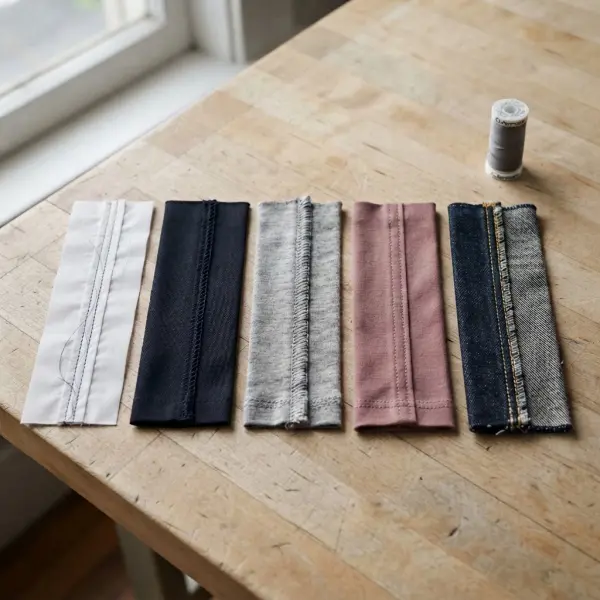
A stitch type is a specific thread formation created by one or more needles, bobbins, loopers, or spreaders to join, finish, cover, secure, or decorate textile materials. Its structure influences how a seam behaves when the garment is stretched, pulled, washed, pressed, abraded, or repeatedly worn.
The ISO 4915 classification of textile stitch types identifies and illustrates formal stitch categories used in machine- and hand-sewn seams. In commercial apparel production, frequently encountered formations include lockstitches, chainstitches, overedge stitches, covering stitches, zigzag formations, and specialized reinforcement cycles.
A stitch affects at least five practical characteristics:
- How firmly the fabric layers remain joined
- How far the seam can extend before thread or fabric failure
- How easily the stitching may unravel or become damaged
- How much bulk or stiffness the seam adds
- How the finished seam looks from the inside and outside
These characteristics are related, but they are not identical. A seam can have high breaking strength yet be visually unsuitable. It can look clean when laid flat but fail when stretched over the body. It can survive an initial laboratory pull test but become wavy after repeated laundering.
That is why stitch selection must begin with the garment’s intended use rather than with a preferred machine or familiar construction.
Stitch Strength and Seam Strength Are Not the Same Thing
Stitch strength describes the ability of the thread formation to resist force. Seam strength refers to the performance of the entire joined construction, including the fabric, thread, stitch type, seam type, stitch density, and sewing conditions.
This distinction is fundamental. A high-strength thread does not guarantee a strong garment seam. If the thread is too coarse for a lightweight fabric, concentrated needle holes and a rigid stitch line may damage the material before the thread breaks. In this case, the thread survives while the garment fails.
ASTM D6193 identifies fabric type and strength, seam type, stitch type, stitch density, thread tension, and thread strength as variables affecting sewn-seam strength. It also notes that elasticity, durability, security, and appearance depend on combinations of these factors rather than on stitch formation alone.
A useful seam is therefore a balanced system.
For example, the side seam of a lightweight silk blouse does not need the same thread size or reinforcement level as a workwear trouser inseam. Making both constructions equally heavy would not necessarily improve quality. On the blouse, it could introduce stiffness, needle marking, or puckering that reduces the value of the product.
What Is Seam Efficiency?
Seam efficiency is commonly understood as the strength of a sewn seam relative to the strength of the unsewn fabric. It helps product developers assess whether the seam uses an appropriate proportion of the material’s strength.
A seam does not always need to equal the maximum breaking strength of the fabric. The target depends on product category, safety requirements, expected loading, repairability, and customer specification.
ASTM D1683/D1683M describes testing for sewn-seam failure in woven fabrics and explains that thread size, stitch type, seam type, and stitch density are seam-engineering variables used to evaluate sewn-seam strength, seam efficiency, and seam slippage. The standard also cautions that the test does not predict actual wear performance by itself.
This caveat matters commercially. A laboratory result is useful, but it cannot fully reproduce body movement, repeated washing, abrasion against furniture, stretching during dressing, or local stress around pockets and closures.
How Seams Commonly Fail
When a seam is placed under load, failure does not always mean that the sewing thread simply snaps. Several different mechanisms can occur.
|
Failure mode |
What happens |
Likely garment consequence |
|
Stitch breakage |
One or more sewing threads rupture |
Seam opens or loses reinforcement |
|
Fabric rupture |
Fabric tears beside the stitch line |
Damage may be difficult to repair cleanly |
|
Seam slippage |
Fabric yarns shift away from the stitch line |
Visible opening develops without immediate thread breakage |
|
Stitch unraveling |
The thread formation releases progressively |
Long seam sections may open |
|
Seam grinning |
Stitching or gaps become visible when the seam is pulled |
Garment appears strained or poorly constructed |
|
Elasticity failure |
The seam cannot extend with the material |
Thread breaks or movement becomes restricted |
|
Abrasion failure |
Exposed thread wears through during use |
Topstitching or structural seams deteriorate |
|
Permanent distortion |
Fabric or seam does not recover after stress |
Wavy, stretched, or misshapen appearance |
These failure modes require different responses. A stronger thread may help when the original thread breaks under expected load, but it will not necessarily solve seam slippage in a loosely constructed woven fabric. Adding more stitches may increase thread contact, yet excessive needle penetration can weaken or perforate certain materials.
The deeper issue is where the construction should yield under stress. In some products, it is preferable for the stitching to fail in a repairable way rather than for an expensive or specialized fabric to tear permanently.
How Lockstitch Affects Strength and Appearance
Strength Characteristics of Lockstitch
The common type 301 lockstitch interlocks a needle thread with a bobbin thread within the fabric layers. It is widely used for shirts, dresses, trousers, jackets, pockets, zippers, and topstitching because it produces a controlled seam with a similar linear appearance on both sides.
Lockstitch provides good security when properly balanced. Individual stitch damage generally remains more localized than in some chainstitch formations, which can unravel progressively if an unsecured thread end is pulled in the release direction.
Its main structural limitation is relatively low extensibility compared with several chain, overedge, zigzag, or covering formations. A standard straight lockstitch may perform well along a stable woven shirt seam but break when placed across a tightly fitted, highly stretchable knit.
The practical result is straightforward: lockstitch works best when the fabric and seam do not need to extend far beyond the available thread reserve within the stitch formation.
Appearance Characteristics of Lockstitch
Visually, lockstitch can produce a crisp and restrained result. It is therefore common where stitching precision contributes to perceived garment quality, such as:
- Shirt collars and cuffs
- Jacket lapels
- Pocket edges
- Zipper installations
- Waistband topstitching
- Decorative denim details
- Fine edge stitching
The clean appearance depends on balance between the upper and lower thread tensions. Ideally, the interlocking point remains within the fabric layers rather than being pulled visibly to one surface.
On lightweight fabrics, a short, tight lockstitch can make the seam rigid or puckered. On heavy fabrics, thread that is too fine may look visually weak or disappear into the construction. Thread size, stitch length, needle size, and material weight must therefore be coordinated.
Where Lockstitch Works Best
Lockstitch is often suitable for stable woven garments, precise topstitching, short component-attachment operations, and areas where a neat two-sided appearance is required.
It is less suitable as the sole stitch across areas that must repeatedly expand, such as close-fitting knit necklines, stretch waistbands, compression garments, or high-movement activewear panels.
A fuller overview of common formations and their functions is available in basic sewing machine stitches and their functions.
How Chainstitch Changes Seam Performance
Why Chainstitch Can Accommodate More Movement
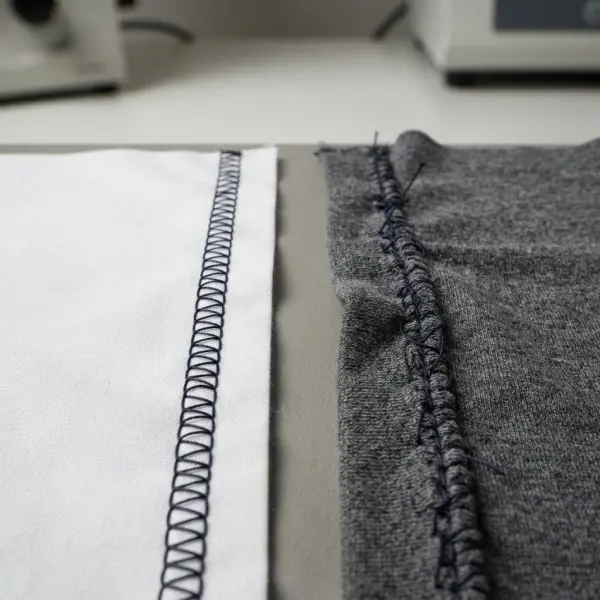
Type 401 double chainstitch is formed by interlooping needle and looper threads. Its looped underside contains more thread within the formation than a basic lockstitch, giving the seam additional capacity to extend before the threads are fully tensioned.
This makes chainstitch useful for long seams, selected knit constructions, waistbands, trousers, shirts, denim, and operations where some extensibility is beneficial.
ASTM D6193 states that seam elasticity depends on fabric, seam type, stitch type, stitch density, thread tension, and thread elasticity. In practice, chainstitch should not be described as automatically “stretch-proof.” Its performance still depends on the complete seam system.
Security and Unraveling Trade-Offs
Chainstitch can provide strong and efficient production seams, but some formations may unravel when an unsecured end is pulled from the correct direction. Starts, stops, seam intersections, thread tails, and reinforcement methods must therefore be controlled.
This characteristic is especially relevant when a chainstitched seam terminates at an exposed edge or is later cut during alteration. The seam may remain secure throughout normal wear but release rapidly after its thread structure is disturbed.
For a brand, the issue is not whether chainstitch is “good” or “bad.” The issue is whether the construction includes an appropriate securing method and whether operators understand the direction and structure of the stitch.
Visual Impact of Chainstitch
From the face, a single-needle chainstitch may resemble straight lockstitch. The underside has a more pronounced looped appearance.
In denim, chainstitch can contribute to characteristic hem and topstitch effects, particularly after washing. The amount and appearance of roping or seam distortion depend on fabric structure, differential shrinkage, thread, folder geometry, sewing conditions, and finishing—not simply on the presence of chainstitch.
For formal or lightweight garments, the looped reverse side may add more visual texture and bulk than desired. The choice should match both product performance and interior finishing expectations.
How Overlock and Safety Stitches Affect Garments
Overlock Strength Depends on Its Configuration
Overedge or overlock stitches wrap threads around a raw fabric edge. Depending on the stitch formation and number of threads, they may be used primarily for edge finishing or for joining and finishing fabric in one operation.
A three-thread overlock is frequently used to control raw edges. Four-thread configurations are commonly used to join many knit garments. Five-thread safety-stitch combinations typically pair an overedge formation with a separate chainstitch joining line.
These are common production practices, not universal guarantees. Machine setup, stitch width, thread type, seam allowance, garment use, and fabric behavior still determine actual performance.
A narrow three-thread finish on the seam allowance of a blouse may be entirely appropriate. The same construction should not automatically be expected to carry the repeated load of a woven workwear inseam.
Extensibility and Recovery
Overlock stitches can accommodate fabric movement because thread loops are distributed around the edge. This makes them useful for many jersey garments and other materials that must extend during use.
However, extensibility alone is not enough. After the seam is stretched, both the stitch and fabric should recover without remaining wavy or enlarged. A seam can survive the stretch test and still be aesthetically unacceptable if it does not return to its original shape.
Differential feed, presser-foot pressure, thread tension, stitch length, seam width, and operator handling influence how the fabric moves through the machine. These settings affect appearance, but detailed diagnosis belongs in common stitching problems and how to prevent them.
Interior Appearance and Bulk
Overlocking creates a recognizable wrapped-edge finish. On many casual garments, consumers associate this with normal industrial construction. On transparent blouses, unlined formalwear, or premium reversible products, the same finish may appear visually heavy.
A wider overlock can provide greater edge coverage but may add thread mass and stiffness. A narrow edge finish can look cleaner on lightweight material but may provide less coverage and be more sensitive to trimming accuracy.
The decision should reflect how much of the garment interior is visible and how the seam feels against the body.
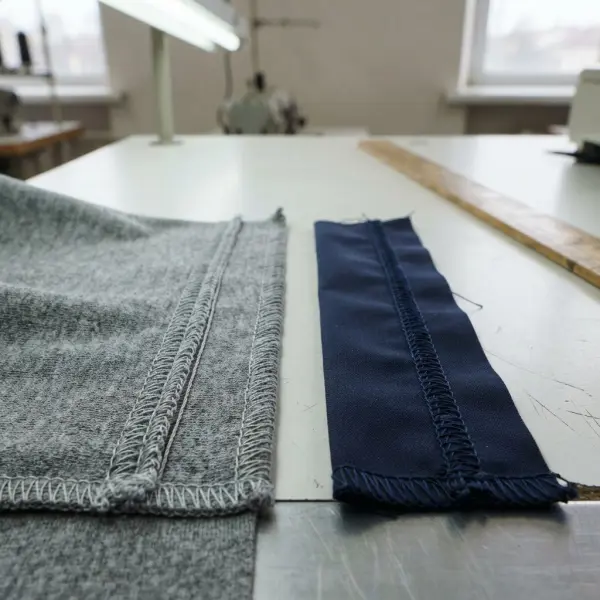
How Coverstitch Affects Stretch Hems and Surface Appearance
Coverstitch is commonly used on T-shirt sleeves, knit garment hems, activewear, underwear, bindings, and elastic applications. Parallel needle rows appear on one surface, while looper thread covers the edge or spans the reverse side.
Its principal advantage is that it combines visible linear stitching with a looped formation that can accommodate movement. This is why a T-shirt hem sewn with coverstitch can stretch more effectively than one secured with two separate rows of conventional straight lockstitch.
The formation also covers the folded raw edge, producing an interior finish that is practical for knit garments. Depending on machine configuration, multiple needles and top-cover threads can create different widths and visual effects.
When Coverstitch Improves Appearance
Coverstitch can support a clean commercial appearance when:
- Needle rows remain consistently spaced
- The folded hem edge is fully covered underneath
- The garment retains its original width after sewing
- Thread tension does not create tunneling between needle rows
- Seam elasticity is compatible with the fabric
- Intersections remain controlled rather than excessively bulky
The stitch is visible by design. Any variation in spacing, feeding, thread balance, or hem width is therefore easy to notice.
When Coverstitch Becomes Too Much
Covering formations use more thread and create more surface activity than a single lockstitch row. On very fine fabric, a wide or dense coverstitch can dominate the garment, create stiffness, or distort the hem.
For minimalist luxury knitwear, designers may prefer a narrow, subtle finish. For sportswear, a wider covering stitch may reinforce the technical visual identity of the product.
The correct appearance is tied to market positioning. There is no universal premium stitch width.
Zigzag and Multi-Step Stitches: Flexible but Visually Distinct
Zigzag stitches move from side to side, allowing the thread path to open when the material stretches. They are used for elastic attachment, lingerie, selected knit seams, appliqué, edge control, and decorative applications.
A narrow zigzag may appear almost straight while retaining some lateral movement. A wide zigzag offers more visible thread coverage and can distribute load across a broader area.
Multi-step zigzag divides each diagonal movement into several shorter stitches. This can help spread stress when attaching elastic or repairing fabric, but the surface result is more visually noticeable than straight stitching.
For fashion businesses, zigzag is often a useful functional choice where the stitch will be concealed, integrated into lingerie styling, or deliberately used as a decorative feature. On a minimalist tailored garment, an exposed zigzag may conflict with the intended aesthetic.
Domestic stretch stitches also deserve caution. Their icons and names are not standardized across machine brands, and a factory may not have a directly equivalent industrial cycle. The intended performance should be translated into a recognized stitch or seam specification before production.
Reinforcement Stitches and Concentrated Loads
Some garment areas do not require an entirely heavier seam. They require localized reinforcement.
Bar tacks, short zigzag reinforcements, backtacks, triangular stitching, box stitching, and crossed box formations are commonly used around:
- Pocket openings
- Belt-loop ends
- Zipper bases
- Fly constructions
- Strap attachments
- Drawcord openings
- Pleat terminations
- Workwear stress points
A bar tack distributes load over a short reinforced area. It can substantially improve resistance where a component repeatedly pulls against the garment.
More density is not automatically better. On lightweight or loosely constructed fabric, a dense bar tack may behave like perforation. The reinforced thread block remains intact while the surrounding fabric tears away.
Reinforcement must therefore spread force into a sufficiently stable area of the garment. Backing material, interlining, seam allowance, pocket shape, stitch length, bar-tack width, and distance from the raw edge all affect the result.
Stitch Density: Why More Stitches Do Not Always Mean More Strength
Stitch density is commonly expressed as stitches per inch or stitches per centimetre. Increasing density places more thread intersections along a seam, which can improve load distribution within an appropriate range.
Beyond that range, several problems may appear:
- Excessive needle holes can weaken the fabric
- The seam can become rigid relative to the garment
- Short stitches may increase sewing heat and thread abrasion
- Dense stitching may cause puckering
- Removal and repair become more difficult
- More thread and machine time are consumed
- Fine or coated fabrics may develop visible perforation
ASTM D6193 identifies stitch density as a factor in seam strength, elasticity, security, durability, and appearance. It specifically cautions that density must be selected carefully so that excessive tension does not unbalance elasticity or create puckering.
The correct density is therefore a range validated for a particular material and construction—not a single quality number applied to every garment.
Density and Garment Category
A fine shirt fabric may need a relatively refined stitch length to achieve a clean visual scale, but the needle and thread must remain small enough to avoid distortion.
Heavy denim may use visibly longer topstitches with thicker thread for aesthetic reasons, while some hidden structural seams use different density and thread combinations.
On stretch garments, excessively short stitches can reduce the amount of thread available within each formation, making the seam feel rigid even when the stitch class is technically extensible.
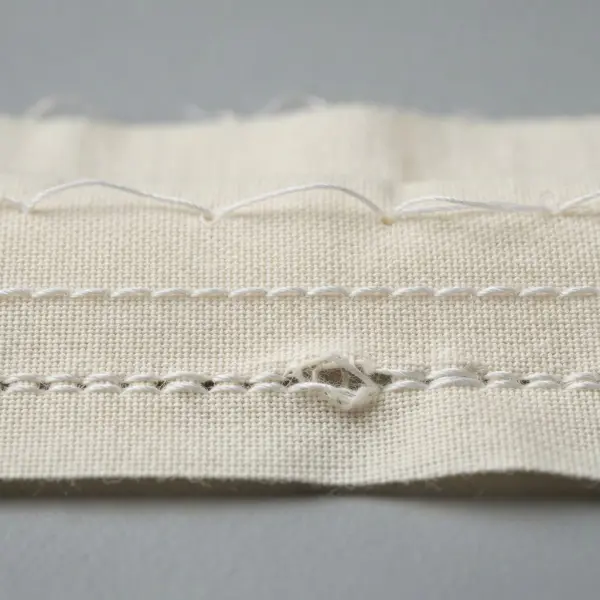
Thread Size, Thread Properties, and Visible Quality
The stitch type determines the formation, but thread determines much of what the customer actually sees and what the seam can withstand.
A thicker thread can provide greater tensile strength when fiber type and construction are comparable, but it also requires sufficient fabric support, an appropriate needle, and enough space within the seam. A finer thread tends to blend more easily into lightweight fabric and can produce less distortion.
Coats’ technical guidance states that thread should be as fine as possible while still meeting the required seam strength. It also notes that finer threads work with finer needles and generally produce less fabric distortion, while thread elasticity, shrinkage, abrasion resistance, and uniformity affect finished seam performance.
Thread Elasticity
A stitch formation may contain enough geometric reserve to extend, but thread behavior still matters. If the thread has inadequate elongation for the garment’s movement, it can rupture before the seam reaches the fabric’s useful stretch range.
Conversely, a thread that extends excessively or fails to recover may allow the seam to become loose or visually uneven.
Thread Shrinkage
Thread and fabric may respond differently to washing, heat, pressing, or garment finishing. If one component contracts more than the other, the seam can become puckered even when it looked smooth immediately after sewing.
Coats identifies low thread shrinkage as a characteristic that can reduce the risk of seam puckering when used with material that has a higher shrinkage response.
Thread Color and Surface
Thread color affects more than simple matching. Slight differences may become more noticeable under store lighting, daylight, photography, or after washing.
High-contrast topstitching exposes every variation in line accuracy. Tonal thread can conceal small inconsistencies but may also disappear when the stitching is intended to communicate craftsmanship.
Surface character also matters. Matte spun thread, smoother corespun thread, and lustrous continuous-filament thread produce different visual effects even when their nominal colors are similar.
How Fabric Structure Changes Stitch Performance
Stable Woven Fabrics
Stable woven fabrics usually have limited mechanical stretch. Straight lockstitch can therefore work effectively for many joining operations.
The main concerns may shift toward seam slippage, yarn damage, fraying, and puckering. A loosely constructed woven fabric can allow yarns to move away from the stitch line even when the sewing thread remains intact.
ASTM D1683/D1683M includes the evaluation of sewn-seam strength and seam slippage in woven materials. The standard distinguishes stitching failure from yarn displacement and notes that fabric damage may make a product less repairable than a seam in which only the thread fails.
Knitted Fabrics
Knitted fabrics are formed from intermeshing loops and often provide greater stretch than stable woven materials. Seams must usually accommodate both extension and recovery.
Overlock, chainstitch, coverstitch, zigzag, and other extensible formations are frequently considered. The correct choice depends on whether the seam joins panels, finishes an edge, forms a hem, attaches elastic, or sits directly against the body.
A soft jersey T-shirt and a compression legging should not receive the same specification merely because both fabrics are knitted.
Delicate and Lightweight Fabrics
Fine woven fabrics, microfibers, lightweight knits, lace, and transparent materials are sensitive to bulk and needle penetration.
A structurally adequate stitch can still be rejected because it creates:
- Visible puckering
- Needle holes
- Shadowing through transparent layers
- A stiff seam ridge
- Thread dominance
- Uneven drape
- Distortion near curved edges
Coats recommends needle points according to fabric structure and notes that finer or specialized points may reduce damage and help create straighter seams in dense or delicate materials.
Heavy and Abrasive Fabrics
Denim, canvas, heavy twill, coated textiles, and workwear materials place greater demands on needle penetration, feeding, thread abrasion resistance, and seam bulk management.
A heavy thread may support the visual identity of the garment, but it also increases needle size and can affect seam flexibility. Multiple folded layers at belt loops, hems, and pocket corners can become difficult to feed consistently.
Strength problems in heavy garments often occur at transitions rather than across long straight sections. The machine may sew smoothly through two layers but lose control where the seam suddenly crosses six or eight layers.
Stitch Type and the Visual Language of a Garment
Stitching is not only structural engineering. It is part of the product’s visual language.
A fine tonal lockstitch supports the restrained appearance of tailored apparel. Bold contrast topstitching is central to many denim products. Coverstitch lines communicate casual knitwear or performance construction. Decorative zigzag can signal craft, lingerie, outdoor utility, or visible repair depending on context.
The stitch must align with four aspects of the design:
- Scale: Thread thickness and stitch length should relate to fabric weight and garment proportions.
- Visibility: Exposed stitching requires tighter control than concealed construction.
- Rhythm: Spacing, parallelism, and repeated stitch lines contribute to visual consistency.
- Context: A construction associated with sportswear may look out of place on minimalist eveningwear, while a delicate seam may appear insufficient on utility clothing.
Consumers may not know whether a garment uses stitch type 301 or 401. They still recognize when pocket lines are uneven, hems wave, buttonholes are inconsistent, or contrast stitching fails to meet cleanly at intersections.
How Stitching Influences Drape, Bulk, and Comfort
Every sewn seam changes the material locally. It adds thread, folds, layers, compression, and a line of needle penetrations.
On structured garments, this may be desirable. A firm seam can define an edge, hold a tailored shape, or support topstitching.
On fluid garments, too much seam rigidity can interrupt drape. A delicate fabric may fall softly through the body but form a hard ridge at the side seam if the thread, seam allowance, stitch density, or edge finish is too heavy.
Bulk also affects wearer comfort. A wide safety stitch may be structurally appropriate for trousers but uncomfortable in close-fitting underwear. Flat or covering constructions may offer a lower-profile alternative, depending on the material and required strength.
The softest seam is not automatically the best seam. A construction that feels almost invisible may lack sufficient security for repeated use. Product developers must balance tactile comfort against durability and production consistency.
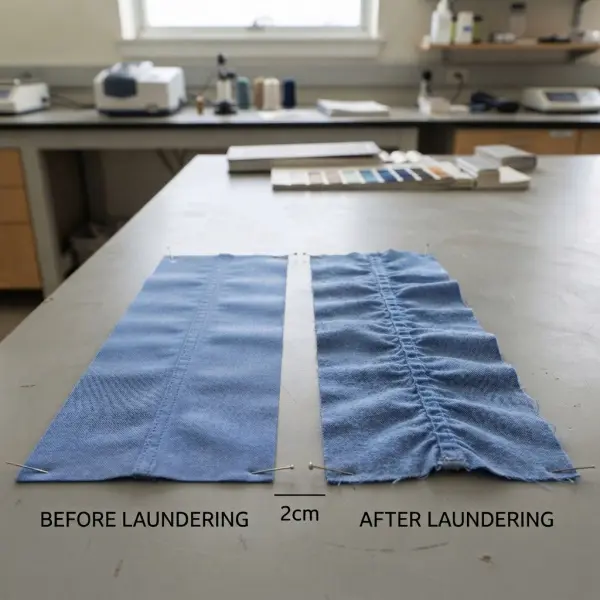
Why Laundering Can Change Seam Appearance
A seam approved immediately after sewing may not look the same after washing and drying.
Fabric, thread, interlining, elastic, and trims can shrink or relax at different rates. Mechanical agitation can expose poor thread balance, unstable hems, seam slippage, or edge curling. Heat may affect synthetic materials, elastics, coatings, and fusible components.
AATCC TM88B is intended to evaluate seam smoothness after home laundering and can be applied to seams in washable woven, knitted, or nonwoven fabrics. It evaluates seams as supplied from manufacturing rather than prescribing one universal seaming technique.
This reinforces an important development principle: visual approval should include the relevant care cycle.
A smooth unwashed sample is not sufficient evidence for a garment marketed as machine washable.
Matching Stitch Performance to Garment Category
|
Garment or operation |
Primary performance need |
Common stitch direction |
Main appearance concern |
|
Woven shirt side seam |
Stable joining and clean interior |
Lockstitch with finished edge or safety stitch |
Puckering and seam allowance bulk |
|
T-shirt side seam |
Extension and recovery |
Four-thread overlock or suitable knit seam |
Waviness and edge coverage |
|
T-shirt hem |
Stretchable folded hem |
Coverstitch |
Tunneling and uneven needle rows |
|
Tailored trouser seam |
Strength and controlled shape |
Lockstitch, chainstitch, or safety stitch |
Grinning, puckering, and bulk |
|
Legging inseam |
High extension and comfort |
Extensible overlock, covering, or flat construction |
Restricted movement and skin irritation |
|
Denim pocket |
Reinforcement and visible styling |
Lockstitch or chainstitch topstitching with bar tacks |
Line accuracy and wash response |
|
Delicate blouse hem |
Low bulk and subtle appearance |
Narrow hem construction suited to fabric |
Needle marking and stiffness |
|
Workwear pocket opening |
Concentrated load resistance |
Structural seam plus bar-tack reinforcement |
Fabric tearing around dense stitches |
|
Lingerie elastic |
Extension, recovery, and softness |
Zigzag, multi-step zigzag, overlock, or cover application |
Elastic tunneling and uneven gathering |
|
Formal skirt hem |
Minimal face visibility |
Blind stitch or another concealed finish |
Visible needle bites and hem impressions |
These are starting directions, not production instructions. Final decisions require material testing and agreement between product development, technical design, factory engineering, and quality teams.
A Practical Seam-Engineering Process for Fashion Businesses
Start with End Use
The team should describe how the garment will be worn and what loads the seam will experience.
A loose woven blouse experiences different forces from shapewear, cycling shorts, protective workwear, or children’s clothing. “Daily wear” is not specific enough. The development brief should identify movement, fit, care method, abrasion exposure, and expected product life.
Map Critical Seam Locations
Not every seam requires the same engineering level. Identify areas that carry high loads or create high visual exposure:
- Inseams and rise seams
- Armholes and underarms
- Neck openings
- Waistbands
- Pocket openings
- Strap attachments
- Zipper ends
- Hem intersections
- Crotch gussets
- Closures and buttonholes
This allows the team to reinforce critical points without making the entire garment unnecessarily heavy.
Define Strength and Appearance Requirements Separately
A useful specification should state both what the seam must withstand and how it must look.
For example:
- Must extend with the fabric during dressing without thread breakage
- Must recover without permanent waviness
- No visible seam grinning at normal body extension
- Parallel topstitch rows must maintain approved spacing
- Seam must remain smooth after the specified wash cycle
- Raw edge must remain fully covered
- No unacceptable fabric damage beside reinforcement points
This prevents a technically strong but visually poor sample from being approved.
Develop Multiple Seam Candidates
For a critical operation, it may be worth sampling more than one combination of:
- Stitch type
- Seam construction
- Thread size
- Thread type
- Stitch density
- Needle size and point
- Seam width
- Reinforcement method
The cheapest construction at the sewing stage may produce higher repair, rejection, or return costs later. Conversely, the most elaborate construction may add machinery and labor without delivering a meaningful customer benefit.
Test Production-Intent Materials
Development samples should use the actual or technically equivalent fabric, thread, elastic, interlining, and trims.
A seam approved on substitute fabric may behave differently once production material arrives. Small changes in fabric density, finish, stretch recovery, coating, or thickness can alter the result.
Evaluate Before and After Care
Inspect the seam in an unwashed condition and after the relevant washing, drying, pressing, garment-dyeing, or finishing cycle.
For stretch garments, evaluate the seam in a relaxed state and under realistic extension. For visible stitching, inspect the garment at normal viewing distance as well as close range.
Document the Approved Construction
The final tech pack or construction manual may include:
- Stitch classification
- Seam type
- Machine type
- Stitch density range
- Thread specification
- Needle requirements
- Seam allowance or stitch width
- Reinforcement details
- Appearance standard
- Wash-test requirement
- Performance-test requirement
- Photographs or seam diagrams
- Approved sealed sample
Good documentation reduces dependence on verbal instructions and operator memory.
Quality-Control Criteria That Should Be Measurable
Garment quality cannot be controlled through phrases such as “strong seam” or “neat stitching” alone.
Depending on the product, measurable criteria may include:
- Stitches per inch or centimetre
- Seam allowance width
- Distance of topstitching from an edge
- Gauge between parallel needle rows
- Bar-tack position and dimensions
- Seam breaking force
- Seam efficiency
- Extension before thread failure
- Recovery after extension
- Seam-slippage threshold
- Seam-smoothness grade after laundering
- Maximum allowed puckering or waviness
- Permitted needle damage
- Acceptable thread-color tolerance
ASTM D1683/D1683M can support evaluation of sewn-seam strength, efficiency, and slippage in woven fabrics, while AATCC TM88B addresses seam smoothness after laundering. The appropriate method depends on material, product, buyer requirement, and intended risk.
Visual inspection remains necessary. Laboratory strength data will not reveal every issue in stitch alignment, shade variation, thread cleanliness, or design proportion.




Comments 0
Leave a CommentSend Comment
Anda harus Login terlebih dahulu untuk dapat memberikan komentar.