
Basic Sewing Machine Stitches and Their Functions
Quick Answer
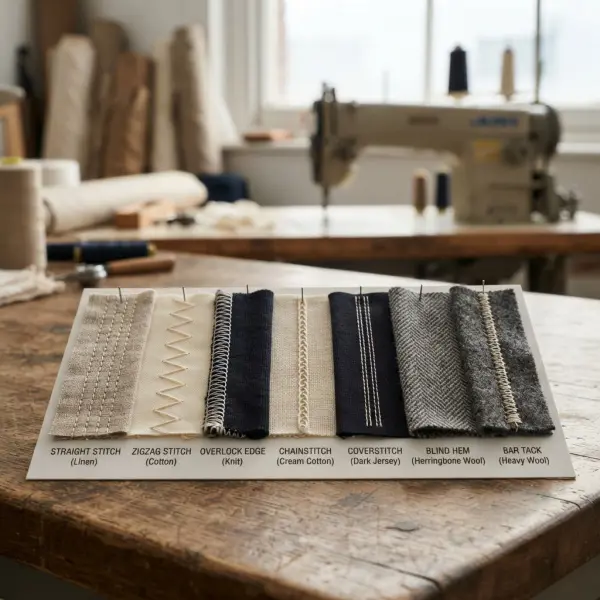
Basic sewing machine stitches are thread formations used to join fabric pieces, finish raw edges, create hems, attach components, reinforce stress points, or add visible design details. The most widely used stitches include straight lockstitch, zigzag, overedge or overlock, chainstitch, coverstitch, blind hem, buttonhole, and bar tack.
Each stitch performs a different job. Straight lockstitch is commonly used for general assembly on woven fabrics. Zigzag can finish edges, accommodate limited fabric movement, and attach elastic. Overlock trims and encloses raw edges, while coverstitch creates flexible hems commonly seen on T-shirts. Chainstitch offers useful extensibility and production efficiency, and bar tacks reinforce concentrated stress areas such as pocket openings.
A stitch should not be selected by appearance alone. The correct choice depends on fabric structure, garment use, seam position, required stretch, wash conditions, thread, needle, stitch density, available machinery, and production scale. A stitch that works well on a cotton shirt may fail on leggings, swimwear, delicate silk, or heavy denim.
What Is a Sewing Machine Stitch?
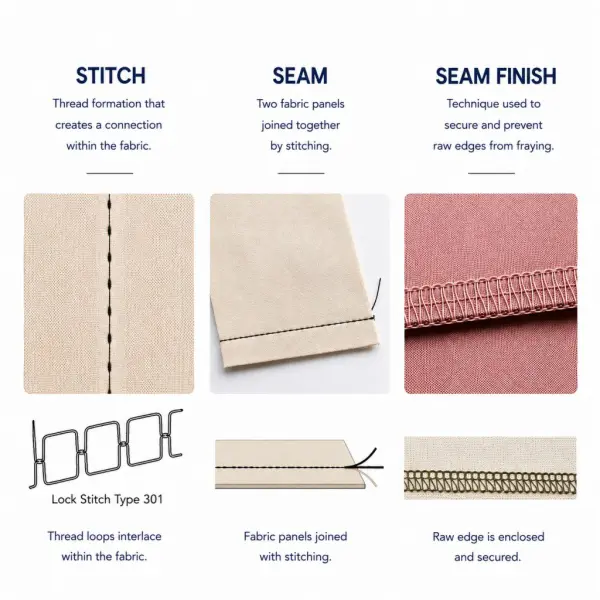
A sewing machine stitch is a thread formation created by one or more needles, bobbins, loopers, or spreaders to connect, secure, cover, decorate, or reinforce textile materials. The stitch is the thread structure itself; the seam is the completed construction formed when fabric pieces are joined or finished.
This distinction matters because two garments may use the same stitch type in very different seam constructions. A lockstitch can form a simple side seam, attach a pocket, secure a zipper, or create decorative topstitching. Its function changes according to the fabric layers, seam allowance, stitch position, thread, and construction method.
The international reference ISO 4915 stitch classification classifies, designates, describes, and illustrates stitch types used in hand- and machine-sewn seams. ASTM D6193 similarly addresses the categories, formation, characteristics, and general purposes of stitches and seams used in sewn products.
For beginners, commercial stitch names are usually more useful than classification numbers. For manufacturers, however, a numeric designation such as stitch type 301, 401, 504, or 406 can reduce ambiguity when communicating with factories, technicians, sourcing teams, and quality inspectors.
Stitch, Seam, and Seam Finish Are Not the Same Thing
These terms are frequently used interchangeably, but they refer to different aspects of garment construction.
|
Term |
Practical meaning |
Example |
|
Stitch |
The thread formation produced by the machine |
Lockstitch 301 |
|
Seam |
The structural arrangement that joins or finishes materials |
Plain side seam joining two shirt panels |
|
Seam finish |
The treatment used to control or cover a raw edge |
Overlocked seam allowance |
|
Stitching operation |
The production task performed at a sewing station |
Attaching a collar or hemming a sleeve |
|
Topstitching |
Visible stitching placed mainly for control, reinforcement, or design |
Double rows around a jeans pocket |
A factory specification that says only “use a straight stitch” is therefore incomplete. It may not identify the seam construction, stitch density, needle size, thread type, seam allowance, reinforcement method, or required finished appearance.
ASTM notes that seam security is influenced by stitch type, stitch density, and susceptibility to unraveling. Seam appearance is also affected by the relationship between thread size, stitch density, fabric weight and texture, as well as operator technique.
The Main Classes of Machine Stitches
Formal stitch systems contain many individual configurations, but most apparel businesses repeatedly encounter a smaller group of stitch families.
|
Common stitch |
Typical classification example |
Main function |
Common applications |
|
Straight lockstitch |
301 |
General joining and topstitching |
Shirts, trousers, dresses, jackets |
|
Zigzag lockstitch |
304 |
Edge control, elastic attachment, limited extensibility |
Lingerie, elastic applications, light edge finishing |
|
Chainstitch |
401 |
Flexible joining and long production seams |
Trousers, denim, shirts, knitwear |
|
Overedge or overlock |
503, 504 and related types |
Enclosing raw edges and joining some constructions |
Knit side seams, woven seam finishing |
|
Safety stitch |
516 and related combinations |
Joining plus edge finishing |
Woven trousers, workwear, production garments |
|
Coverstitch |
406 and related covering stitches |
Flexible hemming and covering |
T-shirts, activewear, underwear |
|
Blind stitch |
Varies by machine and formation |
Creating minimally visible hems |
Tailored trousers, skirts, formalwear |
|
Bar tack |
Specialized dense reinforcement |
Reinforcing concentrated stress points |
Pockets, belt loops, zipper ends |
|
Buttonhole stitch |
Specialized cycle |
Reinforcing a functional opening |
Shirts, jackets, trousers |
Classification codes identify stitch formations rather than guaranteeing performance. Two seams made with the same stitch class can behave differently because of variations in thread, needle, stitch density, fabric, seam construction, machine setting, and operator control.
Straight Stitch and Lockstitch
What Is a Straight Stitch Used For?
A straight stitch creates a linear row of stitches and is the standard choice for many general sewing operations. On conventional domestic and industrial lockstitch machines, the most common formation is stitch type 301, produced by interlocking a needle thread with a bobbin thread within the material.
Its main applications include:
- Joining woven garment panels
- Sewing darts and pleats
- Attaching pockets, facings, waistbands, collars, and cuffs
- Inserting zippers
- Creating visible topstitching
- Securing temporary construction before another operation
- Producing edge stitching close to a fold
The straight lockstitch is popular because it can create a neat appearance on both sides of the material and does not normally unravel as readily as a basic chainstitch when one thread is pulled. It is also easy to start and stop within a garment section.
Its limitation is extensibility. A standard straight lockstitch may break when placed across a highly stretchable knit or elastic section, particularly when the seam must repeatedly extend during dressing or movement. Increasing stitch density is not an automatic solution; excessive needle penetration can damage some fabrics or create a rigid line.
For a woven cotton shirt, lockstitch may be appropriate for the shoulder, collar, cuff, placket, pocket, and topstitching operations. For a compression garment, the same stitch would usually have a much narrower role unless the construction is engineered so that the seam does not need to stretch.

Straight Stitch Is Not Automatically a Structural Seam
A row of straight stitching may be decorative, temporary, structural, or reinforcing. Its role depends on placement.
A single line around a jacket lapel may control the edge and contribute to appearance. The same stitch used in a trouser rise seam may carry repeated body load. Product developers should therefore avoid specifying a stitch without describing its operation and performance requirement.
A deeper assessment of how stitch formation, seam construction, fabric, and stitch density influence durability belongs in how stitch types affect garment strength and appearance.
Zigzag Stitch
What Is Zigzag Stitching Used For?
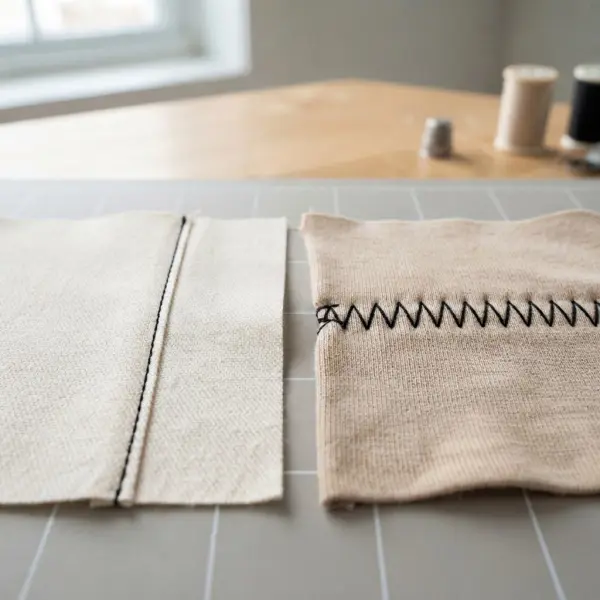
A zigzag stitch moves alternately from side to side rather than following one straight line. A common lockstitch formation is type 304, although domestic machines may provide several related zigzag patterns.
The lateral structure gives the stitch more potential movement than a conventional straight lockstitch. It is often used for attaching elastic, controlling raw edges, sewing appliqué, producing satin stitching, and constructing selected lingerie or stretch applications.
Its suitability still depends on the width, length, thread, fabric, and amount of movement required. A narrow zigzag may appear almost straight while providing limited extensibility. A wider zigzag can accommodate more movement but becomes more visible and may alter the handfeel of the seam.
Typical applications include:
- Attaching elastic to underwear or lightweight garments
- Finishing low-fray or moderate-fray fabric edges
- Sewing around appliqué shapes
- Reinforcing areas where limited movement is required
- Creating satin-stitched decorative lines
- Mending small tears
- Sewing selected stretch fabrics on a domestic machine
Zigzag edge finishing should not automatically be treated as equivalent to industrial overlocking. A zigzag machine does not normally trim the edge, and the stitch formation, coverage, productivity, appearance, and thread consumption differ from those of an overlock machine.
What Is a Three-Step Zigzag?
Three-step zigzag, sometimes called multi-stitch zigzag, forms each side-to-side movement through several shorter stitches. It can distribute thread and load across a broader area than a basic zigzag pattern.
It is useful for attaching elastic, repairing fabric, sewing some lingerie constructions, and working with materials that may tunnel or pucker under a dense conventional zigzag. The name and exact pattern can vary between domestic machine brands, so production teams should confirm the actual formation rather than relying only on the icon displayed on a machine.
Overedge and Overlock Stitches
What Does an Overlock Stitch Do?
An overlock stitch forms thread loops around the edge of the fabric. An overlock machine usually trims the raw edge with built-in knives immediately before enclosing it with needle and looper threads.
This makes overlocking useful for two broad purposes:
- Finishing a raw edge to reduce fraying and create a cleaner interior.
- Joining and finishing fabric in one operation when the selected construction and material allow it.
Three-thread overlock is often associated with edge finishing, while four-thread configurations are widely used for joining many knitted garments. Five-thread safety stitch combinations are frequently used when a separate chainstitch provides the joining line and an overedge formation finishes the edge.
Those descriptions are practical conventions rather than universal rules. Machine configuration, material weight, seam loading, brand specification, and product category must still be considered.
Industrial overlock equipment contains several adjustment systems—including needles, loopers, knives, feed components, thread controls, and differential feed—that affect stitch formation and fabric handling. JUKI’s technical materials treat overlock and safety-stitch machines as dedicated industrial categories rather than simple decorative variations on a general-purpose machine.
When Overlock Should Not Be the Only Joining Stitch
A three-thread edge finish may look complete while providing insufficient structural security for a heavily loaded woven seam. Conversely, adding a heavy safety stitch to a lightweight, transparent blouse can create unnecessary bulk and affect drape.
The correct decision is based on the function of the seam, not merely whether the raw edge appears covered.
For small brands working with external manufacturers, the tech pack should state whether overlocking is intended only as a seam finish or whether the overedge formation is also responsible for joining the panels.
Chainstitch
What Is a Chainstitch Used For?
A chainstitch is formed through interlooping threads rather than interlocking a needle thread with a bobbin thread in the same manner as a conventional lockstitch. The widely used type 401 double chainstitch uses a needle thread and a looper thread.
Chainstitch can provide useful extensibility and is well suited to long seams and high-volume production. It is used in operations such as trouser seams, waistbands, shirt construction, denim sewing, knitwear, and decorative stitching, depending on the machine and seam design.
It also avoids frequent bobbin changes because the lower thread is supplied from a larger cone through a looper system. That can support production flow on long operations, although the machine, thread path, maintenance requirements, and operator skill differ from lockstitch production.
A basic chainstitch can unravel if the thread end is pulled in the appropriate direction. This does not make chainstitch unsuitable; it means starts, ends, seam intersections, and securing methods must be properly engineered.
Thread consumption is also higher for many chain, overedge, and covering stitches than for a basic lockstitch because more thread is required to form their loops. Coats’ technical guidance shows that consumption is affected by stitch type, seam type, fabric thickness, number of layers, construction, and stitches per inch rather than by garment category alone.
Coverstitch
Why Is Coverstitch Common on T-Shirts?
Coverstitch creates parallel rows of needle stitching on one side of the fabric and a looper-based covering formation on the other. It is commonly used for hemming T-shirt sleeves and bodies because it can cover the folded raw edge while retaining more extensibility than a conventional straight lockstitch hem.
Typical applications include:
- T-shirt sleeve and body hems
- Knit necklines
- Activewear and swimwear
- Underwear and base layers
- Elastic covering
- Decorative reverse-cover effects
- Flat or low-profile constructions on selected equipment
Industrial covering systems include configurations such as stitch types 406, 407, 602, and 605. The number of needles and the presence of top covering threads change the appearance, coverage, extensibility, bulk, and thread requirement.
JUKI lists dedicated coverstitch and flatseaming equipment for applications including underwear, fleece garments, and swimwear. This illustrates an important production distinction: coverstitch is a machine system designed for particular operations, not simply a visual stitch selected from the dial of every sewing machine.
Twin-Needle Stitching Is Not Identical to Industrial Coverstitch
A domestic twin needle can produce two parallel rows on the face while the bobbin thread zigzags underneath. This may approximate the appearance of coverstitch and provide some movement, but the formation is different from a dedicated coverstitch produced with loopers.
For samples, alterations, or small production runs, a twin needle may be adequate. For repeatable commercial knitwear production, a dedicated coverstitch machine generally provides more appropriate edge coverage, control, and production consistency.
Blind Hem Stitch
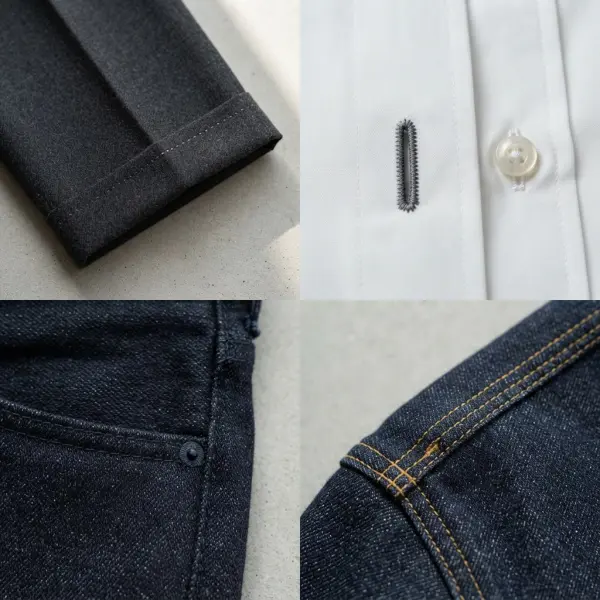
A blind hem stitch secures a folded hem while allowing only a very small portion of the stitch to appear on the garment face. It is commonly used on tailored trousers, skirts, dresses, coats, curtains, and formal garments where a visible row of topstitching would conflict with the intended appearance.
On domestic machines, blind hemming is often performed with a pattern combining several straight movements and an occasional side bite that catches the garment fold. Dedicated industrial blindstitch machines use a different mechanism designed for speed and controlled penetration.
The “blind” result is not automatically invisible. The visible mark depends on how deeply the needle catches the fabric, the fabric structure, thread color and fineness, machine adjustment, pressing, and operator control. A heavy needle bite on a fine satin may create visible dots or pulling, while an insufficient bite may fail to secure the hem.
Brother’s machine guidance distinguishes blind hem settings for non-stretch and stretch fabrics and instructs users to adjust stitch width so that the needle only slightly catches the fold.
Buttonhole Stitches
A machine buttonhole is a reinforced stitched opening designed to allow a button to pass through the fabric without leaving an uncontrolled raw slit. The stitch surrounds the opening, while bartacks or rounded ends secure the ends depending on the buttonhole style.
Domestic machines may create buttonholes through one-step or multi-step cycles. Industrial production often uses dedicated buttonhole machines selected according to garment category and required shape.
Common variations include:
- Rectangular buttonholes for shirts and lightweight garments
- Keyhole buttonholes for tailored jackets and heavier outerwear
- Rounded buttonholes for selected fashion applications
- Stretch buttonholes for certain knit constructions
- Corded buttonholes for additional dimension or reinforcement
Buttonhole length should be tested with the actual button, fabric, interlining, thread, and number of layers. A mathematically calculated opening may still be too tight after laundering or too loose when sewn into a soft, compressible material.
Buttonholes are highly visible and operationally sensitive. A small positioning error can misalign a placket, distort the garment front, or cause buttons to pull against the edge.
Bar Tacks and Reinforcement Stitches
A bar tack is a short, dense area of stitching used to reinforce a concentrated stress point. It is commonly placed at the top of pockets, the base of a fly, belt-loop ends, zipper openings, pleat terminations, and selected workwear components.
The function is not to strengthen the entire garment. It is to distribute or resist load at a specific point where normal wear repeatedly pulls on the construction.
Too little reinforcement may allow the component to tear away. Excessive density can also be harmful, especially on lightweight fabrics, because many needle penetrations within a small area may cut yarns, stiffen the material, or create an obvious visual block.
Industrial bar-tacking machines provide programmed stitch cycles for repeatable production. On a domestic machine, a short narrow zigzag or repeated reinforcement cycle may provide a functional approximation for samples and repairs, but it should be tested before commercial use.
Stretch Stitches on Domestic Machines
Many multipurpose sewing machines include patterns marketed as stretch stitch, lightning stitch, reinforced straight stitch, elastic stitch, or knit stitch. These names are not always standardized across brands.
The patterns generally use forward, backward, or lateral needle movements to create more extensibility or reinforcement than a basic straight stitch. They can be useful for prototyping knit garments when an overlock or coverstitch machine is unavailable.
They also have limitations:
- Some patterns are slow because the machine repeatedly moves forward and backward.
- Dense stitching can be difficult to remove during correction.
- The seam may become bulky on lightweight knits.
- The fabric can wave if feeding, presser pressure, needle, or tension is unsuitable.
- Commercial factories may not own an equivalent programmable machine.
- A domestic pattern name may not translate into an industrial stitch specification.
A sample should therefore distinguish between the intended performance and the exact equipment used to create the prototype. A factory should not be asked to “copy stitch number 12” from a domestic machine manual without receiving a seam sample, photograph, construction description, or recognized stitch designation.
Decorative Stitching and Topstitching
Decorative stitching is used primarily to create a visible surface effect, although it may also control an edge or add local reinforcement. Modern machines can produce scallops, geometric patterns, satin stitching, imitation hand stitches, and programmed motifs.
Topstitching is broader. It refers to visible stitching placed on the face of a garment and may be produced with lockstitch, chainstitch, coverstitch, or another formation.
In denim, topstitching contributes to brand identity, pocket design, and visual structure. On tailoring, restrained edge stitching may stabilize a lapel or pocket. On performance apparel, coverstitch may be deliberately exposed as a design feature.
Appearance depends on more than selecting a pattern. Thread thickness, needle point, stitch length, seam guide accuracy, spacing between rows, fabric recovery, and color contrast all influence the result.
How Domestic and Industrial Machines Differ
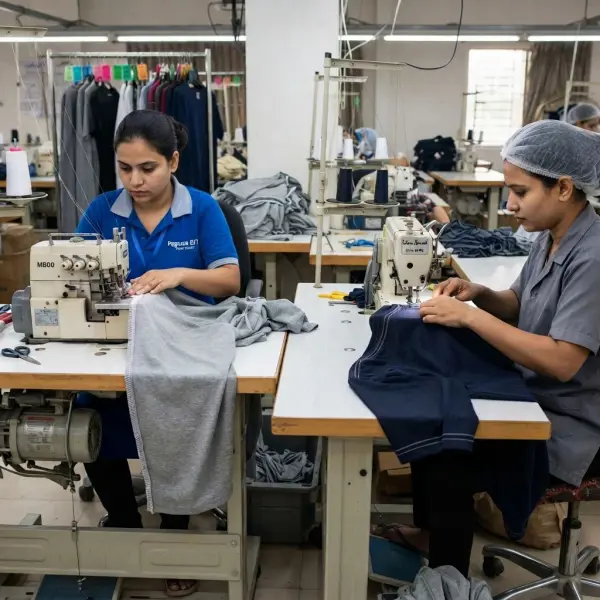
A domestic sewing machine is usually designed for versatility. One machine may provide straight, zigzag, blind hem, buttonhole, stretch, and decorative patterns by changing settings, presser feet, or electronic programs.
Industrial sewing machines are generally optimized for narrower operation groups. A garment factory may use separate machines for:
- Single-needle lockstitching
- Double-needle lockstitching
- Chainstitching
- Overlocking
- Safety stitching
- Coverstitching
- Blind hemming
- Buttonholing
- Button attaching
- Bar tacking
- Feed-off-the-arm or flatseaming
This specialization supports speed, repeatability, feeding control, attachment use, and consistent handling of particular materials. It also means that adding a stitch to a tech pack may affect line layout, subcontracting, equipment allocation, operator training, and cost.
JUKI’s industrial equipment catalog separates lockstitch, overlock, safety-stitch, zigzag, coverstitch, and double-chainstitch machines into distinct categories. Its lockstitch training also identifies needle motion, hook timing, feed mechanisms, presser-foot pressure, and thread tension as separate elements influencing sewing quality.
A fashion startup should confirm machine availability before finalizing a design that requires specialized operations. A factory that produces woven shirts efficiently may not have the correct coverstitch or flatseaming equipment for technical activewear.
How to Match a Stitch to the Garment Operation
The starting point is the function of the operation, not the list of stitches available on the machine.
|
Garment operation |
Common starting option |
What must be verified |
|
Joining stable woven panels |
Lockstitch or safety stitch |
Load, fraying, seam allowance, puckering |
|
Joining stretch knit panels |
Four-thread overlock or another extensible seam |
Required extension, recovery, bulk, skin comfort |
|
Finishing woven raw edges |
Three-thread overlock or another edge finish |
Fray level, transparency, laundering |
|
Hemming T-shirts |
Coverstitch |
Hem stretch, tunneling, skipped stitches |
|
Hemming tailored trousers |
Blind stitch |
Face visibility, fabric thickness, hem depth |
|
Attaching elastic |
Zigzag, three-step zigzag, overlock, or covering stitch |
Elastic recovery, stitch width, tension |
|
Reinforcing pockets |
Bar tack or designed reinforcement |
Fabric damage, position, density |
|
Creating button openings |
Machine buttonhole |
Button size, interlining, wash response |
|
Visible denim detail |
Lockstitch or chainstitch topstitching |
Thread size, feeding, wash effect |
|
Temporary assembly |
Long lockstitch or basting method |
Ease of removal, fabric marking |
This table is a starting framework rather than a substitute for testing. A stretch percentage measured in the fabric does not directly determine seam performance. The direction of stretch, seam orientation, garment fit, thread extensibility, stitch geometry, and user movement all matter.
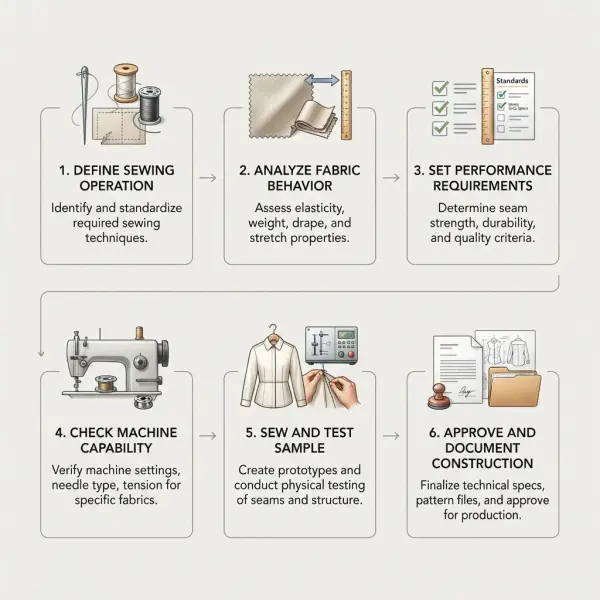
A Practical Stitch-Selection Process for Fashion Businesses
1. Define the Operation
State exactly what the stitching must accomplish. “Sew sleeve” is too vague. “Join the underarm seam of a lightweight stretch jersey while preserving extension and avoiding bulky interior ridges” is operationally useful.
2. Identify Material Behavior
Record whether the fabric is woven, knitted, nonwoven, coated, laminated, elasticated, highly fraying, transparent, compressible, abrasive, or sensitive to needle damage.
Material name alone is insufficient. Two fabrics described as polyester jersey may differ considerably in weight, stretch, recovery, yarn structure, surface finish, and heat sensitivity.
3. Define the Required Performance
Consider whether the seam needs:
- Structural strength
- Extensibility
- Recovery after extension
- Low bulk
- Soft skin contact
- Water or particle resistance
- Wash durability
- Minimal face visibility
- Decorative prominence
- Easy repair or alteration
Not every operation needs the highest possible strength. A delicate blouse hem and a workwear pocket opening require different priorities.
4. Review Available Equipment
Confirm that the sampling room and production factory can create the specified stitch consistently. If specialized equipment is unavailable, decide whether to change the construction, approve an alternative, or allocate the operation to another facility.
5. Build and Test the Actual Seam
Testing should use production-intent fabric, thread, needle, interlining, elastic, stitch settings, and finishing processes. Garment washing, dyeing, coating, pressing, and abrasion can change the final result.
6. Document the Approved Construction
The approved specification may include:
- Recognized stitch type
- Seam construction
- Stitch density
- Needle and thread requirements
- Seam allowance
- Stitch width or needle gauge
- Reinforcement location
- Start and stop treatment
- Appearance tolerance
- Reference photograph
- Sealed sample
- Required performance test
This converts a visual preference into a repeatable manufacturing instruction.
Business Implications of Stitch Selection
Product Development
A suitable stitch allows the pattern, fabric, and garment construction to behave as intended. An unsuitable choice may create restricted movement, distorted hems, bulky seams, visible impressions, or early thread failure.
Stitch decisions should therefore be reviewed during sampling rather than left entirely to the production floor. The relationship between construction and pattern accuracy is explored further in how accurate patterns improve garment fit and production quality.
Manufacturing Capacity
Specialized stitches can require dedicated machinery, folders, binders, guides, pullers, feed systems, or skilled operators. A design may appear simple in a sketch while introducing a production bottleneck because only one machine in the factory can perform a critical operation.
Before approving a collection, production planners should identify uncommon operations and estimate their impact on line balancing and subcontracting.
Cost and Thread Consumption
More complex formations frequently use additional needles, loopers, or covering threads. This can increase thread consumption and setup requirements. The cost impact per garment may be small, but it becomes material across high-volume production.
Coats’ thread-consumption guide lists different consumption ratios for lockstitch, chainstitch, overedge, safety, and covering stitches and emphasizes that density, fabric thickness, construction, and number of plies affect actual usage.
The correct commercial question is not simply, “Which stitch uses the least thread?” It is, “Which construction achieves the required performance and appearance with acceptable material, labor, equipment, and quality cost?”
Quality Control
Quality inspectors need measurable criteria. “Stitching must look good” is subjective. A useful inspection standard may address stitch density, seam width, alignment, skipped stitches, loose loops, puckering, visible needle damage, unsecured ends, differential feeding, and placement tolerances.
Detailed troubleshooting of broken threads, skipped stitches, seam puckering, looping, and fabric feeding should be handled as a separate operational topic. See common stitching problems and how to prevent them.
Brand Appearance
Stitching contributes to how a garment is perceived at close range. Even when customers cannot name the stitch type, they notice uneven topstitching, stretched necklines, twisted hems, bulky seam intersections, and poorly aligned buttonholes.
Premium appearance does not necessarily require decorative complexity. In many garments, consistent spacing, appropriate thread, clean tension, and restrained construction produce a more credible result than adding unnecessary stitch lines.
Common Stitch-Selection Mistakes
Treating Every Straight Stitch as Equivalent
A prototype may use domestic lockstitch while production uses chainstitch or another system. The face appearance can look similar, but extensibility, reverse-side formation, security, thread use, and finishing behavior may differ.
The better approach is to specify the intended formation and approve the production seam rather than matching only the top view.
Using Standard Lockstitch Across High-Stretch Areas
This happens when a team focuses on the clean appearance of straight stitching without testing the seam during dressing and movement. The result may be thread breakage or a seam that restricts the garment.
A more suitable approach is to define the required extension and test zigzag, overlock, chainstitch, coverstitch, or another engineered construction.
Assuming Overlock and Coverstitch Perform the Same Function
Both use loopers and are common in knit garments, but their primary applications differ. Overlock usually works at the fabric edge and can join or finish it. Coverstitch is commonly used to cover folded edges or create flexible rows of stitching across the fabric.
Substituting one for the other can alter the hem, seam bulk, appearance, and stretch.
Specifying a Domestic Stitch Icon in a Factory Tech Pack
Machine icons and stitch numbers vary by manufacturer. A symbol understood on one machine may have no direct meaning on another.
Use a recognized stitch designation where appropriate, supported by a seam diagram, photograph, physical sample, and clear operational description.
Increasing Stitch Density Without Considering Fabric Damage
More stitches per inch may appear stronger, but excessive needle penetration can perforate delicate or coated fabrics, contribute to seam puckering, or create a rigid line.
Stitch density must be balanced with thread size, needle size, fabric construction, seam type, and performance requirement.
Selecting Stitches Before Confirming Factory Capability
A collection may rely on keyhole buttonholes, multi-needle covering, flatseaming, or decorative chainstitching that the chosen supplier cannot produce.
Resolving this after purchase orders are placed may lead to redesign, outsourcing, delays, or inconsistent substitutes. Machine capability should be confirmed during development and costing.
Important Technical Caveats
A Stitch Name Is Not a Complete Specification
“Overlock,” “chainstitch,” and “coverstitch” each describe families containing several formations. Number of needles, number of threads, looper arrangement, stitch width, and machine setup can change the result.
Stitch Performance Is System-Dependent
No stitch is inherently strong, flexible, premium, or durable in every situation. Performance depends on the complete sewing system: fabric, seam construction, thread, needle, stitch density, feeding, tension, machine condition, operator control, and garment use.
ASTM D6193 specifically links seam security and appearance to multiple variables rather than stitch classification alone.
Domestic and Industrial Terminology May Differ
Consumer machine manuals often use descriptive names intended for ease of use. Industrial documentation is more likely to use stitch classifications, machine classes, and operation-specific terminology.
When moving from prototype to production, translate the intended function rather than assuming the names are interchangeable.
Physical Testing Remains Necessary
Standards and reference charts help teams communicate, but they do not replace a sewn trial on the actual material. The approved sample should be evaluated after relevant finishing and care processes.
Frequently Asked Questions
What is the most commonly used sewing machine stitch?
Straight lockstitch is one of the most commonly used formations in general garment assembly, particularly for stable woven fabrics. It is suitable for joining panels, attaching components, inserting zippers, sewing darts, and producing topstitching.
It is not the correct stitch for every operation. Knit garments frequently require overlock, chainstitch, coverstitch, zigzag, or another extensible construction. The choice should reflect fabric behavior and seam function rather than familiarity with the machine.
What is the difference between lockstitch and chainstitch?
Lockstitch commonly interlocks a needle thread with a bobbin thread inside the material. Chainstitch forms through interlooping needle and looper threads.
Lockstitch usually creates a balanced appearance and good resistance to accidental unraveling. Chainstitch can offer useful extensibility, avoids frequent bobbin replacement, and works efficiently on long production operations. However, some chainstitch formations can unravel if their ends are not secured correctly.
Neither is universally better. Suitability depends on the material, seam, machinery, production method, and required performance.
Can zigzag replace an overlock stitch?
Zigzag can control some raw edges and may be adequate for samples, home sewing, repairs, or low-volume construction. It does not normally trim the edge or create the same coverage, formation, feeding behavior, and productivity as a dedicated overlock machine.
For commercial production, the decision should consider fraying, seam appearance, wash durability, fabric stretch, labor time, and available equipment. A zigzag substitute should be approved through a physical sample rather than assumed to be equivalent.
Why do T-shirt hems usually have two parallel stitch lines?
Many commercial T-shirt hems are made with a two-needle coverstitch. The face shows two parallel rows, while looper thread covers the folded raw edge on the reverse.
This construction provides a clean appearance and useful extensibility for knit garments. A domestic twin needle can create a similar top appearance, but it uses a different thread formation and may not provide the same edge coverage or production consistency as a dedicated coverstitch machine.
Which stitch should be used for stretch fabric?
There is no single stitch for every stretch fabric. Options may include narrow zigzag, three-step zigzag, stretch patterns, chainstitch, overlock, coverstitch, or flatseam formations.
Selection depends on how far the fabric must extend, how well it recovers, the direction of stretch, seam orientation, garment fit, skin-contact requirements, and machine capability. A seam should be tested under realistic movement rather than judged only while lying flat.





Comments 0
Leave a CommentSend Comment
Anda harus Login terlebih dahulu untuk dapat memberikan komentar.