

Computerized Embroidery Explained for Fashion and Apparel Decoration
Quick Answer
Computerized embroidery is a method of decorating fabric or finished garments with stitches generated by an embroidery machine from digitally prepared design data. Instead of an operator manually guiding every stitch, a digitized embroidery design tells the machine where stitches should be placed, which stitch structures to use, when colors change, and how different design areas are sequenced.
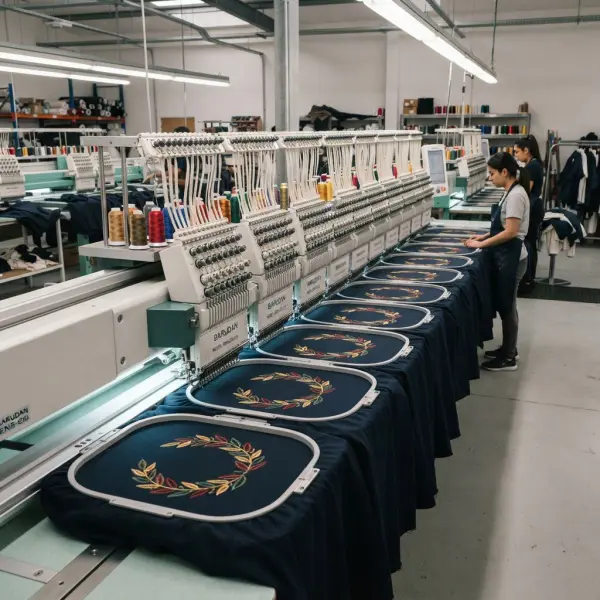
For fashion and apparel businesses, its value lies in repeatability, production control, and the ability to reproduce logos, lettering, motifs, patches, decorative surfaces, and personalized details across multiple products. Commercial systems range from single-head machines suited to sampling or customized pieces to synchronized multi-head machines designed to embroider the same design on several items simultaneously.
The technology does not eliminate embroidery craftsmanship. A visually attractive graphic still has to be translated into stitch structures that suit the design, fabric, thread, stabilizer, garment construction, and machine. Poor digitizing or inappropriate production settings can still produce puckering, distorted shapes, weak lettering, excessive stiffness, or inconsistent registration.
What Is Computerized Embroidery?
Computerized embroidery is a form of machine embroidery in which a digital embroidery design controls the placement and sequence of stitches used to reproduce a decorative motif on textile material. The digital instructions are interpreted by an embroidery machine, while the physical result still depends on thread, needle, fabric stability, hooping, machine setup, and operator control.
That distinction matters because computerized embroidery is sometimes described as if a normal image file could simply be uploaded and automatically stitched. In professional production, there is usually an intermediate process known as embroidery digitizing. Digitizing converts artwork into embroidery objects and defines properties such as stitch type, density, position, underlay, and compensation. Wilcom's technical documentation, for example, describes embroidery objects as carrying stitch-specific properties in addition to conventional design information such as size and position. Wilcom embroidery digitizing documentation
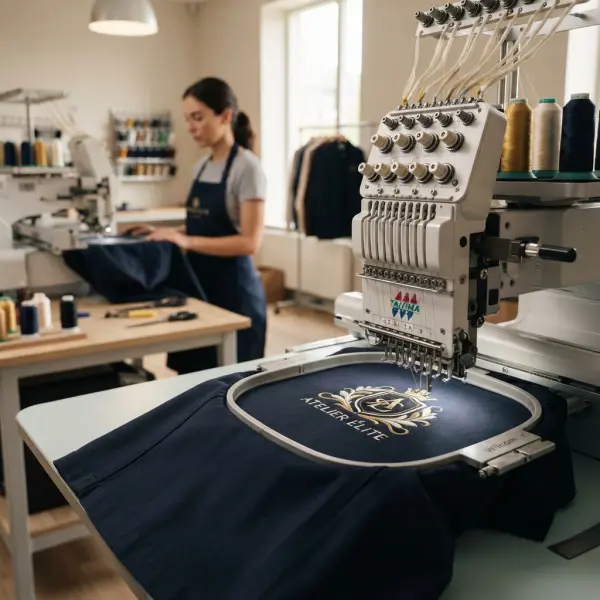
The machine then moves the embroidery frame or sewing field in coordination with the needle mechanism to form the programmed motif. Multi-needle machines can hold several thread colors, allowing color changes to occur without manually rethreading a single needle for each section. Commercial equipment may also incorporate automatic trimming, thread-break detection, positioning systems, or digitally controlled thread and presser-foot functions, although the exact capabilities vary considerably by model.
This combination of digital planning and mechanical stitching is what makes computerized embroidery useful to apparel businesses. The same design can be reproduced repeatedly, but each application can still require adjustments when the base material, placement, garment shape, or finished appearance changes.
How Does Computerized Embroidery Work?
At a basic level, computerized embroidery connects design preparation with controlled machine stitching. The workflow normally begins before the garment reaches the embroidery machine, because the design has to be interpreted as stitches rather than simply treated as printed artwork.
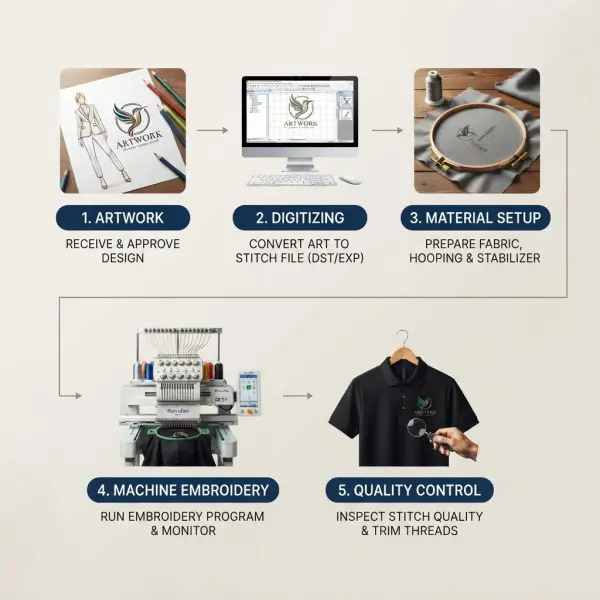
A typical fashion-production workflow can be understood through five broad stages:
- Artwork or motif preparation. A logo, illustration, monogram, decorative motif, or lettering concept is selected and cleaned up if necessary.
- Embroidery digitizing. The design is converted into embroidery objects and stitch instructions, including stitch structures, sequence, density, underlay, and other production parameters.
- Material and production preparation. Fabric or garments are matched with suitable thread, needles, stabilizers, hoops or frames, and machine settings.
- Machine embroidery. The design is loaded into a compatible embroidery machine and stitched according to its programmed sequence.
- Finishing and quality control. Excess backing, loose threads, registration, shape, surface appearance, and placement are inspected before the item moves to the next production stage.
The second stage is important enough to deserve its own discussion, which is why how digital embroidery files turn designs into stitched motifs should be treated separately from this broader introduction. Digitizing involves more than selecting a file extension, and its quality often determines whether a design that looks clean on screen remains clean when interpreted in thread.
The Digital Design Is Only Part of the Embroidery System
It is tempting to think that once a design is digitized correctly, the rest of the process becomes automatic. In reality, embroidery quality emerges from an interaction between the design data and the physical textile system.
The same embroidered logo can behave differently on a tightly woven cotton shirt, a stretch polo knit, a soft fleece sweatshirt, lightweight satin, denim, or a structured cap. Stretch, fabric thickness, surface texture, dimensional stability, seam construction, and the amount of support provided underneath the fabric can all affect stitch appearance.
Wilcom specifically notes that fabric characteristics influence embroidery parameters such as density, pull compensation, underlay, and stitch behavior. Stretchy knits generally require different stabilization and compensation from stable woven materials, while thicker fabrics may need a different balance of stitch spacing and support. Wilcom guidance on embroidery fabric settings
For a fashion business, that means a successful sample on one substrate should not automatically be treated as final approval for every colorway, material, or garment version. Moving the same logo from a cotton tote bag to a stretch jersey shirt, for example, may require changes in stabilization or embroidery settings even if the artwork remains identical.
This is why experienced embroidery production teams usually evaluate the stitch-out, not only the digital preview.

What Types of Stitches Are Used in Computerized Embroidery?
Computerized embroidery can generate many decorative effects, but most conventional apparel designs are constructed from a relatively small group of fundamental stitch structures. The digitizer chooses among them based on the width, shape, scale, visual effect, and material.
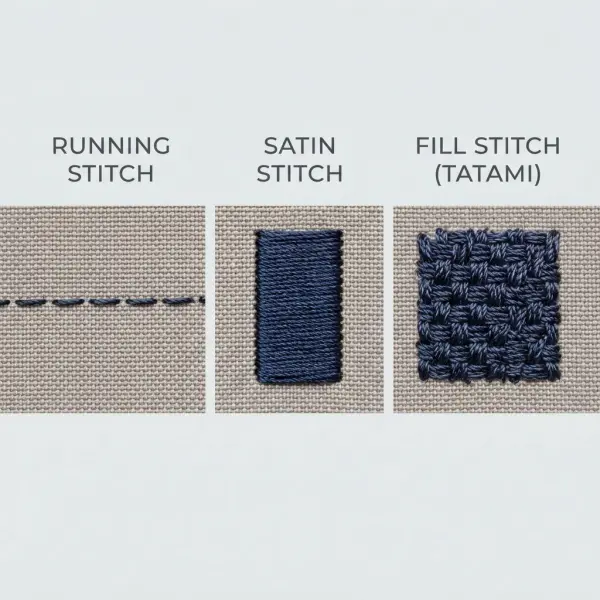
Three common categories illustrate how digital design decisions become physical surfaces.
Running stitches
Running stitches form relatively thin lines and are useful for outlines, fine details, travel paths, and certain decorative effects. Because they use relatively little thread compared with dense filled areas, they can also help create lightweight linework where a satin or fill structure would be inappropriate.
Satin stitches
Satin stitching produces closely arranged stitches that span from one side of a narrow shape to another. It is commonly associated with lettering, borders, monograms, and logo elements because the continuous thread direction can create a smooth and visually pronounced surface.
The suitability of satin stitching depends on the width and geometry of the object. Very wide areas may require different treatment because excessively long stitches can become vulnerable to snagging or lose structural control.
Fill or tatami stitches
Fill structures are commonly used for larger areas where repeatedly spanning an entire shape with satin stitches would be impractical. Wilcom describes tatami as a fill method for larger or irregular shapes and notes that its density is controlled by the spacing between stitch rows. Wilcom guidance on tatami stitch density
These categories are not simply visual styles. Each changes stitch count, production time, thread consumption, fabric loading, surface texture, and potentially the handfeel of the embroidered area.
Why Underlay, Density, and Compensation Matter
One of the clearest differences between basic artwork conversion and professional embroidery digitizing is the attention paid to what happens underneath and around the visible stitches.
Underlay is stitching placed beneath the visible cover stitches to provide support. Depending on the design and material, it can help stabilize the fabric, improve edge definition, lift top stitching away from soft surfaces, and reduce distortion. Wilcom notes that underlay can help reduce puckering and pulling and can prevent cover stitches from sinking into soft or textured fabrics. Wilcom explanation of embroidery underlay
Density describes how closely stitch rows or penetrations are arranged within a stitched area. More density does not automatically mean better embroidery. Excessive stitching can make a design stiff, increase production time, place unnecessary stress on lightweight material, or cause thread buildup. Insufficient coverage can expose the substrate or make shapes appear weak.
Pull compensation addresses the tendency of stitched areas and fabric to draw inward during embroidery. The amount needed is affected by factors including material, object geometry, stitch structure, and embroidery settings. Compensation that works for one fabric should therefore not be treated as a universal number.
These adjustments show why embroidery production remains a technical craft even when the machine itself is digitally controlled.
Stabilizer and Hooping Are Part of the Technology, Too
Embroidery machines need a controlled surface on which to stitch. Fabric that shifts, stretches, wrinkles, or collapses during stitching can undermine even a carefully prepared digital design.
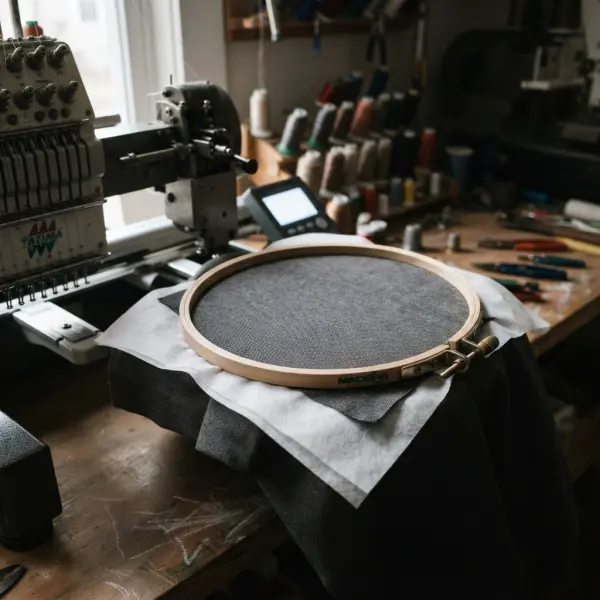
A stabilizer, sometimes referred to as backing, supports the material during embroidery. Different stabilizer families include tear-away, cut-away, water-soluble, adhesive, and other specialized constructions. Selection depends on garment material, embroidery density, required finish, access to the back of the garment, wash requirements, and the amount of long-term support needed.
Brother's embroidery guidance recommends stabilizing stretch, lightweight, coarse-weave, or otherwise unstable fabrics and emphasizes that fabric should be secured appropriately in the embroidery frame. It also warns that poorly held fabric can contribute to poor embroidery results. Brother embroidery preparation guidance
Hooping is equally important. The objective is not simply to make the material as tight as possible. Fabric should normally be held securely without being unnecessarily stretched out of its natural state. Brother's general embroidery workflow similarly instructs users to keep the fabric and stabilizer taut but not stretched.
This detail becomes commercially important when producing repeated garments. Poorly standardized hooping can create small placement differences or distortion from item to item, particularly on flexible garments.
Computerized Embroidery Machines Range From Studio Tools to Factory Equipment
Computerized embroidery is not one single machine category. Equipment is available for home use, small studios, customization businesses, sampling departments, embroidery contractors, and industrial-scale apparel production.
For commercial fashion applications, two distinctions are especially useful: single-head versus multi-head, and flat versus cylinder-type production.
A single-head commercial machine stitches one item or embroidery position at a time and can suit sampling, personalization, development work, or smaller production volumes. For example, Tajima lists commercial single-head equipment intended for items such as uniforms, caps, socks, bags, and in-store personalization.
Multi-head machines synchronize several embroidery heads so multiple pieces can be stitched with the same design during one production cycle. Tajima's multi-head cylinder systems are positioned for finished garments such as uniforms and caps, while its flat multi-head systems are designed for embroidering fabric or garment parts before assembly. Tajima commercial flat embroidery systems
The distinction affects workflow. Embroidering a chest logo onto completed polo shirts presents different handling requirements from embroidering decorative panels before those panels are sewn into jackets.
For apparel manufacturers, the best equipment configuration therefore depends less on whether a machine is simply “computerized” and more on product type, order volume, placement, design complexity, available labor, changeover frequency, and production architecture.
Where Computerized Embroidery Is Used in Fashion
Computerized embroidery is versatile because the process can create both functional identification and decorative surface design. Its applications extend well beyond conventional corporate logos.
Fashion and apparel businesses commonly use embroidery for:
- brand logos and monograms;
- chest, sleeve, collar, pocket, or back motifs;
- names and personalized lettering;
- patches and badges;
- decorative borders and repeating motifs;
- sportswear and uniform identification;
- cap embroidery;
- children's wear and casualwear details;
- bags and textile accessories;
- fashion collections using embroidery as a surface-design element.
Specialized embroidery equipment can extend these possibilities further. Chenille embroidery, for example, uses loop and chain constructions to create the textured appearance commonly associated with varsity-style patches and dimensional casualwear decoration. Tajima manufactures dedicated systems for this technique rather than treating it as simply another setting on a conventional embroidery head.
Not every embroidery effect is suitable for every machine, however. Sequins, beads, chenille, cording, and other specialty treatments may require additional hardware or specialized equipment.
Computerized Embroidery Compared With Hand Embroidery and Basic Machine Embroidery
Computerized embroidery shares its basic decorative purpose with older embroidery methods, but the production logic is different.
|
Factor |
Computerized Embroidery |
Hand Embroidery |
|
Stitch control |
Primarily governed by digitized design and machine settings |
Controlled manually by the embroiderer |
|
Repeatability |
Designed for relatively consistent repetition when setup remains controlled |
Natural variation between pieces is common |
|
Production speed |
Suitable for repetitive machine production |
Generally labor-intensive |
|
Personalization |
Efficient once names or designs are prepared digitally |
Possible, but created manually |
|
Artistic variation |
Controlled through digitizing, thread, stitch effects, and machine capability |
Highly flexible through direct hand manipulation |
|
Best suited to |
Branded apparel, repeat motifs, customization, commercial production |
Craft, couture, artisanal surfaces, unique pieces |
The distinction should not be interpreted as “computer embroidery versus craftsmanship.” The craftsmanship has partly moved into different activities: artwork interpretation, digitizing, sampling, machine setup, thread selection, material preparation, quality control, and production judgment.
For certain luxury or artisanal products, visible handwork may itself be part of the product value. Computerized embroidery serves a different operational need: reproducing stitch-based decoration with greater consistency and scalability.
Why Fashion Businesses Use Computerized Embroidery
Repeatability is probably its clearest operational advantage. Once a design has been digitized, sampled, tested, and approved for a particular product configuration, the embroidery process can be repeated more consistently than reconstructing the motif manually for every garment.
That can be especially useful for uniforms, branded collections, merchandise, sportswear, schoolwear, corporate apparel, accessories, and repeat fashion programs where visual consistency matters.
Computerized embroidery also works well for personalization. Names, initials, numbers, or variations of an approved motif can be incorporated into a digital production workflow. Single-head and modular commercial machines are particularly relevant when a business handles many small or variable orders rather than one enormous run of identical items.
At the opposite end of the spectrum, synchronized multi-head machines support production of repeated designs across multiple pieces. This makes embroidery adaptable to both customization and larger manufacturing programs, provided the production system is matched to the order structure.
The commercial appeal is explored more deeply in why embroidery technology supports custom and premium fashion products. Embroidery can contribute texture, perceived craftsmanship, customization, and product differentiation, but technology alone does not make a garment premium.
What Determines Embroidery Cost and Production Time?
Machine ownership is only one component of embroidery economics. For actual jobs, production time and unit cost can be influenced by design complexity, total stitch count, number of color changes, hooping and loading time, trimming, garment handling, setup, testing, and finishing.
A small logo is not necessarily inexpensive if it contains intricate lettering, frequent color changes, difficult placement, or material that requires slow handling. Conversely, a somewhat larger motif may run efficiently if its stitch structure and production sequence are straightforward.
Fashion businesses evaluating embroidery quotations should therefore look beyond dimensions alone. Useful production questions include:
- What is the approximate stitch count?
- How many thread colors and color changes are required?
- Is the garment embroidered before or after assembly?
- Does the location require specialized framing?
- Is additional stabilization needed?
- Is the design being produced on one substrate or several?
- How much sampling is required before bulk production?
- Is trimming or backing removal labor-intensive?
The answers help explain why two motifs of similar visual size can have very different production costs.
Common Computerized Embroidery Problems
Treating embroidery like printing
One common mistake is assuming that every line, gradient, tiny detail, or small typeface visible in artwork can be translated directly into thread. Embroidery has physical constraints: thread has thickness, stitches need room to form, and the fabric moves under repeated needle penetration. A better approach is to evaluate artwork specifically for embroidery and simplify details where necessary rather than forcing the machine to imitate print resolution.
Using the same embroidery settings on every fabric
A logo approved on stable woven fabric may behave differently on piqué, fleece, jersey, or satin. Using identical density, underlay, stabilization, and compensation can lead to distortion or a visibly different result. Material-specific sampling should therefore be part of approval whenever the substrate changes significantly. Wilcom's fabric guidance explicitly adjusts several embroidery parameters according to substrate characteristics.
Solving coverage problems only by increasing density
When background fabric shows through, the instinct may be to pack in more stitches. That can make the embroidery heavy without correcting the underlying stabilization problem. Appropriate underlay, stitch direction, thread coverage, fabric preparation, and object construction should be reviewed before density is increased indiscriminately.
Resizing machine files without evaluating stitch behavior
Scaling artwork on screen is easy; scaling embroidery is more complicated. Some working-file formats retain object information that allows stitches to be regenerated, while exported machine stitch files may retain less editable design intelligence. Hatch, for example, distinguishes its editable EMB working format from exported machine formats and notes that machine files do not preserve as much information. Hatch embroidery file format guidance
Approving only the screen preview
A virtual stitch preview is valuable for checking sequence and obvious construction issues, but it cannot fully reproduce the interaction among thread, fabric, stabilizer, tension, needle, and garment geometry. Production approval should ultimately be based on a physical stitch-out using material and conditions representative of the intended product.
How Fashion Businesses Can Apply Computerized Embroidery Strategically
The most useful way to introduce embroidery is to treat it as part of product development rather than as a decoration ordered at the last minute.
Start with the intended product. A heavyweight varsity jacket, lightweight blouse, knit polo, denim overshirt, cap, and tote bag create very different embroidery conditions. Design scale and placement should therefore be evaluated together with the garment construction and fabric.
Next, build a repeatable approval process. Brands working regularly with embroidery can keep approved artwork, editable embroidery source files, thread references, approved dimensions, placement specifications, and physical samples as part of the product specification library. This reduces the risk of rebuilding the same design differently every season.
For production, define exactly what has been approved. A useful embroidery specification may include design identification, finished dimensions, thread color references, location, distance from seams or garment landmarks, orientation, approved substrate, backing requirements, and a reference stitch-out.
Finally, evaluate embroidery in the context of the product's value proposition. A small embroidered monogram may support understated branding on premium basics, while dense decorative embroidery can become a dominant visual feature. Neither approach is inherently better. The appropriate treatment depends on design intent, garment price architecture, production cost, material capability, and customer expectations.

What Should Brands Verify Before Approving Computerized Embroidery?
Before bulk production, the most important question is not whether the embroidery machine can technically stitch the file. It is whether the complete combination of design, material, placement, and process produces an acceptable garment.
Brands should verify:
- the design dimensions and placement on the actual garment;
- legibility of small lettering and fine details;
- stitch density and surface coverage;
- edge definition and registration between design elements;
- puckering or distortion around the motif;
- garment stretch or stiffness after embroidery;
- compatibility of backing with comfort and product finish;
- thread appearance against the actual fabric color;
- performance around seams, pockets, curves, or thick layers;
- consistency between samples and planned production equipment.
The approval sample should ideally represent real production conditions. A sample stitched on spare cotton merely to evaluate the motif is useful during development, but it is not a substitute for testing the actual fabric or garment construction.
Important Technical Caveats
Computerized embroidery improves repeatability, but it does not guarantee identical visual results under every condition. Material variation, thread tension, needle condition, hooping, stabilizer choice, machine maintenance, operator setup, and garment construction can all influence the finished surface.
Machine speed also should not be confused with actual production throughput. Manufacturers may specify maximum stitching speeds, but the achievable rate for a real job can be lower depending on the design, material, machine configuration, frame, thread behavior, and quality requirements. For example, current Tajima commercial machine specifications include maximum speeds around 1,000–1,200 rpm on several models, while Melco specifies up to 1,500 stitches per minute for one commercial system; those figures are equipment capabilities rather than guaranteed garment output rates.
The technology should therefore be viewed as controlled manufacturing rather than push-button reproduction. Good equipment expands what an embroidery operation can do, but reliable output still requires appropriate digitizing, setup, material knowledge, and quality management.
Frequently Asked Questions
Is computerized embroidery the same as machine embroidery?
Computerized embroidery is a type of machine embroidery, but the term usually emphasizes that stitch placement and sequencing are controlled by digitally prepared embroidery data. Some forms of machine embroidery can involve much more manual fabric guidance or simpler mechanical systems. In modern fashion decoration, computerized embroidery generally refers to machines that read an embroidery design file and execute its programmed stitch sequence. Commercial versions may add multiple needles, automatic trimming, multi-head production, positioning tools, and other production features.
Can a JPG, PNG, or logo file be sent directly to an embroidery machine?
Usually not as a production-ready embroidery design. Artwork normally has to be digitized so that visual shapes become embroidery objects or stitch instructions. Image files may be imported into embroidery software as artwork references, but the software or digitizer still needs to define how those shapes are stitched. Some software includes automatic conversion tools, yet complex logos commonly need review and adjustment. The detailed artwork-to-stitch process is addressed in digital embroidery file preparation.
What embroidery file format is most common?
There is no single universal embroidery format used by every machine. Common machine-oriented formats include DST, PES, EXP, JEF, VP3, and others, while embroidery software may also maintain richer editable working files. Hatch's current format documentation, for example, lists Tajima DST, Brother PES, Melco EXP, Janome JEF, and several other supported formats. The important operational question is therefore which format the intended machine accepts and whether the editable source file is also being preserved.
Can the same embroidery file be used on any fabric?
A file may technically be loadable regardless of fabric, but that does not mean the same setup will produce the same quality. Fabric stretch, thickness, weave, surface pile, and dimensional stability can change how stitches behave. Density, underlay, compensation, stabilizer, needle selection, and hooping may need adjustment. For fashion production, a new material should normally be tested rather than assuming that an approved embroidery setup can be transferred unchanged.
Does computerized embroidery work on finished garments?
Yes. Commercial cylinder-type machines are specifically designed to handle many finished products, including shirts, uniforms, caps, sleeves, pockets, bags, and other tubular or difficult-to-access items. Flat multi-head equipment is also widely used to embroider fabric panels or garment parts before assembly. The preferred workflow depends on placement, garment construction, quantity, and accessibility of the embroidery area.
Is computerized embroidery suitable for small fashion brands?
It can be, especially when embroidery is outsourced or produced on flexible single-head equipment. Small brands do not necessarily need to purchase industrial multi-head machinery to use embroidery effectively. The decision to bring production in-house should account for expected order volume, personalization demand, machine utilization, digitizing skills, operator labor, maintenance, space, and capital cost. Outsourcing often remains practical when embroidery volume is inconsistent or highly specialized.
Does embroidery automatically make a garment look premium?
No. Embroidery can add texture, dimension, customization, and visible craft cues, but poor digitizing, excessive stitch density, weak placement, inexpensive-looking artwork, or inappropriate material combinations can produce the opposite effect. Premium perception depends on the entire product—including garment material, construction, embroidery execution, design restraint, finishing, branding, and pricing context. Technology is an enabling production method, not a guarantee of premium positioning.
Conclusion
Computerized embroidery combines digital design preparation with controlled textile stitching, giving fashion businesses a practical way to reproduce logos, lettering, decorative motifs, patches, and personalized details across apparel and accessories. Its commercial strength comes from repeatability and production flexibility: the same underlying technology can support a single customized garment, small-batch brand merchandise, or synchronized multi-head factory production.
The important qualification is that embroidery remains a material process. A design that looks correct on screen still has to work as thread moving through real fabric. Stitch structure, density, underlay, compensation, stabilization, hooping, thread selection, garment construction, and machine configuration all contribute to the finished result.
For brands, the best approach is therefore to treat computerized embroidery as part of product engineering as well as decoration. Digitize for the intended substrate, test on representative material, approve physical stitch-outs, document the production specification, and preserve editable design files. When those disciplines are in place, computerized embroidery becomes a highly adaptable tool for repeatable fashion decoration without reducing embroidery to a simple push-button process.




Comments 0
Leave a CommentSend Comment
Anda harus Login terlebih dahulu untuk dapat memberikan komentar.