
Quilted Fabric Explained: Structure, Warmth, and Fashion Uses
Quilted fabric is one of those textile structures that combines an immediately recognizable appearance with a practical construction purpose. Its stitched patterns, raised surfaces, and layered composition can provide insulation, softness, and dimension, making it useful in everything from lightweight jackets to structured accessories.
Yet quilting is not simply a decorative pattern sewn onto fabric. The way its layers are assembled, the materials used between them, and the placement of the stitching all influence how the finished textile feels, moves, retains warmth, and performs during wear.
For fashion designers and apparel businesses, understanding these characteristics helps explain why two fabrics with similar diamond stitching can behave very differently. One may be soft and flexible enough for a transitional jacket, while another creates the structured body required for a tote bag or protective accessory.
The distinction matters when selecting materials, developing garment samples, estimating production costs, or communicating product benefits to customers.
Quick Answer: What Is Quilted Fabric?
Quilted fabric is a layered textile structure in which two or more material layers are secured together with stitching, usually with a layer of batting or wadding between them to provide thickness, insulation, or a raised surface texture. The stitching holds the layers together and creates recognizable patterns such as diamonds, squares, parallel channels, or decorative curves.
In apparel, quilted fabric is commonly used for jackets, vests, coats, garment linings, and accessories. Its practical advantages can include warmth, dimensional stability, cushioning, and a distinctive visual finish.
However, not every quilted fabric provides substantial insulation. Warmth depends on the type and quantity of filling, the amount of air retained within the structure, fabric permeability, quilting density, and the construction of the finished garment.
For fashion businesses, the central consideration is matching the quilted structure to the product's intended function. Lightweight quilting may be appropriate for indoor layering or decorative clothing, while colder-weather outerwear requires more careful evaluation of insulation, wind protection, mobility, and overall thermal performance.
What Is Quilted Fabric and How Is It Constructed?
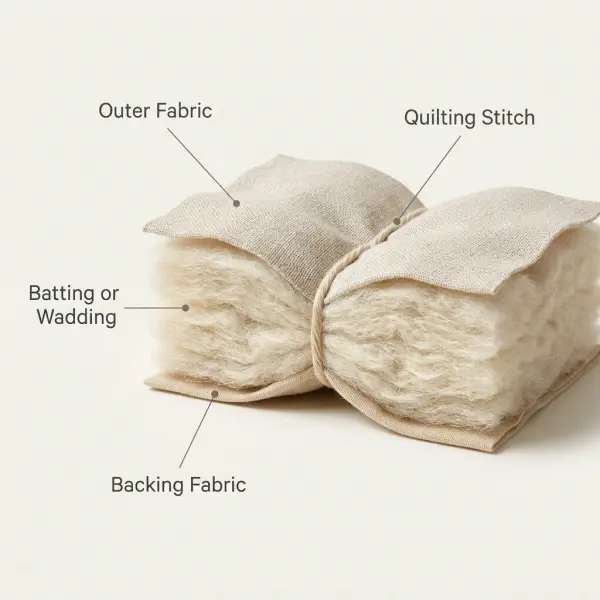
Quilting is fundamentally a method of joining textile layers. In its most familiar apparel form, an outer fabric and a backing fabric surround a middle layer of padding, with stitching passing through the assembled materials to hold them in position.
The resulting textile has both physical depth and visible surface structure. Areas between the stitching lines can appear raised, while the stitched lines compress the layers into a defined pattern.
The Textile Research Centre in Leiden describes quilting as a sewing technique that joins multiple layers of cloth and notes that padding is common but not universal. This distinction is useful because some decorative quilted textiles contain little or no insulating fill. The broader construction is documented in its explanation of quilting techniques.
Understanding the Three Main Layers
Most commercially produced padded quilted fabrics contain three functional components.
Outer or face fabric. This is the visible surface that influences appearance, durability, touch, and protection from external conditions. Common options include woven polyester, nylon, cotton, cotton blends, and other fabrics selected according to the garment's intended use.
Batting or wadding. The middle layer creates much of the material's thickness and can provide thermal insulation or cushioning. Polyester fiberfill is common, although cotton, wool, and other insulating materials may be appropriate for specific products.
Backing fabric. The inner layer helps contain the padding, supports the quilted assembly, and may function as a garment-facing surface. Depending on the product, it may be a lightweight woven fabric, knitted backing, or another compatible textile.
These layers must work together rather than being selected independently. A dense outer shell combined with thick batting and a lightweight backing may produce an effective insulated panel, but its final comfort will still depend on stiffness, vapor transport, garment fit, and the location of seams.
Why the Stitching Matters
The visible stitching performs more than an ornamental role. It secures the layered materials, helps control movement of the filling, and determines the placement of raised and compressed areas.
Without sufficient stabilization, some types of insulation can shift, bunch, or lose their intended distribution during use or cleaning. Conversely, excessive stitching may compress too much of the insulating layer and produce a flatter, less flexible textile.
This creates a practical trade-off. The pattern must provide enough structural control to maintain the material's appearance and performance without unnecessarily compromising loft, comfort, or movement.
The ideal stitch arrangement therefore depends on the filling, shell fabric, panel dimensions, and product application rather than appearance alone.
How Does Quilted Fabric Provide Warmth?
Quilted fabric can provide warmth because its layered structure contains insulating material that slows heat transfer between the body and the surrounding environment. Much of the insulating effect comes from air retained within the filling, rather than from the visible quilting pattern itself.
Air conducts heat relatively poorly when it is held within a stable textile structure. Fibrous insulation helps limit air movement, reducing heat loss under suitable conditions.
However, the actual warmth of a quilted garment cannot be determined from thickness alone. Wind exposure, moisture, fabric construction, body movement, garment openings, and the distribution of insulation all influence the result.
Insulation Loft and Trapped Air
Loft refers to the thickness or volume maintained by an insulating material. A filling that retains a suitable three-dimensional structure can trap air within and between its fibers.
For example, a lightweight polyester batting may provide useful insulation in a casual jacket while allowing moderate flexibility. A thicker insulating layer may retain more air under comparable conditions, but it also adds bulk and can affect the garment's fit.
Two fillings of identical thickness may perform differently because of their fiber composition, density, resilience, and internal construction.
This is why brands should evaluate complete material assemblies rather than assuming that a visibly puffier textile is necessarily warmer.
Quilting Density and Heat Loss
Stitch spacing influences both material stability and thermal performance.
When stitching passes through the entire padded structure, the thread compresses the insulating layer along the stitch line. These compressed areas generally contain less insulating air than the surrounding raised sections.
In sewn-through insulated garments, they can create localized areas of increased heat transfer, sometimes called cold spots or thermal bridges.
Research into sewn-through and alternative stitching arrangements for insulated jackets discusses this effect in the context of garment thermal efficiency. See the 2025 research on stitching and thermal performance in insulated jackets.
For product development, this means closer quilting lines may improve visual definition and filling stability but can reduce loft and alter how the garment bends. Widely spaced quilting may preserve more raised volume, although the spacing must remain compatible with the filling's construction and movement characteristics.
Why the Complete Garment Matters
A quilted panel should not be evaluated independently of the garment design.
Consider two jackets made with similar insulating layers. One has a tightly woven, wind-resistant outer shell, well-designed closures, and a fit that accommodates layering. The other has a more air-permeable shell, large openings, and compressed insulation around several seams.
They may feel substantially different in windy conditions even if their batting specifications appear similar.
Thermal performance can be evaluated through laboratory methods such as ISO 11092:2026, which specifies measurement of thermal resistance and water-vapor resistance for textile materials, including multilayer assemblies.
Such measurements support material comparison, but they do not establish a universal outdoor temperature rating or guarantee the comfort of a finished garment.
What Materials Are Used in Quilted Fabric?
Quilted textiles can be assembled from various combinations of natural and synthetic materials. The most suitable construction depends on the desired appearance, insulation, weight, care requirements, production process, and price positioning.
The face fabric determines much of the visible finish, while the filling is particularly important for thickness and cushioning. The backing contributes to internal comfort and compatibility with the overall construction.
Choosing the Outer Fabric
Woven polyester and nylon are frequently considered for lightweight quilted outerwear because they can provide relatively low fabric weight, useful mechanical strength, and controlled surface finishes.
Cotton and cotton-blend fabrics create a different appearance. Depending on their weave and finishing, they may offer a softer, more natural surface character suited to casual jackets, quilted overshirts, or lifestyle collections.
Heavier woven materials may be selected for accessories where dimensional stability and abrasion performance are more important than a soft garment drape.
Surface coatings, finishes, and treatments can further change how the material handles moisture and wind. These characteristics must be verified for the specific fabric rather than inferred from fiber content alone.
Comparing Common Batting Materials
The filling has a substantial influence on how the quilted structure behaves.
|
Filling material |
Typical characteristics |
Suitable applications |
Considerations |
|
Polyester batting |
Available in varied thicknesses and constructions; can provide resilient loft |
Jackets, vests, linings, accessories |
Thermal performance and recovery depend on fiber and batting construction |
|
Cotton batting |
Often creates a comparatively flatter, natural-fiber padded structure |
Casual apparel, heritage-inspired pieces, decorative quilting |
Shrinkage, drying behavior, and compression require evaluation |
|
Wool batting |
Can provide insulating properties with natural-fiber characteristics |
Selected premium outerwear and specialty textiles |
Cost, cleaning compatibility, and dimensional stability |
|
Blended batting |
Combines fibers to achieve a chosen balance of properties |
Lifestyle garments and custom fabric development |
Performance depends on the actual blend and bonding method |
|
Foam padding |
Can create cushioning and defined structure |
Selected bags, protective accessories, structured panels |
Flexibility, breathability, aging, and care compatibility |
This comparison is not a ranking of warmth or quality. The same fiber category can produce very different results depending on density, thickness, bonding, and manufacturing conditions.
Loose down and feathers are also used in insulated clothing, but they are generally managed through appropriate chambers or baffles rather than treated as interchangeable with continuous sheet batting.
Material Weight Is Not the Same as Insulation Performance
Textile specifications commonly use grams per square meter (GSM) to describe material mass per unit area.
For quilted fabrics, that measurement requires careful interpretation. A total composite GSM may include the shell, filling, backing, and stitching, while a separate batting GSM describes only the insulating layer.
Two suppliers may quote similar total weights despite using different layer combinations.
A brand comparing samples should therefore request both the total composite weight and the component specifications when available. Thickness and thermal resistance may also need to be measured separately, particularly when developing performance-oriented outerwear.
How Quilting Patterns Influence Texture, Flexibility, and Appearance
Quilting patterns give the textile its recognizable surface identity, but they also influence how the material bends, where it compresses, and how securely the filling remains distributed.
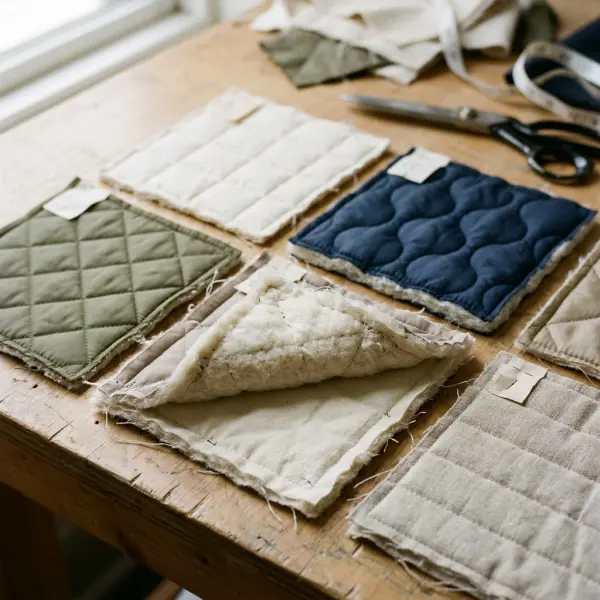
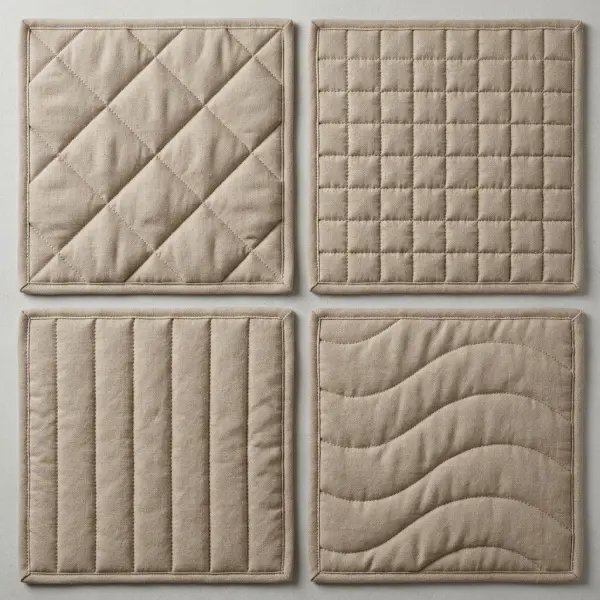
A large diamond pattern creates broader raised areas between crossing stitches. A smaller diamond grid typically produces a more closely articulated texture. Parallel channels create directional surface lines, while curved stitching can emphasize selected garment panels or decorative motifs.
The visual difference is clear. The structural consequences require closer consideration.
Diamond and Square Quilting
Diamond and square quilting are familiar options for jackets, vests, and accessories. Their repeated intersecting lines distribute stitching across the fabric surface and produce a recognizable geometric pattern.
The scale of these shapes changes the garment's visual proportions. A large diamond pattern on a long coat may create a relaxed, pronounced padded effect, while smaller diamonds can produce a more controlled surface.
Manufacturers must also consider how the pattern aligns across adjoining panels. Poor alignment at prominent seams can make otherwise well-sewn garments look inconsistent.
Channel Quilting
Channel quilting uses parallel stitching lines to create elongated sections.
Horizontal channels are particularly recognizable in insulated jackets, while vertical or diagonal channels may be selected for different visual or structural purposes.
When channels contain loose filling, their arrangement must adequately control migration of that filling. With continuous batting, the concern is more often the balance between stabilization, flexibility, and compression.
Channel direction can also affect how material folds around the body. A construction that looks attractive when laid flat may behave differently around shoulders, elbows, or curved garment panels.
Decorative and Irregular Quilting
Curved, wavy, or irregular stitch patterns allow designers to create a more distinctive surface without depending on prints or added embellishments.
These treatments can be effective in fashion collections where texture is central to product identity.
However, complex patterns introduce additional challenges in stitch consistency, repeat accuracy, production efficiency, and quality control. A decorative motif that is straightforward on a small sample may require substantial refinement before it can be reproduced consistently across a full garment.
Fashion Uses of Quilted Fabric
Quilted textiles serve different purposes depending on the product category. In insulated outerwear, the structure contributes to thermal comfort. In fashion garments with lighter padding, it may be valued primarily for texture and shape. In accessories, cushioning and dimensional stability may become more important than warmth.
This versatility explains why similar construction principles can appear across products with very different functional requirements.
Jackets, Coats, and Vests
Jackets and vests are among the most recognizable apparel applications.
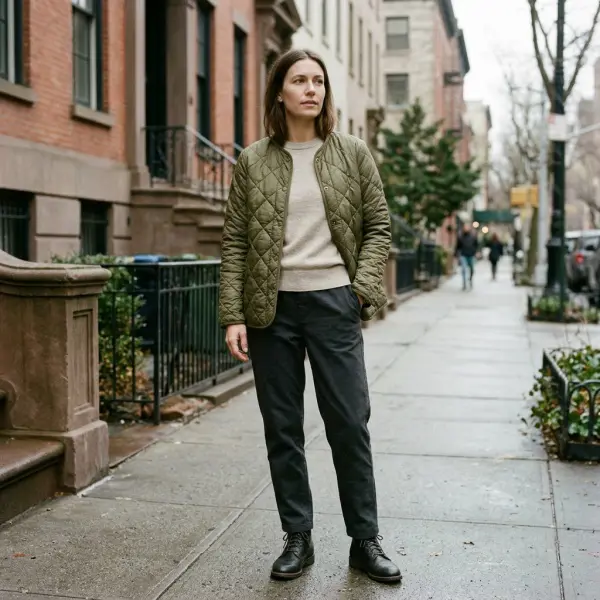
A quilted jacket can combine a lightweight shell, insulating batting, and backing into a relatively compact garment suitable for layering. Depending on the fabric and filling, it may be designed for transitional weather, everyday outdoor use, or more demanding cold-weather conditions.
For a fashion brand, the design brief should establish the intended environment before the material is selected. An urban lifestyle jacket may prioritize flexibility, silhouette, and easy care, while a technical insulated jacket needs more rigorous evaluation of warmth, wind protection, and moisture management.
The external styling can be similar even when the performance expectations are not.
Quilted Linings and Layering Pieces
Some garments use quilting inside rather than on the visible exterior.
A quilted lining can introduce an insulating layer beneath an outer shell while allowing the exterior garment to maintain a smoother appearance. This approach may be appropriate for selected coats, utility jackets, and winter garments.
The lining must still be compatible with the outer shell, particularly around the armholes, sleeves, closures, and hems. Excessive lining bulk can restrict movement or distort the outer garment.
The relationship between the garment shell and its internal construction is explored further in garment lining, comfort, and finishing.
Skirts, Overshirts, and Contemporary Casualwear
Quilting can also be used in garments where insulation is secondary.
A lightly padded overshirt may gain enough structure to create a distinctive silhouette without behaving like a heavy winter coat. Quilted skirts can develop a sculptural surface, although designers need to account for bulk around waistbands, seams, and areas of movement.
These applications often benefit from lower-loft batting and carefully controlled stitch spacing.
For brands producing apparel for milder climates, the objective may be texture and form rather than substantial thermal protection. That purpose should guide both fabric selection and product description.
Bags, Accessories, and Selected Footwear
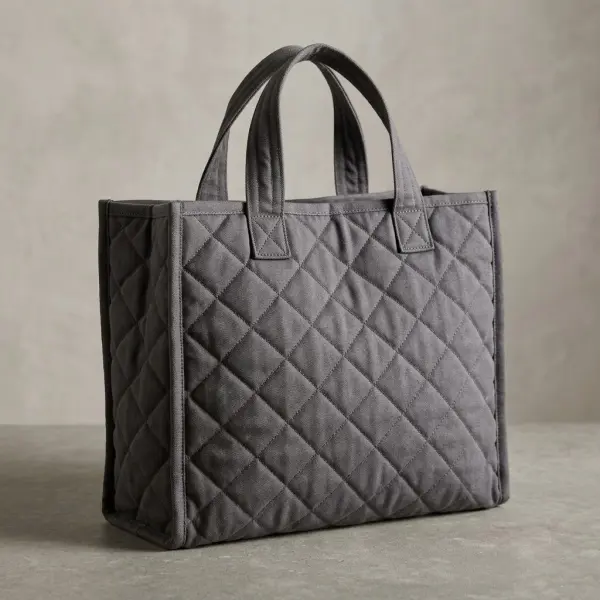
In accessories, quilted fabric can provide visual depth and moderate cushioning.
Tote bags, laptop sleeves, pouches, and cosmetic bags may use quilting to create a softer tactile surface while maintaining a recognizable product identity.
However, quilted batting should not automatically be treated as impact protection. A laptop sleeve intended to protect electronics may require additional cushioning materials, reinforcement, or construction testing.
Footwear designers may use quilted panels for surface texture or localized padding, but their suitability depends on abrasion exposure, moisture, flexibility, and the requirements of the footwear design.
From Fabric Selection to Garment Production
Working with quilted textiles introduces considerations that are less prominent with many single-layer fabrics. Because the material is already layered and stitched, cutting and sewing can affect several components simultaneously.
The production method also changes the workflow. A manufacturer may purchase pre-quilted fabric by the roll, quilt individual garment panels, or use a combination of outsourced quilting and in-house assembly.
Each method has implications for sample development, quality consistency, cost, and production flexibility.
Pre-Quilted Fabric Versus Quilting Garment Panels
Pre-quilted fabric arrives with its layers already joined. This can simplify downstream garment assembly and reduce the need for a separate quilting operation.
It may also limit design flexibility. The existing stitch pattern has to be accommodated during cutting, which can create challenges when matching geometric quilting across seams or positioning a motif precisely.
Quilting individual panels gives designers greater control over pattern placement and can reduce certain alignment problems, but it requires additional processing and consistent technical execution.
For smaller brands, the most practical choice often depends on supplier minimum order quantities, access to quilting equipment, approved sample requirements, and the complexity of the garment.
Managing Cutting, Seams, and Bulk
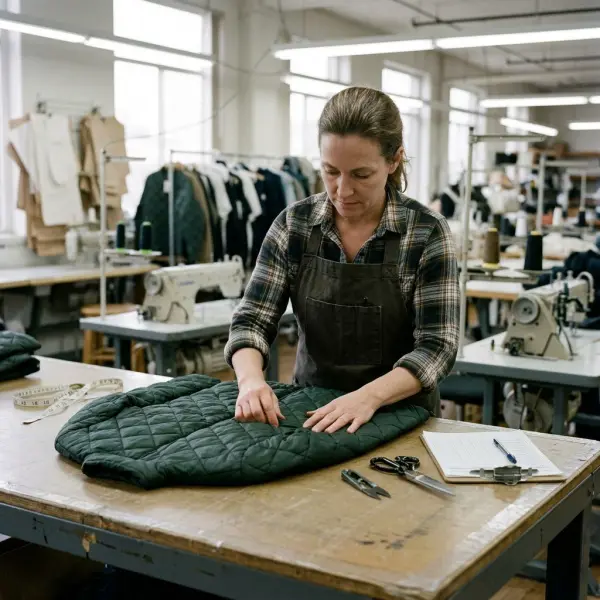
Quilted fabric behaves differently under cutting and sewing equipment because several layers must remain aligned.
Design teams should account for possible dimensional changes caused by quilting, particularly when preparing patterns from unquilted material. Fabric dimensions may change after the layers are stitched together, so patterns should be validated against the actual quilted state.
Seam construction also requires attention. Thick seam allowances may create uncomfortable ridges, while aggressive trimming can compromise the insulating layer or finish if performed incorrectly.
A lightweight jacket may use bound or carefully finished seams to limit exposed edges and control bulk. The appropriate technique depends on fabric composition, thickness, garment construction, and the machinery available.
Quality Control for Quilted Fabric
An effective quality review needs to assess the assembled material rather than judging only the outer surface.
Key inspection points include:
- Stitch consistency: Check that quilting lines are secure, appropriately spaced, and free from excessive skipped or broken stitches.
- Surface appearance: Identify puckering, distorted patterns, unwanted wrinkles, or irregular raised areas.
- Filling distribution: Check that the batting remains positioned correctly without conspicuous lumps or thin zones.
- Dimensional stability: Compare material dimensions before and after relevant cleaning or conditioning procedures.
- Seam performance: Inspect high-stress areas such as armholes, shoulders, pockets, and bag handles.
- Care compatibility: Confirm that the selected shell, backing, filling, and trims can tolerate the intended cleaning method.
Not every product requires the same testing program. A decorative fashion pouch and an insulated outdoor jacket face different performance risks, so inspection criteria should reflect actual use.
How Fashion Businesses Can Choose the Right Quilted Fabric
Selecting quilted material should begin with the finished product rather than with a visually appealing swatch.
A sourcing team reviewing a collection of fabrics may find several options with similar quilting patterns but different batting weights, shell constructions, flexibility, and manufacturing costs. Without clear product requirements, those choices can be difficult to compare objectively.
A useful evaluation framework includes the following decisions:
- Define the product's function. Determine whether quilting is intended primarily for warmth, cushioning, shape, or decorative texture.
- Specify the intended wear conditions. Establish the relevant climate, activity, layering requirements, and expected frequency of use.
- Evaluate the full material assembly. Request specifications for the face fabric, filling, backing, finished weight, and thickness.
- Test the actual construction. Review representative quilted panels and finished samples rather than relying only on loose batting or shell swatches.
- Check production compatibility. Confirm that stitch patterns, panel dimensions, seam designs, and equipment capabilities support repeatable manufacturing.
- Calculate the complete cost. Include quilting operations, material yield, cutting waste, assembly labor, finishing, testing, and any additional processing.
This framework helps prevent an attractive fabric selection from becoming an expensive production problem.
For example, a brand developing a moderately priced quilted vest may find that a standard pre-quilted polyester construction meets its design requirements more efficiently than a custom quilting pattern. A premium design-focused collection, however, may justify additional sampling and processing to achieve a distinctive appearance.
Neither approach is inherently superior. The commercial decision depends on product positioning, production quantity, and the value that the material contributes to the finished garment.
Supplier Communication and Material Specifications
A complete material request should identify more than color and quilting design.
Suppliers may need to confirm fiber composition for each layer, fill weight, total fabric weight, usable width, construction method, stitching arrangement, relevant care information, and applicable testing results.
Where thermal performance matters, a defined testing method and comparable sample conditions are preferable to broad descriptions such as “premium warm padding.”
Consistency between suppliers also matters. Two fabrics that look nearly identical in a photograph may have substantially different fill structures, stiffness, or recovery after compression.
Clear documentation reduces the likelihood of repeated sampling and inconsistent bulk-production outcomes.
Important Technical Caveats: What Quilted Fabric Does Not Guarantee
Quilting can support insulation, but it does not automatically establish a garment's warmth rating, water resistance, durability, or suitability for a specific climate.
A product may look substantial while using limited insulating material. Another may use effective insulation but lose heat through poorly designed openings, compressed areas, or a highly air-permeable shell.
The same caution applies to waterproofing. Conventional sewn-through quilting creates needle penetrations in the assembly, and a water-resistant face fabric does not make the complete quilted garment waterproof. Waterproof performance depends on the entire construction, including seams, closures, coatings or membranes where applicable, and appropriate testing.
Care performance also requires validation. ISO 6330:2021 provides standardized domestic washing and drying procedures for textile testing, while ISO 5077:2007 addresses dimensional change associated with washing and drying.
These methods support controlled evaluation; they do not replace product-specific acceptance criteria.
Environmental claims require similar care. Recycled polyester batting, natural-fiber padding, or a lower-material-weight construction may have relevant environmental attributes, but those attributes alone do not demonstrate that the completed product is environmentally preferable. Material sourcing, processing, durability, care, and end-of-life limitations should be considered together.
Common Mistakes When Working With Quilted Fabric
Assuming Thicker Quilting Always Means Better Warmth
A substantial raised surface can create the impression of greater insulation, but visual thickness is not a sufficient performance measure. Some padding compresses easily, while different fiber structures retain heat differently under comparable conditions. Brands that select fabric solely by appearance risk making product promises they cannot substantiate. A better approach is to evaluate filling construction, completed garment design, and appropriate thermal test results.
Choosing the Quilting Pattern Without Testing Movement
A tightly stitched geometric design may look refined on a flat material sample, yet become too rigid across an elbow, shoulder, or fitted waist. This happens when visual development is separated from garment fit testing. The result may be restricted movement, awkward folds, or unnecessary bulk. Designers should test pattern scale and stitch density on representative garment panels before final approval.
Ignoring Material Compatibility Across Layers
A quilted textile combines materials that may respond differently to washing, drying, and mechanical stress. If the face fabric and backing change dimensions differently, the surface may pucker or distort. A filling that loses its loft can also alter the garment's appearance. Suppliers and product developers should evaluate the complete composite rather than assuming each individually acceptable component will perform well when combined.
Underestimating Production Complexity
Custom quilting can introduce additional production stages, alignment requirements, quality checks, and material handling. Small brands may initially compare only the price of the outer fabric and batting, overlooking quilting labor and downstream garment assembly. This can create unexpected differences between estimated and actual product cost. Sampling should establish repeatable construction methods before prices and delivery schedules are finalized.
Confusing Visual Texture With Product Performance
A fashionable quilted jacket does not necessarily perform like technical outdoor apparel. The distinction becomes especially relevant when product descriptions reference warmth, weather protection, or specialized use. Unsupported performance claims can create customer dissatisfaction and commercial risk. Brands should explain the material's verified characteristics rather than relying on broad words such as “thermal,” “weatherproof,” or “all-season.”
Frequently Asked Questions About Quilted Fabric
Is Quilted Fabric the Same as Padded Fabric?
No. Quilted fabric refers primarily to a construction in which layers are joined through a stitching pattern, while padded fabric describes a material or garment containing a cushioning or insulating layer. The terms often overlap because many quilted textiles include batting or wadding. However, padding may be present without visible quilting, and some forms of quilting use little or no filling. In product specifications, this distinction matters because a buyer requesting padded fabric may be focused on softness or insulation, whereas a request for quilted fabric may also involve specific stitching, texture, and appearance requirements. The detailed terminology is covered in padding, wadding, and quilting in apparel construction.
Is Quilted Fabric Warm Enough for Winter Clothing?
Quilted fabric can be suitable for winter clothing when the complete garment provides sufficient insulation and protection for its intended conditions. The fabric's visible quilting pattern does not establish a temperature rating. Filling type, loft, thermal resistance, wind protection, construction details, and garment fit must all be considered. A lightly quilted jacket may be comfortable for indoor wear or mild outdoor conditions but inadequate for prolonged exposure to low temperatures. Brands developing cold-weather products should assess the full garment under relevant conditions rather than assuming that any padded quilted textile qualifies as winter outerwear.
Can Quilted Fabric Be Used in Warm or Tropical Climates?
Yes, although material selection becomes particularly important. Lightweight quilting can be used for decorative overshirts, skirts, accessories, or garments intended for air-conditioned environments. In hot and humid conditions, thick insulating layers may retain unwanted heat, while low air permeability and restricted moisture transport can contribute to discomfort. Designers should consider thin batting, lighter shell fabrics, ventilation, and garment fit where appropriate. For tropical collections, the purpose of quilting may be primarily aesthetic rather than thermal. Marketing language should reflect the product's actual comfort characteristics and intended use.
Does More Batting Make a Quilted Jacket Better?
Not necessarily. Adding batting generally increases material mass and may increase thickness, but it can also make a garment bulky, stiff, or difficult to layer. Thermal performance depends on the batting's structure and its ability to maintain insulating air spaces, not just the quantity used. Additional filling may also increase cost and complicate seam construction. A more appropriate specification balances insulation requirements with fit, mobility, intended climate, and garment design. Brands should compare finished samples under representative conditions instead of selecting the heaviest filling automatically.
Should Brands Buy Pre-Quilted Fabric or Produce Custom Quilted Panels?
Pre-quilted fabric can be practical when brands want established patterns, accessible material options, and a simpler garment assembly process. Custom panel quilting offers more control over pattern placement, scale, and alignment with garment design, but generally requires additional development and manufacturing coordination. The decision depends on production quantity, supplier capability, lead time, cost, and brand positioning. A small lifestyle collection may benefit from a reliable pre-quilted material, while a collection built around signature quilting may justify custom production. In either case, sample approval should cover appearance, construction, and consistency.
Why Does Quilted Fabric Sometimes Pucker or Develop Uneven Surfaces?
Puckering may result from uneven thread tension, differential feeding of fabric layers, dimensional changes, or incompatible material behavior during stitching and cleaning. Uneven batting distribution can also affect the raised appearance of the finished textile. The cause should be investigated rather than automatically corrected by increasing thread tension or adding more stitching. Manufacturers can review layer alignment, machine settings, stitch formation, quilting sequence, and cleaning results. For apparel businesses, approving a washed or conditioned production-representative sample can help reveal problems that are not obvious in a freshly completed panel.
How Should Quilted Garments Be Washed and Maintained?
Care instructions should be based on the complete fabric assembly and the finished garment, not just the outer shell material. Different combinations of cotton, synthetic fabrics, wool, batting, linings, and trims may respond differently to washing and drying. Some constructions tolerate suitable machine-washing procedures, while others require more restricted care. High temperatures or aggressive handling may affect certain fillings and finishes. Manufacturers should validate cleaning methods and monitor dimensional change, surface puckering, filling movement, and loft retention. Retail customers should follow the product's care label rather than assuming all quilted garments can be cleaned in the same way.
Can Quilted Fabric Be Considered a Sustainable Textile Choice?
Quilted fabric is not inherently sustainable or unsustainable because quilting describes a construction rather than a single fiber or production system. Its environmental characteristics depend on the materials used, manufacturing methods, product durability, cleaning requirements, and end-of-life possibilities. A quilted garment made with recycled filling may reduce reliance on certain virgin feedstocks, but its multilayer construction can make material separation and recycling more difficult. Brands should evaluate environmental claims at the product level and avoid treating recycled content, natural fibers, or long service life as automatic proof of overall sustainability.
Conclusion: Quilted Fabric as a Functional and Design Structure
Quilted fabric occupies a useful position in apparel development because its construction can influence appearance, insulation, cushioning, and garment structure at the same time. The familiar stitched surface is only one part of its value. Beneath that surface, the relationship between shell fabric, filling, backing, and stitching determines much of the finished material's behavior.
For fashion businesses, the most effective approach is to define the product's intended purpose before choosing the quilting structure. An insulated vest, lightweight overshirt, structured bag, and decorative skirt may all use quilting, but they require different material specifications and construction decisions.
The commercial value of quilting therefore comes from aligning its technical characteristics with a clear product concept, realistic manufacturing capability, and credible customer expectations.
Beyond its practical construction benefits, quilting also provides an established visual language that designers can interpret through proportion, texture, and material combinations. Its broader role in contemporary apparel and accessories is explored in why quilted textures remain relevant in jackets, bags, and outerwear.
For brands, the objective is not simply to create a recognizable quilted appearance. It is to ensure that the structure contributes meaningfully to the garment's design, comfort, performance, and commercial purpose.





Comments 0
Leave a CommentSend Comment
Anda harus Login terlebih dahulu untuk dapat memberikan komentar.