

Padding, Wadding, and Quilting: Key Differences in Apparel Construction
Padding, wadding, and quilting are closely connected concepts in garment construction, yet they do not describe exactly the same thing. They appear together in many jackets, coats, vests, bags, and textile accessories, which makes the terminology easy to confuse when reviewing material specifications or discussing production requirements with suppliers.
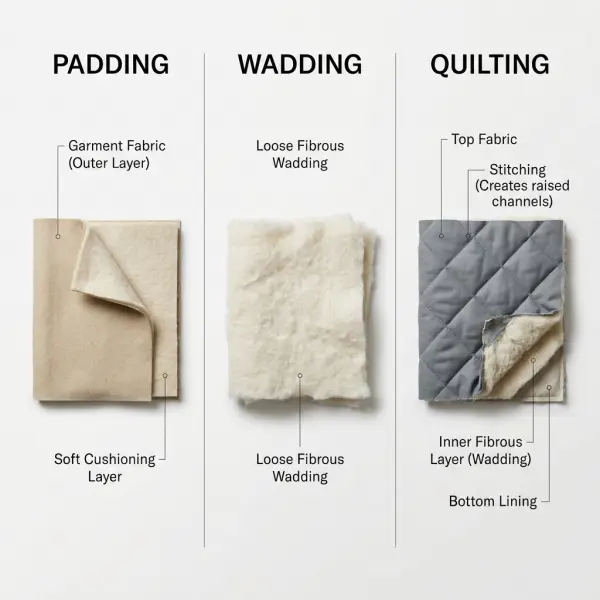
The distinction becomes clearer when each term is considered according to its function. Padding describes the addition of material to provide volume, cushioning, insulation, or shape. Wadding refers to a particular type of filling material, typically made from a fibrous sheet. Quilting is a construction technique that joins textile layers through stitching.
These differences are more than technical vocabulary. They influence fabric selection, manufacturing methods, garment comfort, quality control, and the cost of producing a finished product.
A fashion brand developing a padded jacket, for example, may need to choose an appropriate wadding material before deciding how the layers will be secured. Another brand producing a structured handbag might use foam padding without conventional quilting. A decorative garment could have a quilted appearance with little or no insulating filling.
Understanding where these materials and processes overlap—and where they remain distinct—helps fashion businesses communicate more precisely and avoid costly assumptions during product development.
Quick Answer: What Is the Difference Between Padding, Wadding, and Quilting?
Padding is the use of added material to provide cushioning, thickness, insulation, or shape; wadding is a fibrous filling material commonly placed between textile layers; and quilting is the stitching technique used to join layers of fabric, often with wadding or another filling between them.
The three concepts frequently work together in apparel construction, but they are not interchangeable.
A padded jacket contains material intended to provide thickness or insulation. That material may be sheet wadding, synthetic insulation, loose down, foam, or another suitable filling, depending on the construction.
Wadding, also called batting in many North American textile contexts, is commonly supplied as a fibrous sheet that can be cut and incorporated into garment panels.
Quilting, meanwhile, is a method of securing textile layers using stitches. It can help stabilize a filling and create recognizable surface patterns, but quilting does not necessarily require thick padding.
For fashion brands and manufacturers, the practical distinction is straightforward: padding describes the added structure or function, wadding identifies a type of filling material, and quilting describes how layers are joined.
The right combination depends on the garment's intended use, comfort requirements, appearance, and production method.
Padding vs Wadding vs Quilting: The Main Differences
Although these terms are often used together in supplier discussions, they refer to different aspects of textile construction.
|
Aspect |
Padding |
Wadding / Batting |
Quilting |
|
Primary meaning |
Added material that provides volume, cushioning, insulation, or shape |
A fibrous filling material, commonly supplied in sheets |
A technique for joining textile layers with stitching |
|
Technical category |
Material or construction function |
Material category |
Construction process |
|
Typical purpose |
Add thickness, support, protection, or warmth |
Provide soft volume, cushioning, or insulation |
Secure layers and create structural or decorative stitching |
|
Common materials |
Foam, fibrous filling, preformed pads, other cushioning materials |
Polyester, cotton, wool, and fiber blends |
Fabric layers and sewing thread, sometimes with filling |
|
Requires stitching? |
Not necessarily |
Not necessarily |
Yes, in conventional sewn quilting |
|
Requires a filling? |
Padding itself is added material |
Wadding is a filling |
Not always |
|
Typical applications |
Shoulder pads, padded jackets, bags, protective panels |
Jacket insulation, garment linings, textile accessories |
Quilted jackets, vests, coats, bags, decorative textile panels |
|
Main sourcing question |
What type of padding and performance are required? |
What filling composition, weight, and thickness are specified? |
What stitching pattern and layer construction are required? |
The distinction is consistent with the terminology used by the Textile Research Centre, which describes padding as material added between layers and identifies wadding or batting as common filling terminology. Its textile padding glossary also recognizes that padding is not necessarily used for warmth.
In real manufacturing conversations, terminology is sometimes less precise. A supplier may use “padding” to describe a polyester insulation sheet that another supplier calls “wadding.” These descriptions may refer to similar products, even though their broader technical meanings differ.
The safest approach is to clarify the physical material, its purpose, and the proposed construction rather than relying on a single term.
What Is Padding in Apparel Construction?
Padding is the addition of material to a garment or textile product to create cushioning, volume, insulation, support, or a particular shape. It is a broad construction concept rather than the name of one specific fiber or fabric.
In fashion production, padding may be distributed across an entire garment panel or positioned in selected areas. The required material depends on whether the designer wants softness, structural support, thermal insulation, or a combination of these characteristics.
This flexibility explains why the word appears in very different product categories.
A padded winter jacket may contain a lightweight fibrous insulation layer, while a tailored garment may use shaped shoulder pads to influence the silhouette. A laptop sleeve may contain foam padding intended to cushion the device.
All three products use padding, but their performance requirements are not equivalent.
Padding for Warmth and Insulation
Thermal padding is commonly incorporated into outerwear to reduce heat transfer between the wearer and the surrounding environment.
Fibrous insulation can retain air within its structure, reducing heat movement under suitable conditions. The amount of insulation depends on the filling material, its thickness, density, loft, and the way the garment is assembled.
For a lightweight transitional jacket, relatively thin insulation may provide enough warmth without creating excessive bulk. A product designed for substantially colder conditions may require a more carefully engineered insulation system.
The key point is that padding does not automatically establish the warmth of a garment. Material properties, wind exposure, moisture, fit, openings, and stitching all affect the final result.

Padding for Shape and Structural Support
Not all padding is intended to provide warmth.
Shoulder pads, structured bra cups, and selected costume or fashion components use padding to influence garment shape, fit, or local support.
A shoulder pad may help establish a defined shoulder line in a blazer. Foam-based components in other garments may create smoother contours or maintain a particular silhouette.
The manufacturing challenge is different from that of insulated outerwear. Here, the priority is controlling shape and compression rather than maximizing trapped air.
A padding material that works well in a jacket lining may be unsuitable for a tailored shoulder because its structure and recovery characteristics are different.
Padding for Cushioning and Protection
In accessories, padding can provide a soft barrier between external forces and the contents of a product.
Examples include selected laptop sleeves, camera bags, protective pouches, and structured travel accessories.
Foam, spacer materials, and other cushioning constructions may be considered depending on the intended use. Their performance should be evaluated under relevant conditions, especially when a product is marketed as protective.
A visually thick padded fabric does not necessarily provide meaningful impact protection. The material must be compatible with the type of force, object, and usage conditions involved.
For fashion businesses, this creates an important distinction between padding that improves tactile comfort and padding designed to deliver measurable protective performance.
What Is Wadding or Batting?
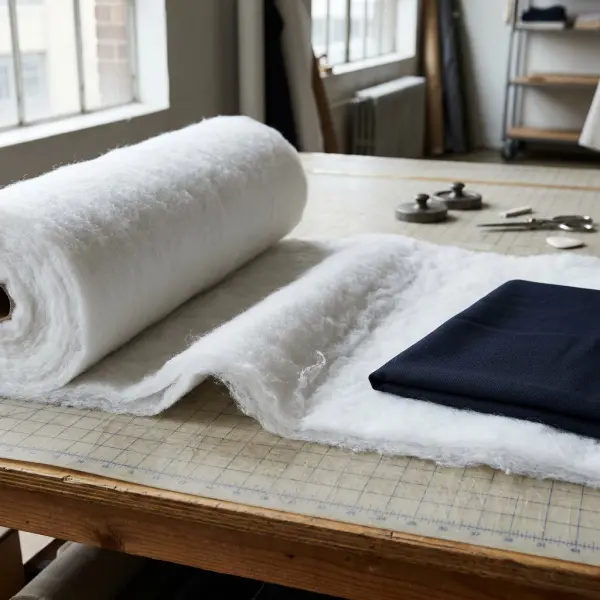
Wadding is a soft fibrous material used as a filling layer in textile products. It is commonly supplied in sheets or rolls and may be positioned between an outer fabric and a backing or lining.
The term batting is widely used in North American quilting terminology, while wadding is frequently associated with British English. The Textile Research Centre identifies this regional naming distinction in its quilting and batting terminology reference.
In apparel sourcing, both terms can describe fibrous filling products, although suppliers may also use terms such as insulation, fiberfill, or polyester padding.
These names should not be treated as guarantees of identical composition or performance.
Common Wadding Materials
Wadding can be manufactured using different fiber types and bonding methods.
Polyester is commonly used for synthetic wadding because it can be engineered into various weights, thicknesses, and resilient structures. Cotton and wool are also used in certain textile applications, while blended fibers may be selected for particular handling, appearance, or performance requirements.
The fiber content alone does not determine the final result.
Two polyester waddings may have different loft, softness, durability, and recovery characteristics because of differences in fiber fineness, fiber shape, web formation, bonding, and finishing.
Similarly, a cotton batting sheet may be suitable for a particular decorative or casual construction but may not deliver the same volume recovery as a different synthetic alternative.
These are material-specific considerations rather than universal rankings between natural and synthetic fibers.
How Wadding Is Manufactured and Supplied
Many commercial waddings are made by forming fibers into a web and stabilizing them sufficiently for handling and subsequent production.
Stabilization may involve mechanical, thermal, or chemical bonding methods, depending on the fiber composition and intended material properties.
Some products are designed to remain soft and flexible, while others prioritize loft stability or easier handling during cutting and sewing.
For apparel manufacturers, the important question is whether the supplied wadding can be processed consistently without excessive stretching, tearing, delamination, or deformation.
A material that looks satisfactory in a small sample may behave differently when fed through production machinery or handled repeatedly during garment assembly.
Understanding Wadding Weight, Thickness, and Loft
Wadding specifications may include fiber composition, mass per unit area, thickness, width, and other material characteristics.
Mass per unit area is commonly expressed in grams per square meter (GSM). This describes how much the material weighs over a given area, not directly how warm it will be.
Loft describes the volume or thickness maintained by the fiber structure. It influences the amount of air that can remain within the insulation, but insulation performance also depends on fiber arrangement and the surrounding textile assembly.
A 100 GSM wadding sheet and another 100 GSM sheet may differ noticeably in thickness and resilience.
This is particularly important when suppliers offer several insulation grades under similar product descriptions.
For procurement teams, weight should therefore be assessed alongside thickness, construction, intended application, and relevant performance testing.
What Is Quilting in Garment Construction?
Quilting is a sewing technique in which two or more layers of material are joined by stitches. In contemporary apparel, this often involves stitching an outer fabric, a filling layer, and a backing together to create a stable textile assembly.
The resulting surface may display diamonds, squares, parallel channels, curves, or other repeated motifs.
While the stitching creates a recognizable appearance, its construction purpose can be equally important. It helps secure the layers and may control the movement of the filling.
The Textile Research Centre's definition of quilting makes an important distinction: quilted textiles often contain padding, but padding is not an absolute requirement.
This means a quilted surface is not necessarily an insulated surface.
Structural Quilting Versus Decorative Quilting
Structural quilting focuses on keeping the textile layers stable during use.
For example, a jacket containing fibrous insulation may use repeated stitching to reduce unwanted movement of the filling and maintain a consistent surface.
Decorative quilting places greater emphasis on the visible pattern.
A lightweight garment may use quilting primarily to create texture, with only a small amount of padding or even no added insulation.
In practice, many products combine structural and decorative functions. A diamond pattern can help secure an insulating layer while contributing to the garment's appearance.
Designers should not assume that the most attractive stitch pattern will automatically be the most appropriate for the filling or garment performance.
Why Stitch Spacing Matters
Stitch spacing affects how the quilted assembly behaves.
Closely spaced stitching creates smaller raised areas and can provide more frequent stabilization. However, when stitching passes through thick insulation, it also compresses the filling along the stitch lines.
This compression may reduce local thermal resistance and create areas of increased heat transfer.
A 2025 experimental study of sewn-through insulated jackets investigated how conventional stitching compression affects thermal performance and compared it with an alternative construction designed to preserve loft.
The study supports the technical relevance of stitch-line compression, although its findings should not be generalized to every fabric, filling, or garment design.
For manufacturers, stitch spacing needs to balance filling stabilization, visual consistency, flexibility, and thermal requirements.
How Padding, Wadding, and Quilting Work Together
The relationship between these concepts becomes clearer when looking at actual garment constructions.
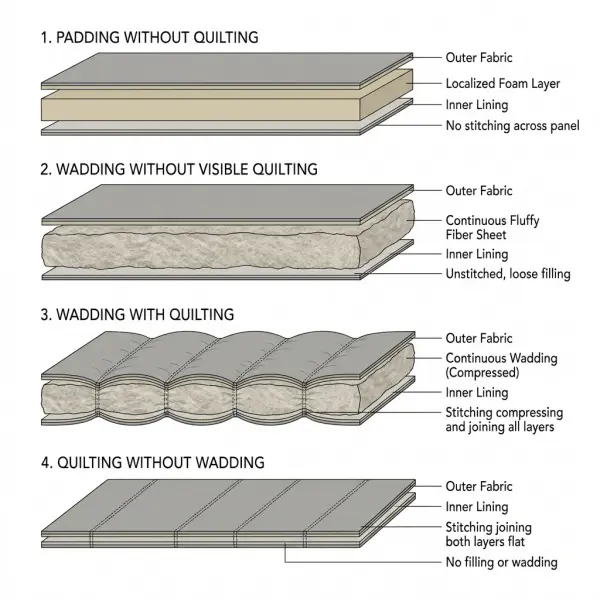
Not every padded product uses wadding. Not every product containing wadding is quilted. And not every quilted fabric contains significant padding.
These combinations allow manufacturers to solve different design and performance problems.
Construction A: Padding Without Quilting
A tailored blazer with shoulder pads is a straightforward example.
The shoulder pads create a specific shape, but the garment does not require visible quilting lines to hold them in position.
Likewise, a bag may contain foam cushioning secured between its outer material and lining through seams or other suitable assembly methods.
The material provides padding, while the construction secures it without conventional quilt stitching across the surface.
Construction B: Wadding Without Visible Quilting
A garment may contain sheet wadding beneath an outer shell without a visible stitched pattern across the exterior.
The filling may be secured through seams, internal attachment points, specialized stabilization methods, or other construction details appropriate to the material.
This approach can preserve a smooth exterior appearance.
However, the filling must still remain adequately positioned during wear and care. The absence of visible quilting does not remove the need for stabilization.
Construction C: Wadding Combined With Quilting
This is a familiar construction for padded jackets, vests, and certain garment linings.
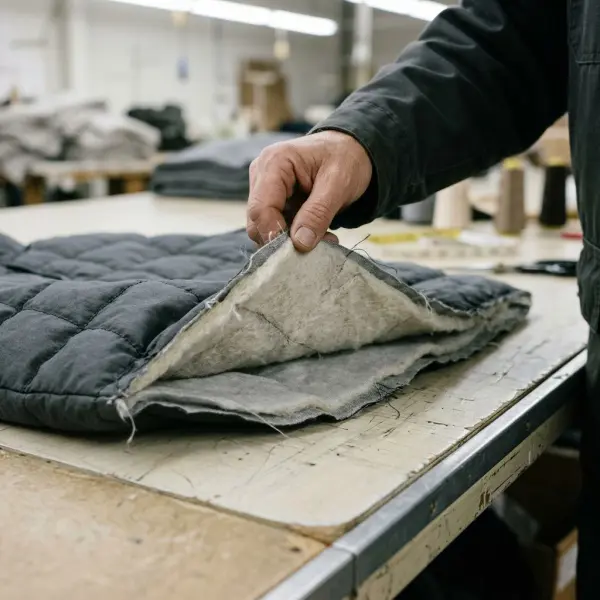
An outer textile layer and a backing surround the wadding. Stitching passes through the assembly, joining the components and creating the quilted surface.
The combination provides an insulating or cushioning layer alongside an identifiable textile texture.
Brands can purchase the assembly as pre-quilted fabric or produce the quilting during garment-panel preparation, depending on their manufacturing process.
Construction D: Quilting Without Wadding
Two fabric layers can also be joined through decorative or functional quilting without a separate batting layer.
The resulting material may have visible stitch lines but relatively little additional thickness.
This type of construction can be appropriate where the intention is surface detail rather than substantial insulation.
The underlying principle is also important historically. Quilting has existed in different regional and historical forms, and not every textile identified as quilted follows the modern three-layer padded construction.
How These Materials and Processes Affect Garment Manufacturing
A material specification does not become a reliable garment until the factory can reproduce the intended construction consistently.
Padding, wadding, and quilting each introduce different manufacturing considerations, from cutting and handling to seam finishing and quality inspection.
The most appropriate production sequence depends on whether the brand uses pre-quilted fabric, assembles padded panels internally, or combines different methods across the garment.
Material Preparation and Layer Assembly
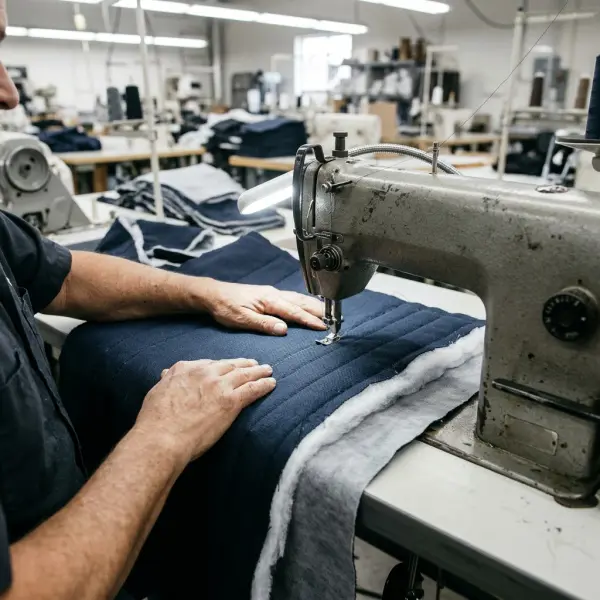
For a conventional quilted panel, production often begins with the preparation of the face fabric, filling, and backing.
The layers are aligned and temporarily secured where necessary before quilting. The manufacturer must consider grain direction, material tension, and the behavior of each layer during feeding through the machine.
Uneven feeding can produce wrinkles or puckering, particularly when the outer textile, filling, and backing respond differently to movement.
The wadding itself may also require careful handling. Certain loose or low-stability constructions can deform when stretched, while other forms are easier to manage during cutting.
These characteristics should be considered during sample development rather than discovered only during bulk production.
Quilting Before or After Cutting
A manufacturer may quilt material in larger continuous sections before cutting garment panels. This approach can be efficient when working with standardized stitch patterns and relatively straightforward designs.
Alternatively, garment components may be cut and quilted individually.
Panel quilting offers greater control over pattern placement, particularly when the design requires specific alignment or decorative motifs.
However, quilting can change panel dimensions because stitching compresses and draws together the layers. This must be accounted for in pattern allowances and quality tolerances.
A factory that cuts final-size panels before quilting without considering dimensional change may create assembly problems later.
The right process depends on material behavior, design complexity, equipment, and the accuracy required in the finished garment.
Sewing and Seam Construction
Padded or quilted materials frequently require additional attention during garment assembly.
Thick layers can create bulky seam allowances, particularly around armholes, collars, pocket openings, and other construction intersections.
Excessive thickness may affect seam appearance, flexibility, and comfort.
Depending on the construction, manufacturers may use suitable seam finishes, binding, controlled trimming, or other techniques to manage bulk.
Care must be taken not to damage the insulating material or compromise its intended coverage.
The objective is not simply to flatten every seam. It is to achieve an appropriate balance between secure construction, manageable thickness, and the product's functional requirements.
How Padding and Quilting Affect Warmth, Flexibility, and Comfort
Adding padding or wadding changes the physical properties of a garment, but the result is not determined by filling thickness alone.
Thermal performance depends partly on the insulating material and partly on how the complete garment controls heat loss.
Flexibility is influenced by shell fabric stiffness, filling resilience, stitch spacing, seam placement, and garment fit. A lightly padded textile may remain comfortable during movement, while a densely stitched or heavily filled construction may resist bending.
Moisture transport also matters. Even when the filling provides useful insulation, the complete layer combination may feel uncomfortable if vapor transfer is restricted under the intended wearing conditions.
Why More Padding Does Not Always Mean More Comfort
Increasing insulation can create a warmer garment under suitable conditions, but it also introduces additional mass and volume.
For a fashion jacket intended for urban daily use, excessive filling may make the garment difficult to layer or create undesirable bulk around the shoulders and sleeves.
A more appropriate solution may involve selecting a better-suited insulation construction rather than simply increasing the amount of material.
The decision should reflect the target customer, expected climate, activity level, and garment silhouette.
Thermal Performance Should Be Measured, Not Assumed
When warmth is an important product requirement, brands should request performance information appropriate to the full textile assembly.
ISO 11092:2026 specifies methods for measuring thermal resistance and water-vapor resistance of textile materials, including multilayer assemblies.
These measurements can support comparison between material constructions.
However, the standard does not assign universal comfort ratings to complete garments. Its controlled test conditions are not intended to represent every real-world wearing situation.
Therefore, a fabric test result should be interpreted alongside garment design, expected use, and any additional finished-product testing needed.
Padding and Wadding Compared With Linings, Interlinings, and Interfacing
Another source of confusion in apparel development is the relationship between padding and other internal garment materials.
A lining, interlining, interfacing, and underlining may all appear beneath the main fabric, but their functions are not identical.
|
Component |
Primary purpose |
Common placement |
|
Padding |
Provide cushioning, volume, insulation, or support |
Selected areas or larger garment panels |
|
Wadding / batting |
Serve as a fibrous filling layer |
Between shell and backing or lining layers |
|
Lining |
Finish the interior and support comfortable wearing |
Inside the garment |
|
Interlining |
Add an intermediate layer for insulation, body, or other properties, depending on construction |
Between shell and lining or other garment layers |
|
Interfacing |
Reinforce and stabilize specific garment areas |
Collars, cuffs, waistbands, plackets, and other structural locations |
|
Underlining |
Support the main garment fabric as an attached layer |
Directly behind the fashion fabric |
An interlining can contain an insulating material, including wadding, but the term describes its position or role in the garment assembly rather than one mandatory material type.
Interfacing usually addresses localized reinforcement rather than broad thermal insulation. Underlining supports the outer fabric and is generally handled with it during construction.
These distinctions are consistent with the practical garment-construction guidance published by New Mexico State University on interfacing, underlining, and lining materials.
For brands developing coats or jackets, these components must be selected as a compatible system. Adding wadding to a lining assembly may change the garment's thickness and fit even when the outer pattern remains unchanged.
Further construction considerations are covered in garment lining functions and finishing techniques.
Which Construction Is Best for Different Apparel Products?
There is no universally superior choice between padding, wadding, and quilting because they address different design requirements.
The decision becomes more useful when connected to specific product categories.
Insulated Jackets and Vests
For an insulated jacket, the primary requirement is usually an appropriate combination of thermal performance, weight, flexibility, and appearance.
Sheet wadding can provide a manageable insulation layer, while quilting may help stabilize the assembly and create a consistent exterior texture.
Alternatively, a designer may use a construction that minimizes visible stitching across the outer shell.
The choice depends on product positioning, insulation characteristics, and the factory's ability to control filling movement.
A lightweight casual vest and a technical winter jacket may therefore use different internal constructions even when their external silhouettes appear similar.
For a more detailed explanation of quilted fabric behavior, see quilted fabric structure, warmth, and fashion applications.
Tailored Garments and Structured Fashion Pieces
Tailored apparel frequently uses localized support rather than large continuous insulation layers.
Shoulder pads and other shaped components may help create the desired silhouette without requiring quilting across the garment.
The relevant evaluation criteria include shape retention, compatibility with the outer fabric, comfort, and stability during wear and care.
For this type of product, choosing a structurally suitable padding component is often more important than increasing its thickness.
Handbags and Textile Accessories
Quilted and padded materials are also used in accessories, but the priorities can differ from apparel.
A decorative quilted handbag may use thin batting to produce a softly raised surface. A functional laptop sleeve may require a more substantial cushioning construction, whether or not quilting is visible.
Aesthetic padding should not be confused with verified protective performance.
Manufacturers must also consider how material thickness affects seams, corners, closures, and handle attachment points.
A well-executed padded accessory needs both appropriate material selection and strong overall product construction.
Lightweight Decorative Apparel
Some clothing uses quilting primarily for surface interest.
In these cases, thick padding may not be desirable. A thin filling or two-layer stitched construction can provide sufficient texture without substantially increasing garment weight.
This approach may be appropriate for selected overshirts, skirts, casual outer layers, and design-focused collection pieces.
The objective is to create a controlled surface treatment while maintaining an acceptable drape and range of movement.
Practical Sourcing and Specification Guidelines for Fashion Brands
One of the most common sourcing problems is using a broad material description that leaves too much interpretation to the supplier.
A purchase inquiry stating “polyester padded fabric” may not establish whether the buyer expects a loose insulation sheet, a laminated composite, a pre-quilted textile, or a fabric with localized foam.
The terms can overlap commercially, but those materials may require different cutting, sewing, and quality procedures.
A clearer specification should address the material and the finished construction separately.
What to Include in a Material Specification
For most padded or quilted apparel developments, the relevant information may include:
- Product application: Jacket shell, insulated lining, tailored padding, handbag panel, or another defined use.
- Material composition: Fiber or material composition of the outer fabric, filling, and backing where applicable.
- Filling construction: Sheet wadding, loose-fill insulation, foam, or another specified format.
- Material weight: Separate filling GSM and composite GSM where relevant, with measurement conditions agreed.
- Thickness and loft: Required dimensions and suitable measurement conditions.
- Stitching requirements: Quilting pattern, stitch spacing, thread type, and any alignment requirements.
- Performance requirements: Relevant insulation, durability, dimensional stability, and care criteria.
- Manufacturing method: Pre-quilted roll goods, panel quilting, or another clearly defined process.
- Approval criteria: Reference samples, acceptable tolerances, and any required test results.
A technical specification becomes more reliable when it can be checked against an approved sample and an agreed inspection procedure.
It is also useful to distinguish mandatory product requirements from aesthetic preferences. An exact quilting motif may be essential for a signature collection, while a standard pattern may be acceptable for an internal insulated lining.
Understanding Cost Implications
Material cost is only one part of the commercial decision.
A garment using pre-quilted fabric may require less internal quilting work but could have higher fabric purchasing costs or pattern-placement waste.
Custom quilting can support differentiated designs, yet it introduces additional labor, machinery, sampling, and inspection requirements.
The cost of a finished product may also increase when thick materials require specialized handling or more complicated seam finishing.
For sourcing teams, comparing only the price per meter of fabric can be misleading.
The more useful measure is the cost of achieving the approved finished construction at the intended production quantity.
Quality Control: What Manufacturers Should Check
Quality control requirements differ according to the construction.
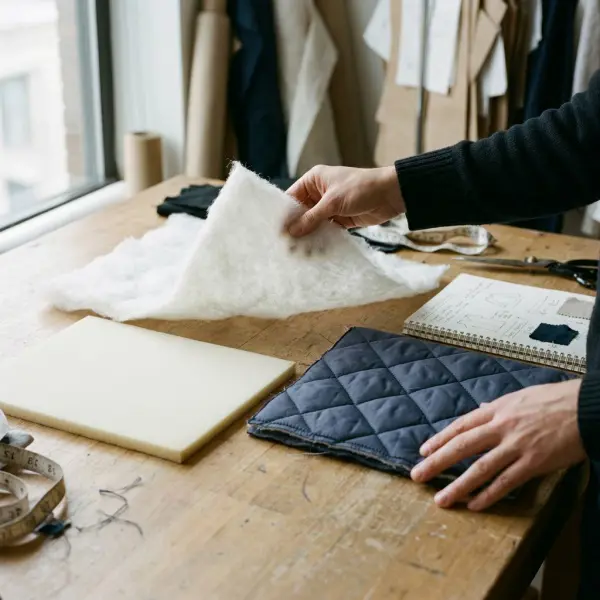
A standalone wadding sheet needs to be evaluated for material consistency and handling characteristics. A padded garment component may require checks for shape, positioning, and recovery. A quilted fabric assembly introduces additional stitching and dimensional requirements.
Combining these checks into a single broad visual inspection may overlook problems that appear only after manufacturing or care.
Inspecting Wadding and Padding Materials
For fibrous wadding, manufacturers should check whether the material is consistent with the approved specification.
Visible variations in thickness, unwanted lumps, weak areas, or uneven fiber distribution may create problems during construction.
Material recovery can be especially relevant when the product is repeatedly compressed during storage, transportation, or use.
For shaped padding components, dimensional consistency and form retention may be more important than the surface appearance of the raw material.
The inspection method should reflect the actual function of the component.
Inspecting Quilted Assemblies
A quilted panel needs to be assessed as a combined structure.
Stitch lines should be secure and consistent with the approved pattern. The material should not display unacceptable puckering, distortion, uneven filling movement, or damaged areas.
Particular attention may be needed where the quilted surface intersects with garment seams.
Geometric patterns can make alignment inconsistencies more visible, particularly on the front of jackets or at prominent panel joins.
For production teams, the approved reference sample should establish the acceptable appearance and construction rather than leaving those judgments entirely subjective.
Testing After Washing and Drying
The layers of a padded or quilted product may respond differently to cleaning.
A shell fabric can shrink or distort while the filling retains a different shape. Some materials may lose loft, move within the assembly, or develop surface irregularities.
ISO 6330:2021 specifies standardized domestic washing and drying procedures used in textile testing.
Dimensional change can be evaluated using ISO 5077:2007, which remains a current standard for determining changes associated with specified washing and drying procedures.
These standards help establish reproducible conditions, but brands must still define product-specific acceptance criteria.
A garment that maintains its dimensions but develops visible batting migration may still fail the intended quality requirement.
Common Mistakes When Specifying Padding, Wadding, and Quilting
Treating All Three Terms as the Same Material
A buyer may ask for “quilted padding” without clarifying whether the requirement is for a filling sheet or a completed stitched fabric. The supplier may quote a technically different product from the one intended. This can cause delays when samples arrive in the wrong construction. The better approach is to identify the physical material, its function, and whether quilting is required as a separate manufacturing step.
Selecting Wadding by GSM Alone
A higher GSM value describes greater mass per unit area, but it does not automatically establish better insulation or cushioning. Wadding materials with similar weights can have different thicknesses, fiber structures, and recovery characteristics. Selecting material only from a weight specification may produce unexpected bulk or performance differences. Buyers should evaluate relevant physical properties and production-representative samples alongside the stated weight.
Assuming Quilting Is Always Necessary for Padded Garments
Quilting can provide effective layer stabilization, but certain padded constructions can use other suitable attachment methods. Adding unnecessary quilting may affect the outer appearance, increase processing work, or create unwanted compression. Conversely, removing quilting without providing sufficient filling stabilization can introduce shifting or uneven distribution. The construction method should reflect the insulation material, product purpose, and manufacturing requirements.
Ignoring the Interaction Between Layers
A face fabric, filling, and backing may each appear suitable when tested independently but behave poorly as an assembled composite. Differences in flexibility, shrinkage, or feeding behavior can cause distortion during sewing and cleaning. These problems may remain hidden until the first production run. Brands should approve the complete material assembly and evaluate it under realistic handling and care conditions.
Confusing Thickness With Proven Performance
Thick foam may not provide the intended cushioning under all impact conditions, just as thick fibrous padding does not guarantee a specific warmth level. Performance depends on material behavior and the product's complete construction. When brands make claims based only on appearance, they risk creating expectations that the product cannot reliably satisfy. Relevant testing and precise product descriptions offer a stronger basis for commercial communication.





Comments 0
Leave a CommentSend Comment
Anda harus Login terlebih dahulu untuk dapat memberikan komentar.