

Tencel vs Rayon: Key Differences in Cellulosic Fabrics
Quick Answer
TENCEL™ and rayon are related, but they are not equivalent textile terms. Rayon is a generic category of manufactured regenerated cellulose fibers. In international textile trade, the word “rayon” is often associated with viscose rayon, the most widely produced type. TENCEL™, meanwhile, is a Lenzing trademark used for specific branded lyocell and modal fibers.
The most useful comparison for fashion businesses is therefore TENCEL™ Lyocell versus conventional viscose rayon.
Both begin with purified cellulose, usually derived from wood pulp, and both can produce soft, absorbent, breathable-feeling fabrics with attractive drape. The main difference lies in how the cellulose is converted into fiber. Conventional viscose uses a chemical derivatization process involving carbon disulfide, while lyocell directly dissolves cellulose in a solvent system commonly based on N-methylmorpholine N-oxide, or NMMO.
Lyocell fibers generally have higher molecular orientation, greater strength—particularly when wet—and better dimensional potential than conventional viscose fibers. Viscose may offer softer fluidity, broad availability, and lower sourcing costs.
Neither option is automatically sustainable or technically superior. Actual performance depends on fiber producer, forest sourcing, chemical recovery, yarn construction, fabric finishing, garment design, care requirements, and product use.
Why “Tencel vs Rayon” Is Not a Perfectly Equal Comparison
The phrase “Tencel vs rayon” compares a trademark with a generic fiber category. This is similar to comparing one branded ingredient with the wider family of materials to which it belongs.
Under United States textile regulations, rayon is defined as a manufactured fiber composed of regenerated cellulose. The same regulation permits “lyocell” to be used as the generic description for a defined type of regenerated cellulose fiber produced by precipitating cellulose from an organic solution without forming a chemical intermediate. This means lyocell falls within the broader regenerated-cellulose framework while still having a distinct recognized name.
TENCEL™ is a fiber brand owned by Lenzing. It covers both TENCEL™ Lyocell and TENCEL™ Modal, which are separate fiber types made through different processes. A fabric labeled informally as “Tencel fabric” could contain either branded lyocell, branded modal, or a blend of branded and non-branded fibers. Lenzing requires certification and product licensing when supply-chain partners use its trademarks on specific products.
For a technically meaningful comparison, this article primarily distinguishes:
- TENCEL™ Lyocell: Lenzing-branded lyocell fiber
- Generic lyocell: Lyocell made by another producer
- Viscose rayon: Regenerated cellulose fiber made through the viscose process
- Rayon: A broader or regional term that may refer to viscose or other regenerated cellulose fibers
This terminology should be clarified before comparing prices, test results, environmental claims, or garment performance. A sourcing quotation that says only “rayon” or “Tencel” does not provide enough information for production approval.
For a broader explanation of the lyocell category, see Tencel and lyocell fabric explained for fashion applications.
What Do Tencel, Lyocell, Rayon, and Viscose Actually Mean?
Textile terminology becomes confusing because legal labeling rules, scientific classifications, regional trade language, and consumer marketing do not always use the same words in exactly the same way.
Rayon Is a Generic Regenerated Cellulose Category
Rayon is a manufactured fiber made by regenerating purified cellulose into a new fiber form. The cellulose may originate from wood, bamboo, cotton linters, textile waste, or another suitable cellulose source, although wood-derived dissolving pulp remains the dominant commercial input.
The term describes the regenerated-cellulose character of the fiber rather than a single production method in every market. Historically and legally, rayon can encompass more than one process-related fiber type. In everyday commercial use, however, “rayon” frequently means viscose rayon.
Textile Exchange describes man-made cellulosic fibers as fibers made from plant-derived or reclaimed cellulose that is processed into pulp, dissolved, and regenerated into staple or filament fiber. This wider category includes viscose, lyocell, modal, cupro, and acetate.
Viscose Is Both a Process and a Common Fiber Name
Viscose is the largest man-made cellulosic fiber category by production volume. It is manufactured through the viscose process, in which cellulose is chemically converted into a soluble intermediate before being regenerated as fiber. Textile Exchange reports that viscose represents the majority of global man-made cellulosic fiber production.
In many European and Asian markets, garments are labeled and marketed as “viscose.” In the United States, “rayon” is commonly used as the required or accepted generic fiber name, depending on the applicable labeling rules.
As a result, “viscose” and “rayon” are frequently used as synonyms in sourcing discussions, although rayon can have a broader regulatory or historical meaning.
Lyocell Is a Distinct Regenerated Cellulose Fiber
Lyocell is made by directly dissolving cellulose in an organic solvent system and regenerating it without forming the cellulose-xanthate intermediate used in viscose production.
The fiber typically has a more highly oriented structure and higher crystallinity than conventional viscose. These structural differences help explain its generally greater tenacity, wet strength, stiffness, and fibrillation tendency. Scientific comparisons of regenerated cellulose fibers consistently identify higher molecular orientation and stronger mechanical properties in lyocell than in conventional viscose.
TENCEL™ Is a Brand, Not a Generic Fiber Name
TENCEL™ identifies Lenzing-branded lyocell and modal fibers. It should not be used as a substitute for the generic word “lyocell,” just as a specific branded polyester or elastane should not become the technical name for every fiber in its category.
When a fashion brand wants to display the TENCEL™ name, use branded claims, or order approved hangtags, it must follow Lenzing’s certification and licensing process. Lenzing states that its certification system verifies the presence of its fibers and that a valid product license is needed to label specific products with Lenzing brands.
Tencel Lyocell vs Viscose Rayon at a Glance
|
Comparison factor |
TENCEL™ Lyocell or generic lyocell |
Conventional viscose rayon |
|
Material family |
Regenerated cellulose |
Regenerated cellulose |
|
Naming type |
Lyocell is generic; TENCEL™ is a brand |
Viscose and rayon are generic trade or regulatory terms |
|
Main production principle |
Direct dissolution of cellulose |
Chemical derivatization followed by regeneration |
|
Common solvent or key chemistry |
NMMO-based solvent system |
Sodium hydroxide, carbon disulfide, and sulfuric-acid spinning bath |
|
Fiber structure |
Generally higher orientation and crystallinity |
Generally lower orientation and crystallinity |
|
Typical fiber strength |
Usually higher, including when wet |
Usually lower, especially when wet |
|
Surface behavior |
Can fibrillate under wet abrasion |
Less associated with lyocell-type fibrillation |
|
Common handfeel |
Smooth, clean, soft, sometimes slightly crisper |
Soft, fluid, silky, often highly drapable |
|
Dimensional potential |
Often more stable when well engineered |
Can be more sensitive to wet handling and shrinkage |
|
Market availability |
Growing but less dominant |
Widely available across price levels |
|
Typical commercial position |
Mid-market to premium |
Mass market through premium |
|
Process-related concern |
Solvent management, energy, pulp sourcing |
Sulfur chemistry, air emissions, wastewater, pulp sourcing |
|
Environmental claim |
Must be producer- and facility-specific |
Must be producer- and facility-specific |
|
Branded verification |
Required for TENCEL™ claims |
Optional branded viscose systems may have their own rules |
This comparison describes general tendencies at fiber level. It does not guarantee how a finished fabric will behave. A high-quality viscose woven may outperform a poorly engineered lyocell knit in dimensional stability, appearance retention, or sewing performance.
How Are Their Manufacturing Processes Different?
The most important technical difference is the method used to dissolve and regenerate cellulose.
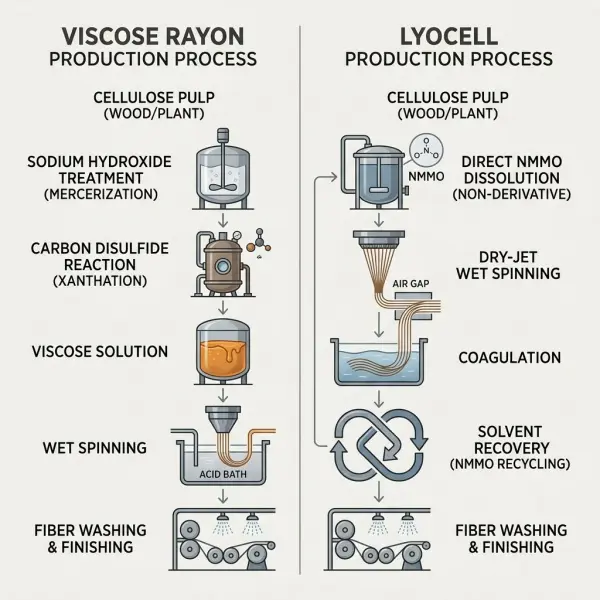
How Conventional Viscose Rayon Is Made
Viscose production begins with dissolving-grade cellulose pulp. The pulp is treated with sodium hydroxide to form alkali cellulose. After pressing, shredding, and controlled aging, the alkali cellulose reacts with carbon disulfide to form cellulose xanthate.
The cellulose xanthate is then dissolved in dilute sodium hydroxide, producing the thick liquid known as viscose. The solution is matured, filtered, and deaerated before being extruded through spinnerets into an acidic coagulation bath. In the bath, the cellulose regenerates into solid filaments.
A simplified sequence is:
- Dissolving-pulp preparation
- Steeping in sodium hydroxide
- Pressing and shredding
- Alkali-cellulose aging
- Reaction with carbon disulfide
- Dissolution into viscose solution
- Ripening, filtration, and deaeration
- Wet spinning into an acidic bath
- Washing, desulfurization, finishing, and drying
This process is technically mature and can produce a wide range of staple fibers and filament yarns. It also requires careful control of carbon disulfide, hydrogen sulfide, sulfur compounds, wastewater, and worker exposure.
ZDHC’s man-made cellulosic fiber guidelines address chemical inputs, sulfur-related air emissions, wastewater, sludge, feedstock, and chemical-recovery practices across viscose and other regenerated-cellulose processes.
How Lyocell Is Made
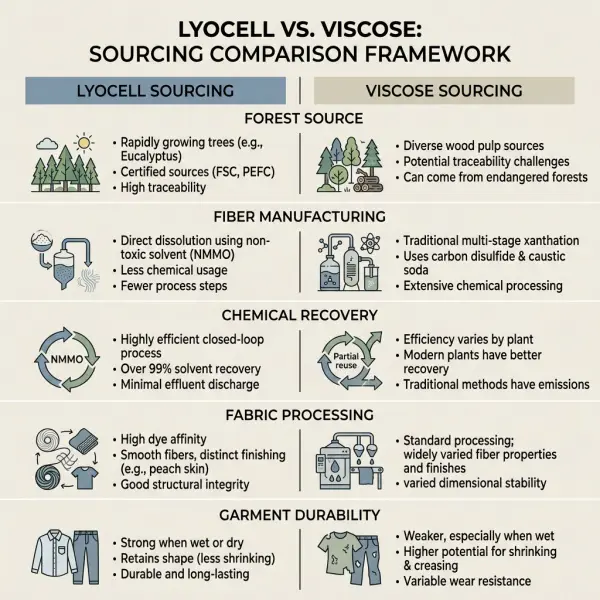
Lyocell uses a direct-solvent route. Purified cellulose pulp is mixed with a solvent system commonly based on NMMO and water. Under tightly controlled temperature and moisture conditions, the cellulose dissolves without first being converted into cellulose xanthate.
The resulting spinning solution is filtered and extruded through spinnerets. The filaments pass through an air gap before entering a coagulation bath, a method known as dry-jet wet spinning. The regenerated fibers are then washed, dried, finished, and prepared for textile processing.
A simplified lyocell sequence is:
- Dissolving-pulp preparation
- Mixing pulp with the solvent system
- Direct cellulose dissolution
- Filtration of the spinning solution
- Dry-jet wet spinning
- Fiber coagulation and regeneration
- Washing and solvent recovery
- Drying, finishing, and cutting or winding
Scientific reviews distinguish this direct-solvent process from the derivatization route used for viscose. They also identify solvent recovery as one of the critical technical and environmental requirements of commercial lyocell production.
Lenzing reports recovering and reusing up to 99.8% of the NMMO solvent in its own lyocell process. This number applies to Lenzing’s technology and should not be presented as a universal recovery rate for every lyocell producer.
Does the Different Process Change Fiber Performance?
Yes. The process affects cellulose-chain length, molecular orientation, crystallinity, cross-sectional structure, and the way the fiber responds to moisture and mechanical stress.
Lyocell’s dry-jet wet-spinning route produces fibers with relatively high orientation along their length. Conventional viscose processing generally causes more cellulose degradation and produces a less highly ordered fiber structure.
These differences do not mean that lyocell is universally more comfortable or attractive. They primarily influence strength, stiffness, wet behavior, surface response, and the range of textile structures that mills can engineer.
Dry and Wet Strength
Lyocell generally has higher tenacity than conventional viscose, including significantly stronger performance in wet conditions. Viscose absorbs moisture readily, but its fiber structure can lose a substantial portion of its strength when wet.
Higher wet strength can make lyocell easier to process in washable apparel, denim, garment washing, and products exposed to repeated laundering. It may also support finer or stronger yarn constructions.
Scientific reviews attribute lyocell’s stronger mechanical properties to its higher molecular orientation and crystallinity.
That does not mean every lyocell garment is durable. Yarn quality, fabric density, finishing, seam construction, abrasion exposure, and care practices can outweigh the original fiber advantage.
Drape and Fluidity
Both viscose and lyocell can create fabrics with attractive drape, but they often express it differently.
Conventional viscose is widely used for flowing dresses, skirts, blouses, linings, scarves, and printed fabrics because it can produce a soft, fluid, silky movement. Lyocell can also drape well, although some constructions feel cleaner, firmer, or more substantial because of the fiber’s higher modulus.
A lightweight lyocell filament fabric may look glossy and fluid. A lyocell staple twill may appear matte, softly structured, or peach finished. The fiber identity does not establish one fixed aesthetic.
Softness and Surface Feel
Viscose is often selected where immediate softness and fluidity are priorities. Lyocell can also feel very soft, particularly when made with fine fibers, low-hairiness yarns, suitable finishing, or blended constructions.
The handfeel perceived by a customer depends on more than fiber chemistry:
- Fiber fineness
- Staple length or filament format
- Yarn twist and spinning system
- Fabric weight and density
- Weave or knit construction
- Enzyme treatment
- Mechanical finishing
- Resin or crosslinking treatment
- Garment washing
- Repeated home laundering
A supplier’s claim that one fiber is inherently “softer than” another should therefore be tested on comparable finished fabrics, not accepted as a universal rule.
Fibrillation
Fibrillation is one of lyocell’s most distinctive technical characteristics. Under wet mechanical abrasion, small fibrils can separate from the fiber surface.
Controlled fibrillation can create a soft peach-skin, washed, or sueded appearance. Uncontrolled fibrillation may create fuzz, pilling, shade whitening, and an uneven surface—especially on dark fabrics.
Lyocell’s tendency to fibrillate is associated with its highly oriented internal structure and relatively weak lateral bonding between fibrillar regions. Research continues to examine chemical and mechanical methods for managing this behavior.
Conventional viscose does not normally show the same characteristic fibrillation pattern, although viscose fabrics can still pill, fuzz, abrade, or lose surface quality for other reasons.
Dimensional Stability and Wet Handling
Well-engineered lyocell fabrics can offer stronger dimensional performance than comparable conventional viscose products. Higher wet strength allows the material to tolerate laundering and wet processing more effectively.
However, shrinkage is not determined by the fiber alone. A loose lyocell knit can shrink or grow substantially when poorly stabilized. A dense, correctly finished viscose woven may remain within acceptable dimensional tolerances.
Brands should test:
- Relaxation shrinkage
- Washing shrinkage
- Growth after wear
- Spirality in knits
- Skew in twills and denim
- Seam puckering
- Garment distortion
- Appearance after repeated laundering
Care-label decisions must be based on the complete garment, not a generalized assumption that all lyocell is washable or all rayon requires dry cleaning.
Which Fabric Is More Comfortable?
Neither material is automatically more comfortable in every garment. Both are cellulosic fibers that absorb moisture and can produce smooth, soft textiles. Comfort depends on the interaction between moisture, heat, airflow, surface friction, fit, stretch, and garment design.
A lightweight viscose challis dress may feel cooler and less restrictive than a heavy lyocell denim jacket. A fine lyocell jersey may feel smoother and more comfortable than a densely knitted viscose fabric. Fabric architecture usually matters more than the generic fiber name.
Moisture Absorption Is Not the Same as Quick Drying
Viscose and lyocell are both hydrophilic, meaning they interact readily with moisture. This can help move moisture away from the immediate skin surface and reduce a plastic-like or clammy sensation associated with some fabrics.
Absorbing moisture does not necessarily mean releasing it quickly. Drying time depends on:
- Fabric mass
- Yarn size
- Fabric thickness
- Surface area
- Air permeability
- Blend composition
- Garment fit
- Airflow
- Temperature and humidity
A fashion brand developing activewear or travel apparel should test drying time and moisture behavior on the intended fabric rather than translating absorbency into an unsupported “quick-dry” claim.
Stretch and Recovery Must Be Engineered
Neither conventional viscose nor lyocell is elastomeric. A knitted structure can stretch because its loops deform, but recovery may be inadequate for close-fitting apparel unless the fabric includes elastane or another recovery mechanism.
For leggings, fitted underwear, bodywear, and slim trousers, brands should evaluate extension, recovery, growth, bagging, and dimensional stability after repeated wear.
The increasing use of lyocell in soft everyday apparel is examined more closely in why lyocell is gaining attention in comfortable modern apparel.
Which Material Is Better for Different Fashion Applications?
The best option depends on silhouette, expected wear, retail price, care requirements, production capability, and the material story the brand intends to communicate.
Flowing Dresses and Printed Fashion
Viscose is widely used for printed dresses because it can offer fluid movement, a soft handfeel, strong color expression, and accessible pricing. Established mills also offer a large variety of viscose challis, crepe, twill, satin, and filament constructions.
Lyocell can create equally sophisticated dresses, but the appearance may be cleaner, slightly fuller, or more structured depending on the yarn and finish. It may be preferred where wet strength, branded sourcing, or a specific surface is important.
Brands should test seam slippage, opacity, shrinkage, color migration, and surface change before choosing between them.
Denim and Casual Bottoms
Lyocell has become especially relevant in soft denim, chinos, utility trousers, and relaxed tailoring. Its strength and ability to develop soft washed effects allow mills to reduce the rigid character of conventional cotton constructions.
Viscose can also be blended into denim and twill, but it may require greater care during wet finishing and garment washing because of its weaker wet performance.
The final result depends heavily on whether the fiber is placed in the warp, weft, or blended yarn and whether cotton, elastane, polyester, or another fiber carries the structural load.
T-Shirts, Loungewear, and Underwear
Both viscose and lyocell can create comfortable knitwear. Viscose jersey is broadly available and can deliver softness at competitive prices. Lyocell jersey may offer a smoother surface, stronger wet performance, and a premium material narrative.
In either case, the fabric should be tested for:
- Pilling
- Spirality
- Shrinkage
- Bursting strength
- Stretch recovery
- Colorfastness
- Seam growth
- Surface appearance after washing
A very soft fabric that twists, grows, or pills after several washes is not a commercially successful comfort fabric.
Shirts and Blouses
Viscose works well for fluid blouses and relaxed shirts where movement is the design priority. Lyocell is useful for shirts that need softness with slightly more body, durability, or a clean surface.
Neither should be assumed to behave like crisp cotton poplin. Interlining selection, collar construction, pressing, seam type, and garment-washing processes may need to be adjusted.
Linings
Viscose filament rayon is widely used as a garment lining because it offers smoothness, drape, moisture interaction, and a more cellulosic feel than many polyester linings.
Lyocell can also be used in lining applications, but availability, cost, surface friction, and supply continuity may limit its commercial use in some markets.
For most brands, lining selection should prioritize seam durability, colorfastness, abrasion, static behavior, garment compatibility, and care method—not material prestige.
Is Tencel Lyocell More Sustainable Than Rayon?
TENCEL™ Lyocell can offer significant process advantages over conventional viscose rayon, but the answer depends on which producers, factories, feedstocks, energy systems, and finished products are being compared.
The lyocell route avoids the cellulose-xanthate stage and the corresponding use of carbon disulfide required by conventional viscose production. Efficient lyocell facilities can recover and reuse most of their solvent. By contrast, viscose production requires careful management and recovery of sulfur-based chemicals, including carbon disulfide and hydrogen sulfide.
That distinction matters, but it does not justify describing every lyocell fabric as environmentally responsible or every viscose fabric as harmful.
Fiber Producer Performance Varies
A modern viscose facility with strong chemical recovery, controlled emissions, responsible wastewater treatment, and verified pulp sourcing may perform better than an inefficient or poorly managed facility producing another fiber type.
ZDHC’s current MMCF framework covers viscose staple fiber, modal, lyocell, viscose filament, cupro, and acetate. The guidelines focus on feedstock, chemical inputs, process controls, wastewater, sludge, air emissions, and reporting because generic material names do not reveal factory-level performance.
Forest Sourcing Applies to Both
Most viscose and lyocell fibers begin with wood-derived dissolving pulp. Both can create forest-related risks when pulp is linked to deforestation, conversion of natural forests, weak chain of custody, or sourcing from ancient and endangered forests.
Canopy’s Hot Button Report evaluates man-made cellulosic fiber producers on forest sourcing, traceability, conservation leadership, and development of next-generation feedstocks. Canopy explicitly notes that this assessment does not cover every environmental or social issue, so brands must use additional evidence for chemical management, labor, energy, water, and community impacts.
Branded Claims Must Remain Brand-Specific
Lenzing reports high NMMO recovery in its lyocell system and provides certifications for specific TENCEL™ fibers. Those claims should be attributed to the relevant Lenzing product and production system.
A supplier cannot legitimately transfer Lenzing’s data to an unrelated generic lyocell fabric. Similarly, a generic claim about “viscose” should not erase the performance differences among individual viscose producers and facilities.
The Finished Garment Still Matters
A lower-impact fiber can be undermined by:
- Short product life
- Poor construction
- Excessive pilling
- Unstable dimensions
- High-impact dyeing or finishing
- Synthetic coatings
- Complex blends
- Air freight
- High return rates
- Unsupported overproduction
- Disposal after limited wear
The most responsible material decision is not necessarily the fiber with the strongest marketing claim. It is the option that combines verified sourcing, controlled production, product durability, suitable performance, efficient use, and realistic end-of-life pathways.
Is Lyocell Always More Expensive Than Viscose?
Lyocell and TENCEL™ fabrics often carry a price premium over standard viscose, but the difference is not fixed.
Viscose benefits from large global production capacity, established supply chains, broad mill experience, and availability across many qualities and price points. Lyocell capacity is smaller, while its solvent-recovery infrastructure and process control can require substantial capital investment.
TENCEL™ may add value through branded-fiber verification, certification services, trademark recognition, technical support, and approved communication assets. That commercial value is separate from the physical performance of the fiber.
Actual fabric pricing depends on:
- Fiber producer and country of origin
- Branded versus generic fiber
- Staple fiber versus filament
- Fiber fineness
- Composition percentage
- Yarn system and count
- Fabric construction
- Dyeing and finishing
- Certification requirements
- Order volume
- Minimum order quantity
- Currency and freight
- Mill capacity and lead time
A brand should compare total garment economics rather than fiber price alone. A fabric that costs more per meter may provide better garment yield, lower shrinkage, fewer defects, stronger repeatability, or greater retail storytelling value.
Conversely, paying a premium for branded lyocell makes little sense when the garment design, target price, customer awareness, or supply-chain documentation cannot support that value.
How Should Brands Choose Between Lyocell and Viscose?
The decision should begin with the garment brief, not an assumption that one fiber is categorically better.
Choose Based on Required Performance
Lyocell may deserve priority when the product requires stronger wet performance, washable construction, controlled garment washing, a clean surface, soft denim effects, or verified branded-fiber communication.
Viscose may be commercially appropriate when the priority is fluid drape, printed fashion, accessible price, broad availability, established production, or a very soft handfeel.
These are starting points rather than rules. The final choice should be made after fabric and garment testing.
Compare Like with Like
A fair comparison should use fabrics with similar:
- Weight
- Construction
- Yarn size
- Fiber percentage
- Finish
- Color depth
- Intended care method
- Garment application
Comparing a premium TENCEL™ Lyocell twill with a low-cost lightweight viscose jersey reveals little about the underlying fibers because almost every construction variable is different.
Ask for Supplier-Specific Evidence
For either material, request:
- Exact generic fiber composition
- Brand and fiber producer, where claimed
- Country and facility of production
- Dissolving-pulp source
- Forest-risk or chain-of-custody documentation
- Chemical-management information
- Fiber or fabric certificates
- Physical-performance tests
- Restricted-substance compliance
- Bulk-production tolerances
- Approved environmental claims
- Trademark authorization where relevant
Certificates should be checked for issuing body, scope, expiry date, facility, product coverage, and transaction relevance.
Test the Finished Garment
Fabric reports cannot predict every production issue. The product-development team should assess the final garment after the intended sewing, pressing, washing, printing, dyeing, or finishing route.
Particular attention should be paid to:
- Shrinkage and growth
- Seam stability
- Surface whitening
- Fibrillation
- Pilling
- Skew and spirality
- Colorfastness
- Pressing marks
- Interlining compatibility
- Recovery after wear
- Appearance after repeated laundering
Match the Material Story to the Evidence
A viscose product should not be presented as “natural bamboo fabric” merely because bamboo supplied the original cellulose. The material has been chemically processed and regenerated into rayon or viscose.
A generic lyocell product should not carry TENCEL™ branding without certification and licensing. Lenzing states that its trademarks may be used on products made from certified materials through the relevant licensing process.

Common Mistakes in Tencel and Rayon Comparisons
Mistake 1: Treating Tencel as the Technical Opposite of Rayon
TENCEL™ is a brand that includes lyocell and modal. Rayon is a generic regenerated-cellulose term. The comparison mixes different levels of classification.
The better approach is to compare specific fibers: TENCEL™ Lyocell versus conventional viscose rayon, or TENCEL™ Modal versus generic modal.
Mistake 2: Assuming Every Rayon Fabric Is Low Quality
Viscose is produced in many qualities. Premium filament viscose, compact-spun viscose, high-quality crepes, engineered blends, and well-finished woven fabrics can deliver excellent drape and retail value.
Low quality usually results from the interaction of weak yarn, unstable construction, inadequate finishing, poor sewing, or inappropriate garment care—not from the word “rayon” alone.
Mistake 3: Assuming Every Lyocell Fabric Is Premium
Generic lyocell can still be poorly spun, inconsistently dyed, inadequately stabilized, or badly finished. The fiber category does not guarantee the quality of the mill, garment factory, or final product.
Performance reports and garment trials remain necessary.
Mistake 4: Using Sustainability as a Simple Ranking
“Lyocell is sustainable; viscose is not” is too simplistic. Lyocell often has process advantages, particularly in well-controlled solvent-recovery systems, but both fibers require responsible pulp sourcing, energy, chemicals, water, and wastewater management.
Producer-level and facility-level evidence should replace generic assumptions.
Mistake 5: Ignoring the Blend Percentage
A garment containing 20% branded lyocell and 80% another fiber should not be discussed as though lyocell alone determines its comfort, durability, biodegradability, or environmental profile.
Product claims must reflect the complete composition and construction.
Mistake 6: Selecting by Handfeel Alone
Softness can win sample approval while hiding shrinkage, seam slippage, weak recovery, opacity, surface abrasion, or pilling.
The correct evaluation combines touch with measurable tests and wear trials.
Mistake 7: Copying Generic Care Advice
Not all viscose must be dry-cleaned, and not all lyocell garments can be machine washed without restriction. Care requirements depend on fabric construction, finishes, trims, color, interlining, garment design, and testing.
The care label must reflect the complete product.
A Practical Selection Framework
|
Business requirement |
Lyocell may be suitable when |
Viscose may be suitable when |
What to verify |
|
Fluid fashion silhouette |
A cleaner or fuller drape is desired |
Maximum fluidity and softness are priorities |
Drape, seam slippage, opacity |
|
Washable everyday apparel |
Wet strength and stability are important |
The fabric has been engineered and tested for washing |
Shrinkage, appearance, care cycle |
|
Soft denim or trousers |
Strength and soft washed effects are needed |
Used as a controlled blend rather than the main load-bearing fiber |
Tensile strength, fibrillation, recovery |
|
Printed dresses |
A premium lyocell surface supports the design |
Broad print-base availability and cost matter |
Print clarity, colorfastness, shrinkage |
|
Loungewear |
Smoothness and premium positioning matter |
Softness and accessible pricing matter |
Pilling, spirality, stretch recovery |
|
Sustainability communication |
Producer and product claims are verified |
Supplier demonstrates strong forestry and chemical management |
Traceability, facility evidence, claim scope |
|
Ingredient branding |
TENCEL™ recognition adds customer value |
A branded fiber is unnecessary |
License, certification, customer relevance |
|
Cost control |
Quality or risk reduction justifies a premium |
Broad availability supports target margin |
Total garment cost, not meter price |
For most brands, the correct decision is not made by choosing a fiber name in isolation. It is made by balancing design intent, test performance, sourcing evidence, production capability, target price, and customer expectations.
What Should Brands Verify Before Approving Either Fabric?
Before bulk ordering, confirm the following:
- The legally correct generic fiber description
- The complete fiber percentages
- Whether “TENCEL™” refers to lyocell or modal
- Fiber-producer and fabric-mill identity
- Certification or transaction documentation
- Trademark and licensing permission
- Pulp and forest-sourcing evidence
- Chemical-management and wastewater practices
- Fabric construction and finish
- Shrinkage, pilling, strength, and colorfastness
- Surface behavior after washing
- Garment-level performance
- Bulk-production tolerance
- Repeat-order availability
- Approved wording for environmental claims
The most important documents are those that connect the claim to the actual material being purchased. A general sustainability report from a fiber producer does not prove that an unrelated fabric lot contains that producer’s fiber.




Comments 0
Leave a CommentSend Comment
Anda harus Login terlebih dahulu untuk dapat memberikan komentar.