

Product Information Management Explained for Fashion Businesses
A fashion product may look straightforward on a retail website: a photograph, a product name, a price, and a few selectable sizes. Behind that listing, however, sits a substantial amount of information. Fabric composition, fit descriptions, measurements, care instructions, color codes, product identifiers, seasonal classifications, and market-specific details all need to be organized before the product can be presented accurately to customers.
For fashion businesses managing multiple collections and sales channels, maintaining this information can become surprisingly difficult. A product description may be updated on the brand's website but remain outdated on a marketplace. A color may be called "Stone" in one catalog and "Beige" in another. Size information might be complete for dresses but inconsistent across trousers and jackets.
Product Information Management (PIM) provides a structured way to address these problems. Its value lies not simply in storing product details, but in helping teams maintain reliable, usable information as their assortments, channels, and operations expand.
Quick Answer: What Is Product Information Management in Fashion?
Product Information Management (PIM) is a business process, typically supported by specialized software, that centralizes, organizes, enriches, validates, and distributes product information across sales and marketing channels. For fashion businesses, it helps manage the commercial details associated with apparel, footwear, accessories, and their individual product variations.
A fashion PIM system can organize product names, descriptions, style identifiers, sizes, colors, materials, measurements, care instructions, product images, and other attributes needed to present merchandise accurately. It also helps teams adapt that information to the requirements of different retail channels and markets.
PIM is particularly useful when a brand manages large assortments, frequent collections, multiple marketplaces, international product catalogs, or several departments contributing to product content.
Its primary benefit is better control over product information. Rather than repeatedly editing the same details in disconnected files and platforms, teams can work with a governed product data repository and defined publication processes.
However, PIM does not automatically replace inventory management, product development software, or digital asset management. Its effectiveness depends on data quality, system integration, and clear operational ownership.
What Does Product Information Management Actually Mean?
Product Information Management refers to the structured handling of information that describes products and supports their commercial presentation.
In a fashion company, product information rarely originates from one department. Designers define styles and garment characteristics. Technical teams maintain measurements and material specifications. Merchandising teams establish categories and assortment positioning. Marketing teams create descriptions, while ecommerce operators prepare product listings for publication.
Each department contributes a different part of the product record. Without a common structure, those contributions can become scattered across spreadsheets, emails, shared folders, ecommerce platforms, and supplier documents.
PIM provides a controlled environment for bringing relevant information together. As explained in Akeneo's overview of Product Information Management, PIM solutions are designed to collect, organize, enrich, and distribute product information across different channels.
The distinction between simply storing data and managing it is significant. A database may hold a jacket's material composition, but a PIM workflow can help ensure that the composition has been verified, associated with the correct style and variants, translated when necessary, and prepared for the channels where the jacket will be sold.
PIM Is More Than a Central Product Database
A central database gives a business one place to access product records. A PIM system adds processes that help keep those records consistent and ready for commercial use.
Depending on the software and configuration, these processes may include product attribute validation, completeness checks, approval workflows, version tracking, localization, and distribution to connected platforms.
Consider a fashion brand preparing a new linen-blend collection. The sourcing team provides confirmed fabric composition, the merchandising team supplies category information, and the content team prepares product descriptions. If the relevant information is missing or has not been approved, the brand can establish a workflow that prevents incomplete content from being released.
The purpose is not to eliminate human judgment. It is to make the information-handling process more dependable and less reliant on individual employees remembering every detail.

Why Fashion Product Data Is More Complicated Than It Appears
Fashion products combine creative characteristics with detailed commercial and technical attributes. A garment's appearance may attract attention, but customers also need information about size, fit, material, and care before making a purchase.
This creates a particular challenge for apparel businesses. A single design may exist in several colors and sizes, with each combination requiring a distinct commercial identifier and potentially different inventory availability.
Seasonal collections introduce another layer of complexity. Fashion companies may maintain several collections simultaneously, including current-season products, carryover styles, replenishment items, and discontinued merchandise.
PIM helps organize these relationships without requiring every product variation to be treated as a completely unrelated record.
Understanding Styles, Products, and Variants
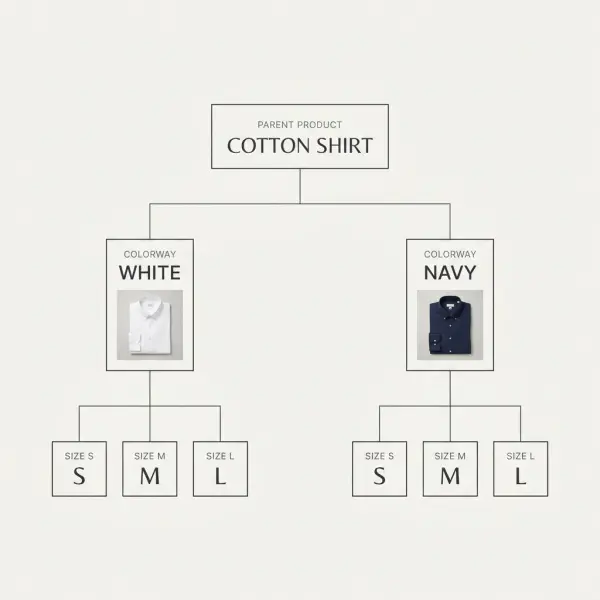
A fashion style is generally the underlying design or model. A product variant represents a specific commercially distinguishable version of that style, such as a particular size and color combination.
Imagine a brand launching a relaxed-fit cotton shirt in two colors, White and Navy, with three sizes: Small, Medium, and Large.
The collection contains one shirt style but six sellable variants.
|
Product level |
Example |
Information |
|
Style |
Relaxed Cotton Shirt |
Design, fit, brand, category |
|
Colorway |
White |
Color-specific details and imagery |
|
Colorway |
Navy |
Color-specific details and imagery |
|
Variant |
White / Small |
Unique SKU, size, color |
|
Variant |
White / Medium |
Unique SKU, size, color |
|
Variant |
Navy / Large |
Unique SKU, size, color |
The table shows selected examples rather than all six possible combinations.
A properly configured product model can distinguish attributes shared by the style from attributes specific to a colorway or sellable variant. The exact hierarchy depends on the PIM software and the brand's merchandising requirements.
This distinction matters because businesses should not need to rewrite identical fabric descriptions six times. At the same time, the White / Small variant must remain distinguishable from Navy / Large when orders and inventory records are processed.
GS1's guidance on product variations explains that each size-and-color combination requires its own Global Trade Item Number (GTIN) when GTINs are assigned to those trade items. A GTIN is a standardized product identifier; it is different from a company's internal Stock Keeping Unit (SKU).
A PIM can maintain these identifiers and relationships, although the actual assignment and governance of identifiers remain business responsibilities.

The Attributes That Describe a Fashion Product
Product attributes are individual pieces of information associated with merchandise. Their importance depends on the product category, intended customer, sales channel, and geographic market.
For apparel businesses, useful attributes commonly fall into several groups:
- Product identity: Brand, style code, product name, category, collection, season, SKU, and applicable GTIN.
- Physical characteristics: Material composition, color, pattern, silhouette, fit, neckline, sleeve length, and garment measurements.
- Customer information: Size guidance, care instructions, product descriptions, styling notes, and intended use.
- Commercial information: Channel-specific titles, merchandising categories, product availability references, and market-specific descriptions.
- Media references: Product photography, detail images, colorway images, videos, and supporting documents.
- Operational information: Publication status, content approvals, data ownership, and product lifecycle status.
These attributes should not be assigned indiscriminately to every item. A footwear catalog may require heel height, upper material, and outsole details, while a dress catalog may need garment length, lining information, and fit descriptions.
The quality of a PIM data model depends partly on how well it reflects these category differences. Too few attributes leave important customer questions unanswered. Too many unnecessary fields create administrative work without improving the product experience.
Where Does Fashion Product Information Come From?
Product information is usually created and updated across several stages of a fashion business's operations. A PIM system can consolidate relevant information, but it does not necessarily originate or independently verify every attribute.
During product development, technical and sourcing teams may define the material composition, construction details, dimensions, and style identifiers. After approval, selected information can be transferred into the commercial product record.
Merchandising teams then add product categories, collection assignments, customer-facing attributes, and positioning information. Marketing or content teams prepare product names, descriptions, and localized messaging.
Photography teams contribute approved product images, while commercial systems may provide pricing or availability information needed by downstream channels. Whether those values are stored in PIM, referenced from another system, or synchronized during publication depends on the architecture.
A critical principle is that each important data field should have a clearly defined authoritative source.
For example, a garment's actual fiber composition should come from verified technical or supplier information rather than a marketing writer's assumption. Similarly, live inventory quantities should normally remain governed by the designated inventory or order management system.
PIM can make the information easier to access and distribute, but it cannot make an inaccurate original specification correct merely by centralizing it.
How Does a PIM System Work in a Fashion Business?
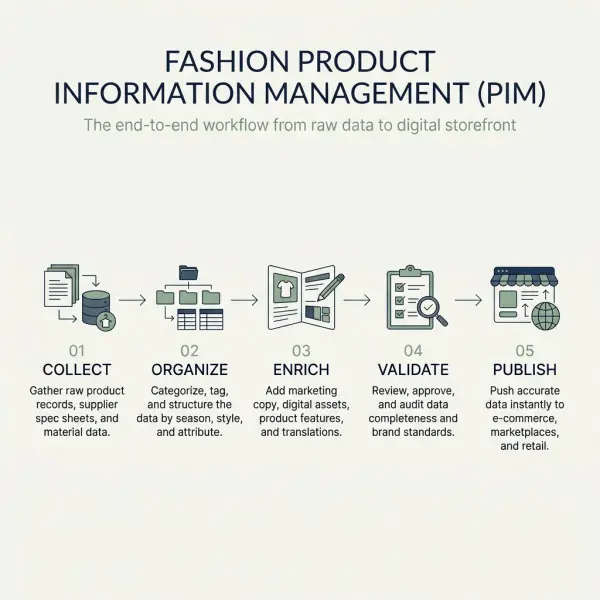
Most PIM implementations follow a broad process: collect product information, organize the data, enrich its content, validate its completeness, and publish approved information to the relevant destinations.
The precise workflow varies by platform, integration architecture, and organizational structure. A brand operating one online store may use a relatively simple process, while a manufacturer supplying multiple retailers may need additional data transformations and approval stages.
Understanding the workflow helps businesses recognize where PIM adds value and where other systems or human decisions are still required.
Collecting and Organizing Product Information
The first stage involves gathering product data from existing sources and associating it with the correct products.
A brand might import an approved style list from a product development system, supplier-provided specifications from a structured file, and existing product descriptions from its ecommerce platform.
The information needs a consistent structure before it becomes useful. This may involve normalizing units, mapping category names, identifying duplicate records, or separating style-level information from variant-level attributes.
For example, measurements recorded in centimeters should not be mixed with inch-based values without clear units. The same principle applies to color naming, sizing conventions, and material terminology.
Enriching and Approving Product Content
Once the underlying records are organized, relevant teams can add missing information and improve the customer-facing presentation.
A basic product record might initially contain only a style code, garment category, and fabric composition. Before publication, it may need an approved product title, fit description, care guidance, imagery, and size information.
Some PIM systems support completeness rules that identify missing required attributes. This allows teams to distinguish between a product that exists in the catalog and one that is ready to be published.
Completeness should not be confused with accuracy. A record containing information in every field may still be incorrect if the values have not been checked against authoritative sources.
Preparing Product Information for Publication
After the required information is approved, the system can prepare it for different commercial destinations.
A brand's own ecommerce website may support extensive descriptions, fit advice, and styling recommendations. A marketplace may require specific attribute names, accepted values, character limits, and structured variant identifiers.
These differences mean that a single internal product record may need several external representations.
The mechanics of how product records, channel-specific mappings, and publication integrations are organized deserve a separate discussion in how PIM systems organize fashion product data across sales channels.
For the present discussion, the key principle is straightforward: the brand should maintain consistent underlying product facts while allowing appropriate differences in how those facts are presented.
Why Product Information Management Matters for Fashion Businesses
The commercial value of PIM is closely connected to the way fashion businesses create and distribute product information.
As product assortments become more complicated, the cost of handling inconsistent information can extend beyond the content team. Merchandising delays, incorrect product listings, duplicate data entry, and supplier clarification requests can affect multiple departments.
A well-designed PIM process can reduce some of this friction. The improvement, however, depends on the quality of existing data, the systems being connected, and how consistently the organization follows its procedures.
More Consistent Product Descriptions and Customer Information
Customers comparing fashion products need details that are reliable enough to support purchasing decisions. Inconsistent sizing labels, inaccurate material claims, or missing fit descriptions can create uncertainty, particularly when customers cannot examine the garment in person.
PIM can help brands establish consistent attribute definitions and content requirements. A company may decide, for example, that every pair of trousers must include fit, rise, material composition, available sizes, and a relevant measurement guide.
Consistency does not require identical writing across every product. Product descriptions can still reflect the garment's character, collection positioning, and styling possibilities. The system provides common factual foundations while allowing editorial variation.
This matters for customer trust because attractive product photography cannot compensate for incorrect product details. A customer who receives a garment that differs materially from its description may have a legitimate reason to question the retailer's information quality.
Better Coordination Between Fashion Departments
Product content often reaches the ecommerce team late in the product launch process. A collection may have already been photographed and scheduled for release while the content team is still waiting for finalized composition details or corrected measurements.
PIM can make missing information and approval responsibilities more visible. Instead of repeatedly requesting updated spreadsheets, teams can work against a defined product record and understand which attributes remain incomplete.
This is especially useful for businesses where product development, sourcing, merchandising, and ecommerce operate in different locations. However, the software must be supported by practical responsibilities and deadlines. A shared system does not automatically resolve unclear decision-making or slow approvals.
More Reliable Marketplace and Retail Data
Third-party marketplaces and retail partners may have different requirements for product titles, descriptions, identifiers, attributes, and product variants.
These requirements are not merely stylistic preferences. Incorrect or incomplete product data can affect whether listings are accepted, displayed correctly, or eligible for particular shopping experiences.
For example, Google Merchant Center's product data specification documents requirements for apparel attributes such as color, size, age group, gender, and variant grouping, with applicability depending on the product and destination market.
A PIM system can help maintain structured information that is mapped to such requirements, provided the mappings remain current and properly configured.
For wholesale-oriented fashion brands, similar logic applies to retailer product catalogs. A buyer may request structured information covering material, sizing, colorways, product identifiers, and imagery. Having validated information in one managed repository can make those requests easier to fulfill.
Stronger Foundations for Product Discovery and SEO
Product information quality affects how clearly fashion merchandise can be understood by customers and digital platforms.
Descriptive titles, accurate categories, meaningful attributes, and consistent variant relationships help ecommerce systems organize products and support product discovery. They also provide useful information for search engines and shopping services.
Google's product variant structured data documentation explains how ProductGroup and Product structured data can describe related product variations.
PIM can supply data used to generate these representations, but it does not automatically implement correct structured data on a website. The ecommerce platform, website templates, integrations, and technical SEO configuration remain responsible for producing valid markup.
Nor does better product data guarantee improved rankings or traffic. Its practical SEO contribution is a more consistent informational foundation that search engines and customers can interpret.

How PIM Differs From Other Fashion Business Systems
One common source of confusion is the assumption that PIM replaces all other software used to manage fashion products.
In reality, different systems often manage different information domains and business processes. Their responsibilities may overlap, particularly when software platforms offer broader functionality, but the underlying purposes remain distinct.
|
System |
Primary responsibility |
Typical fashion application |
|
PIM — Product Information Management |
Commercial product information |
Descriptions, attributes, classifications, variant data, publication readiness |
|
PLM — Product Lifecycle Management |
Product development and technical processes |
Design specifications, materials, tech packs, samples, approvals |
|
ERP — Enterprise Resource Planning |
Business operations and transactional records |
Purchasing, inventory, orders, accounting, depending on configuration |
|
DAM — Digital Asset Management |
Digital asset organization and control |
Product photography, campaign images, video, approved media files |
|
Ecommerce platform |
Online selling experience and transactions |
Product pages, storefront presentation, shopping carts, checkout |
The purpose of these distinctions is not to suggest that every fashion business requires five separate applications. Smaller brands may manage several functions through an ecommerce platform, an inventory tool, and well-maintained spreadsheets.
As complexity increases, specialized systems can become useful because different teams need different forms of control.
For example, PLM may govern the approved material specification, PIM may use that specification to create accurate product descriptions, and the ecommerce platform may display those descriptions to customers.
Similarly, DAM can provide the approved imagery associated with a product, while PIM maintains the relationship between those assets and the relevant product records.
The distinction between PIM and DAM is particularly relevant for fashion businesses with frequent photoshoots, seasonal campaigns, and extensive image libraries. A dedicated discussion of PIM versus Digital Asset Management for fashion brands helps clarify their different responsibilities and where the two systems work together.
A Practical Fashion Business Example: Managing a New Collection
Consider a fictional contemporary womenswear brand preparing a collection of 40 styles, including dresses, blouses, trousers, and lightweight outerwear.
Each style may be offered in several colors and sizes. The brand sells through its own ecommerce website, one external marketplace, and selected wholesale accounts.
Initially, the business manages product information through several spreadsheets. The merchandising team maintains style codes and assortment details, the technical team has fabric specifications, and the marketing team stores product descriptions in separate documents.
During collection preparation, several problems emerge. One marketplace listing uses an outdated product name. A blouse has different fabric descriptions across two channels. Several product photographs are associated with the wrong colorway, while the wholesale catalog lacks complete measurements.
None of these problems necessarily reflects a failure of individual employees. They can arise because the operating process depends on repeated copying, unclear field ownership, and disconnected records.
A PIM implementation could improve the workflow by establishing a managed product record for each style and its relevant variants.
The technical team would supply verified garment details, merchandising would control categorization, and content editors would prepare customer-facing descriptions. The brand could then configure validation rules to identify records that lack required information before publication.
The ecommerce and wholesale outputs would use relevant approved attributes, adjusted to each destination's format.
The brand would still need to confirm physical product details, maintain accurate inventory systems, and review published listings. What changes is the structure through which commercial product information is managed.
This example illustrates an operational use case rather than a measured implementation result. The time saved and errors avoided would depend on the company's initial processes, data quality, software, and adoption.
How Can Fashion Businesses Start Using PIM?
Introducing Product Information Management should begin with understanding the existing product data problems, not immediately selecting a large software platform.
For a smaller fashion business, the first improvement may be a standardized product master spreadsheet, consistent SKU conventions, and a clear content approval process. For a larger brand with numerous channels, dedicated PIM software may provide more useful governance and integration capabilities.
A phased approach generally reduces the risk of adopting a technically sophisticated system before the underlying data is ready.
Establish a Consistent Product Data Model
Start by defining the categories of products the business sells and the information required to describe them accurately.
A brand selling dresses, handbags, and footwear should not assume that every category needs identical attributes. Material composition may be relevant across several categories, but heel height belongs to footwear, while dress length belongs to certain garment categories.
The data model should also define the relationship between styles, colorways, variants, and their identifiers.
Clear naming conventions matter. If a company alternates between "Dark Blue," "Navy," and "Midnight" without a defined color vocabulary or intentional distinction, its catalogs become harder to standardize.
Assign Responsibility for Critical Attributes
Each important product field should have a responsible owner and a trustworthy source.
Technical teams may govern verified composition and garment measurements. Merchandising teams may control category assignments, while marketing teams approve consumer-facing descriptions.
Ownership should include a process for correcting errors. When material information changes after a supplier update, the business needs to know who can approve the correction and how affected listings will be updated.
Without these responsibilities, centralized information can still become inconsistent.
Introduce PIM Through a Controlled Pilot
Instead of migrating the entire product catalog immediately, fashion businesses can start with a representative product category or upcoming collection.
A suitable pilot might include products with different size ranges, colorways, material combinations, and imagery requirements.
The implementation can follow five practical stages:
- Audit the existing catalog: Identify duplicate records, inconsistent attributes, missing information, and unreliable data sources.
- Define the required product structure: Establish categories, identifiers, attributes, variant relationships, and ownership.
- Clean and import a pilot assortment: Transfer a manageable group of verified records rather than every historical product.
- Test the publication process: Confirm that product descriptions, identifiers, media references, and variants reach the intended destinations correctly.
- Review results before expansion: Measure data completeness, correction rates, workflow effort, and unresolved integration issues.
A pilot is useful because integration problems often become visible only when real products are processed. A simple cotton shirt may pass every test, while a reversible jacket or multi-material accessory reveals limitations in the data structure.
Measure Operational Improvement
Businesses should evaluate PIM through practical operational indicators rather than relying on promises of automation.
Relevant measures may include the percentage of products meeting publication requirements, the time required to prepare a new product record, the number of post-publication corrections, and the proportion of records with verified critical attributes.
Other useful measures include the number of rejected marketplace listings caused by product data issues and the amount of manual re-entry required between systems.
These indicators should be compared with an appropriate baseline. Improvements in sales conversion or customer returns can be influenced by numerous factors, making it difficult to attribute changes to PIM alone without additional analysis.

Common PIM Mistakes That Fashion Businesses Should Avoid
The effectiveness of Product Information Management depends heavily on implementation discipline. A poorly structured PIM environment may centralize existing problems rather than solve them.
Several mistakes are particularly relevant to fashion businesses because of the number of product variations, the involvement of multiple departments, and the frequency of assortment changes.
Treating PIM as a Solution to Poor Product Data
Implementing PIM does not automatically correct inaccurate fabric composition, inconsistent measurements, or duplicate product identifiers. Businesses sometimes assume that moving existing spreadsheets into new software will immediately improve data quality.
If incorrect information is imported without validation, the new system may distribute that information more consistently, but it remains incorrect. A better approach is to establish data standards and verification responsibilities before importing critical records.
Creating Too Many Attributes Without a Clear Purpose
Fashion teams may attempt to capture every imaginable product characteristic, including attributes that customers, retailers, and internal teams rarely use.
An excessive attribute model makes product creation more labor-intensive and can reduce compliance with data-entry requirements. Brands should prioritize information that supports product differentiation, customer decisions, channel requirements, and operational needs, then expand the model when justified.
Failing to Distinguish Styles From Sellable Variants
A common structural error is treating all sizes and colors as unrelated products or assigning identifiers inconsistently across variant combinations.
This can create duplicate content, incorrect color associations, and difficulties when matching commercial records with inventory or marketplace data. Fashion businesses should define stable style and variant relationships before importing an assortment, while respecting the requirements of connected platforms.
Expecting PIM to Replace Inventory and Product Development Systems
PIM may contain prices, availability references, or technical attributes, but these capabilities do not necessarily make it the authoritative system for inventory transactions or garment development.
When responsibilities overlap without clear rules, teams may update information in the wrong place. Businesses should determine which system owns each field, how changes are synchronized, and what happens when different systems contain conflicting values.
Ignoring the Human Workflow
A technically sound PIM implementation can still fail operationally if employees do not understand when and how to update product information.
For example, a revised care instruction might be approved by the technical team but never reach the product content team. Effective governance requires practical approval procedures, suitable permissions, training, and accountability, not merely software access.
What Should Fashion Brands Verify Before Investing in PIM Software?
A dedicated PIM system can introduce meaningful costs, including subscription or licensing fees, implementation services, integration development, data migration, employee training, and ongoing administration.
The business case therefore needs to reflect the organization's actual complexity.
A fashion startup selling a limited number of products through one ecommerce platform may find that a disciplined product master and native ecommerce features are sufficient. By contrast, a brand managing frequent collection launches across multiple marketplaces, retailers, and languages may benefit from more specialized capabilities.
Before selecting a platform, the company should establish whether the proposed software can represent its actual product relationships. Apparel-specific requirements such as colorways, size systems, shared attributes, region-specific content, and seasonal assortment structures should be demonstrated using real catalog examples.
Integration capabilities deserve particular scrutiny. A system that stores excellent product data but cannot exchange information reliably with existing ecommerce, inventory, or development applications may create additional manual work.
Brands should also examine whether the software supports the required approval workflows, permissions, localization needs, export formats, and future assortment complexity. These capabilities vary between vendors and subscription tiers.
Finally, data portability matters. Businesses should understand how their product records, attributes, identifiers, and media references can be exported if their technology requirements change.
A successful PIM decision is not necessarily the purchase of the most feature-rich software. It is the selection of an information management approach that matches current business needs while allowing practical growth.
Frequently Asked Questions About Fashion Product Information Management
1. Do Small Fashion Brands Need a PIM System?
Small fashion brands need organized product information, but they do not necessarily need dedicated PIM software. A business selling a relatively small assortment through one ecommerce platform may manage its product records effectively using native platform features and well-maintained spreadsheets.
The need for specialized software generally becomes more compelling when product variants, channel requirements, languages, or content contributors increase operational complexity.
Before purchasing PIM, a smaller brand should assess how often product information must be entered more than once, how frequently errors occur, and whether existing tools support reliable approval and publication workflows. A structured process should come before a complex system.
2. Can PIM Manage Clothing Sizes, Colors, and Product Variants?
Yes. Fashion-oriented PIM systems can organize size, color, and other product variant attributes, although the exact data model and supported capabilities depend on the platform.
A garment style may share a material description and design characteristics across its variants while maintaining separate identifiers for individual size-and-color combinations.
For example, Shopify's documentation on product variants explains how combinations of option values, such as size and color, form individual sellable variants. A PIM can help maintain relevant product information for such structures.
Businesses should verify how their chosen PIM maps product relationships and identifiers into their actual ecommerce and inventory platforms. Compatibility should not be assumed solely because both systems support variants.
3. Is Product Information Management the Same as Inventory Management?
No. Product Information Management primarily organizes the information used to describe, classify, enrich, and publish products. Inventory management tracks quantities, stock movements, availability, and related operational transactions.
The two functions often share information. A product's SKU, for instance, may connect its PIM record to the corresponding inventory record.
Some PIM implementations can receive or reference inventory data, but that does not necessarily make PIM the system responsible for stock accuracy.
For fashion businesses, the distinction is important because an accurate product description and an accurate stock quantity come from different operational processes. Both need to be maintained correctly for a reliable shopping experience.
4. Can PIM Improve Fashion Ecommerce SEO?
PIM can support ecommerce SEO by helping brands maintain accurate product titles, categories, descriptions, attributes, and variant information. These elements provide a more consistent informational foundation for product pages and shopping data.
Structured product information can also support the generation of appropriate product markup and feeds when the ecommerce platform and integrations are configured correctly.
However, PIM itself does not guarantee search rankings, organic traffic growth, or rich-result visibility. Technical indexing, website performance, content relevance, competition, and search platform requirements remain important.
For SEO-oriented fashion businesses, the practical benefit is improved control over the product information that feeds searchable and customer-facing experiences.
5. How Is PIM Different From a Fashion Product Catalog Spreadsheet?
A spreadsheet can store and organize product records, but it generally requires more manual coordination to manage complex approval workflows, multiple contributors, field validation, and distribution across numerous platforms.
Dedicated PIM software may offer configurable attributes, hierarchical product models, role-based permissions, completeness indicators, and integration mechanisms.
This does not mean that every spreadsheet process is inadequate. A carefully governed spreadsheet may work effectively for a small assortment and a limited number of contributors.
The important question is whether the current process can maintain reliable information without excessive manual work or recurring errors. Businesses should evaluate operational limitations before assuming specialized software is necessary.
6. Can PIM Help Fashion Brands Sell Internationally?
PIM can support international selling by organizing localized product descriptions, market-specific attributes, and channel requirements in a structured environment.
For example, a fashion company may need to present product information in different languages or use size conventions appropriate to different markets. A suitable PIM setup can help manage these distinctions while preserving common underlying product attributes.
However, localization requires more than translating descriptions. Brands may need to review measurement conventions, care information, material terminology, and relevant legal requirements for each destination.
A PIM system can support this work but does not independently guarantee translation quality or regulatory compliance. Human review and reliable source information remain necessary.
7. How Long Does It Take to Implement PIM for a Fashion Business?
There is no universally reliable implementation timeline because the work depends on catalog size, data quality, product complexity, integration requirements, software capabilities, and internal resources.
A business with a limited assortment and clean source data may have a much simpler implementation than a multi-brand retailer with several ERP systems, international marketplaces, and inconsistent historical records.
Data cleanup and organizational decisions can require substantial effort, even when the software configuration appears straightforward.
Fashion businesses should request a project plan that separates data preparation, product modeling, migration, integration, user testing, and operational rollout. A realistic pilot using actual products usually provides a stronger basis for planning than a generic vendor implementation estimate.
Conclusion: Better Product Information Starts With Better Structure
Fashion businesses depend on product information to connect creative design decisions with commercial presentation. A garment's fit, fabric, measurements, color, and care requirements must remain accurate as information passes between departments, systems, retailers, and customers.
Product Information Management provides a framework for controlling that complexity. It helps businesses organize product attributes, maintain consistent records, coordinate content preparation, and distribute approved information more reliably.
Yet the most valuable part of PIM is not the software interface. It is the discipline of deciding what information matters, where it comes from, who maintains it, and how it should be validated before publication.
For smaller fashion brands, that discipline may begin with standardized product records and clear ownership. For more established businesses, dedicated PIM software can extend those principles across larger assortments and more demanding channel requirements.
As fashion commerce becomes more dependent on structured product information, businesses that maintain accurate and well-governed records are better positioned to support new sales channels, improve operational coordination, and communicate their products clearly—without confusing product data management with the broader systems required to design, manufacture, stock, and sell fashion merchandise.





Comments 0
Leave a CommentSend Comment
Anda harus Login terlebih dahulu untuk dapat memberikan komentar.