

PIM vs Digital Asset Management: What Fashion Brands Should Know
A fashion brand preparing a new collection needs more than accurate product descriptions. It also needs photographs that show the correct colors, detail images that communicate fabric texture, campaign visuals that reflect the brand's identity, and approved creative files suitable for different sales channels.
These materials are closely connected, but they are not the same kind of information.
A merchandising team may need to confirm a jacket's fabric composition, size range, and product identifiers. Meanwhile, the creative team needs to find the approved studio photographs, distinguish final images from retouching drafts, and ensure that campaign assets are used within their permitted terms.
Product Information Management (PIM) and Digital Asset Management (DAM) address these related but distinct responsibilities.
For fashion businesses, understanding the difference matters because product data and visual content must work together. An accurate product description paired with the wrong color image creates confusion. A beautiful photograph attached to an incorrect size or style record creates another problem.
Choosing between PIM and DAM is therefore not simply a software purchasing decision. It requires understanding how product information, creative assets, teams, and commercial systems interact throughout the fashion product lifecycle.
Quick Answer: What Is the Difference Between PIM and DAM?
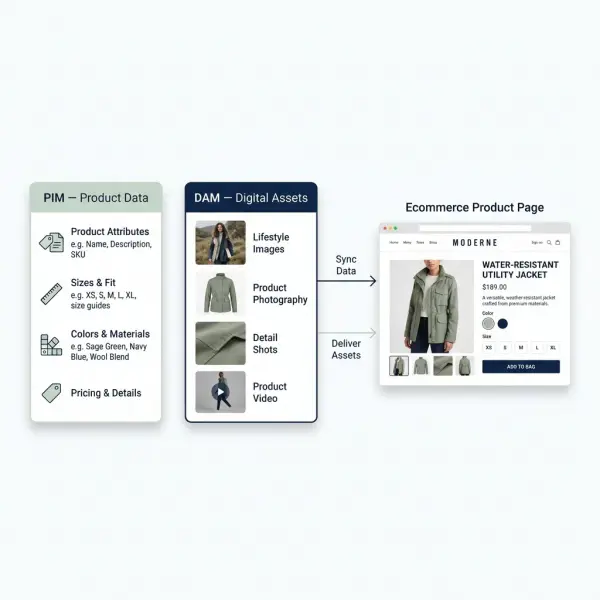
Product Information Management (PIM) manages structured information about products, while Digital Asset Management (DAM) manages digital files and the metadata, workflows, permissions, and usage controls associated with those files. For fashion brands, PIM primarily organizes details such as product names, materials, sizes, colors, descriptions, and identifiers. DAM primarily organizes product photography, campaign imagery, videos, graphics, and other digital assets.
The two systems support different but connected business needs.
PIM helps merchandising and ecommerce teams maintain accurate product information across catalogs and sales channels. DAM helps creative, marketing, and ecommerce teams find, approve, manage, and distribute the appropriate visual and digital content.
A PIM system may store images or reference digital assets, while some DAM platforms can maintain extensive product-related metadata. Their capabilities overlap, and certain software providers offer integrated PIM and DAM functionality.
The practical distinction lies in their primary responsibilities: PIM governs commercial product information, while DAM governs digital content assets.
Fashion businesses may need one system, both systems, or a simpler combination of existing tools, depending on assortment complexity, creative production volume, distribution requirements, and operational resources.
What Does PIM Manage in a Fashion Business?
Product Information Management is a structured approach to collecting, organizing, enriching, validating, and distributing information that describes products.
In the fashion industry, this information may begin with technical specifications and merchandising records before becoming the customer-facing details used on websites, marketplaces, and wholesale catalogs.
A dress, for example, may have an internal style code, several colors, a size range, confirmed material composition, garment measurements, care instructions, and a product description. These details need to remain accurate even when the dress appears in different commercial environments.
PIM helps maintain the relationships between these attributes and the relevant products or variants.
Its value becomes more apparent as a brand manages larger assortments, seasonal collections, international stores, and multiple sales channels.
Structured Product Data Is the Core of PIM
PIM is particularly suited to information that can be organized into defined fields and connected to product records.
For a contemporary apparel brand, those records might contain:
- Product identity: Brand, style code, stock keeping unit (SKU), product name, collection, and category.
- Product characteristics: Material composition, color, pattern, fit, silhouette, neckline, and sleeve length.
- Variant information: Sizes, colorways, variant identifiers, and applicable product identifiers.
- Customer-facing information: Product descriptions, size guidance, care instructions, and styling details.
- Commercial content: Localized titles, sales-channel attributes, and publication readiness.
- Media associations: References linking the appropriate photographs and other assets to particular products.
These fields do not all originate inside PIM. Technical information may come from Product Lifecycle Management (PLM), inventory quantities may be governed by an inventory or Enterprise Resource Planning (ERP) system, and approved product images may be supplied by DAM.
The PIM environment brings together the information needed to create reliable commercial product records.
For a more complete explanation of its foundational functions, see Product Information Management Explained for Fashion Businesses.
Product Information Must Remain Consistent Across Variants
Fashion products are often offered in multiple size and color combinations. A blouse may have one parent style, three colorways, and several sizes for each color.
A properly configured PIM model can distinguish information shared by the style from details specific to a particular variant.
For example, the general garment construction may be shared across the collection, while the SKU, color identifier, and associated product imagery vary between versions.
This distinction matters when multiple channels require different representations of the same merchandise.
PIM provides the information structure that supports those relationships, but the destination ecommerce platform and its integrations must still interpret and display them correctly.
What Does Digital Asset Management Manage in Fashion?
Digital Asset Management is a system for organizing, storing, finding, controlling, and distributing digital content assets.
For fashion businesses, these assets commonly include product photography, lifestyle images, editorial campaigns, promotional videos, lookbooks, brand graphics, logos, and creative production files.
A DAM system is more than a shared folder containing media files. Depending on its capabilities, it can maintain searchable asset metadata, version history, approval status, access permissions, usage restrictions, and alternative file formats.
Adobe's Digital Asset Management documentation describes capabilities such as metadata management, asset discovery, version handling, and asset governance.
These functions address a common fashion industry problem: finding the correct approved file among many similar creative materials.
Why Fashion Brands Need Organized Digital Assets
Consider a seasonal fashion photoshoot producing hundreds of images.
The creative team may capture front, back, and detail shots for each garment. There may also be on-model photographs, alternative poses, social media crops, and promotional campaign imagery.
The original images may undergo retouching and color correction before approval.
Without a controlled asset library, employees may encounter several visually similar files without knowing which version is final or which product colorway it represents.
A DAM system can help distinguish original files, working versions, approved masters, and approved derivatives.
This is especially useful when images are distributed to ecommerce teams, regional marketing offices, agencies, and retail partners.

Asset Metadata Makes Fashion Imagery Searchable
Asset metadata describes a digital file and its associated context.
In a fashion DAM, metadata might identify the collection, season, garment category, campaign, photographer, shoot date, asset status, or related style code.
Imagine a creative director searching for approved images of navy outerwear from a specific campaign. A well-organized DAM may allow the user to filter the library by relevant metadata rather than manually opening dozens of folders.
Adobe's guidance on digital asset metadata explains how descriptive fields such as titles, keywords, ownership information, and usage rights support asset organization and retrieval.
Metadata must still be maintained consistently. A system with powerful search capabilities cannot reliably find an image that has been misclassified or assigned incorrect metadata.

PIM vs DAM: Key Differences for Fashion Brands
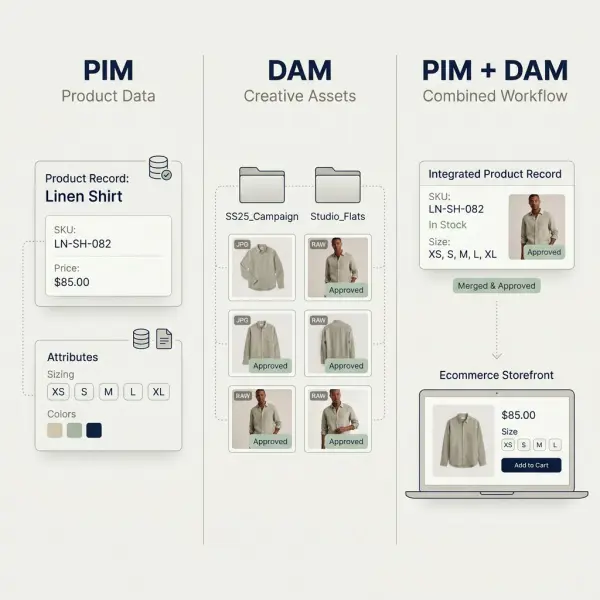
PIM and DAM can both contribute to organized product content, but their central responsibilities differ.
PIM is primarily concerned with what a product is and how its commercial information should be described. DAM is primarily concerned with which digital assets exist, how those assets are governed, and where they are permitted or approved for use.
The distinction becomes clearer when comparing their business functions.
|
Comparison area |
PIM |
DAM |
|
Primary purpose |
Manage commercial product information |
Manage digital content assets |
|
Main records |
Products, styles, variants, attributes |
Images, videos, graphics, documents, media files |
|
Fashion examples |
Fabric composition, size, fit, product description |
Flat-lay photographs, campaign images, product videos |
|
Main users |
Merchandising, ecommerce, product content teams |
Creative, photography, marketing, brand teams |
|
Data organization |
Product identifiers, attributes, families, variants |
Asset metadata, tags, collections, versions |
|
Typical workflow |
Data enrichment, validation, product approval |
Media review, approval, version and usage control |
|
Key relationships |
Style to colorway to sellable variant |
Asset to collection, campaign, product, or usage context |
|
Distribution focus |
Product information across sales channels |
Approved media across teams and destinations |
|
Common quality concern |
Incorrect or incomplete product facts |
Wrong, outdated, or unauthorized creative assets |
|
Typical integration |
PLM, ERP, ecommerce, marketplace systems |
Creative applications, PIM, content management, ecommerce |
This comparison represents the typical functional distinction rather than a strict boundary between all commercial software products.
Some PIM platforms include substantial asset-management features. Some DAM systems support product-specific metadata and integrations that connect assets to product records.
Software capabilities should therefore be evaluated individually rather than inferred from the product category alone.
PIM Manages Product Attributes; DAM Manages Asset Attributes
Both systems can use structured metadata, but the metadata describes different entities.
In PIM, an attribute such as material_composition describes a product. A value such as "70% cotton, 30% linen" represents a property of a particular garment, assuming the composition has been verified.
In DAM, metadata such as photographer, approval_status, or usage_expiration_date describes a digital asset.
A photograph of the garment might be associated with the garment's style code, but the photograph is not itself the source of truth for the garment's material composition.
This distinction is operationally important. A creative team should not infer technical composition from imagery, just as a merchandising team should not assume every available photograph has been approved for publication.
PIM and DAM Have Different Approval Requirements
Approval processes also differ.
A PIM workflow might prevent a garment from being published until required product attributes and descriptions are complete and approved.
A DAM workflow might prevent a campaign image from being distributed until retouching, brand review, and applicable usage permissions have been addressed.
These controls can operate independently.
A shirt's product information may be ready while its photography remains unfinished. Conversely, its photographs may already be approved while the technical team is still confirming a measurement or fiber composition.
For a successful product launch, both information and media may need to reach their required approval states.
Why PIM and DAM Work Better Together in Many Fashion Operations
A fashion product listing normally combines structured product details with visual content.
Customers need to understand what they are buying, but they also need to see the garment's appearance, shape, texture, and relevant details.
The value of connecting PIM and DAM comes from maintaining an accurate relationship between product records and the corresponding approved media assets.
The integration does not necessarily require copying every image into PIM. Depending on the system architecture, PIM may store references to files governed by DAM, receive approved media information, or use a connector to associate assets with product records.
Connecting the Right Images to the Right Garment
Consider a jacket available in Black, Camel, and Olive.
The brand's DAM might contain front, back, detail, and lifestyle images for each colorway. It may also contain editorial photographs showing the jackets in coordinated outfits.
PIM maintains the product structure, including the style, color identifiers, and sellable size combinations.
The integration needs to establish which approved media belongs to each relevant product or colorway.
A shared identifier can help maintain this relationship, but the precise implementation depends on the systems. Some integrations may associate asset records with a style code and color identifier, while others use explicit product-to-asset relationships.
The objective is to avoid situations where a customer selects a Camel jacket but sees photographs of the Olive version.
Separating Approved Masters From Channel-Specific Versions
Fashion images often need to appear in different formats.
A brand website may use large editorial photographs, a marketplace may require specific image dimensions or backgrounds, and a social media campaign may need vertical compositions.
DAM can help manage the approved master and suitable derivatives or renditions where the platform supports these capabilities.
PIM can then help associate or distribute the appropriate asset references alongside product data, depending on how the integration is configured.
The final publication process still needs to respect each destination's technical requirements.
For example, Shopify's product media documentation describes supported product media workflows, including images, videos, and 3D models, while the actual display experience also depends on the storefront theme.
A DAM file being approved does not automatically mean it satisfies every ecommerce platform's upload and presentation requirements.
How PIM and DAM Support the Fashion Product Launch Workflow
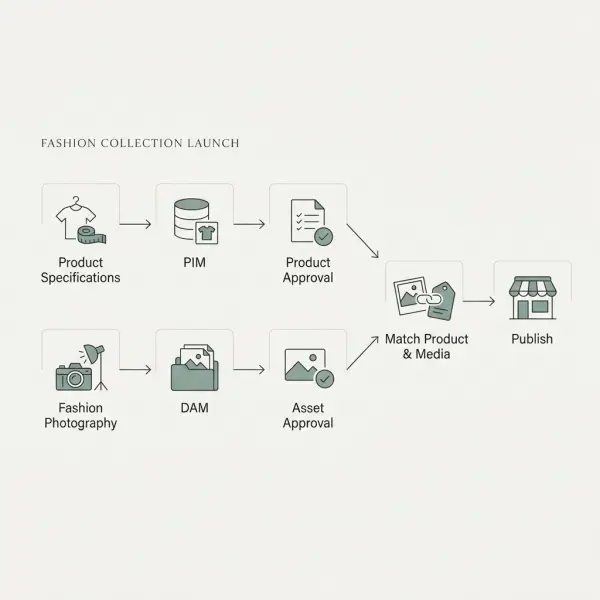
Fashion product launches involve several different types of information and media moving between teams.
The technical department may finalize garment specifications while the photography team prepares visual assets. Merchandising and marketing teams then assemble the information and content needed for the commercial release.
PIM and DAM can support these parallel processes before they converge in the final product listing.
The following workflow is illustrative. A business may use separate applications, an integrated platform, or simpler tools depending on its scale.
Stage 1: Product Development and Technical Information
Product development teams establish the details of the garment.
These may include design specifications, approved material composition, construction details, measurements, and style identifiers.
PLM or other product development systems may maintain this information. Relevant approved fields can then be transferred into the commercial product record managed by PIM.
At this stage, PIM should not be assumed to replace the underlying design, sampling, or technical approval process.
Stage 2: Photography and Creative Production
Once suitable samples or finished products are available, the brand prepares product photography and creative assets.
The photography team may create studio images, detail photographs, on-model shots, and marketing visuals.
These files may pass through editing, retouching, color review, and creative approval.
A DAM system can organize the files throughout this process and distinguish approved assets from unfinished or superseded material.
This matters particularly when multiple departments work on the same collection. Without consistent asset status and version control, an outdated photograph may be selected because it is easier to find than the approved file.
Stage 3: Product and Asset Association
The product data and visual assets are then linked.
The business needs to know which media belongs to which style, colorway, product variant, or campaign.
Some product assets may be shared across all sizes of a colorway. Other images may be relevant only to a particular variant or commercial use.
The association should be designed around actual product and media relationships rather than relying solely on filenames.
Filename conventions can support the process, but they should not substitute for validated identifiers and appropriate approval controls.
Stage 4: Commercial Content Preparation
Merchandising and content teams prepare product titles, descriptions, size information, and other commercial details.
PIM can support completeness and validation checks, while DAM provides access to approved images and videos.
The final publication workflow should verify both sides of the content record.
For example, a product may be blocked from publication because its fit description is incomplete or because the approved hero image has not been associated with the correct colorway.
Whether such checks are enforced automatically depends on the capabilities and configuration of the relevant software.
Stage 5: Distribution and Ongoing Updates
After approval, product information and media are distributed to the intended destinations.
These may include the brand's ecommerce website, marketplaces, wholesale partners, and marketing channels.
Information and assets may be delivered through different integrations. Product data may come from PIM, while media files or URLs may be delivered from DAM or a content delivery service.
The receiving systems must assemble them correctly.
If a product detail changes or an image needs replacement, the workflow should determine which records, assets, and published destinations are affected.
This relationship between structured data and channel publication is explored further in how PIM systems organize fashion product data across sales channels.
When Does a Fashion Brand Need PIM, DAM, or Both?
Not every fashion company requires separate PIM and DAM platforms.
A small brand with a limited product assortment, one ecommerce store, and occasional photoshoots may be able to manage its product details and digital files through existing tools.
A larger fashion organization may face more complex requirements because its product information and creative assets are maintained by different departments, distributed to multiple partners, and updated on different schedules.
The appropriate technology depends on where operational problems actually occur.
When PIM Should Be the Priority
PIM generally deserves priority when the main difficulty involves structured product information.
A brand may struggle with inconsistent product descriptions, duplicate style records, missing material attributes, inaccurate size information, or repeated data entry across marketplaces.
These problems suggest that the business needs stronger product data governance.
For example, a wholesale apparel supplier may have relatively simple photography requirements but thousands of style and variant records. Its immediate challenge may be maintaining reliable attributes and preparing structured information for different retail buyers.
In that situation, investing in PIM capabilities may deliver greater operational value than adopting a sophisticated DAM platform.
When DAM Should Be the Priority
DAM becomes more relevant when the main difficulty involves creative assets.
A fashion company may produce extensive seasonal photography, manage campaigns across several regions, work with external agencies, and maintain numerous image versions.
If teams regularly struggle to locate approved photographs, identify the latest files, or understand image usage restrictions, stronger digital asset governance may be necessary.
A premium fashion label with a relatively small product assortment but intensive creative production could therefore benefit from DAM before it needs dedicated PIM software.
The priority is determined by operational complexity, not simply by the number of products in the catalog.
When an Integrated Approach Makes Sense
Fashion brands may benefit from both capabilities when product information and creative production are complex enough to require dedicated governance.
A company operating multiple collections, international marketplaces, wholesale channels, and frequent campaigns may need structured product information together with controlled visual content.
The business might implement separate PIM and DAM applications connected through integrations, or choose software offering both capabilities in one ecosystem.
For example, Akeneo's Product DAM offering illustrates a product-oriented asset management approach designed to work with PIM.
However, integrated branding does not guarantee that every required feature is included in a particular software package. Businesses need to examine actual functionality, licensing, data relationships, and integration requirements.
A practical decision framework is useful:
|
Business situation |
Likely priority |
Reason |
|
Small catalog, limited photography, one store |
Existing ecommerce tools |
Dedicated systems may introduce unnecessary complexity |
|
Many SKUs and marketplace listings |
PIM |
Product data consistency and distribution are the main concerns |
|
Frequent campaigns and large media libraries |
DAM |
Asset discovery, approval, and reuse create the main workload |
|
Complex assortment and extensive creative production |
PIM + DAM |
Both information and media require dedicated management |
|
Multi-brand international retail |
Integrated or connected PIM + DAM |
Governance across products, assets, channels, and teams is more demanding |
This framework is directional rather than prescriptive. Existing systems, costs, internal skills, and operational requirements should determine the actual investment.
Common PIM and DAM Mistakes Fashion Businesses Should Avoid
Even when businesses understand the difference between PIM and DAM, implementation can become unnecessarily complicated.
The most common problems arise when companies assign responsibilities poorly, duplicate information, or assume that software integration automatically produces a reliable workflow.
Treating a DAM Library as a Product Information Database
A DAM platform may contain images tagged with product codes, colors, and collection names. This does not necessarily make it suitable for managing complex apparel variants, commercial attributes, and channel-specific product descriptions.
When product information is embedded in image filenames or informal asset tags, teams may struggle to maintain accurate relationships between styles and sellable variants.
Businesses should use suitable product records for structured commercial information and asset records for digital files. Shared identifiers can connect them without requiring DAM to replace PIM.
Storing Multiple Uncontrolled Copies of the Same Asset
A brand may store the same photograph in a DAM library, a PIM media field, an agency folder, and several ecommerce platforms.
Multiple copies are not inherently problematic because different formats or delivery requirements may justify them. The risk appears when teams cannot distinguish approved originals from derivatives or determine which version should be used.
The better approach is to establish an authoritative asset record, clear version rules, and controlled relationships between original files and their approved outputs.
Using Filenames as the Only Connection Between Products and Images
A clothing brand might name a photograph jacket-black-final.jpg and expect its systems to associate it automatically with the correct product.
This may work in a limited workflow, but filenames alone can become unreliable when similar styles, multiple seasons, or several image versions exist.
A more dependable model uses validated product identifiers, structured asset metadata, and explicit associations where supported.
Filenames can help people understand files, but they should not become the only mechanism for maintaining product-to-image relationships.
Confusing Image Approval With Usage Permission
A campaign photograph may be visually approved by the creative director but still be subject to restrictions involving models, photographers, licensed elements, or distribution territories.
Creative approval and usage authorization are different responsibilities.
DAM can help track relevant rights metadata and access restrictions, but the organization must establish the underlying rights and determine how those terms apply.
For example, Bynder's access-rights documentation describes different methods for controlling asset visibility and use.
These capabilities support governance but do not independently establish that a business possesses every legal right needed to publish an image.
Purchasing Both Systems Before Defining the Workflow
A fashion business may purchase PIM and DAM because the combination appears comprehensive, even though its immediate problems could be resolved through better data standards and approval processes.
This can introduce integration costs, overlapping functions, and additional training requirements.
Before buying software, the organization should identify which processes are failing, how much work they create, and what capabilities existing tools already provide.
A clear operating model should guide the technology decision, rather than allowing the technology to define the operating model by default.
How Fashion Brands Can Implement PIM and DAM Together
A combined approach is most effective when each system has a defined responsibility and the teams using them understand how information moves between applications.
For many fashion businesses, implementation should begin with a representative collection rather than the entire historical catalog and media archive.
The pilot should include enough product variation and creative complexity to reveal whether the proposed workflow can support actual operations.
Establish Data and Asset Ownership
The business should identify the authoritative source for each type of information.
PIM may govern approved product descriptions and commercial attributes. DAM may govern approved media files and asset usage metadata. PLM may remain authoritative for technical garment specifications, while other systems govern inventory, pricing, and transactions.
The exact division varies between organizations, but conflicting ownership should be avoided.
For example, if a photography team approves a new color-corrected image, the workflow should define how the approval affects the asset record and how the related product listing is updated.
Define the Product-to-Asset Relationship
A stable connection between product and asset records is central to integration.
A fashion business should determine whether images are linked at the style level, colorway level, variant level, or through another appropriate relationship.
A lifestyle photograph might show several products and therefore be associated with multiple styles. A detailed fabric photograph may apply to one colorway, while a campaign hero image may belong primarily to a seasonal creative collection.
The model should accommodate these differences rather than forcing every image into a one-to-one product relationship.
A suitable pilot might test the following sequence:
- Create or import an approved garment style and its variants into PIM.
- Upload the associated photography into DAM and apply relevant metadata.
- Review and approve the correct image versions and usage status.
- Associate approved assets with the appropriate styles or colorways.
- Validate the combined product information and imagery before publication.
- Publish to a test storefront and verify the resulting product presentation.
The pilot should also test what happens when an approved image is replaced, an asset becomes restricted, or a product is discontinued.
These scenarios are operationally important because the challenge is not simply publishing a product for the first time. It is keeping the relationship accurate as records and files change.
Measure the Value of the Combined Workflow
Businesses should evaluate PIM and DAM using measurable operational outcomes.
For PIM, indicators might include product data completeness, the number of listing corrections, and time needed to prepare product records.
For DAM, indicators may include asset retrieval time, the percentage of images with approved status, duplicate-file handling, and time required for creative review.
For the integrated process, useful indicators include the frequency of incorrect product-image associations, time required to assemble launch-ready listings, and the proportion of products published with approved media.
These measures should be compared with an appropriate baseline. Improvements in sales or conversion may be influenced by many factors, making it difficult to attribute them solely to PIM or DAM without additional analysis.

Important Technical and Commercial Caveats Before Choosing PIM or DAM
The functional boundaries between PIM and DAM are not universal.
Some PIM products include asset libraries, media transformations, asset relationships, and approval capabilities. Conversely, some DAM products offer sophisticated metadata models, workflow automation, and integrations with commerce platforms.
For example, Akeneo's Asset Manager documentation describes how assets can be structured and connected to products within its PIM environment. The documentation also identifies edition-specific availability, demonstrating why product capabilities and licensing must be evaluated together.
Businesses should therefore avoid assuming that the presence of image-management features in PIM makes a separate DAM unnecessary—or that sophisticated DAM metadata features provide everything needed for commercial product information management.
The evaluation should also consider practical issues such as asset storage, content delivery, integration APIs, user permissions, data export, version control, and handling of restricted or expired assets.
Usage rights require particular care. A DAM record can document a license restriction, but that record does not replace the underlying contract or legal assessment. Likewise, automatic asset tagging may help with organization, but generated metadata should be reviewed when errors could affect product accuracy or publication permissions.
Finally, total cost should include implementation, data migration, integration development, user training, storage or delivery charges where applicable, and ongoing administration.
The right decision is not necessarily the platform with the largest feature set. It is the system architecture that supports reliable work without unnecessary duplication or complexity.
Frequently Asked Questions About PIM vs DAM for Fashion Brands
1. What Is the Main Difference Between PIM and DAM?
PIM primarily manages structured product information, while DAM primarily manages digital assets and the information needed to organize, approve, and use those assets.
For fashion brands, PIM may store garment descriptions, material composition, sizes, colors, and identifiers. DAM may organize product photographs, campaign imagery, videos, logos, and creative files.
The two systems can connect through shared identifiers and integration workflows. Their capabilities may also overlap, depending on the software.
The important distinction is operational: PIM governs information about the product, while DAM governs the files used to represent or communicate the product.
2. Can a Fashion Brand Use PIM Without DAM?
Yes. A fashion brand can use PIM without a separate DAM platform, particularly if its media requirements are relatively simple.
Some PIM systems can store media files or maintain references to external image locations. Existing ecommerce platforms and organized file repositories may also provide sufficient media-handling capabilities for smaller businesses.
However, this arrangement may become difficult when the brand produces extensive photography, maintains multiple creative versions, or needs detailed asset approval and usage controls.
The business should evaluate whether its current media process supports reliable retrieval, approval, and distribution before deciding that specialized DAM software is necessary.
3. Can DAM Replace PIM for Fashion Ecommerce?
DAM can store product-related metadata, but it is not necessarily designed to replace the structured commercial product management functions of PIM.
A fashion DAM may associate images with style codes and collection names. However, managing complex size and color variations, localized descriptions, commercial product attributes, and marketplace-specific data requirements may call for a product-oriented system.
Some platforms combine these capabilities, so the answer depends on the actual software.
Brands should test their complete product model rather than relying on terminology. A DAM that handles photographs effectively may still lack the product hierarchy, validation, or channel syndication functionality required for a large apparel catalog.
4. How Do PIM and DAM Work Together for Product Photography?
PIM and DAM can work together by connecting product records to approved photographs or other digital assets.
DAM may maintain the master images, versions, metadata, and approval status. PIM maintains the style and variant relationships that determine which media belongs to which commercial product.
An integration can then transfer or reference the appropriate assets during product publication.
For example, a jacket with three colorways may have separate approved images for each color. The product-to-asset relationship must ensure that customers see the correct photographs when viewing or selecting a particular color.
The exact mechanism depends on the systems and ecommerce integration.
5. Which System Is More Important for a Small Fashion Business?
The more useful system depends on the company's immediate operational problem.
A small brand managing a growing number of products, sizes, colors, and marketplace listings may benefit more from PIM capabilities. A design-led label with frequent photoshoots and a large creative archive may need stronger DAM capabilities first.
Some smaller brands may not need either dedicated platform. Organized spreadsheets, ecommerce product records, shared storage, and clearly defined approvals may be sufficient.
Before investing, the business should identify its most frequent errors, the time spent correcting them, and whether existing tools can support a more reliable process.
6. Does a Fashion Brand Need Separate PIM and DAM Software?
Not necessarily. PIM and DAM capabilities may be delivered through separate integrated applications or as part of a broader platform.
An integrated solution can reduce certain coordination requirements, but it should still be evaluated for product data modeling, asset versioning, permissions, usage restrictions, and channel publishing.
Separate specialist systems may offer capabilities that better match complex organizational needs, although integration and administration can require additional resources.
Fashion businesses should assess actual workflows, licensing, data portability, and total cost rather than assum





Comments 0
Leave a CommentSend Comment
Anda harus Login terlebih dahulu untuk dapat memberikan komentar.